June 25: Virginians fly flags to commemorate statehood, and Col. Van T. Barfoot

June 24, 2015

June 25 is Virginia Statehood Day.  The U.S. Flag Code urges Americans to fly the U.S. flag on the statehood date of their states.

Virginia is counted as the 10th state, by virtue of the Virginia ratifying convention’s having voted to ratify the U.S. Constitution on June 25, 1788 — over the strong objections of Gov. Patrick Henry, and with the skilled legislative work of James Madison.

The Constitution became effective upon the ninth state’s ratification, but Virginia, being the largest state in the union at the time, was considered a make-or-break vote.

June 25 is the last U.S. flag flying date in June 2015.

So, Virginians: Fly your U.S. flags on June 25, as Col. Van T. Barfoot did every day until his death.

From the Washington Post: Retired Col. Van T. Barfoot, a Medal of Honor recipient, and his daughter Margaret Nicholls lower the flag outside Barfoot's home in the Sussex Square subdivision in Henrico County, Va., in 2009. Barfoot died March 2 [2012] at a hospital in Richmond. He was 92. (Photo by Eva Russo/AP)

From the Washington Post: “Retired Col. Van T. Barfoot, a Medal of Honor recipient, and his daughter Margaret Nicholls lower the flag outside Barfoot’s home in the Sussex Square subdivision in Henrico County, Va., in 2009. Barfoot died March 2 [2012] at a hospital in Richmond. He was 92. (Photo by Eva Russo/AP)”

You may remember the story of Col. Barfoot. As a veteran of World War II, Korea and Vietnam, he flew Old Glory every day. In 2009 his Henrico County, Virginia homeowners association complained, ordered him to stop flying the U.S. flag and take down his flag pole, erected in violation of HOA “curb appeal” rules.

Col. Barfoot refused.  Eventually the public outcry, including pressure from President Barack Obama, got the HOA to back down.  Obama said Barfoot was a good example, and had earned the right to fly Old Glory.

Barfoot had a particularly compelling case to fly the flag. Barfoot was awarded the Congressional Medal of Honor for his service in Italy, against German troops, in 1944.  The Washington Post explained: 

Early in the war, he participated in the Army’s invasion of Italy. As his unit moved inland, the soldiers took up defensive positions near Carano.

On May 23, 1944, Col. Barfoot was ordered to lead an assault on German positions. He went out alone and crawled to within feet of a German bunker.

According to his Medal of Honor citation, he tossed a grenade inside, killing two Germans and wounding three others. He then moved to another bunker nearby and killed two more German soldiers with his submachine gun while taking three others prisoner. A third machine gun crew, watching Col. Barfoot’s methodical assault, surrendered to him. In all, 17 Germans gave themselves up to Col. Barfoot.

In retaliation, the Germans organized a counterattack on Col. Barfoot’s position, sending three tanks toward him.

Col. Barfoot grabbed a bazooka grenade launcher and stood 75 yards in front of the leading tank. His first shot stopped it in its tracks. He then killed three of the German tank crew members who had attempted to escape.

The other two tanks, witnessing the destruction, abruptly changed directions, moving away from Col. Barfoot. Returning to his platoon, he helped carry two wounded U.S. soldiers almost a mile to safety.

Commending his “Herculean efforts,” Col. Barfoot’s citation praised his “magnificent valor and aggressive determination in the face of pointblank fire.”

Col. Barfoot served in the Korean War and later in Vietnam as a helicopter pilot. His other military decorations included the Silver Star; two awards of the Legion of Merit; the Bronze Star; three awards of the Purple Heart; and 11 awards of the Air Medal.

So, Virginians, would it inconvenience you much to fly your U.S. flags today — in honor of Col. Van T. Barfoot, as well as in honor of your state’s entry into the Union?

What do we do to deserve the loyalty and service of such men?


June 15: Should we fly the flag for Arkansas statehood?

June 15, 2015

Arkansas statehood day is June 15 — Arkansas became the 25th state in 1836. Arkansas residents fly their U.S. flags today in commemoration of the event, the 179th anniversary.

U.S. and Arkansas flags fly at the State Capitol; image from the Arkansas Secretary of State.

U.S. and Arkansas flags fly at the State Capitol; image from the Arkansas Secretary of State.

But I see in news reports stories about how the actual law passed a couple of days earlier, though news didn’t get to Arkansas until about July 4.  Is June 15 the real Arkansas statehood day?

What say you, Arkansas historians? Can you explain it?

We’re flying our flags anyway, for National Flag Week, which is celebrated the week in which Flag Day occurs, June 14.

More:


Flag Day 2015! Fly your flag all week

June 14, 2015

Of course you know to fly your flag on June 14 for Flag Day — but did you know that the week containing Flag Day is Flag Week, and we are encouraged to fly the flag every day?

Clifford Berryman's 1901 Flag Day cartoon, found at the National Archives:

Clifford Berryman’s 1901 Flag Day cartoon, found at the National Archives: “In this June 14, 1904, cartoon, Uncle Sam gives a lesson to schoolchildren on the meaning of Flag Day. Holding the American flag in one hand, Uncle Sam explains that the flag has great importance, unlike the Vice Presidency, which he ridicules in a kindly manner. (National Archives Identifier 6010464)”

Our National Archives has a blogged history of Flag Day pointing out it was a teacher who started Flag Day celebrations.

On June 14, 1885, Bernard J. Cigrand placed a 10-inch, 38-star flag in a bottle on his desk at the Stony Hill School in Ozaukee County, Wisconsin. The 19-year-old teacher then asked his students to write essays on the flag and its significance to them. This small observance marked the beginning of a long and devoted campaign by Cigrand to bring about national recognition for Flag Day.

And so we do, today, still.


June 1: Fly your flags today in Kentucky and Tennessee for Statehood Day

June 1, 2015

Our laws on flag flying encourage citizens to fly U.S. flags on specific dates, and on the date of statehood of the state in which a citizen lives.

Kentucky joined the union on June 1, 1792, the 15th state.  Tennessee joined four years later, on June 1, 1796, becoming the 16th state.

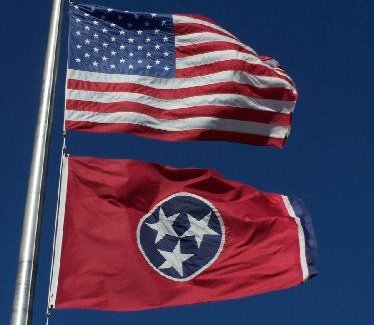
Fly your flags today in Kentucky and Tennessee — or wherever Kentuckians or Tennesseeans may be — in honor of statehood.

U.S. and Tennessee flags flying together on one staff.  Photo by J. Stephen Conn

U.S. and Tennessee flags flying together on one staff. Photo by J. Stephen Conn

Kentucky's state flag, by Gage Skidmore

Kentucky’s state flag features a Native American and European colonist standing together, and the state motto, “United We Stand, Divided We Fall.” Photo by Gage Skidmore

Kentucky’s admission to the union pushed the U.S. flag to 15 stars and 15 stripes.   President George Washington signed the law that authorized the U.S. flag be expanded to 15 stripes in early 1794.  I’ve not pinned down the history of what happened next.  So far as I know there was no law expanding the flag to 16 stripes, and in 1818, Congress said the flag would be 13 stripes, and stars equal to the number of states.

A 15-striped Star-spangled Banner that flew over Fort McHenry in Baltimore Harbor in 1814 and inspired Francis Scott Key to write the poem that is now the lyric to our national anthem.  President James Monroe signed the 13-stripe law in 1818.

What happened in between?  I suspect there are a lot of 15-stripe flags, but it wouldn’t surprise me to find a 16-stripe flag somewhere.  A variety of stars-and-stripes flags cropped up, which the 1818 law was intended to squelch.

Residents of the Bluegrass State and the Volunteer State should fly their flags today, in honor of their state’s having joined the union on June 1.

More:

http://twitter.com/hoyosplacido3/status/604008354571259904


Yes, this is mostly an encore post. Fighting ignorance requires patience.

Yes, this is mostly an encore post. Fighting ignorance requires patience. And repetition.


On what dates should we fly the flag in June?

May 31, 2015

Betsy Ross house in Philadelphia, by tradition the birthplace of Old Glory.

Betsy Ross house in Philadelphia, about 1900, by tradition the birthplace of Old Glory. “Happy Flag Day from Shorpy! Detroit Publishing Co. glass negative.” Image via Shorpy. Betsy Ross House is a traditional site for Philadelphia’s celebration of Flag Day.

June holds only two days designated for flying the U.S. flag out of the specific days mentioned in the U.S. Flag Code, and six statehood days, when residents of those states should fly their flags.  Plus, there is National Flag Week.

Two Flag Code-designated days:

  • Flag Day, June 14
  • Fathers Day, third Sunday in June (June 21)

Several states celebrate statehood. New Hampshire, Virginia, Arkansas, Kentucky, Tennessee and West Virginia celebrate statehood; Kentucky and Tennessee share the same date.

  • Kentucky, June 1 (1792, 15th state)
  • Tennessee, June 1 (1796, 16th state)
  • Arkansas, June 15 (1836, 25th state)
  • West Virginia, June 20 (1863, 35th state)
  • New Hampshire, June 21 (1788, 9th state), and
  • Virginia, June 25 (1788, 10th state)

Additionally, Congress passed a resolution designating the week in which June 14th falls as National Flag Week, and urging that citizens fly the flag each day of that week.  In 2015 that would the week of June 14, which falls on Sunday, through June 20.

Nine designations covering 10 separate days, listed chronologically:

  1. Kentucky and Tennessee statehood, June 1
  2. Flag Day, June 14; National Flag week, June 14 to 20
  3. Arkansas statehood, June 15 (duplicating National Flag Week)
  4. West Virginia statehood, June 20 (also duplicating National Flag Week)
  5. Fathers Day, June 21
  6. New Hampshire statehood, June 21 (duplicating Fathers Day)
  7. Virginia statehood, June 25

Tip of the old scrub brush to Mike’s Blog Rounds at Crooks and Liars — thanks for the plug!


May 29, Rhode Island Statehood Day; fly your flags in Providence

May 29, 2015

https://upload.wikimedia.org/wikipedia/commons/thumb/0/0d/Independent_Man_Providence_Capitol.JPG/800px-Independent_Man_Providence_Capitol.JPG

The Independent Man stands atop the Rhode Island State House in Providence. Photo by Lgalbi; Public Domain via Wikimedia Commons

May 29 is statehood day for Rhode Island, the 13th of the original colonies to join the union.

It’s interesting history to me. Rhode Island was rogue enough at the time — many called it “Rogues’ Island” — the colony sent no delegates to the convention in Philadelphia that wrote the Constitution.  One may wonder why the delegates even bothered to include the colony in the process. But, they did.

Not that it mattered to creation of the United States.  New Hampshire was the 9th state to ratify the document, on June 21, 1788, making it effective under the rules.  Rhode Island did not ratify the Constitution until May 29, 1790 — two years after the Constitution took effect, and about a year after the new government started operation and inaugurated George Washington the first president.  Rhode Island joined the nation already steaming along.

Rear of Rhode Island's Capitol, flying the Rhode Island state flag to the left, and the U.S. and POW flags on the right.  (Just try to find photos of the U.S. and Rhode Island flags together . . . please.)

Rhode Island State Capitol, north facade, by Garrett A. Wollman; bostonradio.org via Wikimedia. Rhode Island’s state flag flies to the left, and the U.S. and POW flags on the right. (Just try to find photos of the U.S. and Rhode Island flags together . . . please.)

Does Rhode Island celebrate Statehood Day? I don’t know. Historian Laureate Patrick T. Conley wrote a column for the Providence Journal revealing that Rhode Island was, like Texas, an independent republic for a time. This news won’t rest well with Texans. Other Rhode Island celebrations may occur, but they’re tough to learn about.

More:


Memorial Day 2015 – Fly your flag today

May 25, 2015

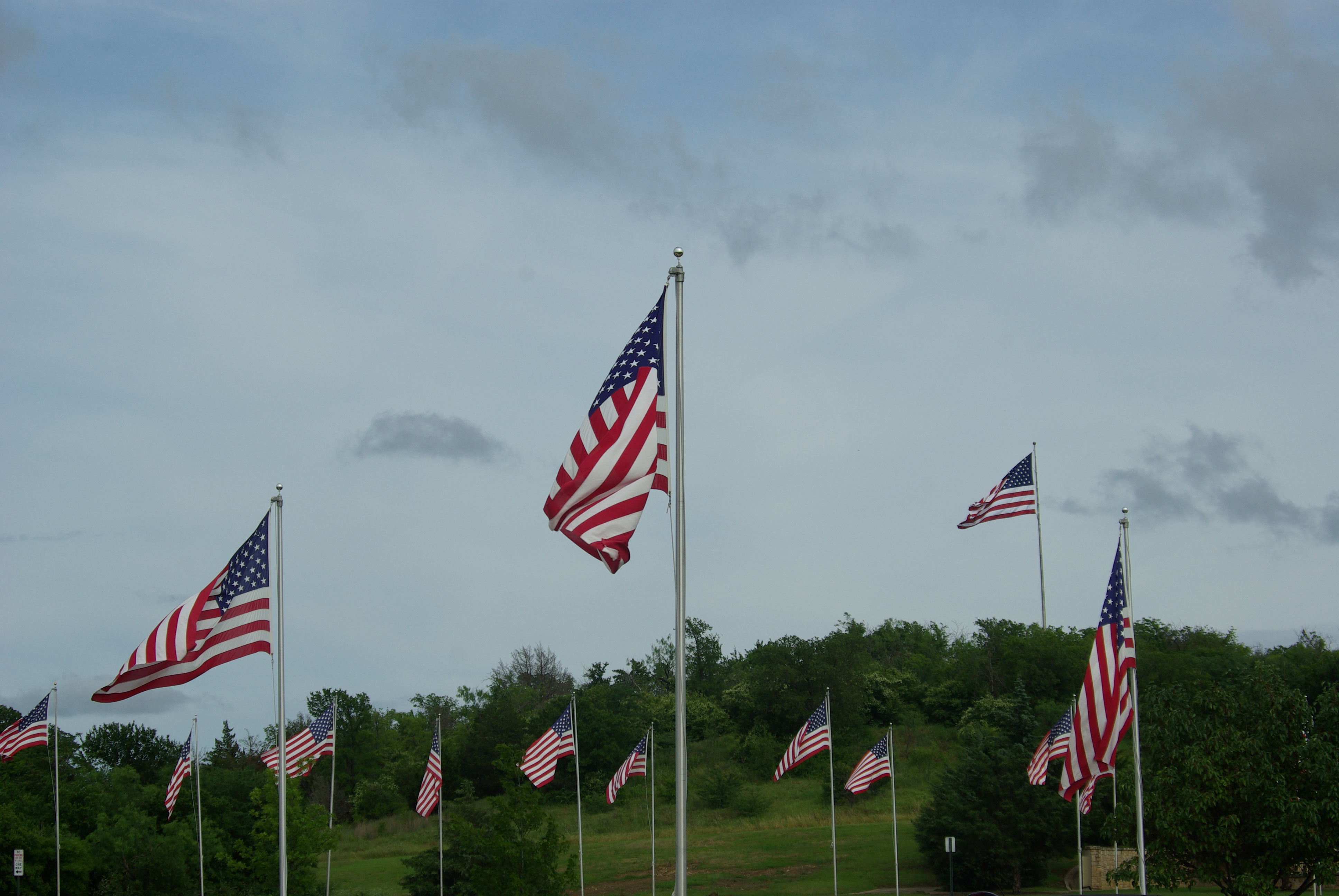
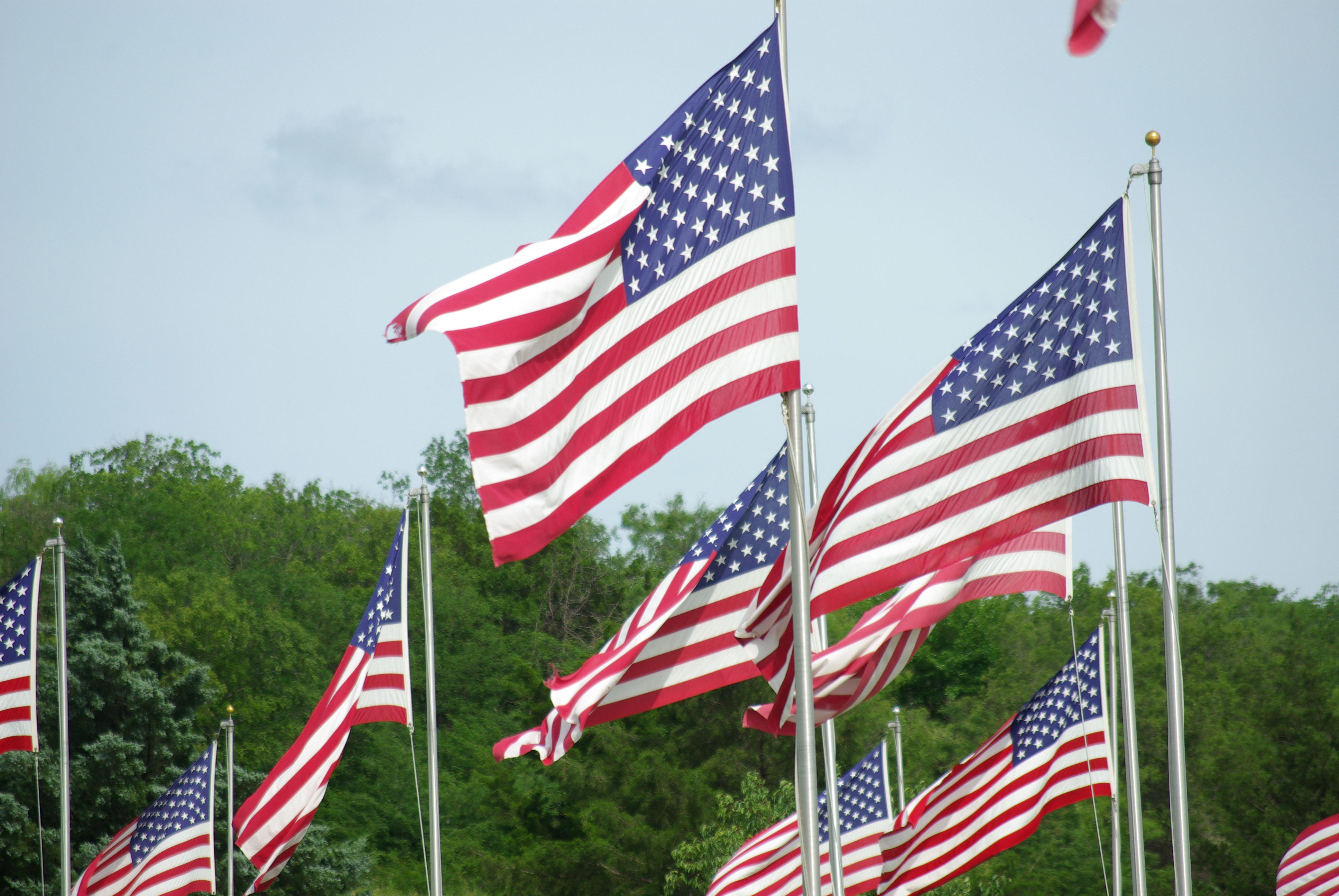
U.S. flags flying at the Dallas-Fort Worth National Cemetery, for Memorial Day 2015. Photo by Ed Darrell. Please use.

U.S. flags flying at the Dallas-Fort Worth National Cemetery, for Memorial Day 2015. Photo by Ed Darrell. Please use.

Fly your flag today for Memorial Day.

On Memorial Day, flags should be flown at half-staff until noon, then raised to full staff (and retired at sunset).

Just a reminder: When posting a flag to half-staff, it should be raised with gusto to full staff, then slowly lowered to the half-staff position.  On Memorial Day, when changing the flag’s position at noon, simply raise the flag briskly to full staff.  At retirement, the flag should be lowered in a stately fashion.

U.S. flags flying at the Dallas Fort Worth National Cemetery, for Memorial Day 2015.  You may use this photo.

U.S. flags flying at the Dallas Fort Worth National Cemetery, for Memorial Day 2015. You may use this photo.


Fly your flags May 23 for statehood in South Carolina and Wisconsin

May 23, 2015

Two states on the same day?

Not exactly.

South Carolina achieved statehood on May 23, 1788, according to the date the state’s people ratified the Constitution. South Carolina was number eight; the Constitution became effective on the ninth ratification.

Wisconsin joined the union in 1848 — but it did name its capital city after James Madison, the Father of the Constitution.

Same day, 60 years apart.

Residents of a state are urged to fly the U.S. flag on the state’s anniversary of entering the union.

U.S. and South Carolina flags. Fox News file photo

U.S. and South Carolina flags. Fox News file photo

Judging by what’s available in on-line news, it appears both South Carolina and Wisconsin don’t have plans to celebrate statehood much, in 2015.

Is this a litmus test?  Will only true patriots fly their flags in the two states?

Or after National Maritime Day on May 22, and with Memorial Day on May 25, are citizens suffering from flag-flying fatigue?

U.S. and Wisconsin flags fly at the Wisconsin Capitol Building in Madison. Wisconsin Legislature image.

U.S. and Wisconsin flags fly at the Wisconsin Capitol Building in Madison. Wisconsin Assembly image.

Here in Texas, Rotary Clubs offer a service to put flags up on flag-flying days, for an annual fee. Boy Scout groups and others service organizations take routes to deliver flags on poles; on weekends, flags go up on Friday, and come down at the end of the holiday, Monday night in this case.

Heck, that covers National Maritime Day, Wisconsin and South Carolina Statehood Days, and Memorial Day (without the half-staff exercise).

A patriot could get lost in all this flag flying.


Merchant mariners bring us the world; fly your flag for National Maritime Day, May 22

May 22, 2015

SS Savannah, first U.S. merchant steam ship to complete an Atlantic crossing, having set sail on May 22, 1819.  gCaptain image

SS Savannah, first U.S. merchant steam ship to complete an Atlantic crossing, having set sail on May 22, 1819. gCaptain image

You’ve got your flag up already? Good.

Most people don’t even know about National Maritime Day, May 22 — let alone President Obama issued a proclamation to fly the U.S. flag in honor of merchant marines.

USS Slater Color Guard member Art Dott of Colonie carries the American flag Sunday during the presentation of the colors at the start of a National Maritime Day ceremony on the boat in Albany. Dott, a culinary specialist chief, is a 350year member of the Navy Reserve. ( Philip Kamrass / Times Union)

From the Albany, New York, Times-Union, 2011: USS Slater Color Guard member Art Dott of Colonie carries the American flag Sunday during the presentation of the colors at the start of a National Maritime Day ceremony on the boat in Albany. Dott, a culinary specialist chief, is a 35-year member of the Navy Reserve. ( Philip Kamrass / Times Union)


National Maritime Day is a United States holiday created to recognize the maritime industry. It is observed on May 22, the date in 1819 that the American steamship Savannah set sail from Savannah, Georgia on the first ever transoceanic voyage under steam power. The holiday was created by the United States Congress on May 20, 1933.

President Obama’s proclamation:

Presidential Proclamation – National Maritime Day, 2015

NATIONAL MARITIME DAY, 2015

– – – – – – –

BY THE PRESIDENT OF THE UNITED STATES OF AMERICA

A PROCLAMATION

For over two centuries, proud mariners have set sail in defense of our people and in pursuit of opportunity.  Through periods of conflict and times of peace, our Nation has relied on the United States Merchant Marine to transport goods to and from our shores and deliver troops and supplies around the world.  On National Maritime Day, we honor the women and men who take to the seas to boost our economy and uphold the values we cherish.

Our Nation is forever indebted to the brave privateers who helped secure our independence, fearlessly supplying our Revolutionary forces with muskets and ammunition.  Throughout history, their legacy has been carried forward by courageous seafarers who have faithfully served our Nation as part of the United States Merchant Marine — bold individuals who emerged triumphant in the face of attacks from the British fleet in the War of 1812, and who empowered the Allied forces as they navigated perilous waters during World War II.  Today, patriots who share their spirit continue to stand ready to protect our seas and the livelihoods they support.

Ninety percent of the world’s commerce moves by sea, and businesses across our country rely on domestic and international trade every day.  Helping to protect our vital shipping routes, Merchant Mariners are critical to our effort to combat piracy and uphold the maritime security on which the global supply chain relies.  And in times of war or national emergency, they bolster our national security as a “fourth arm of defense.”  Whether transporting commercial goods or military equipment, battling tough weather or enemy fire, they strive and sacrifice to secure a brighter future for all Americans.  On this day, we reaffirm the importance of their contributions and salute all those who serve this noble cause.

The Congress, by a joint resolution approved May 20, 1933, has designated May 22 of each year as “National Maritime Day,” and has authorized and requested the President to issue annually a proclamation calling for its appropriate observance.

NOW, THEREFORE, I, BARACK OBAMA, President of the United States of America, do hereby proclaim May 22, 2015, as National Maritime Day.  I call upon the people of the United States to mark this observance and to display the flag of the United States at their homes and in their communities.  I also request that all ships sailing under the American flag dress ship on that day.

IN WITNESS WHEREOF, I have hereunto set my hand this twentieth day of May, in the year of our Lord two thousand fifteen, and of the Independence of the United States of America the two hundred and thirty-ninth.

BARACK OBAMA

More:


Flying the flag half-staff today, May 15, for Peace Officers Memorial Day

May 15, 2015

Flag at half-staff, in Provo, Utah.

Flag at half-staff, in Provo, Utah.

Today, May 15, is designated Peace Officers Memorial Day by a joint resolution of Congress and by Presidential Proclamation.

Fly flags today, at half-staff all day, if you can, to honor fallen peace officers.

Dry your flag tonight: tomorrow, May 16, is Armed Forces Day, another flag-flying date.

More:


Fly your flags today in Minnesota: 157th Minnesota Statehood Day, May 11

May 11, 2015

Flag etiquette following the U.S. Flag Code urges Americans to fly U.S. flags on the day of statehood for the state in which you reside.

Minnesota joined the Union on May 11, 1858.

Minnesota Capitol Chandelier, lit for Statehood Day, May 11.

Caption from the Minneapolis Star-Tribune: The Minnesota Capitol chandelier was illuminated today, May 10, 2013 in celebration of Statehood Day. It has 92 bulbs surrounded by 40,000 crystal beads strung together and was recently painstakingly cleaned and refurbished. The fixture is traditionally lit once per year on Statehood Day. Minnesota became a part of the United States as Minnesota Territory in 1849, and became the 32nd U.S. state on May 11, 1858.

At the Library of Congress’s outstanding American Memory site, a much more detailed history of Minnesota statehood is featured on “Today in History,” reproduced here in its entirety:

The Star of the North

facade of a domed building
Capitol Building, exterior, St. Paul, MN
St. Paul, Minnesota 1902
American Landscape and Architectural Design, 1850-1920

On May 11, 1858, Minnesota became the 32nd state admitted into the Union. Minnesota’s application for statehood was submitted to President James Buchanan in January, but became entangled with the controversial issue of Kansas statehood, delaying it for several months until it was finally approved by Congress.

Known as the “Land of 10,000 Lakes,” or “Star of the North,” Minnesota is the northern terminus of the Mississippi River’s traffic and the westernmost point of an inland waterway which extends through the Great Lakes and, with the St. Lawrence Seaway, to the Atlantic Ocean.

The Ojibwa (Chippewa) and Dakota (Sioux) were among the tribal peoples who first made this land their home. For them state borders were non-existent, and their territory extended far beyond what is today Minnesota. The French claimed this region from the mid-1600s to the mid-1700s, developing a strong fur trade but ceding lands east of the Mississippi to Britain. The U.S. acquired the area and its rich natural resources through the Treaty of Paris (1783), and the Louisiana Purchase (1803).

U.S. administration of the northwest lands formally began with the 1787 passage of the Northwest Ordinance. The ordinance, one of the most important pieces of legislation passed by the Continental Congress, set out the requirements for a territory to become a state. The American Memory collection Continental Congress and the Constitutional Convention, 1774-1789 features a discussion of the Incorporation of the Western Territories. For additional information on England’s yielding of land west of the Appalachian Mountains, see the Today in History feature on the Surrender of Fort Sackville. A representation of Fort Sackville is accessible on The George Rogers Clark National Historic Park site.

From the 1820s on, protected the growth of the area now called Minnesota. During the Civil War, the fort served as a training center for thousands of young Minnesota volunteers who joined the Union Army. Twenty-four thousand soldiers who trained at the fort fought in the Union Army, serving gallantly at Gettysburg or during the Indian Outbreak. Once a military outpost at the edge of a small settlement, Fort Snelling is now located at the center of Minnesota’s “Twin Cities”—Minneapolis and St. Paul.

wheat bundle stacks
Wheat Bundle Stacks, Fosston, Minnesota, circa 1900.
The Northern Great Plains, 1880-1920

a horse in a farming rig in a field
Horse powered threshing rig, Blue Earth, Minnesota, 1898.
The Northern Great Plains, 1880-1920

Until the second half of the nineteenth century, immigration into Minnesota was slow. However, as the value of the state’s woodlands and fertile prairie was realized, settlers poured into the region with New England lumbermen leading the way. Between 1850 and 1857, the state population skyrocketed from 6,077 to over 150,000. As a large state with land for homesteading, Minnesota attracted immigrants from Norway, Sweden, Finland, and those seeking to own land in the United States. An 1878 brochure published by the Minnesota State Board of Immigration, describes the many reasons for moving to the state.

19th century advertisements to get people to move to Minnesota. Library of Congress images

19th century advertisements to get people to move to Minnesota. Library of Congress images; see description and link details below

Advertisement for a steamboat company
Northern Line Packet Co.,
Advertisement for a steamship company in The Minnesota Guide. A Handbook of Information for the Travelers, Pleasure Seekers and Immigrants…, 1869.
Pioneering the Upper Midwest: Books from Michigan, Minnesota, and Wisconsin, ca. 1820-1910

Still a leader in farming, lumbering, milling, and medical research, Minnesota is also an important center for the printing industry and a major producer of iron ore. Its largest city, Minneapolis, is home to the University of Minnesota, numerous museums, and theaters such as the Tyrone Guthrie Theater and the Walker Arts Center, and the world’s largest cash grain market.

St. Paul is the state capital.

Bird's eye view of Duluth
Bird’s Eye View of Duluth, Minnesota, copyright 1914.
Taking the Long View, 1851-1991

More:

U.S. and Minnesota flags flying together. Minnesota state flag photo by AlexiusHoratius - Own work. Licensed under Creative Commons, via Wikipedia

U.S. and Minnesota flags flying together. Minnesota state flag photo by AlexiusHoratius – Own work. Licensed under Creative Commons, via Wikipedia

Yes, this is mostly an encore post. Fighting ignorance requires patience.

Yes, this is mostly an encore post. Fighting ignorance requires patience.


Fly your flag for Victory Europe Day, May 8, 2015 – 70th anniversary

May 8, 2015

Yes, you should be flying your flag today for Victory Europe Day (VE Day)!

Caption from Pinterest, World War Items: A huge American flag unfurled in New York’s Herald Square on VE Day on May 8, 1945. This 80x160 foot flag was hung from the eighth floor balcony of Macy’s New York department store, covering the façade from 34th and 35th Streets along Broadway. Beneath it were placed a set of British, Chinese, French and Russian flags, held by two giant mailer fists. (AP Photo)

Caption from Pinterest, World War Items: A huge American flag unfurled in New York’s Herald Square on VE Day on May 8, 1945. This 80×160 foot flag was hung from the eighth floor balcony of Macy’s New York department store, covering the façade from 34th and 35th Streets along Broadway. Beneath it were placed a set of British, Chinese, French and Russian flags, held by two giant mailer fists. (AP Photo)

VE Day is not one listed in the Flag Code for flying the colors, but in most years there is a proclamation from the President urging that we do fly the flag.

This year President Obama noted the 70th anniversary of VE Day with his weekly message:


What dates do we fly the flag in May?

May 2, 2015

"Allies Day, May 1917" -- 1917 oil on canvas by Childe Hassam; National Gallery of Art, Washington, D.C.

“Allies Day, May 1917” — 1917 oil on canvas by Childe Hassam; National Gallery of Art, Washington, D.C. Allies Day is no longer celebrated.

May has three days designated for flying the U.S. flag out of the specific days mentioned in the U.S. Flag Code, and three statehood days, when residents of those states should fly their flags.

Interestingly, the three designated days all float, from year to year:

  • Mother’s Day, second Sunday in May (May 10, in 2015)
  • Armed Forces Day, third Saturday in May (May 16)
  • Memorial Day, the last Monday in May (May 25)

Residents of these states celebrate statehood; South Carolina and Wisconsin share May 23:

  • Minnesota, May 11 (1858, the 32nd state)
  • South Carolina, May 23 (1788, the 8th state)
  • Wisconsin, May 23 (1848, the 30th state)
  • Rhode Island, May 29 (1790, the last of the 13 original colonies to ratify the Constitution)

This year President Obama issued a proclamation calling on citizens to fly the flag on May 1, Law Day (I missed that one).

May 8 marks the 70th anniversary of Victory in Europe Day, the day the Axis Powers in Europe surrendered at the end of World War II.  Some years that day is marked by a proclamation calling for flag flying.  (You may fly your flag then even if Congress and the President do nothing.)

In recent years President Obama has proclaimed May 15 as Peace Officers Memorial Day, with flags to fly at half-staff. We might expect another such declaration in 2015.

May 22 is National Maritime Day, under a Joint Resolution from Congress from 1933. President Obama may be expected to proclaim that day as a day to fly the flag, too.

Gee, eleven events on ten days to fly the U.S. flag.  May could be quite busy for flag fliers.

  1. Law Day, May 1
  2. Victory in Europe Day, May 8
  3. Mothers Day, May 10
  4. Minnesota Statehood, May 11
  5. Peace Officers Memorial Day, May 15 (half-staff flags)
  6. Armed Forces Day, May 16
  7. National Maritime Day, May 22
  8. South Carolina Statehood, AND Wisconsin Statehood, May 23
  9. Memorial Day, May 25
  10. Rhode Island Statehood, May 29

Presidents Day 2015: Fly your flag today

February 16, 2015

It’s Presidents’ Day on most calendars, though the official U.S. holiday is “Washington’s Birthday.”

You’re already flying your flag today, right?  Let’s recapitulate from last year

Dr. Bumsted reminds us we need to emphasize that the federal holiday is Washington’s Birthday, not a day to honor presidents generically.  See the explanation from the U.S. National Archives.

Presidents Day is February 16, 2015 — fly your U.S. flag today.

National Park Service photo, Lincoln Memorial through flags at Washington Monument

The Lincoln Memorial, seen through flags posted at the Washington Monument, Washington, D.C.; National Park Service Photo via About.com

Oddly enough, some controversy arises from time to time over how to honor President Washington and President Lincoln, and other presidents.  Sometimes the controversy simmers over how to honor great Americans — if Lincoln deserves a day, why not FDR?  Why not Jefferson? — and sometimes the controversy covers more mundane ground — should the federal government give workers a day off?  Should it be on a Monday or Friday to create a three-day weekend to boost tourism?  About.com explains the history of the controversy:

Presidents’ Day is intended (for some) to honor all the American presidents, but most significantly George Washington and Abraham Lincoln. According to the Gregorian or “New Style” calendar that is most commonly used today, George Washington was born on February 22, 1732. But according to the Julian or “Old Style” calendar that was used in England until 1752, his birth date was February 11th. Back in the 1790s, Americans were split – some celebrated his birthday on February 11th and some on February 22nd.

When Abraham Lincoln became president and helped reshape our country, it was believed he, too, should have a special day of recognition. Tricky thing was that Lincoln’s birthday fell on February 12th. Prior to 1968, having two presidential birthdays so close together didn’t seem to bother anyone. February 22nd was observed as a federal public holiday to honor the birthday of George Washington and February 12th was observed as a public holiday to honor Abraham Lincoln’s birthday.

In 1968, things changed when the 90th Congress was determined to create a uniform system of federal Monday holidays. They voted to shift three existing holidays (including Washington’s Birthday) to Mondays. The law took effect in 1971, and as a result, Washington’s Birthday holiday was changed to the third Monday in February. But not all Americans were happy with the new law. There was some concern that Washington’s identity would be lost since the third Monday in February would never fall on his actual birthday. There was also an attempt to rename the public holiday “Presidents’ Day”, but the idea didn’t go anywhere since some believed not all presidents deserved a special recognition. [Take THAT you Franklin Pierce and Millard Fillmore fans!]

Even though Congress had created a uniform federal holiday law, there was not a uniform holiday title agreement among the individual states. Some states, like California, Idaho, Tennessee and Texas chose not to retain the federal holiday title and renamed their state holiday “President’s Day.” From that point forward, the term “Presidents’ Day” became a marketing phenomenon, as advertisers sought to capitalize on the opportunity for three-day or week-long sales.

In 1999, bills were introduced in both the U.S. House (HR-1363) and Senate (S-978) to specify that the legal public holiday once referred to as Washington’s Birthday be “officially” called by that name once again. Both bills died in committees.

Today, President’s Day is well accepted and celebrated. Some communities still observe the original holidays of Washington and Lincoln, and many parks actually stage reenactments and pageants in their honor. The National Park Service also features a number of historic sites and memorials to honor the lives of these two presidents, as well as other important leaders.

Fly your flag, read some history, enjoy the day.

More, Resources, and Related Articles:

English: Air Force One, the typical air transp...

President’s airplane, Air Force 1, flying over Mount Rushmore National Monument, in South Dakota – Image via Wikipedia; notice, contrary to Tea Party fears, the bust of Obama is not yet up on Rushmore (and also note there remains no room for another bust).

Yes, this is mostly an encore post.  This event occurs every year.


Fly your flag February 12 for Lincoln’s birthday

February 12, 2015

President’s Day is next week.  The U.S. Flag Code urges Americans to fly Old Glory on Lincoln’s birthday, on February 12, anyway.

That’s today!

Is your flag waving?

A flag used in 1860 during Lincoln's first campaign for the presidency.  Under the modern flag code, such use of a flag is considered disrespectful -- and therefore not the flag to fly today.  Granger Collection, New York City, via Britannica

A flag used in 1860 during Lincoln’s first campaign for the presidency. Under the modern flag code, such use of a flag is considered disrespectful — and therefore not the flag to fly today. Granger Collection, New York City, via Britannica

More: