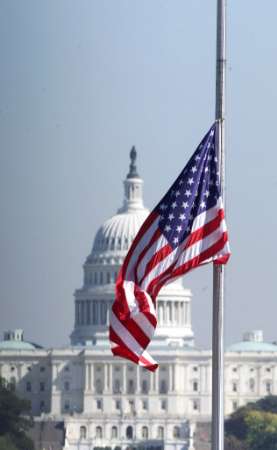
Memorial Day 2009 – Fly your flag today

May 25, 2009

Please fly your flag today. Flag at half-staff, from Veterans Affairs Dept

Memorial Day, traditionally observed on May 30, now observed the last Monday in May, honors fallen veterans of wars. Traditionally, family members visit the cemetery where loved ones are interred and leave flowers on the grave.

On Memorial Day itself, flags on poles or masts should be flown at half-staff from sunrise to noon. At noon, flags should be raised to full-staff position.

When posting a flag at half-staff, the flag should be raised to the full-staff position first, with vigor, then slowly lowered to half-staff; when retiring a flag posted at half-staff, it should be raised to the full staff position first, with vigor, and then be slowly lowered. Some people attach black streamers to stationary flags, though this is not officially recognized by the U.S. Flag Code.

Got another week of school? Here’s a quiz about the history of Memorial Day that might make a warm-up, provided by Carolyn Abell writing in the Tifton (Georgia) Gazette:

1. Memorial Day was first officially proclaimed by a general officer. His name was: A. Robert E. Lee; B. John A. Logan; C. Douglas MacArthur D. George Washington.

2. The first state to officially recognize Memorial Day was A. Virginia; B. Rhode Island; C. New York; D. Georgia.

3. The use of poppies to commemorate Memorial Day started in A. 1870 B. 1915 C. 1948; D. 1967.

4. The original date of Memorial Day was A. May 30; B. July 4; C. May 28; D. Nov 11.

5. Which U.S. Senator has tried repeatedly to pass legislation that would restore the traditional day of Memorial Day observance? A. John McCain B. Ted Kennedy C. Saxby Chambliss D. Daniel Inouye.

The answers, again provided by the Tifton Gazette:

OK, now for the answers. General John Logan, national commander of the Grand Army of the Republic, proclaimed May 30, 1968 as Memorial Day in his General Order Number 11, issued on May 5, 1868. The purpose was to honor the dead from both sides in the War Between the States. Subsequently flowers were placed on the graves of both Union and Confederate soldiers in Arlington National Cemetery on May 30 of that year.

New York was the first state to officially recognize the Memorial Day, in 1873. Southern states, though paying tribute to their dead on separate dates, refused to use May 30 as the official date until after World War I, when the holiday was broadened to honor those who died in any war.

In 1915 a woman named Moina Michael, inspired by the poem, “In Flanders Fields,” (by Canadian Colonel John McRae) began wearing red poppies on Memorial Day to honor our nation’s war dead. The tradition grew and even spread to other countries. In 1922 the VFW became the first veterans’ organization to sell the poppies made by disabled veterans as a national effort to raise funds in support of programs for veterans and their dependents. In 1948 the US Post Office issued a red 3-cent stamp honoring Michael for her role in founding the national poppy movement.

As stated above, May 30 was the original Memorial Day. In 1971, with the passage of the national Holiday Act, Congress changed it so that Memorial Day would be celebrated on the last Monday of May. Some citizens feel that turning it into a “three-day weekend” has devalued the importance and significance of this special holiday. In fact, every time a new Congress has convened since 1989, Senator Daniel Inouye of Hawaii has introduced a bill to the Senate calling for the restoration of May 30th as the day to celebrate Memorial Day.

In his 1999 introductory remarks to the bill, Senator Inouye declared:

“Mr. President, in our effort to accommodate many Americans by making the last Monday in May, Memorial Day, we have lost sight of the significance of this day to our nation. Instead of using Memorial Day as a time to honor and reflect on the sacrifices made by Americans in combat, many Americans use the day as a celebration of the beginning of summer. My bill would restore Memorial Day to May 30 and authorize the flag to fly at half mast on that day.

In addition, this legislation would authorize the President to issue a proclamation designating Memorial Day and Veterans Day as days for prayer and ceremonies honoring American veterans. This legislation would help restore the recognition our veterans deserve for the sacrifices they have made on behalf of our nation.” (from the 1999 U.S. Congressional Record).

Flat at half-staff, U.S.Capitol in background - from Flag Bay

Other sources:

Image of flag and U.S. Capitol from Flags Bay.


Fly your flag today – Presidents’ Day

February 16, 2009

A giant U.S. flag was draped from a building in Springfield, Illinois, at Barack Obamas announcement of candidacy for the U.S. presidency, February 24, 2007 -- photo from JeromeProphet

A giant U.S. flag was draped from a building in Springfield, Illinois, at Barack Obama’s announcement of candidacy for the U.S. presidency, February 24, 2007 — photo from JeromeProphet

Fly your flag today for Presidents’ Day, one of the score of dates designated by Congress to fly the flag.

Presidents’ Day consolidated two separate events, George Washington’s Birthday and Abraham Lincoln’s Birthday.  Lincoln and Washington were first and second in a C-SPAN poll of historians, the Second Historians Survey on Presidential Leadership.


Fly your flag today, for the inauguration of President Obama

January 20, 2009

The United States Armed Forces Color Guard presents the American flag and the different U.S. military service flags at the opening ceremony for the 55th Presidential Inauguration, A Celebration of Freedom, near the Ellipse in Washington, D.C., Jan. 19, 2005. More than 5,000 service members will take part in the 55th Presidential Inauguration. Defense Dept. photo by U.S. Air Force Tech. Sgt. Tracy DeMarco

The United States Armed Forces Color Guard presents the American flag and the different U.S. military service flags at the opening ceremony for the 55th Presidential Inauguration, "A Celebration of Freedom," near the Ellipse in Washington, D.C., Jan. 19, 2005. More than 5,000 service members will take part in the 55th Presidential Inauguration. Defense Dept. photo by U.S. Air Force Tech. Sgt. Tracy DeMarco

The law asks us to do it, but we only get the chance every four years.

Fly your flag today for the inauguration of the president, Barack Obama.

The flag flying today bears 50 stars, the 50th in honor of Obama’s birth state, Hawaii.

Today is one of those days we get to see the flag displayed with scrupulous attention paid to the proper methods of display.  If you see a flag attached to an automobile, for example, it will probably be on a special attachment on the right front fender of the vehicle, as the Flag Code suggests.  The free-for-all flag display methods of small town Fourth of July parades will be reined in.  At least, we hope so.

Fly your flag today — you’ll be glad you did.

Resources:


Thanksgiving 2008 – Fly your flag today

November 27, 2008

Thanksgiving? Texas had it first. No kidding (unless you count the Vinlanders, who probably were grateful to be out of Greenland, but left no records that they ever actually had a feast to say so — but see the comments in the posts linked at various places).

Last year, Mrs. Bathtub was in the hospital. We sprang her before dinner, but barely.  This year, #2 son is off in the wilds of Wisconsin — the first Turkey Day he’s spent away from home and family.  We empathize with the families the first colonizers left behind.

Still, there will be dinner with the family, thanks for the endurance of storms and trials, reflections on good times past, and hopes for the future.

Thanksgiving is a national holiday, one of the 18 days designated by Congress as a “Fly the flag” day.  It’s been a historic year.  It’s a good day to fly the flag.

So, in keeping with that spirit of remembrance, it’s reprise post stuff mostly, today. If you need more, go here:

Google's Thanksgiving logo, 2007

Here’s the main reprise post, text below (there were some good comments in 2006); Margaritas and nachos do sound good, don’t they?
___________________________
Patricia Burroughs has the story — you New Englanders are way, way behind.

Palo Duro Canyon in a winter inversion

Palo Duro Canyon during inversion, Winter 2001, site in 1541 of the first Thanksgiving celebration in what would become the United States. Go here: www.visitamarillotx.com/Gallery/index3.html, and here: www.tpwd.state.tx.us/park/paloduro/

Update, 11/27/2006: Great post here, “Top 10 Myths About Thanksgiving.”

_______________________

Resources for 2007:

Google's 2008 Thanksgiving logo - click here for search on "Thanksgiving"

Google's 2008 Thanksgiving logo - click for search on "Thanksgiving"


Fly your flag today: Columbus Day

October 13, 2008

Fly your U.S. flag today. Fly it to honor Columbus’s discovery of the Americas.

The second Monday in October is celebrated as Columbus Day, a federal holiday (though not widely honored in private enterprise).  Columbus made landfall in the Americas for the first time on October 12, 1492, 516 years ago.

John Vanderlyn Oil on canvas, 12 x 18 Commissioned 1836/1837; placed 1847 Rotunda    Christopher Columbus is shown landing in the West Indies, on an island that the natives called Guanahani and he named San Salvador, on October 12, 1492. He raises the royal banner, claiming the land for his Spanish patrons, and stands bareheaded, with his hat at his feet, in honor of the sacredness of the event. The captains of the Niña and Pinta follow, carrying the banner of Ferdinand and Isabella. The crew displays a range of emotions, some searching for gold in the sand. Natives watch from behind a tree.  John Vanderlyn (1775-1852) had studied with Gilbert Stuart and was the first American painter to be trained in Paris, where he worked on this canvas for ten years with the help of assistants.

John Vanderlyn, Oil on canvas, 12′ x 18′ – Commissioned 1836/1837; placed 1847 in the Rotunda of the Capitol. Christopher Columbus is shown landing in the West Indies, on an island that the natives called Guanahani and he named San Salvador, on October 12, 1492. He raises the royal banner, claiming the land for his Spanish patrons, and stands bareheaded, with his hat at his feet, in honor of the sacredness of the event. The captains of the Niña and Pinta follow, carrying the banner of Ferdinand and Isabella. The crew displays a range of emotions, some searching for gold in the sand. Natives watch from behind a tree. John Vanderlyn (1775-1852) had studied with Gilbert Stuart and was the first American painter to be trained in Paris, where he worked on this canvas for ten years with the help of assistants.


Honor working Americans, fly your flag today

September 1, 2008

Labor Day, 2008 — in addition to honoring America’s working people, especially unionized working people, Labor Day is the traditional start of the presidential campaign in presidential election years.

What if we applied the false start rules the Olympics uses to presidential campaigns?

Fly your U.S. flag today. This is one of the dates designated in law as a permanent date for flag flying.

Miners and their children celebrate Labor Day, Littleton, Colorado, 1940 - Library of Congress

Miners and their children celebrate Labor Day, Littleton, Colorado, 1940 - Library of Congress

Here are some past posts on labor, and Labor Day:

History-minded people may want to look at the history of the holiday, such as the history told at the Department of Labor’s website.

The First Labor Day

The first Labor Day holiday was celebrated on Tuesday, September 5, 1882, in New York City, in accordance with the plans of the Central Labor Union. The Central Labor Union held its second Labor Day holiday just a year later, on September 5, 1883.

In 1884 the first Monday in September was selected as the holiday, as originally proposed, and the Central Labor Union urged similar organizations in other cities to follow the example of New York and celebrate a “workingmen’s holiday” on that date. The idea spread with the growth of labor organizations, and in 1885 Labor Day was celebrated in many industrial centers of the country.

Or this history at the more academic Library of Congress site:

On September 5, 1882, some 10,000 workers assembled in New York City to participate in America’s first Labor Day parade. After marching from City Hall to Union Square, the workers and their families gathered in Reservoir Park for a picnic, concert, and speeches. This first Labor Day celebration was initiated by Peter J. McGuire, a carpenter and labor union leader who a year earlier cofounded the Federation of Organized Trades and Labor Unions, a precursor of the American Federation of Labor.

McGuire had proposed his idea for a holiday honoring American workers at a labor meeting in early 1882. New York’s Central Labor Union quickly approved his proposal and began planning events for the second Tuesday in September. McGuire had suggested a September date in order to provide a break during the long stretch between Independence Day and Thanksgiving. While the first Labor Day was held on a Tuesday, the holiday was soon moved to the first Monday in September, the date we continue to honor.

American Memories at the Library of Congress has several photos of Labor Day celebrations in Colorado, in the mining country.

What do the unions say?  Among other parts of history, the AFL-CIO site has a biography of Walter Reuther, the legendary organizer of automobile factory workersSeptember 1 is the anniversary of Reuther’s birthday (he died in an airplane crash on the way to a union training site, May 10, 1970).

We’re off to a barbecue-style picnic at the in-laws.  Kenny is down from the University of Texas at Dallas, James still hasn’t begun classes at Lawrence University (which is too far to come from for dinner, anyway).  Family usually gets precedence in this house, so we miss the IBEW, UAW, and other union picnics we get invited to here.

We’re glad to have the day off.  Working people made this nation, and this world, what it is today.  We should honor them every day — take a few minutes today, give honor to workers.  Tomorrow, it’s back to work.

Resources:


Independence Day! Fly your flag

July 3, 2008

Remember to fly the flag on July 4, 2008, the 232nd anniversary of the Declaration of Independence. (Postcard above, from 1907, from collection of James R. Heintze)

Flags may be flown sun-up to sun-down. The U.S. flag should be run up the pole quickly, and be left to fly unfettered in the breeze. The flag may be left flying after sundown, if it is lighted.

Resources:


June 14 – Flag Day

June 14, 2008

Did you fly your flag today?  Even without my reminding you?  Good!

Norman Rockwell painting, Scout saluting the flag

Painting by Norman Rockwell, Scout saluting the flag.

Flag Day celebrates the date of the first resolution passing the Continental Congress designating Stars and Stripes as the flag of the soon-to-be U.S., on June 14, 1777.


Memorial Day, 2008 – fly your flag in honor of our nation’s dead

May 26, 2008

(Much of this is reprise from Memorial Day 2007)

You may fly your flag the entire weekend.  Please fly your flag today.

Memorial Day, traditionally observed on May 30, now observed the last Monday in May, is a day to honor fallen veterans of wars. Traditionally, family members visit the cemetery where loved ones are interred and leave flowers on the grave.

On Memorial Day itself, flags on poles or masts should be flown at half-staff from sunrise to noon. At noon, flags should be raised to full-staff position.

When posting a flag at half-staff, the flag should be raised to the full-staff position first, with vigor, then slowly lowered to half-staff; when retiring a flag posted at half-staff, it should be raised to the full staff position first, with vigor, and then be slowly lowered. Some people attach black streamers to stationary flags, though this is not officially recognized by the U.S. Flag Code.

Got another week of school? Here’s a quiz about the history of Memorial Day that might make a warm-up, provided by Carolyn Abell writing in the Tifton (Georgia) Gazette:

1. Memorial Day was first officially proclaimed by a general officer. His name was: A. Robert E. Lee; B. John A. Logan; C. Douglas MacArthur D. George Washington.

2. The first state to officially recognize Memorial Day was A. Virginia; B. Rhode Island; C. New York; D. Georgia.

3. The use of poppies to commemorate Memorial Day started in A. 1870 B. 1915 C. 1948; D. 1967.

4. The original date of Memorial Day was A. May 30; B. July 4; C. May 28; D. Nov 11.

5. Which U.S. Senator has tried repeatedly to pass legislation that would restore the traditional day of Memorial Day observance? A. John McCain B. Ted Kennedy C. Saxby Chambliss D. Daniel Inouye.

The answers, again provided by the Tifton Gazette:

OK, now for the answers. General John Logan, national commander of the Grand Army of the Republic, proclaimed May 30, 1968 as Memorial Day in his General Order Number 11, issued on May 5, 1868. The purpose was to honor the dead from both sides in the War Between the States. Subsequently flowers were placed on the graves of both Union and Confederate soldiers in Arlington National Cemetery on May 30 of that year.

New York was the first state to officially recognize the Memorial Day, in 1873. Southern states, though paying tribute to their dead on separate dates, refused to use May 30 as the official date until after World War I, when the holiday was broadened to honor those who died in any war.

In 1915 a woman named Moina Michael, inspired by the poem, “In Flanders Fields,” (by Canadian Colonel John McRae) began wearing red poppies on Memorial Day to honor our nation’s war dead. The tradition grew and even spread to other countries. In 1922 the VFW became the first veterans’ organization to sell the poppies made by disabled veterans as a national effort to raise funds in support of programs for veterans and their dependents. In 1948 the US Post Office issued a red 3-cent stamp honoring Michael for her role in founding the national poppy movement.

As stated above, May 30 was the original Memorial Day. In 1971, with the passage of the national Holiday Act, Congress changed it so that Memorial Day would be celebrated on the last Monday of May. Some citizens feel that turning it into a “three-day weekend” has devalued the importance and significance of this special holiday. In fact, every time a new Congress has convened since 1989, Senator Daniel Inouye of Hawaii has introduced a bill to the Senate calling for the restoration of May 30th as the day to celebrate Memorial Day.

In his 1999 introductory remarks to the bill, Senator Inouye declared:

“Mr. President, in our effort to accommodate many Americans by making the last Monday in May, Memorial Day, we have lost sight of the significance of this day to our nation. Instead of using Memorial Day as a time to honor and reflect on the sacrifices made by Americans in combat, many Americans use the day as a celebration of the beginning of summer. My bill would restore Memorial Day to May 30 and authorize the flag to fly at half mast on that day.

In addition, this legislation would authorize the President to issue a proclamation designating Memorial Day and Veterans Day as days for prayer and ceremonies honoring American veterans. This legislation would help restore the recognition our veterans deserve for the sacrifices they have made on behalf of our nation.” (from the 1999 U.S. Congressional Record).

Flat at half-staff, U.S.Capitol in background - from Flag Bay

Other sources:

Image of flag and U.S. Capitol from Flags Bay.


Popular idea: Honor the soldiers, sailors and airmen

May 17, 2008

Interesting. The hottest post on this blog today is the one I wrote about honoring Armed Forces Day — last year! The post for Armed Forces Day this year is up there, too.

One of the lessons of Vietnam is that we need to honor our soldiers who go to defend the nation, even when the wars may be of dubious origin. The dubious origins of war cannot be blamed on the soldiers, sailors and airmen who go to do their duty, and they are the ones who can redeem the nation from a disastrous foreign policy, if anyone can.

Love the serviceman, hate the war. Honor the soldier, work on the politicians to change the policy. It’s a workable arrangement that honors good people for doing noble service.

Remember: Memorial Day honors those who died in service to the country; Veterans Day honors the veterans who came back, having served. Armed Forces Day honors those who serve today.

Fly your flag today.