When I wrote about George Santayana’s observation that, “Only the dead have seen the end of war,” I didn’t realize it was a quote with controversy over the attribution.

He said it: Spanish-American philosopher and writer George Santayana, early in his career (Photo: Wikipedia)
Ridley Scott‘s outstanding 2001 movie, “Blackhawk Down,” opened with the quote, but attributing it to Plato, according to Plato expert Bernard Suzanne in Paris. One philosopher is as good as another, you might say, so it’s understandable that a good line from a modern philosopher like Santayana might be attributed to one of the most famous philosophers of all time (“they all look alike,” I hear someone saying). Or, the cynics might say, perhaps Santayana lifted it from Plato — after all, who but another philosopher would actually read the stuff? Who would know?
Suzanne’s sleuthing is impressive if only because it shows the murkiness of the issue. According to Suzanne:
- The quote is popular among American soldiers (ask one — report back in comments).
- Michael Takiff found it attributed to Plato by a U.S. soldier in Vietnam, writing home, in a book published in 2003.
- No one has found it in any of Plato’s dialogues — at least, no one Suzanne can find.
- Gen. Douglas MacArthur used the quote in a farewell address to cadets at the U.S. Military Academy at West Point, in 1962, attributing it to Plato. That would be a likely source of its popularity among U.S. soldiers.
- The Imperial War Museum, in London, has the quote engraved on its walls, attributed to Plato. The museum opened in 1936. Santayana’s version was published in 1922.
- Reminder: Santayana said it here: Soliloquies in England and Later Soliloquies, number 25 (1922)
Who put it on the wall of the Imperial War Museum, and why did they misattribute it, just a dozen years after Santayana wrote it?
More:
- A discharged U.S. soldier, Chuck Luther of Killeen, Texas, has the quote tattooed on his arm, as from Plato — AP photo
- Graffiti after Banksy, in Los Angeles, California
- Get it on a coffee mug — misattributed to Plato
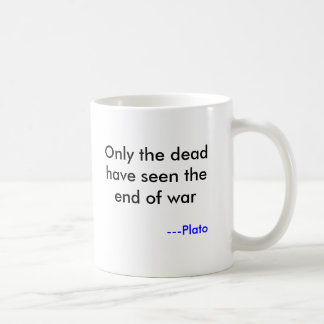
Quote from George Santayana misattributed to Plato, on a coffee mug from Zazzle


 Posted by Ed Darrell




 Millard Fillmore's Bathtub