Encore quote of the moment: George Washington on religious freedom

June 3, 2010

August 17, 1790, found U.S. President George Washington traveling the country, in Newport, Rhode Island.

Washington met with “the Hebrew Congregation” (Jewish group), and congregation leader (Rabbi?) Moses Seixas presented Washington with an address extolling Washington’s virtues, and the virtues of the new nation. Seixas noted past persecutions of Jews, and signalled a hopeful note:

Deprived as we heretofore have been of the invaluable rights of free citizens, we now (with a deep sense of gratitude to the Almighty disposer of all events) behold a government erected by the Majesty of the People–a Government which to bigotry gives no sanction, to persecution no assistance, but generously affording to All liberty of conscience and immunities of Citizenship, deeming every one, of whatever Nation, tongue, or language, equal parts of the great governmental machine.

George Washingtons reply to the Newport, RI, Hebrew congregation, August 17, 1790 - Library of Congress image

George Washington's reply to the Newport, RI, "Hebrew congregation," August 17, 1790 - Library of Congress image

President Washington responded with what may be regarded as his most powerful statement in support of religious freedom in the U.S. — and this was prior to the ratification of the First Amendment:

It is now no more that toleration is spoken of as if it was the indulgence of one class of people that another enjoyed the exercise of their inherent natural rights. For happily, the government of the United States, which gives to bigotry no sanction, to persecution no assistance, requires only that they who live under its protection should demean themselves as good citizens, in giving it on all occasions their effectual support.

Below the fold, more history of the events and religious freedom, from the Library of Congress.

Read the rest of this entry »


Fly your flag today: Presidents Day 2010

February 15, 2010

Fly your flag today.

White House at night

White House with U.S. flag at night; photo by Keith Stanley, kestan.com

Residents of the United States celebrate Presidents Day today, a holiday that grew out of celebrations of the birthdays of both George Washington (February 22, 1732) and Abraham Lincoln (February 12, 1809), both of whom were born in February (under the “new” Gregorian calendar).

President’s Day is one of a score of dates Congress recognized in the Flag Code as appropriate for patriotic display of the U.S. flag.

Note:  Keith Stanley sells his photos, including this one of the White House at night.  You can view this one, and many more, and purchase copies, at Mr. Stanley’s website.


Quote of the Moment: George Washington, “to bigotry, no sanction”

August 17, 2009

August 17, 1790, found U.S. President George Washington traveling the country, in Newport, Rhode Island.

Washington met with “the Hebrew Congregation” (Jewish group), and congregation leader (Rabbi?) Moses Seixas presented Washington with an address extolling Washington’s virtues, and the virtues of the new nation.  Seixas noted past persecutions of Jews, and signalled a hopeful note:

Deprived as we heretofore have been of the invaluable rights of free citizens, we now (with a deep sense of gratitude to the Almighty disposer of all events) behold a government erected by the Majesty of the People–a Government which to bigotry gives no sanction, to persecution no assistance, but generously affording to All liberty of conscience and immunities of Citizenship, deeming every one, of whatever Nation, tongue, or language, equal parts of the great governmental machine.

George Washingtons reply to the Newport, RI, Hebrew congregation, August 17, 1790 - Library of Congress image

George Washington's reply to the Newport, RI, "Hebrew congregation," August 17, 1790 - Library of Congress image

President Washington responded with what may be regarded as his most powerful statement in support of religious freedom in the U.S. — and this was prior to the ratification of the First Amendment:

It is now no more that toleration is spoken of as if it was the indulgence of one class of people that another enjoyed the exercise of their inherent natural rights. For happily, the government of the United States, which gives to bigotry no sanction, to persecution no assistance, requires only that they who live under its protection should demean themselves as good citizens, in giving it on all occasions their effectual support.

Below the fold, more history of the events and religious freedom, from the Library of Congress.

Read the rest of this entry »


Hang George Washington . . .

March 16, 2009

. . . in your school.

George Washington, the porthole portrait by Rembrandt Peale

George Washington, the "porthole portrait" by Rembrandt Peale

I have a tie from the Save the Children Foundation, a picture drawn by a young child that shows a teacher in a classroom, with portraits of Washington, Lincoln and Teddy Roosevelt on the classroom wall.  Where have those portraits gone?

At Mount Vernon this past weekend, with more than 20 teachers at the seminar I attended, a significant majority of us remembered those portraits in our classrooms.  Most of us don’t have such portraits today.

The Mount Vernon Ladies Association, the group that saved Mount Vernon and operates it today, has  program to donate a large, canvas portrait of Washington to your school, the George Washington Portrait Program.  Two thousand schools have already received the framed portraits, and the program to distribute them, free of charge, to schools, has been extended.

Portraits come with an educational kit — a U.S. flag, flown at General Washington’s home, lesson plans for elementary schools, and a CD-ROM with information for middle and high schools.

Here are the instructions on how to request a portrait for your school.  Here is more information on the program. If you can afford to make a donation, feel free.

Portrait of George Washington, available free to schools, displayed on the grounds of Mount Vernon.  Photo, Mount Vernon Ladies Association

Portrait of George Washington, available free to schools, displayed on the grounds of Mount Vernon. Photo, Mount Vernon Ladies Association


George Washington wrote here: “Dear Dickey . . .”

March 16, 2009

TO RICHARD HENRY LEE
Dear Dickey:
I thank you very much for the pretty picture book you
gave me. Sam asked me to show him the pictures and I
showed him all the pictures in it; and I read to him how
the lame elephant took care of the master’s little son. I
can read three or four pages sometimes without missing
a word. Ma says I may go to see you and stay all day
with you next week if it be not rainy. She says I may
ride my pony Hero if Uncle Sam will go with me and lead
Hero. I have a little piece of poetry about the picture
book you gave me, but I mustn’t tell you who wrote the
poetry.

G. W.’s compliments to R.H.L.,

And likes his book full well,

Henceforth will count him his friend,

And hopes many happy days he may spend.

Your good friend,

George Washington

Letter to a very young Richard Henry Lee, from a very young George Washington

It’s one of the earliest samples of George Washington’s writing we have.  I don’t have a date for the letter, but it is likely to have been prior to 1743, when his father died.  This letter was probably written before George was 11.

Can you imagine George Washington as a giggling little boy? He was.  We have the letters to prove it. I like this letter simply because it offers a view of George Washington too rarely thought of or talked about.

Richard Henry Lee remained a friend of Washington’s until Washington died.   Lee was the man who made the motion at the 2nd Continental Congress that the colonies declare independence from England.   Lee was about a month older than Washington, born January 20, 1732.  He was a signer of the Declaration of Independence, the Articles of Confederation, and was President of the Continental Congress.

That these two men were childhood friends is a delightful little historical nugget.

Grant Woods painting illustrating Parson Weems telling the story of George Washingtons honesty.

Grant Wood's famous 1939 painting illustrating Parson Weems telling the story of George Washington's honesty. "Parson Weems' Fable" hangs in the Amon Carter Museum in Fort Worth, Texas.

Grant Wood, the great American painter, couldn’t imagine Washington as a boy, either.  This painting, showing Parson Weems’s version of a story about Washington’s honesty that has not held up to scrutiny as accurate, shows the difficulty Wood expressed:  Washington is portrayed as a child with an adult, bewigged head — a homonculus.  The painting hangs in the Amon Carter Museum in Fort Worth, Texas.

Maybe some of your troubling students will grow up good and honest, too.  Do we know what would push our students to be such model citizens?  Do we know what influenced Washington?

Adult influences in Washington’s early life were not so good as some might imagine.  His father died when he was 11.  At some point he became estranged from his mother, with her repeated accusations that all her children ignored her (to Washington’s great embarrassment).  Washington’s other great adult male influence was his half-brother Lawrence.  George was sent to live with his Lawrence, but Lawrence died in 1752, when George was turning 20.  Also, Washington got little direction from him after he went to sea with the British.

By the time he was 20, Washington was a military commander in the Virginia militia, making adult decisions and living in an adult world.  Where did his childhood go?  What was it that enabled him to pick himself up and aspire to greatness so often, in so many different ways?  What was it bent the twig of the childhood Washington, who grew into the great man the adult Washington became?

You can find this letter in William B. Allen’s George Washington, A Collection, 1998 Liberty Fund.  Liberty Fund wishes to spread these works as far as possible, and so has made the book available on-line.  It is loaded with materials great for DBQs in AP classes, and other readings that should inspire discussion by students and assignments from teachers that make students think.

He may not have chopped down a cherry tree, but Washington most certainly was a child.  What will our students make of this letter?


Snow at Mount Vernon; Washington still hot

March 15, 2009

The photos don’t show the beauty, nor do they capture the wonderful quiet that accompanied it.

It snowed briefly and lightly at George Washington’s home at Mount Vernon Friday morning.

Snow at the Quarters, Mount Vernon, Virginia, March 13, 2009 - copyright Ed Darrell

Snow at the Quarters, Mount Vernon, Virginia, March 13, 2009 - copyright Ed Darrell

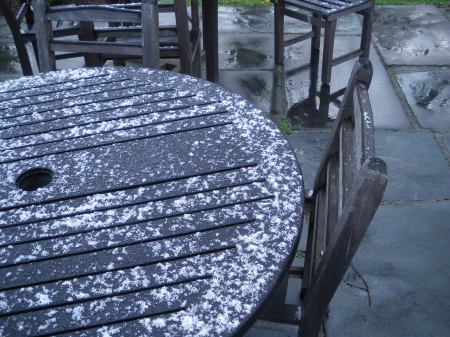
Al fresco dining would have  been cool, and wet.

Snow on tables, The Quarter, Mount Vernon, Virginia - copyright 2009 by Ed Darrell

Snow on tables, The Quarters, Mount Vernon, Virginia - copyright 2009 by Ed Darrell

Inside, a few minutes later, the conversation was hot.  We opened with a session the night before, and post-dinner meeting with William B. Allen, the editor of a recent collection of George Washington’s papers.  Allen is suave, with a perfectly-modulated baritone voice.  He doesn’t just speak in properly punctuated, grammatically correct paragraphs.  He speaks in chapters that summarize volumes.

Among other telling gems, Allen noted that Washington, who is often regarded as an intellectual inferior to Jefferson, Madison, Franklin, Hamilton and others, because he “wrote so little,” has had his collected published papers now pass the 100 volume mark.  Reading the letters in full, as we did much of at this meeting, reveals Gen. Washington as little else can.

You should read yourself some Washington.

Tip of the old scrub brush, again, to the Bill of Rights Institute and Liberty Fund, sponsors and organizers of this event.


George Washington’s influence on American geography

March 15, 2009

A quick snippet of learning from my stay at Mount Vernon:

How many places are named after Washington?  How many schools?

At the relatively new museum here I found a display that notes how Americans have honored our First President by naming things after him:

  • 26 mountains
  • 740 schools
  • 155 places (the exhibit said “155 cities and counties,” but the map also showed the State of Washington)

(All of this comes without the aid of a George Washington Legacy Project to inflate his importance and the love of Americans for his work!)

George Washington can still lay claim to his friend Richard Lee’s eulogy, as “first in the hearts of his countrymen.”

I found the display on place names on the way out of the Education Center — a place designed to help visiting teachers learn about resources available for classroom use.

Of course the group works to help teachers who can’t visit at the moment, too.  To that end they’ve published online a series of lesson plans developed by the George Washington Teachers’ Institute, a summer residency program that provides professional development.

Check out the lesson plans at http://www.mountvernon.org.  Lesson plans are here.  I particularly liked the political cartoons included in this lesson plan, all drawn by Pulitzer Prize-winning cartoonists.

Renovations and new construction at Mount Vernon during the past decade have made the place a much more valuable resource for teachers and students.

Let’s tip the entire Millard Fillmore’s Bathtub to the Bill of Rights Institute and Liberty Fund, who sponsored the program at Mount Vernon.


Fly your flag today – Presidents’ Day

February 16, 2009

A giant U.S. flag was draped from a building in Springfield, Illinois, at Barack Obamas announcement of candidacy for the U.S. presidency, February 24, 2007 -- photo from JeromeProphet

A giant U.S. flag was draped from a building in Springfield, Illinois, at Barack Obama’s announcement of candidacy for the U.S. presidency, February 24, 2007 — photo from JeromeProphet

Fly your flag today for Presidents’ Day, one of the score of dates designated by Congress to fly the flag.

Presidents’ Day consolidated two separate events, George Washington’s Birthday and Abraham Lincoln’s Birthday.  Lincoln and Washington were first and second in a C-SPAN poll of historians, the Second Historians Survey on Presidential Leadership.


Hallucinating George Washington, the Birth Certificate Obsessed

January 20, 2009

Some of the Birth Certificate Obsessed (BCOs) are seeing things (that’s Obama’s birth certificate that they are obsessed with).  They claim to see a vision that is attributed to George Washington in a hoax. It’s voodoo history, stuff that never was.

Hallucinations would be bad enough, but what do you have to smoke to see hallucinations other people were supposed to have had, but didn’t?

Looking at the docket of the Supreme Court, I don’t see that any of the anti-Obama suits got an order for certiorari. Will the dismissal of the wingnut lawsuits make the wingnuts go away?


Beginning of the American experiment in freedom

December 23, 2007

On December 23, 1783, Commander of the Continental Army, Gen. George Washington resigned his commission, to the Continental Congress sitting in Annapolis, Maryland. Washington modeled his actions on the life of Roman general and patriot Cincinnattus. (See especially this site, the Society of the Cincinnati)

John Trumbull painting of Washington resigning his commission

Washington had been thought to be in a position to take over the government and declare himself king, if he chose. Instead, at some cost to himself he personally put down a rebellion of the officers of the army who proposed a coup d’etat against the Continental Congress, angered that they had not been paid. Washington quietly asked that the men act honorably and not sully the great victory they had won against Britain. Then Washington reviewed the army, wrapped up affairs, journeyed to Annapolis to resign, and returned to his farm and holdings at Mount Vernon, Virginia.

Because Washington could have turned into a tyrant, it is reported that King George III of England, upon hearing the news of Washington’s resignation, refused to believe it. If the report were true, George is reported to have said, Washington was the greatest man who ever lived.

Washington’s resignation set precedent: Civilian government controlled the military; Americans served, then went back to their private lives and private business; Americans would act nobly, sometimes when least expected.

Read the rest of this entry »


“Why should I read Shakespeare? Why should I study history?”

November 2, 2007

David McCullough might answer that question this way:

In conclusion I want to share a scene that took place on the last day of the year of 1776, Dec. 31. All the enlistments for the entire army were up. Every soldier, because of the system at the time, was free to go home as of the first day of January 1777. Washington called a large part of the troops out into formation. He appeared in front of these ragged men on his horse, and he urged them to reenlist. He said that if they would sign up for another six months, he’d give them a bonus of 10 dollars. It was an enormous amount then because that’s about what they were being paid for a month—if and when they could get paid. These were men who were desperate for pay of any kind. Their families were starving.

The drums rolled, and he asked those who would stay on to step forward. The drums kept rolling, and nobody stepped forward. Washington turned and rode away from them. Then he stopped, and he turned back and rode up to them again. This is what we know he said:

My brave fellows, you have done all I asked you to do, and more than could be reasonably expected, but your country is at stake, your wives, your houses, and all that you hold dear. You have worn yourselves out with fatigues and hardships, but we know not how to spare you. If you will consent to stay one month longer, you will render that service to the cause of liberty, and to your country, which you can probably never do under any other circumstance.3

Again the drums rolled. This time the men began stepping forward. “God Almighty,” wrote Nathanael Greene, “inclined their hearts to listen to the proposal and they engaged anew.”4

Now that is an amazing scene, to say the least, and it’s real. This wasn’t some contrivance of a screenwriter. However, I believe there is something very familiar about what Washington said to those troops. It was as if he was saying, “You are fortunate. You have a chance to serve your country in a way that nobody else is going to be able to, and everybody else is going to be jealous of you, and you will count this the most important decision and the most valuable service of your lives.” Now doesn’t that have a familiar ring? Isn’t it very like the speech of Henry V in Shakespeare’s play Henry V: “We few, we happy few, we band of brothers . . . And gentlemen in England now a-bed / Shall think themselves accursed they were not here”?5 Washington loved the theater; Washington loved Shakespeare. I can’t help but feel that he was greatly influenced.

He was also greatly influenced, as they all were, by the classical ideals of the Romans and the Greeks. The history they read was the history of Greece and Rome. And while Washington and Knox and Greene, not being educated men, didn’t read Greek and Latin as Adams and Jefferson did, they knew the play Cato, and they knew about Cincinnatus. They knew that Cincinnatus had stepped forward to save his country in its hour of peril and then, after the war was over, returned to the farm. Washington, the political general, had never forgotten that Congress was boss. When the war was at last over, Washington, in one of the most important events in our entire history, turned back his command to Congress—a scene portrayed in a magnificent painting by John Trumbull that hangs in the rotunda of our national Capitol. When George III heard that George Washington might do this, he said that “if he does, he will be the greatest man in the world.”

So what does this tell us? That the original decision of the Continental Congress was the wise one. They knew the man, they knew his character, and he lived up to his reputation.

I hope very much that those of you who are studying history here will pursue it avidly, with diligence, with attention. I hope you do this not just because it will make you a better citizen, and it will; not just because you will learn a great deal about human nature and about cause and effect in your own lives, as well as the life of the nation, which you will; but as a source of strength, as an example of how to conduct yourself in difficult times—and we live in very difficult times, very uncertain times. But I hope you also find history to be a source of pleasure. Read history for pleasure as you would read a great novel or poetry or go to see a great play.

And I hope when you read about the American Revolution and the reality of those people that you will never think of them again as just figures in a costume pageant or as gods. They were not perfect; they were imperfect—that’s what’s so miraculous. They rose to the occasion as very few generations ever have.

David McCullough, from a speech delivered at Brigham Young University in Provo, Utah, on September 27, 2005, “The Glorious Cause of America.”

Do your students know that speech from Henry V? Do your students know the story of Cincinnatus?

Tip of the old scrub brush to Collecting My Thoughts.

Fisking Paszkiewicz — or virtual carnage in Kearny, N.J.

February 20, 2007

That kid in New Jersey whose town turned on him, on the town’s internet bulletin board, after he ratted out the history teacher who was preaching instead of teaching? He’s still under attack.

The teacher took some time out to defend his odd views in the local paper. His letter is several weeks old, and it’s been fisked by others, but I want my licks. I fisk the letter below the fold. Read the rest of this entry »