Remember to fly your flag today for Labor Day, to honor all laborers, and especially those in the union movement to whom we owe gratitude for the concepts and reality of safe work places, good pay, benefits (including health benefits), and vacations.
Members of the Silver Platers and Metal Polishers Union carry a large flag in Rochester’s (New York) 1918 Labor Day Parade. A poster depicting Uncle Sam can be seen to the rear of the marchers. Photograph by Albert R. Stone, Albert R. Stone Photo Collection, Monroe County Library System
2014 notes the 100th anniversary of the Ludlow, Colorado Massacre. Labor Day should give us all pause to consider those who lost their lives campaigning for good wages, for decent working hours, for good and safe working conditions, and for the right of workers to negotiate collectively the companies who employ them for these things.
Have a good Labor Day. Celebrate with family and coworkers. Kick off the 2014 elections.
And remember.
Monument in Haymarket Square, Chicago, noting the 1886 Haymarket Riot and the workers who died or were murdered later. Photo by TRiver on flickr, Creative Commons license, via AtlasObscura.
(Okay, you may fly your flag all weekend — especially if you’re a union member. We get the whole weekend, but Labor Day itself is Monday.)
Labor Day 2014 in the United States is a federal holiday, and one of those days Americans are urged to fly the U.S. flag.
“Free Labor Will Win,” the poster said, encouraging a theme important during World War II, when unions were encouraged to avoid strikes or any action that might interrupt work to build the “arsenal of democracy” believed necessary to win the war. Labor complied, the war was won, and organized labor was the stronger for it. In 2012, some have difficulty remembering when all Americans knew that our future rides on the backs of organized labor.
The poster was issued by the Office of War Information in 1942, in full color. A black-and-white version at the Library of Congress provides a few details for the time:
Labor Day poster. Labor Day poster distributed to war plants and labor organizations. The original is twenty-eight and one-half inches by forty inches and is printed in full color. It was designed by the Office of War Information (OWI) from a photograph especially arranged by Anton Bruehl, well-known photographer. Copies may be obtained by writing the Distribution Section, Office of War Information [alas, you can’t get a copy from the Office of War Information in 2012]
Even down here in deepest, darkest-right-to-work Texas, patriots fly their flags to honor Labor today. It’s heartening.
Flags fly all around in 1882 at the first Labor Day Parade in New York City’s Union Square; lithograph from USC’s Dornsife History Center, via Wikipedia, artist unidentified
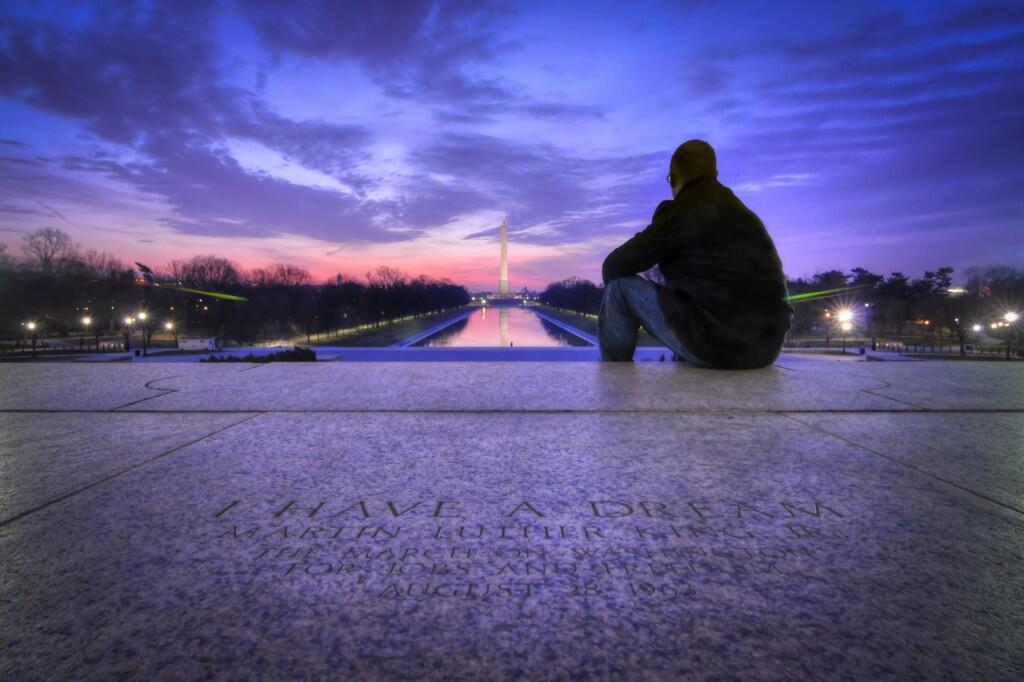
Pic Tweet from the National Park Service: Beautiful photo of the exact spot Dr. King delivered his “I Have a Dream speech” 50 years ago today. #MLKdream50 pic.twitter.com/MHwWsY7Hwp
The photo is a couple of years old, having been taken before the scaffolding went up on the Washington Monument for repairs for damage from the 2011 earthquake — scaffolding which has since been removed. It’s a winter or fall picture, I’m guessing from the bare trees, and taken early in the morning, as the sun rises in the east over the Capitol and Washington Monument. That is one of the best times to be at the Lincoln Memorial, in my experience. The man in the photo has the historic spot very much to himself at that time.
Engraving on the stone says:
I HAVE A DREAM
MARTIN LUTHER KING, JR.
THE MARCH ON WASHINGTON
FOR JOBS AND FREEDOM
AUGUST 28, 1963
Assuming you’re older than 51, where were you that day in August? Do you remember the event in the news?
King’s speech got very little press that day, or the next. It was in the time when television news operations used film. The film came late in the afternoon, and would have to be developed — it missed evening broadcasts on that Saturday. The text did not get much mention, either — reports for the Washington Post and New York Times, had to be filed early. Most reporters wrote before the event. Even those who wrote after the speech often were unaware of how it had moved the crowd. It’s one of those historic events that, had you been there, you’d have known something happened. but not necessarily what.
News reports tended to be dominated by coverage of the size of the crowd, and the fact that violence didn’t break out.
August 26 is the anniversary of the first television broadcast of professional baseball, in 1939; the future-legendary Red Barber called a doubleheader between his Brooklyn Dodgers and the Cincinnati Reds from Ebbets field.
Both games were carried on experimental television station W2XBS, which evolved into New York’s NBC affiliate Channel 2, WNBC. Two stationary cameras were used, in contrast to the several used in modern broadcasts — and it was in black and white. About 3,000 people are estimated to have watched.
The Reds won the opener, 5-2, but the Dodgers roared back in game 2, 6-1.
Ebbets field is gone. The Dodgers absconded to Los Angeles in the 1950s. Baseball games are in color.
Red Barber is gone, too. We have great play-by-play guys, and wonderful color commentators. There will never be another Red Barber though. Below is an old post noting Barber’s ways with typewriters.
The great Red Barber, when his hair was still red, working at his typewriter, with a volume of Roget’s Thesaurus close by.
Many of us knew Red chiefly through his weekly chats with Bob Edwards at NPR’s Morning Edition. The biographies say Red died in 1992. That was 19 years ago — it seems more recent than that. (Edwards left Morning Edition in 2004.)
It may be ironic to show Barber at his typewriter. He would be more accurately portrayed, perhaps, behind a microphone at a baseball park.
From 1939 through 1953 Barber served as the voice of the Brooklyn Dodgers. He was working for the New York Yankees when he retired in 1966. Barber had the distinction of broadcasting baseball’s first night game on May 24, 1935 in Cincinnati and the sport’s first televised contest on August 26, 1939 in Brooklyn.
During his 33-year career Barber became the recognized master of baseball play-by-play, impressing listeners as a down-to-earth man who not only informed but also entertained with folksy colloquialisms such as “in the catbird seat,” “pea patch,” and “rhubarb” which gave his broadcasts a distinctive flavor. (Radio Hall of Fame)
13-year-old paperboy Chester Kahapea happily hawks a commemorative edition of the Honolulu Star-Bulletin with the headline showing the state had achieved statehood after the U.S. House of Representatives passed the law authorizing Hawaii as a state. Star-Bulletin photo by Murray Befeler.
Specimen copy of the ballot used by Hawaiians in a June 27, 1959, plebiscite to approve conditions of statehood. Image from Hawaii Magazine, 2009
After the U.S. annexed Hawaii in 1898 (in action separate from the Spanish-American War) attempts at getting Hawaii admitted as a state got rolling. After World War II, with the strategic importance of the islands firmly implanted in Americans’ minds, the project picked up some steam. Still, it was 14 years after the end of the war that agreements were worked out between the people of Hawaii, the Hawaiian royal family, Congress and the executive branch. The deal passed into law had to be ratified by a plebiscite among Hawaiian citizens. The proposition won approval with 94% of votes in favor.
Other than the tiny handful of loudmouth birthers, most Americans today are happy to have Hawaii as a state, the fifth richest in the U.S. by personal income. The nation has a lot of good and great beaches, but the idea of catching sun and surf in Hawaii on vacation might be considered an idealized part of the American dream.
From Prologue, the blog of the National Archives: This petition, rolled onto a wooden spool, was signed by 116,000 supporters of Hawaii statehood and presented to the U.S. Senate on February 26, 1954. (RG 46, Records of the U.S. Senate)
U.S. postage stamp issued in 2009 commemorating the 50th anniversary of Hawaii’s admission to the union.
Contrast the first class postage price above with the airmail postage price of this stamp issued in 1959 — August 21, 1959 7¢ Rose Hawaii Statehood stamp. Wikipedia image
Ho Chi Minh at his typewriter. Photo from EarthStation 1
The image looks to me to have been lifted off of a film or video; by the non-white color of his beard, this must have been taken sometime before 1955. I’ve found no other details on the photo, especially nothing on the typewriter. Anybody know the date of the photo, the occasion, the location, or the typewriter?
But there you go: Ho Chi Minh, the leader of the Vietnam freedom fighters against the Japanese in World War II, then against the French colonialists (his forces then called Viet Minh, and later Viet Cong), and then of North Vietnam against South Vietnam and the United States after 1954, until his death in 1969.
Ha! A second photo of Ho and a typewriter, from Greg Hocfell:
Ho Chi Minh at his typewriter. Photo via Greg Hocfell
Might those photos be from the same session? Ho looks about the same age, his hair and beard are about the same color, and he’s wearing a dark shirt with white buttons in each.
Found this wonderful page with a list of resources on Millard Fillmore, available on line from the Library of Congress. The list was compiled by Library of Congress’s Virtual Services, Digital Reference Section.
The complete Abraham Lincoln Papers from the Manuscript Division at the Library of Congress consist of approximately 20,000 documents. The Lincoln Papers contain more than fifty items to, from, or referring to Millard Fillmore. To find these documents, go to the collection’s search page, and search on the phrase Millard Fillmore (do not put quotation marks around the words).
Among the collection’s Fillmore-related materials are:
The Printed Ephemera collection comprises 28,000 primary source items dating from the seventeenth century to the present and encompasses key events and eras in American history. Search the bibliographic records and the full-text option to find items related to Millard Fillmore.
This collection contains a large selection of congressional material related to Millard Fillmore’s political career as a member of the House of Representatives, vice president, and president. Search this collection by date and type of publication to find materials related to Fillmore.
The Congressional Globe provides the text of congressional debates from Fillmore’s service in the House of Representatives (1833-35 and 1837-43). It also contains the text of congressional debates and presidential messages from Fillmore’s presidency (1850-53), including Fillmore’s First, Second, and Third Annual Messages to Congress and his message to the Senate announcing the death of President Zachary Taylor on July 9, 1850.
The collection consists of 397 pamphlets, published from 1824 through 1909, by African-American authors and others who wrote about slavery, African colonization, Emancipation, Reconstruction, and related topics, including two items that reference Millard Fillmore.
The focus of Map Collections is Americana and the cartographic treasures of the Library of Congress. These images were created from maps and atlases selected from the collections of the Geography and Map Division. Millard Fillmore’s personal collection of printed and manuscript maps is represented by sixteen maps.
This collection contains more than 62,500 pieces of historical sheet music registered for copyright, including three songs related to Millard Fillmore.
This collection presents twenty-three popular periodicals digitized by Cornell University Library and the Preservation Reformatting Division of the Library of Congress. Search the bibliographic records and the full-text options to find articles that discuss Millard Fillmore.
Among the collection’s Fillmore-related articles are:
Millard Fillmore. [The American Whig Review. / Volume 8, Issue 4, October 1848]
In honor of the Manuscript Division’s centennial, its staff selected approximately ninety representative documents spanning from the fifteenth to the mid-twentieth centuries. The following items reference Millard Fillmore:
PrintsOldandRare.com had a copy of an 1864 Illustrated News with Millard Fillmore on the cover.
Prints Old and Rare: “1853 Portrait of Millard Fillmore. Antique engraved portrait of Fillmore from the May 28, 1853 issue of the Illustrated News, surrounded by text discussing the history of his administration. 11×16 in. SOLD”
What was the contemporary judgment on the last Whig President, whose own party refused to nominate him for a term of his own?
One wonders if there isn’t another copy of that newspaper floating around out there, or whether it might be available at the Library of Congress.
FULTON — Former President Millard Fillmore was a tested leader who would preserve the Union and heal political divisions, Editor John Williams wrote, announcing his preference for the Democratic presidential nomination.
“We have tried him and we know that he will do us justice,” Williams wrote.
The Democratic National Convention was scheduled to begin Aug. 29 at Chicago. Fillmore, 64, was gaining some notice as a potential candidate, but most Democrats were focused on Maj. Gen. George McClellan. Nicknamed “The Young Napoleon,” McClellan was a meticulous officer who thoroughly organized the Army of the Potomac but was relieved of command because of his cautious approach to combat.
Missouri had 22 delegate seats at the convention, with U.S. Rep. William Hall of Randolph County, banker Weston Birch of Howard County and former U.S. Rep. Thomas Price of Cole County included in the delegation.
Williams wrote that while he preferred Fillmore, “McClellan will do — he is a Christian — a soldier and a patriot. Although a war man we believe he would favor peace at once, with the most liberal terms, and on the condition of the Union. If not McClellan, then some other good man…”
A few miles from the New Mexico border, in Chromo, Colorado:
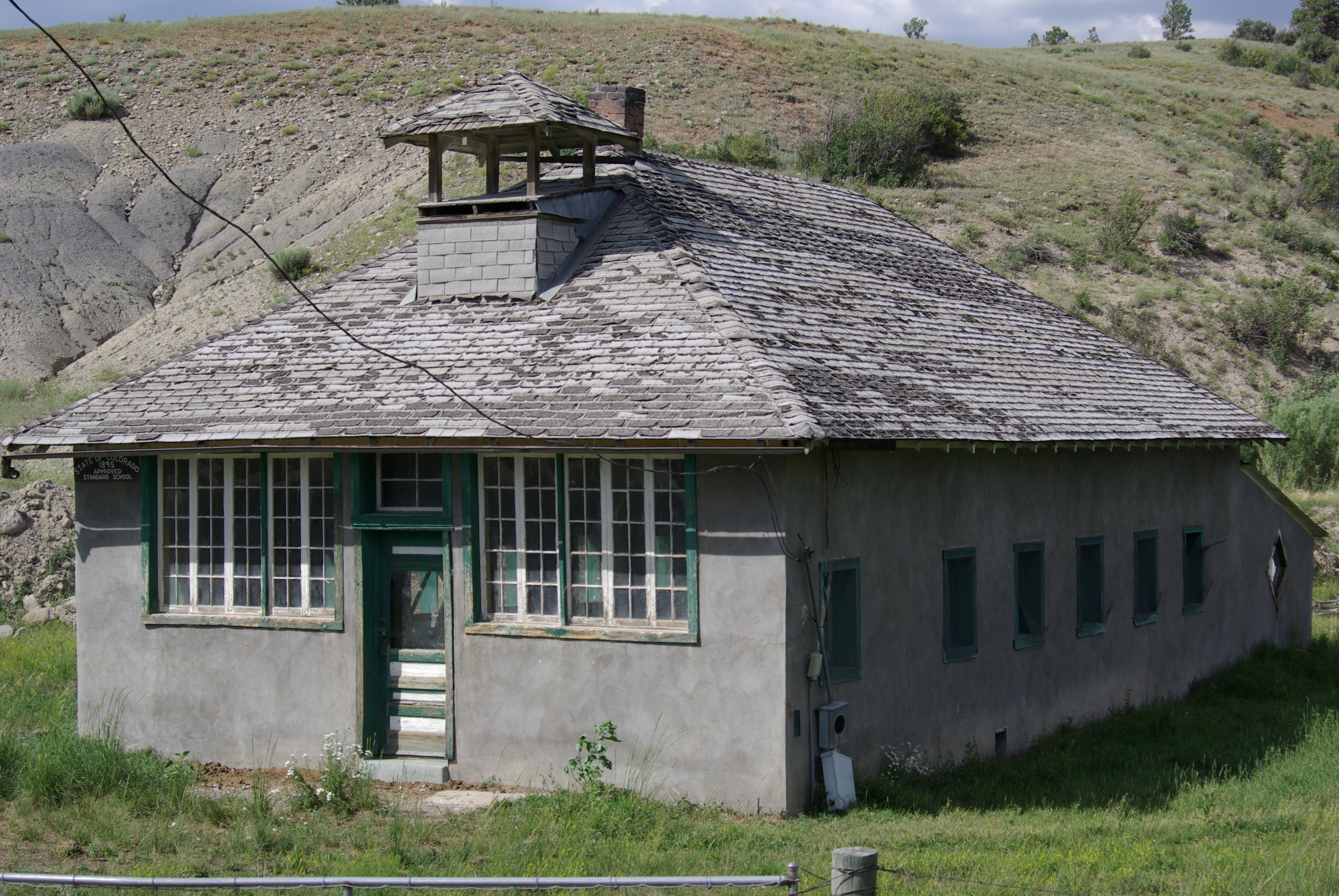
East of Durango, along U.S. Highway 160 84, a school building with a sign suggesting it was built in 1895. The map said it was Chromo, Colorado. Photos by Ed Darrell; use with attribution is encouraged.
Difficult to tell how many rooms; it could have had up to four classrooms at one point, I reckon. The belfry is still there, but the bell is long gone — a prize for some scavenger if it was not removed for re-use, or for a museum.
Bigger windows that many modern schools, windows students could use to actually look outdoors. Modern school architects seem to want students to be unaffected by the outdoors, or light from outdoors, often.
Off in a field by itself, there was plenty of room for kids to run around, at recess.
In this photo the sign is legible: “State of Colorado 1895 Approved Standard School.”
Was this a standard design, or does “standard school” refer to the program of instruction offered?
There were a few homes and farms close by. The community has always been small. How many students learned to read, learned how to handle numbers, read the greats of American history and literature in these walls? Who were they, and where did they go?
How big a mark can a school, or a teacher, actually make?
Chromo School resides on the Colorado Registry of Historic Places, in Archuleta County; “Chromo School, US Hwy. 84, State Register 6/12/1996, 5AA.1907; The 1922 Chromo School served the area’s children from 1922 to 1954, and it continues to function as a community center. The concrete structure is a well preserved example of a rural school complex that also includes a teacherage and privy. Its design is reminiscent of local Hispanic architecture.” Teacherage?
— Bulletin of the Atomic Scientists (@BulletinAtomic) August 9, 2014
From The Bulletin of Atomic Scientists:
At the end of the day, it can be worthwhile on the Hiroshima and Nagasaki anniversaries to think about the personal and the emotional—while keeping such clinical data in mind and ready to hand when it is necessary to debate proponents of ideas such as “battlefield nuclear weapons,” “limited nuclear war,” and the use of select nuclear strikes as a form of “de-escalation.”
Therefore, perhaps the most compelling of the stories in the Bulletin archive is a first-person recollection, Hiroshima Memories, by Hideko Tamura Friedman, who was just a young girl back on August 6, 1945. After moving to the United States and becoming a therapist in private practice and a part-time social worker in the Radiation Oncology Department at the University of Chicago Hospitals, Hideko excerpted this 1995 article from a longer, unpublished manuscript she was working on.
Hideko describes how she was reading a book when “a huge band of white light fell from the sky down to the trees.” She jumped up and hid behind a large pillar as an explosion shook the earth and pieces of the roof fell about her.
Hideko survived; some members of her family did not. “My father,” she wrote in in a heart-rending statement of fact, “brought Mama’s ashes home in his army handkerchief.”
Much has changed since I wrote most of the post, below, in 2009. The number of years, perhaps (and I’ve changed them in the text). Not enough else.
The Obama Administration made some progress in getting Iran to the table to talk non-proliferation of nuclear weapons. START was renewed. But not much more.
We’re left with the hope that this was the last time atomic weapons are used.
Stars and Stripes posted this short video of the ceremonies held in 2011 in Peace Park in Nagasaki
A memorial service was held at the Nagasaki Peace Park on Aug. 9, 2011, the 66th anniversary of the atomic bomb being dropped on the city at the tail end of World War II. The ceremony was attended by dignitaries from 44 countries – including an envoy from the United States – to honor the more than 155,000 people who were claimed by the bomb, including the 80,000 killed instantly.
The service came three days after one similar in Hiroshima, and marked the first time in history that an envoy from the United States attended both services.
In the wake of the March 11 disaster, Japanese officials called for the abolition of nuclear weapons and also for renewable sources of energy to replace nuclear power.
Nuclear anniversaries have been ignored again this year, it seems to me.
Ceremony in Nagasaki marked the remembrance of the victims of the second atomic weapon used in war, which was detonated over Nagasaki on August 9, 1945. Agence France Press reported (in 2009):
Nagasaki’s mayor, marking the 64th anniversary [66th in 2011] of his city’s atomic bombing by the United States, called on Sunday on the leaders of nuclear-armed powers to visit the site and build a nuclear-free world.
Hiroshima and Nagasaki, map by CNN
Tomihisa Tanoue urged world leaders from both declared nuclear powers and others such as Iran, Israel and North Korea to visit the city in southwestern Japan.
“I am sure anyone who visits here would feel the sorrow of the victims and be shaken by it,” the mayor said in an address at an annual ceremony commemorating the 1945 bombing.
A minute of silence was observed at 11:02 am (0202 GMT), when the US bomb exploded above the city, killing roughly 74,000 people. The bombing followed one a week before in Hiroshima and hastened Japan’s surrender in World War II.
Tanoue said an April speech by US President Barack Obama in Prague, where Obama pledged to build a world with no nuclear weapons, “impressed” the residents of Nagasaki.
“The Japanese government must support the Prague speech. As a nation that has come under nuclear attack, Japan must lead the international community” in abolishing the weapons, he said.
Similar appeals were made Thursday when Hiroshima marked the anniversary of its bombing, which killed 140,000 people.
At the Nagasaki ceremony, Prime Minister Taro Aso reiterated the Japanese government’s anti-nuclear stance, three weeks ahead of national elections that he is tipped to lose.
Aso raised eyebrows at the Hiroshima ceremony, when he pledged to work toward abolishing nuclear weapons but later told reporters that he thought it was “unimaginable” to attain a nuclear-free world.
Similar ceremonies, and similar pleas for nuclear non-proliferation marked the August 6 anniversary of the atomic bomb drop on Hiroshima. The Chinese news agency Xinhua reported:
Some 50,000 people gathered Thursday at the peace park in Hiroshima to mourn the 64th anniversary of the atomic bombing of the city by U.S. forces during the World War II.
Hiroshima Mayor Tadatoshi Akiba delivered a peace declaration, calling for the abolition of nuclear weapons by 2020.
“The hibakusha still suffer a hell that continues,” said Akiba.
“The Japanese government should support hibakusha, including those who were victims of black rain and those who live overseas,” he said.
“Japanese Prime Minister Taro Aso delivers a speech in front of the Memorial Cenotaph during the Hiroshima Peace Memorial Ceremony in Hiroshima, western Japan on Aug. 6, 2009. Hiroshima on Thursday mourned the 64th anniversary of the atomic bombing of the city by U.S. forces during the World War II. (Xinhua/Ren Zhenglai)”
It was reported Wednesday that the Japanese government aims to come to an agreement with all atomic bomb survivors who have sued the government for financial support to help them pay medical bills for illnesses related to the bombings of Hiroshima and Nagasaki.
Akiba also said “The year 2020 is important as we want to enter a world without nuclear weapons with as many hibakusha as possible. We call on the world to join forces with us to eliminate all nuclear weapons by 2020.”
Referring to the movements such as the environmentalists, Akibasaid, “Global democracy that respects the will of the world and respects the power of the people has begun to grow.”
“We have the power. We have the responsibility. We are the Obamajority. And we can abolish nuclear weapons. Yes we can,” said the mayor.
On Wednesday, Akiba urged the people around the world to join the city’s efforts to abolish nuclear weapons in response to U.S. President Barack Obama’ s appeal for a world free of nuclear weapons.
During the 50-minute memorial ceremony, a moment of silence was observed at 8:15 a.m., the time the atomic bomb detonated over Hiroshima 64 years ago, killing nearly 100,000 people in a blink.
This in a week when two burgeoning new nuclear powers, Iran and North Korea, continue to claim they will flout non-proliferation agreements for their own self defense. [Still true in 2014, alas.]
The question obtains on nuclear issues as well as genocides: When does “never again” start?
It’s up to you and me. What have you done to make “never again” with atomic weapons, start now?
Other related posts at Millard Fillmore’s Bathtub:
As a Utah Downwinder, I fight depressing ideas every August 6, and August 9.
The first atomic bomb used in war was dropped by my nation on August 6, 1945. The second, on August 9. Hiroshima, then Nagasaki, were the targets.
I know the arguments, both ways. I feel certain my Uncle Leo B. Stewart’s life was saved by the bombs — and the lives of probably two or three million more Americans, and five or ten million Japanese. And still I am troubled.
I’m troubled that there seems to be so little attention paid to the anniversary in the U.S. Year by year, it gets tougher to get news out of remembrance ceremonies in Japan. Here are some Twitter notes on the day. I may be back with more, later.
August 6 1945, 68 years ago today. The Enola Gay drops the bomb Little Boy, devastating Hiroshima. pic.twitter.com/5hG8uuCKmP
— Tule Lake National Monument (@tulelakenps) August 6, 2013
U.S. professor connects global nuclear victims, raises awareness: HIROSHIMA–An American professor living… http://t.co/dVQgKms9N9#HIN
This comes from a pseudo-Truman, but it’s an accurate reflection of the angst Truman went through; once he made the decision, he did not have doubts that it was the right one.
>>> You break your heart & your head trying to figure out a way to save one life. #Hiroshima
— Harry S Truman, CEO of Twltter 🐀 (@PresHarryTruman) August 6, 2013
Fortunately, in 68 years since, no other nuclear device has ever been used in war. May we have a planet that never sees their use in war, again.
Or, until that account is unsuspended by the forces supporting Donald Trump: Follow @FillmoreWhite, the account of the Millard Fillmore White House Library
We've been soaking in the Bathtub for several months, long enough that some of the links we've used have gone to the Great Internet in the Sky.
If you find a dead link, please leave a comment to that post, and tell us what link has expired.
Thanks!
Retired teacher of law, economics, history, AP government, psychology and science. Former speechwriter, press guy and legislative aide in U.S. Senate. Former Department of Education. Former airline real estate, telecom towers, Big 6 (that old!) consultant. Lab and field research in air pollution control.
My blog, Millard Fillmore's Bathtub, is a continuing experiment to test how to use blogs to improve and speed up learning processes for students, perhaps by making some of the courses actually interesting. It is a blog for teachers, to see if we can use blogs. It is for people interested in social studies and social studies education, to see if we can learn to get it right. It's a blog for science fans, to promote good science and good science policy. It's a blog for people interested in good government and how to achieve it.
BS in Mass Communication, University of Utah
Graduate study in Rhetoric and Speech Communication, University of Arizona
JD from the National Law Center, George Washington University


 Posted by Ed Darrell









 Millard Fillmore's Bathtub
