Typewriters of the moment: Mitford and Carson, two environmental journalists

September 24, 2013

The great editorial cartoonist Bill Mauldin of the Chicago Sun-Times illustrates the gender dimension of the controversy over Carson and Silent Spring. In this 27 October 1963 cartoon he pairs her with Jessica Mitford, author of The American Way of Death, a scathing indictment of the funeral home industry. Men from both industries have been flattened under the platens of the women’s typewriters.  All rights reserved © 1963 by Bill Mauldin. Courtesy of Bill Mauldin Estate LLC

The great editorial cartoonist Bill Mauldin of the Chicago Sun-Times illustrates the gender dimension of the controversy over Carson and Silent Spring. In this 27 October 1963 cartoon he pairs her with Jessica Mitford, author of The American Way of Death, a scathing indictment of the funeral home industry. Men from both industries have been flattened under the platens of the women’s typewriters. All rights reserved © 1963 by Bill Mauldin. Courtesy of Bill Mauldin Estate LLC

Captured from Mark Stoll’s “Rachel Carson’s Silent Spring, a book that changed the world,” at the Environment and Society Portal.

A well-fitting image in the few days before the Society of Environmental Journalists (SEJ) opens its 2013 convention in Chattanooga, Tennessee (October 2-4).  It was the power of the typewriter in 1963; the power of the word processor in 2013, more likely.  In either case, it’s the hard work of environmental journalists, who are out to make the world a better place by showing us what it is, what shape it’s in, and how we might conserve it.

More:


Banned Books Week is coming, September 22-28, 2013

September 18, 2013

Got a stack of banned books ready?

Banned Books Week is September 22-28 for 2013.

Banner for Banned Books Week 2013

So THAT’s what Lady Liberty holds in her left hand. (Reading the Declaration of Indpendence can still get you into trouble in a few places — mostly not in the U.S., but even in the U.S.)

We still have banned books?  Is that bad?

Consider, first, that on September 17, 2013, the Texas State Board of Education opened hearings on science textbooks to be “adopted” for Texas schoolsRadical elements of the SBOE furiously organized to stack rating panels with people who want to censor science, to stop the teaching of Darwin’s work on evolution.  (No, I’m not kidding.)

This comes in the middle of a rancorous fight in Texas over CSCOPE, a cooperative lesson-plan exchange set up by 800 Texas school districts to help teachers meet new Texas education standards adopted years ago (without new books!).  Critics labeled reading lists and any reading on religions other than Christianity “socialist” or “Marxist,” and complained that Texas social studies books do not slander Islam.

Then there is the flap over Persepolis, in Chicago.  With all the other trouble Chicago’s schools have several bluenoses worked to get this graphic “novel” banned (it’s not really a novel; it’s a memoir).  They complained about graphic violence in what is a comic book.  Persepolis tells the story of a young woman growing up in Iran during the Iranian Revolution.

The autobiographical graphic memoir Persepolis by Marjane Satrapi was pulled from Chicago classrooms this past May by Chicago Public Schools CEO Barbara Byrd-Bennett due to “inappropriate” graphic language and images, specifically, scenes of torture and rebellion. Parents, teachers, and First Amendment advocates protested the ban, and as a result — while still pulled from 7th grade — Persepolis is currently under review for use in grades 8-10. (For details, see CBLDF Rises to Defense of Persepolis.)

Persepolis is an important classroom tool for a number of reasons. First, it is a primary source detailing life in Iran during the Revolution and the Iran-Iraq War . Readers of all ages get a glimpse of what life is like under repressive regimes and relive this period in history from a different perspective. It also begs detailed discussion of the separation of church and state. Furthermore, this is a poignant coming-of-age story that all teens will be able to relate to and serves as a testament to the power of family, education, and sacrifice.

In America, textbooks get attacked for telling the truth about Islam and not claiming it is a violence-based faith; and supplemental reading gets attacked when it presents the violence the critics complain was left out of the texts.

We need to think this through.

What banned books have you read lately?

More:

Cover of "Persepolis"

Persepolis has been made into a movie.


Yes, DDT is deadly to humans, as suicides demonstrate

September 16, 2013

One of the anti-environmental, anti-green false myths kicking around is that DDT is not harmful to humans, and therefore it probably shouldn’t have been banned, “and Rachel Carson was wrong.”

This poster from the U.S. Fish and Wildlife Service illustrates bioaccumulation, theprocess by which larger animals can be killed by acute DDT poisoning.

This poster from the U.S. Fish and Wildlife Service illustrates bioaccumulation, the process by which larger animals can be killed by acute DDT poisoning.

Reality is that DDT is a poison, but acute poisoning of large animals tends to take a lot.  Insectivorous animals or their predators can get those fatal amounts, but humans generally don’t.  DDT as a toxin kills mammals and birds and amphibians and reptiles and fish with equal alacrity, slowed only by the size of the organism and whether the organism’s diet consists of other things that consume and accumulate DDT.

Often that misperception is coupled with a claim that DDT does not cause cancer, and so should have its ban lifted.

But, the facts:

  • DDT is a neurotoxin; in accumulates in fat, and if enough of it courses through the blood of an animal at a given point, it kills off parts of the neurosystem including the brain.
  • DDT kills mammals (humans are mammals); in fact the U.S. Army argued to keep DDT on the market to use against bats that infested barracks in training camps (bats are mammals, too).  Death depends on the dose, which depends on body size.  Takes a fair amount to kill off a large mammal, quickly.  DDT is implicated in the near extinction of different species of migratory free-tail bats in the Southwest.
  • DDT is carcinogenic.  Fortunately for humans, it’s a weak carcinogen for most cancers, though research points to a troubling link to some cancers (breast, reproductive organs) that appear very late relative to exposure, especially if exposure to DDT occurs in utero, or in infancy.
  • DDT was not banned as a hazard to human health; it was banned as a hazard to wildlife.  DDT in almost all concentrations becomes an indiscriminate killer of wildlife when used outdoors.
  • DDT can kill humans with acute poisoning.

That last point isn’t easy to document in the U.S.  During the go-go DDT years there was one case of a young girl who drank from a prepared DDT solution, and died a short time later.  The incident was a tragedy, but not unique for the 1950s and 1960s.  It was written off to lax safety standards, and because it occurred long before the origin of on-line databases, essentially it has fallen out of history.  Just try to find a reference to the death today.

Partly, this lack of information on human toxicity is due to the fact that DDT use was slowing dramatically by the late 1960s (it was becoming ineffective), and after the ban in 1972, there were few cases in the U.S. where humans were exposed to the stuff, except in emissions from DDT manufacturing plants.  EPA’s order banning DDT in the U.S. applied only to agricultural use, and the chief agricultural use remaining was on cotton.  Manufacturing was not banned, however, which meant U.S. DDT makers could continue to pump the stuff out and sell it overseas, in Africa, and Asia.  This continued right up to that day in 1984 that U.S. companies became subject to damage for the poisons they make under the Superfund law — almost every DDT maker declared bankruptcy to escape liability in the weeks before the Superfund became effective, saddling taxpayers with a few dozen Superfund sites to be cleaned up on the taxpayer’s dime.

DDT has never been banned in Africa or Asia, however.  And there we find a badly-documented history of people poisoning themselves with DDT, usually in suicides.

Whatever other pathologies these cases may exhibit, they reveal that DDT does, indeed, kill humans.

Like this recent case, from Ghana; yes, that’s the illustration used in the newspaper; from the Ghana Broadcasting Corporation:

Sep 11, 2013 at 11:52am
Man commits suicide over wife’s confession

Benjamin Kwaku Owusu, a 40-year-old former Manager of Unity Oil Filling Station in Suhum, has committed suicide by drinking DDT Gamullio 20 insecticide.

A family spokesperson who spoke to the Ghana News Agency on condition of anonymity said Owusu and his wife lived at Suhum and had been married for five years but never had a child.

He said the situation often developed into misunderstanding between them but later the wife got pregnant and left for her home town.

According to the spokesperson, whiles Owusu was preparing for the wife to deliver, he had a shocking message from the wife that the pregnancy belonged to another man and not him.

He said Owusu, who had a shock, rushed into his room and drunk the DDT Insecticide and fell unconscious.

“Owusu was rushed to the hospital but died soon after he was admitted,” he said.

When the police at Suhum was contacted, they confirmed the story and said the body of the deceased had since been buried after post mortem examination at the Suhum Government Hospital.

GNA

Not sure what “Gamullio 20” means, but it seems to be the brand name of the poison used.

More:


Mexican Independence Day celebrated: Grito de Dolores!

September 16, 2013

It’s almost painful how much residents of the U.S. don’t know about our neighbor to the south, Mexico.

No, Cinco de Mayo is not Mexican Independence Day.

That would be September 16.

Dolores Hidalgo Church at night.

Dolores Hidalgo Church at night. Wikipedia image

But just to confuse things more, Mexico did not get independence on September 16.

September 16 is the usual date given for the most famous speech in Mexico’s history — a speech for which no transcript survives, and so, a speech which no one can really describe accurately.  A Catholic priest who was involved in schemes to create an armed revolution to throw out Spanish rule (then under Napoleon), thought his plot had been discovered, and moved up the call for the peasants to revolt.  At midnight, September 15, 1810, Father Miguel Hidalgo y Costilla declaimed the need for Mexicans to rise in revolution, from his church in the town of Dolores, near Guanajuato.  The cry for freedom is known in Spanish as the Grito de Dolores.

Hidalgo himself was hunted down, captured and executed.  Mexico didn’t achieve independence from Spain for another 11 years, on September 28, 1821.

To commemorate, usually the President of Mexico repeats the speech at midnight, in Mexico City, or in Dolores.  If the President does not journey to Dolores, some other official gives the speech there.  Despite no one’s knowing what was said, there is a script from tradition used by the President:

Mexicans!
Long live the heroes that gave us the Fatherland!
Long live Hidalgo!
Long live Morelos!
Long live Josefa Ortiz de Dominguez!
Long live Allende!
Long live Galena and the Bravos!
Long live Aldama and Matamoros!
Long live National Independence!
Long Live Mexico! Long Live Mexico! Long Live Mexico!

Political history of Mexico is not easy to explain at all.

Hidalgo’s life was short after the speech, but the Spanish still feared the power of his ideas and names.  In his honor, a town in the Texas territory of Mexico was named after him, but to avoid provoking authorities, the name was turned into an anagram:  Goliad.

In one of those twists that can only occur in real history, and not in fiction, Goliad was the site of a Mexican slaughter of a surrendered Tejian army during the fight for Texas independence.  This slaughter so enraged Texans that when they got the drop on Mexican President and Gen. Santa Ana’s army a few days later at San Jacinto, they offered little quarter to the Mexican soldiers, though Santa Ana’s life was spared.

Have a great Grito de Dolores Day, remembering North American history that we all ought to know.

Check out my earlier posts on the Grito, for a longer and more detailed explanation of events, and more sources for teachers and students.

Father Hidalgo:  Antonio Fabres, Miguel Hidalgo, oil on canvas, image taken from: Eduardo Baez, military painting in the nineteenth century Mexico, Mexico, National Defense Secretariat, 1992, p.23.  Wikipedia image

Father Hidalgo: Antonio Fabres, Miguel Hidalgo, oil on canvas, image taken from: Eduardo Baez, military painting in the nineteenth century Mexico, Mexico, National Defense Secretariat, 1992, p.23. Wikipedia image

More:


CBS’s short history of the flag at the Battle of Baltimore, Fort McHenry, and the new replica flag

September 16, 2013

Francis Scott Key beholding the still-flying Star-spangled Banner, after the Battle of Baltimore, 1814.  1912 painting by Edgar Percy Moran, Wikipedia image.

“By Dawn’s Early Light”: Francis Scott Key beholding the still-flying Star-spangled Banner, after the Battle of Baltimore, 1814. 1912 painting by Edgar Percy Moran, Wikipedia image.

Short videos often pack a heckuva punch for history classes.  Here’s one from today’s CBS “Sunday Morning,” with Charles Osgood reporting on the creation and flying at Fort McHenry of a replica of a flag that flew there 199 years ago on September 14 — the inspiration to Francis Scott Key for his poem, “The Star-spangled Banner.”

<iframe frameborder=”0″ width=”480″ height=”270″ src=”//www.dailymotion.com/embed/video/x15schq” allowfullscreen>
Star-Spangled Banner flies again at Fort McHenry by cbsnews

Star-Spangled Banner flies again at Fort McHenry by cbsnews

http://www.cbsnews.com/news/the-star-spangled-banner-yet-waves-anew/

Published on Sep 15, 2013

CBS News video: Star-Spangled Banner flies again at Fort McHenry – Applying the same techniques used nearly two hundred years ago, a team of quilters created an exact replica of the flag that flew over Baltimore Harbor during the War of 1812, the same flag that inspired Francis Scott Key to pen our national anthem. Charles Osgood reports.

This is history that most of my juniors didn’t know.  It’s not history we’re supposed to teach, but it’s history they are accountable for on Texas tests.  A short video like this one at a key spot can boost scores on the state tests — and, though I’ve not been victimized by them yet, the new end-of-course tests probably assume juniors know this stuff, too.

I hope CBS keeps this piece available for history teachers, especially through 2014 and the 200th anniversary of the battle, and Key’s writing of the poem.

[Text of CBS news story here, in case video stops working.]

More:

Fort McHenry today:

Aerial view of Fort McHenry, at the mouth of Baltimore Harbor, clearly show the star design that made it more defensible from ground attack. During the Battle of Baltimore, British troops were not able to land and get close to the fort.  Image from the office of the Governor of Maryland, via the National Park Service

Aerial view of Fort McHenry, at the mouth of Baltimore Harbor, clearly show the star design that made it more defensible from ground attack. During the Battle of Baltimore, British troops were not able to land and get close to the fort. Image from the office of the Governor of Maryland, via the National Park Service


Just stay quiet: Poster hoax about the Pledge of Allegiance

September 15, 2013

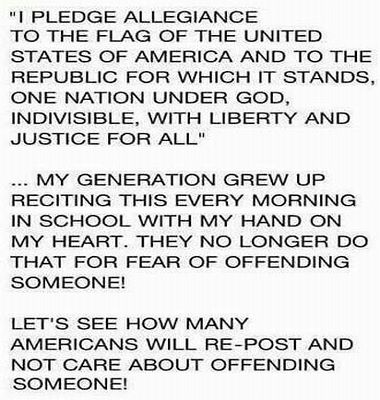
Anybody send this to you on Facebook (100 times, maybe?)

Hoax claims about the Pledge of Allegiance, found on Facebook and innumerable e-mails

Hoax claims about the Pledge of Allegiance, found on Facebook and innumerable e-mails

Clever, eh?  It repeats the McCarthy-era editing of the Pledge of Allegiance, and then comes up with this whopper:

. . . My generation grew up reciting this every morning in school, with my hand on my heart.  They no longer do that for fear of offending someone!

Let’s see how many Americans will re-post and not care about offending someone!

Not quite so long-lived as the Millard Fillmore Bathtub Hoax — which started in 1917 — but a lot more common these days.

Just as false.  Maybe more perniciously so.

Consider:

  1. Actually, 45 of our 50 states require the Pledge of Allegiance in public schools.  The five exceptions:  Iowa, Hawaii, Oklahoma, Vermont and Wyoming.  See any pattern there?
  2. None of the five states previously required the Pledge, and then stopped.
  3. None of the five states claim to not require the pledge in order to avoid offending anyone.  Oklahoma would be happy to offend people on such issues, most of the time.
  4. Reposting historically inaccurate claims, without fear of offending anyone, is no virtue.  It’s just silly.

The creator of that poster is probably well under the age of 50, and may have grown up with the hand-over-heart salute used after World War II.  That was not the original salute, and I’d imagine the author is wholly ignorant of the original and why it was changed.

Students pledging to the flag, 1899, 8th Division, Washington, D.C. Part of the Frances Benjamin Johnston 1890 - 1900 Washington, D.C., school survey.

Wikipedia image and caption: Students pledging to the flag, 1899, 8th Division, Washington, D.C. Part of the Frances Benjamin Johnston 1890 – 1900 Washington, D.C., school survey.

Wikipedia gives a concise history of the salute:

Swearing of the Pledge is accompanied by a salute. An early version of the salute, adopted in 1892, was known as the Bellamy salute. It started with the hand outstretched toward the flag, palm down, and ended with the palm up. Because of the similarity between the Bellamy salute and the Nazi salute, developed later, the United States Congress instituted the hand-over-the-heart gesture as the salute to be rendered by civilians during the Pledge of Allegiance and the national anthem in the United States, instead of the Bellamy salute. Removal of the Bellamy salute occurred on December 22, 1942, when Congress amended the Flag Code language first passed into law on June 22, 1942.

Students in an unnamed school in 1941, offering the Bellamy Salute for the Pledge of Allegiance.

Students in an unnamed school in 1941, offering the Bellamy Salute for the Pledge of Allegiance. Wikipedia image.

One might understand why the Bellamy Salute was changed, during war with Nazi Germany.

Arrogance and ignorance combine to form many different kinds of prejudices, all of them ugly.  The arrogant assumption that only “our generation” learned patriotism and that whatever goes on in schools today is not as good as it was “in our day,” regardless how many decades it’s been since the speaker was in a public school, compounds the ignorance of the fact that since 1980, forced patriotic exercises in schools have increased, not decreased.

Like much about our nation’s troubles, assumptions based on ignorance often are incorrect assumptions.  Consequently, they give rise to what is today clinically known as the Dunning Kruger Effect (or syndrome), so elegantly summed by by Bertrand Russell in the 1930s:

The trouble with the world is that the stupid are cocksure and the intelligent are full of doubt.

Humorously summed up by “Kin” Hubbard:

It isn’t what we don’t know that gives us trouble, it’s what we know that ain’t so.

Ignorance is a terrible disease, but one easily cured, by reading.  We can hope.

More:


Voyager I becomes Earth’s first interstellar object

September 14, 2013

Can you recall what you were doing on September 5, 1977?

The Voyager 1 aboard the Titan III/Centaur lif...

The Voyager 1 aboard the Titan III/Centaur lifted off on September 5, 1977, joining its sister spacecraft, the Voyager 2, on a mission to the outer planets. Wikipedia image, from NASA

That’s the day NASA launched Voyager I, on a trip to photograph planets in our solar system more close up than we can get with Earth-bound telescopes.  The Hubble Space Telescope was not even on the drawing board then.

After completing its mission, Voyager I continued on its path.  Scientists thought it would survive to leave the solar systems, and a few forward-looking thinkers hoped to learn more about just how far the influence of our Sun really extends.  At some point, Voyager I would leave space where the chief gravitational and wind influence is the Sun, and move into truly inter-stellar (“between the stars”) space, where gravity and particle emissions are dominated by other objects in our galaxy.

Last week NASA announced that time came in August of 2012, confirmed by data transmitted back to earth by Voyager’s primitive capabilities, over the last year.

Space.com explains it well:

Interesting to think of the investment in thought, money, effort and patience by scientists and policy-makers to wait more than 35 years for such a research result.

More:

Voyager I, artist's interpretation.  NASA image

Voyager I, artist’s interpretation. NASA image


Quote of the moment: Carl Sagan, on perspective on our own lives

September 14, 2013

You’ve heard the news by now: Voyager I has left the system.

What are we to think of that?

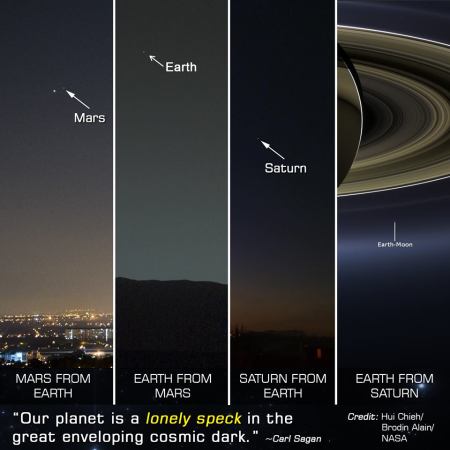
perspective-mars-earth-saturn

Earth, Moon, Mars, Jupiter – What you see depends on where you are, in reality as well as metaphorically. Images from NASA

” . . . astronomy is a humbling and character-building experience.”

Carl Sagan on how images of Earth from space change our perspective

Sagan’s words in the full passage impart a larger message, about caring for our planet and our neighbors on it.

From this distant vantage point, the Earth might not seem of any particular interest. But for us, it’s different. Consider again that dot. That’s here. That’s home. That’s us. On it everyone you love, everyone you know, everyone you ever heard of, every human being who ever was, lived out their lives. The aggregate of our joy and suffering, thousands of confident religions, ideologies, and economic doctrines, every hunter and forager, every hero and coward, every creator and destroyer of civilization, every king and peasant, every young couple in love, every mother and father, hopeful child, inventor and explorer, every teacher of morals, every corrupt politician, every “superstar,” every “supreme leader,” every saint and sinner in the history of our species lived there – on a mote of dust suspended in a sunbeam.

The Earth is a very small stage in a vast cosmic arena. Think of the rivers of blood spilled by all those generals and emperors so that in glory and triumph they could become the momentary masters of a fraction of a dot. Think of the endless cruelties visited by the inhabitants of one corner of this pixel on the scarcely distinguishable inhabitants of some other corner. How frequent their misunderstandings, how eager they are to kill one another, how fervent their hatreds. Our posturings, our imagined self-importance, the delusion that we have some privileged position in the universe, are challenged by this point of pale light. Our planet is a lonely speck in the great enveloping cosmic dark. In our obscurity – in all this vastness – there is no hint that help will come from elsewhere to save us from ourselves.

The Earth is the only world known, so far, to harbor life. There is nowhere else, at least in the near future, to which our species could migrate. Visit, yes. Settle, not yet. Like it or not, for the moment, the Earth is where we make our stand. It has been said that astronomy is a humbling and character-building experience. There is perhaps no better demonstration of the folly of human conceits than this distant image of our tiny world. To me, it underscores our responsibility to deal more kindly with one another and to preserve and cherish the pale blue dot, the only home we’ve ever known.

Carl SaganPale Blue Dot: A Vision of the Human Future in Space, 1997 reprint, pp. xv–xvi

In other words, we’re on our own.  What are we going to do about that?

Tip of the old scrub brush to Hashem Al-ghaili for making this image! https://www.facebook.com/ScienceNaturePage, and to All Science, All the Time.

It would be good to have better photo credits, including the genius who put together the montage.

More:

Voyager I photo of the Earth from outside Jupiter's orbit - the Pale Blue Dot photo

This is the photo that inspired Sagan’s reflection, as opposed to the photos in the poster mashup above. Via Wikipedia, with captions. ¶Seen from about 6 billion kilometers (3.7 billion miles), Earth appears as a tiny dot (the blueish-white speck approximately halfway down the brown band to the right) within the darkness of deep space. ¶This narrow-angle color image of the Earth, dubbed ‘Pale Blue Dot’, is a part of the first ever ‘portrait’ of the solar system taken by Voyager 1. The spacecraft acquired a total of 60 frames for a mosaic of the solar system from a distance of more than 4 billion miles from Earth and about 32 degrees above the ecliptic. From Voyager’s great distance Earth is a mere point of light, less than the size of a picture element even in the narrow-angle camera. Earth was a crescent only 0.12 pixel in size. Coincidentally, Earth lies right in the center of one of the scattered light rays resulting from taking the image so close to the sun. This blown-up image of the Earth was taken through three color filters – violet, blue and green – and recombined to produce the color image. The background features in the image are artifacts resulting from the magnification.

Save


A Misplaced Massacre: Struggling over the memory of Sand Creek – at SMU, September 19, 2013

September 12, 2013

Painting of the Sand Creek Massacre, Colorado Historical Society

Painting of the Sand Creek Massacre, Colorado Historical Society

Sometimes the e-mail I get brings wind of real history discussions, and this one sounds interesting even if the Texas State Board of Education is trying to run away from U.S. history on the issues of war on Native Americans.

Teachers, you can get an hour of CE credit, if you phone and let them know in advance.

And it’s free.

These sessions are good, and if you think you don’t know enough to ask good questions, you should understand that SMU faculty will be there to grill the author if you don’t.

A Misplaced Massacre:
Struggling over the Memory of Sand Creek
Ari Kelman, University of California-Davis

Thursday, September 19, 2013
6 pm reception followed by 6:30 lecture and book-signing
The DeGolyer Library
6404 Hilltop Lane at McFarlin Boulevard, on the campus of SMU

In this lecture, Kelman will examine the ways in which generations of Americans have struggled to come to terms with the meaning the Sand Creek Massacre and its aftermath, most publicly at the 2007 opening of the Sand Creek Massacre National Historic Site in Kiowa County, Colorado.

Books will be available for purchase and for signing.

Although this event is free and open to the public, seating is limited. Please register on the link below.  If you have questions or need special accommodations, please call 214-768-3684 or email swcenter@smu.edu

More:


September 12 — Anniversary of the 1962 day JFK challenged all of America to go to the Moon, “because it is hard”

September 12, 2013

President John F. Kennedy speaking to an audience in the football stadium at Rice University in Houston, September 12, 1962.  Kennedy made the public case for why the U.S. should try a Moon shot.  NASA photo.

President John F. Kennedy speaking to an audience in the football stadium at Rice University in Houston, September 12, 1962. Kennedy made the public case for why the U.S. should try a Moon shot. NASA photo.

Kennedy’s speech at Rice University, “We Choose to Go to the Moon,” was delivered in the football stadium (not nearly full), on September 12, 1962.

Obviously, that was back before global warming held such a tight death grip on Texas (it’s so bad here, even Rick Perry is trying to move north, out of the state).

Day in and day out, Kennedy’s speech, the text, the audio, and sources of commentary on it, are among the most popular of the nearly 5,000 posts at Millard Fillmore’s Bathtub. Go see why:

September 12, 1962, was also the ninth anniversary of JFK’s marriage to Jacqueline Bouvier.  She let him go out of town to talk rockets?

Anything for the nation, I suppose.

More:

Moonwalking astronaut salutes the U.S. flag on the Moon. Twelve people went to the Moon, all of them in the U.S. space program run by NASA.  (My photo source does not identify this astronaut.)

Moonwalking astronaut salutes the U.S. flag on the Moon. Twelve people went to the Moon, all of them in the U.S. space program run by NASA. (My photo source does not identify this astronaut.)


We remember

September 11, 2013

Stunning photo of a snowy owl, taken by Frank K. Schleicher (who holds the copyright), and shared by the Hawk Mountain Sanctuary Association.

Most stunning in the photograph:  Look behind the owl.

Photo of snowy owl, looking across New York Harbor, by Frank K. Schleicher

Photo of snowy owl, looking across New York Harbor, by Frank K. Schleicher


National Patriot Day 2013 — Fly your flag today, volunteer service

September 11, 2013

Flags at the Washington Monument fly at half staff honoring Sen. Arlen Specter of Pennsylvania, with the dome of the U.S. Capitol in the background.

Flags at the Washington Monument fly at half staff, with the dome of the U.S. Capitol in the background. Fly your flag at half-staff today, Patriot Day.

Federal law and presidential proclamation urge Americans to fly flags today at half-staff, in honor of patriots and those who died in the attacks on the U.S. on September 11, 2001.

President Barack Obama issued a declaration yesterday:

PATRIOT DAY AND NATIONAL DAY OF SERVICE AND REMEMBRANCE, 2013
– – – – – – –

BY THE PRESIDENT OF THE UNITED STATES OF AMERICA

A PROCLAMATION

Twelve years ago this month, nearly three thousand innocent men, women, and children lost their lives in attacks meant to terrorize our Nation. They had been going about their day, harming no one, when sudden violence struck. We will never undo the pain and injustice borne that terrible morning, nor will we ever forget those we lost.

On September 11, 2001, amid shattered glass, twisted steel, and clouds of dust, the spirit of America shone through. We remember the sacrifice of strangers and first responders who rushed into darkness to carry others from danger. We remember the unbreakable bonds of unity we felt in the long days that followed — how we held each other, how we came to our neighbors’ aid, how we prayed for one another. We recall how Americans of every station joined together to support the survivors in their hour of need and to heal our Nation in the years that followed.

Today, we can honor those we lost by building a Nation worthy of their memories. Let us also live up to the selfless example of the heroes who gave of themselves in the face of such great evil. As we mark the anniversary of September 11, I invite all Americans to observe a National Day of Service and Remembrance by uniting in the same extraordinary way we came together after the attacks. Like the Americans who chose compassion when confronted with cruelty, we can show our love for one another by devoting our time and talents to those in need. I encourage all Americans to visit www.Serve.gov, or www.Servir.gov for Spanish speakers, to find ways to get involved in their communities.

As we serve and remember, we reaffirm our ties to one another. On September 11, 2001, no matter where we came from, what God we prayed to, or what race or ethnicity we were, we were united as one American family. May the same be said of us today, and always.

By a joint resolution approved December 18, 2001 (Public Law 107-89), the Congress has designated September 11 of each year as “Patriot Day,” and by Public Law 111-13, approved April 21, 2009, the Congress has requested the observance of September 11 as an annually recognized “National Day of Service and Remembrance.”

NOW, THEREFORE, I, BARACK OBAMA, President of the United States of America, do hereby proclaim September 11, 2013, as Patriot Day and National Day of Service and Remembrance. I call upon all departments, agencies, and instrumentalities of the United States to display the flag of the United States at half-staff on Patriot Day and National Day of Service and Remembrance in honor of the individuals who lost their lives on September 11, 2001. I invite the Governors of the United States and the Commonwealth of Puerto Rico and interested organizations and individuals to join in this observance. I call upon the people of the United States to participate in community service in honor of those our Nation lost, to observe this day with appropriate ceremonies and activities, including remembrance services, and to observe a moment of silence beginning at 8:46 a.m. Eastern Daylight Time to honor the innocent victims who perished as a result of the terrorist attacks of September 11, 2001.

IN WITNESS WHEREOF, I have hereunto set my hand this tenth day of September, in the year of our Lord two thousand thirteen, and of the Independence of the United States of America the two hundred and thirty-eighth.

BARACK OBAMA

According to Cornell University’s Legal Information Institute, the law says:

TITLE 36 > Subtitle I > Part A > CHAPTER 1> § 144

§ 144. Patriot Day

How Current is This?

(a) Designation.— September 11 is Patriot Day.

(b) Proclamation.— The President is requested to issue each year a proclamation calling on—
(1) State and local governments and the people of the United States to observe Patriot Day with appropriate programs and activities;

(2) all departments, agencies, and instrumentalities of the United States and interested organizations and individuals to display the flag of the United States at halfstaff on Patriot Day in honor of the individuals who lost their lives as a result of the terrorist attacks against the United States that occurred on September 11, 2001; and

(3) the people of the United States to observe a moment of silence on Patriot Day in honor of the individuals who lost their lives as a result of the terrorist attacks against the United States that occurred on September 11, 2001.

Patriot Day formerly occurred earlier in the year; information on flag flying has not been added to the Flag Code portions of U.S. law, and consequently this news gets missed.

Fly your flag today, at half-staff if you can. Remember when flying a flag at half-staff, it is first raised to full staff, then slowly lowered to the half-staff position. When the flag is retired at the end of the day, it should again be crisply raised to the full-staff position before being lowered.

A flag attached to a pole that does not allow a half-staff position should be posted as usual.

A National Day of Service

September 11 is also designated as a national day of service, under the Edward M. Kennedy Serve America Act, Public Law 111-13 (April 21, 2009). The Corporation for National and Community Service is charged with encouraging appropriate service in honor of the day and in honor of those who died.

National Day of Service and Remembrance

Date(s): September 11, 2010

Location: National

Event URL: http://911day.org/

Description
On April 21, 2009, President Barack Obama signed legislation that for the first time officially established September 11 as a federally recognized National Day of Service and Remembrance.

By pledging to volunteer, perform good deeds, or engage in other forms of charitable service during the week of 9/11, you and your organization will help rekindle the remarkable spirit of unity, service and compassion shared by so many in the immediate aftermath of the attacks. And you’ll help create a fitting, enduring and historic legacy in the name of those lost and injured on 9/11, and in tribute to the 9/11 first responders, rescue and recovery workers, and volunteers, and our brave military personnel who continue to serve to this day.

Check in your own community to find opportunities for service projects.

Texas schools this year will make a mandatory one-minute observance of the events of September 11, 2001, under a new law, H. B. 1501.

More:

Boy Scouts and Girl Scouts raised the U.S. flag at Patriot Day ceremonies in 2012 at Willie Brown Elementary School, in Mansfield ISD, Mansfield, Texas.

Boy Scouts and Girl Scouts raised the U.S. flag at Patriot Day ceremonies in 2012 at Willie Brown Elementary School, in Mansfield ISD, Mansfield, Texas.


Still, it’s what we know — that ain’t so — that gets us into trouble

September 10, 2013

Yes, yes, it’s the Dunning Kruger Effect.

It’s being gullible to hoaxes.

Gullible’s travels, etc. (illustration 1)

Gullible’s travels, etc. (illustration 1) (Photo credit: UIC Digital Collections)

And it’s not really understanding politics, or economics, but assuming that we do, that gets us moving in the wrong direction.

Is it dangerous?  The entire Tea Party is misled by their own wrong assumptions.  Mistaken belief in what intelligence sources found in Iraq helped get us into the second longest war in U.S. history (and perhaps the costliest ever). Erroneous beliefs about the economy contributed to the great Crash of 2008.  False beliefs about the economy short-circuited our recovery, after Obama got action to prevent our bottoming out.

They’re still at it.

Today I had a guy tell me that Paul Krugman, the Nobel winning economist from Princeton and the New York Times, was wrong when he advocated creating a housing bubble, back in 2002.

Krugman did that?  Really?

Maybe in the land of Gullible’s Travels.

https://twitter.com/Obomination1/status/377500188710944768

Turns out the claim is based on a carefully edited-out-of-context quote from a 2002 column Krugman wrote.  It’s a hoax quote, as it appears, and as it appears to make Krugman call for a housing bubble — which he didn’t do.

This guy afraid to put his name to his claims, “Obomination1” hadn’t bothered to check the source.  Any journalist worth the newspaper ink on his hands would have had a clattering Hemingway Brand® Sh** Detector at that point. Krugman advocating a housing bubble?

Not tough to find that quote, and track it back to an opposite-editorial page piece Krugman wrote for the New York Times on August 2, 2002, “Dubya’s Double Dip?”  In it, the usual-critic of Greenspan, Krugman, worried about the failure of the economy to recover except by excessive consumer spending — which both had a finite amount of capability, Krugman argued, and did not mend the organic problems of production that caused the recession whose pain was eased by the NASDAQ bubble but not cured in any way.  Put Krugman’s quote from the photo poster into real context (I’ve highlighted the quoted part below):

A few months ago the vast majority of business economists mocked concerns about a ”double dip,” a second leg to the downturn. But there were a few dogged iconoclasts out there, most notably Stephen Roach at Morgan Stanley. As I’ve repeatedly said in this column, the arguments of the double-dippers made a lot of sense. And their story now looks more plausible than ever.

The basic point is that the recession of 2001 wasn’t a typical postwar slump, brought on when an inflation-fighting Fed raises interest rates and easily ended by a snapback in housing and consumer spending when the Fed brings rates back down again. This was a prewar-style recession, a morning after brought on by irrational exuberance. To fight this recession the Fed needs more than a snapback; it needs soaring household spending to offset moribund business investment. And to do that, as Paul McCulley of Pimco put it, Alan Greenspan needs to create a housing bubble to replace the Nasdaq bubble.

Judging by Mr. Greenspan’s remarkably cheerful recent testimony, he still thinks he can pull that off. But the Fed chairman’s crystal ball has been cloudy lately; remember how he urged Congress to cut taxes to head off the risk of excessive budget surpluses? And a sober look at recent data is not encouraging.

Krugman wasn’t calling for the creation of a housing bubble at all.  He was warning there were other problems that needed to be solved then.  They weren’t solved, the housing bubble collapsed and took down a great deal of the world’s financial markets with it.

So, was Krugman “a loser” as my correspondent claims?  Or is my correspondent looking the wrong way through the telescope, and being suckered by a hoaxed-context quote?

Krugman continued:

On the surface, the sharp drop in the economy’s growth, from 5 percent in the first quarter to 1 percent in the second, is disheartening. Under the surface, it’s quite a lot worse. Even in the first quarter, investment and consumer spending were sluggish; most of the growth came as businesses stopped running down their inventories. In the second quarter, inventories were the whole story: final demand actually fell. And lately straws in the wind that often give advance warning of changes in official statistics, like mall traffic, have been blowing the wrong way.

Despite the bad news, most commentators, like Mr. Greenspan, remain optimistic. Should you be reassured?

Bear in mind that business forecasters are under enormous pressure to be cheerleaders: ”I must confess to being amazed at the venom my double dip call still elicits,” Mr. Roach wrote yesterday at cbsmarketwatch.com. We should never forget that Wall Street basically represents the sell side.

Bear in mind also that government officials have a stake in accentuating the positive. The administration needs a recovery because, with deficits exploding, the only way it can justify that tax cut is by pretending that it was just what the economy needed. Mr. Greenspan needs one to avoid awkward questions about his own role in creating the stock market bubble.

But wishful thinking aside, I just don’t understand the grounds for optimism. Who, exactly, is about to start spending a lot more? At this point it’s a lot easier to tell a story about how the recovery will stall than about how it will speed up. And while I like movies with happy endings as much as the next guy, a movie isn’t realistic unless the story line makes sense.

Had only Greenspan, Bush, and a few million more people only listened to Krugman, then, we might have been spared two decades of lousy economy growth.

But they didn’t.  It wasn’t Krugman who was “the loser,” on this — though he certainly is pained by America’s failure to follow his advice.

Bertrand Russell warned us of the Obomination1/Thiessens and others.  So did Will Rogers, and Kin Hubbard, and Daniel Boorstin, as well as Drs. Dunning and Kruger.

Those who don’t listen to Russell, Rogers, Hubbard, Boorstin, the repentant Mencken, and Krugman, are the losers, and they drag the rest of us with them.

By the way, Krugman’s Nobel was awarded in 2008, after the great shock of the housing bubble’s bursting, but before all the predictions he had made were played out.  He was right.

Santayana’s Ghost dines with von Hayek’s Ghost tonight, and they both smile pityingly at those who ignore Krugman and claim to ridicule him while failing to even check out the accuracy of what they thought Krugman said.

More:


Millard Fillmore nominates the government of the Utah Territory

September 9, 2013

Interesting exercise, probably for an undergraduate college history student:  What became of these men during their service in the Utah Territory, and afterward?  What effect did they have on Utah’s history, and Utah on them?

In September 1850, Millard Fillmore sent the Senate, for confirmation, his nominations of officers to run the Utah Territory, three years after Brigham Young had led the first band of Latter-day Saints into the Salt Lake Valley to settle:

Letter from President Millard Fillmore to the U.S. Senate, nominating people (all men) to govern the Utah Territory, September 26, 1850 - U.S. National Archives image

Letter from President Millard Fillmore to the U.S. Senate, nominating people (all men) to govern the Utah Territory, September 26, 1850 – U.S. National Archives image

Page 2:

Page 2 of President Fillmore's letter to the U.S. Senate, nominating officers to govern the Utah Territory , in 1850.  National Archives image

Page 2 of President Fillmore’s letter to the U.S. Senate, nominating officers to govern the Utah Territory , in 1850. National Archives image

National Archives notes:  Executive Nominations for the First Session of the 31st Congress, 12/03/1849 – 09/30/1850

Production Dates: 09/26/1850

Notes in red ink indicate that confirmation dates for each of these nominees — all but one done two days later.  Fillmore’s nominee to be U.S. marshall in the territory wasn’t confirmed until the following February.

Amazing to think of the speed with which these confirmations occurred, compared to today’s U.S. Senate — and remembering that Congress was not particularly friendly to Fillmore.

An animated GIF of the as it evolved from 1850...

An animated GIF of the Utah Territory as it evolved from 1850 to 1896, when statehood was granted. (Territory boundaries not exact, especially in the west, where early proposals took in parts of California) Wikipedia image

Nominations were:

  • Brigham Young, of Utah, to be governor of the Utah territory
  • Broughton Davis Harris, of Vermont, to be Secretary of the territory
  • Joseph Buffington, of Pennsylvania, to be Chief Justice of the Supreme Court of the Utah Territory
  • Perry E. Brocchus, of Alabama, to be Associate Justice of the Supreme Court of the Utah Territory
  • Zerubabbel Snow, of Ohio, to be Associate Justice of the Supreme Court of the Utah Territory
  • Seth Blain, of Utah, to be U.S. Attorney
  • Joseph L. Haywood, of Utah, to be U.S. Marshall.

What other odd little delights are hidden away in the on-line holdings of the National Archives?  What sort of DBQ exercise can history teachers make out of this stuff?

More:

Brigham Young in 1851; photo from LDS archives

Brigham Young in 1851; photo from LDS archives


Imagequilts, with Edward Tufte and Adam Schwartz

September 5, 2013

These are pretty cool.

Can you use them in a classroom?  Some of these Imagequilts pack a lot of information into a small space — such as the one for Cézanne.

Here, “Subatomic Particles“:

Subatomic particles, by Tufte and Schultz; click image for a larger version

Subatomic particles, by Tufte and Schwartz; click image for a larger version

Paul Cézanne“:

Paul Cezanne, Imagequilt by Tufte and Schwartz

Paul Cezanne, Imagequilt by Tufte and Schwartz. Useful in art history? European history?

Super Advanced Placement (AP) history teacher John Irish created outstanding PowerPoints showing off art of European eras, or American eras, for use in introducing a unit of history (see a smattering of examples here).  Could these Imagequilts substitute, or do it as well, and — especially — faster?

Here’s another, “Pablo Picasso“:

Imagequilt, Pablo Picasso, by Tufte and Schwartz

Imagequilt, Pablo Picasso, by Tufte and Schwartz

This one could be particularly useful in a physics course, or a unit on the history of science.  Richard Feynman may be most famous, pedagogically at least, for his invention and use of Feynman Diagrams.  Most discussions simply mention the things, though a few attempt short explanations.  Rare is to find a good example of a Feynman Diagram, to see just what they are and how they work.  Tufte and Schwartz offer a bunch:

Feynman Diagrams, an Imagequilt from Tufte and Schwartz

Feynman Diagrams, an Imagequilt from Tufte and Schwartz

Imagequilts is a Chrome App, available for download so you can make your own.  Of course, you’ll need to use Google Chrome to get full effect.

Got any Imagequilts you’d like to share?

More: