Flag Day 2013 – Fly your flag today!

June 14, 2013

Of course, you’re already flying your Stars and Stripes, right?

I’ve been on the road, mostly without internet access; I’m tardy in my reminder.

June 14th marks the anniversary of the resolution passed by the Second Continental Congress in 1777, adopting the Stars and Stripes as the national flag.

Fly your flag today. This is one of the score of dates upon which Congress suggests we fly our flags.

Flag Day 1916, parade in Washington, D.C. - employees of National Geographic Society march - photo by Gilbert Grosvenor

Flag Day 1916, parade in Washington, D.C. – employees of National Geographic Society march – photo by Gilbert Grosvenor

The photo above drips with history. Here’s the description from the National Geographic Society site:

One hundred and fifty National Geographic Society employees march in the Preparedness Parade on Flag Day, June 14, in 1916. With WWI underway in Europe and increasing tensions along the Mexican border, President Woodrow Wilson marched alongside 60,000 participants in the parade, just one event of many around the country intended to rededicate the American people to the ideals of the nation.

Not only the anniversary of the day the flag was adopted by Congress, Flag Day is also the anniversary of President Dwight Eisenhower’s controversial addition of the words “under God” to the Pledge of Allegiance in 1954.

(Text adapted from “:Culture: Allegiance to the Pledge?” June 2006, National Geographic magazine)

The first presidential declaration of Flag Day was 1916, by President Woodrow Wilson. Wilson won re-election the following November with his pledge to keep America out of World War I, but by April of 1917 he would ask for a declaration of war after Germany resumed torpedoing of U.S. ships. The photo shows an America dedicated to peace but closer to war than anyone imagined. Because the suffragettes supported Wilson so strongly, he returned the favor, supporting an amendment to the Constitution to grant women a Constitutional right to vote. The amendment passed Congress with Wilson’s support and was ratified by the states.

The flags of 1916 should have carried 48 stars. New Mexico and Arizona were the 47th and 48th states, Arizona joining the union in 1913. No new states would be added until Alaska and Hawaii in 1959. That 46-year period marked the longest time the U.S. had gone without adding states, until today. No new states have been added since Hawaii, more than 49 years ago. (U.S. history students: Have ever heard of an essay, “Manifest destiny fulfilled?”)

150 employees of the National Geographic Society marched, and as the proud CEO of any organization, Society founder Gilbert H. Grosvenor wanted a photo of his organization’s contribution to the parade. Notice that Grosvenor himself is the photographer.

I wonder if Woodrow Wilson took any photos that day, and where they might be hidden.

History of Flag Day from a larger perspective, from the Library of Congress:

Since 1916, when President Woodrow Wilson issued a presidential proclamation establishing a national Flag Day on June 14, Americans have commemorated the adoption of the Stars and Stripes by celebrating June 14 as Flag Day. Prior to 1916, many localities and a few states had been celebrating the day for years. Congressional legislation designating that date as the national Flag Day was signed into law by President Harry Truman in 1949; the legislation also called upon the president to issue a flag day proclamation every year.

According to legend, in 1776, George Washington commissioned Philadelphia seamstress Betsy Ross to create a flag for the new nation. Scholars debate this legend, but agree that Mrs. Ross most likely knew Washington and sewed flags. To date, there have been twenty-seven official versions of the flag, but the arrangement of the stars varied according to the flag-makers’ preferences until 1912 when President Taft standardized the then-new flag’s forty-eight stars into six rows of eight. The forty-nine-star flag (1959-60), as well as the fifty-star flag, also have standardized star patterns. The current version of the flag dates to July 4, 1960, after Hawaii became the fiftieth state on August 21, 1959.

Fly your flag with pride today.

Elmhurst Flag Day 1939, DuPage County Centennial - Posters From the WPA

Elmhurst flag day, June 18, 1939, Du Page County centennial / Beauparlant.
Chicago, Ill.: WPA Federal Art Project, 1939.
By the People, For the People: Posters from the WPA, 1936-1943

This is an encore post, from June 14, 2009, and other previous Flag Days.

More, and Other Voices:


Do Nothing GOP Congress

June 13, 2013

Poorly-attended hearing of Congressional Joint Economic Committee hearing on jobs, 2013

“Do Nothing Congress?” How about “Missing in Inaction Congress?” Photo and caption from National Journal: When the Joint Economic Committee’s hearing on fixing the nation’s long-term unemployment problem kicked off on April 24, only one lawmaker was in attendance: Sen. Amy Klobuchar, the committee’s vice chair who was holding the hearing. (Niraj Chokshi)

National Journal’s article fairly damns Congress and especially the House for doing very little this year about jobs.

Probably more damning is this little fact:  In a period of time that historically might see 50 or 100 laws passed, Congress has passed into law only 13 measures.  The “Do Nothing” 80th Congress Truman campaigned against passed nearly 900 laws.  The current Congress is on track to pass 52.  Most important, probably, are the authorization and appropriations bills for the different departments of the federal government, much more important than the non-binding budget resolutions conservatives whine about.  Republicans have successfully blocked almost all authorization and appropriations action.  Appropriations bills, of course, must originate in the GOP-shackled House of Representatives.

In the six months and four days since the 113th Congress began, it has passed 13 laws. And, despite lawmakers constantly beating the drum on boosting jobs, none of the new measures have been focused on employment. Here’s a list of what the 113th Congress has passed in its first six months:

  1. H.R.41: To temporarily increase the borrowing authority of the Federal Emergency Management Agency for carrying out the National Flood Insurance Program.
    Sponsor: Rep Garrett, Scott [NJ-5] (introduced 1/3/2013) Cosponsors (44)
  2. H.R.152: Disaster Relief Appropriations Act, 2013
    Sponsor: Rep Rogers, Harold [KY-5] (introduced 1/4/2013) Cosponsors (None)
  3. H.R.325: No Budget, No Pay Act of 2013
    Sponsor: Rep Camp, Dave [MI-4] (introduced 1/21/2013) Cosponsors (1)
  4. S.47: Violence Against Women Reauthorization Act of 2013
    Sponsor: Sen Leahy, Patrick J. [VT] (introduced 1/22/2013) Cosponsors (61)
  5. H.R.307: Pandemic and All-Hazards Preparedness Reauthorization Act of 2013
    Sponsor: Rep Rogers, Mike J. [MI-8] (introduced 1/18/2013) Cosponsors (5)
  6. H.R.933: Consolidated and Further Continuing Appropriations Act, 2013
    Sponsor: Rep Rogers, Harold [KY-5] (introduced 3/4/2013) Cosponsors (None)
  7. S.716: A bill to modify the requirements under the STOCK Act regarding online access to certain financial disclosure statements and related forms.
    Sponsor: Sen Reid, Harry [NV] (introduced 4/11/2013) Cosponsors (None)
  8. H.R.1246: District of Columbia Chief Financial Officer Vacancy Act
    Sponsor: Rep Norton, Eleanor Holmes [DC] (introduced 3/19/2013) Cosponsors (None)
  9. H.R.1765: Reducing Flight Delays Act of 2013
    Sponsor: Rep Latham, Tom [IA-3] (introduced 4/26/2013) Cosponsors (None)
  10. H.R.1071: To specify the size of the precious-metal blanks that will be used in the production of the National Baseball Hall of Fame commemorative coins.
    Sponsor: Rep Hanna, Richard L. [NY-22] (introduced 3/12/2013) Cosponsors (2)
  11. H.R.360: To award posthumously a Congressional Gold Medal to Addie Mae Collins, Denise McNair, Carole Robertson, and Cynthia Wesley to commemorate the lives they lost 50 years ago in the bombing of the Sixteenth Street Baptist Church, where these 4 little Black girls’ ultimate sacrifice served as a catalyst for the Civil Rights Movement.
    Sponsor: Rep Sewell, Terri A. [AL-7] (introduced 1/23/2013) Cosponsors (301)
  12. H.R.258: Stolen Valor Act of 2013
    Sponsor: Rep Heck, Joseph J. [NV-3] (introduced 1/15/2013) Cosponsors (127)
  13. S.982: Freedom to Fish Act
    Sponsor: Sen Alexander, Lamar [TN] (introduced 5/16/2013) Cosponsors (3)

Freedom to Fish Act?  No doubt it is important to someone.  But even that someone, or those somebodies, would benefit from a jobs bill, more than from the Freedom to Fish Act.

When I worked for Lamar Alexander, I found him to be among the more fair and forward thinking of elected politicians.  It’s good to see he can still move a bill.

It’s tragic he’s been unable to push the GOP to move on more important matters.

The “Do-Nothing Congress” Harry Truman successfully indicted in 1948 looks like Wilma Rudolph streaking over the finish line in the 1960 Rome Olympics, by comparison.

I recall sitting up to get the news out to Utah, and anyone else interested in the nation, when Congress would pass 13 laws in a night.  At no point did it occur to me to think “these are the good old days of America,” then.

More:

taken by yours truly during 2007 hof induction...

Baseball Hall of Fame on Induction Weekend, 2007, crowded with people who now need jobs.  Congress passed a bill dealing with the Baseball Hall of Fame.  Ironic, no? All inductees in Cooperstown got there by doing something, doing it with hustle, and doing a lot, a sharp contrast to the 2013-2014 U.S. Congress.  Wikipedia image


War on Teachers and Education, Part 1: Prof. Ravitch’s emotion-touching call for a cease-fire on teachers

June 10, 2013

This is the first of five parts needed to document and lay the background for what unfortunately promises to be a pitched public relations battle, if not a serious battle to rescue a California school from being crushed by a corporation making a hostile takeover of a school using California’s “parent trigger” law.  Follow-ups may be needed.

Diane Ravitch in Dallas, April 28, 2010 - Copyright 2010 Ed Darrell (you may use freely, with attribution)

Diane Ravitch in Dallas, April 28, 2010 – Copyright 2010 Ed Darrell (you may use freely, with attribution)

If you’ve followed education issues, you know Dr. Diane Ravitch is a professor of education at Columbia, one of the most respected schools of education in the world.  Her work on education reform was popular with the Reagan administration in the period after the Report of the Commission on Excellence in Education in 1983, and particularly with education reformers at the time I was tapped to work at the Department of Education, in the old Office of Educational Research and Improvement.  Dr. Ravitch was appointed to head that arm of Education in the administration of George H. W. Bush, but after I had left government for the private sector.

More recently, Dr. Ravitch has looked hard to find evidence that the testing regimes imposed by the “No Child Left Behind” Act (NCLB) actually produce benefits to the education of students.

Finding no such evidence, Dr. Ravitch has called for an end to unproven methods of destruction of schools and school systems in pursuit of foggy, unattainable goals.

Recently, big-dollar guys have backed efforts to kick out teachers and trained educators from schools, and in particular with “parent-trigger” laws, which allow a group of parents to petition for the removal of professionals at a school, and for a group of parents to then take over the management of that school.

Oddly, the first places these laws have been applied is against teachers in schools where parental involvement has been historically abysmal.  A closer look shows that in these cases professional organizers, well-financed by businessmen who fancy themselves education reformers, did the load-carrying to get the petitions signed, and to get the educators ousted.

One of the schools where this process is moving is Weigand Avenue Elementary School in Watts, that troubled, poverty-ridden section of Los Angeles more famous for riots and gangs than educational attainment.

Dr. Ravitch wrote on her blog on May 25:

Parent Revolution Force Out Excellent Principal

The billionaire-funded Parent Revolution flexed its muscle and got enough parent signatures to force the resignation of a highly effective principal.

Please read the story.

This is the principal who was ousted by Parent Revolution:

“Third-grade teacher Kate Lewis said Irma Cobian is the best principal she’s had in nine years at Weigand Avenue Elementary School in Watts.

“Joseph Shamel called Cobian a “godsend” who has used her mastery of special education to show him how to craft effective learning plans for his students.

“Los Angeles Unified Supt. John Deasy praised a plan developed by Cobian and her team to turn around the struggling campus — where most students test below grade level in reading and math — calling it a “well-organized program for accelerated student achievement.” He thanked Cobian for her commitment and hard work.”

21 of the school’s 22 teachers have requested transfers because of Cobian’s ouster.

Parent Revolution is a malevolent organization funded by Walton, Gates, and Broad.

There is a special place in hell reserved for everyone who administers and funds this revolting organization that destroys schools and fine educators like Irma Cobian.

Dr. Ravitch has a good sense of justice, and injustice in my opinion.  This situation got her thinking, and she had more comments later.

Wondering About Ben Austin

Earlier today, I posted an article that appeared in the Los Angeles Times about Parent Revolution forcing the ouster of an excellent principal, Irma Cobian.

I keep thinking about it. I think about the way her staff admired and respected her, how 21 of 22 teachers requested a transfer when she was targeted by the phony Parent Revolution.

Ben Austin is loathsome. He ruined the life and career of a dedicated educator. She was devoted to the children, he is devoted to the equally culpable foundations that fund his Frankenstein organization–Walton, Gates, and Broad. His biggest funder is the reactionary Walton Family Foundation [line added here], which spends $160 million every year to advance privatization.

Ben Austin is Walton’s useful idiot. He prattles on about his liberal credentials, but actions speak louder than words.

Here is my lifelong wish for him.

Ben, every day when you wake up, you should think of Irma Cobian. When you look in the mirror, think Irma Cobian. Your last thought every night should be Irma Cobian.

Ben, you ruined the life of a good person for filthy lucre. Never forget her. She should be on your conscience–if you have one–forever.

W. Edwards Deming

W. Edwards Deming,Wikipedia image. Oddly, few, if any, education reform efforts work to incorporate any of Deming’s rules for running high-efficiency, highly-productive, championship-quality organizations; its as if there is a different agenda being pursued.

Ravitch makes a good point.  Organizational turnarounds rarely work when they start with mass firings.  It didn’t work in the French Revolution, it didn’t work in Russian in 1917.  Management experts like W. Edwards Deming, the most famous of the tough-reorganization management consultants in the drive for high quality organizations, bluntly warn that such efforts generally are destructive — the people fired are not the problem, nor do they have the authority to fix the problems, most often.  People on the front line know the problems better than anyone else, and can provide the leadership to turn organizations around, however — and for those reasons, you don’t get rid of them, if your goal is to effect an organizational turnaround.

Mr. Austin should have a framed photo of Mrs. Cobian on his desk so he must see her, every day.

Mr. Austin disagrees.

See part 2.

This series, on the dustup between Prof. Diane Ravitch and Ben Austin in California:

More, different views, and resources:


Typewriter of the moment: Alice Denham, circa 1956

June 8, 2013

One needs a typewriter to type out a story; but one needs a story to tell, first.

Alice Denham and her typewriter, 1956

Alice Denham, Playboy magazine’s Playmate of the Month in July 1956; photo undated, but probably about the same time; from 20th Century Man

I haven’t been able to identify the typewriter.  A short story she wrote appeared in the same issue of Playboy as her playmate layout.

Denham led an adventurous life in the New York literary scene, as an aspiring writer, and as a woman who liked sex.  Was she working on her book in this photo?  It was eventually published in 1967, My Darling from the Lions.

In 2006 she got attention for another book, a tell-much memoir of her life and romances and flings along the way, Sleeping With Bad Boys – A Juicy Tell-All of Literary New York in the Fifties and Sixties, good enough, or historically interesting enough, to get a review in the New York Times.

If typewriters could talk, you know?

More:


Mike Rowe: The value of Scouting, even for kids who don’t make Eagle

June 7, 2013

Distinguished Eagle Scout Award

Distinguished Eagle Scout Award Wikipedia image

Boy Scouts of America (BSA)  invited Mike Rowe to the 2012 Annual National Meeting.  They asked him to speak, but surprised him with a Distinguished Eagle Scout award.

Listen to his praise for the value of Scouting, for and from Scouts who don’t make Eagle (it’s at least ten minutes in, but this is entertaining).  Rowe has two brothers, neither of whom earned Eagle; his story involves the exploits of his younger brother, who was a Scout, and achieved the rank of Star.

It really is a Star Scout story.

More:

Ray Suarez receiving his Distinguished Eagle S...

PBS News Hour’s Ray Suarez receiving his Distinguished Eagle Scout Award. You find Eagles all over the place. Wikipedia image


Quote of the moment: Eisenhower’s astonishing D-Day leadership example, “Blame . . . is mine alone”

June 6, 2013

Eisenhower's unused statement on the failure of D-Day

Eisenhower’s contingency statement, in case D-Day failed – image from the National Archives

This quote actually isn’t a quote. It was never said by the man who wrote it down to say it. It carries a powerful lesson because of what it is.

In preparing for the D-Day invasion, Supreme Allied Commander Dwight Eisenhower carefully contemplated what would happen if the invasion failed.  What if the Germans repulsed the Allies, and no foothold was established to re-take the main body of Europe from the Germans?

Ike’s answer is a model of leadership:  He would take the blame.  Regardless what happened, Ike took full responsibility for the failure, giving credit to the soldiers who would have sacrificed in vain, perhaps their lives.

The Bathtub recently posted Gen. Dwight Eisenhower’s “order of the day” to the troops about to conduct the Allied invasion of Normandy — D-Day — to establish the toehold in Europe the Allies needed to march to Berlin, and to end World War II in Europe. As a charge to the troops, it was okay — Eisenhower-style words, not Churchill-style, but effective enough. One measure of its effectiveness was the success of the invasion, which established the toe-hold from which the assaults on the Third Reich were made.

eisenhower-with-paratrooper-eve-of-d-day.jpg

Photo shows Eisenhower meeting with troops of the 101st Airborne Division, 502nd Parachute Infantry Regiment, on the eve of the invasion. It was these men whose courage he lauded.

When Eisenhower wrote his words of encouragement to the troops, and especially after he visited with some of the troops, he worried about the success of the operation. It was a great gamble. Many of the things the Allies needed to go right — like weather — had gone wrong. Victory was not assured. Defeat strode the beaches of Normandy waiting to drive the Allies back into the water, to die.

Eisenhower wrote a second statement, a shorter one. This one was directed to the world. It assumed the assault had failed. In a few short sentences, Eisenhower commended the courage and commitment of the troops who, he wrote, had done all they could. The invasion was a chance, a good chance based on the best intelligence the Allies had, Eisenhower wrote. But it had failed.

The failure, Eisenhower wrote, was not the fault of the troops, but was entirely Eisenhower’s.

He didn’t blame the weather, though he could have. He didn’t blame fatigue of the troops, though they were tired, some simply from drilling, many from war. He didn’t blame the superior field position of the Germans, though the Germans clearly had the upper hand. He didn’t blame the almost-bizarre attempts to use technology that look almost clownish in retrospect — the gliders that carried troops behind the lines, sometimes too far, sometimes killing the pilots when the gliders’ cargo shifted on landing;  the flotation devices that were supposed to float tanks to the beaches to provide cover for the troops (but which failed, drowning the tank crews and leaving the foot soldiers on their own); the bombing of the forts and pillboxes on the beaches, which failed because the bombers could not see their targets through the clouds.

There may have been a plan B, but in the event of failure, Eisenhower was prepared to establish who was accountable, whose head should roll if anyone’s should.

Eisenhower took full responsibility.

Our landings in the Cherbourg-Havre area have failed to gain a satisfactory foothold and I have withdrawn the troops. My decision to attack at this time and place was based upon the best information available. The troop, the air [force] and the navy did all that bravery and devotion to duty could do. If any blame or fault attaches to the attempt, it is mine alone.

Who in the U.S. command would write such a thing today?  Who else in history would have written such a thing?  Is there any indication that Julius Caesar, Alexander the Great, Attila the Hun, Genghis Khan, or any other commander of a great army in  a world-turning invasion, considered how to save and perhaps salve the reputation of his troops, though they had failed?

Leadership is more than just positive thinking.

  • The message may also be viewed here. Yes, it’s incorrectly dated July 5 — should have been June 5.  In history, little is perfect.  We can excuse his slip of the pen, considering what he had on his mind.

This is much of an encore post.

More:

General Eisenhower speaks with members of the ...

Another  angle of the meeting with the troops:  General Eisenhower speaks with members of the 101st Airborne Division on the evening of 5 June 1944.  Wikipedia image


Typewriter of the moment: Stanley Kubrick’s

June 6, 2013

Stanley Kubrick's typewriter on Instagram, from sophireaptress.

Stanley Kubrick’s typewriter used in “The Shining” on Instagram, from sophireaptress.

It’s an Adler, but Instagram isn’t built for details, you know?

The typewriter is probably on display at the Los Angeles County Museum of Art’s Kubrick Exhibit, which closes June 30, 2013 (hurry!).

More:

Save

Save


Fly your flag today? Remembering D-Day, 1944 – 69 years ago

June 6, 2013

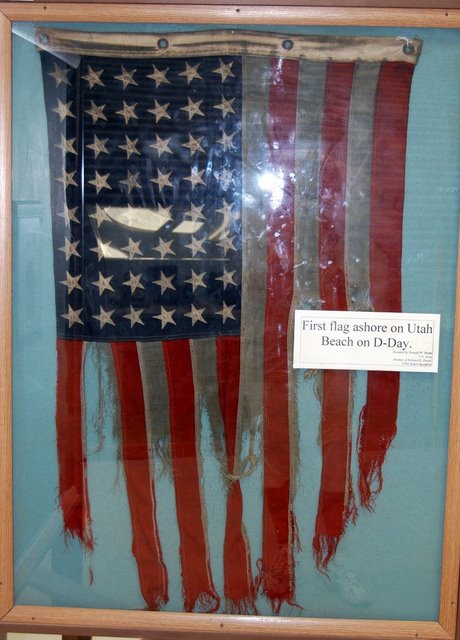
First Flag on Utah Beach, June 6, 1944

First Flag on Utah Beach, June 6, 1944 – Photo by Mark Wainwright

Today is the 69th anniversary of the Invasion of Normandy in World War II, a date generally called D-Day.  I usually get at least one e-mail request:  No, you don’t have to fly your flag.  This is not one of the days designated by Congress for flag-flying.

But you may fly your flag, and probably, you should.  If there are any D-Day veterans in your town, they’ll appreciate it.

This is mostly an encore post.


Why it’s important to have accurate history and science on the internet: Don’t lie to kids about DDT

June 6, 2013

Great accomplishment by this kid from Hudson, Massachusetts — but troubling, too.  He’s winning a persuasive speech competition, persuading people against history, law and science, calling for a return of DDT.

Andrew Brandt of Hudson MA, persuasive speaking champion

Andrew Brandt of Hudson holds his winning certificate at the regional speech and debate tournament in New Hampshire in April. He was one of seven to advance to the national competition. (Photo/submitted)

Hudson – Andrew Barndt, 13, from Hudson will be traveling to Tulsa, Okla., in June to join more than 500 students competing in a National Speech and Debate Tournament.

Andrew has qualified to compete in the Persuasive Speech category with the National Christian Forensics and Communications Association (NCFCA). Home-schooled students aged 12 to 18 compete at local and regional tournaments around the country in the winter and spring, culminating in the national tournament in June.

In April, at the regional tournament in Concord, N.H., 27 students competed in the Persuasive Speech category. Andrew’s speech, “DDT: What You Think You Know May Not Be So,” was one of seven chosen to move on the national competition.

According to the NCFCA, “a persuasive speech is an original platform speech that attempts to persuade the audience to adopt a particular point of view or course of action.”

A competitor will give a speech three times in front of different three-judge panels. Judges can be other parents, members of the community or former competitors. The judges rank them on 17 criteria, including: using outside evidence, relating a clear thesis, demonstrating a logical flow of ideas, incorporating proper vocal technique, having good energy level and making eye contact. The top candidates advance to a final round and the winners are decided. Winners receive a trophy and recognition on the NCFCA website.

Andrew will present his winning speech at the national competition held at Oral Roberts University June 18-22. His speech has three parts: debunking the myth of birds’ eggs being harmed due to DDT, disproving the claim that DDT causes cancer in humans, and pointing out that DDT has saved hundred of millions of lives by reducing mosquitoes that carry malaria. He concludes by urging his listeners to repeal the ban on DDT.

“I’m an avid birdwatcher,” Andrew said. “which is how I became familiar with DDT in the first place.”

According to his mother, Ann Barndt, Andrew also competes in debate. “This year he and his brother, Jonathan, 16, partnered together as a team,” she said. “However, their record was not high enough to advance.”

She said the brothers did enjoy preparing for the tournaments, researching various aspects of the this year’s topic, the United Nations. They plan to partner together again next year.

“As for my future, I’m still thinking about how to merge [bird watching] with a sustainable livelihood,” Andrew said.

For more information about the tournament, visit www.ncfca.org.

At the site of the Hudson Community Advocate, I offered what I hope is gentle but persuasive advice to the kid, from one old debater to another:

I commend the young man on his speaking prowess — but he needs a lot of help with his research chops.

1. Birds eggs are harmed by DDT; worse, that’s just one of four ways DDT kills birds. It also poisons chicks outright, in the eggs, poisons the adults (especially migratory birds), and it disrupts the nervous systems of chicks so that, even when they do hatch, they don’t survive.

2. Although it’s a weaker carcinogen, DDT is listed as a “suspected human carcinogen” by the American Cancer Society, CDC and WHO. DDT’s carcinogenic qualities were evidenced long after EPA banned its use because it kills wildlife systems.

3. While DDT played a role in defeating malaria in some countries, it was overused, and it ceased to be so effective as it was. However, malaria rates of infection and total deaths from malaria now are much, much lower than they ever were with DDT. Since malaria deaths are reduced by more than 75%, it’s incorrect math to claim millions died without DDT, wholly apart from the history.

3.1 DDT has never been banned for use against malaria, anywhere. The U.S. ban on DDT, in fact, allowed manufacturing to continue in the U.S., with all DDT dedicated to export. So the U.S. ban, which saved the bald eagle, osprey, peregrine falcon and brown pelican, among others, also multiplied the amount of DDT available to fight malaria in Africa and Asia.

Andrew must be very, very persuasive, to persuade people that DDT, a deadly and mostly useless pollutant, should be revived. Good luck to him in his tournament, and good luck finding better sources next year.

Mr. Brandt must be excused, partly, for his error.  There remains a dedicated and well-funded disinformation assault on the reputation of Rachel Carson, author of Silent Spring, on the World Health Organization, on malaria fighters, on scientists and “environmentalists,” and this assault largely succeeds in ruthlessly elbowing aside the facts in internet searches, and elsewhere.  Fox News still employs serial-prevaricator Steven Milloy whose assault hoaxes on Carson and science of DDT should be more legendary than they are.  So-called Christian organizations join the political fray, while Christians like the Methodists actually fight malaria with the Nothing But Nets campaign — the workers are too busy to crow, the crowers are too busy to fight malaria.  (One may wonder about this Christian debate group — it caters to the small band of home schoolers.  Their evidence standards aside — standards which would disqualify most of the claims against Rachel Carson and for DDT — one wonders how a speaker would fare in this competition,  who praised Rachel Carson and the EPA for banning DDT, and for keeping the ban.  Accuracy of information is not among the criteria to be used in judging.)

The problem with lying to kids is they often believe the lies.  This isn’t a case of scientific disputes, or conflicting studies or information.  Not a jot nor tittle of Rachel Carson’s research citations has ever been questioned.  What she wrote about DDT in 1962 remains valid today, supported by more than a thousand follow-up studies and contradicted by none.  The destructive nature of DDT on bird populations is not questioned by scientists nor experienced bird watchers.  Where did this well-intentioned kid get led so far astray?

Science communicators?  What’s the solution to this problem?

More:


George Washington in the cherry blossoms

June 4, 2013

Interesting to me that a guy who didn’t go to college, made a fortune, left money to establish a college (and other schools), and has a great university named after him, today.

George Washington (by Avard Fairbanks) among the cherry blossoms at George Washington University

Bust of George Washington by Avard Fairbanks, at George Washington University, among the cherry blossoms. GWU photo

Full disclosure:  My law degree comes from George Washington University, which was for many years Utah’s second law school, after the University of Utah.

More:


June 1: Fly your flags today in Kentucky and Tennessee to celebrate their statehood

June 1, 2013

Law on flag flying encourages citizens to fly their U.S. flags on specific dates, and on the date of statehood of the state in which a citizen lives.

Kentucky joined the union on June 1, 1792, the 15th state.  Tennessee joined four years later, on June 1, 1796, becoming the 16th state.

U.S. and Tennessee flags flying together on one staff.  Photo by J. Stephen Conn

U.S. and Tennessee flags flying together on one staff. Photo by J. Stephen Conn

Kentucky's state flag, by Gage Skidmore

Kentucky’s state flag features a Native American and European colonist standing together, and the state motto, “United We Stand, Divided We Fall.” Photo by Gage Skidmore

Kentucky’s admission to the union pushed the U.S. flag to 15 stars and 15 stripes.   President George Washington signed the law that authorized the U.S. flag be expanded to 15 stripes in early 1794.  I’ve not pinned down the history of what happened next.  So far as I know there was no law expanding the flag to 16 stripes, and in 1818, Congress said the flag would be 13 stripes, and stars equal to the number of states.

A 15-striped Star-spangled Banner that flew over Fort McHenry in Baltimore Harbor in 1814 and inspired Francis Scott Key to write the poem that is now the lyric to our national anthem.  President James Monroe signed the 13-stripe law in 1818.

What happened in between?  I suspect there are a lot of 15-stripe flags, but it wouldn’t surprise me to find a 16-stripe flag somewhere.  A variety of stars-and-stripes flags cropped up, which the 1818 law was intended to squelch.

Residents of the Bluegrass State and the Volunteer State should fly their flags today, in honor of their state’s having joined the union on June 1.


Quote of the moment: Reorganization creates illusion of progress, and demoralization – Charlton Ogburn

May 31, 2013

Historian and birder Charlton Ogburn, right.

Historian and birder Charlton Ogburn, right.

We trained hard, but it seemed that every time we were beginning to form up into teams we would be reorganized. Presumably the plans for our employment were being changed. I was to learn later in life that, perhaps because we are so good at organizing, we tend as a nation to meet any new situation by reorganizing; and a wonderful method it can be for creating the illusion of progress while producing confusion, inefficiency, and demoralization.

This quotation is often misattributed to one Greek philosopher or another, or to the Roman Petronius.

Cover of "The Marauders"

Cover of The Marauders

Ogburn’s magazine article became the basis for his book, The Marauders. In turn, that was the basis for a movie, Merrill’s Marauders.  In the book, the quote is different:

As a result, I suppose, of high-level changes of mind about how we were to be used, we went though several reorganizations. Perhaps because Americans as a nation have a gift for organizing, we tend to meet any new situation by reorganization, and a wonderful method it is for creating the illusion of progress at the mere cost of confusion, inefficiency and demoralization.

  • The Marauders (1959), chapter 2, page 60 (attributed)

My old friend Frank Hewlett had been a correspondent in the South Pacific and Southeast Asia, including Burma, during World War II.  Frank told me that he had been the first to call the American group “Merrill’s Marauders” in a war news dispatch on the progress the group made.  He did not get any credit for the book or movie title, but he said it was great that any group of soldiers that worked that well got popular attention for their work.  I’ve never found Hewlett’s dispatches from that period, but I’ve never found anything else he told me to be inaccurate.

In serious corporate reorganizations, or in corporate culture change operations, this quote is usually trotted out in opposition to whatever the proposed change may be.  Generally reorganizers will dismiss the thing as fictional, in at least one case claiming that renegade corporate leader Bob Townsend made it up.

In our work at Committing to Leadership at American Airlines, CEO Bob Crandall actually read the full quote (misattributed at the time), and observed that it was probably true — but not a good reason to stop a needed reorganization.  Crandall pointed to the last sentence, and said that a good manager’s job is to make sure that reorganization creates real success, not just an illusion of action, and that any good manager will recognize that reorganizations offer the danger of demoralization and confusion.  Those are problems to be managed, Crandall said, not fates that cannot be avoided.

Do you find Ogburn’s snippet of wisdom to be true? So what?

More:

Merrill's Marauders (film)

Advertising poster for Merrill’s Marauders; Wikipedia image


“Rise Again”: How a sea chanty saved a sailor, and why government regulation saves lives

May 30, 2013

Stan Rogers?

P. Z. Myers was feeling a tad puny, though he’s in Minnesota where that Texas phrase might not win understanding.  In any case, he queued up Nathan Rogers singing his late father’s most famous tune, “The Mary Ellen Carter.”

That was Stanfest, an annual music festival dedicated to Stan Rogers, who died tragically trying to put out an airplane fire, in 1983. (Stanfest is July 5, 6 and 7 in 2013. Actually, Ricky Skaggs kicks it off this year on July 4, a day early.)

The Mary Ellen Carter” is a bit of an odd song, probably best performed where a bunch of people can join in, obviously fueled by a few pints to the guitar players, and seemingly not correct if not done with at least one twelve-string in the band. More, it’s a song with a story that you may not get the first time through, but you should get.  Stan Rogers’s poetry is not simple.  He tells complex stories.

Home in Halifax, one of three albums by Stan Rogers on which “The Mary Ellen Carter” appears. The song is also on Between the Breaks . . . Live! and The Very Best of Stan Rogers.

It’s a song about a group of men who were aboard the Mary Ellen Carter when that ship scuttled.  The song describes their work to patch her up, to raise her from the depths and make her “rise again.”  But we never learn whether the ship was refloated.  That’s not the point of the song.  It’s a song about getting back up when you’ve been scuttled, when you’ve got holes punched in your side, and you’re under water.

That doesn’t get lost on fans of Stan Rogers, nor others who listened to the song over the years.

The song has become a classic of the genre and many artists covered it even before Rogers’ death, including Jim Post who began performing it in the 1980s, as did Makem and Clancy, and the English a cappella trio, Artisan, who went on to popularise their harmony version of it in UK folk circles throughout the 1980s and 1990s, and Portland, Maine-based folk group Schooner Fare. Ian Robb recorded it with the other members of Finest Kind on his album From Different Angels. It was also recorded by the seven piece Newfoundland band The Irish Descendants as part of the tribute album Remembering Stan Rogers: An East Coast Tribute performed by a large number of acts at Rogers’ favorite venue in Halifax, Dalhousie University; the album is out of print though occasionally available from online sellers; the track does not appear on any of the band’s own albums.

It was also recorded by Williamsburg, Virginia-based Celtic rock band Coyote Run as part of their self-titled Coyote Run album. According to liner notes with their 10 Years and Running retrospective album, Coyote Run‘s recording of the song was done with the same 12-string guitar that Stan Rogers himself had used when recording the song.

As a tribute to Stan Rogers, “The Mary Ellen Carter” has been sung to close the annual Winnipeg Folk Festival every year since his death.

Surely you’ve heard it, no?

English: Winnipeg Folk Festival 2006.

Winnipeg Folk Festival 2006. “The Mary Ellen Carter” is sung to close this festival, each year since 1983. Wikipedia image

According to the lore, the song actually saved a sailor’s life once, in 1983, with the sinking of the Marine Electric.  The pedestrian version of the story:

So inspiring is the song that it is credited with saving at least one life. On February 12, 1983 the ship Marine Electric was carrying a load of coal from Norfolk, Virginia to a power station in Somerset, Massachusetts. The worst storm in forty years blew up that night and the ship sank at about four o’clock in the morning on the 13th. The ship’s Chief Mate, fifty-nine-year-old Robert M. (“Bob”) Cusick, was trapped under the deckhouse as the ship went down. His snorkeling experience helped him avoid panic and swim to the surface, but he had to spend the night alone, up to his neck in water, clinging to a partially deflated lifeboat, and in water barely above freezing and air much colder. Huge waves washed over him, and each time he was not sure that he would ever reach the surface again to breathe. Battling hypothermia, he became tempted to allow himself to fall unconscious and let go of the lifeboat. Just then he remembered the words to the song “The Mary Ellen Carter”.

And you, to whom adversity has dealt the final blow
With smiling bastards lying to you everywhere you go
Turn to, and put out all your strength of arm and heart and brain
And like the Mary Ellen Carter, rise again.

Rise again, rise again—though your heart it be broken
Or life about to end.
No matter what you’ve lost, be it a home, a love, a friend,
Like the Mary Ellen Carter, rise again.

He started to sing it and soon was alternately shouting out “Rise again, rise again” and holding his breath as the waves washed over him. At seven o’clock that morning a Coast Guard helicopter spotted him and pulled him to safety.[1] Only two men of the other thirty-three that had been aboard survived the wreck. After his ordeal, Cusick wrote a letter to Stan Rogers telling him what had happened and how the song helped save his life. In response, Cusick was invited to attend what turned out the be the second-to-last concert Rogers ever performed. Cusick told his story in the documentary about Stan Rogers, One Warm Line.[2][3]

Truth is stranger and better than fiction once again. You couldn’t convince me that story was plausible, if it were fiction.

Cusick’s story has a coda, though, and it’s an important one.  From the survivors come not only tales of the trials, but information that, if listened to, can prevent future tragedies.

In a 2008 story in the Hampton Roads Virginian-Pilot, Bob Cusick related just how close and hard death breathed on him that night:

Bob Cusick is “still kicking.” That’s no small feat for any man about to turn 85. It’s especially notable when you are one of only three sailors to survive what was among the nation’s worst maritime disasters.

Tuesday will mark the 25th anniversary of the sinking of the coal ship Marine Electric in a blizzard off Chincoteague. Thirty-one sailors died.

Cusick was the ship’s chief mate. He still has nightmares about how the rusted relic of World War II rolled before the crew could launch its lifeboats. He can still feel the water swallowing him and hear the men screaming for help in the darkness.

But the nightmares aren’t as frequent now.

“It’s really been a long time,” he said from his home in New Hampshire. “And evidently, a lot of good came from that ship’s sinking.”

Most of it because of Cusick and the other two survivors’ testimonies.

Before we hear the good, let’s get the facts:

The Marine Electric was what mariners call a rust bucket. Its huge cargo hatches were warped, wasted away and patched cosmetically with putty and duct tape. The deck was cracked, and the hull even had a hole punched through by a bulldozer.

Still, inspectors cleared it to sail, and it routinely hauled pulverized coal from Norfolk to a power plant near Boston.

Its last trip was into the teeth of a violent nor’easter. The aging ship was no match for the weather. For more than 24 hours, the Marine Electric was battered by swells that stretched 40 feet from trough to crest.

For part of the trip, the ship had been diverted to escort a trawler into Chincoteague.

Not long after resuming its course, the Marine Electric started taking on water.

Seas crashing over those corroded decks rushed inside the hatches, mixing with the powdered coal to create an unstable slurry.

The water couldn’t be pumped out, because the ship’s owners had welded covers over the drain holes.

Cusick was lucky. He had just come off watch and was wearing an insulated coat his wife had insisted he buy and a raw wool cap she had knitted for him. They would eventually make the difference between life and death.

Cusick swam for an hour in the tempest before finding a swamped lifeboat. He climbed inside and wedged himself beneath the seats, slipping under the 37-degree water, to escape the howling winds. He gasped for breaths between waves.

Cusick found strength in a song about the shipwreck of the Mary Ellen Carter, and folksinger Stan Rogers’ refrain to “rise again, rise again.”

Cusick would spend 2 hours and 45 minutes in the frigid water, nearly double what Navy survival charts claimed was possible.

It was after dawn when a Coast Guard helicopter from Elizabeth City, N.C., running on fumes, dropped a basket into his lifeboat and Cusick was hoisted to safety.

Rogers’s song, and Cusick’s story, were put to great use.

As a result of this accident, and the detailed records of neglect Cusick kept, the Coast Guard launched its renowned rescue swimmers program. Ships sailing in cold waters are required to provide survival suits to their crews; safety inspections are more rigorous; lifeboats must have better launching systems; and rafts must have boarding platforms to allow freezing sailors to climb inside.

We lived on the Potomac when the Marine Electric went down.  We had the daily, sometimes hourly updates, and the growing sense of tragedy.  I well recall my amazement that anyone survived in the cold water.  In the 30 years since, I had never heard the full story.

This is why we study history.  This is why we write history.  This is why we revel in history, even faux history, being turned into art by the poets and troubadors.

Knowing history, and knowing the art, we can stand up to demand that money to inspect ships for safety be restored to the federal budget, that money to build safe air transport be revived, that politicians stop blocking the doors to the hospitals and clinics (Rick Perry, Greg Abbott), and that justice be done on a thousand other scores where cynics and highway robbers tell us it cannot be done or it’s too expensive.

And then we all may, as the Mary Ellen Carter, rise again.

Marine Electric sank on February 12, 1983; Stan Rogers died less than four months later, on June 2, 1983, returning home from performing at the Kerrville Folk Festival in Texas.  Listen to Mr. Cusick’s story, and listen to Mr. Rogers’s telling of his:

More, and resources:


President Obama, a man of grace and encouragement

May 27, 2013

Consoler and Encourager in Chief:

Note President Obama left at Plaza Towers Elementary in Moore, Oklahoma

Caption from Pete Souza‘s slide show: A message from President Barack Obama is seen on a Plaza Towers Elementary School sign, at Moore Fire Department Station #1 in Moore, Okla., May 26, 2013. (Official White House Photo by Pete Souza)

Pete Souza‘s work as White House photographer will ultimately make historians’ work much richer.  He’s got a great eye for a shot that needs to be snapped, and a great sense of art on the fly.  If you’re not a regular watcher of Souza’s work, you probably should be, especially if you’re teaching history.

More:


Flags flying on Memorial Day, 2013

May 27, 2013

Certainly you’ve remembered to put your flags up for Memorial Day.

This is what it looks like at Officers Row, at Mammoth Hot Springs in Yellowstone National Park:

Flags on Officers' Row, Mammoth Hot Springs, Yellowstone NP

Yellowstone National Park “On this Memorial Day, American Flags are proudly displayed on Officers’ Row in Mammoth Hot Spring as we remember those who gave their lives in military service to our country. (dr2)”

More: