Republican policy: Forward to the Gilded Age

April 10, 2011

Cover of "The Gilded Age"

Cover of "The Gilded Age," a novel by Mark Twain and Charles Dudley Warner published in 1873. Image courtesy of the Center for Mark Twain Studies, Elmira College.

You know why it was called the Gilded Age, right?

Santayana’s Ghost keeps telling me the Republicans don’t know why.  Republicans as a rule do not read Mark Twain, so it’s a cinch they’ve never read Mark Twain plus Charles Dudley Warner.

Mark Twain, PBS image from Mark Twain House

Mark Twain, who wrote the novel, The Gilded Age, with Charles Dudley Warner. Twain wrote of the Republican Manifesto earlier: "What is the chief end of man?--to get rich. In what way? -- dishonestly if we can; honestly if we must." Image from Mark Twain House, Hartford, Connecticut, via PBS

Still, don’t you recall with some fondness the Eisenhower, Nixon and Ford years, when Republicans at least pretended not to be grand misanthropes?  Do you remember that?  Nixon tried to make nicey-nice with conservationists and environmentalists, expanding the National Parks and creating the Environmental Protection Agency (fitting, since the environmental movement had been born among and from wealthy  and smart Republicans); even after killing the air traffic controllers union, Ronald Reagan enjoyed easy camradary with Teamsters, and to some degree, even with the heads of the AFL-CIO.    Reagan encouraged and signed a jobs training bill, and signed our first home health care law, making it possible for people to go home to die, where they ironically lived much longer than in hospitals, but at much reduced cost to Medicare.

Forget those days.  Forget that human compassion.  Today’s conservatives don’t have time for the wimpiness of Ronald Reagan.

Did you see the full list of proposed agency cuts the Republicans tried to pin on the 2011 appropriations bill, H.R. 1?

Here’s the entire list, from OMB Watch:  OMB_Watch-HR1_Policy_Riders (April 7, 2011).  I’m sure OMB Watch  has a bias, but the descriptions of the cuts are so balanced and neutral that they may hide some of the more unscrupulous, Scroogey actions.

In consumer protection, for example, Republicans inexplicably oppose the creation of watchdogs to prevent another housing bubble — are Republicans protecting criminals here?

Prohibits the Federal Reserve from transferring more than $80 million to the new Bureau of Consumer Financial Protection, Sec. 1517
Prohibits funds for a government sponsored “consumer products complaints database,” Sec. 4046.

No one to prevent new crimes, and no collecting of information to warn consumers of dangerous products.  Wonderful.

Prohibits funds to take any action to effect or implement the disestablishment, closure or realignment of the US Joint Forces Command.  Sec. 4020

No, no, don’t want the Pentagon to save money — heaven knows, wasting money at the Pentagon is flag-waving patriotism — so let’s ban the Secretary of Defense, Robert Gates, from making changes that save money.  It’s in the Bible that this must be done, I’m sure.

Prohibits funds for implementing a provision specific to the State of Texas in the “Education Job Fund.”  Sec. 4051

After claiming he wouldn’t accept “bailouts” from the federal government, Texas Gov. Rick Perry accepted money from Congress to prevent the loss of teaching jobs — but then threw the money into a different pot, so teachers were not protected.  U.S. Rep. Lloyd Doggett, D-Texas, amended the last appropriation bill to say that Texas can’t take money from the teachers — but the Republicans want to allow Perry to take the money, and keep it from the teachers, again.  It’s the old playground game where the big kids play keep away from a little kid.  It’s vicious, of course, and should be criminal — but the older kids have a lot of fun.

Prohibits funding for the Weatherization Assistance Program or the State Energy Program.  Sec. 1434

Let the poor people freeze in the dark — they all vote Democratic, anyway.  But wait!  Tea Partiers, fresh from the Mad Hatter’s, say that global warming will take care of the poor people!   No need for weatherization.

Prohibits funding for various environmental projects in California.  Sec. 1475
Prohibits funding for a climate change czar in the White House.  Sec. 1535
Prohibits funding for EPA efforts to regulate greenhouse gases.  Sec. 1746

Oh, well, maybe there isn’t any global warming.  Yeah, this is contrary to what the Republicans said about warming keeping the poor from needing weatherization — but they’re just poor people, the Republicans say.  Let ’em get a job!  (Where?  Not the problem of Republicans; Republicans identified that the poor need to get a job, and that should be the limit of federal action . . .).

This morning on CBS, New York Sen. Charles Schumer said he would not list cuts until he sees a final copy of the bill.  Probably wise — but it’s also almost a cinch that almost all of the cuts will be mean-spirited, worthy of Ebenezer Scrooge before his conversion, and damaging to the U.S. people and the U.S. economy.

What in the hell is going on in Washington?

Tip of the old scrub brush to Jean Detjen, protecting the nation from being over-run by Canadians up there in the north, in Wisconsin.


Only in small towns, where leaders have time to think . . .

April 7, 2011

Years ago when I staffed a U.S. senator’s office, one of my tasks was to look through all the weekly newspapers in the state.    Back then subscriptions were cheap, and most senators would take out a subscription to these weeklies more to flatter the editors and publishers than to read.  We put them to use, first checking to see whether the clipping services were getting all the clips (mostly), and then on a hunch, to see what issues were raging in the state, well below the radar of the big city daily newspapers and broadcast outlets.

You can learn a lot.

Many of those old weekly newspapers are gone, now, victims to local populations that turn over in every recession, and to electronic news gathering services — and to general alienation:  People are not so sure they want to know what their neighbors are up to, these days.  Heck, many people aren’t sure they want to know their neighbors.

My own electronic news gatherers occasionally pull out something to think about from a minor news outlet.  For example, below is an opinion piece out of the Carrboro Citizen from Dan Coleman, a member of the town council in Carrboro, North Carolina.  I gather from the paper it is rather close to Chapel Hill, the home of the University of North Carolina (I haven’t checked a map).

But look at what this guy says.  He questions the wisdom of Adam Smith.  Adam Smith! It appears Coleman wasn’t led astray by all those Adam Smith neckties that were so popular in the Reagan administration.  He questions the true need for profits from corporations, and he wonders if there isn’t a higher duty for a corporation.

How many others like Dan Coleman are there, out there in America, relatively sane on all other accounts, and thinking?

How many bottom lines do we really need?

April 7, 2011 | Posted in: Opinion | 0 Responses

By Dan Coleman

Did you know that Carrboro’s Town Code incorporates a principle devised by Shell Oil? That’s right, the same Shell Oil that has been accused of human rights violations in Nigeria, including summary execution, crimes against humanity, torture, inhumane treatment and ­collaborating in the execution of Nigerian activist Ken Saro-Wiwa. The same Shell Oil that has despoiled the Niger delta and was responsible for the largest freshwater oil spill ever.

With a record like this, it is little wonder that Shell came up with one of the corporate world’s more effective public relations concepts of recent years: the Triple Bottom Line (TBL), also known as People, Planet, Profit. It’s as if Shell was saying, sure you can criticize our environmental and humanitarian record but don’t forget, we have to make a profit.

Efforts to value people have dogged profiteering for over a century. The late 19th and early-to-mid-20th centuries were marked by many thousands of strikes by workers, more than 1,400 in the year 1886 alone. Many of these were met by violent strikebreakers backed up at times by military force. This is a struggle that continues in 2011 in Wisconsin and other states.

William Blake, Biography Online

William Blake

Through the efforts of these men and women, much of value was created: the weekend, workplace-safety standards, health care for workers, vacation and sick leave, etc. And each of these was wrested from the one bottom line that corporate America really cares about.

Despite William Blake offering the image of “dark satanic mills” as far back as 1804, the environmental impacts of industrial capitalism began to be understood with Rachel Carson’s 1962 publication of The Silent Spring. Within a decade, there was Earth Day, the Environmental Protection Agency, the Clean Water Act and much more, each a challenge to the profit-focused priorities of capital.

Given the pre-eminent importance of profit-maximization, it is not surprising that corporations touting the Triple Bottom Line often oppose measures to combat global warming, oppose workers’ rights and oppose regulatory mechanisms to protect the health of people and planet.

History has taught us that Adam Smith was wrong when he offered the justification for prioritizing profit that “by pursuing his own interest [the businessman] frequently promotes that of the society more effectually than when he really intends to promote it.” If Smith were correct, companies like Shell would not have such a devastating impact on society and nature. In part, this impact results from profit being measured in a short timeframe, a year or even a quarter of a year, while sustainability requires a vision spanning, as the Iroquois put it, as much as seven generations.

But Smith was right that profit ought to serve human well-being. Therefore, it must be understood within an ethical system that places people and planet first. This holds true for the vague term “stakeholder value” that some, including Carrboro, use instead of profit. Who are the stakeholders if not people and planet?
The TBL offers nothing to help us navigate the inevitable contradictions between profit on the one hand and people/planet on the other. But, really, why should we have any social or political bottom lines at all?

It was social ecologist Murray Bookchin who bemoaned the cultural turn to the “grubby language” of the market economy, which has “replaced our most hallowed moral and spiritual expressions. We now ‘invest’ in our children, marriages, and relationships. … We live in a world of ‘trade-offs’ and we ask for the ‘bottom line’ of any emotional ‘transaction.’”

There are a variety of frameworks that speak to a more fundamental commitment to the well-being of all life. In an 1854 speech, Chief Seattle offered the notion of a web of life: “Humankind has not woven the web of life. We are but one thread within it. Whatever we do to the web, we do to ourselves.”

Aldo Leopold, in Arizona

Aldo Leopold, in Arizona, Arizona State Parks image

A century after Chief Seattle, Aldo Leopold articulated his land ethic in Sand County Almanac, “A thing is right when it tends to preserve the integrity, stability and beauty of the biotic community. It is wrong when it tends otherwise.” The biotic community, of course, includes humans.

We need the ability to truly place people and planet first and to reject the false, self-serving homilies offered by those who spread pavement and poverty in pursuit of the almighty dollar. Rather than seek simplistic nostrums, we may have to take the time to look hard at each decision, and bring a clear ethical sensibility, like that of Seattle or Leopold, to bear.

Dan Coleman is a member of the Carrboro Board of Aldermen.

Coleman may want to check the provenance of the Chief Seattle quote — but the thought is solid.

What do you think?


Ironic anniversary: Marshall Plan, April 3, 1948

April 4, 2011

Texas Republicans rammed through their radical budget cut program on April 3, 2011 — ironically on the anniversary of another legislative decision made in the depths of deficit spending.

President Truman signing legislation to create the Marshall Plan, 1948 - Library of Congress, Averill Harriman collection

Caption from Library of Congress: "Surrounded by members of Congress and his cabinet, on April 3, 1948, President Harry S Truman (1884-1972) signed the Foreign Assistance Act, the legislation establishing the Marshall Plan. His official statement said, "Few presidents have had the opportunity to sign legislation of such importance. . . . This measure is America's answer to the challenge facing the free world today." The Marshall Plan was a bipartisan effort--proposed by a Democratic president and enacted into law by a Republican Congress in a hotly contested presidential election year. The plan's supporters shown in the photograph are (l-r) Senator Arthur Vandenberg (R--Mich.), Treasury Secretary John Snyder, Representative Charles Eaton (R--N.J.), Senator Tom Connally (D--Tex.), Secretary of the Interior Julius A. Krug, Representative Joseph Martin (R--Mass.), Representative Sol Bloom (D--N.Y.),and Attorney General Tom Clark." Copyprint from The Marshall Plan at the Mid-Mark. Averell Harriman Papers, Manuscript Division

April 3 is the traditional anniversary of the Marshall Plan.  From the U.S. Census Bureau:

SUNDAY, APRIL 3: MARSHALL PLAN

Profile America — Sunday, April 3rd.  One of the major programs that helped to shape history after World War II was signed into law on this date in 1948.  The European Recovery Program — far better known as the Marshall Plan, was suggested a year earlier by Secretary of State George Marshall. It had become clear that the economies of the nations battered by the war were not recovering on their own, and millions of people were not only jobless, but were also going hungry.  The Marshall Plan lasted for four years, distributing some 130 billion in today’s dollars, and helped many nations on the road to recovery.  Recently, the U.S. has given nearly $34 billion a year in economic aid and some $15.5 billion in military aid to countries around the world.  Profile America is in its 14th year as a public service of the U.S. Census Bureau.

Sources:  Chase’s Calendar of Events 2011, p. 204

Statistical Abstract of the United States 2011, t. 1298

Profile America is produced by the Public Information Office of the U.S. Census Bureau. These daily features are available as produced segments, ready to air, on a monthly CD or on the Internet at http://www.census.gov (look for “Multimedia Gallery” by the “Newsroom” button).

SOURCE U.S. Census Bureau

Read more: http://www.sacbee.com/2011/04/02/3523990/us-census-bureau-daily-feature.html#ixzz1IY7ec6mu

On that date in 1948, the U.S. faced the greatest deficits the nation had ever seen, leftover from World War II. Faced with the choice of deeper deficits or no Marshall Plan, Members of Congress chose to borrow the money to rebuild nations hammered by the war,  including our enemies, Germany, Italy and Japan.

What would have happened had the U.S. said “we can’t afford a Marshall Plan?”  Santayana’s Ghost shakes his head.  The U.S. would not have had the aid of growing, free-market economics in France, Germany, Italy, England and Japan, during the Cold War.  Advantages would have been conceded to the Soviet Union and communism, worldwide.

Notice the photograph includes Republicans and Democrats.

What are Texas and U.S. legislators thinking these days?

Resources:


Boston Tea Party: An anti-corporation protest?

April 3, 2011

Thom Hartmann said so.  In Hartmann’s reading, the 1773 Boston Tea Party was as much a protest against corporate oligarchy as a protest against government — quite the opposite of the way most Neo Tea Partiers see things.   Is he right?  Historians, what say you?

Hartmann relies on his copy of George R. T. Hewes’ book, A retrospect of the Boston tea-party, with a memoir of George R. T. Hewes, a survivor of the little band of patriots who drowned the tea in Boston harbour in 1773 (1834). Are you familiar with the book?

George R. T. Hewes in 1835, a veteran of the 1773 Boston Tea Party - CUNY image

George Robert Twelves Hewes in 1835 at age 93, a veteran of the 1773 Boston Tea Party. Painting by Joseph G. Cole. CUNY image

More, and resources:


Then and now: Capitalism vs. Labor 1883, and today

April 2, 2011

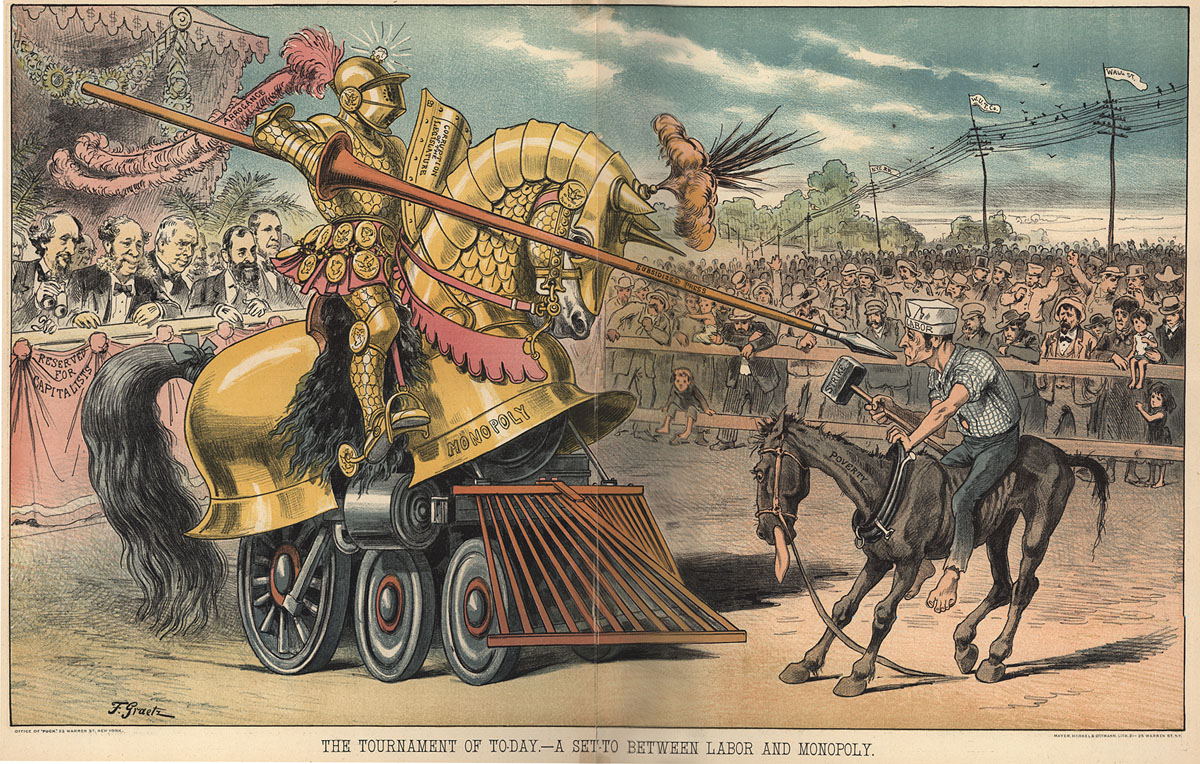
Alas, it’s almost exactly the same now as then:

"Tournament of Today:  A set-to between Labor and Monopoly," Cartoon by Frederick Graetz, Puck Magazine, August 1, 1883 (from files of Georgia State University); click image for a larger view at Georgia State

“Tournament of Today: A set-to between Labor and Monopoly,” Cartoon by Frederick Graetz, Puck Magazine, August 1, 1883 (from files of Georgia State University); click image for a larger view at Georgia State

Information on the cartoon, from SuperITCH: Frederick Graetz, a chromolithograph that was the center spread for Puck Magazine‘s issue of August 1, 1883.  Monopolists portrayed are, from left to right, “businessman, financier and telecommunications pioneer Cyrus Field; railroad tycoon William Vanderbilt; shipbuilding magnate John Roach; financier, railroad mogul, and speculator Jay Gould; and an unknown monopolist.”  Some might say that the “unknown monopolist” bears a striking resemblance to one of the Koch brothers, but that’s fanciful thinking.

Cartoon - Labor vs Monopoly, Graetz, Puck 8-1-1883 (GSU image)

Labor vs Monopoly – click on this image for a larger version of this historic Puck Magazine cartoon

Tip of the old scrub brush to One Penny Sheet’s “condemned to repeat” feature.

More:


A salute to Medal of Honor winner Rodolfo Hernandez

April 1, 2011

No television cameras.  No professional photographers.  An employee of American Airlines, Andres Otero, standing by, caught the event, probably with his phone camera.

Here’s the picture, published in the obscure Queens Gazette:

Congressional Medal of Honor Winner Rodolfo Hernandez March 25, 2011.  Photo by Andres Otero, American Airlines

Congressional Medal of Honor Winner Rodolfo Hernandez received a salute from active duty military, as he boarded an American Airlines flight to Washington, D.C., for Medal of Honor Day, March 25. Photo by Andres Otero, American Airlines

[Click through to the Queens Gazette for a larger image.]

The rest of the story?

California-native Corporal Rodolfo P. Hernandez served in the U.S. Army, and saw action in the Korean conflict.  He and his unit came under attack near Wontong-ni, Korea, on May 31, 1951.  Here’s the citation, from the Congressional Medal of Honor Society:

Cpl. Hernandez, a member of Company G, distinguished himself by conspicuous gallantry and intrepidity above and beyond the call of duty in action against the enemy. His platoon, in defensive positions on Hill 420, came under ruthless attack by a numerically superior and fanatical hostile force, accompanied by heavy artillery, mortar, and machine gun fire which inflicted numerous casualties on the platoon. His comrades were forced to withdraw due to lack of ammunition but Cpl. Hernandez, although wounded in an exchange of grenades, continued to deliver deadly fire into the ranks of the onrushing assailants until a ruptured cartridge rendered his rifle inoperative. Immediately leaving his position, Cpl. Hernandez rushed the enemy armed only with rifle and bayonet. Fearlessly engaging the foe, he killed 6 of the enemy before falling unconscious from grenade, bayonet, and bullet wounds but his heroic action momentarily halted the enemy advance and enabled his unit to counterattack and retake the lost ground. The indomitable fighting spirit, outstanding courage, and tenacious devotion to duty clearly demonstrated by Cpl. Hernandez reflect the highest credit upon himself, the infantry, and the U.S. Army.

Congressional Medal of Honor awardee Cpl. Rodolfo P. Hernandez - CMOHS image

Congressional Medal of Honor awardee Cpl. Rodolfo P. Hernandez - Congressional Medal of Honor Society image

Cpl. Hernandez received the Congressional Medal of Honor on April 21, 1962.

No, I had not heard of Medal of Honor Day, either.

Here are some details from MedalofHonorNews.com, so you can get a head start on next year’s observation:

Sunday, March 13, 2011

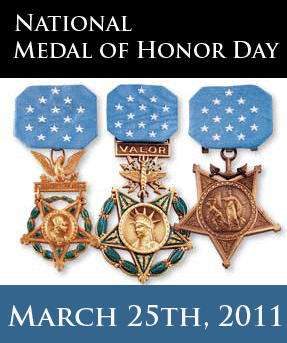
National Medal of Honor Day: Let’s not forget our heroes on March 25th, 2011


National Medal of Honor Day is officially observed on March 25th. The Medal of Honor is the highest distinction that can be awarded by the President, in the name of the Congress, to members of the Armed Forces who have distinguished themselves conspicuously by gallantry and intrepidity at the risk of their lives above and beyond the call of duty.

“This holiday should be one of our most revered. Unfortunately all too many Americans are not even aware of its existence.” Home of Heroes

The date of March 25th was chosen because the first Medals of Honor were awarded to members of Andrew’s Raiders on March 25, 1863, for their actions during the “Great Locomotive Chase.”

Col. Robert Howard (USA Ret.) president of the Congressional Medal of Honor Society on National Medal of Honor Day states:

“Hard times ask us to put a greater good before our own interests. It is sometimes physically or emotionally painful. Yet throughout history, you will find common men and women who fought selflessly in a variety of ways for something so much larger than just their own benefit.

Today, we’re fighting terrorism and the spread of tyranny. We’re challenged by market upheaval, joblessness and perhaps hunger. But the human spirit is resilient and can withstand more than sometimes we are able to immediately comprehend.

It’s up to each of us to not lay and wait for better days, but instead look for opportunities to make the lives of those around us better. National Medal of Honor Day is not a celebration. It is a solemn time to reflect on the freedom we enjoy, its price, and how our own bravery can improve the world around us.”

Home of Heroes, a premier resource of Medal of Honor information on the internet suggests:

“National Medal of Honor day is celebrated in some communities, however for the most part the occasion comes and goes with little notice. As a patriotic American there are a few things you can do to commemorate this day:

  • Fly your flag with pride and patriotism on this day.
  • Remember our heroes. As a gesture of your appreciation, why not take just a few moments in the week prior to National Medal of Honor Day to mail a “Thank You” card to one of our living Medal of Honor recipients. You can find a list of the living as well as information on writing to them among the pages of the Home of Heroes website or contact the Congressional Medal of Honor Society who will forward the letter to the Medal of Honor Recipient.
  • Inform your local media. Most newspapers aren’t even aware that this special day exists. Why not tip your local media to the occasion. Before you do, check out the Home of Heroes database for Medal of Honor recipients from your city and state as well as any who might be buried in your city. This information can give your media a “local angle” that can increase the probability that they will consider doing a story to remind Americans of our heroes.
  • If there is a Medal of Honor recipient buried in your home town, get a school class, scout troop, or other youth organization to “adopt a grave site”.

Please visit the Home of Heroes website and the Educational Resources section of Medal of Honor News.

Also read our upcoming article: Lesson plans for History and Social Studies teachers on National Medal of Honor Day, March 25th, 2011


Updates on Wisconsin, the War on Education, the War on Americans in Unions, the assault on public employees by Wisconsin Republicans, etc., etc.

April 1, 2011

First, be sure to read Zeno’s work over at Halfway There.  Zeno’s writing will make your mouth water, your pupils expand, your pulse quicken, your hands go all Galvanic on you, and otherwise get your attention — but in this case, his topic is important, too.  Zeno explains the American Legislative Exchange Council (ALEC) with a peek inside ALEC’s  sumptuous, legislator-seducing red tent.   He’s got documents from ALEC, secured through not completely legitimate means (but neither are they illegal), and he lays the group bare.  It’s not a pleasant sight if you’re not fond of adipose tissue and necrosis.

Second, at Desmogblog you should check out John Mashey’s work on loose political organizations joined to politically oppose scientists learning about global warming, to oppose publication of findings about global warming, and to oppose government action to do anything to stop global warming.  Interestingly enough, Mashey informs me, the current cast of malefactors in Wisconsin, appear earlier as malefactors in the discussions and actions about global warming.  Coincidence?

And then stay tuned.  There is more to come on the issue of the Republican Party’s rebirth of McCarthyism, and the witch hunt they wish to conduct against historian Bill Cronon, I’m sure.


FOIA “request” in Wisconsin could be violation of whistleblower protection law

March 27, 2011

Wisconsinite Jean Detjen sent me a note correcting my misinformation:  Wisconsin does indeed have a whistleblower protection act.  The law protects Wisconsin state employees, against retaliation for disclosing information about wrongdoing.

William Cronon, Frederick Jackson Turner Professor of History, University of Wisconsin

William Cronon, Frederick Jackson Turner Professor of History, University of Wisconsin - University of Wisconsin photo

My reading suggests that, since professors are not specifically exempted, Prof. Cronon, at the University of Wisconsin, is specifically protected.

If the University of Wisconsin gives that answer to the Wisconsin Republican Party, however, the Party will argue that it is not a government official prevented from retaliating against a government employee.  That would be ample reason for the state to deny the FOIA request of the Party flatly and completely.

There is another, potentially more pernicious angle here:  The Republican Party in Wisconsin is, in this case, an agent of the Republicans in the state legislature, those whose tails are on the line for violating Wisconsin law, and as Prof. Cronon outlines it, Wisconsin tradition and historical norms.  It’s likely that the Party is acting at the direction of legislators.

In short, it’s kind of an organized crime action.  I think that the federal Racketeer Influenced and Corrupt Organization Act (RICO) would cover this sort of action — any retaliation for hire, or by an agent, which creates a pattern or practice of organized crime activities.  Worse for the Wisconsin Republicans, if there were an ambitious U.S. attorney out there somewhere, there is no scienter requirement on RICO actions — that is, there need not be a clear formation of criminal intent.  The mere actions of an organized crime group, even with no intent to break the law, can be a RICO violation.

Even worse for the Republicans, RICO is available for anyone to use.  Were I Prof. Cronon, and were the Republicans to press their FOIA request to court, I’d counterclaim in federal court with the RICO statute.

That’s a nasty escalation.  But in these days, in this case, where a state party organization has gone to the employer of a university professor to get his job after he merely reported history, I wouldn’t take chances that the Republicans would later play fair or nice.

Every step against Cronon, every press release, every statement from a legislator or party apparatchik, provides more evidence of the coordinated effort, and establishes further the “pattern and practice” of organized crime activity.

Maybe cool heads will soon prevail, maybe patriotism and love of the First Amendment will break out among Wisconsin Republicans, and they will retract their demand that Prof. Cronon deliver them all of his e-mails as a professor at  the University of Wisconsin.

Maybe badgers will fly.

“Badger” is supposed to be the mascot of Wisconsin’s top-flight university, not a tool of partisan politics.


Surely ALEC wouldn’t be purging e-mails that are now evidence, would they?

March 26, 2011

You could write a soap opera about this stuff.

You remember Wisconsin?  Remember the teachers, cops, firefighters and other public employee unions?

Of course.  And it’s still a mess.  Gov. Scott  “Ahab” Walker signed into law a bill that would have the effect of abrogating union contracts without any bargaining, but the skullduggery used to sneak the bill through the Wisconsin legislature opened the door to charges that Wisconsin open meetings laws were violated, and a judge has stayed the implementation of the law.

In the meantime, a Wisconsin historian stepped up to lend historical perspective to the whole affair.  He thought he was turning on some lights, but Wisconsin Republicans have treated it like great heat.

[Off-topic note:  Some creatures are negatively photo-tropic, which means they avoid light.  You know, like the way the cockroaches in your first New York apartment scattered when you’d turn on the light.]

So, just as Virginia Attorney General and Chief Inquisitor and Witch Hunter Ken Cucinelli tried with those pesky scientists who keep finding the global temperature rising, Wisconsin Republican legislators have turned on the historian.  Here’s how the  New York Times‘ editorial, “A Shabby Crusade in Wisconsin,”  described it:

The historian, William Cronon, is the Frederick Jackson Turner and Vilas research professor of history, geography and environmental studies at the University of Wisconsin, and was recently elected president of the American Historical Association. Earlier this month, he was asked to write an Op-Ed article for The Times on the historical context of Gov. Scott Walker’s effort to strip public-employee unions of bargaining rights. While researching the subject, he posted on his blog several critical observations about the powerful network of conservatives working to undermine union rights and disenfranchise Democratic voters in many states.

In particular, he pointed to the American Legislative Exchange Council, a conservative group backed by business interests that circulates draft legislation in every state capital, much of it similar to the Wisconsin law, and all of it unmatched by the left. Two days later, the state Republican Party filed a freedom-of-information request with the university, demanding all of his e-mails containing the words “Republican,” “Scott Walker,” “union,” “rally,” and other such incendiary terms. (The Op-Ed article appeared five days after that.)

American Legislative Exchange Council.  ALEC, in K Street lobbyist parlance.

But, Dear Reader, do you see the potential problem here for Republicans in Wisconsin?  They have based their request on a Wisconsin law that prohibits private use of state-supplied e-mail — no politicking, no religious proselytizing.

What about all those ALEC e-mails to Wisconsin Republican legislators?  Sure, they’re more than fair-game for such a witch hunt, too.  And, since it’s the state Republican Party, and not a state or other public official making the FOIA request, surely that means the Republicans would not mind a similar request to cover contacts legislators had with the Wisconsin Republican Party, to the National Republican Party, or even ALEC itself.

Fair is fair, right?

ALEC generally has better lawyers than state legislators, and so we’d expect a group like that to recognize they could be in trouble.

Of course, purging of e-mails now would be a crime, a Watergate-style cover-up, destruction of evidence and obstruction of justice — after it’s become clear that there could be court action and claims of violation of law.

Jean Detjen provided links to the stories of the attacks on the distinguished Prof. Cronon over the last couple of days.  In a Facebook exchange, I noted that ALEC is fair game for such a witch hunt fishing expedition FOIA inquiry, too.

Don’t look now, Ms. Detjen said — but the ALEC site is down.

Server Error

The server encountered an internal error and was unable to complete your request.

JRun closed connection.

[Here’s a general link — try it, and let me know when the site is back up, if Paul Weyrich and the other ALEC-ians don’t skip to Brazil.]

Surely ALEC wouldn’t be illegally purging e-mails to Wisconsin, New York, Ohio, Texas, Idaho, Washington, California, Arizona, Florida, Kentucky, Louisiana and Florida legislators, would it?

Update:  As of this evening, March 26, 2011, the ALEC site is back up.  Why was it down?

The NYT editorial closed with this:

The party refuses to say why it wants the messages; Mr. Cronon believes it is hoping to find that he is supporting the recall of Republican state senators, which would be against university policy and which he denies. This is a clear attempt to punish a critic and make other academics think twice before using the freedom of the American university to conduct legitimate research.

Professors are not just ordinary state employees. As J. Harvie Wilkinson III, a conservative federal judge on the Fourth Circuit Court of Appeals, noted in a similar case, state university faculty members are “employed professionally to test ideas and propose solutions, to deepen knowledge and refresh perspectives.” A political fishing expedition through a professor’s files would make it substantially harder to conduct research and communicate openly with colleagues. And it makes the Republican Party appear both vengeful and ridiculous.

Well, yeah, Wisconsin’s Republicans wouldn’t want to be caught stifling discussion, nor taking revenge on a whistle-blower — because certainly if Cronon’s e-mails are discoverable with an FOIA request, he is a Wisconsin state employee.  “Whew,” the Wisconsin Republicans might wheeze:  Wisconsin has no specific whistleblower protection.  Ah, the plot thickens:  There are general laws that would appear, to me, a no-longer-practicing-in-that-area lawyer, to offer some protections for any employee engaged in general political speech, or in speech protecting the employee’s rights, or in speech designed to shed light on a wrongful or wrongfully executed official act — that is, Cronon’s evidence showing the unsavory and potentially illegal links of legislators to businessmen and business groups, and the potential conspiracy issues of ALEC’s nationally-directed efforts to use state legislators to gut union laws.

I wish Ahab would just get Jesus and quit thickening the plot.

More, resources, links from Jean Detjen and others:

Obviously, big tip of the old scrub brush to Jean Detjen, in Wisconsin.


Annals of global warming: Records from Mauna Loa show continuing rise in atmospheric CO2

March 26, 2011

NOAA's Mauna Loa Observatory, NOAA photo, 1982, Cmdr. John Bortniak

NOAA's Mauna Loa Observatory, from NOAA At the Ends of the Earth Collection, 1982 NOAA photo by Commander John Bortniak

John Adams observed, and Ronald Reagan was fond of quoting, “Facts are stubborn things . . .”

Here are the facts on atmospheric carbon dioxide (CO2):


Monthly CO2 levels since 1960, Mauna Loa Observatory (Scripps Inst of Oceanography)

Mauna Loa Observatory, Scripps Institution of Oceanography, UCSD (University of Calfornia-San Diego); CO2 concentrations in parts per million (ppm)

As described at the Scripps Institution of Oceanography site:

Description:
Monthly average atmospheric carbon dioxide concentration versus time at Mauna Loa Observatory, Hawaii (20°N, 156°W) where CO2 concentration is in parts per million in the mole fraction (p.p.m.). The curve is a fit to the data based on a stiff spline plus a 4 harmonic fit to the seasonal cycle with a linear gain factor.

Data from Scripps CO2 Program.

For perspective, here’s a chart from Scripps that shows why there is concern over current levels of CO2:

CO2 over the past 420,000 years - Scripps Institution of Oceanography

CO2 over the past 420,000 years - Scripps Institution of Oceanography

Resources, More:


No, Henry Wallace would not have been president long, had FDR died a few months early

March 25, 2011

Oh, it’s a technical quibble, I know.

Henry Wallace campaign button from 1948

Henry Wallace campaign button, probably from 1948. R. Emmett Tyrell worries unnecessarily that Henry Wallace might have been president, had FDR died a few months earlier.

I’ve read R. Emmett Tyrell for years.  Back in the day, when American Spectator was scratching to get anyone to read, they sent me free copies — I presume because they got my name off of a list for National Review.  At some point they decided they could actually get someone to pay for the magazine, and I fell off their list.

It was a fun read back then.  American Spectator showed up on newsprint, not slick paper.  There was a college newspaper feel to it.  They had a great section called “Brayings from the barnyard,” in which they’d quote stupid things that people said.  That was the first place I encountered the old saw, “Those whom the gods destroy, they first make mad.”

And I’m sure that, had he thought about it for three minutes, he wouldn’t have written it.  But Tyrell didn’t think.

In the on-line blog for the Spectator, in the traditionally-named “The Current Crisis,” Tyrell wrote:

Progressives have long been in favor of One World vouchsafed by the United Nations. Henry Wallace, Franklin Delano Roosevelt’s second vice president and the 1948 presidential candidate for the Progressive Party, spoke of it often. On the campaign trail in 1948 he spoke of “jobs, peace, and freedom” that “can be attained together and make possible One World, prosperous and free, within our lifetime.” He too promised to coordinate policy through the United Nations. Had President Roosevelt died but six months earlier, America would have had this fantastico in the White House. As it was, in one last act of cunning for his country, Roosevelt maneuvered Wallace out of the vice presidency and Harry Truman in. Harry was green but he was not naïve. We came that close to Henry Wallace and his “Gideon’s Army” in the White House.

Does Tyrell really believe that?

Henry Wallace could not have succeeded to the presidency at any time after noon, January 21, 1945, and had he succeeded to the presidency any time before January 21, he’d have served only until January 21.  Had Roosevelt died any time after November 7, 1944, Harry S Truman would have been inaugurated on January 21, 1945.  Had Roosevelt died between the Democratic Convention and the election, one could make an argument that Truman would not have won the nomination nor the presidency — we’ve never had a candidate die before election day, nor between election and inauguration (though William Henry Harrison sure pushed it).

Berryman cartoon, 1948, Truman v. Tom Dewey

Berryman cartoon, probably from the Washington Star, 1948 — New York Gov. Thomas Dewey was expected to handily defeat President Harry S Truman; the election was held anyway. Elections have consequences.

Roosevelt died on April 12, 1945.  Six months earlier quickly calculated would have been October 12.  [I goofed when I submitted a comment at the Spectator site, and calculated December — too quick a calculation!]  Wallace, then the vice president to FDR, almost certainly would not have won the Democrats’ nomination for president.  It may have been possible for the party to name a new ticket, and if so, it would not have had Wallace on top.  One can make a case that Truman wouldn’t have been on top of a new ticket, either — but even October 12 may have been too late to change the ballot, for pragmatic purposes, prior to the election.  Most discussions I’ve seen suggest that the vice presidential candidate would be moved up in such a case.

So, had Roosevelt died months prior to April 12, 1945, we would have had Henry Wallace as president for only a few weeks, until inauguration day the next January.  Then we would have had Harry S Truman, or Thomas E. Dewey.  Dewey ran against Truman in 1948, and lost.  There’s a good case to be made that Truman would have defeated Dewey in 1944, had they run against each other then.  Truman would have had the sympathy vote, and he would have been thought to have been the heir to the Roosevelt legacy and policies near the end of World War II.  With Hitler and Tojo on the run, it would have been a bad time to switch parties and policies.

We’ll never know, but Tyrell need not worry.

Harry Truman and Chicago Tribune from November 4, 1948

Harry Truman and Chicago Tribune from November 4, 1948


EDUSolidarity Day After, Part 3: Why would a teacher like me hang with a union?

March 23, 2011

I mean, really.  I have two degrees after attending three colleges.  I’ve taught at three different universities.  My parents were (nominally) Republicans.  I worked the Republican side of the U.S. Senate, for Orrin Anti-Labor-Law-Reform Hatch, for heaven’s sake.  I sat  through the hearings on the graft in the Operating Engineers local, the graft in the welders union in Pennsylvania that provided workers to the nuclear reactors, and the graft in the Central States Teamsters Pension Fund.  Two of my staff colleagues went on to chair the National Labor Relations Board, one is a well-known anti-labor lobbyist, and I’ve sat through the “no union here, ever” courses at three different corporations as a member of management.

What gives?

Why do I and other teachers stick with the union?

Diagram of a Liberty Ship

Diagram of a Liberty Ship

My father did carry a union card, though he was a Republican.  He had lots of stories about the difficulty of working with unions from his days with the United Cigar Stores in Los Angeles, and he probably had plenty of reason  to dislike them — but he got a job as a pipefitter building Liberty Ships.  He had to join the pipefitters union, and so he did.

Deep at heart, my father wanted to be a successful businessman.  After the war, he went back to sales.  He wound up in Burley, Idaho, managing a Western Auto store, when he struck out on his own.  Well, he and a partner.  Sedam and Darrell Furniture.  They had a disagreement, and it ended up as Sedam’s on one side of town, and Paul Darrell Hotpoint on the other.

Liberty Ships under construction during World War II

Liberty Ships under construction during World War II

It was about that time that he got a lung x-ray for something, and they found the spot.  He’d given up smoking in the 1930s, but as a pipefitter, he put a lot of asbestos on pipes to shield merchant marines from heat, to insulate the pipes, to prevent shipboard fires.  That was before the dangers of asbestos were well understood.  On the x-ray, it looked like cancer.

But it didn’t grow.  The spot just stayed there, for years.

The store in Burley fell victim to a bad economy when the union at J. R. Simplot Potatoes struck one year, in November.  The strikers weren’t buying Christmas gifts.  There were about 16 furniture and appliance stores in a county with about 16,000 people total.  Several of them didn’t survive the strike and my father’s was one of them.  A lot of people in town cursed the union for causing the strike.  On one of our trips moving to Utah, I rode with Dad and asked him about it, and why the union went on strike.  As a victim of the strike, he could have unloaded.  But he didn’t.

He explained how workers organized to get power to negotiate with big businesses.  Jack Simplot was a man we knew, a good man and a customer from all we knew — but the workers were good people, too, my father explained.  Sometimes workers and employers can’t agree.  My father explained that a strike was one of the few tools workers could use to get an employer to change his position against his will.  I told him I thought it was unfair that workers could strike and force other businesses out.  My father explained that it was tougher on the workers who didn’t buy from us — they needed the stuff they didn’t buy.

Over the next few years I watched as my father got screwed over by good people running good companies, people who were anti-union, but more, anti-employee.  He lost guaranteed bonuses.  He lost promised promotions.  He didn’t get promised raises.  My father never again owned his own business.  Instead he was an employee, unprotected by unions in a string of positions where union protection would have been a good deal for him.  He could not strike, as the workers at J. R. Simplot had.

One of the investigators for the Senate Labor Committee was a character of great proportion — no central casting bureau could have thought up a character like Frank Silbey.  Silbey headed Orrin Hatch’s investigations into unions, and he was a marvel to watch.  Soon after Hatch took over as chair of Labor, Silbey and I had a long lunch to work out just how we would work together.  I expressed to him my concern that any investigation of a union might hurt unions, and hurt workers.

Silbey thought for a minute, and took in a deep breath.  He started to put his finger in my face, but he stopped, and used it to doodle on the table cloth at the old Monocle, near his office in an odd building the Senate owned.

“Listen,” he said.  “You need to know that I am not anti-union.  I can’t be.”  And he told me about his own father.

I don’t remember the business.  I remember that Frank talked about how his family was not rich by any stretch, and his father worked hard at a union job.  The old man had not a lot of time for friends off the job, not after spending the time he wanted to with his wife and kids.  And so it was that, when he died unexpectedly, too young, Frank’s mother knew that it would be a sad funeral, with very few people attending.

When they got to the synagogue for the funeral, though, there was a huge crowd.  The place was literally overflowing with people.  The union had closed the business in honor of Mr. Silbey, and the union turned out for the funeral.  Each of the workers spent time meeting the widow, and telling her what a great man and good friend her husband had been.

“And that’s why I can’t ever be anti-union,” Frank said.  “When all is said and done, the union will stick by you when nobody else does.”

Over the next five years we found a few unions where that was not exactly true, but in most of those cases, those people who made that not true, went to jail.

The health care side of the Senate Labor Committee had a hearing into lung diseases, including black lung, brown lung, and the mesothelioma, the disease pipefitters got from asbestos.  One of the witnesses came from a pipefitters union.  Among other things, he testified to the astonishing rates of illness and untimely deaths among the pipefitters on the World War II Liberty Ships.

On the way out of the hearing I mentioned to the guy that my father had worked on the Liberty Ships, as a pipefitter.  He looked stricken, and paled.  He pulled me off to the side of the hallway, and said, “I am so sorry for you.  Your father did heroic work and the nation owes him a deep debt.”  No one had ever spoken about my father like that to me before, and I teared up.

“How long has he been gone,” the guy asked.

“Well, he’s got a spot on his lung, but it hasn’t changed.  He’s still alive,” I said (my father would die within the decade).

The pipefitters representative smiled, then laughed.  “He’s one of a very small band of survivors.  He’s still a hero, though.”

Throughout his life, my father was a very good man.  Think of the character Jimmy Stewart played in “It’s a Wonderful Life.”  That was my father.  He organized across party lines for local elections.  He organized blood drives.  During the Korean War he headed the local program to take care of soldiers passing through town who ran out of money, or got sick, or got thrown in jail.  My father served on more Troop Committees for the various Boy Scout units my brothers and I joined than anyone had a right to expect.

For all his good work, he didn’t get anything but his own satisfaction out of it.

It was a staffer who never met him, for a union he hadn’t worked in for 40 years who called him the hero he was.

“When all is said and done, the union will stick by you when no one else does,” Frank Silbey said.

It’s still true.  In America, we still need that kind of loyalty to working people, especially to teachers.  We need it now more than ever.


Quote of the moment: Goodbye unions, goodbye democracy

March 20, 2011

Nelson Lichtenstein, University of California - Santa Barbara

Nelson Lichtenstein, University of California - Santa Barbara, Santa Barbara Independent photo

Most jobs in America are not in manufacturing or subject to international competition. So the service sector, retail, construction — there are a huge number of jobs where international competition has nothing to do with it. The obstacles there are domestic. Labor law is totally dysfunctional. Workers really don’t have the right to form unions of their choosing. So you’re right to be pessimistic, just for different reasons.

I also have a mega-historical answer to that question, though. If you look at the last 150 years of history across all nations with a working class of some sort, the maintenance of democracy and the maintenance of a union movement are joined at the hip. We’ve seen this dramatically reconfirmed in Spain and South Korea and Poland over the years. If democracy has a future, then so too must trade unionism. Sadly, that doesn’t offer much hope for my lifetime. But there is such a thing as conflict between capital and labor.

Nelson Lichtenstein is arguably the most influential living historian of American labor; interviewed by Ezra Klein of the Washington Post blogs, March 10, 2011


Another Brazilian wins Lurie Cartoon Award from UN Correspondents

March 20, 2011

2010’s Lurie Award Winner for cartooning was another Brazilian — as in 2007.  The subject is global warming, with a wistful look at what might happen:

Lurie Award Winner, 2010 - Raimundo Waldez Da C. Duarte in Amazonia, in Brazil

Lurie Award Winner, 2010 - Raimundo Waldez Da C. Duarte in the publication Amazonia, in Brazil

Ice continues to melt at the South Pole, alas.  How to break it to the penguins?

Cartoonist Raimundo Waldez Da C. Duarte, Amazonia, Brazil

Cartoonist Raimundo Waldez Da C. Duarte, Amazonia, Brazil

Raimundo Waldez Da C. Duarte took $10,000  from the award.  He cartoons for Amazonia in Brazil.

You may view the 1st, 2nd and 3rd place cartoons, and ten citations for excellence, at the Lurie Award site.


Yellowstone, Land to Life — a film to free from bondage

March 20, 2011

Yes, it’s a tease.  Drat.  Just a trailer for the film.

But how exquisite is just the trailer!

Yellowstone National Park Orientation Film (excerpt) from Northern Light Productions on Vimeo.

Northern Light Productions made the film for the “Canyon Visitor Education Center in Yellowstone National Park. The film offers a compelling overview of the ‘big picture’ geology that has shaped and continues to influence Yellowstone and its ecosystem.”

Big picture geology?  How about making this film available to schools to talk about geology, geography, and history?

Yellowstone National Park annually gets about three million visitors.  Yellowstone is one of those places that ever American should see — but at that rate, it would be more than 100 years before everybody gets there.

We need good, beautifully shot, well-produced, interesting films on American landmarks in the classroom.

How do we get this one freed for America’s kids, Yellowstone Park?