July 19, 2012

Found this at Under the Lobsterscope — our incarceration rates form a testament to one of the greatest failures of the U.S. over the past two decades. Live links added here for your convenience.

(This may be the last time we use the reblog feature — it’s very clunky!)

btchakir's avatarUnder The LobsterScope


Here are the facts… you make your own conclusion. Personally, I think making prisons a private industry sucks— I wonder when they’ll be exporting the prisoners to China.


View original post


Fact vs. Fiction on the Affordable Care Act (Sen. Leahy)

July 2, 2012

From the good offices of Vermont’s Sen. Pat Leahy (a few links added):

Fact vs. Fiction

It is disappointing that inaccurate and purposely misleading information regarding health care reform continues to be widely circulated. Throughout the past two years during the lengthy debate on Health Care Reform, Senator Leahy has continued to post updated information regarding the various health care legislative proposals being debated, including the full text of proposals, questions asked by directly by Vermonters, and daily updates on floor proceedings in the Senate in an effort to provide Vermonters with accurate and timely information on the health care reform debate.

Below are some of the most common myths regarding the Affordable Care Act with accurate information dispelling those myths and providing information about where to learn more.

To review some of the most commonly questions by Vermonters please also visit the Frequently Asked Questions page on this website.

To test your knowledge about what is actually included in the health care reform law visit the Kaiser Family Foundation website and take their Affordable Care Act quiz.

Fact vs. Fiction

  • Fiction

    If you don’t buy health insurance, you will be sent to jail.

  • Fact

    Taxpayers who are required to purchase health insurance and do not will receive a notice from the Internal Revenue Service (IRS) with the amount of the penalty they owe. Individuals who fail to pay the penalty are not subject to criminal prosecutions and the government cannot file notice of lien or levy any property for a taxpayer who doesn’t pay the penalty.

    The obligation for individuals to purchase health insurance beginning in 2014 was included as part of the Affordable Care Act.  The provision requires individuals to maintain minimum essential coverage for themselves and their dependents or pay a penalty of $95 in 2014. Families would pay half the amount for children, and the requirement includes a cap on the total allowable fine per family. If affordable health insurance coverage is not available to an individual, then the penalty would be waived.  Along with the individual responsibility requirement, the Affordable Care Act also provides subsidies to some individuals beginning in 2014 to help pay for their health insurance premiums and other costs associated with their health insurance.

    Taxpayers who are required to pay a fine but fail to do so will receive a notice from Internal Revenue Service (IRS). If an individual still neglects to pay the fine, the IRS can attempt to collect the funds by reducing the amount of their tax refund in the future.  Individuals who fail to pay the penalty, however, will not be subject to criminal prosecution. The government cannot file notice of lien or levy on any property for a taxpayer who does not pay the penalty.

    The aim of this provision is to encourage all Americans to obtain health insurance, which will result in lower health care costs for everyone. The Affordable Care Act relies on the shared responsibility of individuals, employers, states and the federal government.

    For additional information regarding the individual responsibility requirement please visit the Kaiser Family Foundation website.


  • Fiction

    Members of Congress are exempt from the health care reform law.

  • Fact

    No one has received a special exemption from the Affordable Care Act. In fact, the health care reform law explicitly includes language regarding the health insurance plans for Members of Congress and their staff.

    As a United States Senator, Senator Leahy’s health plan options are the same options offered to all federal employees.  Included in the Affordable Care Act, was a provision that requires that “the only health plans that the Federal Government may make available to Members of Congress and Congressional staff shall be health plans that are created under this Act or offered through an Exchange established under this Act.”  Members of Congress and their staffs can only purchase health insurance coverage from the health insurance exchanges that are made available for uninsured Americans. The full text of this provision is available on pages 80-81 in section 1312 of the Affordable Care Act which you can read here.


  • Fiction

    Health care reform will jeopardize Medicare and will mean cuts in services and benefits for seniors.

  • Fact

    Health care reform will help strengthen Medicare so that seniors can continue to receive quality health coverage for years to come.

    The Affordable Care Act explicitly states that no benefits guaranteed under Medicare will be cut as a result of health care reform legislation.  Today’s forecasts estimate that Medicare will be insolvent by 2017 because of ever-rising health care costs.  The Affordable Care Act takes aim at that unfolding threat by addressing cost inefficiencies now, instead of waiting until later.  The Affordable Care Act strengthens the financial stability of Medicare by targeting fraud and ending wasteful overpayments to insurance companies, while maintaining the benefits and services to seniors who use Medicare.  The Act also helps Medicare users by offering prescription drug discounts to seniors who are trapped in the “donut hole,” by creating a better pathway for generic drugs to enter the marketplace, by eliminating the cost-share for preventative services, and by promoting coordinated care to prevent avoidable hospital readmissions.

    For more information about what the health care reform law means for Medicare beneficiaries read Medicare and the New Health Law -What it Means for You prepared by the Center for Medicare and Medicaid Services.

    • Beginning January 1, 2011, Medicare beneficiaries entering the Medicare donut hole will get a 50% discount on brand name prescription drugs. Click here to learn more about this provision.

  • Fiction

    The health care reform law includes a tax on all real estate sales.

  • Fact

    Under the Affordable Care Act, only certain real estate transactions for certain individuals above a particular income level would be subject to a Medicare Tax.

    Unfortunately, much of the information widely circulated about a tax on home sales and other real estate transactions inaccurately describes the purpose and the effect of this provision. The 3.8 percent Medicare tax is often misunderstood, and has frequently been described as a 3.8 percent “sales tax” on all real estate transactions, which is inaccurate.

    The provision that establishes this tax can be found on page 946, Section 1402 of the Affordable Care Act.  This tax is often referred to as the “Medicare tax,” because it was designed to raise funds for Medicare. The Medicare tax goes into effect after December 30, 2012.

    The Medicare tax is not a tax on all new home sales; it only applies to the profit that certain high income Americans make from the sale of their home.  The groups that may be affected by this provision are individuals with annual incomes over $200,000 and married couples with a joint income of over $250,000. The only home sellers who will be affected by this provision are those who fit the above description, and who sell their home for a profit of more than $250,000. The tax will not apply to the first $250,000 in profits for the individual selling his or her home or to the first $500,000 in profits for a married couple.

    While undoubtedly some home sales will see a tax increase under this provision, the tax will affect only a small percentage of home sales.  A report released by the Tax Foundation on April 15, 2010 predicts that the new tax on investment income (including real estate) will affect only the top-earning 2 percent of American families.

    The full text of the Affordable Care Act is available on the health care reform page of this website.


  • Fiction

    Health care reform will hurt small businesses.

  • Fact

    The Affordable Care Act will help small businesses, many of which are struggling now to even afford health plans for their employees.

    Small businesses are a vital engine of Vermont’s economy. Unfortunately, rising health care costs are hitting small businesses especially hard, putting them at an even greater disadvantage against larger corporations. The Affordable Care Act will help level the playing field and give affordable options to small businesses that wish to offer insurance to their workers.

    For example, the Affordable Care Act:

    • Provides tax credits to small businesses to help them offer health insurance to their employees;
    • Requires insurance companies to provide free preventative care so businesses do not suffer productivity costs because of sick employees;
    • End the “hidden insurance tax” that has prevented small businesses from being able to afford to offer insurance to their employees.  This hidden tax is built in to the premiums for insurance to compensate for the unpaid care given to the uninsured.  Health reform will help get Americans health insurance and will end the inflated premium costs.  And investments to lower health care costs overall will help spur the economy, enabling more businesses to thrive;

    For more information regarding how health care reform efforts will help small businesses please visit the Implementation Center on this website as well as the Small Business Administration website and the Small Business Majority website for additional resources.


  • Fiction

    The Affordable Care Act provides subsidies for illegal immigrants to receive health insurance.

  • Fact

    The Affordable Care Act explicitly defines who is eligible for federal payments, credits or subsidies for health insurance coverage and makes clear that undocumented immigrants are ineligible.

    Some have expressed concerned that undocumented immigrants will have the ability to receive subsidies for health insurance under the reform proposals in Congress.  Senator Leahy does not support using government funding to subsidize insurance for those who have entered the United States illegally or who are residing in the United States in an undocumented status. The full text of the law clearly defines who is eligible for federal payments, credits or subsidies.

    The relevant statutory language is below:

    Patient Protection and Affordable Care Act
    Subtitle D—Available Coverage Choices for All Americans
    PART II–Consumer Choices and Insurance Competition Through Health Benefit Exchanges

    • Section 1312 (f)(3) makes clear that undocumented immigrants are ineligible to participate in the health insurance exchanges: “ACCESS LIMITED TO LAWFUL RESIDENTS- If an individual is not, or is not reasonably expected to be for the entire period for which enrollment is sought, a citizen or national of the United States or an alien lawfully present in the United States, the individual shall not be treated as a qualified individual and may not be covered under a qualified health plan in the individual market that is offered through an Exchange.”

    Subtitle E—Affordable Coverage Choices for All Americans
    PART I—PREMIUM TAX CREDITS AND COST SHARING REDUCTIONS
    Subpart B—Eligibility Determinations

    • Section 1412(d) unambiguously states “NO FEDERAL PAYMENTS FOR INDIVIDUALS NOT LAWFULLY PRESENT.—Nothing in this subtitle or the amendments made by this subtitle allows Federal payments, credits, or cost-sharing reductions for individuals who are not lawfully present in the United States.”

    The Act also establishes a fair process to accurately verify eligibility for participation in the benefits of health insurance reform that does not place unnecessary bureaucratic hurdles for U.S. Citizens nor undue administrative costs on the government.

    Patient Protection and Affordable Care Act

    Subtitle E—Affordable Coverage Choices for All Americans
    PART I—PREMIUM TAX CREDITS AND COST SHARING REDUCTIONS
    Subpart B—Eligibility Determinations

    • Section 1411(a) required that the Secretary of Health and Human Services “shall establish a program . . . for determining . . . whether an individual who is to be covered in the individual market by a qualified health plan offered through an Exchange, or who is claiming a premium tax credit or reduced cost-sharing [is] a citizen or national of the United States or an alien lawfully present in the United States.”
    • Section 1411(b) requires applicants for enrollment in a qualified health plan offered through an Exchange in the individual market to provide “name, address, and date of birth.”  For those individuals claiming eligibility based on an attestation of citizenship, they must provide their social security number.  For those individuals whose eligibility is based on an attestation of their immigration status, they must provide “the enrollee’s social security number (if applicable) and such identifying information with respect to the enrollee’s immigration status as the Secretary, after consultation with the Secretary of Homeland Security, determines appropriate.”

    Senator Leahy has also heard from Vermonters with small businesses who employ seasonal workers and their concern about the requirement that employers purchase health insurance for their employees.

    The Act exempts small businesses from the employer mandate to provide health insurance for employees, and employers are not subject to penalties if they employ 50 or fewer employees.  Seasonal workers do not count towards the 50 employee threshold.  And for those employers subject to the penalty, they are only responsible for providing health insurance for full-time employees.

    Patient Protection and Affordable Care Act
    Subtitle F—Shared Responsibility for Health Care
    PART II—EMPLOYER RESPONSIBILITIES
    Section 1513—Shared Responsibility For Employers

    • Section 1513(a) states:

    (B) EXEMPTION FOR CERTAIN EMPLOYERS-

    (i) IN GENERAL- An employer shall not be considered to employ more than 50 full-time employees if—

    (I) the employer’s workforce exceeds 50 full-time employees for 120 days or fewer during the calendar year, and

    (II) the employees in excess of 50 employed during such 120-day period were seasonal workers.

    (ii) DEFINITION OF SEASONAL WORKERS—The term `seasonal worker’ means a worker who performs labor or services on a seasonal basis as defined by the Secretary of Labor, including workers covered by section 500.20(s)(1) of title 29, Code of Federal Regulations and retail workers employed exclusively during holiday seasons.”


  • Fiction

    Health care reform will lead to rationing of health care

  • Fact

    Health care reform is aimed at increasing the options for Americans, not limiting them.

    Unfortunately, prior to the passage of the Affordable Care Act rationing of health care happened all too often. Insurance companies decided whether or not beneficiaries could have a certain test or procedures, based not on medical necessity, but on the insurance plan and whether the test is affordable. This rationing left millions of Americans without adequate care or coverage and is taking away the decision making from patients and their doctors, putting those decisions instead in the hands of insurance company bureaucrats.

    The Affordable Care Act is intended to improve the ability of patients to receive the care they need by setting ground rules for insurance companies to follow.  No longer will insurance companies be allowed to deny coverage for preexisting medical conditions or to discriminate against consumers because of their gender. No longer will insurance companies be allowed to revoke insurance coverage from a patient who has been ill and deemed too sick for coverage. The government will have no role in telling patients what tests they can and cannot have. In fact, for the first time, the Affordable Care Act prohibits insurance companies from limiting choice of doctors.  The Affordable Care Act guarantees your right to choose a primary care doctor from any available participating provider, designate any available participating pediatrician as your child’s primary care provider, and prohibits insurers or employer-sponsored plans from requiring a referral for obstetrical or gynecological (OB-GYN) care. Additionally, the Affordable Care Act prohibits health insurers and plans from restricting access to and charging patients more for out-of-network emergency care.

    Health care reform is about improving choice for all Americans.


  • Fiction

    The health care reform law will force individuals to pay taxes on their health benefits.

  • Fact

    Health benefits will not be taxed under the Affordable Care Act, even though the value of your health insurance will be included on your W-2 form.

    Title IX of the Affordable Care Act, Section 9002 on page 800 states that beginning in the tax year 2011, employers are required to report the value of the health insurance coverage they provide employees on each employee’s annual W-2 Form so that employees can be informed consumers and know the full cost of their plan. The amount reported does not affect tax liability and the value of the employer contribution to health coverage will continue to be excludible from an employee’s income and is not taxable.

    Updates and guidance will be posted regularly on the IRS website regarding all tax provisions included in the Affordable Care Act.


  • Fiction

    The government will encourage or force seniors to choose euthanasia as an end-of-life option.

  • Fact

    This has been shown over and over again to be another false rumor.  Nothing in the Affordable Care Act requires that seniors participate in consultations about their end-of-life wishes.

    Unfortunately, this rumor has been spreading fast and is worrying many Vermonters and Americans across the country. Nothing in the Affordable Care Act will force seniors to have consultations regarding their end-of-life choices, or have a consultation to discuss suicide.

    Currently, voluntary end-of-life planning is covered as a part of the “Welcome to Medicare” doctor visits available to seniors with in the first year of joining the program.   The Affordable Care Act authorized Medicare coverage of yearly physician exams, or wellness visits for beneficiaries. Specifically, section 4103 of the Affordable Care Act provides coverage under Medicare, with no copayments or deductible, for an annual wellness visit and personalized prevention plan services.  Often times patients are not given the time to ask important questions about options available to them such as hospice, or home care, or additional services available to seniors.  This provision would simply give seniors the choice to have a discussion during their wellness visit, about the topics of their choosing, with their doctor. It empowers seniors to have conversations about living wills and other questions they might have but do not have the opportunity to ask.  In no way does the law mandate these conversations or tell doctors what options to discuss.  If seniors do not wish to have these discussions with their doctors and families, nothing will force them to.


June 15: Magna Carta anniversary, #797

June 15, 2012

Today, June 15, 2012, is the 797th anniversary of the signing of the Magna Carta.  The document laid a foundation for freedom, almost 800 years ago, upon which we stand today.

Runnymede, Magna Carta Isle, photo by Wyrdlight, Antony McCallum, 2008 (Wikimedia)

What event critical to western history and the development of the democratic republic in the U.S. happened here in 1215?

A teacher might use some of these photos explaining the steps to the Constitution, in English law and the heritage of U.S. laws. Other than the Magna Carta, all the events of Runnymede get overlooked in American studies of history. Antony McCallum, working under the name Wyrdlight, took these stunning shots of this historic meadow. (He photographs stuff for studies of history, it appears.)

Maybe it’s a geography story.

View of Runnymede Meadow from Engham Village -- Wyrdlight photo through Wikimedia

View of Runnymede Meadow from Engham Village — Wyrdlight photo through Wikimedia

Several monuments to different events of the past millennium populate the site. The American Bar Association dedicated a memorial to the Magna Carta there — a small thing open to the air, but with a beautiful ceiling that is probably worth the trip to see it once you get to England.

Wikipedia explains briefly, with a note that the ABA plans to meet there again in 2015, the 800th anniversary of the Great Charter:

Magna Carta Memorial


The Magna Carta Memorial & view towards the ‘medes’


Engraved stone recalling the 1985 ABA visit

Situated in a grassed enclosure on the lower slopes of Cooper’s Hill, this memorial is of a domed classical style, containing a pillar of English granite on which is inscribed “To commemorate Magna Carta, symbol of Freedom Under Law”. The memorial was created by the American Bar Association to a design by Sir Edward Maufe R.A., and was unveiled on 18 July 1957 at a ceremony attended by American and English lawyers.[5]

Since 1957 representatives of the ABA have visited and rededicated the Memorial renewing pledges to the Great Charter. In 1971 and 1985 commemorative stones were placed on the Memorial plinth. In July 2000 the ABA came:

to celebrate Magna Carta, foundation of the rule of law for ages past and for the new millennium.

In 2007 on its 50th anniversary the ABA again visited Runnymede and during the convention installed as President Charles Rhyne who devised Law Day which seeks in the USA an annual reaffirmation of faith in the forces of law for peace.

The ABA will be meeting at Runnymede in 2015 on the 800th anniversary of the sealing of the original charter.

The Magna Carta Memorial is administered by the Magna Carta Trust, which is chaired by the Master of the Rolls.[10]

In 2008, flood lights were installed to light the memorial at night, but due to vandalism they now lie smashed.

I’ll wager the lights get fixed before 2015.

Detail of the Magna Carta monument at Runnymed...

Detail of ceiling of the Magna Carta Memorial detailing play of light, and star pattern, Runnymede – Wikimedia image

More, resources:

This is mostly an encore post.


Still looking? Again, here’s how to find “separation of church and state” in the Constitution

May 16, 2012

It’s an election year. People get crazy. I’ve already heard from a dozen wacko candidates that “separation of church and state isn’t in the Constitution.”

Yes it is. Separation of church and state resides in the Constitution.  Here’s a post from 2010 to help them find it.

_____________

It’s been at least 20 years since I first heard the old canard of an argument that “there’s no separation of church and state in the Constitution.” I think I first heard it attributed to David Barton, which would make sense, since he doesn’t understand the Constitution, but neither does he fear sharing his misunderstandings.

It was an incorrect statement then, and it’s been incorrect since September 1787. Separation of state and church is woven throughout the Constitution, part of the warp and woof.

Recently, latter-day Constitution ignorami repeat the old canard.

Toles cartoon on dangers of marrying church and state

Toles cartoon on dangers of marrying church and state

I was surprised to discover I’ve not posted this before on this blog. So here’s a slightly-edited version of a response I gave many months ago to someone who made that silly claim, a basic description that I developed years ago to explain the issue, in speeches by members of the Senate Subcommittee on the Constitution:

Separation of church and state: It’s in the Constitution.

I don’t play a constitutional lawyer on television, I am one*, but it seems to me anyone can read the Constitution and see. Especially if one understands that the Constitution sets up a limited government, that is, as Madison described, one that can do only what is delegated to it. The Constitution is a short document.

Where should you look to find separation of church and state in the Constitution?

First, look in the Preamble. It is made clear that the document is a compact between citizens: “We the people . . . do ordain and establish this Constitution . . .” The usual role of God ordaining (in some western nations) is altered, intentionally. It is not God who establishes this government, but you and I, together. From the first words of the Constitution, there is separation of church and state. The power of our government grows out of a secular compact between you and me, and 308 million other residents of the nation. We have a government created by consent of the governed, as the Declaration of Independence said a just government should be. It is not a government created by the will of God directly (though some, including the Mormons, argue it is divinely inspired). We have no divine right kings or other monarchs. The government is not the grantor of rights from God, but is instead the protector of the rights of citizens, whatever the source of the rights.

Second, look in the key parts of the document itself. Start with Article 1. The legislative branch is given no role in religion; neither is any religion given any role in the legislature. In Article 2, the executive branch gets no role in religion, and religion gets no role in the executive branch. In Article 3, the judicial branch gets no role in religion, and religion gets no role in the judicial branch. In Article 4, the people get a guarantee of a republican form of government in the states, but the states get no role in religion, and religion gets no role in state government. This is, by design of the founders, a perfect separation of church and state.

Third, in Article 6, the convention wrote the hard and fast rule that no religious test can be used for any office in government, federal, state or local, means that no official will have a formal, governmental role in religion, and no religion can insist on a role in any official’s duties.

Fourth, Amendment 1 closes the door to weasling around it: Congress is prohibited from even considering any legislation that might grant a new bureaucracy or a new power to get around the other bans on state and church marriage, plus the peoples’ rights in religion are enumerated.

Fifth: In 1801 the Baptists (!) in Danbury, Connecticut, grew concerned that Connecticut would act to infringe on their church services, or teachings, or right to exist. So they wrote to President Jefferson. Jefferson responded with an official declaration of government policy on what the First Amendment and Constitution mean in such cases. Jefferson carefully constructed the form of the device as well as the content with his Attorney General, Levi Lincoln, to be sure that it would state what the law was. This “letter” is the proclamation. It’s an official statement of the U.S. government, collected in the president’s official papers and not in his personal papers. Make no mistake: Jefferson’s letter to the Danbury Baptists was an official act, an official statement of the law of the United States. Jefferson intended it to assuage the Baptists in Danbury, to inform and warn the Connecticut legislatures, and to be a touchstone to which future Americans could turn for information. It was only fitting and proper for the Supreme Court to use the letter in this capacity as it has done several times.

Sixth: The phrase, “separation of church and state” dates back another 100 years and more, to the founding of Rhode Island. It is the religion/state facet of the idea of government by consent of the governed without interference from religious entities, expressed so well in the Mayflower Compact, in the first paragraphs of the Declaration of Independence, and carried through in the Constitution (see especially the Preamble, above).

No, the phrase “separation of church and state” never appears in the Constitution. The principles of separation of church and state are part of the warp and woof, and history, of the document, however. The law is clear, the law was clear, the law has always been clear, and denying the Constitution says what it says won’t change it or make it go away. You could just as easily point out that the word “democracy” or “democratic” never appears in the document, though we rely on democratic mechanisms and institutions to make it work. You could point out that nowhere does it say that our national government is a republic, though it is. The Constitution doesn’t say “checks and balances,” nor does it say “federalism.” The Constitution doesn’t mention political parties. The Constitution was written before the advent of broadcasting, and makes no mention of radio nor television, nor of the internet — but the First Amendment freedoms apply there anyway. The Constitution doesn’t say “privacy,” though it protects your right to privacy.

You won’t find “separation of church and state” as a phrase in the Constitution. If you read it, you’ll find that the concept of the separation of state and church can’t be taken out of the document, either — it’s a fundamental principle of our government.

More, and Resources:

__________

* A non-practicing one. We have way more than 50,000 lawyers in Texas. That’s enough trouble for one lifetime. Someone has to look out for the welfare of the world.


Odd site to defend Peter Gleick’s exposing of Heartlandgate, citing the law that will let him skate

March 18, 2012

Much angst among Heartlandgate perpetrators over the increasingly obvious fact that Peter Gleick not only shouldn’t be prosecuted, but can’t be prosecuted under federal law, for duping Heartland employees into revealing their true intentions, to lie about global warming so people won’t “believe” it and support solutions.

Peter Gleick - World Economic Forum Annual Mee...

Peter Gleick, lifetime of informing the public accurately at a researcher's greatly diminished salary; Heartland Institute is spending thousands of dollars to convince people he changed suddenly. Who to believe? Here's Gleick at the World Economic Forum Annual Meeting Davos 2009 (Photo credit: World Economic Forum)

But this odd site cut through the clutter and posted the words of the relevant law, establishing Peter Gleick’s lack of criminality:

18 U.S.C. 1343:
Whoever, having devised or intending to devise any scheme or artifice to defraud, or for obtaining money or property by means of false or fraudulent pretenses, representations, or promises, transmits or causes to be transmitted by means of wire, radio, or television communication in interstate or foreign commerce, any writings, signs, signals, pictures, or sounds for the purpose of executing such scheme or artifice, shall be fined under this title or imprisoned not more than 20 years, or both….

Did you catch that, Dear Reader?  Gleick would be guilty of federal wire fraud had he asked the perpetrators of Heartlandgate to send him money or property.

But all Gleick asked for was a copy of their agenda for a meeting, and the supporting data.  No money, no property.  Nothing of value.  Nor did he intend to use, nor could he use, any of that information to get money or property.

You noted, of course, the site is one promulgated by the Heartland Institute itself.

(Did they really mean it that way?  Probably not.)

(By the way — you may want to read the actual law from an authoritative source like the Cornell University Law Library’s Legal Information Institute (LII), and not a version filtered by people who deny global warming, nor its severity, nor its causes, or who don’t work to hoodwink gullible politicians.)

Peter Gleick:  Deep Throat of the climate denial scandals.

How can you tell whether you should be concerned, Dear Reader?

For example, if you’re a teacher, should you be concerned that in Heartlandgate, the Heartland Institute reveals itself to be working to “dissuade” science teachers from teaching science?  Or, if you’re just a concerned citizen, should you be concerned that you’ve heard precious little about the analysis of the documents released, from major news outlets?

If you are in any degree confused about who to believe in this issue, or worse, if you are convinced that there is a pattern of skirting of the laws by scientists (contrary to the evidence), you should be concerned that you’re not getting the full story.

More, Resources, Further reading:


Oldest federal judge remembered: Followed the Boy Scout Oath

February 11, 2012

He served on the federal bench through his 104th birthday, slowing down only when death took him last month.

Federal Judge Wesley E. Brown, at 103, in Wichita, Kansas - photo by Larry Smith for the New York Times

Federal Judge Wesley E. Brown, then 103, at his desk in the courthouse in Wichita, Kansas, in 2010 - photo by Larry Smith for the New York Times. Note the computer pictured behind Judge Brown -- not a technophobe.

U.S. Federal District Judge Wesley Brown died last month.  At a memorial service, those who knew him paid homage to his lifelong devotion to the Boy Scout Oath.  At the risk of angering the copyright poobahs at Associated Press, I quote from the AP story from Wichita, Kansas, carried at the site of Fox 6 WBRC (somewhere in Alabama):

“He was truly a first among equals – an icon of all that is good and faithful and true, both as a person and as a judge,” said U.S. District Judge Katherine Vratil, now the chief judge for the federal district in Kansas.

Mike Lahey, Brown’s law clerk for the past 24 years, said the judge’s life was governed by two oaths: one that he took to be a district judge in 1962 and the other when he became a Boy Scout in 1920.

Lahey said the judge often would recite the oath to him from memory: “On my honor I will do my best to do my duty to God and my country and to obey the scout law; to help other people at all times; to keep myself physically strong, mentally awake and morally straight.”

“To Judge Brown those words were never a simple rite of passage,” Lahey said. “To him, they were the aspiration of what a man should be and he adopted them as a guide for the rest of his life.”

He was born three years before Scouting was incorporated in the U. S. and lived past Scouting’s 100th anniversary.  Any other Scouters out there with greater longevity in Scouting?

An article in The Wichita Eagle laid out the historical perspective of Brown’s astonishing service:

Brown served during an era of changing civil rights, equality for men and women in the workplace and legal battles over Internet privacy.

During the 1970s, Brown told a Wichita hospital it couldn’t fire a woman because she was single and pregnant and ruled that North High School had to let a girl on its golf team. During the 1980s, Brown ordered millions of dollars in payments to railroad workers denied promotions because they were Americans of African descent.

More recently, Brown presided over cases including a $3 million athletic ticket scandal at the University of Kansas, where he studied physical education under James Naismith.

Calvin Coolidge was president when Brown entered the University of Kansas as an undergraduate in 1925.

Brown studied by night and worked to support himself at the Ford Motor Co. factory in Kansas City. When the Great Depression hit, he found himself having to write pink slips notifying fellow workers that they were out of jobs. One of those pink slips was his own. He finished law school working as a secretary for a local attorney’s office for $15 a week.

At his first job for a Hutchinson law firm, Brown made $25 a month, before being elected as Reno County attorney from 1935 to 1939.

Brown never let age get in his way. When he joined the Navy in World War II he was 37 — the oldest in his unit.

He was a past president of the Kansas Bar Association. He became chief judge for the Kansas federal district in 1971.

Brown assumed senior status in 1979, which is seen in the federal court system as semi-retirement at full salary. Brown, however, continued to work full time for the next three decades.

More: 


Birthers: Lacking the sense God gave chickens

January 30, 2012

Birthers are still claiming the Earth is flat, still looking for a missing link, still claiming Judge Crater didn’t go missing, and still embarrassing America?

Yep.

Barack Obama's Long Form Birth Certificate

Barack Obama’s Long Form Birth Certificate – image from Snopes.com (available many places)

Orly Taitz was in court in Georgia, losing another case because she lacks even a whiff of a scintilla of an iota of evidence to back any of her claims that President Barack Obama was not born in Honolulu, Hawaii, as his now-released long-form birth certificate, short-form birth certificate, contemporary newspapers, eyewitnesses and all other evidence indicate.  They have no evidence, and they have clowns for lawyers:

In court filings, Obama’s legal team has called the “birther” allegations baseless and the criticisms of his birth records “patently unfounded.” The filings also noted 68 similar challenges filed have been dismissed and, during a 2009 challenge, a federal judge in Columbus fined Taitz $20,000 for “frivolous” litigation.

But I stumbled onto a wildly misnamed blog, The Constitution Club*, where the issue is given credence and way too many electrons.

(Are lobotomies legal, again?  Can people perform self-lobotomies?  Just wondering.)

I added some references to sites in the real world, so that anyone not totally insane might find an anchor in reality and follow the threads back to the light.

The post’s author, Daniella Nicole, tried to make a defense of the birthers insane, destructive antics.

I responded, but you never can tell when the birthers will plug their ears, cover their eyes and start singing “Born in the U.S.A.” at the top of their lungs to avoid information that would require them to appear sober.  My comment went straight to “moderation.”  Probably too many links, or too many high-quality links (thank you, Cornell University Law Library’s Legal Information Institute).   For the record, here’s my last reply to Daniella Nicole:

[Daniella Nicole wrote:]

I daresay any of the GOP contenders, or to use your reference, SNL’s the Church Lady, Frankie and Willie or one of the Coneheads, would all be better than the clown (or Homey D. Clown from In Living Color, if you will) currently in office.

Excuse me. I had mistaken you for an American, a patriot, and someone who bears no ill will to the American people.

Unless Obama has lied about who his father is and the birth certificate is a fraud (which would raise other legal issues), Obama is NOT a natural born citizen. Period.

“Born on American soil” means “natural born American citizen.” Obama was born on American soil. End of your argument.

BUT, had he been born on foreign soil, with one American citizen parent, he would still be a natural born citizens — as is John McCain, born in Panama (and not on a military base, but in the local Panama hospital).

Remind me never to refer any of my clients or friends to you for immigration advice.

The Supreme Court actually set the precedent of defining natural born as born of two American citizen parents in the 1875 case Minor v. Happersett. Note it was not a dicta, which is an authoritative statement by a court that is not legally binding, but an actual precedent, which is a rule of law established for the first time by a court and is referred to by other courts afterwards.

The holding in Minor was that women are not voting citizens. The case dealt with Mrs. Minor’s attempt to register to vote. Obama is not a woman, and the issue you’re talking about has nothing to do with registering to vote. So, if the case says what you claim, it MUST be in obiter dicta. [Obiter dicta means those parts of the decision in which the court explains how and why it ruled as it did, but NOT the key ruling itself.]  No offense, but you really could use some legal training. At least get a Black’s Law dictionary, will you?

Here, read excerpts from the opinion:

The question is presented in this case, whether, since the adoption of the fourteenth amendment, a woman, who is a citizen of the United States and of the State of Missouri, is a voter in that State, notwithstanding the provision of the constitution and laws of the State, which confine the right of suffrage to men alone. We might, perhaps, decide the case upon other grounds, but this question is fairly made. From the opinion we find that it was the only one decided in the court below, and it is the only one which has been argued here. The case was undoubtedly brought to this court for the sole purpose of having that question decided by us, and in view of the evident propriety there is of having it settled, so far as it can be by such a decision, we have concluded to waive all other considerations and proceed at once to its determination.

So it would be error to claim the case got to the issue of who is a “natural born citizen” at all. It did not.

And, had you read the case, you’d know that. In fact, the case says the opposite of what you claim. It says:

Additions might always be made to the citizenship of the United States in two ways: first, by birth, and second, by naturalization. This is apparent from the Constitution itself, for it provides [n6] that “no person except a natural-born citizen, or a citizen of the United States at the time of the adoption of the Constitution, shall be eligible to the office of President,” [n7] and that Congress shall have power “to establish a uniform rule of naturalization.” Thus new citizens may be born or they may be created by naturalization.

The Constitution does not, in words, say who shall be natural-born citizens. Resort must be had elsewhere to ascertain that. At common-law, with the nomenclature of which the framers of the Constitution were familiar, it was never doubted that all children born in a country of parents who were its citizens became themselves, upon their birth, citizens also. These were natives, or natural-born citizens, as distinguished from aliens or foreigners. Some authorities go further and include as citizens children born within the jurisdiction without reference to the citizenship of their [p168] parents. As to this class there have been doubts, but never as to the first. For the purposes of this case it is not necessary to solve these doubts. It is sufficient for everything we have now to consider that all children born of citizen parents within the jurisdiction are themselves citizens. The words “all children” are certainly as comprehensive, when used in this connection, as “all persons,” and if females are included in the last they must be in the first. That they are included in the last is not denied. In fact the whole argument of the plaintiffs proceeds upon that idea.

Under the power to adopt a uniform system of naturalization Congress, as early as 1790, provided “that any alien, being a free white person,” might be admitted as a citizen of the United States, and that the children of such persons so naturalized, dwelling within the United States, being under twenty-one years of age at the time of such naturalization, should also be considered citizens of the United States, and that the children of citizens of the United States that might be born beyond the sea, or out of the limits of the United States, should be considered as natural-born citizens. [n8] These provisions thus enacted have, in substance, been retained in all the naturalization laws adopted since. In 1855, however, the last provision was somewhat extended, and all persons theretofore born or thereafter to be born out of the limits of the jurisdiction of the United States, whose fathers were, or should be at the time of their birth, citizens of the United States, were declared to be citizens also. [n9]

If you’re going to opine on citizenship, you would do well to read a summary of actual citizenship law, and don’t take the odd rantings of anti-Obama people on the internet.

Dani said:

Interestingly, many refer to Vattel’s definition of natural born (which is essentially the same thing and may have influenced the founders in their work on the Constitution), but it is not Vattel that sets legal precedent. The Supreme Court can and did set the precedent in the matter in 1875.

Minor v. Happersett, 88 U.S. 162 (1875) most assuredly did not rule that a child must have two U.S. citizen parents to be a citizen, nor to be a “natural born” citizen. Read the case’s key sections above.

The precedent that is important here is the presidency of Chester Alan Arthur, a man who, like Obama, had a father born in a foreign country, and who was not a citizen of the U.S. at the time of Arthur’s birth. While opponents tried to make an issue of this in the campaign of 1880, it was a non-starter. You know the rest — Arthur was elected vice president under James Garfield, and ascended to the presidency upon Garfield’s death after being shot (no, Orly Taitz was not the shooter). So, had Hapersett had anything to do with presidential eligibility, it would have applied to Arthur. Since Arthur served out his term as president, it’s pretty clear that the actual precedent supports Obama’s eligibility 100%.

Somebody told you a tall tale about the case — it’s about whether a woman may vote, not about what is a natural born citizen. Seriously, how could anyone confuse those issues?

Congress in 2008 (including Hillary Clinton and Barack Obama) also defined natural born as having been born to two American citizen parents when a challenge to John McCain’s eligibility was issued.So, even by the standard and definition of Congress, including Obama himself, he is not legally qualified or eligible.

1. That was a non-binding resolution, stating the opinion of the U.S. Senate.
2. The resolution, S. Res. 511 in the 110th Congress, ( does NOT say “two American citizen parents,” but instead refers to children born to “Americans.” Obama’s mother was an American.
3. Obama was born on American soil, and so the resolution, covering kids born outside the U.S., is inapplicable, and off the mark.

Obama was not born to two American citizen parents, by his own admission and via the birth certificate which he has provided to America. Ergo, he is not a natural born American citizen and does not meet the Constitutional requirement for the office of President of the United States of America. As such, not only is he not legally qualified to be in the office he currently holds, but he is not legally eligible to be on any ballot in the U.S. for the upcoming election. Period.

Except, none of the laws you cite says what you’d need it to say. Obama is natural born because he was born in the U.S. He is also natural born having been a child of a U.S. citizen. He is fully legally qualified — at least, to people who know the law, and who appreciate that it’s necessary to follow the laws.

If wishes were horses, beggars would ride. Your wishes do not change the law. Your misstatements of the cases and the laws do not change the laws. Your wish to find something bad against Obama, a good man and a good president, does not give you a leg to stand on, nor a horse to ride.

And how, pray tell, is using legal means to resolve serious legal matters “polluting the courts”? That is what they are there for.

Junk lawsuits. Nuisance suits. Orly Taitz has already been fined for making these nuisance claims. The evidence needed to challenge Obama’s eligibility simply does not exist, except in the fevered and overactive imaginations of those crazies. The stuff in Georgia this last week is a supreme embarrassment to America — but thank God, the courts got it right.

But by all means, continue to stamp your foot and blather on about this. Your work on this insane and hopeless issue keeps you off the streets, and out of real politics. You can’t do damage to a school board race while you’re lost in the ozone on citizenship and Obama.

_____________

* Maybe by “Constitution Club” they mean “a club with which to beat the Constitution,” and not a group of people joining together in a noble cause, you think?

Earlier at Millard Fillmore’s Bathtub


Why we worry about global warming: It ain’t the climate, it’s the people

January 9, 2012

Alun Salt gave great advice about not bothering to engage idiots, pigs, denialists or trolls (here, among other places).  He said I should avoid lengthy answers to blogs that have little audience.

This is probably one of those occasions.

But in a running attempt to stimulate serious thought at a denialist blog, I got a question that has been rather common, and a question which indicates the deep serious misunderstanding denialists and even some well-meaning, overly-skeptical sensible people have:

Why worry about  climate change, since the climate is changing all the time?  Especially, why are people like Al Gore urging that we stop climate change, when CO2 has no great direct effect on human health?  Shouldn’t environmentalists be cheering climate change on, since it’s a “natural process?”

The answer is lost on the other blog, as Mr. Salt predicted it would be.  But since I’ve gotten some version of the question repeatedly in the last month, I may as well repeat the answer here, for the record.

The short answer to why we worry about climate change is that, as with almost all environmental protection, we are worried first about the quality of life of humans, and ultimately about the ability of human life to survive at all.

Here’s the question put to me there:

Ed I’m a little confused. I thought we were talking about the effect of co2 on the climate not the effect of co2 on human health. Co2 is not a toxic gas and would have no effect on human health. The fact that humans weren’t around when co2 was 10-20 times higher has absolutely nothing to do with its effect on climate.
Ed there was no runaway greenhouse effect or climate catastrophe. The planet was fine during the phanerazoic. There is actually a lack of co2 in the atmopshere comapred to that time.

Here’s my answer, with a few more links than their format would allow:

No, you’re not a little confused.  You’re a lot confused, greatly misinformed, and not thinking hard.

We worry about CO2’s effects on climate only because we worry about the future of humanity.  Many of us who have children and wish them the same blessings of having children and grandchildren, have thought through the truth of the matter that we don’t possess and rule the Earth for ourselves, but instead act only as stewards for future generations.

No Earth, no humans; but at the same time, no habitable Earth, no humans.  In the long run, Earth doesn’t care.  It’ll do fine — without humans.

We can’t damage the planet.  We can only damage its habitability for humans.

I don’t know what sort of dystopian Randian future you and other Do Nothings hope for, but it’s a future contrary to human life, American values, and all known religions.

We’re talking about the future of humans.  I tell “skeptics,” “If you don’t care, butt out.  You’ll be dead in the short run anyway, but that’s no reason to stand in the way of action not to ensure a livable planet for our grandchildren.”

You also fail to understand chemistry, pollution, and how the world works.  CO2 is indeed a toxic gas.  For about a century now we’ve had indoor air standards that require air circulation to keep CO2 down below concentrations of about 500 ppm, because at that level it starts to have dramatic effects on humans working.  It clouds their thinking and causes drowsiness.  CO2 is a conundrum, in that it is also necessary to trigger mammalian breathing.  If CO2 drops too low, we don’t take in enough oxygen and may pass out.  Too much oxygen in place of CO2 is a problem in that regard.  A substance can be both essential and a  pollutant, at the same time. (This has vexed food safety experts for years, especially after the 1958 Delaney Clause; substances we know to be essential nutrients can be carcinogenic, in the same concentrations, or in the same concentrations with a slight twist in chemical formula — how do we regulate that stuff?)

CO2 is toxic in much greater proportions — it was a CO2 cloud that killed thousands in Cameroon 30 years ago or so, if you know history.

Clearly you did not know that we’ve regulated indoor CO2 for decades.  Clearly you haven’t looked at the medical journals‘ discussion on CO2 — and I’ll wager you’d forgotten the Cameroon incident, if you ever knew about it.

CO2 is a toxic gas (the dose is the poison); CO2 has dramatic effects on human health — too little and we die, too much and we die.

The fact that humans were not around when CO2 was much higher is exactly the point.  That was presented here, as it is in most venues, as support for a claim that we don’t need to worry about CO2 pollution.  Well, that’s right — if we don’t care about a habitable Earth.  But when CO2 was higher, life for humans was impossible.

I think it’s reckless to run an experiment on what would happen with higher CO2 levels, using the entire planet as a testing place, and testing the hypotheses on just how much CO2 will kill us all off, and how.

How about a control group, at least?

In the past, massive CO2 created massive greenhouse effects that would devastate us today — not as a toxic gas, but as a result of the warming that greenhouse gases do.

Let us understand the physical conundrum of CO2 here:  Without the greenhouse effect from the human-historic levels of CO2, this would be an ice planet.  Our lives today depend on the greenhouse effects of CO2.

Consequently, anyone who claims there is no greenhouse effect fails to understand physics, chemistry, biology and history.  (Heck, throw in geology, too.)  Life would be impossible but for the greenhouse effect.  Life is impossible without water, too, but you can’t live totally surrounded by water.

Can it be true that there can never be too much of a good effect, with regard to greenhouse gases?  Ancient Greek ideas of “all things in moderation” applies here.  We need a Goldilocks amount of CO2 in our atmosphere — not to much, not too little; not too hot, not too cold.

To the extent that higher CO2 levels didn’t produce a total runaway greenhouse effect, as some hypothesize exists on Venus, we know that was due to other feedbacks.  Early on, for example, CO2 began to be reduced by photosynthesizing life.  Animal life today would be impossible but for that occurrence.  Few if any modern chordates could breathe the very-low oxygen atmosphere of the early Earth, and live.  Those feedbacks and limiting situations do not exist today.

So now we face a double or triple whammy.  The reduction in CO2 in the air was accomplished through a couple billion years of carbon sequestration through plants.  In fact, a lot of carbon was sequestered in carbon-rich fossils, stuff we now call coal and oil.  Oxygen replenishment was accomplished with massive forests, and healthy oceans, with a great deal of photosynthesis.  This created a rough CO2 equilibrium (with fluctuations, sure) that existed we know for at least the last 50,000 years, we’re pretty sure for the last 100,000 years (we know that from carbon-dating calibration exercises).

Today we have removed fully 30% of the forests that used to replenish oxygen and lock up a lot of CO2 (some estimates say 50% of the forests are gone); modern plant communities cannot pluck CO2 out fast enough.  Plus, we’re releasing a lot of that old, sequestered carbon in coal and oil — at rates unprecedented in human history.

Will more CO2 warm the planet?  We know from the fact that the planet is warm enough for life, that more CO2 will warm the planet more.  Anyone who says differently does not know physics and chemistry, nor history.

Is there anything that can stop that effect?  Sure — healthy, massive forests, and healthy oceans.  Reducing carbon emissions could help a lot, too.  But we’re committed for about a century.  CO2 in the atmosphere doesn’t fall to the ground like particulate pollution.  it drifts until it is incorporated into something else, either through photosynthesis or other chemical reactions.  It takes a mole of CO2 a couple of centuries to come out of the air.  We’re stuck with elevated and elevating CO2 regardless our actions, for a century or two, even if we are wildly successful in reining in emissions and creating sequestration paths.

What happens when CO2 levels get higher than 350 ppm?  History, physics and chemistry tells us glaciers will melt, rainfall patterns will alter dramatically, sea levels will rise, carbon will be absorbed by the seas in increasing amounts (causing acidification — simple chemistry).

It’s a very exciting experiment.  The entire human race is at stake. How much CO2 will it take to produce the effects that kill us all?  It’s likely that changing rainfall patterns and rising sea levels will produce wars over resources, long before CO2 itself starts being physically toxic.  That’s what the Pentagon’s big thinkers say.  That’s what the Chinese big thinkers say, which is why they are working to reduce emissions even without an enforceable treaty.

As experiments go, I think it’s immoral to use humans in experimentation without getting their consent, and without passing the entire experiment through the Institutional Review Board to make sure the experiment is useful, necessary, and done ethically.

Do you have those consent statements?  All seven billion of them?  Have you got approval from the research overseers of the institution?

If you don’t have permission to proceed with this progeny-killing experiment, why do you propose to proceed?  Many people believe that, if the courts on Earth don’t get us, a higher court will.

How will you plead wherever the call to justice is delivered?


Republicans Unfit to Govern Dept: All laws must quote from the Magna Carta

January 5, 2012

For a biologist, P. Z. Myers is really good at finding historical and legal error, you know?  He’s got this post up at his FreeThoughts blog — I copy here in the entirety because I’m laughing too hard to rewrite it.  And P. Z. writes well, and he won’t mind:

New Hampshire has some world-class lunatics

Too bad they’re in the legislature. The latest wacky idea from a trio of Republicans is to require that all new bills reference the Magna Carta.

House Bill 1580 is the product of such a brainstorming session this summer between three freshman House Republicans: Bob Kingsbury of Laconia, Tim Twombly of Nashua and Lucien Vita of Middleton. The eyebrow-raiser, set to be introduced when the Legislature reconvenes next month, requires legislation to find its origin in an English document crafted in 1215.

“All members of the general court proposing bills and resolutions addressing individual rights or liberties shall include a direct quote from the Magna Carta which sets forth the article from which the individual right or liberty is derived,” is the bill’s one sentence.

You might be wondering why the Magna Carta . . . I think the three stooges should be wondering that, too.

Vita admitted he needs to “bone up” on the content of the charter

In other words, he has no idea what’s in the Magna Carta. I’m guessing he’s also a Christian of the the type that has a similar reverence for the contents of a document they’ve never read.

Yeah, I’ll have a little more to say about it later — especially about how this cuts just the opposite of what Republicans have been screaming about for much of the last four years.


Heart of Atlanta Motel and civil rights

December 28, 2011

PG posted this photo in one of his collections at Chamblee54:

Heart of Atlanta Motel, 1956 - Special Collections and Archives,Georgia State University Library

Heart of Atlanta Motel, 1956 - Special Collections and Archives,Georgia State University Library

I wondered whether this is the motel in the case testing the 1964 Civil Rights Act — and sure enough, it is.  The case was decided, finally, by the U.S. Supreme Court in 1964, Heart of Atlanta Motel, Inc., v. United States, 379 U.S. 241 (1964) .

This important case represented an immediate challenge to the Civil Rights Act of 1964, the landmark piece of civil rights legislation which represented the first comprehensive act by Congress on civil rights and race relations since the Civil Rights Act of 1875. For much of the 100 years preceding 1964, race relations in the United States had been dominated by segregation, a system of racial separation which, while in name providing for “separate but equal” treatment of both white and black Americans, in truth perpetuated inferior accommodation, services, and treatment for black Americans.

During the mid-20th century, partly as a result of cases such as Powell v. Alabama, 287 U.S. 45 (1932); Smith v. Allwright, 321 U.S. 649 (1944); Shelley v. Kraemer, 334 U.S. 1 (1948); Sweatt v. Painter, 339 U.S. 629 (1950); McLaurin v. Oklahoma State Regents, 339 U.S. 637 (1950); NAACP v. Alabama, 357 U.S. 449 (1958); Boynton v. Virginia, 364 U.S. 454 (1960) and probably the most famous, Brown v. Board of Education of Topeka, 347 U.S. 483 (1954), the tide against segregation began to turn. However, segregation remained in full effect into the 1960s in parts of the southern United States, where the Heart of Atlanta Motel was located, despite these decisions.

The Atlanta Time Machine, a great collection of photos in the history of Atlanta and Georgia, has more photos, and this description of the site:

The Heart of Atlanta motel, located at 255 Courtland Street NE, was owned by Atlanta attorney Moreton Rolleston Jr.  Rolleston, a committed segregationist, refused to rent rooms at his hotel to black customers.  Upon passage of the Civil Rights Act of 1964, Rolleston immediately filed suit in federal court to assert that the law was the result of an overly broad interpretation of the U.S. Constitution’s commerce clause.  Rolleston represented himself in the case, HEART OF ATLANTA MOTEL, INC. v. UNITED STATES ET AL., which  went all the way to the United States Supreme Court.  Rolleston lost when the Supreme Court ruled that Congress was well within its powers to regulate interstate commerce in such a manner.  The Hilton Hotel now stands on the former site of the Heart of Atlanta Motel.

Texts in law school rarely have illustrations.  I know the motel mostly as a citation on pages of text, great grey oceans of somnambulent text.  This case is important in civil rights, though it is mentioned almost never in history texts.  What are these cases really about?  These photos offer us insight.

The Heart of Atlanta Motel aspired to greatness in the late 1950s and 1960s — evidenced by this publicity flyer photo from the Atlanta Time Machine; notice the flag flying for the motel’s Seahorse Lounge (Atlanta is landlocked):

Heart of Atlanta Motel publicity photo - Atlanta Time Machine

Heart of Atlanta Motel publicity photo - Atlanta Time Machine; not just a podunk "motor lodge," but a "resort motel." Click for larger image.

For the 1960s, this place offered great amenities, including two swimming pools and in-room breakfast service.

Flyer for the Heart of Atlanta Motel, circa 1960 - Atlanta Time Machine image

Flyer for the Heart of Atlanta Motel, circa 1960 - Atlanta Time Machine image

This photo is amusing — I can just imagine the difficulties of launching a motor boat of this size in one of the swimming pools, obviously for a publicity stunt.  The photo is dated February 27, 1960, in the Pullen Library Collection.

Boat in the pool at the Heart of Atlanta Motel, 1960 - Atlanta Time Machine image

Boat in the pool at the Heart of Atlanta Motel, 1960 - Atlanta Time Machine image

To compare how times have changed, you may want to look at this aerial photo of the area, including the Heart of Atlanta Hotel, and compare it with modern photos which show the Hilton Hotel that replaced the property.

Rolleston appears to have had a big ego.  As noted above, he represented himself in this case, and he argued it in the Supreme Court.  Here’s a picture from about that time, from the University of Missouri-Kansas City Law School “Famous Trials” site:

Moreton Rolleston, Jr., owner of the Heart of Atlanta Motel and the attorney who argued the case at the Supreme Court - UMKC Law School image

Moreton Rolleston, Jr., owner of the Heart of Atlanta Motel and the attorney who argued the case at the Supreme Court - UMKC Law School image; photo: Wayne Wilson/Leviton-Atlanta

You may decide for yourself whether this fits the old legal aphorism that a lawyer who represents himself in a case has a fool for a client.  The Oyez site at the University of Chicago provides access to the audio of the oral arguments.  Did Rolleston argue ably?  Rolleston argued against Archibald Cox, who went on to fame in the Watergate scandals.  This appears to have been Rolleston’s only appearance before the Supreme Court; it was Cox’s ninth appearance (he argued 20 cases before the Court in his career, several well known and notable ones).

Heart of Atlanta vs. United States was argued on October 5, 1964.  The opinion was issued on December 14, 1964, a 9-0 decision against Rolleston and segregation authored by Justice Tom C. Clark (one of Dallas’s earliest Eagle Scouts).

This was a fight Mr. Rolleston picked.  He was not cited nor indicted for violation of the Civil Rights Act, but instead asked for an injunction to prevent the law’s enforcement; according to the published decision,

Appellant, the owner of a large motel in Atlanta, Georgia, which restricts its clientele to white persons, three-fourths of whom are transient interstate travelers, sued for declaratory relief and to enjoin enforcement of the Civil Rights Act of 1964, contending that the prohibition of racial discrimination in places of public accommodation affecting commerce exceeded Congress’ powers under the Commerce Clause and violated other parts of the Constitution. A three-judge District Court upheld the constitutionality of Title II, §§ 201(a), (b)(1) and (c)(1), the provisions attacked, and, on appellees’ counterclaim, permanently enjoined appellant from refusing to accommodate Negro guests for racial reasons.

Oyez summarizes the case question:

Facts of the Case 

Title II of the Civil Rights Act of 1964 forbade racial discrimination by places of public accommodation if their operations affected commerce. The Heart of Atlanta Motel in Atlanta, Georgia, refused to accept Black Americans and was charged with violating Title II.

Question 

Did Congress, in passing Title II of the 1964 Civil Rights Act, exceed its Commerce Clause powers by depriving motels, such as the Heart of Atlanta, of the right to choose their own customers?

The decision turned on the commerce clause, and the reach of Congressional power to regulate interstate commerce.

Decision: 9 votes for U.S., 0 vote(s) against
Legal provision: Civil Rights Act of 1964, Title II

The Court held that the Commerce Clause allowed Congress to regulate local incidents of commerce, and that the Civil Right Act of 1964 passed constitutional muster. The Court noted that the applicability of Title II was “carefully limited to enterprises having a direct and substantial relation to the interstate flow of goods and people. . .” The Court thus concluded that places of public accommodation had no “right” to select guests as they saw fit, free from governmental regulation.

Good decision.

Heart of Atlanta Motel is gone.  The site is occupied by the Hilton Atlanta, today.


Religious freedom for students in public schools — what is the law?

December 7, 2011


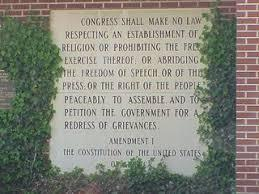
It's engraved in stone. The First Amendment, at the entrance to the Bremen Public Library in Bremen, Indiana. The Bremen Public Library serves the citizens of German Township in Marshall County, Indiana. Photo from Bremen Library.

It’s engraved in stone. The First Amendment, at the entrance to the Bremen Public Library in Bremen, Indiana. The Bremen Public Library serves the citizens of German Township in Marshall County, Indiana. Photo from Bremen Library.


President Clinton directed the Secretary of Education and the Attorney General to inform  each school district in America about the law on religious freedom in public schools.  This was the law in 2000 when Clinton left office, and it still is the law.  This statement is still accurate. [And if that site stays weird or doesn’t work for you, check it out here at the 5th Circuit U.S. Court of Appeals.]

UNITED STATES DEPARTMENT OF EDUCATION
THE SECRETARY


“…Schools do more than train children’s minds. They also help to nurture their souls by reinforcing the values they learn at home and in their communities. I believe that one of the best ways we can help out schools to do this is by supporting students’ rights to voluntarily practice their religious beliefs, including prayer in schools…. For more than 200 years, the First Amendment has protected our religious freedom and allowed many faiths to flourish in our homes, in our work place and in our schools. Clearly understood and sensibly applied, it works.”

President Clinton
May 30, 1998


Dear American Educator,

Almost three years ago, President Clinton directed me, as U.S. Secretary of Education, in consultation with the Attorney General, to provide every public school district in America with a statement of principles addressing the extent to which religious expression and activity are permitted in our public schools. In accordance with the President’s directive, I sent every school superintendent in the country guidelines on Religious Expression in Public Schools in August of 1995.

The purpose of promulgating these presidential guidelines was to end much of the confusion regarding religious expression in our nation’s public schools that had developed over more than thirty years since the U.S. Supreme Court decision in 1962 regarding state sponsored school prayer. I believe that these guidelines have helped school officials, teachers, students and parents find a new common ground on the important issue of religious freedom consistent with constitutional requirements.

In July of 1996, for example, the Saint Louis School Board adopted a district wide policy using these guidelines. While the school district had previously allowed certain religious activities, it had never spelled them out before, resulting in a lawsuit over the right of a student to pray before lunch in the cafeteria. The creation of a clearly defined policy using the guidelines allowed the school board and the family of the student to arrive at a mutually satisfactory settlement.

In a case decided last year in a United States District Court in Alabama, (Chandler v. James) involving student initiated prayer at school related events, the court instructed the DeKalb County School District to maintain for circulation in the library of each school a copy of the presidential guidelines.

The great advantage of the presidential guidelines, however, is that they allow school districts to avoid contentious disputes by developing a common understanding among students, teachers, parents and the broader community that the First Amendment does in fact provide ample room for religious expression by students while at the same time maintaining freedom from government sponsored religion.

The development and use of these presidential guidelines were not and are not isolated activities. Rather, these guidelines are part of an ongoing and growing effort by educators and America’s religious community to find a new common ground. In April of 1995, for example, thirty-five religious groups issued “Religion in the Public Schools: A Joint Statement of Current Law” that the Department drew from in developing its own guidelines. Following the release of the presidential guidelines, the National PTA and the Freedom Forum jointly published in 1996 “A Parent’s Guide to Religion in the Public Schools” which put the guidelines into an easily understandable question and answer format.

In the last two years, I have held three religious-education summits to inform faith communities and educators about the guidelines and to encourage continued dialogue and cooperation within constitutional limits. Many religious communities have contacted local schools and school systems to offer their assistance because of the clarity provided by the guidelines. The United Methodist Church has provided reading tutors to many schools, and Hadassah and the Women’s League for Conservative Judaism have both been extremely active in providing local schools with support for summer reading programs.

The guidelines we are releasing today are the same as originally issued in 1995, except that changes have been made in the sections on religious excusals and student garb to reflect the Supreme Court decision in Boerne v. Flores declaring the Religious Freedom Restoration Act unconstitutional as applied to actions of state and local governments.

These guidelines continue to reflect two basic and equally important obligations imposed on public school officials by the First Amendment. First, schools may not forbid students acting on their own from expressing their personal religious views or beliefs solely because they are of a religious nature. Schools may not discriminate against private religious expression by students, but must instead give students the same right to engage in religious activity and discussion as they have to engage in other comparable activity. Generally, this means that students may pray in a nondisruptive manner during the school day when they are not engaged in school activities and instruction, subject to the same rules of order that apply to other student speech.

At the same time, schools may not endorse religious activity or doctrine, nor may they coerce participation in religious activity. Among other things, of course, school administrators and teachers may not organize or encourage prayer exercises in the classroom. Teachers, coaches and other school officials who act as advisors to student groups must remain mindful that they cannot engage in or lead the religious activities of students.

And the right of religious expression in school does not include the right to have a “captive audience” listen, or to compel other students to participate. School officials should not permit student religious speech to turn into religious harassment aimed at a student or a small group of students. Students do not have the right to make repeated invitations to other students to participate in religious activity in the face of a request to stop.

The statement of principles set forth below derives from the First Amendment. Implementation of these principles, of course, will depend on specific factual contexts and will require careful consideration in particular cases.

In issuing these revised guidelines I encourage every school district to make sure that principals, teachers, students and parents are familiar with their content. To that end I offer three suggestions:

First, school districts should use these guidelines to revise or develop their own district wide policy regarding religious expression. In developing such a policy, school officials can engage parents, teachers, the various faith communities and the broader community in a positive dialogue to define a common ground that gives all parties the assurance that when questions do arise regarding religious expression the community is well prepared to apply these guidelines to specific cases. The Davis County School District in Farmington, Utah,is an example of a school district that has taken the affirmative step of developing such a policy.

At a time of increasing religious diversity in our country such a proactive step can help school districts create a framework of civility that reaffirms and strengthens the community consensus regarding religious liberty. School districts that do not make the effort to develop their own policy may find themselves unprepared for the intensity of the debate that can engage a community when positions harden around a live controversy involving religious expression in public schools.

Second, I encourage principals and administrators to take the additional step of making sure that teachers, so often on the front line of any dispute regarding religious expression, are fully informed about the guidelines. The Gwinnett County School system in Georgia, for example, begins every school year with workshops for teachers that include the distribution of these presidential guidelines. Our nation’s schools of education can also do their part by ensuring that prospective teachers are knowledgeable about religious expression in the classroom.

Third, I encourage schools to actively take steps to inform parents and students about religious expression in school using these guidelines. The Carter County School District in Elizabethton, Tennessee, included the subject of religious expression in a character education program that it developed in the fall of 1997. This effort included sending home to every parent a copy of the “Parent’s Guide to Religion in the Public Schools.”

Help is available for those school districts that seek to develop policies on religious expression. I have enclosed a list of associations and groups that can provide information to school districts and parents who seek to learn more about religious expression in our nation’s public schools.

In addition, citizens can turn to the U.S. Department of Education web site (http://www.ed.gov) for information about the guidelines and other activities of the Department that support the growing effort of educators and religious communities to support the education of our nation’s children.

Finally, I encourage teachers and principals to see the First Amendment as something more than a piece of dry, old parchment locked away in the national attic gathering dust. It is a vital living principle, a call to action, and a demand that each generation reaffirm its connection to the basic idea that is America — that we are a free people who protect our freedoms by respecting the freedom of others who differ from us.

Our history as a nation reflects the history of the Puritan, the Quaker, the Baptist, the Catholic, the Jew and many others fleeing persecution to find religious freedom in America. The United States remains the most successful experiment in religious freedom that the world has ever known because the First Amendment uniquely balances freedom of private religious belief and expression with freedom from state-imposed religious expression.

Public schools can neither foster religion nor preclude it. Our public schools must treat religion with fairness and respect and vigorously protect religious expression as well as the freedom of conscience of all other students. In so doing our public schools reaffirm the First Amendment and enrich the lives of their students.

I encourage you to share this information widely and in the most appropriate manner with your school community. Please accept my sincere thanks for your continuing work on behalf of all of America’s children.

Sincerely,


Richard W. Riley
U.S. Secretary of Education


RELIGIOUS EXPRESSION IN PUBLIC SCHOOLS

Student prayer and religious discussion: The Establishment Clause of the First Amendment does not prohibit purely private religious speech by students. Students therefore have the same right to engage in individual or group prayer and religious discussion during the school day as they do to engage in other comparable activity. For example, students may read their Bibles or other scriptures, say grace before meals, and pray before tests to the same extent they may engage in comparable nondisruptive activities. Local school authorities possess substantial discretion to impose rules of order and other pedagogical restrictions on student activities, but they may not structure or administer such rules to discriminate against religious activity or speech.

Generally, students may pray in a nondisruptive manner when not engaged in school activities or instruction, and subject to the rules that normally pertain in the applicable setting. Specifically, students in informal settings, such as cafeterias and hallways, may pray and discuss their religious views with each other, subject to the same rules of order as apply to other student activities and speech. Students may also speak to, and attempt to persuade, their peers about religious topics just as they do with regard to political topics. School officials, however, should intercede to stop student speech that constitutes harassment aimed at a student or a group of students.

Students may also participate in before or after school events with religious content, such as “see you at the flag pole” gatherings, on the same terms as they may participate in other noncurriculum activities on school premises. School officials may neither discourage nor encourage participation in such an event.

The right to engage in voluntary prayer or religious discussion free from discrimination does not include the right to have a captive audience listen, or to compel other students to participate. Teachers and school administrators should ensure that no student is in any way coerced to participate in religious activity.

Graduation prayer and baccalaureates: Under current Supreme Court decisions, school officials may not mandate or organize prayer at graduation, nor organize religious baccalaureate ceremonies. If a school generally opens its facilities to private groups, it must make its facilities available on the same terms to organizers of privately sponsored religious baccalaureate services. A school may not extend preferential treatment to baccalaureate ceremonies and may in some instances be obliged to disclaim official endorsement of such ceremonies.

Official neutrality regarding religious activity: Teachers and school administrators, when acting in those capacities, are representatives of the state and are prohibited by the establishment clause from soliciting or encouraging religious activity, and from participating in such activity with students. Teachers and administrators also are prohibited from discouraging activity because of its religious content, and from soliciting or encouraging antireligious activity.

Teaching about religion: Public schools may not provide religious instruction, but they may teach about religion, including the Bible or other scripture: the history of religion, comparative religion, the Bible (or other scripture)-as-literature, and the role of religion in the history of the United States and other countries all are permissible public school subjects. Similarly, it is permissible to consider religious influences on art, music, literature, and social studies. Although public schools may teach about religious holidays, including their religious aspects, and may celebrate the secular aspects of holidays, schools may not observe holidays as religious events or promote such observance by students.

Student assignments: Students may express their beliefs about religion in the form of homework, artwork, and other written and oral assignments free of discrimination based on the religious content of their submissions. Such home and classroom work should be judged by ordinary academic standards of substance and relevance, and against other legitimate pedagogical concerns identified by the school.

Religious literature: Students have a right to distribute religious literature to their schoolmates on the same terms as they are permitted to distribute other literature that is unrelated to school curriculum or activities. Schools may impose the same reasonable time, place, and manner or other constitutional restrictions on distribution of religious literature as they do on nonschool literature generally, but they may not single out religious literature for special regulation.

Religious excusals: Subject to applicable State laws, schools enjoy substantial discretion to excuse individual students from lessons that are objectionable to the student or the students’ parents on religious or other conscientious grounds. However, students generally do not have a Federal right to be excused from lessons that may be inconsistent with their religious beliefs or practices. School officials may neither encourage nor discourage students from availing themselves of an excusal option.

Released time: Subject to applicable State laws, schools have the discretion to dismiss students to off-premises religious instruction, provided that schools do not encourage or discourage participation or penalize those who do not attend. Schools may not allow religious instruction by outsiders on school premises during the school day.

Teaching values: Though schools must be neutral with respect to religion, they may play an active role with respect to teaching civic values and virtue, and the moral code that holds us together as a community. The fact that some of these values are held also by religions does not make it unlawful to teach them in school.

Student garb: Schools enjoy substantial discretion in adopting policies relating to student dress and school uniforms. Students generally have no Federal right to be exempted from religiously-neutral and generally applicable school dress rules based on their religious beliefs or practices; however, schools may not single out religious attire in general, or attire of a particular religion, for prohibition or regulation. Students may display religious messages on items of clothing to the same extent that they are permitted to display other comparable messages. Religious messages may not be singled out for suppression, but rather are subject to the same rules as generally apply to comparable messages.

THE EQUAL ACCESS ACT

The Equal Access Act is designed to ensure that, consistent with the First Amendment, student religious activities are accorded the same access to public school facilities as are student secular activities. Based on decisions of the Federal courts, as well as its interpretations of the Act, the Department of Justice has advised that the Act should be interpreted as providing, among other things, that:

General provisions: Student religious groups at public secondary schools have the same right of access to school facilities as is enjoyed by other comparable student groups. Under the Equal Access Act, a school receiving Federal funds that allows one or more student noncurriculum-related clubs to meet on its premises during noninstructional time may not refuse access to student religious groups.

Prayer services and worship exercises covered: A meeting, as defined and protected by the Equal Access Act, may include a prayer service, Bible reading, or other worship exercise.

Equal access to means of publicizing meetings: A school receiving Federal funds must allow student groups meeting under the Act to use the school media — including the public address system, the school newspaper, and the school bulletin board — to announce their meetings on the same terms as other noncurriculum-related student groups are allowed to use the school media. Any policy concerning the use of school media must be applied to all noncurriculum-related student groups in a nondiscriminatory matter. Schools, however, may inform students that certain groups are not school sponsored.

Lunch-time and recess covered: A school creates a limited open forum under the Equal Access Act, triggering equal access rights for religious groups, when it allows students to meet during their lunch periods or other noninstructional time during the school day, as well as when it allows students to meet before and after the school day.

Revised May 1998


List of organizations that can answer questions on religious expression in public schools

Religious Action Center of Reform Judaism
Name: Rabbi David Saperstein
Address: 2027 Massachusetts Ave., NW, Washington, DC 20036
Phone: (202) 387-2800
Fax: (202) 667-9070
Web site: http://www.rj.org/rac/
American Association of School Administrators
Name: Andrew Rotherham
Address: 1801 N. Moore St., Arlington, VA 22209
Phone: (703) 528-0700
Fax: (703) 528-2146
Web site: http://www.aasa.org
American Jewish Congress
Name: Marc Stern
Address: 15 East 84th Street, New York, NY 10028
Phone: (212) 360-1545
Fax: (212) 861-7056
National PTA
Name: Maribeth Oakes
Address: 1090 Vermont Ave., NW, Suite 1200, Washington, DC 20005
Phone: (202) 289-6790
Fax: (202) 289-6791
Web site: http://www.pta.org
Christian Legal Society
Name: Steven McFarland
Address: 4208 Evergreen Lane, #222, Annandale, VA 22003
Phone: (703) 642-1070
Fax: (703) 642-1075
Web site: http://www.clsnet.com
National Association of Evangelicals
Name: Forest Montgomery
Address: 1023 15th Street, NW #500, Washington, DC 20005
Phone: (202) 789-1011
Fax: (202) 842-0392
Web site: http://www.nae.net
National School Boards Association
Name: Laurie Westley
Address: 1680 Duke Street, Alexandria, VA 22314
Phone: (703) 838-6703
Fax: (703) 548-5613
Web site: http://www.nsba.org
Freedom Forum
Name: Charles Haynes
Address: 1101 Wilson Blvd, Arlington, VA 22209
Phone: (703) 528-0800
Fax: (703) 284-2879
Web site: http://www.freedomforum.org

-###-


Can “Pepper-spraying cop” use copyright to stop the use of his image?

November 22, 2011

Just looking at a few of the dozens of parodies that make use of the photographic image of the cop at UC-Davis with the pepper spray can.

What if he, or UC-Davis, wanted to slow down the parodies, to catch their breath?  Could he, or the university, copyright the image and enforce copyright?  Do such over-the-top and often abusive parodies fall within the parody rules?

What say you, legal beagles?  What say you, anyone?

Pepper Spray Cop and Edvard Munch's "The Scream"

One of the least offensive parodies using the cop's image.


Kids Bill of Rights

November 18, 2011

Kids write and sing about the Bill of Rights — captured on video by the folks at EmergentOrder.com (the producers of the second Keynes/Hayek video).

How close to right are they?  Can you use this in class?

Can your kids improve on this, or do something like it?


Scalia and Thomas: Neither is Caesar’s wife

November 18, 2011

It sure looks like a breach of ethics, but James Oliphant writes in the Los Angeles Times that there is no formal rule prohibiting a sitting Supreme Court justice from hobnobbing with a law firm set to argue a gargantuan case in a few months.

The day the Supreme Court gathered behind closed doors to consider the politically divisive question of whether it would hear a challenge to President Obama’s healthcare law, two of its justices, Antonin Scalia and Clarence Thomas, were feted at a dinner sponsored by the law firm that will argue the case before the high court.

The occasion was last Thursday, when all nine justices met for a conference to pore over the petitions for review. One of the cases at issue was a suit brought by 26 states challenging the sweeping healthcare overhaul passed by Congress last year, a law that has been a rallying cry for conservative activists nationwide.

The justices agreed to hear the suit; indeed, a landmark 5 1/2-hour argument is expected in March, and the outcome is likely to further roil the 2012 presidential race, which will be in full swing by the time the court’s decision is released.

The lawyer who will stand before the court and argue that the law should be thrown out is likely to be Paul Clement, who served as U.S. solicitor general during the George W. Bush administration.

Clement’s law firm, Bancroft PLLC, was one of almost two dozen firms that helped sponsor the annual dinner of the Federalist Society, a longstanding group dedicated to advocating conservative legal principles. Another firm that sponsored the dinner, Jones Day, represents one of the trade associations that challenged the law, the National Federation of Independent Business.

Another sponsor was pharmaceutical giant Pfizer Inc, which has an enormous financial stake in the outcome of the litigation. The dinner was held at a Washington hotel hours after the court’s conference over the case. In attendance was, among others, Mitch McConnell, the Senate’s top Republican and an avowed opponent of the healthcare law.

The featured guests at the dinner? Scalia and Thomas.

One wishes for some of the usual journalistic “balancing,” with someone to note who among the crowd represents the opposite side in the case, and someone else to note that the dinner had a lot of other sponsors.  But one might get uneasy thinking that the usual journalistic balancing can’t be mustered here, and that Scalia and Thomas just don’t care about appearances of ethical violations, if they can get away with it.

Lower court judges have clear ethical guidance on the issue, counseling against such appearances:

It’s nothing new: The two justices have been attending Federalist Society events for years. And it’s nothing that runs afoul of ethics rules. In fact, justices are exempt from the Code of Conduct that governs the actions of lower federal judges.

If they were, they arguably fell under code’s Canon 4C, which states,A judge may attend fund-raising events of law-related and other organizations although the judge may not be a speaker, a guest of honor, or featured on the program of such an event.“

Those rules do not apply to the nine people who sit on the nation’s highest court.

In those few times I lunched with Thomas and worked with him, when he staffed environmental issues for Indiana’s Missouri’s Sen. John Danforth, I found him an agreeable lunch companion and smart, but a great idealogue.  Had I known then what we all know now, I would have paid closer attention, asked different and sharper  questions, and kept notes.  And I might have dropped a few hints about history, and Caesar’s wife.  Supreme Court justices should consider themselves wedded to the American republic, and act accordingly.

What do you think, Dear Reader?  Was this a violation of ethics, even if not required by the rules that apply to Supreme Court justices?


Sausage makers? Or U.S. Congress? Do you want to see how they do it?

September 15, 2011

How does a bill become law?

Charts in government and civics texts always amuse me for what they leave out — mostly the political machinations.  Anyone who worked or works in the halls of Congress knows the process is never so clean as Bismarck pretended with his old, misattributed bon mot (actually John Godfrey Saxe, not Bismarck) (and would Bismarck be chagrined at my using a French phrase to describe his words?).

At In Custodia Legis, the blog of the law librarians at the Library of Congress, I stumbled across this post featuring a photograph of a chart hanging in a committee room on the House side.  Wouldn’t it be nice to have a copy of that available to teachers?

Andrew Weber wrote the post.

Sometimes the legislative process is a little more confusing than I’m Just a Bill.  As Margaret mentioned in The Curious History of the 2011 Debt Ceiling Legislation earlier this week, sometimes the legislative process takes interesting turns.  Christine also blogged about the unique situation of vehicle bills.  The poster below details the various status steps legislation can take, including Introductory, Committee, Discharge, Calendar, Floor, Conference, and Presidential Steps.

For tips on THOMAS that can relate to the legislative process, you can subscribe to the RSS feed or via email alert.  There is also a glossary in THOMAS to help.

Is the poster available?  I asked, and got this response from Mr. Weber:

This is what it says at the bottom right of the poster:

Committee on House Administration
Wayne L. Hays, Chairman
Prepared by House Information Systems Staff
Frank B. Ryan, Director

Also, on the bottom left it has a date:

Current as of November 1974

Wayne Hayes, the meanest man in the House according to Bud Shuster?  November 1974?  This was pre-scandal Hayes (Democrat of Ohio), just barely post-Nixon Washington. [

If you can find a link to this chart that makes the wording and details legible, or if you happen to find it and can photograph it so we can read it, will you let us know here?