
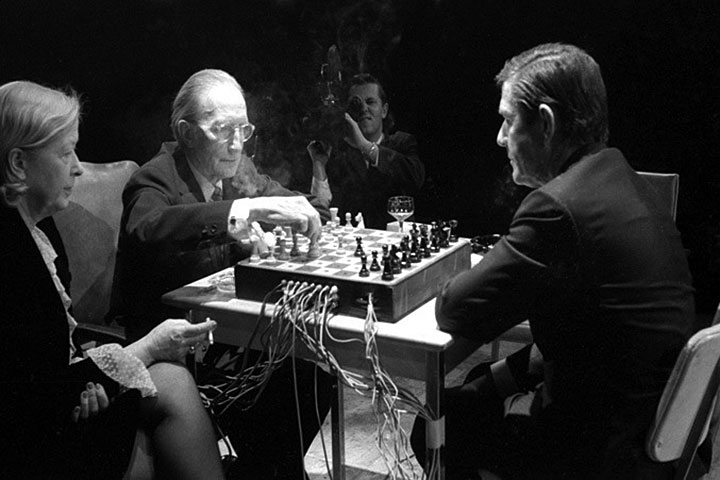
Sculptor and conceptual artist Marcel Duchamp playing chess. Unknown photographer, via Concepts into Virtualities
Marcel Duchamp, according to Andrew Stafford:
Marcel Duchamp (1887-1968), the painter and mixed media artist, was associated with Cubism, Dadaism and Surrealism, though he avoided any alliances. Duchamp’s work is characterized by its humor, the variety and unconventionality of its media, and its incessant probing of the boundaries of art. His legacy includes the insight that art can be about ideas instead of worldly things, a revolutionary notion that would resonate with later generations of artists.
Also, he liked to play chess.

Marcel Duchamp with chess set designed by his friend, Max Ernst
The photograph at left comes from ChessMate.com:
. . . Marcel Duchamp, enjoying a chess set designed and presented to him by fellow artist, Max Ernst.
To say that Duchamp was an avid chess player would be an understatement. He played at approximately expert to master strength, and it is well known that he had — during the later part of his formidable career as a visual artist — given up the pursuit of art in favor of chess.
Here is an interesting quote about art and chess that is attributed to Marcel Duchamp:
“I am still a victim of chess. It has all the beauty of art — and much more. It cannot be commercialized. Chess is much purer than art in its social position.”
You will also want to see:
- “Half-naked Thursday: Eve Babitz with Marcel Duchamp,” at You Can Hire An Artist. Is it safe for work or school? The photo shows Duchamp in a gallery filled with his works at in 1963, playing chess with Eve Babitz, who is nude. (The museum is identified as the “Pasadena Art Museum,” which would be the Pasadena Museum of Art of California See the explanation from Kathleen Benton in comments; I think it more likely that the museum is the Norton Simon Museum, also in Pasadena, but showing much more modern art and European art. (The Pasadena Art Museum is wonderful, by the way — an outstanding place to spend an afternoon; the Norton Simon is one you must see in your lifetime.)
- “Not Wanting to Say Anything About Marcel,” by John Cage, at the Norton Simon Museum in Pasadena.
Spread the word; friends don't allow friends to repeat history.


 Posted by Ed Darrell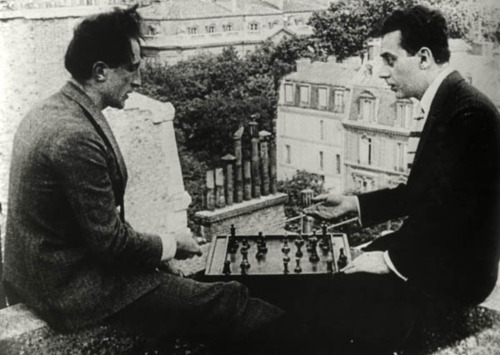




 Millard Fillmore's Bathtub