December 2: Happy Guano Day! (Thank you, Millard Fillmore)

December 2, 2016

Why December 2?

(You couldn’t make this stuff up if you were Monty Python.)

English: Millard Fillmore White House portrait

Millard Fillmore’s White House portrait, via Wikipedia

President Millard Fillmore, in the State of the Union Address, December 2, 1850

Peruvian guano has become so desirable an article to the agricultural interest of the United States that it is the duty of the Government to employ all the means properly in its power for the purpose of causing that article to be imported into the country at a reasonable price. Nothing will be omitted on my part toward accomplishing this desirable end. I am persuaded that in removing any restraints on this traffic the Peruvian Government will promote its own best interests, while it will afford a proof of a friendly disposition toward this country, which will be duly appreciated.

Did any other U.S. President spend so much time thinking about guano?  Did any president ever mention it in a State of the Union Address?  The curious case of Millard Fillmore, Seer, just grows.

Guano, or bird poop (and its relative, bat poop), contains phosphorus, which is an essential element for life.  Consequently, it turns out to be a key ingredient in effective agricultural fertilizers.  In international competition for supremacy in farming and farm exports, guano became a key resource to fight over, in the 19th century.

It’s almost safe to say the fights were economic; but guano did play a key role in wars in South America (see Andrew Leonard’s article, noted below).

Fillmore figured out that the substance had great importance, coupled that with the rather esoteric knowledge that sea birds tended to deposit guano in great abundance on certain islands, often unoccupied, and ordered the U.S. Navy to claim islands found to contain guano deposits that were not claimed by other nations.

By the American Civil War, the importance of phosphorus to the production of gun powder became an issue for the armies of the North and South.  Millard Fillmore had set the stage for the North to win an important advantage in gun powder production, just one of many that led to the defeat of the South.

It’s one more thing we should thank Millard Fillmore for doing. Our study of history should inform us that it is, indeed, important for politicians to understand the importance of guano.

Fillmore knew his guano.

Take a moment on December 2 to toast Millard Fillmore’s prescience, on Guano Day!

More:  

Yes, this is mostly an encore post. Fighting ignorance requires patience.

Yes, this is mostly an encore post. Fighting ignorance requires patience.

Save

Save


Buffalo News quiz: How well do you know birthday boy Millard Fillmore?

January 7, 2016

Inscription on the statute of Millard Fillmore at Buffalo's City Hall. Fillmore's better qualities crowd out critical elements. Buffalo News file photo.

Inscription on the statute of Millard Fillmore at Buffalo’s City Hall. “Lawyer, Educator, Philanthropist, Statesman.” Fillmore’s better qualities crowd out critical elements. Buffalo News file photo.

The venerable Buffalo News offers a quiz on our 13th president, Millard Fillmore, native son of Buffalo.

Happy birthday, Millard Fillmore, born January 7, 1800.

Nice of the Berkshire-Hathaway owned Buffalo News to make such a great tool for teachers, eh?


Any special activities at the Millard Fillmore Presidential Library for January 7?

January 7, 2016

The Ladies of Mount Vernon maintain George Washington’s home and a couple of farms, and now have an extensive center for teachers, in addition to an extensive library on Washington.

In Springfield, Illinois, a private foundation established the Abraham Lincoln Presidential Library and Museum.

Neither is part of the National Archives (NARA) presidential libraries programs. NARA operates libraries for Hoover, FDR, Truman, Eisenhower, Kennedy, Johnson, Nixon, Ford, Carter, Reagan, George H. W. Bush, Clinton, George Bush, and NARA will operate the Obama library from the start.

Other presidents are left out in the cold, mostly. There are informal facilities for Teddy Roosevelt, James Garfield, and Woodrow Wilson.

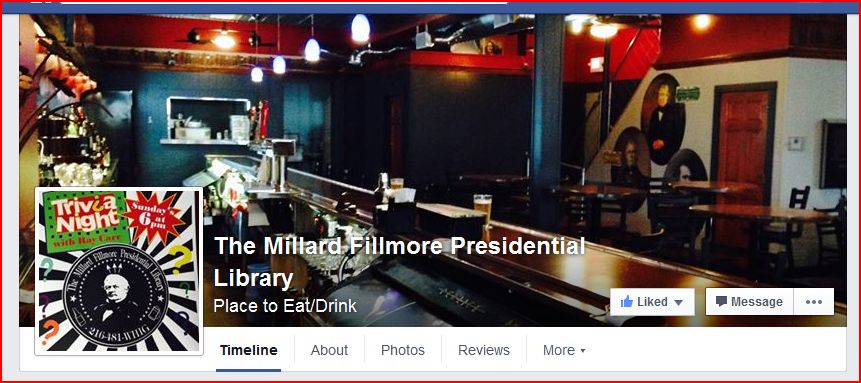
On Millard Fillmore’s birthday, January 7, I am happy to report there is a Millard Fillmore Presidential Library, too.

For some reason, it’s in Cleveland, Ohio.

Photo of the interior of the Millard Fillmore Presidential Library, in Cleveland, Ohio. Motto something like, "This ain't the LBJ Library."

Photo of the interior of the Millard Fillmore Presidential Library, in Cleveland, Ohio. From Facebook page. Motto something like, “This ain’t the LBJ Library.”

A promising place for scholarship on our 13th president, perhaps. Photos of Fillmore, previously unknown, have been published by this establishment.

The new Millard Fillmore Presidential Library casts new light on the 13th president's talents and methods of relaxation.

The new Millard Fillmore Presidential Library casts new light on the 13th president’s talents and methods of relaxation.

Finally, a place to properly celebrate Millard Fillmore’s 216th birthday anniversary, today!


A Gospel About Millard Fillmore – a Unitarian paean to our 13th president, born January 7, 1800

January 7, 2016

This sermon was delivered at the First Unitarian Universalist Society of San Francisco, by the Rev. John Robinson, on September 18, 2005.

Choir practice at First Unitarian Universalist Church of San Francisco.

Choir practice at First Unitarian Universalist Church of San Francisco.

That church used to keep this text in its sermon archives, but I recently discovered the archive had gone away.  I was happy to find I could get a historic version of the page, from which I got this text below.

I offer this here for scholars of the history of the presidency, and for scholars and fans of Millard Fillmore.  Oh, and to update the link in my list of sources on Millard Fillmore.

The Gospel About Millard Fillmore

This sermon began many years ago, over 30. Elliot Richardson had been invited to speak at the Annual Meeting of our Association of Free churches. He was then the martyred hero who had resigned as Attorney General of these United States rather than obey Richard Nixon’s order to fire Archibald Cox as Special Watergate Prosecutor. He was a Unitarian from an old Unitarian family.

Not all Unitarians were happy to have him as speaker. There was much agitation about the choice. Protesters tried to interrupt his speech, but were finally prevailed upon to let him make it.

In the question and answer period that followed, one of the dissenters demanded to know how Elliot Richardson, when Nixon’s Secretary of Defense, could have authorized the infamous December bombings of Hanoi and Haiphong.

Elliot Richardson pointed out to the questioner that he had not been appointed to Secretary of Defense until after the bombings, indeed until after the Vietnam Truce had been declared. He could have stopped there. Gotten off, as so many of us are apt to do, looking good. But he did not. He told the truth. He continued saying: “But, I think the decision to bomb was right.” It was the sort of candor that impresses.

Later that evening a young minister, this was years ago, was on a hotel elevator on to which Elliot Richardson stepped, unsuspectingly. Emboldened by spirits if not spirit. The young minister thanked Mr. Richardson for his speech and apologized for the rude behavior of some self-righteous Unitarians who treat those others of this tradition with whom they disagree so intolerantly. And then, as an illustration he launched into an impromptu sermon on Millard Fillmore. Ever polite, Elliot Richardson said he would like to see a full text. The young minister sent it to him, at the Court of St. James, where Mr. Richardson was at the time United States Ambassador to Great Britain. The Ambassador sent back a letter thanking the young minister for his sermon, saying that he had enjoyed it immensely. As a not so young minister, I still treasure that letter. Here for you this morning is the text of that sermon.

History has been unkind to Millard Fillmore, often referred to as “Millard Who?” forgetting that he was 13th president of the United States. One of the few accomplishments for which he is given credit is installing the first bath tub in the White House. There is serious doubt about that. [MFB note: No longer is there doubt; Fillmore was not the first.]

One historian said of Fillmore: “He came to the Presidency by the only road available to a man of limited ability, the death of his predecessor.” He was accused of being both pro-slavery and abolitionist. It was said he did “not have courage” “but was just inflexible.” They accused him of having “no position except equivocation,” that he was “without personal earnest conviction, personal force, or capacity for strong personal leadership.” His general rating as a president has been, until recently, below average, way below. He is judged bad or poor in his religiousness by those who judge such things. He was rejected by the religious community of which he was a member. He was a Unitarian.

There are three reasons to tell the story of Millard Fillmore: First, he illustrates the on-going tension in our free religious community, between the prophetic and the practical – the privilege of moral purity and the necessity to make real world decisions. Second, he illustrates well how difficult it is to judge our contemporaries. And third, to help restore Millard Fillmore to his rightful place in history.

The list of reasons for Fillmore’s lack of fame or infamy is long. His presidency was very short, only 2 years 236 days. His presidency is greatly overshadowed by the momentous events of the Civil War, eight years later. He was not liked by either the abolitionist historians or those historians who were apologists for the south. His association with the Know-Nothings tarnished his memory. And perhaps most important, the principal source of information about him came from the writings of his arch rival and enemy, the New York political boss Thurlow Weed, who called Fillmore derisively, “That incorruptible man from Buffalo.” Weed was very corruptible.

Millard Fillmore was born in a log cabin January 1, 1800, in upstate New York on his father’s poor, unproductive, isolated, farm. Millard was his mother’s maiden name. His education was sparse, no more than three months a year. He said that in the nine months working on his father’s farm, he forgot more than he learned the other three months. But his ambitious father apprenticed Millard to a cloth cutter, and then later got him a job in a law office. Millard’s Education was mostly self-learning, though by 20 he had a position as a schoolteacher. And then he became a lawyer. At 26 he married Abigail Powers who had taught him as he tried to catch up on his education. At 28 he was elected to the New York State Assembly.

At age 31 he joined a group of like-minded citizens in Buffalo New York where he now made his home. These were the founding and charter members of the First Unitarian Church of Buffalo New York.

Millard fought many good fights in the New York State Assembly. He fought for repeal of a law that required anyone testifying in court to swear that they believed in God and the hereafter. He pushed for an end to imprisonment for debt, and bankruptcy laws to protect small business interests. He fought for separation of church and state.

Millard was a party switcher right from the beginning. He was elected to the assembly as a National Republican, the party of Jefferson. Then He was elected as an Anti-Mason, a party he had helped to form. The Anti-Masons held that the Masonic Order with its lodges, secret rites and oaths, loyalties to something other than the Constitution, constituted an invisible Empire, a dangerous intrusion in a democracy. He wanted to get Masons out of government.

Fillmore was elected to Congress as a National Republican in 1832. His first term saw the formation of the Whig Party, an event he supported, as he wanted to see a party of National Union.

Unfortunately for those who look for titillation in sermons there were no publish rumors of moral turpitude. He served but one term in Congress, (perhaps an early supporter of term limits) and then went home to Buffalo and devoted himself to cultural and intellectual enrichment of Buffalo. (I know, you may think that an oxymoron.) He supported good causes like free public education and free public libraries.

In 1836 he was again elected to the House of Representatives. There he was made chair of the powerful House Ways and Means Committee. He also was chair of a Select Committee charged with investigation of election fraud in New Jersey (yes, I know, no change there). Incredibly Fillmore’s committee found 5 congressmen of his own party guilty, threw them out of congress, and thus handed control of The House to the opposition party! (IMAGINE!)

In 1842 he again left Congress, this time as a prominent Whig. The next year Horace Greely, editor of the NEW YORK TRIBUNE (also an alleged Unitarian), urged Fillmore’s candidacy for Vice-President. (Years later Fillmore repaid the favor by getting Greely out of debtors’ prison in Paris.)

1844 was not the year for Millard to get the nomination. He was held to be anti-slave and anti-Southern. He opposed the annexation of Texas as an attempt to swell slavery forces.

Later Millard opposed the Mexican War, which he believed would spread slavery and weaken the North’s industrial economy.

1848 was the year when Fillmore was tapped as the Whigs vice-presidential candidate. He balanced the ticket, with General Zachary Taylor, a Southerner, and slave owner, who was a hero of the Mexican War (ironically). Taylor ran on a rough and ready image. Leading abolitionists bolted the party, particularly New Englanders, notably the leading Unitarian, Charles Francis Adams.

The Taylor-Fillmore ticket had no platform because whatever was said would alienate part of the country. Abe Lincoln supported this ticket. On November 7, they won.

On July 9, 1850, rough and ready Zachary Taylor died from illness. Fillmore became President, the third President to be Unitarian. (In October of that same year this church was founded.) Within a month Fillmore had aroused the ire of the North by signing the Compromise of 1850. He did it, knowing that he had ruined any hope he had to run for the Presidency on his own. He also earned the animosity of many Unitarians.

The Compromise of 1850 preserved the balance between the North and South that dated from the Missouri Compromise and earlier. By it: California was admitted as a free state; New Mexico and Utah became Territories with no restriction on slavery; Texas was paid 10 million dollars to accept the Texas-New Mexico boundaries; slavery was to be decided by the people of Texas. The balance of concessions was further kept by prohibiting the slave trade in Washington, D.C. but continuing the right (better said the wrong) of slave ownership in the capital. The provision that enraged the abolitionists most was the strengthening of the fugitive slave laws. It empowered federal agents to enforce the act. The Whig Party split over Fillmore’s signing of the law.

Ralph Waldo Emerson (Unitarian) said of the fugitive slave law, “I will not obey it, by God.” Theodore Parker (author of the opening words this morning), a Boston Unitarian minister, led an armed band of vigilantes that confronted slave hunters up from the South; intimidated them into leaving; and saved a slave couple who had escaped to Boston. Parker had acted in direct defiance of the Fugitive Slave Law. With loaded pistol and sword ready on his writing desk Unitarian Parker wrote the Unitarian President, Fillmore, telling what he had done and challenging Fillmore to enforce his “damned law.”

History has judged Fillmore harshly for that one law – a Unitarian President perpetuating slavery – the scandal! Why did he do it? Talk of secession! Remember the times. Even before Taylor’s inauguration, Virginia had passed legislation that threatened secession if the federal government interfered with “Southern Institutions”. John C. Calhoun (also a Unitarian and charter member of the Unitarian Church in Washington D.C.) and other Southern leaders were making ominous warnings. Tension between the States in the House of Representatives kept them from selecting a Speaker for over three weeks. By the time Fillmore took office, the South was ringing with calls for secession, not only if slavery were interfered with but if its expansion were checked.

Fillmore’s predecessor, Taylor, a Southerner, a slave owner and war hero, might have held the country together had he lived to veto the compromise of 1850 as he had said he would. Fillmore knew he could not hold the Union if he vetoed it. He set one goal, to preserve the Union and the Constitution. To give up the great compromise forged in 1787-1788 would, he knew, lead to the rupture of the Union. He thought the North was at that time not yet strong enough to win a civil war. Modern historians agree.

By the end of October 1850, Fillmore had angered abolitionists by sending federal troops to assist U.S. Marshal’s in the arrest of fugitive slaves. His determination for the compromise was also felt in the South. He sent reinforcements for Charleston, South Carolina where Southerners, angry over the North’s resistance to the fugitive slave laws, were threatening to seize federal property.

Fillmore has been most severely criticized for not fighting slavery with determination. However, there is another side. John F. Kennedy in Profiles of Courage chose to profile Daniel Webster. Webster was also a Whig and a Unitarian. Kennedy praises Webster for his courage in supporting The Compromise of 1850 with its Fugitive Slave Law. Fillmore had presided as Vice-President over the debates on the Compromise. He had heard Webster’s famous speech that cost Webster the support of his Massachusetts constituents. Emerson said of Webster at this time “The word ‘liberty’ in the mouth of Mr. Webster sounds like the word ‘love’ in the mouth of a courtesan.”

Webster and Fillmore thought slavery would die a natural death in the industrial revolution (Why invest capital in slave ownership when an Irishman could be rented for next to nothing in wages.) They saw the tension, not so much as slave vs. free, as agriculture vs. industry.

Webster was but one vote for the bill. Fillmore alone shouldered the final responsibility to veto or sign the bill. Fillmore bore the blame for the Compromise of 1850. Do not forget that Lincoln, the Great Emancipator, said that if he could preserve the Union by keeping slavery, he would.

When the Compromise of 1850 fell apart, the Civil War began. The Whigs were terribly weakened by abolitionist outrage.

Perhaps Fillmore’s next most far-reaching act was to send Commodore Perry to Japan. But Fillmore was done. The Whigs were done.

In the election of 1852 Fillmore and Webster fought over the nomination for President at the next Whig Convention, for 47 ballots to a deadlock. In the end, a man neither of them could support was nominated and lost the election. A saddened Fillmore attended, with his wife, the cold rainy inauguration of Franklin Pierce. Three weeks later Fillmore’s wife died of pneumonia contracted that inauguration day. Fillmore’s 22 year old daughter died the year after he left office.

After he had stepped down from office, the Officers of the American Unitarian Association invited Millard Fillmore to preside over the Annual Meeting. But abolitionists refused to allow him to be seated after he got there. They would have no part of this man who would not follow their conscience. One hopes that this free religion might be gentler today but I am not sure. After the Civil War, Fillmore stung by their action resigned from the Buffalo Church when its minister and his friend died.

By 1856 the Whig party had disintegrated. The lines grew harder: Democrats to the South, Republicans to the North. Millard Fillmore wanted a party for the Union. He then made the second mistake for which he has been charged harshly. He offered himself to the American Party, the Know-Nothings, anti-foreign and anti-Catholic, as candidate — a devil of a thing for a free religionist to do. He hoped to gather there the remnants of the Whigs. He then went off to Europe on a 12-month vacation.

Ironically he was on foreign soil, after just completing an audience with the Pope when he was notified that he had received the Know-Nothing’s nomination for President. He was chosen because he was the only person of stature that they could get.

But many Know-Nothings were unhappy with him and bolted the party. Fillmore is not known to have ever expressed any anti-Catholic sentiments. This though he had lost a bid for Governor of New York because Catholics were angry that his militancy for separation of church and state made him oppose state funding they sought for various Catholic institutions.

Fillmore expressed no support for the Know-Nothing goal of removing all Catholics from office alleging they would be loyal to the Pope rather than the U.S.A. He did, however, believe that foreigners should be fully Americanized in their views before becoming citizens. He was also concerned that immigrants, who joined our diplomatic service, were sent to the countries from which they had come. He thought it a potential conflict of interest.

In 1856, he ran for President as the American Party candidate with a Southern slaveholder as his running mate. They emphasized in the campaign regional compromise and preservation of the Union. They carried only the State of Maryland. However they also were the spoilers that kept the Republicans from winning and thus put the Civil war off four more years. It is important remember that the changes happening in this nation, at this time, were more dramatic and far reaching in many ways than the computer revolution in our own. These were the years of the industrial revolution. The dramatic growth of railroads and factories, was changing the North for a subsistence farm economy to market agriculture and industrial growth. These changes radically altered the balance between North and South, increasing the might of the North disproportionately.

It is difficult to know whether Millard was in any sense a believer in Know-Nothingism, or if he knew of the violence in which some of its members engaged, or if he merely compromised himself to win his objective of continued Union of the States. He wouldn’t be the first prejudice Unitarian. He was not a radical Abolitionist. He said, however, that he thought the fugitive slave law odious but constitutional.

Slavery was a despicable practice. There is no apology for it. It is easy to condemn compromisers. But it is harder to make the difficult decisions that the real world demands. If it had not been for the courage of Fillmore the Civil war would have come sooner. And if the South had succeeded in becoming independent, how long and how entrenched by bitterness would slavery have lasted? Until today? And if cooler heads had prevailed, compromise succeeded, would slavery possibly have collapsed anyway without the blood shed and bitterness engendered by that fratricidal war?

The tension between the ideal and the real, the promise and what is practical, between moral purity and the sin of every day life, is very real. It is a tension that we humans are both burdened and blessed with. I leave you to struggle with these hard dilemmas. You do each time you vote. I believe that we are at our best when we walk with each other talk with each other, even in our differences, rather than separating.

Millard Fillmore lived out the balance of his days quietly in private life. He supported Lincoln, met Lincoln in Buffalo when Lincoln was on his way from Illinois to his First Inaugural. He took Lincoln to services at the First Unitarian Church of Buffalo. He thought that the Republicans had provoked the Civil War but gave it his support at rallies. He thought Lincoln too harsh – he strongly supported Andrew Johnson’s efforts at conciliation.

Fillmore was no Saint if you look for moral purity, nor was he our most brilliant President. He refused an Honorary Degree from Oxford, because he had no earned degree of any kind. He said he was “not entitled to it.” (Give him high marks on humility). But he was more than most have given him credit for. He risked and lost his reputation to keep the vision of a United States, even as others risked much to purify that vision. In looking up Eliot Richardson on the Internet, I find that he is listed as an Episcopalian/Anglican. Perhaps he too felt the sting of our righteousness at the General Assembly.

May we, O God, be people who understand that the course of truth and good is never so easy, and that the tread of evil runs through each of us, most surely when we are convinced of our own righteousness.

Amen and Amen.

Mostly accurate, so far as I can tell.  No, I haven’t figured out how you cite this under MLA standards.

Yes, this is mostly an encore post. Fighting ignorance requires patience.

Yes, this is mostly an encore post. Fighting ignorance requires patience.


Happy birthday, Millard Fillmore! Mo Rocca’s profile, from our archives to yours

January 7, 2016

Millard Fillmore as a younger man? Several sites claim this is a painting of Fillmore, but as with much about our mysterious 13th president, it's difficult to confirm, partly because images of Fillmore really are rather rare.

Millard Fillmore as a younger man? Several sites claim this is a painting of Fillmore, but as with much about our mysterious 13th president, it’s difficult to confirm, partly because images of Fillmore really are rather rare.

Our 13th president, Millard Fillmore, was born January 7, 1800. He’s 216 years old today, though he’s been dead most of that time.

After commemorating Fillmore’s birthday each year for the past several years, I’m running out of ideas to write about him that seem novel, at least to me. Several years I’ve called the University of Buffalo to try to get copies of the remarks officials make at Fillmore’s gravesite, but those remarks rarely come through — so we don’t get enlightenment from them.

Reality? Few people remember anything about Fillmore even after we feature it here. For Fillmore’s 216th, let’s review what little we really know about him, with some encore posts.

Raconteur Mo Rocca profiled Fillmore for CBS’s Sunday Morning, a while back. That may be as good a place as any to review the highlights of Fillmore’s life, and meaning and place in U.S. history.

Most historians give Fillmore bad marks as a president, despite his having opened Japan for trade, and despite his having procured a steady supply of bird poop for U.S. industry.

I get this eerie feeling Fillmore would fit right in today in the GOP presidential scraps, and would be a serious challenge to fellow New Yorker Donald Trump. Do you agree?

You may view Mo Rocca’s “profile” of President Millard Fillmore for CBS Sunday Morning, on YouTube:

“CBS Sunday Morning” correspondent Mo Rocca, far left, poses with Kathy Frost, curator of the Millard Fillmore Presidential Site, and Robert Lowell Goller, town historian and director of the Aurora Historical Society, during his recent visit to East Aurora. Photo by Robert Lowell Goller

East Aurora Advertiser caption: CBS Visits East Aurora “CBS Sunday Morning” correspondent Mo Rocca, far left, poses with Kathy Frost, curator of the Millard Fillmore Presidential Site, and Robert Lowell Goller, town historian and director of the Aurora Historical Society, during his recent visit to East Aurora. Photo by Robert Lowell Goller

CBS broadcast this piece on February 16, 2014.

 974

More:


July 10, 1850: Last of the Whigs, Millard Fillmore sworn in as president

July 10, 2015

Bust of Millard Fillmore as Vice President, by Robert Cushing. Fillmore served 17 months as Vice President and President of the Senate. Photo from the U.S. Senate

Bust of Millard Fillmore as Vice President, by Robert Cushing. Fillmore served 17 months as Vice President and President of the Senate. Photo from the U.S. Senate

Whig Party? Does anyone know what a Whig stood for any more?

Millard Fillmore was elected vice president riding the ticket with the very popular Gen. Zachary Taylor, hero of the Mexican War.  Fillmore was a capable, yeoman politicians from a northern state; with only one president’s death in the preceding 59 years, parties had not yet figured out that the vice presidential candidate probably ought to be able to serve as president. Regional balance of the ticket was enough.

About 15 months into his presidency, President Taylor took ill  after presiding over July 4 festivities in blazing heat.  He died on July 9, 1850; Vice President Millard Fillmore took the oath as president the next day, and served out the term.  165 years ago today, Millard Fillmore served his first day as President, July 10, 1850.

Fillmore became the second person to take the presidency of the U.S. without having been elected.  John Tyler was William Henry Harrison’s vice president when Harrison died of pneumonia a mere 31 days after being sworn in as president.

Millard Fillmore in an 1850 lithograph by Francis DAvignon after a photograph by Matthew Brady (unclear if this was before or after his ascending to the presidency) - Library of Congress image

Millard Fillmore in an 1850 lithograph by Francis D’Avignon after a photograph by Matthew Brady (unclear if this was before or after his ascending to the presidency) – Library of Congress image

As president, Zachary Taylor encouraged New Mexico and California to draw up state constitutions, which would have disallowed slavery in those states.  To southern leaders who threatened secession, Taylor promised to personally lead the army that would hold the union together by force, and personally hang those who had proposed rebellion.  Fillmore succeeded Taylor at a crucial time in the union’s history, on the knife-edge of states’ seceding over the issues of slavery.

Fillmore had presided over the Senate during months of furious debate on issues that always seemed to come down to slavery.  Because he didn’t hold to the views of the Whig Party which had elected the Taylor-Fillmore ticket, even more than Taylor had strayed, the cabinet resigned.  Fillmore appointed Daniel Webster as Secretary of State, and proceeded to push for compromise on issues to avoid war.  His machinations helped get California admitted as a free state, but left New Mexico as a territory.  Fillmore’s support of the Fugitive Slave Act alienated even more Whigs, and by 1852 the Whigs refused to nominate Fillmore for a term of his own.  He left office in 1853, succeeded by Franklin Pierce.

Fillmore’s greatest accomplishment as president, perhaps, was his sending a fleet of ships to Japan to force that nation to open up to trade from the U.S.  The political furor over the Fugitive Slave Act, the Missouri Compromise, and other issues around slavery, tend to eclipse the memory of the good that Fillmore did.

Nota bene:  Controversy surrounded the death of Taylor.  Because he had threatened southern secessionists and incurred anger from several other groups, from the time of his death there were rumors he had been poisoned with arsenic.  Officially, the cause of death was gastroenteritis; popular accounts note that he had, in the heat of July, drunk milk and eaten cherries and cucumbers.  Certainly strep, staph or other bacteria in the milk could have created a problem.  In 1991 a team led by George Washington University Law Professor James Starrs exhumed Taylor’s body from his Louisville, Kentucky burial plot, and tested his remains for arsenic at the Oak Ridge National Laboratory.  Analysis presented to the Kentucky medical examiner indicated arsenic levels way too low for a poisoning victim.

[This is an encore post, in parts.]

More:

"An Available Candidate: The One Qualific...

“An Available Candidate: The One Qualification for a Whig President”. Political cartoon about the 1848 presidential election which refers to Zachary Taylor or Winfield Scott, the two leading contenders for the Whig Party nomination in the aftermath of the Mexican-American War. Published by Nathaniel Currier in 1848, digitally restored. (Photo credit: Wikipedia)  Despite the cynicism of many , Zachary Taylor won the Whig Party nomination, and the presidency.  Taylor died just over a year after his inauguration.

Yes, this is mostly an encore post. Fighting ignorance requires patience.

Yes, this is mostly an encore post. Fighting ignorance requires patience.


Millard Fillmore’s ascent, July 9, 1850: Death of President Zachary Taylor

July 10, 2015

President Zachary Taylor died on July 9, 1850.  The cause is still not fully clear, but poisoning by arsenic has been ruled out.

What would have happened had Taylor lived?

At the blog of the National Constitution Center, we get a few details of his death and life immediately preceding:

President Zachary Taylor’s death on July 9, 1850 shocked a nation that was in a heated debate about issues that eventually led to the Civil War. But his sudden passing also sidestepped two constitutional crises.

zachary-taylorThe details about how and why President Taylor died are still in dispute today. The president attended a ceremony at the site of the Washington Monument on July 4th on a reportedly hot summer day.

He fell ill soon after with a stomach ailment. His doctors gave him relief medication that included opium and later bled the president. Taylor died five days later at the age of 65.

Officially, he died from cholera morbus, and today, the prevalent theory is that Taylor suffered from gastroenteritis, an illness exacerbated by poor sanitary conditions in Washington.

There are other theories, including one where Taylor was poisoned by people who supported the South’s pro-slavery position. (In recent years, Taylor’s body was exhumed and a small, non-lethal amount of arsenic was found in samples taken from his corpse.)

It was Taylor’s unexpected opposition to slavery (he was from the South and was the last president to own slaves) that had caused an immediate crisis in 1850.

Taylor ran as a Whig candidate in 1848 and he wasn’t a professional politician. Taylor was a career military man and a hero in the war with Mexico.

Once he took office in March 1849, it became clear that Taylor, the military man, was more interested in preserving the Union than the art of politics.

Taylor decided to press for statehood for the newly acquired territories of California and New Mexico, and to let the regions hold their own constitutional conventions. This guaranteed that California and New Mexico would join the Union as anti-slavery states, tipping the balance in the Senate to the North.

[more at the blog site]

In any case, Taylor died on July 9.

And on July 10, 1850, his vice president, Millard Fillmore, was sworn in as president.

No, that doesn’t mean the bathtub tale is true.

More:

Yes, this is mostly an encore post. Fighting ignorance requires patience.

Yes, this is mostly an encore post. Fighting ignorance requires patience.


89 years ago, May 23, 1926: Mencken confessed Fillmore bathtub hoax, “any facts . . . got there accidentally”

May 23, 2015

Reasons for my annual observance of a moment of silence, here on May 23, for the failed confession of Mr. Mencken should be obvious to even a sleepy reader.  Alas, annually the need grows to call attention to the dangers of hoaxing, as hoaxes particularly in the political life of the U.S. grow in number, in viciousness, and in the numbers of gullibles suckered.  Here, again, is our annual reading of the confession with a few photographs and new links thrown in for easy learning:

May 23, 1926, H. L. Mencken‘s newspaper column confessed his hoax of nine years earlier — he had made up whole cloth the story of Millard Fillmore‘s only accomplishment being the installation of a plumbed bathtub in the White House (in the 1850s known as the Executive Mansion).

H. L. Mencken, America's "wittiest defender of liberty," according to a story in the resurrected American Mercury. Image from American Mercury.

H. L. Mencken, America’s “wittiest defender of liberty,” according to a story in the resurrected American Mercury. Image from American Mercury.

Alas, the hoax cat was out of the bag, and the hoax information still pollutes the pool of history today.

Text of Mencken’s confession, from the Museum of Hoaxes:

Melancholy Reflections

On Dec. 28, 1917, I printed in the New York Evening Mail, a paper now extinct, an article purporting to give the history of the bathtub. This article, I may say at once, was a tissue of absurdities, all of them deliberate and most of them obvious…

This article, as I say, was planned as a piece of spoofing to relieve the strain of war days, and I confess that I regarded it, when it came out, with considerable satisfaction. It was reprinted by various great organs of the enlightenment, and after a while the usual letters began to reach me from readers. Then, suddenly, my satisfaction turned to consternation. For these readers, it appeared, all took my idle jocosities with complete seriousness. Some of them, of antiquarian tastes, asked for further light on this or that phase of the subject. Others actually offered me corroboration!

But the worst was to come. Pretty soon I began to encounter my preposterous “facts” in the writings of other men. They began to be used by chiropractors and other such quacks as evidence of the stupidity of medical men. They began to be cited by medical men as proof of the progress of public hygiene. They got into learned journals. They were alluded to on the floor of congress. They crossed the ocean, and were discussed solemnly in England and on the continent. Finally, I began to find them in standard works of reference. Today, I believe, they are accepted as gospel everywhere on earth. To question them becomes as hazardous as to question the Norman invasion.

* * *

And as rare. This is the first time, indeed, that they have ever been questioned, and I confess at once that even I myself, their author, feel a certain hesitancy about doing it. Once more, I suppose, I’ll be accused of taking the wrong side for the mere pleasure of standing in opposition. The Cincinnati boomers, who have made much of the boast that the bathtub industry, now running to $200,000,000 a year, was started in their town, will charge me with spreading lies against them. The chiropractors will damn me for blowing up their ammunition. The medical gents, having swallowed my quackery, will now denounce me as a quack for exposing them. And in the end, no doubt, the thing will simmer down to a general feeling that I have once more committed some vague and sinister crime against the United States, and there will be a renewal of the demand that I be deported to Russia.

I recite this history, not because it is singular, but because it is typical. It is out of just such frauds, I believe, that most of the so-called knowledge of humanity flows. What begins as a guess — or, perhaps, not infrequently, as a downright and deliberate lie — ends as a fact and is embalmed in the history books. One recalls the gaudy days of 1914-1918. How much that was then devoured by the newspaper readers of the world was actually true? Probably not 1 per cent. Ever since the war ended learned and laborious men have been at work examining and exposing its fictions. But every one of these fictions retains full faith and credit today. To question even the most palpably absurd of them, in most parts of the United States, is to invite denunciation as a bolshevik.

So with all other wars. For example, the revolution. For years past American historians have been investigating the orthodox legends. Almost all of them turn out to be blowsy nonsense. Yet they remain in the school history books and every effort to get them out causes a dreadful row, and those who make it are accused of all sorts of treasons and spoils. The truth, indeed, is something that mankind, for some mysterious reason, instinctively dislikes. Every man who tries to tell it is unpopular, and even when, by the sheer strength of his case, he prevails, he is put down as a scoundrel.

* * *

As a practicing journalist for many years, I have often had close contact with history in the making. I can recall no time or place when what actually occurred was afterward generally known and believed. Sometimes a part of the truth got out, but never all. And what actually got out was seldom clearly understood. Consider, for example, the legends that follow every national convention. A thousand newspaper correspondents are on the scene, all of them theoretically competent to see accurately and report honestly, but it is seldom that two of them agree perfectly, and after a month after the convention adjourns the accepted version of what occurred usually differs from the accounts of all of them.

Political boss Harry M. Daugherty (later Attor...

Political boss Harry M. Daugherty (later Attorney General of the United States), left, with Senator Warren G. Harding (later President of the United States) at Harding’s home in Marion, Ohio during the 1920 presidential campaign. (Photo credit: Wikipedia)

I point to the Republican convention of 1920, which nominated the eminent and lamented Harding. A week after the delegates adjourned the whole country believed that Harding had been put through by Col. George Harvey: Harvey himself admitted it. Then other claimants to the honor arose, and after a year or two it was generally held that the trick had been turned by the distinguished Harry M. Daugherty, by that time a salient light of the Harding cabinet. The story began to acquire corroborative detail. Delegates and correspondents began to remember things that they had not noticed on the spot. What the orthodox tale is today with Daugherty in eclipse, I don’t know, but you may be sure that it is full of mysterious intrigue and bold adventure.

Ambassador Myron T. Herrick was part of the U....

Ambassador Myron T. Herrick was part of the U.S. delegation to the International Chamber of Commerce which sailed on Kroonland in 1920. (Photo credit: Wikipedia)

What are the facts? The facts are that Harvey had little more to do with the nomination of Harding than I did, and that Daugherty was immensely surprised when good Warren won. The nomination was really due to the intense heat, and to that alone. The delegates, torn by the savage three cornered fight between Lowden, Johnson, and Wood, came to Saturday morning in despair. The temperature in the convention hall was at least 120 degrees. They were eager to get home. When it became apparent that the leaders could not break the deadlock they ran amuck and nominated Harding, as the one aspirant who had no enemies. If any individual managed the business it was not Harvey or Daugherty, but Myron T. Herrick. But so far as I know Herrick’s hand in it has never been mentioned.

* * *

English: Jack Dempsey and Georges Carpentier i...

Jack Dempsey and Georges Carpentier in arena before fight at Boyle’s Thirty Acres. (Photo credit: Wikipedia)

I turn to a more pleasant field — that of sport in the grand manner. On July 2, 1921, in the great bowl at Jersey City, the Hon. Jack Dempsey met M. Carpentier, the gallant frog. The sympathy of the crowd was overwhelmingly with M. Carpentier and every time he struck a blow he got a round of applause, even if it didn’t land. I had an excellent seat, very near the ring, and saw every move of the two men. From the first moment Dr. Dempsey had it all his own way. He could have knocked out M. Carpentier in the first half of the first round. After that first half he simply waited his chance to do it politely and humanely.

Yet certain great newspapers reported the next morning that M. Carpentier had delivered an appalling wallop in the second round and that Dr. Dempsey had narrowly escaped going out. Others told the truth, but what chance had the truth against that romantic lie? It is believed in to this day by at least 99.99 per cent of all the boxing fans in Christendom. Carpentier himself, when he recovered from his beating, admitted categorically that it was nonsense, but even Carpentier could make no headway against the almost universal human tendency to cherish what is not true. A thousand years hence schoolboys will be taught that the frog had Dempsey going. It may become in time a religious dogma, like the doctrine that Jonah swallowed the whale. Scoffers who doubt it will be damned to hell.

The moral, if any, I leave to psycho-pathologists, if competent ones can be found. All I care to do today is to reiterate, in the most solemn and awful terms, that my history of the bathtub, printed on Dec. 28, 1917, was pure buncombe. If there were any facts in it they got there accidentally and against my design. But today the tale is in the encyclopedias. History, said a great American soothsayer, is bunk.

[Emphasis in that last paragraph added here.]

Mencken’s confession gets much less attention than it deserves.  In a just world, this essay would be part of every AP U.S. history text, and would be available for printing for students to read individually in class and to discuss, debate and ponder.  Quite to the contrary, state legislatures today debate whether to require teaching of the hoax that disastrous climate change is not occurring, only 45% of Americans claim to know better for certain; more legislatures work hard to devise ways to insert hoaxes against biology (evolution and human reproduction, notably), astronomy and physics (Big Bang), history and even education (Islam is a root of socialist thought, President Obama is not Christian, weapons of mass destruction were found in Iraq after the U.S. invasion, teachers are socialists).

In 2013, the governing body of the Boy Scouts of America voted on whether to allow homosexual boys to be Scouts — as if an 8-year-old kid joining Cub Scouts knows enough about sex and love, and sex predation, to threaten the Constitution of the U.S. if we allow him to learn how to put alphabet macaroni onto a board spelling out “Mom,” or to learn how to carve an automobile out of a block of wood and race it on a closed-course track.  The so-called Family Research Council (FRC) has conducted a campaign of vicious hoaxes against the measure, even going so far as to purloin official logos of the Boy Scouts to suggest they speak for BSA.  The hoax has millions of victims, they claim.

Meanwhile, in Washington, D.C., GOP Members of Congress call for investigations into wrongdoing evidenced in e-mails between the White House and State Department and CIA, over the attack on the U.S. diplomatic mission in Benghazi, Libya, and the death of Ambassador Chris Stevens.  To hear the GOP describe it, you’d never know that the GOP opposed President Obama’s actions to save the city of Benghazi from destruction by dictator Muammar Gadhafy a few months before, that the GOP slashed the security budget for all U.S. diplomatic missions, leaving Ambassador Stevens underprotected, that the GOP was opposed to much of the work of Ambassador Stevens, or that the incriminating e-mails were hoaxed up by GOP Congressional staff.  [This paragraph was written two years ago; still oddly valid in 2015.]

Other hoaxes that plague our nation, national security, and freedom from fear:

  • Texans fret that President Obama will invade Texas and annex it into the United States of America.
  • Many business lobbyists scream that rogue scientists cooked up global warming, and tell us that all of us frogs will know when the water is too warm, and can leap to safety later.
  • Any Google or Bing search turns up high dudgeon ne’er-do-gooders who scream that we need to bring back DDT to beat malaria, Ebola, West Nile virus and tooth decay, though DDT has always been available to fight disease-carrying insects, and it won’t work against Ebola, and it’s inappropriate against West Nile.
  • Et cetera.
  • Et cetera.
  • Et cetera.

If you see pale faces among the GOP Congressional staff or the FRC this morning, it may be because the ghost of H. L. Mencken appeared to them last night to give them hell.  We could hope.

More:

Yes, this is mostly an encore post. Fighting ignorance requires patience.

Yes, this is mostly an encore post. Fighting ignorance requires patience, and repetition of the facts.


Millard Fillmore, live on Peachtree Street, 1854

March 4, 2015

Lower Peachtree Street, Atlanta, in 1910, 56 years after ex-President Millard Fillmore visited. Library of Congress photo via Chamblee54

Lower Peachtree Street, Atlanta, in 1910, 56 years after ex-President Millard Fillmore visited. Library of Congress photo via Chamblee54

Chamblee54, in a history of Peachtree Street studded with interesting photographs, notes Atlanta’s first-time brush with any ex-president:

In 1854, Atlanta entertained, for the first time, a man who had been President. On May 2, Millard Fillmore arrived from Augusta on a private rail car.

Two years after the Whigs refused to nominate Fillmore for a term of his own, he was out touring the country?

Several accounts explain that Fillmore and his wife Abigail wanted to tour the U.S. after his presidency.  Unfortunately, she died shortly after he left office.  He pined through the rest of 1853, but by February 1854 had decided to tour by himself, without his children, accompanied by friends he could persuade to join him.

That same month, Fillmore decided to take the trip southward that he and Abigail had not been able to take. Given the timing, some observers believed that Fillmore had a political motive in making the journey.  They suspected that he might be planning to speak out against the Nebraska Bill [proposed by Illinois’s U.S. Senator Stephen A. Douglas]. Others were convinced that it was a leisure tour.  But whatever Fillmore’s intentions may have been, his speeches to southern audiences were relatively neutral.  He restated his faith in the [Missouri] Compromise, but he spent mos tof his time enjoying a series of receptions, dinners, and parades in his honor throughout the region.  A marching band escorted him through the streets of Louisville, Kentucky.  Girls scattered his path with flowers in Montgomery, Alabama.  A row of trains blew their whistles in greeting in Atlanta, Georgia.  Fillmore returned home refreshed and with renewed faith in his fellow Americans.

Alison Behnke, Millard Fillmore (a child’s history of the man), 2005, page 92.

A longer description came out of Robert J. Scarry’s 1982 biography:

By late February 1854 Fillmore had resumed his plans to travel.  He perceived that a southern trip would do him good and that the journey would divert his mind from the loss of Abigail.

*******

Fillmore hoped Francis Granger, John P. Kennedy, and Washington Irving would go with him on the trip. Granger lost interest, and Irving, who had been asked by his friend Kennedy, was in no mood for politics.

*******

En route to Atlanta from Augusta on the Georgia Railroad, they stopped at Greensboro where a large crowd of teachers and students of the Female College greeted Fillmore and Kennedy.  They dined at Madison.  At Stone Mountain an escort committee from Atlanta met them.

At the Atlanta Depot a novel reception welcomed them.  A large number of locomotives were present with their steam up.  When the Augusta engineer signalled their arrival they all opened up their valves and whistled out a welcome the like of which, reported a newspaper, “no mortal man had heard before.” The shouts from the crowd and locomotive whistles were deafening to one reporter.  By carriage the party went from the depot to the Atlanta Hotel where a reception was held.

Fillmore had become hoarse. Nonetheless, he managed to say that he was impressed by the large population and that he had heard that it was a beautiful village in the center of the state. He also admonished the state legislature to to take note “of the array of female loveliness before me” seated at the reception.  If they did so, he joked, they wouldn’t hesitate to locate the state capital at Atlanta.  At that time the capital was at Milledgeville.  Atlanta became the capital in 1877.  In the evening, after dinner, a ball was held.  Fifty young ladies dressed in white with bouquets of flowers were a highlight of the occasion.

Robert J. Scarry, Millard Fillmore, 1982, pages 247-252 variously.

Any photos of Fillmore in Atlanta?

Millard Fillmore is in some ways the ultimate exemplar of American civic boosterism.  These accounts tend to be softball, even when the potential political effects of his trip to Atlanta are discussed.  One gets a sense that contemporary accounts of the trip were equally bland and uncontroversial.  Fillmore’s trip offered a lot of local chamber of commerce precursors a chance to plug their local industry, development and pride.  Fillmore seems incapable of not offering pride-stoking flattery to these group of people.  That’s not necessarily bad.

Within a dozen years the nation would be engulfed in the Civil War.  Atlanta would be burned.  The railroads Fillmore rode would be torn up by Union armies.

What a snapshot, even without photos.

A not-often seen image of Millard Fillmore.  Via Accessible Archives.

A not-often seen image of Millard Fillmore. Via Accessible Archives.


Millard Fillmore, blazing paths as an ex-president

January 15, 2015

Caption from the University of Buffalo: Aurora [New York] town historian Robert Goller delivers the commemorative address indoors at the Margaret L. Wendt Archive and Resource Center in Forest Lawn. Photo: Douglas Levere - See more at: http://www.buffalo.edu/ubreporter/campus/campus-host-page.host.html/content/shared/university/news/ub-reporter-articles/stories/2015/01/fillmore_commemoration.detail.html#/imagegallery/5

Caption from the University of Buffalo: Aurora [New York] town historian Robert Goller delivers the commemorative address indoors at the Margaret L. Wendt Archive and Resource Center in Forest Lawn. Photo: Douglas Levere – See more at: http://www.buffalo.edu/ubreporter/campus/campus-host-page.host.html/content/shared/university/news/ub-reporter-articles/stories/2015/01/fillmore_commemoration.detail.html#/imagegallery/5

I finally found reports of the ceremonies at Millard Fillmore’s gravesite, from January 7, Fillmore’s 215th birth anniversary.  This one comes from the Seneca (New York) Bee:

Historian delivers annual address at Fillmore memorial

by MARY BEST
Reporter

Frigid temperatures didn’t turn away a crowd at the 50th annual Millard Fillmore Commemoration Ceremony at Forest Lawn Cemetery on Jan. 7.

The program, presented by the University at Buffalo and co-hosted by Forest Lawn and the Buffalo Club, was celebrated on Fillmore’s 215th birthday. Robert Goller, Town of Aurora historian, gave the memorial address.

New York Air National Guard Col. Kevin Rogers began the ceremony by laying a wreath at Fillmore’s grave site from President Barack Obama, in keeping with tradition of past presidents. Deputy Mayor of the City of Buffalo Ellen Grant also presented a wreath, later adorned with pins from representatives of Fillmore’s legacy organizations.

Fillmore returned to Buffalo following his loss of the 1852 presidential election. He had a hand in establishing and ensuring the survival of many organizations including the Albright Knox Art Gallery, the Buffalo and Erie County Public Library System, the SPCA serving Erie County and the University at Buffalo.

Due to the subzero wind chill, Goller delivered the memorial address from the Margaret L. Wendt Archive and Resource Center after the wreath dedications.

Goller began his address describing Fillmore’s humble beginnings, including the rough journey Fillmore took from Central New York on foot to arrive to his family’s home in Aurora.

“It’s easy to forget that in Millard Fillmore’s day, there wasn’t even a railroad to take the future president halfway across New York State,” Goller said.

The Aurora Historical Society, which runs the Millard Fillmore National Historic Landmark Museum, is also raising funds to commemorate Fillmore’s legacy by commissioning a presidential site to include a statue and a recreation of Fillmore’s law office. Goller also noted Fillmore’s role presiding over the Senate as vice president during a turbulent time in history, which dealt with slavery and secession.

Fillmore’s greatest legacy, however, happened after his time at the White House was over, an often overlooked period of time, according to Goller.

“While Fillmore’s presidency was relatively short, he was probably one of the most effective at using the power of the post-presidency to lend support to important efforts,” Goller said. “The word retirement certainly didn’t describe Millard Fillmore after he left the White House, and we have a much better community today because of it.”

Goller ended by noting the revitalization of Buffalo, most notably the development at the waterfront. He credited Fillmore with igniting the fire when he showed the same passion in the Western New York Community more than a century ago.

“We must not forget that it’s the people, not necessarily the buildings that make the community thrive,” Goller said. “Today we honor one of those people who saw potential in our community and maybe do our best as stewards of our community to continue Millard Fillmore’s legacy of civic pride and community spirit.”

email: @beenews.commbest


New York Air National Guard honored Millard Fillmore, presented President Obama’s wreath at grave

January 7, 2015

I wasn’t there; this is the press release:

107th Airlift Wing Honors Millard Fillmore During Annual Ceremony at Presidents Grave Wednesday, Jan. 7

New York Air National Guard Col. Kevin Rogers places a wreath from President Barack Obama at the gravesite of President Millard Fillmore on Jan. 7, 2015. (Photo by Tech Sgt. Brandy Fowler, 107th AW)

New York Air National Guard Col. Kevin Rogers places a wreath from President Barack Obama at the gravesite of President Millard Fillmore on Jan. 7, 2015. (Photo by Tech Sgt. Brandy Fowler, 107th AW)

BUFFALO, NY (01/07/2015)(readMedia)– New York Air National Guard Col. Kevin Rogers marked the 215th birthday of President Millard Fillmore by laying a wreath from President Barack Obama at the grave of the 13th President on Wednesday, Jan. 7.

The tribute from the 107th Airlift Wing Inspector General, was part of the 50th graveside ceremony marking Fillmore’s birth conducted at Forest Lawn Cemetery by the University of Buffalo.

Fillmore, who was president from 1850 to 1853, was one of the founders of the University of Buffalo. He was also the school’s first Chancellor and instrumental in founding Buffalo’s General Hospital and local libraries and museums.

The University of Buffalo has hosted a graveside ceremony for Fillmore for the past 50 years. The ceremony also encompasses another tradition: the presentation of wreaths form the current president at the gravesites of past presidents on their Birthday.

The 107th Airlift Wing, based at Niagara Falls Air Reserve Station, traditionally places a wreath on Fillmore’s Grave. The New York National Guard also places wreaths on the graves of President Martin Van Buren in Kinderhook and President Chester Arthur in Albany.

Fillmore was born in 1800 in Moravia New York. He was a lawyer and served in the New York State Assembly. He served in the United States Congress from 1833 to 1835 and again from 1837 to 1845.

Fillmore ran unsuccessfully for governor of New York in 1844 but was defeated. He ran successfully for the position of State Comptroller in 1847 and was the first person to serve in that office as the state’s financial watchdog.

In 1848 Fillmore was nominated to run as vice president with the popular General Zachery Taylor, a hero of the Mexican War. Taylor died suddenly and Fillmore became president. He approved the bills that put in place the Compromise of 1850 designed to allow Texas to enter the Union as a Slave State in exchange for California entering it as a Free State. The measure also banned the sale of slaves in the District of Columbia.

Fillmore, the last member of the Whig Party to serve as president, returned home to Buffalo after losing the election of 1852. During the Civil War Fillmore, a former Major in the New York Militia, commanded a Buffalo home guard regiment called the Union Corps. He died in 1874.

The New York Air National Guard’s 107th Airlift Wing shares Niagara Falls Air Reserve Station with the Air Force Reserve’s 914th Airlift Wing. The unit is currently in the process of transitioning to a mission flying remotely piloted MQ-9 aircraft after previously flying the C-130 transport aircraft and the KC-135 refueling plane.

Members of the 107th Airlift Wing also respond to New York state emergencies and were heavily involved in responding to the lake effect snowstorm which hit Erie County in November.


Graveside commemoration for Millard Fillmore’s birthday in Buffalo, January 7

January 6, 2015

Are you going to the graveside event in Buffalo, New York, for Millard Fillmore’s birthday?

Press release from the University of Buffalo:

Millard Fillmore’s Buffalo legacy to be recognized at commemoration

A plaque commemorating Millard Fillmore hangs on a gate in front of the grave site in Forest Lawn Cemetery.

By Sue Ann Wuetcher

December 30, 2014

“Millard Fillmore’s imprint on Buffalo’s development into a leading U.S. city of the 19th century is unparalleled and his legacy today remains truly vibrant.”
– William J. Regan, director of special events,University at Buffalo

BUFFALO, N.Y. – If Millard Fillmore, the much-maligned 13th president of the United States, were alive today, he might tell you he has a lot to be proud of.

Fillmore helped establish UB — serving as the university’s first chancellor from 1847 until his death in 1874 —and he played a major role in founding numerous cultural, civic and community organizations in Buffalo and Erie County, among them the Buffalo History Museum, the Buffalo & Erie County Public Library and Buffalo General Medical Center.

He also was instrumental in framing the charter that transformed the village of Buffalo into the city of Buffalo, and as a four-term congressman, secured funding to enlarge the Buffalo Harbor and expand the Erie Canal.

Fillmore’s “legacy organizations” will be well represented at the annual commemoration of Fillmore’s birthday, the 50th year UB has organized the annual program.

The ceremony will take place at 10 a.m. Jan. 7 — the 215th anniversary of Fillmore’s birth — at Fillmore’s gravesite in Forest Lawn Cemetery.

“In celebrating 50 years of planning this event, we thought it would be fitting to include all the organizations that can trace their roots back to Millard Fillmore,” says William J. Regan, director of special events. “Millard Fillmore’s imprint on Buffalo’s development into a leading U.S. city of the 19th century is unparalleled and his legacy today remains truly vibrant as these organizations continue to define and lead Buffalo in so many ways.”

The roster of organizations Fillmore touched is impressive, Regan says, and includes the Albright-Knox Art Gallery, The Buffalo Club, the Buffalo Public Schools, Buffalo Science Museum, the law firm Hodgson Russ LLP and the SPCA serving Erie County, as well as the history museum, public library, Buffalo General and, of course, UB.

Representatives of these organizations — Provost Charles F. Zukoski will represent UB — will give short tributes to Fillmore and present a community wreath to be placed on Fillmore’s grave. Wreaths also will be presented by the White House and Forest Lawn. Col. Kevin Rogers, inspector general of the 107th Airlift Wing of the New York Air National Guard based at the Niagara Falls Air Base, will place the White House wreath on behalf of President Obama.

Robert Goller, Town of Aurora historian, will deliver the memorial address and provide an account of Fillmore’s early days. Although he was born in Moravia, Cayuga County, Fillmore started his law practice in East Aurora and built a house there for himself and his wife, Abigail.

Following the gravesite ceremony, a reception sponsored by Forest Lawn and the Buffalo Club will be held in the new Margaret L. Wendt Archive and Resource Center in Forest Lawn.

The tradition to honor Fillmore dates back to 1937. From 1937 until 1965, the commemoration was staged by the city of Buffalo and the Buffalo Board of Education. The annual ceremonies were administered by Irving R. Templeton, a 1909 graduate of UB, who scheduled two programs annually on or near Jan. 7 — one in City Hall and one in Forest Lawn.

The responsibility of planning the commemoration shifted to UB when Templeton died in 1965. Although UB participated in the Fillmore birthday commemoration during Templeton’s stewardship, the university took over the ceremony and made it a community event starting in 1966.

The ceremony is open to all members of the UB and broader Western New York communities. Registration is encouraged at www.ubevents.org/event/mf2015

– See more at: http://www.buffalo.edu/news/releases/2014/12/043.html#sthash.dqcO3WTO.dpuf

No bathtub races this year, that I have found.

Do you know of any other commemorations of Fillmore’s birthday?


December 2: Millard Fillmore’s Guano Day!

December 1, 2014

Why December 2?

(You couldn’t make this stuff up if you were Monty Python.)

English: Millard Fillmore White House portrait

Millard Fillmore’s White House portrait, via Wikipedia

President Millard Fillmore, in the State of the Union Address, December 2, 1850

Peruvian guano has become so desirable an article to the agricultural interest of the United States that it is the duty of the Government to employ all the means properly in its power for the purpose of causing that article to be imported into the country at a reasonable price. Nothing will be omitted on my part toward accomplishing this desirable end. I am persuaded that in removing any restraints on this traffic the Peruvian Government will promote its own best interests, while it will afford a proof of a friendly disposition toward this country, which will be duly appreciated.

Did any other U.S. President spend so much time thinking about guano?  Did any president ever mention it in a State of the Union Address?  The curious case of Millard Fillmore, Seer, just grows.

Guano, or bird poop (and its relative, bat poop), contains phosphorus, which is an essential element for life.  Consequently, it turns out to be a key ingredient in effective agricultural fertilizers.  In international competition for supremacy in farming and farm exports, guano became a key resource to fight over, in the 19th century.

It’s almost safe to say the fights were economic; but guano did play a key role in wars in South America (see Andrew Leonard’s article, noted below).

Fillmore figured out that the substance had great importance, coupled that with the rather esoteric knowledge that sea birds tended to deposit guano in great abundance on certain islands, often unoccupied, and ordered the U.S. Navy to claim islands found to contain guano deposits that were not claimed by other nations.

By the American Civil War, the importance of phosphorus to the production of gun powder became an issue for the armies of the North and South.  Millard Fillmore had set the stage for the North to win an important advantage in gun powder production, just one of many that led to the defeat of the South.

It’s one more thing we should thank Millard Fillmore for doing. Our study of history should inform us that it is, indeed, important for politicians to understand the importance of guano.

Fillmore knew his guano.

Take a moment on December 2 to toast Millard Fillmore’s prescience, on Guano Day!

More:  


Millard Fillmore and middle school: Enough for a sit-com set in Buffalo?

October 28, 2014

Buzz in Buffalo, New York, is that there may be a sit-com coming, set in Buffalo, about education — the kids and teachers at Millard Fillmore Middle School.

Potential cast for a potential sitcom situated in Millard Fillmore's hometown, Buffalo, New York

Potential cast for a potential sitcom situated in Millard Fillmore’s hometown, Buffalo, New York

Seriously?   A reporter for Buffalo Rising, Newell Nussbaumer, wrote:

Do you remember the last time that Buffalo had a sitcom “based” here? Do you recall what the name of the show was? It was Jesse – a show that ran for a couple of years (1998-1999). Since that time there has not been a show “set in” the city of Buffalo. But Jordan Imiola wants to change that. Jordan is currently a screenwriter in LA, who lives and breathes Buffalo, as does his girlfriend. They are huge Sabres and Bills backers, and do their part to expound Buffalo’s virtues whenever they are able. Sometimes they do that by frequenting Buffalo backers bars, and sometimes they simply wear it on their sleeves (both of them sport Buffalo tattoos).

Now Jordan wants to put Buffalo back on the map via a new sitcom that takes place in this city. “The new TV comedy is called “Get Educated.” It’s a Feel Good Comedy similar to “Modern Family” and “The Office,” but it takes place in Millard Fillmore Middle School. It focuses on teachers and students. Growing up, my Grandpa took me to Millard Fillmore’s Birthday Party every year at the Roycroft Inn in East Aurora so that’s what inspired the school name. Also, my mom, Uncle Dave, and Aunt Laurie taught in Western NY schools for years. My mom and Aunt were faculty members of the Cheektowaga-Sloan district where I went to school K – 10. And my Uncle Dave taught at the Stanley G. Falk School and now teaches in the city of Buffalo.”

This is the age of the internet:  You may contribute to the production of the series, at IndiGoGo.

At Buffalo Rising, one commenter paid homage to a teacher at the real Millard Fillmore Junior High School in Buffalo, years ago:

buffalorr10 hours ago
“Millard Fillmore Middle School”–It was named Millard Fillmore Jr. High when it opened in the early sixties. Located on Appenheimer St. off Fillmore Ave. next to the now demolished Kensington Heights projects. My Alma Mater class of ’66. There was an amazing teacher there, Mrs. Stallings, a black woman who for many of the white kids that lived in our all white neighborhood at the time, was the first contact we’d ever had with a person of color. She was so strict that no one dared not turn in their homework or disrupt the classroom. We all ended up with a 90 point or higher grade upon leaving her class along with the feeling that she was one of the best educators we’d ever had. I think that could be material for an interesting TV show.

Okay, I’d watch that.

(Hey, is there a photo of the old Millard Fillmore Jr. High on the internet?)


Millard Fillmore resources, from the Library of Congress

August 20, 2014

Found this wonderful page with a list of resources on Millard Fillmore, available on line from the Library of Congress.  The list was compiled by Library of Congress’s Virtual Services, Digital Reference Section.

Completely cribbed from that site:

Millard Fillmore: A Resource Guide

Millard Fillmore: whig candidate for Vice President of the United States
Millard Fillmore: whig candidate for Vice President of the United States.
1 print : lithograph.
New York : Published by N. Currier, c1848.
Prints & Photographs Division.
Reproduction Number:
LC-USZ62-7549

American Memory Historical Collections

Abraham Lincoln Papers at the Library of Congress

The complete Abraham Lincoln Papers from the Manuscript Division at the Library of Congress consist of approximately 20,000 documents. The Lincoln Papers contain more than fifty items to, from, or referring to Millard Fillmore. To find these documents, go to the collection’s search page, and search on the phrase Millard Fillmore (do not put quotation marks around the words).

Among the collection’s Fillmore-related materials are:

An American Time Capsule: Three Centuries of Broadsides and Other Printed Ephemera

The Printed Ephemera collection comprises 28,000 primary source items dating from the seventeenth century to the present and encompasses key events and eras in American history. Search the bibliographic records and the full-text option to find items related to Millard Fillmore.

A Century of Lawmaking for a New Nation: U.S. Congressional Documents and Debates, 1774-1875

This collection contains a large selection of congressional material related to Millard Fillmore’s political career as a member of the House of Representatives, vice president, and president. Search this collection by date and type of publication to find materials related to Fillmore.

From Slavery to Freedom: The African-American Pamphlet Collection, 1824-1909

The collection consists of 397 pamphlets, published from 1824 through 1909, by African-American authors and others who wrote about slavery, African colonization, Emancipation, Reconstruction, and related topics, including two items that reference Millard Fillmore.

“I Do Solemnly Swear…”: Presidential Inaugurations

This collection contains approximately 400 items relating to presidential inaugurations, including a lithograph of Millard Fillmore from 1850.

Map Collections

The focus of Map Collections is Americana and the cartographic treasures of the Library of Congress. These images were created from maps and atlases selected from the collections of the Geography and Map Division. Millard Fillmore’s personal collection of printed and manuscript maps is represented by sixteen maps.

Music for the Nation: American Sheet Music, 1820-1860 & 1870-1885

This collection contains more than 62,500 pieces of historical sheet music registered for copyright, including three songs related to Millard Fillmore.

The Nineteenth Century in Print: Periodicals

This collection presents twenty-three popular periodicals digitized by Cornell University Library and the Preservation Reformatting Division of the Library of Congress. Search the bibliographic records and the full-text options to find articles that discuss Millard Fillmore.

Among the collection’s Fillmore-related articles are:

Words and Deeds in American History: Selected Documents Celebrating the Manuscript Division’s First 100 Years

In honor of the Manuscript Division’s centennial, its staff selected approximately ninety representative documents spanning from the fifteenth to the mid-twentieth centuries. The following items reference Millard Fillmore:

Happy researching! Teachers, be sure to make your students aware of these sites (I presume other presidents are covered, too).