V for Vaccine: A slightly rude film with a powerful point

January 10, 2013

A couple of kids in the Dallas area have died already from influenza — neither had been vaccinated against it.  Deaths have occurred across the nation, frequently in young, otherwise healthy people.

Nasty flu bugs going around this year, and the every-year epidemic has hit about two months early.  One part of the good news is that the vaccines this year are especially well-suited to target the viruses that cause the trouble.  The vaccines work well every year, but especially well in 2012 and 2013.

The bad news is that millions of people haven’t bothered to get vaccinated. That’s not good.

  1. Under Obamacare, there’s no copay for insurance for a flu shot.  It’s “free” if you have any kind of insurance. In addition, county health offices offer the vaccines for free to any comers.  A couple of weeks ago at the pharmacy I stood behind a woman who confessed she’d not gotten a flu shot (pharmacies are pushing vaccinations these days, to promote their mini-clinics).  “I’ve got that crappy teachers’ insurance,” she told the technician.  “It never pays for anything like that.”  The tech looked it up, and told her that her copay was zero, and her insurance paid for it — essentially a free shot, to her.  On the way into the clinic she said, “I’ve never gotten a flu shot before.”  Oy.
  2. Think Herd Immunity:  Are you usually healthy?  Great.  But if you’re pregnant, or you work around people who are or may be pregnant, or if you’re over 60, or if you have any chronic condition like diabetes, high blood pressure, chronic sinusitis, or a raft of other things, you’re at risk, and you put others in those risk categories at risk.  My grandfather worked at a hospital while my mother and my oldest brother were living with him; after a week of my grandfather’s working in the polio ward, my brother came down with the disease.  Of course we don’t know for sure, but my grandfather kicked himself for 40 years, until his death, because he thought he’d brought home the disease my brother caught.  With vaccines, those incidents become much more rare.

Risking this blog’s G rating, I’m going to post this film, “V for Vaccine.”  Found it at New Anthropocene.  Turn up your offense filter, or ignore the language — but pay attention to what this guy says, PowerM1985:

Is it worth getting your children vaccinated if it risked them becoming autistic? In this video I give a short demonstration of why I personally believe that even if there was a risk of my child becoming autistic (AND THERE IS NOT!) I would still get them vaccinated.

You should probably know that the work of the Centers for Disease Control to correctly predict which strains of the viruses will be most prevalent, and get vaccines that will fight those viruses, has been very, very good this year.

  • Influenza A (H3N2), 2009 influenza A (H1N1), and influenza B viruses have all been identified in the U.S. this season. During the week of December 23-29, 2,346 of the 2,961 influenza positive tests reported to CDC were influenza A and 615 were influenza B viruses. Of the 1,234 influenza A viruses that were subtyped, 98% were H3 viruses and 2% were 2009 H1N1 viruses.
  • Since October 1, 2012, CDC has antigenically characterized 413 influenza viruses, including 17 2009 influenza A (H1N1) viruses, 281 influenza A (H3N2) viruses and 115 influenza B viruses.
    • All 17 of the 2009 influenza A (H1N1) viruses were characterized as A/California/7/2009-like. This is the influenza A (H1N1) component of the Northern Hemisphere vaccine for the 2012-2013 season.
    • Of the 281 influenza A (H3N2) viruses, 279 (99%) were characterized as A/Victoria/361/2011-like. This is the influenza A (H3N2) component of the Northern Hemisphere influenza vaccine for the 2012-2013 season.
    • Approximately 69% of the 115 influenza B viruses belonged to the B/Yamagata lineage of viruses, and were characterized as B/Wisconsin/1/2010-like, the influenza B component for the 2012-2013 Northern Hemisphere influenza vaccine. The remaining 31% of the tested influenza B viruses belonged to the B/Victoria lineage of viruses.

What are you waiting for?  Go get a flu shot!

More:

English: This is CDC Clinic Chief Nurse Lee An...

This is CDC Clinic Chief Nurse Lee Ann Jean-Louis extracting Influenza Virus Vaccine, Fluzone® from a 5 ml. vial. (Photo credit: Wikipedia)

Graphic on influenza, 2013 - Flu.gov

Information from Flu.gov; click image to get to active Flu Vaccine Finder


High political theatre: Video of Republicans voting to repeal Obamacare, again, 32nd time

July 11, 2012

You almost can’t believe this is real.  Boehner is the guy with the mustache, isn’t he?


Go to the original source: Supreme Court’s decision on Obamacare

June 28, 2012

You can read the entire decision here:  http://www.supremecourt.gov/opinions/11pdf/11-393c3a2.pdf

5-4 decision, Chief Justice Roberts voting to uphold the bill, Kennedy voting against and leading the dissent.

Official 2005 photo of Chief Justice John G. R...

Official 2005 photo of Chief Justice John G. Roberts (Photo credit: Wikipedia)

Syllabus from the case (links added for your convenience, not in the original):

NATIONAL FEDERATION OF INDEPENDENT BUSINESS ET AL. v. SEBELIUS, SECRETARY OF
HEALTH AND HUMAN SERVICES, ET AL.
CERTIORARI TO THE UNITED STATES COURT OF APPEALS FOR THE ELEVENTH CIRCUIT
No. 11–393. Argued March 26, 27, 28, 2012—Decided June 28, 2012*

*Together with No. 11–398, Department of Health and Human Services et al. v. Florida et al., and No. 11–400, Florida et al. v. Department of Health and Human Services et al., also on certiorari to the same court.

In 2010, Congress enacted the Patient Protection and Affordable Care Act in order to increase the number of Americans covered by health insurance and decrease the cost of health care. One key provision is the individual mandate, which requires most Americans to maintain“minimum essential” health insurance coverage. 26 U. S. C. §5000A.For individuals who are not exempt, and who do not receive health insurance through an employer or government program, the means of satisfying the requirement is to purchase insurance from a private company. Beginning in 2014, those who do not comply with the mandate must make a “[s]hared responsibility payment” to the Federal Government. §5000A(b)(1). The Act provides that this “penalty”will be paid to the Internal Revenue Service with an individual’s taxes, and “shall be assessed and collected in the same manner” as tax penalties. §§5000A(c), (g)(1). Another key provision of the Act is the Medicaid expansion. The current Medicaid program offers federal funding to States to assist pregnant women, children, needy families, the blind, the elderly, and the disabled in obtaining medical care. 42 U. S. C. §1396d(a). The Affordable Care Act expands the scope of the Medicaid program and increases the number of individuals the States must cover. For example, the Act requires state programs to provide Medicaid coverage by 2014 to adults with incomes up to 133 percent of the federal poverty level, whereas many States now cover adults with children only if their income is considerably lower, and do not cover childless adults at all. §1396a(a)(10)(A)(i)(VIII). The Act increases federal funding to cover the States’ costs in expanding Medicaid coverage. §1396d(y)(1). But if a State does not comply with the Act’s new coverage requirements, it may lose not only the federal funding for those requirements, but all of its federal Medicaid funds. §1396c.

Twenty-six States, several individuals, and the National Federation of Independent Business brought suit in Federal District Court,challenging the constitutionality of the individual mandate and the Medicaid expansion. The Court of Appeals for the Eleventh Circuit upheld the Medicaid expansion as a valid exercise of Congress’s spending power, but concluded that Congress lacked authority to enact the individual mandate. Finding the mandate severable from the Act’s other provisions, the Eleventh Circuit left the rest of the Act intact.

Held: The judgment is affirmed in part and reversed in part.
648 F. 3d 1235, affirmed in part and reversed in part.

1. CHIEF JUSTICE ROBERTS delivered the opinion of the Court with respect to Part II, concluding that the Anti-Injunction Act does not bar this suit.
The Anti-Injunction Act provides that “no suit for the purpose of restraining the assessment or collection of any tax shall be maintained in any court by any person,” 26 U. S. C. §7421(a), so that those subject to a tax must first pay it and then sue for a refund. The present challenge seeks to restrain the collection of the shared responsibility payment from those who do not comply with the individual mandate. But Congress did not intend the payment to be treated as a “tax” for purposes of the Anti-Injunction Act. The Affordable Care Act describes the payment as a “penalty,” not a “tax.” That label cannot control whether the payment is a tax for purposes of the Constitution, but it does determine the application of the Anti-Injunction Act. The Anti-Injunction Act therefore does not bar this suit. Pp. 11–15.

2. CHIEF JUSTICE ROBERTS concluded in Part III–A that the individual mandate is not a valid exercise of Congress’s power under the Commerce Clause and the Necessary and Proper Clause. Pp. 16–30.

(a) The Constitution grants Congress the power to “regulate Commerce.” Art. I, §8, cl. 3 (emphasis added). The power to regulate commerce presupposes the existence of commercial activity to be regulated. This Court’s precedent reflects this understanding: As expansive as this Court’s cases construing the scope of the commerce power have been, they uniformly describe the power as reaching “activity.” E.g., United States v. Lopez, 514 U. S. 549, 560. The individual mandate, however, does not regulate existing commercial activity. It instead compels individuals to become active in commerce by purchasing a product, on the ground that their failure to do so  affects commerce.

Construing the Commerce Clause to permit Congress to regulate individuals precisely because they are doing nothing would open a new and potentially vast domain to congressional authority. Congress already possesses expansive power to regulate what people do. Upholding the Affordable Care Act under the Commerce Clause would give Congress the same license to regulate what people do not do. The Framers knew the difference between doing something and doing nothing. They gave Congress the power to regulate commerce, not to compel it. Ignoring that distinction would undermine the principle that the Federal Government is a government of limited and enumerated powers. The individual mandate thus cannot be sustained under Congress’s power to “regulate Commerce.” Pp. 16–27.

(b) Nor can the individual mandate be sustained under the Necessary and Proper Clause as an integral part of the Affordable Care Act’s other reforms. Each of this Court’s prior cases upholding laws under that Clause involved exercises of authority derivative of, and in service to, a granted power. E.g., United States v. Comstock, 560 U.S. ___. The individual mandate, by contrast, vests Congress with the extraordinary ability to create the necessary predicate to the exercise of an enumerated power and draw within its regulatory scope those who would otherwise be outside of it. Even if the individual mandate is “necessary” to the Affordable Care Act’s other reforms, such an expansion of federal power is not a “proper” means for making those reforms effective. Pp. 27–30.

3. CHIEF JUSTICE ROBERTS concluded in Part III–B that the individual mandate must be construed as imposing a tax on those who do not have health insurance, if such a construction is reasonable.

The most straightforward reading of the individual mandate is that it commands individuals to purchase insurance. But, for the reasons explained, the Commerce Clause does not give Congress that power.It is therefore necessary to turn to the Government’s alternative argument: that the mandate may be upheld as within Congress’s power to “lay and collect Taxes.” Art. I, §8, cl. 1. In pressing its taxing power argument, the Government asks the Court to view the mandate as imposing a tax on those who do not buy that product. Because “every reasonable construction must be resorted to, in order to save a statute from unconstitutionality,” Hooper v. California, 155 U. S. 648, 657, the question is whether it is “fairly possible” to interpret the mandate as imposing such a tax, Crowell v. Benson, 285 U. S. 22, 62. Pp. 31–32.

4. CHIEF JUSTICE ROBERTS delivered the opinion of the Court with respect to Part III–C, concluding that the individual mandate may be upheld as within Congress’s power under the Taxing Clause. Pp. 33–44.

(a) The Affordable Care Act describes the “[s]hared responsibility payment” as a “penalty,” not a “tax.” That label is fatal to the application of the Anti-Injunction Act. It does not, however, control whether an exaction is within Congress’s power to tax. In answering that constitutional question, this Court follows a functional approach,“[d]isregarding the designation of the exaction, and viewing its substance and application.” United States v. Constantine, 296 U. S. 287,
294. Pp. 33–35.

(b) Such an analysis suggests that the shared responsibility payment may for constitutional purposes be considered a tax. The payment is not so high that there is really no choice but to buy health insurance; the payment is not limited to willful violations, as penalties for unlawful acts often are; and the payment is collected solely by the IRS through the normal means of taxation. Cf. Bailey v. Drexel Furniture Co., 259 U. S. 20, 36–37. None of this is to say that payment is not intended to induce the purchase of health insurance. But the mandate need not be read to declare that failing to do so is unlawful. Neither the Affordable Care Act nor any other law attaches negative legal consequences to not buying health insurance, beyond requiring a payment to the IRS. And Congress’s choice of language—stating that individuals “shall” obtain insurance or pay a “penalty”—does not require reading §5000A as punishing unlawful conduct. It may also be read as imposing a tax on those who go without insurance. See New York v. United States, 505 U. S. 144, 169–174. Pp. 35–40.

(c) Even if the mandate may reasonably be characterized as a tax, it must still comply with the Direct Tax Clause, which provides:“No Capitation, or other direct, Tax shall be laid, unless in Proportion to the Census or Enumeration herein before directed to be taken.” Art. I, §9, cl. 4. A tax on going without health insurance is not like a capitation or other direct tax under this Court’s precedents. It therefore need not be apportioned so that each State pays in proportion to its population. Pp. 40–41.

5. CHIEF JUSTICE ROBERTS, joined by JUSTICE BREYER and JUSTICE KAGAN, concluded in Part IV that the Medicaid expansion violates the Constitution by threatening States with the loss of their existing Medicaid funding if they decline to comply with the expansion. Pp. 45–58.

(a) The Spending Clause grants Congress the power “to pay the Debts and provide for the . . . general Welfare of the United States.” Art. I, §8, cl. 1. Congress may use this power to establish cooperative state-federal Spending Clause programs. The legitimacy of Spending Clause legislation, however, depends on whether a State voluntarily and knowingly accepts the terms of such programs. Pennhurst State School and Hospital v. Halderman, 451 U. S. 1, 17. “[T]he Constitution simply does not give Congress the authority to require the States to regulate.” New York v. United States, 505 U. S. 144, 178. When Congress threatens to terminate other grants as a means of pressuring the States to accept a Spending Clause program, the legislation runs counter to this Nation’s system of federalism. Cf. South Dakota v. Dole, 483 U. S. 203, 211. Pp. 45–51.

(b) Section 1396c gives the Secretary of Health and Human Services the authority to penalize States that choose not to participate in the Medicaid expansion by taking away their existing Medicaid funding. 42 U. S. C. §1396c. The threatened loss of over 10 percent of a State’s overall budget is economic dragooning that leaves the States with no real option but to acquiesce in the Medicaid expansion. The Government claims that the expansion is properly viewed as only a modification of the existing program, and that this modification is permissible because Congress reserved the “right to alter, amend, or repeal any provision” of Medicaid. §1304. But the expansion accomplishes a shift in kind, not merely degree. The original program was designed to cover medical services for particular categories of vulnerable individuals. Under the Affordable Care Act, Medicaid is transformed into a program to meet the health care needs of the entire nonelderly population with income below 133 percent of the poverty level. A State could hardly anticipate that Congress’s reservation of the right to “alter” or “amend” the Medicaid program included the power to transform it so dramatically. The Medicaid expansion thus violates the Constitution by threatening States with the loss of their existing Medicaid funding if they decline to comply with the expansion. Pp. 51–55.

(c) The constitutional violation is fully remedied by precluding the Secretary from applying §1396c to withdraw existing Medicaid funds for failure to comply with the requirements set out in the expansion. See §1303. The other provisions of the Affordable Care Act are not affected. Congress would have wanted the rest of the Act to stand, had it known that States would have a genuine choice whether to participate in the Medicaid expansion. Pp. 55–58.

6. JUSTICE GINSBURG, joined by JUSTICE SOTOMAYOR, is of the view that the Spending Clause does not preclude the Secretary from withholding Medicaid funds based on a State’s refusal to comply with the expanded Medicaid program. But given the majority view, she agrees with THE CHIEF JUSTICE’s conclusion in Part IV–B that the Medicaid Act’s severability clause, 42 U. S. C. §1303, determines the appropriate remedy. Because THE CHIEF JUSTICE finds the withholding—not the granting—of federal funds incompatible with the Spending Clause, Congress’ extension of Medicaid remains available to any State that affirms its willingness to participate. Even absent §1303’scommand, the Court would have no warrant to invalidate the funding offered by the Medicaid expansion, and surely no basis to tear down the ACA in its entirety. When a court confronts an unconstitutional statute, its endeavor must be to conserve, not destroy, the legislation. See, e.g., Ayotte v. Planned Parenthood of Northern New Eng., 546 U. S. 320, 328–330. Pp. 60–61.

Read the entire decision, and its dissents, for the authoritative view . . .

Earlier related articles:


Activist Supreme Court?

June 25, 2012

Today’s the day, most likely, the Supreme Court will announce the results of the legal challenges to what has come to be called ObamaCare.

English: West face of the United States Suprem...

West face of the United States Supreme Court building in Washington, D.C. (Photo credit: Wikipedia)

In a twist of fate, conservatives are praying for an activist court to go against precedent, and strike the plan down.  They hope that will improve their chances of getting into the driver’s seat of federal government again in November, because a fiscal ditch is looming and they find the temptation too strong to resist.

Ezra Klein’s Wonkbook noted:

Most legal scholars think the mandate is constitutional, but few are confident it will be upheld. ”The U.S. Supreme Court should uphold a law requiring most Americans to have health insurance if the justices follow legal precedent, according to 19 of 21 constitutional law professors who ventured an opinion on the most-anticipated ruling in years. Only eight of them predicted the court would do so…Five of the 21 professors who responded, including Whitman, said the court is likely to strike down the coverage requirement. Underscoring the high stakes and complexity of the debate, eight described the outcome as a toss-up..” Bob Drummond in Bloomberg.

Klein’s post is titled “Everything you need to know about health care and SCOTUS in one post.”  He covers the waterfront — you should read it.

Interesting day.  I’ll be traveling.


More good news about Obamacare: No pre-existing conditions clause

May 31, 2012

More:


ObamaCare: Making stuff up to complain about

April 17, 2012

Collected on Facebook, April 16, 2012:

Van painted with hoax claim that Obama and Congress exempt from ObamaCare, Page 114 Line 22. Not so.

It even offers a page and a line — page 114, line 22.  But that page has nothing to do with what the caption on the truck says.  Congress, the President and their families, are not exempt from the Affordable Care Act. The Grassley Amendment expressly puts them in the plan, though they would have been left with their employer-provided plans without that special inclusion clause.

Here’s the text from H.R. 3200, the Affordable Care Act, on page 114.  Where’s the language this guy complains about?

17 ‘‘(b) LIMITATIONS ON USE OF DATA.—Nothing in this
18 section shall be construed to permit the use of information
19 collected under this section in a manner that would ad
20 versely affect any individual.
21 ‘‘(c) PROTECTION OF DATA.—The Secretary shall en
22 sure (through the promulgation of regulations or otherwise)
23 that all data collected pursuant to subsection (a) are—
24 ‘‘(1) used and disclosed in a manner that meets
25 the HIPAA* privacy and security law (as defined in

[continuing to page 115]

1 section 3009(a)(2) of the Public Health Service Act),
2 including any privacy or security standard adopted
3 under section 3004 of such Act; and
4 ‘‘(2) protected from all inappropriate internal
5 use by any entity that collects, stores, or receives the
6 data, including use of such data in determinations of
7 eligibility (or continued eligibility) in health plans,
8 and from other inappropriate uses, as defined by the
9 Secretary.

That GPO version of the bill is searchable in .pdf form — searching for “Congress” I find no reference to any part that exempts Congress.  Searching for “exemption,” I find no mention of any exemption from any provision that applies to Congress or the President.

So, what are the anti-ObamaCare fanatics really concerned about?  Is there language in the bill that exempts either Congress or the President, from any provision?

Some guy is so obsessed with hatred for President Obama and health care reform that he paints the offending part on his truck.  But he gets the law wrong.

Nothing in the Affordable Care Act exempts Congress, nor the President, from its terms.

Dear Reader, what am I missing?  Can you explain?

I wonder if the guy is into tattoos.

_____________

*  HIPAA is The Health Insurance Portability and Accountability Act of 1996 (HIPAA; Pub.L. 104-191, 110 Stat. 1936, enacted August 21, 1996)

_____________

PPS:  Here’s the text of H. R. 3590, the number of the bill that finally passed.  I can’t find any more light there, either.

_____________

Update: In comments, blueollie refers us to a Forbes blog article that both reveals the truth of the matter — Congress and the President get no special treatment — and the origins of the hoax.

So, here’s the real deal –As things currently stand, Members of Congress and their staff, until 2014, will continue to participate in the Federal Employees Health Benefits Program (FEHBP). This program, considered among the best in the nation, allows federal employees- including Members of Congress and their staff- to choose from a wide range of health plans and select the one that best suits their needs. Note that the current plan is neither ‘government’ insurance, ‘free’ insurance nor any other sort of sweet deal that the public has been led to believe is the case. The federal employee’s program involves private insurance policies with premiums, deductibles, co-pays, etc.

Here’s the surprise – come 2014, when the lion’s share of the ACA provisions come on line, Members of Congress and their staff will be required to buy their health insurance on an exchange. In fact, their choices will be even more limited than our own. While it is expected that some 24 million people will elect to purchase their health care policy on a state run exchange, we are not required by law to do so. Members of Congress and their staff, however, must buy their insurance in this way.

There you have it.  That guy, whoever he is, had his truck painted erroneously.  We hope he doesn’t have a close relationship with the tattoo parlor.

_____________

So many hoaxes relating to Barack Obama; do you think there’s a shop somewhere with a dozen people sitting around dreaming up these hoaxes?  What else explains the sheer number of Obama-related hoaxes?

_____________

Welcome to readers of The LOLBRARY.  What do you think?  (Tip of the old scrub brush to CapnUnderpants, who must be a great guy.)

_____________

Dear Readers, in 2013 – how about leaving a note in comments to tell me from where you’re coming?  Who referred you to this set of facts?


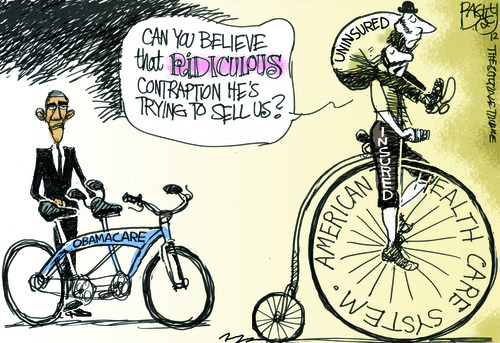
Bagley’s cartoon on criticizing Obamacare

April 6, 2012

Generally the Pulitzer Prize committees look at specific works submitted by candidates.  Bagley‘s day-in, day-out brilliance must make it difficult for editors to choose what to nominate, no?

This cartoon is just perfect, in so many ways:


Criticism of ObamaCare. Cartoon by Pat Bagley, Salt Lake Tribune, March 28, 2012.

I hope these cartoons get picked up by newspapers far outside of Utah. They deserve to be seen more broadly. Click cartoon to go to Salt Lake Tribune’s archives of Bagley’s work. Cartoon of March 28, 2012.

President Obama’s campaign film, “The Road We’ve Traveled”

April 1, 2012

Some encouragement for those who follow Santayana’s Ghost, and recall history; some information to change the minds of those who don’t:


More good news about the Affordable Care Act (Obamacare): CBO says it will save money

March 22, 2012

President Barack Obama's signature on the heal...

President Barack Obama's signature on the health insurance reform bill at the White House, March 23, 2010. The President signed the bill with 22 different pens. CBO projections in March 2012 indicate savings under the bill will increase beyond earlier projections, offsetting increased costs from continuing economics woes. (Photo credit: Wikipedia)

Remember, without the Affordable Care Act, the U.S. was experiencing health care cost inflation of about 15%annually.

You might not know it if you read conservative blogs, watch Fox News, or listen to the Republican candidates for president — all of whom seem to have their fact panties on wrong — but the Congressional Budget Office (CBO) projects the bill will reduce federal spending, still, even after accounting for recent changes in law and changes in the economy that will increase costs of the bill’s provisions.

Yeah, Obamacare saves money.

The new law will  not eliminate the problem of people not having insurance coverage to guarantee access to health care, a sad result of Republican efforts to cut the bill’s effectiveness.  But it’s a great first step to making America better, healthier, and economically more sound.  Here’s the blog post from the CBO discussing the bill, and CBO’s continuing studies of the effects of the law:

CBO Releases Updated Estimates for the Insurance Coverage Provisions of the Affordable Care Act

March 13, 2012

In preparing the March 2012 baseline budget projections, CBO and the staff of the Joint Committee on Taxation (JCT) have updated estimates of the budgetary effects of the health insurance coverage provisions of the Affordable Care Act (ACA)—the health care legislation enacted in March 2010. Those provisions:

  • Establish a mandate for most legal residents of the United States to obtain health insurance;
  • Create insurance “exchanges” through which certain individuals and families may receive federal subsidies to substantially reduce the cost of purchasing health insurance;
  • Significantly expand eligibility for Medicaid;
  • Impose an excise tax on certain health insurance plans with relatively high premiums;
  • Establish penalties on certain employers who do not provide minimum health benefits to their employees; and
  • Make other changes to prior law.

The most recent previous estimate of those effects was prepared in March 2011. For more details on the insurance coverage provisions of the ACA, you can see CBO’s cost estimate for the health care legislation, which was issued in March 2010.

The Estimated Net Cost of the Insurance Coverage Provisions Is Smaller Than Estimated in March 2011

CBO and JCT now estimate that the insurance coverage provisions of the ACA will have a net cost of just under $1.1 trillion over the 2012-2021 period-about $50 billion less than the agencies’ March 2011 estimate for that 10-year period. (For comparison with previous estimates, these numbers cover the 2012-2021 period; estimates including 2022 can be found below.)

The net costs–specifically the combined effects on federal revenues and mandatory spending–reflect:

  • Gross additional costs of $1.5 trillion for Medicaid, the Children’s Health Insurance Program (CHIP), tax credits and other subsidies for the purchase of health insurance through the newly established exchanges and related costs, and tax credits for small employers,
  • Offset in part by about $0.4 trillion in receipts from penalty payments, the new excise tax on high-premium insurance plans, and other budgetary effects (mostly increases in tax revenues).

Those amounts do not encompass all of the budgetary impacts of the ACA. They do not include federal administrative costs, which will be subject to future appropriation action. Also, they do not include the effects of the many other provisions of the law, including some that will cause significant reductions in Medicare spending relative to that under prior law and others that will generate added tax revenues relative those under prior law.

CBO and JCT have previously estimated that the ACA will, on net, reduce budget deficits over the 2012-2021 period; that estimate of the overall budgetary impact of the ACA has not been updated.

Gross Costs Are Higher, but Offsetting Budgetary Effects Are Also Higher

The current estimate of the gross costs of the coverage provisions—$1,496 billion through 2021—is about $50 billion higher than last year’s projection; however, the other budgetary effects of those provisions, which partially offset those gross costs, also have increased in CBO’s and JCT’s estimates—to $413 billion—leading to the small decrease in the net 10-year tally.

Over the 10-year period from 2012 through 2021, enactment of the coverage provisions of the ACA was projected last March to increase federal deficits by $1,131 billion, whereas the March 2012 estimate indicates that those provisions will increase deficits by $1,083 billion.

The net cost was boosted by:

  • An additional $168 billion in estimated costs for Medicaid and CHIP, and
  • $8 billion less in estimated revenues from the excise tax on certain high-premium health insurance plans.

But those increases were more than offset by a reduction of:

  • $97 billion in the projected costs for the tax credits and other subsidies for health insurance provided through the exchanges and related spending
  • $20 billion in the projected costs for tax credits for small employers, and
  • $107 billion in deficits from the projected revenue effects of changes in taxable compensation and penalty payments and from other small changes in estimated spending.

The Revisions in Estimates Reflect Legislative, Economic, and Technical Changes

The major sources for the differences between the March 2011 and March 2012 projections are the following:

  • New Legislation. Several laws were enacted during the past year that changed the estimated budgetary effects of the insurance coverage provisions of the ACA.
  • Changes in the Economic Outlook. The March 2012 baseline incorporates CBO’s macroeconomic forecast published in January 2012, which reflects a slower recovery when compared with the forecast published in January 2011 (which was used in producing the March 2011 baseline).
  • Technical Changes. The March 2012 baseline incorporates updated projections of the growth in private health insurance premiums, reflecting slower growth than the previous projections. In addition, CBO and JCT made a number of other technical changes in their estimating procedures.

The Number of the Nonelderly Uninsured Is Higher Than Previously Estimated

CBO and JCT’s projections of health insurance coverage have changed since last March. Fewer people are now expected to obtain health insurance coverage from their employer or in insurance exchanges; more are now expected to obtain coverage from Medicaid or CHIP or from nongroup or other sources. More are expected to be uninsured. The extent of the change in insurance coverage varies from year to year.

Compared with prior law, the ACA is now estimated by CBO and JCT to reduce the number of nonelderly people without health insurance coverage by 30 million to 33 million in 2016 and subsequent years, leaving 26 million to 27 million nonelderly residents uninsured in those years (see Table 3 at the end of the report). The share of legal nonelderly residents with insurance is projected to rise from 82 percent in 2012 to 93 percent in 2016 and subsequent years. That share rose to 95 percent in CBO and JCT’s previous estimate.

According to the current estimates, from 2016 on, between 20 million and 23 million people will receive coverage through the new insurance exchanges, and 16 million to 17 million additional people will be enrolled in Medicaid and CHIP as a result of ACA. Also, 3 million to 5 million fewer people will have coverage through an employer compared with the number under prior law

Estimates Through Fiscal Year 2022

This report also presents estimates through fiscal year 2022, because the baseline projection period now extends through that additional year. The ACA’s provisions related to insurance coverage are now projected to have a net cost of $1,252 billion over the 2012-2022 period; that amount represents a gross cost to the federal government of $1,762 billion, offset in part by $510 billion in receipts and other budgetary effects (primarily revenues from penalties and other sources).

The addition of 2022 to the projection period has the effect of increasing the costs of the coverage provisions of the ACA relative to those projected in March 2011 for the 2012-2021 period because that change adds a year in which the expansion of eligibility for Medicaid and subsidies for health insurance purchased through the exchanges will be in effect. CBO and JCT have not estimated the budgetary effects in 2022 of the other provisions of the ACA; over the 2012-2021 period, those other provisions were previously estimated to reduce budget deficits.

If we could get another stimulus program to goose the economy into quicker recovery, the cost savings would likely grow much faster.  What conservative budget chopper wouldn’t prefer that solution?

Barack Obama signing the Patient Protection an...

Barack Obama signing the Patient Protection and Affordable Care Act at the White House Español: Barack Obama firmando la Ley de Protección al Paciente y Cuidado de Salud Asequible en la Casa Blanca (Photo credit: Wikipedia)

How did your favorite media outlets report the CBO cost projections?

More, Resources (with help from Zemanta and WordPress):


Eugene Robinson: “The GOP’s rude awakening on health-care repeal”

January 23, 2011

Eugene Robinson stuck to the facts, and noted that by a careful count, 62 percent of Americans oppose the Republican vote to repeal the new health care law:

What actually happened, though, is that the Republican majority managed to win the votes of just three Democrats – all of them Blue Dogs who have been consistent opponents of the reform package anyway. In terms of actual defectors, meaning Democrats who changed sides on the issue, there were none. This is momentum?

The unimpressive vote came at a moment when “the will of the people” on health care is coming into sharper focus. Most polls that offer a simple binary choice – do you like the “Obamacare” law or not – show that the reforms remain narrowly unpopular. Yet a significant fraction of those who are unhappy complain not that the reform law went too far but that it didn’t go far enough. I think of these people as the “public option” crowd.

Eugene Robinson, op-ed writer, Washington Post
Washington Post header for Eugene Robinson’s columns                                                                      .

The numbers:

A recent Associated Press poll found that 41 percent of those surveyed opposed the reform law and 40 percent supported it. But when asked what Congress should do, 43 percent said the law should be modified so that it does more to change the health-care system. Another 19 percent said it should be left as it is.

More troubling for the GOP, the AP poll found that just 26 percent of respondents wanted Congress to repeal the reform law completely. A recent Washington Post poll found support for outright repeal at 18 percent; a Marist poll pegged it at 30 percent.

In other words, what House Republicans just voted to do may be the will of the Tea Party, but it’s not “the will of the people.”

[My math:  43% +19%=62%.]

The facts:

The CBO, which “scores” the impact of proposed legislation, calculated that the health-reform law will reduce federal deficits by at least $143 billion through 2019. Confronted with the fact that repeal would deepen the nation’s fiscal woes, Republicans simply claimed the CBO estimate to be rubbish. Who cares what the CBO says, anyway?

Er, um, Republicans care, at least when it’s convenient. Delving into the CBO’s analysis, they unearthed a finding that they proclaimed as definitive: The reform law would eliminate 650,000 jobs. Hence “Job-Killing” in the repeal bill’s title.

One problem, though: The CBO analysis contains no such figure. It’s an extrapolation of a rough estimate of an anticipated effect that no reasonable person would describe as “job-killing.” What the budget office actually said is that there are people who would like to withdraw from the workforce – sometimes because of a chronic medical condition – but who feel compelled to continue working so they can keep their health insurance. Once the reforms take effect, these individuals will have new options. That’s where the “lost” jobs supposedly come from.

So, in other words, Republicans voted to keep people slaves to jobs that provide health care benefits.  The party of  Abraham Lincoln has fallen so far not even Abraham Lincoln at his most charitable moment would recognize it any longer.


Repeal ObamaCare, drive American families into bankruptcy

January 19, 2011

Getting everybody insured is the first step toward controlling health care costs — and the bill we have makes significant savings even without being so strong as it should be.  Watch and listen to White House adviser Stephanie Cutler’s explanation.

Tip of the old scrub brush to Mary Almanza.