At the same time the Cleveland Plain Dealer defended inaccurate history in flag-folding ceremonies, the U.S. Department of Veterans Affairs announced it would allow inaccurate ceremonies, if the family of the departed veteran requests it, and if the family provides the script. Here’s the news from the Akron Beacon-Journal.
Scripts must still adhere to standards that prohibit racism, obscenity, or political partisanship.
Spread the word; friends don't allow friends to repeat history.
Some people can’t let go of the past, and like the greedy chimpanzee who grasps the rice in the jar, and then is trapped when he cannot pull out his fist nor will he give up his prize to save his freedom, they trap themselves out of a good life.
Okay. I’ve had five or six people send me links to a YouTube video of Ron and Kay Rivoli singing “Press One for English.” Ha. Ha.
It’s a rant about language accommodations. Some Americans, free marketeers for the most part, get all buggy when confronted with a free market in language choices. America is becoming more global, marketing more goods in more places, and getting visited by more people. This growth in commerce brings things like American Airlines’ Spanish language reservations center (Who would have thought? When they can make reservations in Spanish, Spanish speakers buy a lot more airplane tickets.)
And Ron and Kay Rivoli put these fears into a song. Funny.
Can we talk? Can I pick a bone? Ron and Kay Rivoli insult the U.S. flag. They may not mean to do it, they may have done it unthinkingly — but that’s the problem with the whole rant: It’s all unthinking.
Here are the flag insults:
44 seconds into the video three servicemen are shown saluting the U.S. flag, displayed with the flag of California and the POW-MIA flag. Contrary to the Flag Code and good flag etiquette, the U.S. flag is in the center, rather than to its own right. A center display would be acceptable if the center flag pole were higher than the others — but in this case the U.S. flag’s pole is lower than the other two. Two flag insults at once.
At 2:59 into the video, the flag is shown as cut into an agricultural field of some kind. The Flag Code specifies that the flag is never to be displayed flat. The flag should fly free. Since this flag is cut into a crop on the ground, it cannot be displayed properly. Further, it is generally considered poor etiquette to make representations of the flag out of things other than cloth.
This is all highly ironic. At 1:37 into the video, a scroll of the famous Theodore Roosevelt quote on English as the only language scrolls by. “We have room for but one flag, the American flag,” Roosevelt said (oops — there goes the POW-MIA flag). “We have room but for one language, and that is the English language,” Roosevelt continues.
They use the flag they insult as a model for going for one language? This makes no sense.
Do I pick nits? No, I think that every educated American should know the flag code, and should avoid insult to the U.S. flag at least, if not honor it correctly. I am not pedantic about a lot of things, but this is one.
Ron and Kay Rivoli, you owe America and its flag apologies. Get straight with the flag, before you ask me to insult the traditional languages and free enterprise heritage of our nation. If you want my support, don’t tread on the American flag when you ask it.
The Rivolis owe apologies to the U.S. flag. Will we see it?
Spread the word; friends don't allow friends to repeat history.
Interest in proper etiquette for flag display increased recently — not enough by my calculation, but any increase is welcomed. Where is good information available?
This Congressionally-sponsored guide is basic and accurate. As a classroom resource or a piece of a Scout troop library, it’s a useful reference guide. It can be downloaded (it’s a .pdf), and printed out in color (56 pages).
The book includes many illustrations showing proper flag display. It also covers the history of the U.S. flag in good enough detail to get through most high school reports, and it features illustrations of flags of each of the states.
Congress in the past provided many publications on such topics for general public consumption and use in classrooms, but has cut back on free distribution of printed information since the early 1980s. One might be able to get a printed copy with a request to one’s local Member of the House of Representatives, or U.S. Senator.
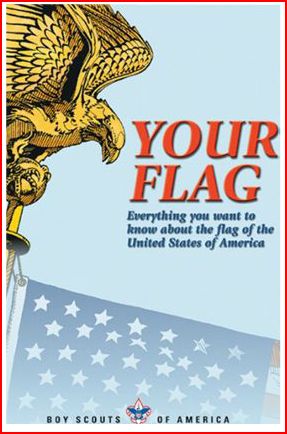
Boy Scouts of America version of the flag etiquette guide, Your Flag
Another book I’ve found very useful is an official Boys Scouts of America publication of the almost the same name, Your Flag. It’s a graphic-novel type of publication — cartoons for every point to be made. It features deeper information on proper flag display. The book can be purchased at any local Boy Scout Council supply shop, or any other shop that stocks Scout literature. It can also be ordered from BSA’s national catalog, or online at Scoutstuff.org, for $7.9910.99plus shipping. Every Scout troop should have one of these, and it is also very useful for classroom libraries, for history and civics.
In either publication, one learns that there are not many ways to display a flag properly from a vehicle — improper displays include decals on windows, bumper stickers, flying them from the radio antenna, or attaching them to a window pole to be battered in freeway-speed winds.
One might hope these books get much broader circulation.
Spread the word; friends don't allow friends to repeat history.
I am guilty. I made a bit of an assumption that state flag pledges are rare. There were none in Idaho, or Utah, where I attended public schools. Maryland made no fuss about one while we were there. In most conversations when the issue of a state pledge comes up, people tell their shock at discovering there was such a thing for Texas, and that Texans actually say it from time to time.
But a search of Google finally managed to strike something, having got just the right combination of terms. Below the fold are the state flag pledges for Arkansas, Kentucky, Louisiana, Ohio and South Dakota. I note that the years of adoption are recent — some sort of competition between state legislatures with too little to do? — which leads me to suspect that there may be more state pledges out there, but they are just showing up in the civics and history books.
Inside the Thunderbirds Hangar at Nellis AFB, Airman 1st Class Michael Thayer, left, and Senior Airman David Prye demonstrate how to fold a U.S. flag. Photo by John Gurzinski, Las Vegas Review-Journal [Replacement photo]
[Sad, but the Las Vegas Review-Journal appears to have taken down this story and photo] Photo by John Gurzinski from the Las Vegas Review-Journal: Inside Thunderbirds Hangar at Nellis AFB, Airman 1st Class Michael Thayer, left, and Senior Airman David Prye demonstrate how to fold a U.S. flag.
Airman First Class Michael D’Ancona and Senior Airman Assad Pharr demonstrated how to properly fold an American flag during a special visit to Robbins Lane Elementary School in Syosset on May 23. (Syosset-Jericho Tribune, June 19, 2014; photo added here October 2014)
Capt. Isham Barrett, Air Force action officer on Honor Guard policy, said the new script was developed because reference to the flag in the U.S. code “does not associate anything with any fold of the flag.”
“We don’t want to force a belief on somebody,” he said.
Barrett said the decision to develop a standardized script wasn’t prompted by someone complaining about religious connotations. “We can’t find anything in our files with regard to complaints,” he said.
Nevertheless, Christopher J. Andersen, an Army sergeant and member of the Military Association of Atheists and Freethinkers, wrote a letter in 2003, asking the U.S. Air Force Academy to remove the unofficial script from its Web site.
“In order to ensure this religious flag-folding ceremony is not portrayed as an official, government-sponsored flag-folding ceremony, I ask you to remove it from your .gov site,” wrote Andersen.
Andersen, who could not be reached last week, noted in his letter that the Air Force Academy removed the old script from its Web site after he complained.
Air Force leaders later set out to develop a script based on history rather than one that could be interpreted as contrary to the Establishment Clause of the First Amendment of the U.S. Constitution: “Congress shall make no law respecting an establishment of religion.”
Combined with the Free Exercise Clause — “or prohibiting the free exercise thereof” — they prohibit endorsement of a national religion or a preference for one over another. They also preclude dominance of religion over nonreligious philosophies, according to a 1994 Supreme Court majority opinion.
The new standardized script based on history was approved by Air Force leaders in July 2005 and first appeared in revised Honor Guard protocol manuals in January.
Three cheers for the Air Force (yes, I’m biased, for family reasons).
Archibald M. Willard, “The Spirit of ’76,” one of the best-recognized icons of American patriotism; courtesy of the American Reserve Society Sons of the American Revolution (of which Willard was a member); Library of Congress data: “Yankee doodle 1776 “/ A.M. Willard. Creator(s): Clay, Cosack & Co., lithographer. Related Names: Willard, Archibald M., 1836-1918 , artist Ryder, James F., 1826-1904 , publisher Date Created/Published: Cleveland, Ohio : Pub. by J.F. Ryder, c1876.
Archibald M. Willard, “The Spirit of ’76,” one of the best-recognized icons of American patriotism; courtesy of the American Reserve Society Sons of the American Revolution (of which Willard was a member).
Scouters discuss issues of leadership and skill, a wide-ranging group of topics that pertain to Boy Scouting, on a list-server known as Scouts-L. I subscribe to the discussion, and at times have participated frequently in it. Looking over my own archives, I was amused to see that it was more than a decade ago that I addressed the issue of how to quell any need for a Constitutional Amendment on flag desecration.
The U.S. flag fascinated me from my early childhood. It always strikes me as unique among flags of nations, and I can truly say that I find it stirring to see it in good display. In court, in schools, in the Senate and executive branch of federal government, and in local government, I have had more than my share of occasions to participate in cermonies honoring the flag, or merely sit in contemplation of it during official proceedings. I always reflect on John Peter Zenger’s trial for telling the truth about the King’s governor of New York, and how our flag now means that we can tell the truth about our own government without fear of official reprisal.
In times of crisis and turmoil, Americans often turn to patriotic symbols for inspiration. Caption from the National Museum of American History (Smithosonian): Elmira Cornet Band, Civil War The song’s popularity increased enormously during the Civil War. Because the song extolled the national flag—a symbol of loyalty to the Union—Northerners enthusiastically embraced it as a patriotic anthem.
The scientist, science and science fiction writer Isaac Asimov at one time held the title for the most published human being ever. There were few topics he didn’t have a learned opinion on, and there were many areas of ignorance where a well-trained scientist with a drive to get at the facts could shed a lot of light. His path lighting was not always appreciated. He wrote a guide to the Bible that has earned disdain from many a Christian conservative, thought I suspect that their disdain is really a disguise for the fear that a secular Jew could know the text so well and challenge so many unwarranted, but common, assumptions.
To the surprise of some, Asimov was quite a patriot. His short piece on the four stanzas of the “Star-spangled Banner” demonstrate his patriotism and his love of history, while offering a bit of humor to make it all stick in your mind. I post a complete copy below the fold.
As a lifelong Boy Scout and Scouter, I have lived with flag etiquette so long as I can remember. One of the key parts of flag etiquette with the U.S. flag is the proper folding, done to allow the flag to unfurl neatly when hoisted on a lanyard. (I have earlier discussed the meaning of folding the flag, or rather, the lack of meaning, here, here, and here.)
Several people wrote to ask about etiquette for folding state flags. Whenever I’ve been involved in ceremonies involving state flags, we have used the same fold prescribed for the U.S. flag, for the same reason — it allows the flags to neatly unfurl when they are posted. I have found several sites that urge a different fold for state flags, to preserve some uniqueness of the U.S. flag folding, but of course, that rather avoids the fact that the method used for the U.S. flag is just old ship tradition.
It seemed likely to me that some state had a special fold, however — and sure enough, I’ve found one. Ohio’s flag is not a rectangle, but is instead a tapered banner with two tails. In 2005, as an Eagle Scout project, Ohio Scout Alex Weinstock from Ohio’s Junction City Troop 260 devised a folding method for Ohio’s flag that ends with with 17 folds — appropriate to Ohio’s being the 17th state admitted to the union.
Ohio’s flag is the only one of the state flags that is not a rectangle. So far as I have found, it is the only one with any suggested method of folding that differs from the method used for the U.S. flag — but my searches may have missed an odd law here or there.
If you know of other special folding methods, please leave a note in comments, or e-mail me.
Spread the word; friends don't allow friends to repeat history.
Navy caption: SAN DIEGO (April 2, 2007) – Aviation Support Equipment Technician 3rd Class Danny Ly, Storekeeper Seaman Joe Jackson and Electronics Technician Timothy Swartz fold the American flag on the flight deck aboard nuclear-powered aircraft carrier USS Nimitz (CVN 68). Nimitz Carrier Strike Group (CSG), embarked Carrier Air Wing (CVW) 11 and Destroyer Squadron Group (DESRON) 23 are deploying to support operations in U.S. Central Command area of responsibility. U.S. Navy photo by Mass Communication Specialist 2nd Class Jeremiah Sholtis (RELEASED) – Wikimedia image
Earlier I wrote about a flag-folding ceremony that is making the internet rounds. I noted that much of the claimed mythology is, um, ahistoric.
There is no particular meaning attached to folding the flag. Comments noted that the ceremony making the internet rounds is posted at the website of the American Legion. I wrote to the Legion’s public relations department, but have heard nothing back. Generally, the information on flag etiquette at that site is solid. Only the flag-folding ceremony material is not top-notch. I would be happy were the Legion to add a note that the ceremony is a sample ceremony. Several sites mention that the ceremony comes “from the U.S. Air Force Academy.” One site even had a link, but the link was dead. I did find a few sources that explained further. The Air Force Academy web site may have featured a flag-folding ceremony at one point, perhaps even the one being passed around. One of the more popular ceremonies featured had been written by one of the chaplains at USAFA. As happens in the military, someone got concerned about the accuracy of the claims, and the ceremony was pulled. However, Air Force color guards had used the ceremony, and there was demand for something to say during the folding of the U.S. flag, at some ceremonies.
Below the fold, at some length, I reprint the “official” story.
Yes, the flag amendment is dead, again. Yes, the Fourth of July is past. False history continues to plague the U.S. flag, however. When my wife forwarded to me the post below, it was the fourth time I had gotten it, recently. Bad history travels fast and far. Let’s see if we can steer people in a better direction with real facts.
A flag folding at a funeral for a military person carries great weight, without any script at all. Wikimedia image from DOD release: Members of the U.S. Navy Ceremonial Guard fold the American flag over the casket bearing the remains of sailors killed in the Vietnam War during a graveside interment ceremony at Arlington National Cemetery on May 2, 2013. Lt. Dennis Peterson, from Huntington Park, Calif.; Ensign Donald Frye, from Los Angeles; and Petty Officers 2nd Class William Jackson, from Stockdale, Texas, and Donald McGrane, from Waverly, Iowa, were killed when their SH-3A Sea King helicopter was shot down on July 19, 1967, over Ha Nam Province, North Vietnam. All four crewmembers were assigned to Helicopter Squadron 2.
Here is the post as it came to me each time — I’ve stripped it of the sappy photos that are occasionally added; note that this is mostly whole cloth invention:
Did You Know This About Our Flag
Meaning of Flag Draped Coffin.
All Americans should be given this lesson. Those who think that America is an arrogant nation should really reconsider that thought. Our founding fathers used God’s word and teachings to establish our Great Nation and I think it’s high time Americans get re-educated about this Nation’s history. Pass it along and be proud of the country we live in and even more proud of those who serve to protect our “GOD GIVEN” rights and freedoms.
To understand what the flag draped coffin really means……
Or, until that account is unsuspended by the forces supporting Donald Trump: Follow @FillmoreWhite, the account of the Millard Fillmore White House Library
We've been soaking in the Bathtub for several months, long enough that some of the links we've used have gone to the Great Internet in the Sky.
If you find a dead link, please leave a comment to that post, and tell us what link has expired.
Thanks!
Retired teacher of law, economics, history, AP government, psychology and science. Former speechwriter, press guy and legislative aide in U.S. Senate. Former Department of Education. Former airline real estate, telecom towers, Big 6 (that old!) consultant. Lab and field research in air pollution control.
My blog, Millard Fillmore's Bathtub, is a continuing experiment to test how to use blogs to improve and speed up learning processes for students, perhaps by making some of the courses actually interesting. It is a blog for teachers, to see if we can use blogs. It is for people interested in social studies and social studies education, to see if we can learn to get it right. It's a blog for science fans, to promote good science and good science policy. It's a blog for people interested in good government and how to achieve it.
BS in Mass Communication, University of Utah
Graduate study in Rhetoric and Speech Communication, University of Arizona
JD from the National Law Center, George Washington University


 Posted by Ed Darrell





 Millard Fillmore's Bathtub