Quote of the moment: William Pitt, on the crime of being young

July 22, 2008

One of the philosophers of Rising Sun (CRS – LA Jonas Foundation) observed that it is impossible to be both young and brave, and old and wise. Age of our leaders often equates to experience. Age becomes an issue in election campaigns — Ronald Reagan, the previous record holder of the oldest person ever to run for a first term as president of the United States before John McCain, headed off arguments that he was “too old” with a zinger in a debate with Walter Mondale in Reagan’s campaign for reelection in 1984.

It was the second debate in 1984, from Kansas City’s Municipal Auditorium (To confuse our foreign readers, we should note that this is in Kansas City, Missouri; Kansas City, Kansas, is on the western side of the river, and is a city of less consequence than Kansas City, Missouri, in population, and in most discussions. We confuse our foreign readers in revenge for English politics, which pertains to the Quote of the Moment, but cannot be explained by or to a person who is not intoxicated). The debate focused on foreign policy and the future of the world. Among the panel of journalists doing the questioning in this deformed type of debate, was the late Henry Trewhitt, then diplomatic correspondent for The Baltimore Sun, one of America’s historically great newspapers, and still great.

About 20 minutes into the debate, Trewhitt asked this question:

REPORTER: Mr. President, I want to raise an issue that I think has been lurking out there for two or three weeks, and cast it specifically in national security terms. You already are the oldest President in history, and some of your staff say you were tired after your most recent encounter with Mr. Mondale. I recall, yes, that President Kennedy, who had to go for days on end with very little sleep during the Cuba missile crisis. Is there any doubt in your mind that you would be able to function in such circumstances?

Reagan sealed his reputation for wit, and probably sealed the election, with this previously-scripted (we know now) zinger:

REAGAN: Not at all, Mr. Trewhitt and I want you to know that also I will not make age an issue of this campaign. I am not going to exploit for political purposes my opponent’s youth and inexperience. If I still have time, I might add, Mr. Trewhitt, I might add that it was Seneca or it was Cicero, I don’t know which, that said if it was not for the elders correcting the mistakes of the young, there would be no state.

Former Vice President Walter Mondale, a great statesman in his own right, and no youth at the time, had a solid response, but not an election-winning response: It won no laughter. (It’s interesting, in 2008, to remember that Mondale was criticizing Reagan for his failure to act to prevent a terrorist attack on U.S. forces in Lebanon, that killed more than 200 Marines.):

REPORTER [Henry Trewhitt]: Mr. Mondale, I’m going to hang in there. Should the President’s age and stamina be an issue in the political campaign?

MONDALE: No. And I have not made it an issue nor should it be. What’s at issue here is the President’s application of his authority to understand what a President must know to lead this nation, secure our defense and make the decisions and judgments that are necessary. A minute ago, the President quoted Cicero, I believe. I want to quote somebody a little closer home, Harry Truman. He said the buck stops here. We just heard the President’s answer for the problems at the barracks in Lebanon where 241 Marines were killed. What happened? First, the Joint Chiefs of Staff, with the President, said don’t put those troops there. They did it. And then five days before the troops were killed, they went back to the President, through the Secretary of Defense, and said please, Mr. President, take those troops out of there because we can’t defend them. They didn’t do it. And we know what’s – what happened. After that, once again our embassy was exploded. This is the fourth time this has happened – an identical attack in the same region, despite warnings even public warnings from the terrorists. Who’s in charge? Who’s handling this matter. That’s my main point.

Which brings us to William Pitt’s remarks.

William Pitt, later Earl of Chatham, was 32 years old, and already a powerful member of the Whig opposition to England’s de facto first, and longest-serving Prime Minister, Robert Walpole, (who also was a Whig — see what I mean about English politics?). Though leading the opposition to Walpole, Pitt and a few of his colleagues were known as the Patriot Boys (Kansas City residing mostly in Missouri pales in comparison to these complexities of British politics).

Walpole, 32 years older than Pitt, leader of the House of Commons, complained at some point about Pitt’s youth. Walpole played dirty against Pitt, getting Pitt’s commission in the military cancelled. The two would dispute for a few years yet — finally, Pitt’s side prevailed, and Walpole lost a vote of confidence.

But on March 6, 1741, Pitt rose in the House of Commons and responded to Walpole’s charges:

“The atrocious crime of being a young man, which the honorable gentleman [Walpole] has with such spirit and decency charged upon me, I shall neither attempt to palliate nor deny; but content myself with wishing that I may be one of those whose follies may cease with their youth, and not of that number who are ignorant in spite of experience.”*

Walpole, Massachusetts, founded in 1724, is named after Robert Walpole. Pittsburgh, Pennsylvania, is named after William Pitt (the elder), as are Pittsfield County, Virginia, Chatham County, North Carolina (remember, Pitt was later Earl of Chatham), Pittsburg, New Hampshire, Chatham, New Jersey, and Chatham University, in Pittsburgh, Pennsylvania.
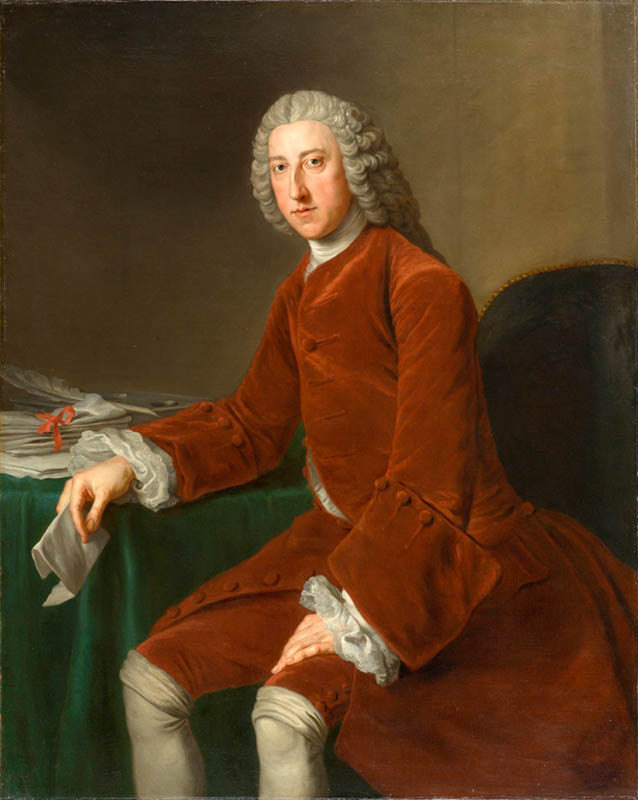
William Pitt, later Earl of Chatham

William Pitt, later Earl of Chatham

* Did Pitt ever actually utter these words? There was no official reporting service for debates in the House of Commons in 1741. Some speeches were written out before hand, some were carefully noted. This speech, alas, comes to us reported by the essayist and literature critic Samuel Johnson, who was famous for writing great speeches for members of the House of Commons, after the fact. Of this particular speech, Bartlett’s Familiar Quotations, 17th ed. carries this footnote: “This was the composition of Johnson, founded on some note or statement of the actual speech. Johnson said, ‘That speech I wrote in a garret, in Exeter Street'” – Boswell, Life of Johnson [1791]. If only Walter Mondale had Samuel Johnson whispering in his ear. Barack Obama may need the whisperings of Johnson in the current campaign.


Quote of the moment: Sallust, on “mental excellence”

July 21, 2008

Thus spake Gaius Sallustius Crispus, the Roman historian known as Sallust (86-34 B.C.):

The renown which riches or beauty confer is fleeting and frail; mental excellence is a splendid and lasting possession.

From The War with Catiline, 1

Statue of Sallust near the Austrian Parliament, by Haslinger Willibald

Statue of Sallust near the Austrian Parliament, photo by Haslinger Willibald

Photo rights: Creative Commons License
Creative Commons Attribution iconCreative Commons Share Alike icon

This file is licensed under the Creative Commons Attribution ShareAlike 2.5 License. In short: you are free to share and make derivative works of the file under the conditions that you appropriately attribute it, and that you distribute it only under a license identical to this one. Official license


Quote of the moment: T. H. Huxley

June 29, 2008

From Smithsonian.com:
June 29, 1895: T.H. Huxley Dies

Thomas Henry Huxley, a British biologist and firm believer in evolution, dies at age 70. The greatest defender of Darwinism in Britain, he once said,

“The deepest sin against the human mind is to believe things without evidence.”


28 poems on living life to the fullest, today

June 25, 2008

So, you just graduated from [pick one: high school, college, business school, law school, medical school, flight school, cooking school, firefighters academy, police academy] and you’re looking for a job. But here you are cruising the web instead of knocking on the doors of employers.  Carpe diem poems for making the most of time

You have come to the right place. To keep you in the flow where you need to be to get that job, let me suggest this article from the Academy of American Poets, “Carpe Diem: Poems for making the most of time.” And most especially, let me suggest the 28 poems they list there on plucking the day. The chief list of 28 you will find below the fold.

The Latin phrase and a lot of the history of the idea in poetry gets a lithe explanation in the essay there:

The Latin phrase carpe diem originated in the “Odes,” a long series of poems composed by the Roman poet Horace in 65 B.C.E., in which he writes:

Scale back your long hopes

to a short period. While we
speak, time is envious and

is running away from us.
Seize the day, trusting
little in the future.

Various permutations of the phrase appear in other ancient works of verse, including the expression “Eat, drink, and be merry, for tomorrow we die,” which is derived from the Biblical book of Isaiah. At the close of “De rosis nascentibus,” a poem attributed to both Ausonius and Virgil, the phrase “collige, virgo, rosas” appears, meaning “gather, girl, the roses.” The expression urges the young woman to enjoy life and the freedom of youth before it passes.

Since Horace, poets have regularly adapted the sentiment of carpe diem as a means to several ends, most notably for procuring the affections of a beloved by pointing out the fleeting nature of life . . .

The careful reader will find another three poems on the topic hidden in the list at the end of the article.

Graduates, you’d be happy with just a little per diem at the moment. I can’t give you that. You might find that these poets give you much more. Seize the opportunity, and see for yourself.

Read the rest of this entry »


Quote of the moment: Sir Francis Bacon, creation as testament

May 30, 2008

Sir Francis Bacon (source unidentified)

Sir Francis Bacon (January 22, 1561 – April 9, 1626)

For certain it is that God worketh nothing in nature but by second causes: and if they would have it otherwise believed, it is mere imposture, as it were in favour towards God; and nothing else but to offer the Author of Truth the unclean sacrifice of a lie. But farther, it is an assured truth, and a conclusion of experience, that a little or superficial knowledge of Philosophy may incline the mind of man towards Atheism, but a farther proceeding therein doth bring the mind back again to Religion: for in the entrance of philosophy, when the second causes, which are next the senses, do offer themselves unto the mind of man, if it swell and stay there it may induce some oblivion of the highest cause; but when a man passeth on further, and seeth the dependence of causes, and the works of Providence, then, according to the allegory of the poets, he will easily believe that the highest link of Nature’s chain must needs be tied at the foot of Jupiter’s chair. To conclude therefore, let no man upon a weak conceit of sobriety or an ill-applied moderation think or maintain, that a man can search too far, or be too well studied in the Book of God’s Word, or in the Book of God’s Works—Divinity or Philosophy. But rather, let men endeavour an endless progress or proficience in both; only let men beware that they apply both to charity, and not to swelling [pride]; to use and not to ostentation; and again that they do not unwisely mingle or confound those learnings together.

Francis Bacon, Advancement of Learning (1605), Bk I. [for example, here]

Tip of the old scrub brush to John Stockwell commenting at Constructive Curmudgeon


Quote of the moment: Ashley Montagu, on creationists

May 11, 2008

Ashley Montagu

“Science has proof without any certainty. Creationists have certainty without any proof.”

Ashley Montagu (full citation needed!)

Tip of the old scrub brush to Aunt Betsy.


Quote of the moment: Utah Phillips, to graduates

April 19, 2008

Those of you lucky — or unlucky — enough to be giving commencement addresses are polishing them right now, if you have any sense about getting these things done before deadline.

Consider the wisdom of the not-well-enough-known folksinger, Utah Phillips, who is said to have once said to a high school class:

“You are about to be told, again, that you are America’s most valuable natural resource. Have you seen what this country does to its valuable natural resources?” -Utah Phillips, addressing a high school class.

Tip of the old scrub brush to Rob Lopresti and his trademarked Unfamiliar Quotations. [Hey, Rob: Got a more detailed citation on that one?]


Quote of the moment: Abraham Lincoln: A war that’s gone on too long

February 24, 2008

Siege of Vera Cruz, U.S. Mexican War

Image: Battle of Vera Cruz, artist unknown by me.

U.S. Rep. Abraham Lincoln, Whig-Ill., speaking on the floor of the House of Representatives, January 12, 1848:

If the prossecution of the war has, in expenses, already equalled the better half of the country, how long it’s future prosecution, will be in equalling, the less valuable half, is not a speculative, but a practical question, pressing closely upon us. And yet it is a question which the President seems to never have thought of. As to the mode of terminating the war, and securing peace, the President is equally wandering and indefinite. First, it is to be done by a more vigorous prossecution of the war in the vital parts of the enemies country; and, after apparently, talking himself tired, on this point, the President drops down into a half despairing tone, and tells us that “with a people distracted and divided by contending factions, and a government subject to constant changes, by successive revolutions, the continued success of our arms may fail to secure a satisfactory peace[.]” Then he suggests the propriety of wheedling the Mexican people to desert the counsels of their own leaders, and trusting in our protection, to set up a government from which we can secure a satisfactory peace; telling us, that “this may become the only mode of obtaining such a peace.” But soon he falls into doubt of this too; and then drops back on to the already half abandoned ground of “more vigorous prossecution.[“] All this shows that the President is, in no wise, satisfied with his own positions. First he takes up one, and in attempting to argue us into it, he argues himself out of it; then seizes another, and goes through the same process; and then, confused at being able to think of nothing new, he snatches up the old one again, which he has some time before cast off. His mind, tasked beyond it’s power, is running hither and thither, like some tortured creature, on a burning surface, finding no position, on which it can settle down, and be at ease.

Again, it is a singular omission in this message, that it, no where intimates when the President expects the war to terminate. At it’s beginning, Genl. Scott was, by this same President, driven into disfavor, if not disgrace, for intimating that peace could not be conquered in less than three or four months. But now, at the end of about twenty months, during which time our arms have given us the most splendid successes–every department, and every part, land and water, officers and privates, regulars and volunteers, doing all that men could do, and hundreds of things which it had ever before been thought men could not do,–after all this, this same President gives us a long message, without showing us, that, as to the end, he himself, has, even an imaginary conception. As I have before said, he knows not where he is. He is a bewildered, confounded, and miserably perplexed man. God grant he may be able to show, there is not something about his conscious, more painful than all his mental perplexity!


Sinclair Lewis on patriotism, the flag, and fascism

February 16, 2008

Oh, my.

Sun dog on US flag, Sinclair Lewis quote on fascism

When fascism comes to America, it will be wrapped in a flag and carrying a cross.

Sinclair Lewis

You can’t purchase the actual poster anywhere. It’s a photographic political cartoon. From our friends at Hot Dogs, Pretzels, and Perplexing Questions. (Bob, in Austin)

Did Lewis actually say that?  I’ve not sourced it yet.

Wave the flag for real:

Add to FacebookAdd to NewsvineAdd to DiggAdd to Del.icio.usAdd to StumbleuponAdd to RedditAdd to BlinklistAdd to TwitterAdd to TechnoratiAdd to Furl


Quote of the moment: Richard Feynman, science vs. public relations

January 7, 2008

Feynman speaking from the grave? You decide:

Feynman uses a glass of ice water to show the Challenger's O-ring problem, 1986

For a successful technology, reality must take precedence over public relations, for nature cannot be fooled.

Richard Feynman, in the Rogers Commission Report on the Space Shuttle Challenger Accident, appendix (1986)

Photo: Richard Feynman, at a hearing of the Rogers Commission, demonstrates with a glass of ice water and a piece of O-ring material, how cold makes the O-rings inflexible; photo credit unknown


    Quote of the moment: Psalms 55.21

    December 21, 2007

    The words of his mouth were smoother than butter, but war was in his heart: his words were softer than oil, yet were they drawn swords.

    ◊ Psalm 55.21 (King James Version)

    His words were smoother
    than butter,
    and softer
    than olive oil.
    But hatred filled his heart,
    and he was ready to attack
    with a sword.

    ◊ Psalm 55.21 (Contemporary English Version)


    Quote of the moment: “A rising tide of mediocrity”

    December 21, 2007

    “Our nation is at risk. The educational foundations of our society are presently being eroded by a rising tide of mediocrity. If an unfriendly foreign power had attempted to impose on America the mediocre educational performance that exists today, we might well have viewed it as an act of war. We have, in effect, been committing an act of unthinking, unilateral educational disarmament. History is not kind to idlers.”

    Those warnings, grim and intentionally provocative, were issued last week by the 18-member National Commission on Excellence in Education in a 36-page report called A Nation at Risk: The Imperative for Educational Reform. Headed by University of Utah President David P. Gardner, the NCEE was set up 20 months ago by Secretary of Education Terrel Bell to examine U.S. educational quality.

    – Ellie McGrath, “To Stem ‘A Tide of Mediocrity,'” Time, May 9, 1983.


    Typewriter and quote of the moment: David McCullough

    December 17, 2007

    I bought my Royal Standard typewriter in 1965. It was secondhand. I have written everything I’ve ever had published on it, and there is nothing wrong with it.

    Giambarba photo of historian David McCullough and his typewriter

    • Pulitzer-winner David McCullough, defending his refusal to write on a computer during a Dallas book-signing.

    (Found in Dallas Morning News, Alan Peppard, “Salutations, Year in Review, Local Celebrities,” December 17, 2007, page 1E, in graphic on page 4E)

    More from McCullough on typing, and on writing, reading and understanding history, below the fold.

    Read the rest of this entry »


    Quote of the moment: Housman, “accuracy a duty” in history

    December 16, 2007

    Poet A. E. Housman, with a book - Bryn Mawr College photo


    Poet A. E. Housman in 1910, portrait photo by E. O. Hoppé

    . . . accuracy is a duty and not a virtue.

    A. E. Housman, English poet (1859-1936), Manilius (The Richards Press, 1930), p. xxii ll. 27 sqq


    Google the phrase “accuracy is a duty” plus Housman.* You will get several dozen hits.

    Historians are fond of citing it, though I suspect that few have actually read Housman’s version of the line. The idea is that historians should not get kudos for accuracy, because in their trade, accuracy is not a virtue, but instead is the baseline duty. Housman arrived at that conclusion in comparing versions of translations of Manilius, and he made the comment in the preface to fifth volume of his own translation of the works of Roman poet Marcus Manilius. Housman’s five volumes were published between 1903 and 1930.

    The full quote lacks the punch of the usual truncations, however. The Housman Society in Britain was kind to track down the precise quote and the citation.

    p. xxii ll. 27 sqq. I did not quote Brechart’s accuracy, because accuracy is a duty and not a virtue; but if I could have seen the shameful carelessness’ of Breiter and van Wageningen I should have said with emphasis, as I do now, that he was very accurate indeed.

    Admit it — like me you were probably unaware that Housman had ever translated Manilius. Perhaps you were unaware that Manilius existed (don’t ask me to recite anything he wrote).
    Historians have this further problem: Housman probably was talking about the accuracy of the translation, not accuracy in recording history.

    One more quote that has been dragooned into duty in fields unrelated to its usual use. Got a problem with that?

    The statement is good advice in every field I can think of.

    Update: Go see Elektratrig’s report of Housman’s send-up of Greek tragedy. Well worth the click, just for edification.

    *  And if you check it now, you’ll see the search is skewed by this very post; it’s the Heisenberg Principle of the internet.


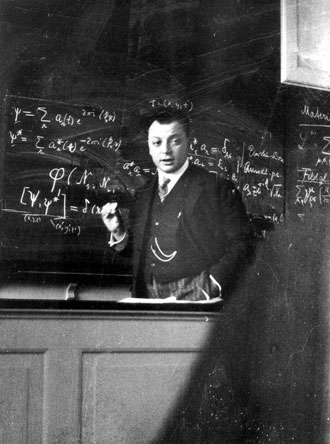
    Quote of the moment: Wolfgang Pauli, “not even wrong.”

    December 14, 2007

    Wolfgang Pauli, before 1945 - Nobel Foundation photo
    Photograph of Wolfgang Pauli, circa 1929; photo from Nobel Foundation.

    That’s not right. It’s not even wrong.

    From Wikipedia:

    Wolfgang Pauli (1900-1958), as quoted by R. Peierls

    Peierls (1960) writes of Pauli, “… a friend showed him the paper of a young physicist which he suspected was not of great value but on which he wanted Pauli’s views. Pauli remarked sadly ‘That’s not right. It’s not even wrong'”.  (Peierls  R  (1960). “Wolfgang Ernst Pauli, 1900-1958”. Biographical memoirs of fellows of the Royal Society 5: 174-92. Royal Society (Great Britain))

    Pauli won the Nobel Prize in Physics in 1945:  “At this stage of the development of atomic theory, Wolfgang Pauli made a decisive contribution through his discovery in 1925 of a new law of Nature, the exclusion principle or Pauli principle. The 1945 Nobel Prize in Physics has been awarded to Pauli for this discovery.”