May 12, 2011
What is the driving motivation of Republican budget cuts in Texas, Wisconsin, and the rest of the nation?
Quote of the moment:
Darkness is cheap, and Scrooge liked it.
— Charles Dickens, A Christmas Carol, Stave 1
I thought of that line of Dickens’s when I read of this celebration of darkness, ignorance and calumny. Although, with the recent renewing of Limbaugh’s contract, it may no longer be true that his particular brand of darkness is cheap.
Still, it remains dark.

Scrooge meets Ignorance and Want, the products of his stinginess (drawing by John Leech, 1809-1870)
I was reminded of this post from three years ago by a discussion at What’s Wrong With the World (commented on earlier at the Bathtub, here), in which the principal protagonists appear to me to be wholly ignorant of the New Deal, the progressive movement and progressive ideals, and much more of U.S. history, law, and events. In effect, I thought, that discussion was fueled by that ugly, mean little boy, Ignorance. The angel warned Scrooge, “but most of all beware this boy [Ignorance], for on his brow I see that written which is Doom.”
(More about the drawing below the fold)
Read the rest of this entry »
Spread the word; friends don't allow friends to repeat history.
 14 Comments |
  Books, Education, Famous quotes, History, Literature, Quotes | Tagged: Charles Dickens, Darkness, Ebenezer Scrooge, Education, Famous quotes, History, ignorance, John Leech, Literature, Quotes, Want |
  Permalink
 Posted by Ed Darrell
March 14, 2011
In Concord, New Hampshire, on March 11 and 12, 2011, apparently testing to see whether that little state has bad enough education standards before announcing a presidential bid, Michelle Bachmann butchered history and geography once again, according to the conservative Minnesota Independent:
“You’re the state where the shot was heard around the world in Lexington and Concord,” she said, referencing Ralph Waldo Emerson’s “Concord Hymn,” an ode to the lives lost at the start of the American Revolution in Concord, Massachusetts, not New Hampshire.
How many bites at the apple does stupid get? Has Ed Brayton picked up on this yet?

Minnesota U.S. Rep. Michelle Bachmann
More:
Tip of the old scrub brush to Pat Carrithers.
Update: Oh, yeah, others noticed:
- New American did its damnedest to explain it away as a slip of the tongue — either assuming Bachmann is too reckless not to use prepared remarks for her first foray into New Hampshire (maybe a more serious indictment), or not paying attention to her written remarks (Was it just one more in a long string of really stupid slips of the tongue? Loose tongues sink as many ships as loose lips . . .); in another article New American falsely claimed a worldwide ban on DDT, falsely claiming the ban killed 30 million kids, and said that it disrupted food growing in America, though food crops hadn’t been sprayed with DDT for nearly a decade when its use was banned on agricultural crops in the U.S. alone. Accuracy isn’t in that animal
- And that site for undiscriminating, miseducated people, American Elephants, thought Bachmann’s earlier distortions of history just lovely.
- Peter Fenn blogging at U.S. News and World Report asks, “Why does anyone take Michelle Bachmann seriously?”
- Politico notes the long history of Bachmann getting the facts wrong, and reveals that Bachmann repeated the error about the location of the Battle of Concord at least twice in that New Hampshire swing. Bachmann can’t hire competent aides, either? Politico questions Bachmann’s basic governing competence, noting that, while she is a member of the House Intelligence Committee and should know better, she urged President Obama to follow the counsel of Gen. David Patraeus about intervention in Libya. Petraeus isn’t in the chain of command on Libya since he took over the job in Afghanistan several months ago.
- The Concord (New Hampshire) Monitor took a hands-off approach, using the Associated Press story on the gaffe
- Cartoonist Jeff Danziger, one of America’s best, puts the event into pithy perspective (see below)
- Mike the Mad Biologist, who uses one of the greatest images for free speech as his avatar, lists Bachmann as “dumber than a sack of hammers”
- Even Little Green Footballs appears to take after Bachmann, but with an account that is, after all, just the facts

Jeff Danziger
Spread the word; friends don't allow friends to repeat history.
10 Comments | Accuracy, America's founding, Bogus history, Campaigns, History, Humor, Infamous Quotes, Politics, Quotes, Voodoo history | Tagged: Bogus history, Campaigns, Concord, Education, History, Humor, Infamous Quotes, Lexington, Michelle Bachmann, Politics, Quotes, Shot heard 'round the World, Voodoo history | Permalink
Posted by Ed Darrell
March 14, 2011

Playwright Edward Albee - Albee Foundation photo
[On the slashing of arts education funding:] It’s especially discouraging when you live in a democracy where anything good is possible, if only we have the courage to deal with it.
— Edward Albee, playwright, Diane Rehm Show (WAMU-FM/NPR), March 14, 2011 (49:50 in)
Spread the word; friends don't allow friends to repeat history.
Leave a Comment » | Art, Democracy, Famous quotes, Literature, Quotes | Tagged: Arts, courage, Democracy, Diane Rehm, Education, Edward Albee, Famous quotes, Literature, NPR, Quotes, WAMU | Permalink
Posted by Ed Darrell
February 25, 2011
When I wrote about George Santayana’s observation that, “Only the dead have seen the end of war,” I didn’t realize it was a quote with controversy over the attribution.

He said it: Spanish-American philosopher and writer George Santayana, early in his career (Photo: Wikipedia)
Ridley Scott‘s outstanding 2001 movie, “Blackhawk Down,” opened with the quote, but attributing it to Plato, according to Plato expert Bernard Suzanne in Paris. One philosopher is as good as another, you might say, so it’s understandable that a good line from a modern philosopher like Santayana might be attributed to one of the most famous philosophers of all time (“they all look alike,” I hear someone saying). Or, the cynics might say, perhaps Santayana lifted it from Plato — after all, who but another philosopher would actually read the stuff? Who would know?
Suzanne’s sleuthing is impressive if only because it shows the murkiness of the issue. According to Suzanne:
- The quote is popular among American soldiers (ask one — report back in comments).
- Michael Takiff found it attributed to Plato by a U.S. soldier in Vietnam, writing home, in a book published in 2003.
- No one has found it in any of Plato’s dialogues — at least, no one Suzanne can find.
- Gen. Douglas MacArthur used the quote in a farewell address to cadets at the U.S. Military Academy at West Point, in 1962, attributing it to Plato. That would be a likely source of its popularity among U.S. soldiers.
- The Imperial War Museum, in London, has the quote engraved on its walls, attributed to Plato. The museum opened in 1936. Santayana’s version was published in 1922.
- Reminder: Santayana said it here: Soliloquies in England and Later Soliloquies, number 25 (1922)
Who put it on the wall of the Imperial War Museum, and why did they misattribute it, just a dozen years after Santayana wrote it?
More:

Quote from George Santayana misattributed to Plato, on a coffee mug from Zazzle
Save
Spread the word; friends don't allow friends to repeat history.
21 Comments | Accuracy, Famous quotes, History, Quotes, Santayana's ghost, War | Tagged: Accuracy, Famous quotes, Gen. Douglas MacArthur, George Santayana, History, Quotes, War | Permalink
Posted by Ed Darrell
February 21, 2011

Banner photographed by Wavy1 in Pueblo, Colorado, featuring quote from President John F. Kennedy
Stuck away from my library, I can’t confirm that John Kennedy actually said it, only that he is reputed to have said it:
Those who make peaceful revolution impossible will make violent revolution inevitable.
[March 13, 1962, White House reception for Latin American diplomatic corps,
on the first anniversary of the Alliance for Progress]
The ruling families of Libya and Wisconsin pledge to fight to hold on to power, splitting their nations if necessary rather than concede to democratic forces.
Was Kennedy right?
(What did he really say, where and when?)
Photo of banner from Pueblo, Colorado, by Wavy1.
Spread the word; friends don't allow friends to repeat history.
8 Comments | Famous quotes, History, John F. Kennedy, Peace, Quotes | Tagged: Change, Famous quotes, John F. Kennedy, Libya, Peace, Quotes, Revolution, Wisconsin | Permalink
Posted by Ed Darrell
January 30, 2011
Rather sweeping changes coming in Advanced Placement courses — World History, German and French for the coming year, Spanish and Latin for 2012-13, and probably Biology. Changes for U.S. History (APUSH) got delayed however.
At AP’s website where teachers can look at the proposed changes, three quotes alternate on the first page, including one from our resident ghost, George Santayana:
Spread the word; friends don't allow friends to repeat history.
2 Comments | Advanced Placement, Education, Famous quotes, History, Humor, Quotes, Santayana's ghost | Tagged: Advanced Placement, Education, Famous quotes, History, Humor, Quotes, Santayana's ghost | Permalink
Posted by Ed Darrell
January 27, 2011

Monticello, from the former header of A Summary View
That wonderful blog, “A Summary View,” which so often worked on misquotes from Jefferson? Moribund at the old WordPress site.
But arisen anew, in a grander cover, and keeping up the spirit of learning about Thomas Jefferson, here: A Summary View, at Monticello’s site.
Great history, like:
Anna Berkes continues to enlighten and brighten the study of history.
Spread the word; friends don't allow friends to repeat history.
Leave a Comment » | Accuracy, Famous quotes, History, Libraries, Quotes, Thomas Jefferson | Tagged: A Summary View, Accuracy, Anna Berkes, History, Librarians, Monticello, Quotes, Thomas Jefferson | Permalink
Posted by Ed Darrell
January 26, 2011

Walden Pond frozen over, Winter 2005 - Wikimedia image by Bikeable
Every winter the liquid and trembling surface of the pond, which was so sensitive to every breath, and reflected every light and shadow, becomes solid to the depth of a foot or a foot and a half so that it will support the heaviest teams, and perchance the snow covers it to an equal depth, and it is not to be distinguished from any level field. Like the marmots in the surrounding hills, it closes its eyelids and becomes dormant for three months or more. Standing on the snow-covered plain, as if in a pasture amid the hills, I cut my way first through a foot of snow, and then a foot of ice, and open a window under my feet, where, kneeling to drink, I look down into the quiet parlor of the fishes, pervaded by a softened light as through a window of ground glass, with its bright sanded floor the same as in summer; there a perennial waveless serenity reigns as in the amber twilight sky, corresponding to the cool and even temperament of the inhabitants. Heaven is under our feet as well as over our heads.
Henry David Thoreau, Walden, or Life in the Woods, “The Pond in Winter,” 1899, pp 296-297.
Thanks to Inward/Outward, a project of the Church of the Saviour community.
Special tip of the old scrub brush to Bill Longman, who sent me the e-mail today.
Spread the word; friends don't allow friends to repeat history.
2 Comments | Books, Famous quotes, Literature, Quotes | Tagged: Books, Famous quotes, Heaven, Henry David Thoreau, Literature, Quotes, Walden Pond, Winter | Permalink
Posted by Ed Darrell
December 1, 2010

Mrs. Parks being fingerprinted in Montgomery, Alabama; photo from New York World-Telegram & Sun Collection, Library of Congress
Rosa Parks: “Why do you push us around?”
Officer: “I don’t know but the law is the law and you’re under arrest.”
From Rosa Parks with Gregory J. Reed, Quiet Strength
(Grand Rapids, MI: Zondervan Pub. House, 1994), page 23.
Photo: Mrs. Parks being fingerprinted in Montgomery, Alabama; photo from New York World-Telegram & Sun Collection, Library of Congress
Today in History at the Library of Congress provides the simple facts:
On the evening of December 1, 1955, Rosa Parks, an African American, was arrested for disobeying an Alabama law requiring black passengers to relinquish seats to white passengers when the bus was full. Blacks were also required to sit at the back of the bus. Her arrest sparked a 381-day boycott of the Montgomery bus system and led to a 1956 Supreme Court decision banning segregation on public transportation.
Rosa Parks made a nearly perfect subject for a protest on racism. College-educated, trained in peaceful protest at the famous Highlander Folk School, Parks was known as a peaceful and respected person. The sight of such a proper woman being arrested and jailed would provide a schocking image to most Americans. Americans jolted awake.
Often lost in the retelling of the story are the threads that tie together the events of the civil rights movement through the 1940s, 1950s and 1960s. As noted, Parks was a trained civil rights activist. Such training in peaceful and nonviolent protest provided a moral power to the movement probably unattainable any other way. Parks’ arrest was not planned, however. Parks wrote that as she sat on the bus, she was thinking of the tragedy of Emmet Till, the young African American man from Chicago, brutally murdered in Mississippi early in 1955. She was thinking that someone had to take a stand for civil rights, at about the time the bus driver told her to move to allow a white man to take her seat. To take a stand, she kept her seat. [More below the fold] Read the rest of this entry »
Spread the word; friends don't allow friends to repeat history.
6 Comments | Civil Rights, Famous quotes, History, Human Rights, Lessons of history, Martin Luther King, Quotes | Tagged: Civil Rights, Famous quotes, History, Human Rights, Martin Luther King Jr., Montgomery Bus Boycott, Politics, Quotes, Rosa Parks | Permalink
Posted by Ed Darrell
November 23, 2010
Excerpted from ENVIRONMENTAL DEFENSE FUND, INCORPORATED et al., Petitioners, v. William D. RUCKELSHAUS, Administrator of the Environmental Protection Agency & Environmental Protection Agency, Respondents, Izaak Walton League of America, Montrose Chemical Corporation of California, State of New York, Intervenors, 439 F.2d 584 (1971); Chief Judge David L. Bazelon wrote the decision.
This is a petition for review of an order of the Secretary of Agriculture,1 refusing to suspend the federal registration of the pesticide DDT or to commence the formal administrative procedures that could terminate that registration.
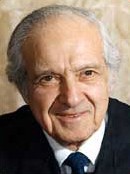
Born in Wisconsin, David L. Bazelon grew up in Chicago and practiced law there. In 1949, President Truman named him to the United States Court of Appeals for the District of Columbia Circuit, often described as the country's most influential court, next to the Supreme Court. At 40, he was the youngest judge ever appointed to that court. From 1962-1978 he served as chief judge, retiring in 1986 as a senior judge.
* * * * *
We conclude that the order was based on an incorrect interpretation of the controlling statute, and accordingly remand the case for further proceedings. In this case the Secretary has made a number of findings with respect to DDT. On the basis of the available scientific evidence he has concluded that (1) DDT in large doses has produced cancer in test animals and various injuries in man, but in small doses its effect on man is unknown; (2) DDT is toxic to certain birds, bees, and fish, but there is no evidence of harm to the vast majority of species of nontarget organisms; (3) DDT has important beneficial uses in connection with disease control and protection of various crops. These and other findings led the Secretary to conclude ‘that the use of DDT should continue to be reduced in an orderly, practicable manner which will not deprive mankind of uses which are essential to the public health and welfare. To this end there should be continuation of the comprehensive study of essentiality of particular uses and evaluations of potential substitutes.’38
There is no reason, however, for that study to be conducted outside the procedures provided by statute. The Secretary may, of course, conduct a reasonable preliminary investigation before taking action under the statute. Indeed, the statute expressly authorizes him to consult a scientific advisory committee, apart from the committee that may be appointed after the issuance of a cancellation notice.39 But when, as in this case, he reaches the conclusion that there is a substantial question about the safety of a registered item, he is obliged to initiate the statutory procedure that results in referring the matter first to a scientific advisory committee and then to a public hearing. We recognize, of course, that one important function of that procedure is to afford the registrant an opportunity to challenge the initial decision of the Secretary. But the hearing, in particular, serves other functions as well. Public hearings bring the public into the decision-making process, and create a record that facilitates judicial review.40 If hearings are held only after the Secretary is convinced beyond a doubt that cancellation is necessary, then they will be held too seldom and too late in the process to serve either of those functions effectively.
The Secretary’s statement in this case makes it plain that he found a substantial question concerning the safety of DDT, which in his view warranted further study. Since we have concluded that that is the standard for the issuance of cancellation notices under the FIFRA, the case must be remanded to the Secretary with instructions to issue notices with respect to the remaining uses of DDT, and thereby commence the administrative process.
* * * * *
We stand on the threshold of a new era in the history of the long and fruitful collaboration of administrative agencies and reviewing courts. For many years, courts have treated administrative policy decisions with great deference, confining judicial attention primarily to matters of procedure.48 On matters of substance, the courts regularly upheld agency action, with a nod in the direction of the ‘substantial evidence’ test,49 and a bow to the mysteries of administrative expertise.50 Courts occasionally asserted, but less often exercised, the power to set aside agency action on the ground that an impermissible factor had entered into the decision, or a crucial factor had not been considered. Gradually, however, that power has come into more frequent use, and with it, the requirement that administrators articulate the factors on which they base their decisions.51
Strict adherence to that requirement is especially important now that the character of administrative litigation is changing. As a result of expanding doctrines of standing and reviewability,52 and new statutory causes of action,53 courts are increasingly asked to review administrative action that touches on fundamental personal interests in life, health, and liberty. These interests have always had a special claim to judicial protection, in comparison with the economic interests at stake in a ratemaking or licensing proceeding.
To protect these interests from administrative arbitrariness, it is necessary, but not sufficient, to insist on strict judicial scrutiny of administrative action. For judicial review alone can correct only the most egregious abuses. Judicial review must operate to ensure that the administrative process itself will confine and control the exercise of discretion.54 Courts should require administrative officers to articulate the standards and principles that govern their discretionary decisions in as much detail as possible.55 Rules and regulations should be freely formulated by administrators, and revised when necessary.56 Discretionary decisions should more often be supported with findings of fact and reasoned opinions.57 When administrators provide a framework for principled decision-making, the result will be to diminish the importance of judicial review by enhancing the integrity of the administrative process, and to improve the quality of judicial review in those cases where judicial review is sought.
Remanded for further proceedings consistent with this opinion.
(President Nixon’s Secretary of Agriculture Clifford M. Hardin reviewed DDT regulations and decided no further action was required — since 1958, USDA had been reducing and eliminating DDT from use on USDA lands, as was the Department of the Interior. Environmental Defense Fund sued, arguing more action should have been required. In a complex decision, the U.S. Court of Appeals for the District of Columbia ordered more study of the issue. By the time of the decision, the Environmental Protection Agency (EPA) had been established, and EPA Director William D. Ruckelshaus took Hardin’s place as defendant, with EPA assuming USDA’s position as defendant agency. EPA’s review resulted in a ban on use of DDT on crops in the U.S.)
Some historians and many critics of EPA’s decision to ban DDT from agricultural use in the U.S. fail to acknowledge the importance of this ruling. Judge Bazelon said that great caution alone is not sufficient on the part of administrators, and he ordered that the evidence against DDT be placed on the public record for public scrutiny. “Public scrutiny” in this case would mean analysis by scientists, pesticide manufacturers, farming and farm support organizations, health workers, policy makers, and reporters.
On one hand, this decision tends to favor DDT advocates. Judge Bazelon said the administrator in charge of carrying out FIFRA, the Federal Insecticide, Fungicide and Rodenticide Act, must give advocates of DDT the basis for the ruling: “On the basis of the available scientific evidence he has concluded that (1) DDT in large doses has produced cancer in test animals and various injuries in man, but in small doses its effect on man is unknown; (2) DDT is toxic to certain birds, bees, and fish, but there is no evidence of harm to the vast majority of species of nontarget organisms; (3) DDT has important beneficial uses in connection with disease control and protection of various crops.”
On the other hand, Bazelon’s order means that the significant harms of DDT must be spelled out in public — so that the administrator’s ruling can be contested if it does not do what FIFRA requires. In other places in the decision, Judge Bazelon notes that Congress had required, through FIFRA, that a pesticide determined to be uncontrollably dangerous must be taken off the market, under the justification that it was “mislabeled.” Lower courts had already made that determination on DDT. Bazelon’s order set the stage to require the administrator to ban DDT as a matter of law — the administrator being the Secretary of Agriculture originally, or the Director of EPA under the reorganization of the government that created EPA .
Critics of William Ruckelshaus’s decision to ban DDT miss this point of the law. Under the findings of the nearly year-long hearing in EPA’s administrative law courts, DDT was found to be an uncontrollable poison in the wild. FIFRA required such a pesticide to have its registration cancelled, with very little wiggle room to make a case for any continued use of the stuff. Ruckelshaus’s action stopped the immediate shutdown of DDT manufacturing in the U.S. This proved to be a mixed benefit decision. While the U.S. benefited financially from export of DDT, that the U.S. exported a chemical banned for most uses inside the U.S. proved to be a sore point in foreign relations with other nations; also most of the manufacturing sites were highly contaminated, so much so that the manufacturers declared bankruptcy rather than stick around to clean them up under the rules of the Superfund which took effect in 1984. Taxpayer dollars now pay for massive cleanup operations of DDT manufacturing sites in California, Michigan, and Alabama, and other places.
Spread the word; friends don't allow friends to repeat history.
2 Comments | DBQ sources, DDT, Environmental protection, Famous quotes, Famous trials, Government, History, Justice, knowledge, Law, Quotes, Regulation | Tagged: Courts, DDT, Environmental protection, EPA, Famous quotes, Famous trials, Government, History, Jurisprudence, Law, Quotes, Regulation, William D. Ruckelshaus | Permalink
Posted by Ed Darrell
November 23, 2010

Thomas Jefferson. South Elevation of the Rotunda, begun 1818, completed March 29, 1819. Ink and pencil drawing. Courtesy of the Thomas Jefferson Architectural Drawings, University Archives, Special Collections Department, University of Virginia Library
By far the most important bill in our whole code is that for the diffusion of knowledge among the people. No other sure foundation can be devised for the preservation of freedom, and happiness.
Jefferson in a letter to his mentor George Wythe, from Paris, August 13, 1786; referring to his Bill for the More General Diffusion of Knowledge, proposed in 1779
Excerpted from The Quotable Jefferson, collected and edited by John Kaminski, Princeton University Press, 2006
Spread the word; friends don't allow friends to repeat history.
6 Comments | Education, Famous quotes, Freedom - Political, Quotes, Thomas Jefferson | Tagged: Education, Famous quotes, freedom, History, Quotes, Thomas Jefferson, University of Virginia | Permalink
Posted by Ed Darrell
November 21, 2010

Bas relief portrait of Thomas Jefferson, as one of the great lawgivers whose heritage of laws we draw from, portrayed in the chamber of the U.S. House of Representatives. Image from Architect of the Capitol, Wikimedia
It is error alone which needs the support of government. Truth can stand by itself.
Thomas Jefferson, Notes on the State of Virginia, 1782
Excerpted here from The Quotable Jefferson, edited by John P. Kaminski, Princeton University Press, 2006, p. 226.
No, he didn’t specify, but I think he was talking about creationists who seek legislation to sneak creationism into science classes.
Spread the word; friends don't allow friends to repeat history.
2 Comments | Famous quotes, Quotes, Thomas Jefferson | Tagged: Famous quotes, Quotes, Thomas Jefferson | Permalink
Posted by Ed Darrell
October 26, 2010
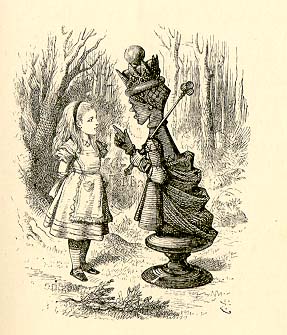
Alice and the Red Queen – illustration by Sir John Tenniel
Alice laughed: “There’s no use trying,” she said; “one can’t believe impossible things.”
“I daresay you haven’t had much practice,” said the Queen. “When I was younger, I always did it for half an hour a day. Why, sometimes I’ve believed as many as six impossible things before breakfast.”
Charles Lutwidge Dodgson, writing under the name Lewis Carroll,
Alice in Wonderland, 1866
[Yes, the illustration is from Through the Looking Glass, 1871]
Spread the word; friends don't allow friends to repeat history.
Leave a Comment » | Books, Creationism, denialism, Global warming, History, Literature, Politics, Quotes, Voodoo history, Voodoo science | Tagged: Alice in Wonderland, Books, Creationism, denialism, Famous quotes, Literature, Politics, Quotes, Tea Party, Voodoo history, Voodoo science, Warming Skeptics | Permalink
Posted by Ed Darrell
October 3, 2010

Eleanor Roosevelt at Pearl Harbor in 1943 - image from MedScape
Is this story true? I’ve not been able to verify the quote — it’s a great story, and better if true. From MedScape Today, “The Case of the Well-known Woman with Unexplained Anemia”:
Although reserved, Roosevelt had a quiet sense of humor. When commenting about how she felt about having a rose named after her, she remarked: “I was very flattered . . . but not pleased with the description in the catalogue: no good in a bed, but fine up against a wall.”
Can anyone tell us when and where she said that? Gardeners, can you confirm? Can anyone find a photo of the rose, “Eleanor Roosevelt?” (It’s probably a yellow rose, but I haven’t found a description.)

Eleanor Roosevelt teacup, First Ladies Library
More:
Spread the word; friends don't allow friends to repeat history.
2 Comments | A Good Story, Biography, Famous quotes, First Ladies, Gardening, History, Humor, Quotes | Tagged: Biography, Eleanor Roosevelt, Famous quotes, First Ladies, Gardening, History, Humor, Quotes, Roses | Permalink
Posted by Ed Darrell
August 17, 2010
Double encore post. And look at the date
August 17, 1790, found U.S. President George Washington traveling the country, in Newport, Rhode Island.
Washington met with “the Hebrew Congregation” (Jewish group), and congregation leader (Rabbi?) Moses Seixas presented Washington with an address extolling Washington’s virtues, and the virtues of the new nation. Seixas noted past persecutions of Jews, and signalled a hopeful note:
Deprived as we heretofore have been of the invaluable rights of free citizens, we now (with a deep sense of gratitude to the Almighty disposer of all events) behold a government erected by the Majesty of the People–a Government which to bigotry gives no sanction, to persecution no assistance, but generously affording to All liberty of conscience and immunities of Citizenship, deeming every one, of whatever Nation, tongue, or language, equal parts of the great governmental machine.

George Washington's reply to the Newport, RI, "Hebrew congregation," August 17, 1790 - Library of Congress image
President Washington responded with what may be regarded as his most powerful statement in support of religious freedom in the U.S. — and this was prior to the ratification of the First Amendment:
It is now no more that toleration is spoken of as if it was the indulgence of one class of people that another enjoyed the exercise of their inherent natural rights. For happily, the government of the United States, which gives to bigotry no sanction, to persecution no assistance, requires only that they who live under its protection should demean themselves as good citizens, in giving it on all occasions their effectual support.
Below the fold, more history of the events and religious freedom, from the Library of Congress.
Read the rest of this entry »
Spread the word; friends don't allow friends to repeat history.
3 Comments | Famous quotes, Freedom - Political, George Washington, Historic documents, History, Quotes, Religion, Religious Freedom | Tagged: Civil Rights, Famous quotes, George Washington, History, Quotes, Religion, Religious Freedom | Permalink
Posted by Ed Darrell





 Millard Fillmore's Bathtub
