Associated Press claims to own Thomas Jefferson’s words

August 3, 2009

Update:  See comment from Mr. Higginbotham; AP claims machine error and not arrogance.

Potential collisions are delicious:  Associated Press versus the Library of Congress’s “Thomas” legislation tracker;  Associated Press versus the Supreme Court for quoting the Declaration of Independence.

Associated Press versus the Southern Baptist Convention and Holy See for quoting the Bible, in phrases Jefferson used in his mashup of the New Testament.

Sotomayor either doesn’t know what she’s in for, or she saw this coming and is going to relish the ride.

James Grimmelman at The Laboratorium has been tracking AP’s attempts to wring pennies out of penniless bloggers and scholars for using AP product.  On the one hand, AP certainly deserves credit and payment for the great work it does reporting the news.

On the other hand, AP policies don’t seem much concerned with reporting news or creating new product that can make money for the organization, but instead seem bent on punishing people who read Associated Press stories.  (Full disclosure:  I make it a point to avoid AP stories and images on topics of my interest just to avoid the conflict — oddly, I’ve found that this actually does shift my news sources on major stories.)

Grimmelman caught AP red-handed in what must be a much embarrassing gaffe:  He asked permission from AP to quote from a letter written by Thomas Jefferson which AP had not published.

Sure enough, AP told him he owed them $12 to quote the letter, and AP offered to restrict the uses of the letter.

Grimmelman said:

The Associated Press has become so deranged, so disconnected from reality, that it will sell you a “license” to quote words it didn’t write and doesn’t own. Here, check it out:

Screen capture of Associated Presss charging for a Thomas Jefferson letter in the public domain - The LaboratoriumScreen capture of Associated Presss charging for a Thomas Jefferson letter in the public domain – The Laboratorium

These things threaten to put hoax makers out of business. Who could think of something so absurd? Grimmelman said:

I paid $12 for this “license.” Those words don’t even come from the article they charged me 46 cents a word to quote from (and that’s with the educational discount). No, they’re from Thomas Jefferson’s letter to Isaac McPherson, in which Jefferson argues that copyright has no basis in natural law.

(A commenter notes that Jefferson was actually writing about patents, but close is good enough in hand grenades and freedom of the press and freedom of thought.)

Grimmelman has more thoughts (and links to his earlier work on the issue)Boing-Boing did a cover of Grimmelman’s piece.

James Grimmelman pwns AP instead.

Tip of the old scrub brush to Dr. Pamela Bumsted.


Proper flag display, on the way to Monticello

July 4, 2009

U.S. flag displayed over Virginia Route 53, the road to Monticello, Jeffersons home in Virginia, 2008 - Photo by Emory

U.S. flag displayed over Virginia Route 53, the road to Monticello, Jefferson's home in Virginia, 2008 - Photo by Emory

Properly displayed, by the way.  The field is in the “northwest” position.


Fly your flag today, July 4, 2009

July 4, 2009

Soldiers raise the U.S. flag at a base in Afghanistan, 2003

Soldiers raise the U.S. flag at a base in Afghanistan, 2003

It’s the 233rd anniversary of the announcement of the Declaration of Independence.  The resolution calling for independence of the 13 colonies passed the Continental Congress on July 2, 1776.  The Declaration would be Thomas Jefferson’s crowning achievement, outshining even his presidency and the Louisiana Purchase.   John Adams wrote to his wife, Abigail, that July 2 would forever be marked by patriotic displays.

But the Declaration, which gave teeth to the resolution, was adopted on July 4.  Adams didn’t miss a beat.  Who quibbles about a couple of days when the celebrating is so good?

Adams and Jefferson were two of the five-member committee the Congress had tasked to write a declaration.  Adams and Ben Franklin quickly determined to leave it up to Jefferson, who had a grand flair with words, and who had just written a couple of stirring documents for Virginia.  Roger Sherman and Robert Livingston, the other two members, went along.

Adams and Jefferson became friends only later, when they both served the nation at war as ambassadors to France, and then for Adams, to England.  A widower, Jefferson was taken in by Abigail Adams who worried about him.  After the war, Jefferson was in England when Adams was to meet King George III in a grand ceremony in which the king would accept the credentials of all the ambassadors of foreign nations to England.  As the king strode down the line, each ambassador or delegation would bow, the king would acknowledge them, the papers would be passed, and the king would move on.  Adams and Jefferson bowed.  King George moved on, ignoring them completely.

In such a case of such a snub, the snubbed foreigners usually made a quick exit.  Adams and Jefferson did not.  They stood at attention as if the king had treated them like all the rest, reversing the snub.

Back in America in peacetime, Adams and Jefferson fell out.  Jefferson favored a more limited federal government; Adams favored a more powerful one.  By the end of Washington’s second term, party politics had been well developed.  Adams defeated Jefferson in the election of 1796.  As was the law then, Jefferson was vice president; but Adams kept Jefferson out of all government affairs.  Perhaps because he didn’t have Jefferson to help, Adams’s presidency did not go well.  In the rematch election in 1800, one of  the bitterest fights ever, Jefferson’s party defeated Adams.  The gleeful Democratic-Republican electors all voted one ballot for Jefferson, the presidential candidate, and one ballot for Aaron Burr, the party’s vice presidential candidate.

Alas, that produced a tie vote in the electoral college.  Adams’s party, the Federalists, still held the House of Representatives before the new Congress came in.  A tie vote goes to the House for decision.  They could not bring themselves to vote for Jefferson, and the deadlock continued for 37 ballots.  Finally Jefferson’s arch enemy Alexander Hamilton intervened, explaining that Burr was clearly the greater scoundrel, and the House elected Jefferson.  Adams slunk out of town, avoiding the inauguration.

It wasn’t until after 1809 when Benjamin Rush hoodwinked Jefferson into writing to Adams, and Adams to Jefferson, that the two became friendly again.  For the next 17 years Jefferson and Adams carried on perhaps the greatest series of correspondence in history between two great minds.  Letters went out almost daily.  They discussed the weather, their families, old times, farming — but especially the republic they had been most instrumental in creating, and how it might be preserved, and prosper.  Eventually the letters became harder to read, both because their eyesight was failing, and because their penmanship deteriorated, too.

The ideas, however, flowed like a river.

Both men took ill early in 1826.  This was a landmark year, 50 years since the Declaration of Independence.  In Massachusetts, a grand display of fireworks was to cap off a day of feasting and celebration.  Adams hoped he might attend.  In Virginia, a week before, it became clear Jefferson was too ill to venture even as close as Charlottesville for the celebration.  Jefferson slept through most of July 3, but awoke about 9:00 p.m., and asked, “This is the fourth?”  It was not.  These are the last significant, recorded words of Jefferson.  He awoke at about 4:00 a.m. on the Fourth of July, 1826, but could not make a rally.  He died at 12:50 in the afternoon.

Adams, too, was too ill to attend the celebrations.  In the late afternoon or early evening of the Fourth, he awoke, and heard the celebration in the town.  Almost as if he had worked just to live to see that particular day, he checked the date.  Realizing he was near the end, happy that he’d seen 50 years after the Declaration, and unaware of the events earlier that day in Virginia, Adams said, “Thomas Jefferson still survives.”

Fly your flag today. Remember John Adams and Thomas Jefferson.  Remember their great work in creating the nation that protects our freedoms today.  Remember their great friendship.  Write a letter to a good friend you’ve not written to lately.

It’s the Fourth of July.  Their spirit survives in us, as we celebrate, and as we remember why we celebrate.


No, the U.S. is not a “Christian nation”

April 9, 2009

Why is this an issue again?

Here’s the encore post of the original 2006 post quoting Jefferson on the topic of religious freedom, and what it means.

Can we lay off Obama now?  It’s no slam on America that he knows U.S. history better than most of us.  It’s encouraging.


Misquoting Jefferson?

February 1, 2009

Statue of Thomas Jefferson in the Jefferson Memorial - Mr. Lant's HIstory page

Statue of Thomas Jefferson in the Jefferson Memorial, Rudulph Evans, sculptor – Library of Congress photo by Carol Highsmith, who graciously puts her photos in the public domain

A commentary from Cal Thomas caught my eye — little more than a few quotes from Thomas Jefferson strung together.  Jefferson seems oddly prescient in these quotes, and, also oddly, rather endorsing the views of the right wing.

From the way the text is laid out, and the brevity of the piece, I’m guessing it’s a radio commentary.

I read Jefferson often.  I’ve read Jefferson a lot.  I don’t recognize any of the quotes.

So I plugged them into the Jefferson collection at Liberty Fund’s Online Library of Liberty, which has a lot of Jefferson ready for full-text searching.

Oops.  None of the quotes scored a hit.

Couldn’t find them in the Library of Congress’s on-line list of quotes, either.

It looks as though Jefferson didn’t say these things that are being attributed to him.

Cal, is that you?

Cal, can you give us citations on these quotes?

How about you, Dear Reader?  Can you save Cal Thomas’s bacon by providing a citation for any of the quotes below, alleged to be from Thomas Jefferson?

AS WE LISTEN TO TALK OF BAILOUTS AND ENDLESS DEBT, THINK ON THESE THOUGHTS FROM THOMAS JEFFERSON:

“THE DEMOCRACY WILL CEASE TO EXIST WHEN YOU TAKE AWAY FROM THOSE WHO ARE WILLING TO WORK AND GIVE TO THOSE WHO WOULD NOT.”

HERE’S ANOTHER: “IT IS INCUMBENT ON EVERY GENERATION TO PAY ITS OWN DEBTS AS IT GOES. A PRINCIPLE WHICH IF ACTED ON WOULD SAVE ONE-HALF THE WARS OF THE WORLD.”

AND ANOTHER: “I PREDICT FUTURE HAPPINESS FOR AMERICANS IF THEY CAN PREVENT THE GOVERNMENT FROM WASTING THE LABORS OF THE PEOPLE UNDER THE PRETENSE OF TAKING CARE OF THEM.”

AND ONE MORE:  “MY READING OF HISTORY CONVINCES ME THAT MOST BAD GOVERNMENT RESULTS FROM TOO MUCH GOVERNMENT.”

There you have ’em, Dear Readers.  Did somebody hoodwink Cal Thomas into thinking these are Jefferson’s bon mots, when they are not?

Shake of the wet scrub brush to Truthseeker.

Below the fold, the complete Cal Thomas commentary.
Read the rest of this entry »

Dirty play on PUMA blogs, and election history (1800)

September 1, 2008

Oh, it’s only a little dirty, sure.  With but with Democrats like the PUMAs, sometimes you wonder why we need Karl Rove.  With Hillary supporters like a few of the PUMAs, who needs Monica Lewinsky?

At the Confluence, anything that displeases the board moderators gets edited to say something completely trivial and, the board’s moderators appear to hope, embarrassing.  Even compliments from people they don’t like get edited.  So much for robust discussion and debate.  So much for fairness.

The Ghost of Goebbels smiles.  The Ghost of Alexander Hamilton paces nervously. Hamilton, you recall, paid editors and writers to put all sorts of scandal and calumny against Thomas Jefferson into their newspapers, in 1796 and 1800.  Dumas Malone wrote in his Pulitzer Prize-winning biography of Jefferson that fully half the American electorate was convinced that Jefferson was an atheist who hated religious freedom by election day, 1800.  Still, Americans voted overwhelmingly for the Jefferson/Burr ticket.  So Hamilton’s skullduggery didn’t pay off.

Alas, prior to the 12th Amendment, electors in the electoral college all had two votes, and the rule was that the winner became president, the 2nd place person became vice president.  The electors of the Democratic Republican Party (the modern-day Democrats) each cast a vote for Jefferson for President, and a vote for Burr.  In electoral votes, there was a tie for the presidency.  The election went to the House of Representatives (see the Constitution, Article II, Section 1, Clause 3).

The new Congress had not been sworn in yet, so the old, Federalist-controlled Congress got to make the decision between the two top electoral college vote getters (same as today — the old congress decides).  A history site at the City University of New York gives the short version:

Uneasy about both men, the Federalists in the House of Representatives took five days and 35 ballots to choose Jefferson over Burr. The deadlocked election between the two allies spawned the Twelfth Amendment to the U.S. Constitution in 1804, which led to separate Electoral College ballots for president and vice-president. Jefferson called the election the “Revolution of 1800.”

35 ballots in the House of Representatives, before Jefferson was chosen on the 36th! When an election goes to the House, each state gets one vote; the Representatives and Senators must decide how to cast that state’s vote.  34 times that ballot came up inconclusive between Jefferson and Burr, both men despised by the Federalists due to the poisoned waters from the campaign.

Alexander Hamilton knew both men well.  Hamilton and Jefferson both served in Washington’s cabinet.  He had been a friend of Jefferson and guest at Jefferson’s table for the great compromise that gave us the first U.S. bank and put the capital on the Potomac.   Hamilton had worked closely with James Madison on policy and speeches in the Washington administration, an on the conspiracy to get the Constitution before that — Madison was Jefferson’s “campaign manager” in the election.  Hamilton also had crossed paths with Aaron Burr in New York, where both men practiced law.  Eventually, Hamilton persuaded a few Federalists to vote for Jefferson over Burr, and persuaded a few others to abstain from voting in their state delegations, throwing those delegations to Jefferson, too.  Jefferson was thus elected president, and Burr became vice president. Alexander Hamilton had to eat crow to keep his worst enemy, Burr, from becoming president.

Hamilton’s agonies did not end there.  After engineering Burr’s defeat in New York’s gubernatorial election in 1804, Burr claimed Hamilton had insulted Burr’s reputation.  A string of letters failed to resolve the situation, and Burr challenged Hamilton to a duel.  On July 11, 1804, Burr mortally wounded Hamilton in a dawn duel at Weehawken, New Jersey (dueling being illegal in New York).

Alexander Hamilton, hero of the American Revolution, created much of the financial underpinnings of our modern economic system, with a central bank and a view looking toward promoting trade to benefit the citizens of the nation.  He worked with Madison and Washington to created the Constitution, and worked with Jay and Madison to compose what became the Federalist Papers, originally a set of essays to persuade New Yorkers to ratify the Constitution, now a legal and history backgrounder in what the Constitution is and how it is supposed to work. Few important events in international or domestic affairs did not feature work by Hamilton, from Washington’s inauguration in 1789 to Hamilton’s death in 1804.  When his country called, Hamilton responded.

Hamilton’s death creates one of the greatest “what if” questions in American history:  What if Hamilton had lived, perhaps to serve as president himself? Opportunities lost do not knock again.

Resources:

Alexander Hamiltons gravestone, in the courtyard of Trinity Church, close to the location of the former towers of the World Trade Center, New York. AmericanRevolution.com

Alexander Hamilton’s gravestone, in the courtyard of Trinity Church, close to the location of the former towers of the World Trade Center, New York. AmericanRevolution.com

Another version of the same photo, Alexander Hamilton’s grave.


Encore post: Jefferson on religious freedom, “infidels of every denomination”

July 31, 2008

Jefferson on religious freedom

Thomas Jefferson

August 1, 2006

 *

In his Autobiography Jefferson recounted the 1786 passage of the law he proposed in 1779 to secure religious freedom in Virginia, the Statute for Religious Freedom:

The bill for establishing religious freedom, the principles of which had, to a certain degree, been enacted before, I had drawn in all the latitude of reason and right. It still met with opposition; but, with some mutilations in the preamble, it was finally passed; and a singular proposition proved that its protection of opinion was meant to be universal. Where the preamble declares, that coercion is a departure from the plan of the holy author of our religion, an amendment was proposed, by inserting the word “Jesus Christ,” so that it should read, “a departure from the plan of Jesus Christ, the holy author of our religion;” the insertion was rejected by a great majority, in proof that they meant to comprehend, within the mantle of its protection, the Jew and the Gentile, the Christian and the Mahometan, the Hindoo, and the Infidel of every denomination.

Life and Selected Writings of Thomas Jefferson, Modern Library 1993 edition, pp. 45 and 46.

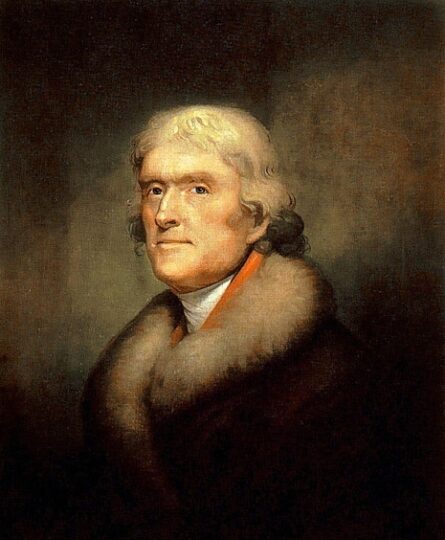
* Image is a photo of detail from a painting of Jefferson by Rembrandt Peale, courtesy of the New York Historical Society by way of the Library of Congress.

[Encore post from August 1, 2006]

An encore post; fighting ignorance takes repetition.

Save

Save


I was working and I missed it: Happy Religious Freedom Day! (a little late)

January 18, 2008

January 16 was Religious Freedom Day. I missed it again.

But I celebrate it most days, and you can, too.

They just don’t make many like Thomas Jefferson any more.

Thomas Jefferson, in bas relief, in the chamber of the U.S. House of Representatives.  Architect of the Capitol photo.   C. Paul Jennewein, sculptor

Thomas Jefferson, in bas relief, in the chamber of the U.S. House of Representatives, a gallery of lawgivers who contributed to the heritage of U.S. law and freedom. Architect of the Capitol photo. C. Paul Jennewein, sculptor


False Quotes Department: Jefferson, Kerry, Tim and Josh

July 26, 2006

Catching false quotes is a key goal of this enterprise.

Back in April, Josh at The Everyday Economist linked to Tim Blair with an almost snarky catch of John Kerry citing a line from Jefferson that, alas, Jefferson didn’t write or say. Tim links to The Jefferson Library. It’s short; here’s the entirety of Tim’s post:

John Kerry:

No wonder Thomas Jefferson himself said: “Dissent is the greatest form of patriotism.”

The Jefferson Library:

There are a number of quotes that we do not find in Thomas Jefferson’s correspondence or other writings; in such cases, Jefferson should not be cited as the source. Among the most common of these spurious Jefferson quotes [is]:

* “Dissent is the highest form of patriotism.”

Jefferson could have said something like that (and did — posts for another time, perhaps). I don’t find this common error nearly so irritating as those where a founder is quoted saying quite the opposite of what he or she would have said, or did say. Read the rest of this entry »