The museum is a monument to the failure of education.
o Bob Park, “What’s New,” May 25, 2007
[See full quote below the fold]
o Bob Park, “What’s New,” May 25, 2007
[See full quote below the fold]
 Leave a Comment » |
  Bogus history, Creationism, Natural history, Science, Science and faith, Voodoo history |
  Permalink
 Posted by Ed Darrell
If you answered “Margaret Chase Smith, the Senator from Maine,” you’d be close, but not close enough. Can you tell when she served, even?
David Parker is back from his vacation; in merely noting that he’s back, he pointed to this article about the first woman to serve in the U.S. Senate. Having spent so much time prowling those halls, and having lived with so many people who are so steeped in Senate history, the information caught me a little off guard. 
Who is it, if it’s not Smith? Read the rest of this entry »
Leave a Comment » | Capturing history, Politics, U.S. Senate, Women's rights | Permalink
Posted by Ed Darrell
It’s not clear who will win in the bloody vouchers war going on in Utah — it’s only clear that, once again, public education, students and teachers, lose.
Utah’s legislature, a bastion of Republican conservatism in the last decade or so, passed a voucher bill in its just-ended regular session. Conservative legislature, conservative governor — a law authorizing vouchers is what should be expected these days, no? What the advocates of vouchers failed to take into account has made this quite a drama.
Utah’s voters don’t like vouchers much, but love their public schools a lot.
So, the Utah state board of education opposed the measure. A hint of graft in existing alternatives to public schools angered many citizens. Opponents pointed to, among other things, the possibility that vouchers would vacuum funding from public schools — Utah is already dead last in per-pupil spending in the U.S.
It’s turned into a real donneybrook. [Bloody details below the fold.] Read the rest of this entry »
16 Comments | Economics, Education, Education reform, Education spending, Elections, Politics, School vouchers | Permalink
Posted by Ed Darrell
From today’s Christian Science Monitor, a story about Ken Ham’s Creation Museum in Petersburg, Kentucky:
The $27 million museum set on 50 acres opens on Memorial Day, and [Answers in Genesis] AiG hopes for 250,000 visitors a year. Mr. Ham, a former science teacher in Australia, is direct about the museum’s purpose: to restore the Bible to its “rightful authority” in society.
And, later in the article:
No one has a handle on the scope of creationism’s influence, says [Ronald] Numbers, author of “The Creationists.” “Intelligent design” (which disputes aspects of evolution but accepts that the universe is billions of years old) has been more in the news recently. But AiG, simply one group in the creationism fold, is clearly doing well. The museum has 8,500 charter members, [Mark] Looy says [AIG’s p.r. guy], and is all paid for – by donations averaging $100.
Now, I admit to having had difficulty with calculus in college. But even using a calculator to make sure my in-the-head numbers were right, 8,500 members multiplied by an average contribution of $100 equals $850,000. That’s considerably less than the $27 million advertised at the top of the article.
There’s a gap of more than $26 million in those figures. Where did the extra $26 million come from?
Is that where the money missing from Iraq went? Is Judge Crater in one of the displays? Is their claim of a 6,000-year-old Earth also off by a factor of at least 27?
Just askin’.
Leave a Comment » | Bogus history, Creationism, Natural history, Voodoo history, Voodoo science | Permalink
Posted by Ed Darrell
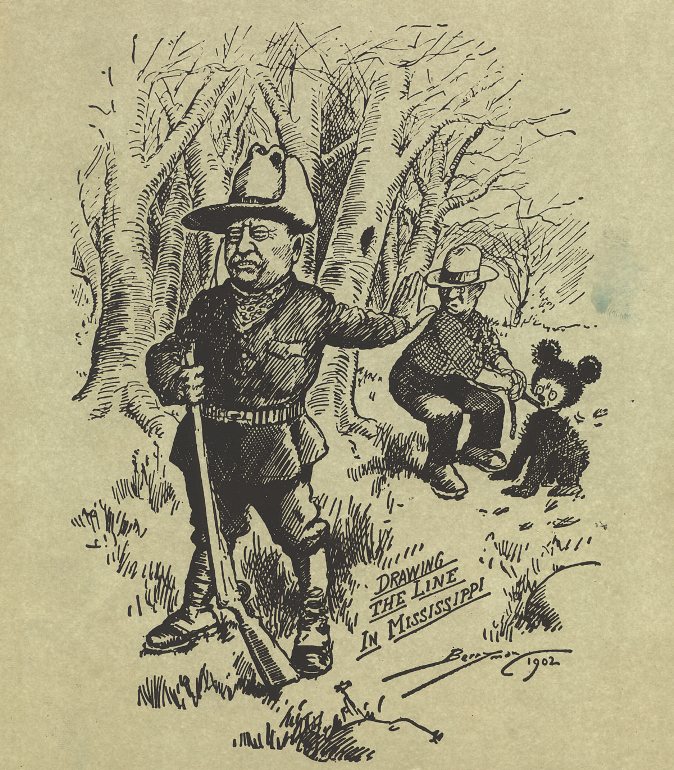
Clifford Berryman cartoon, “Drawing the Line in Mississippi, 1902”
Berryman’s Bear: “Drawing the line in Mississippi.”
In 1902 Teddy Roosevelt hunted bear near Smedes, Mississippi. He didn’t get a bear, as he had hoped. Trip guides tracked a bear with dogs, clubbed it, and tied it up. The bear was offered to TR to shoot.
Teddy refused to shoot it, of course. It was tied up. It was not sporting, not fair, not a match — not the vigorous hunting Roosevelt wanted.
Clifford K. Berryman, a cartoonist for the Washington Post newspaper (he moved to the Washington Star in 1907), captured the moment in a drawing published November 16, 1902. This 1902 cartoon is among the most famous political cartoons ever done.
The good sportsmanship Roosevelt demonstrated echoed long and hard among Americans. His reputation for fair dealing and good sportsmanship increased his popularity immensely.
Berryman continued to use the bear cub in cartoons for the rest of his career.
Teddy Roosevelt cartoon sources:
7 Comments | Capturing history, Cartoons, Newspapers, Political cartoons, Presidents, Theodore Roosevelt | Permalink
Posted by Ed Darrell

Today is the 300th birthday of Linnaeus, aka Carl Linnaeus, Carolus Linnaeus, Carl von Linné, Carl Linné, etc. etc. Oh, heck, just call him Carl. Happy birthday, Carl!
Leave a Comment » | Evolution, Heroes, History, Natural history, Science | Permalink
Posted by Ed Darrell
Everything is connected.
Unaware that the Cutty Sark still existed, the news of the fire on the most famous of the clipper ships caught me by surprise.

Our U.S. history texts these days mention the clippers, but little more. This wonderful chunk of history, showing great invention in the capture of wind power, and great romance of the sea, falls by the wayside.
Were a teacher so inclined, she might introduce some of that romance and admiration of invention with a bit more than two minutes spent on clipper ships.
For starters, what does “cutty sark” mean? Antiquarian’s Attic provides links to the news of the fire and enough background to make any teacher sound like an aficianado in just a few minutes. “Cutty sark” means a short shift, a very short skirt or dress — it’s from a poem, “Tam O’Shanter” by Robert Burns.
Her cutty sark, o’ Paisley harn,
That while a lassie she had worn,
In longitude tho’ sorely scanty,
It was her best, and she was vauntie.
Hey, who knew there was a poem that gave the name to the hat favored by U.S. Sen. Sam Hayakawa, and the hat which played such a prominent role in the opening sequence of The Mary Tyler Moore Show?
 Connections can get a bit out of hand, no?
I digress. Back to Cutty Sark.
Progress in transportation, particularly in speed, makes a solid unit of study in 8th and 11th grade history in Texas, fitting neatly in the advances in technology and how such advances push history along. Particularly with the defense of the America‘s Cup this year putting a spotlight on speed sailing and sailing history, there should be a lot of supplemental material to provide good lesson plan hooks to make a day’s diversion into clipper ships well worth the time.
Perhaps your class would like to contribute to the restoration of the Cutty Sark? Remember it was pennies from U.S. school kids that saved Old Ironsides, after Oliver Wendell Holmes, Sr., wrote a poem in tribute to her. See also the Ballad of Mad Jack.
Did you hear how Mad Jack saved “Old Ironsides” too,
From the scrapheap of flagships too old to renew,
At sixty-five years he inspected each shroud,
And promised the Navy he’d make her stand proud.
He collected the finest ship-riggers around,
From Boston, New Bedford, and Old Portsmouth Town,
He rigged her and jigged her and made her stand tall,
Then he sailed her around the world once and for all.
- Ballad of Mad Jack by Steve Romanoff, performed by Schooner Fare, 1981
Leave a Comment » | Brain learning, History, History museums, Technology, Transportation, Travel, War of 1812 | Permalink
Posted by Ed Darrell
Another of my favorite blogs, I Thought A Think, hosts the 120th Carnival of Education this week. Graciously, ITAT included Millard Fillmore’s Bathtub — part of the sideshow or part of the midway, I’m not sure. But I’m grateful. The link is to my post on the Internet Archive features on tobacco, and the Flintstones promoting Winston cigarettes.
Interesting that the Carnival of Education cites the post on tobacco in the Internet Archive, and not the post on education reform in the same archive.

Sketch of the Flintstone Elementary School, Flintstone, Maryland (Allegany County Public Schools)
Leave a Comment » | Education, Education blogs, Education reform, Education spending, History video sources, Technology in the classroom, Video and film, Weblogs | Permalink
Posted by Ed Darrell
It’s a delightful story I’ve heard dozens of times, and retold a few times myself: Abraham Lincoln faced with some thorny issue that could be settled by a twist of language, or a slight abuse of power, asks his questioner how many legs would a dog have, if we called the dog’s tail, a leg. “Five,” the questioner responds confident in his mathematical ability to do simple addition.

Sunrise at the Lincoln Memorial. National Park Service photo.
“No,” Lincoln says. “Calling a dog’s tail a leg, doesn’t make it a leg.”
But there is always the doubt: Is the story accurate? Is this just another of the dozens of quotes that are misattributed to Lincoln in order to lend credence to them?
I have a source for the quote: Reminiscences of Abraham Lincoln by distinguished men of his time / collected and edited by Allen Thorndike Rice (1853-1889). New York: Harper & Brothers Publishers, 1909. This story is found on page 242. Remarkably, the book is still available in an edition from the University of Michigan Press. More convenient for us, the University of Michigan has the entire text on-line, in the Collected Works of Abraham Lincoln, an on-line source whose whole text is searchable.
However, Lincoln does not tell the story about a dog — he uses a calf. Read the rest of this entry »
46 Comments | Abraham Lincoln, Accuracy, Famous quotes, Good Quotes, History, On-line education, Quotes | Tagged: Abraham Lincoln, Accuracy, Aphorisms, Famous quotes, History, On-line education, Quotes | Permalink
Posted by Ed Darrell
One Blog a Day features Millard Fillmore’s Bathtub today.
 One Blog a Day probably qualifies as a sort of internet navel gazing — each day it highlights one blog of some interest. Generally it just points the way, but on a couple of occasions it has generated controversies, or at least discussions, in the comments (see the 726-comment entanglement on the original posting of Pharyngula’s feature).
Where else do you see history, exotic travel, biology and cream puffs clumped together like that? Eclecticism has its place, and One Blog a Day appears to be it.
Tip of the old scrub brush and thanks to One Blog a Day.
1 Comment | Technology, Technology in the classroom, Travel, Weblogs | Permalink
Posted by Ed Darrell
Citations get lost on the internet. Not only do people send copies of e-mails to everyone on their list, not only is there spam beyond all measure, but good stuff gets stripped of attribution. Someone sends you a good poem, or a genuinely funny story — and if you want more of the same, you’re completely at sea about where to look. Author? That information got stripped away several forwardings earlier.
“Must be Lincoln, Einstein, or Jefferson,” some wag says, and the piece is misattributed ever after.
A fellow posted this interesting film on YouTube — The Civil War in Four Minutes. One second of the film equals one week of the war. It’s a fascinating pictorial map presentation, with a lot of information packed into 240 seconds.
Who did it? Are there others like it? How do we get the rights for classroom use?
YouTube can be likened to grave robbers who invade Egyptian royal tombs — they bring important material to light, but the context is lost, and perhaps the meaning.
Can you help track down the creator of this film? This film was created for the Abraham Lincoln Presidential Library and Museum in Springfield, Illinois. (Now — how can we get legal copies?)
Update, June 15, 2007: Every YouTube version of the video has been pulled — probably a copyright thing. In the interim, I’ve checked with the Abraham Lincoln Presidential Library and Museum to see if it is available. One person said there is discussion for making it available in the next two years. Ain’t that the way? Why not strike while the iron is hot and sell it now? Somebody, please wake me if it’s ever released.
Update, October 4, 2007: ABLPLM explains the creation of the movie. Nice shot of the screen, still not available for classrooms. Alas.
Update December 20, 2007: If that one doesn’t work, try this one for a while:
Vodpod videos no longer available. from www.idkwtf.com posted with vodpod
5 Comments | Abraham Lincoln, Civil War, Geography - Physical, Geography - Political, History, History museums, History video sources, Juneteenth, Presidents, Technology in the classroom, Texas, War | Tagged: Art, Civil War, History, Technology | Permalink
Posted by Ed Darrell
European Union rules require member states to do something about indoor air pollution. European states are banning smoking in public places. Gone soon will be days when we can joke about Britons and their Player’s cigarettes, or the French and their Galois habits.
Every once in a while as I recount the great Tobacco/Health Wars, my kids remind me that they never saw a cigarette commercial on television. Once, we caught a showing of past ads, and I was truck nostalgic by Fred Flintstone’s testimony for Winston cigarettes — the kids gasped: “Fred Flintstone used to smoke!”
Everybody smoked, once upon a time, it seemed. 1940s and 1950s magazines have ads in which doctors and athletes claim cigarette smoking is either unharmful, sheer pleasure, or even health promoting. Got a cigarette cough? Switch to menthol cigarettes! Mouth burns? Try a filter cigarette.
Today, kids wonder why Virginia did so well selling tobacco to Britain — who in their right mind would have smoked? they ask.
The Internet Archive has an abundance of film material on tobacco. The films come from the University of California – San Francisco: Read the rest of this entry »
3 Comments | Business Ethics, Current History, Dissent, Economics, First Amendment, Free market economics, Freedom - Economic, Geography - Physical, History, History Revisionism, History video sources, Hoaxes, Movies, On-line education, Politics, Public health, Science | Permalink
Posted by Ed Darrell
Do we use enough different media in our classrooms?
In my continuing search for sources of useful and inspiring video and audio stuff, I keep running into the Internet Archive. A few of Dorothy Fadiman’s thought-provoking films can be viewed there, including this one some of us may recall from past PBS broadcasts, which features nine schools that appear to work well: “Why Do These Kids Love School?” (1990)
Now I have two questions: First, since 1990, how have these schools fared? Second, since 1990, have we learned anything really significant about how students learn that would change our views of what goes on in these schools?
Leave a Comment » | Education, Education reform, Education spending, Pedagogy, Public education, Teaching, Video and film | Permalink
Posted by Ed Darrell

Philip K. Dick’s typewriter and favorite mug, his “workstation.” Image via GavinRothery.com

Philip K. Dick’s typewriter and favorite mug; photo copyright by Philip K. Dick Trust.
Leave a Comment » | Books, Technology | Permalink
Posted by Ed Darrell
Okay, I think this site is a parody, a hoax, on U.S. Sen. Sam Brownback‘s presidential campaign.
But it’s difficult to tell, especially when stuff like this voodoo history is on Brownback’s official campaign site. Alvin Reed thinks Brownback understands “the creator” better than other candidates because he was Secretary of Agriculture in Kansas, and that made Brownback ‘closer to the soil?’
Brownback is one of the three Republicans who confessed to supporting creationism, so he has no chance of my vote in any case. All the same, I’d prefer lunatics stay out of the presidential campaign.
I have written the Brownback campaign asking them for an explanation of the heliocentrism stuff. If they are not savvy enough to have a disavowal of the Blogs4Brownback out, and the sites are not part of the campaign, he’s going to get toasted quickly.
But if the site is affiliated with him, he deserves to get toasted more quickly — already there are serious posters there defending Brownback. Someone needs to tell them Jesus died to take away their sins, not their brains ©.
More commentary from experts:
3 Comments | Bogus history, Campaigns, Creationism, Hoaxes, Intelligent Design, Politics, Voodoo history, Weblogs | Permalink
Posted by Ed Darrell
You are currently browsing the Millard Fillmore's Bathtub blog archives for May, 2007.


Ed Darrell on Texas's Colorado River


Come on in, the water's fine. Come often: Cleanliness is next to godliness.


 Millard Fillmore's Bathtub