The very secret Darwin letter you never hoped to see

August 11, 2008

You can see it here, at the Sneer Review.

What do you think? Is Darwin outed forever?

Gotta run. Someone is knocking at the door — Mencken’s Ghost, probably.

Could be Ben Stein, I suppose.

Tip of the old scrub brush to Kevin Fisher, Texas Citizens for Science.


Planning for an end to the conflict: Whatever happened to the U.S. Institute of Peace?

August 11, 2008

Whatever happened to the U.S. Institute of Peace?

I asked that question as I read a post over at Jon Taplin’s Blog, “The Cost of Empire Conversion.

Here’s the website for USIP. Here’s a video introduction:

Remember the old gospel tune, “Ain’t gonna study war no more?”   Time to sing it louder, and implement the idea.


Northern Ireland creationists push ID for schools

August 11, 2008

Ireland’s economy makes a bright spot on the Emerald Isle.  Ireland no longer appears the backward, backwater it was for much of the 20th century, producing people angry enough to write fantastically.

Northern Ireland?  How can one small island contain such contradictions?  Today, when religiously-fueled backwardness rears its head, it’s more often from the counties of Northern Ireland, the counties England still rules.  It seems that religionists in the northern counties want to keep their area away from the economic success of the south, fighting against almost all advances in economics, technology, and thinking.

That’s the case with the most recent outbreak of creationist tom foolery.

In a recent eruption, Democratic Unionist Party called for intelligent design to be given equal time in public schools.  Better, one guy says, get rid of evolution in science classes altogether, according to a story in The Irish Times (the good reporting and writing still comes from the southern counties).  Heck, he’d probably be happy to get rid of science classes altogether.

Mervyn Storey, who chairs the Stormont education committee, said his “ideal” would be the removal of evolutionary teaching from the curriculum altogether.

“This is not about removing anything from the classroom, although that would probably be the ideal for me, but this is about us having equality of access to other views as to how the world came into existence and that I think is a very, very important issue for many parents in Northern Ireland.”

Mr Storey has also challenged education minister Caitríona Ruane to apply her principles of “equality” to the issue.

“She tells us she’s all for equality; surely if that is the case, you can’t have one set of interpretations being taught at the expense of others,” he told the Belfast News Letter.

Creationists take a position that even the radical Sinn Fein disavows.  When your advocacy is outside the bounds of the radicals, it’s time to reevaluate.

Northern Ireland is already riven by religiously-driven strife.  Creationism wants to throw gasoline on that fire.  Pray for the peacemakers and scholars to win.

(Full text of The Irish Times story below the fold.)

Read the rest of this entry »


In the Utah desert, a GPS is no substitute for common sense

August 10, 2008

A cardinal rule of driving the western U.S. is this: Don’t head off through the mountains or desert without knowing how you’re going to get back, or get to the next smattering of civilization.

Why? Old friend Peter B. Pope once trekked a chunk of Wyoming with another friend, and they had a bit of an altitude sickness scare. After three days above 9,000 feet, they realized they needed to get down, and that was a problem — miles of hiking. Help?

They picked that area of Wyoming to hike because the USGS topographical map showed no roads at all in that section. Real adventure territory. The only way to get help was to get out, and what they needed, really, was just to get out.

Or, consider the sign that used to greet travelers leaving Green River, Utah, going west on U.S. Highway 50: “No services for next 140 miles.” I once stopped to help a guy who had run out of gas 42 miles into that stretch. He confessed he’d seen the sign, but thought a bit less than a quarter-tank of gas in his old gas guzzler would do it. It hadn’t occurred to him it also meant no food or water, or towns, or telephones (I wonder if that road has cell coverage now). He was thinking of walking back for gas. 42 miles. It was well over 100°. I’m sure the highway patrol could have found him before he died.

Maps help. A compass is good. Having the skills of a First Class Boy Scout to use the map and compass together also benefits travelers.

If you have a compass, you still need a map; if you have a GPS, you still need to know whether the roads are passable. In short, you need to know where you’re going, how to get there, and whether you have the equipment to make the trip.

Comes this story from the Associated Press, in USA Today, about a “convoy” of people who thought they’d use a GPS to navigate the back country from Bryce Canyon National Park to the Grand Canyon. The only appropriate response is the one Will Smith’s character gave the woman whose husband had been killed so his skin could be used as a disguise by a giant interstellar cockroach in “Men In Black.” He said: “I mean . . . damn!”

Old friend, John Hollenhorst’s story of the incident on KSL-TV (Channel 5) carries pictures and maps that show just how foolish is the assumption that “a GPS and a cell phone are all they need to get by.”

Vodpod videos no longer available.

more about “ksl.com – Deputies rescue tourists lo…“, posted with vodpod

(KSL ought to let Hollenhorst play the expert on this story — he’s an Eagle Scout and once was an accomplished outdoorsman himself, perhaps still is.)

The group took off heading south from Grosvenor Arch, a natural arch south of the National Geographic-named Kodachrome Basin State Park. To get to Kodachrome Basin, you travel ten miles on unpaved roads. Going south out of Kodachrome Basin to Grosvenor Arch, you find the roads get less well-maintained. The maps show nothing but dirt roads, though some maps show a rather major dirt road that connects with Highway U.S. 89 east of Kanab, Utah, on the way to Page, Arizona. Most highway maps probably don’t convey the reality of the situation. This is the landscape you find:

White Cliffs in the Grand Staircase/Escalante National Monument (BLM photo)

White Cliffs in the Grand Staircase/Escalante National Monument (BLM photo)

It’s not exactly friendly to non-four-wheel-drive vehicles. It’s not friendly to any vehicle.

You don’t see a lot of roads in the 50 or 70 miles you can see, either. Roads that go through that area are unpaved, often unauthorized, and shouldn’t be on any map. Hollenhorst painted the scene:

The Californians ventured into one of the roughest and most remote landscapes in the United States. They believed their GPS unit would lead them back to a paved highway. They wound up desperately calling relatives in California in the middle of the night.

Yes, Virginia — and New York, and California — there really are places like that in America.

One relative, Esther Lahiji, said, “They ran out of gas and they lost their way. It was dark at night. And thank God they could charge their cell phones in their cars.”

The convoy of four vehicles, containing 13 adults and 10 children, had visited Bryce Canyon and Kodachrome Basin. But it left pavement to visit Grosvenor Arch. Using a GPS unit, they tried to reconnect to a paved road far to the south. But they got lost in a network of dirt roads, which Kane County Sheriff Lamont Smith says often lead nowhere.

“Those little spurs, those little dirt sandy spurs go out to the cliffs and dead-end,” he said.

With one vehicle stuck in sand and others running out of gas, they couldn’t go back. And heat was an issue, especially for the children.

The group stumbled into an area with cell phone coverage skipping from a distant tower — an area of accidental coverage (weather can change such coverage patterns — they are hit and miss, at best). They were able to phone for help.

After they called for help by cell phone, rescuers delivered food, water and gasoline and escorted them out.

Sheriff Smith says tourists just shouldn’t rely on a GPS unit in such rugged country.

“If you go off the pavement, you either need to ask the locals where the road goes or which roads to take, or else just stay on the paved roads, because a lot of these roads just don’t go anywhere,” he said.

Need we say it? Out there, one may not find locals to talk to. Last time Kathryn and I visited Kodachrome Basin, there were no other parties camping there — in August, at the height of the tourist season. South of the park? Are you serious? (We didn’t visit Kodachrome this summer.)

From Grosvenor Arch, to get to the Grand Canyon, go north back to Utah State Road 12; it’s about 20 miles. Then go east, through Tropic, Utah, and past the entrance to Bryce Canyon National Park to U.S. Highway 89 (about 30 miles). Highway 89 south to Kanab is another of the most spectacular drives in America, through miles and miles of millions of years of petrified sand dunes — white, red, ochre, maroon, purple and chocolate cliffs, juniper-pinyon desert, pink sands, green cottonwoods, and nice paved roads.

You can stop for coffee in Kanab, in the afternoon at a book/outdoors outfitter/coffee shop, Willow Canyon Outdoor (we stopped three different days — it’s a great cup of good coffee in an area more than 200 miles from the nearest Starbucks; which Starbucks may have the New York Times, Willow Canyon will have the latest High Country News to read; we picked up a couple of CDs of Beethoven for the drive, and had I had more sense, I could have gotten some good trekking poles there).

From Willow Canyon Outdoor, it’s about 40 miles to where that dirt road from Bryce Canyon enters U.S 89, if you survive the drive. It’ll take you two to three hours to make the drive and get coffeed up on paved road if you take the long way — this group from California spent several times that amount of time, and risked their lives.

Paved roads, great scenery, good coffee, nice drive, or you can eat dust and threaten your life. You choose.

Resources:


Creationist educational problem

August 10, 2008

Y’all with a smattering of understanding about evolution:  Go to this blog and help straighten out the creationists, will you?

“Creationist medical dilemma” at Unreasonable Faith

This is one of the hottest posts in the WordPress blogging continent at the moment.  Unreasonable Faith posted the old Doonesbury cartoon about the guy whose doctor diagnoses tuberculosis, and then asks the guy whether he’s a creationist before prescribing treatment (if you don’t know the cartoon, go see!).  I don’t think it was intended to attract so much traffic.

In the past three days creationists have moved into the comments section with all manner of creationist misinformation.  Few of the creationists are the hard-shelled, obnoxious type, but they could use some good information on genetics, mutations and evolution rates from someone familiar with the topics.


Disaster at Arches National Park

August 10, 2008

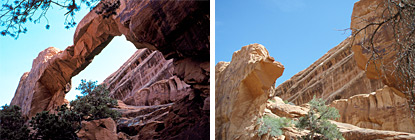
Wall Arch, 12th largest, one of the better-known and most-seen natural arches in Arches National Park, Utah, collapsed.

Wall Arch, before and after collapse - National Park Service photos

Wall Arch, before and after collapse – National Park Service photos

“Not being a geologist, I can’t get very technical but it just went kaboom,” [Arches NP] Chief Ranger Denny Ziemann said. “The middle of the arch just collapsed under its own weight. It just happens.”

Wall Arch, located along the popular Devils Garden Trail, was 71 feet tallwide and 33 1/2 feet widetall, ranking it 12th in size among the known arches inside the park. Lewis T. McKinney first reported and named Wall Arch in 1948.

No one reported observing the arch collapse and there were no visitor injuries, the National Park Service said.

Read the report from the Salt Lake Tribune.

Some tourist on Sunday, August 3, or Monday, August 4, got the last photograph of Wall Arch still standing. Was it you? Were you close? Give us a shout in the comments if so.

Other resources:

x

Other blogs and later reports:


Quote of the moment: Mark Twain, and a majority in favor

August 9, 2008

Hain’t we got all the fools in town on our side? and ain’t that a big enough majority in any town?

— Mark Twain (Samuel Langhorn Clemens),
Adventures of Huckleberry Finn

Mark Twain, Library of Congress image

Mark Twain, Library of Congress image


63rd anniversary: Hiroshima, August 6; Nagasaki, August 9

August 9, 2008

63 years ago, U.S. military action brought a quick close to hostilities without an invasion of Japan, with the detonation of two atomic bombs, one over Hiroshima on August 6, 1945, and one over Nagasaki on August 9.

Daily Yomiuri Online carried a description of memorial events in Hiroshima today, from Yomiuri Shimbun:

NAGASAKI–The Nagasaki municipal government held a ceremony Saturday marking the 63rd anniversary of the atomic bombing of the city, at which participants called for the abolition of all nuclear weapons.

A total of 5,650 A-bomb survivors, representatives of victims’ families from around the nation and Nagasaki citizens participated in the ceremony. Prime Minister Yasuo Fukuda also attended the ceremony, which was held in Nagasaki Peace Park near ground zero.

Nagasaki Mayor Tomihisa Taue read out the Nagasaki Peace Declaration, which urges the worldwide abolition of nuclear weapons.

“Human beings have no future unless nuclear weapons are eliminated. We shall clearly say no to nuclear weapons,” Taue said.

The ceremony started at 10:40 a.m. Three books listing the names of 3,058 people confirmed to have died as a result of the bombing in the past year were placed inside a memorial box in front of the Peace Statue.

The total number of books listing the names of the deceased is 147, and the number of names is 145,984.

Representatives of surviving victims, bereaved families, the prime minister and Hiroshima Mayor Tadatoshi Akiba placed flowers at the site.

At 11:02 a.m., the time the atomic bomb struck, ceremony participants offered a silent prayer. At the same time, local high school students rang the Bells of Nagasaki.

In the peace declaration, Taue read from an academic paper written by four people, including a former U.S. secretary of state, which promoted a new policy for developing nuclear weapons. The proposal encouraged countries to ratify the Comprehensive Test Ban Treaty. The mayor said world nuclear powers “should sincerely fulfill their responsibility of nuclear disarmament,” and urged the government to pass the three nonnuclear principles into law.

This year also marks the 100th anniversary of the birth of Takashi Nagai, a medical doctor who helped rescue of victims after the bombing.

The mayor referenced one of the doctor’s remarks, saying: “There are no winners or losers in a war. There is only destruction.”

Shigeko Mori, 72, representing survivors of the bombing, read out an oath for peace that said Japan should promote its Constitution and the three nonnuclear principles to the rest of the world to prevent nuclear proliferation.

Fukuda gave a speech, saying, “Japan should play a responsible role in the international community as a nation cooperating for peace.”

(Aug. 10, 2008)

Other information:

Other related posts at Millard Fillmore’s Bathtub:


John McCain: Constitution, yes or no?

August 9, 2008

In Denver, Colorado, John McCain has an opportunity to stand up and defend the First Amendment and the rest of the Constitution. All he needs to do is issue a statement that he disagrees with the prosecution of the peaceful woman — he could do even more asking the prosecutor to drop the charges.

Ed Brayton describes the case at Dispatches From the Culture Wars.

The silence from McCain: Will it grow deafening?

More reading:


No one believes it. Is it so?

August 9, 2008

One of the great mysteries of history is how an entire nation of people can follow a leader into tragedy — a stupid war, economic morass, cultural suicide, genocide, or other tragedy — without appearing to notice they were going against their national values, against reason, against morality.

I wonder if part of the answer can be found by studying the way our brains perceive things, in particular, the way our brains force us to see things that are not so.

Some things are just so unbelievable, our brains tell us we’re seeing something different, something more believable. Here are two examples, the Charlie Chaplin mask illusion, and the Einstein mask illusion.

Chaplin — you know it’s concave, but the nose sticks out every time:

Einstein — is Big Brother really watching you? What do your eyes say?

Here’s a nasty little kicker: Even when most people know that it’s an illusion, they can’t perceive the illusion-in-action; as Paul Simon wrote, “Still a man sees what he wants to see and he disregards the rest.” See Stephen Fry’s discussion about the illusion from BBC2:

Historical applications

  • CIA chief William Colby was involved in Operation Phoenix during the Vietnam War. When investigations revealed that the operation involved torture, many people refused to believe the U.S. would be involved in torture (good!). And even after he admitted to Congressional committees that he had personally authorized the torture, people had difficulty believing it. David Wise wrote an article about Operation Phoenix for the New York Times Magazine, July 1, 1973: “Not one of Colby’s friends or neighbors, or even his critics on the Hill, would, in their wildest imagination, conceive of Bill Colby attaching electric wires to a man’s genitals and personally turning the crank. “Not Bill Colby… He’s a Princeton man.'”
  • “[T]he Russians are finished. They have nothing left to throw against us,” a confident Adolf Hitler told Gen. Franz Halder in July 1941. Russia mired down the German army, making the phrase “the Eastern Front” a dreaded death sentence in German commands. In the end, it was the Soviet Army that first got to Berlin, and captured Hitler’s command bunker where der Führer had committed suicide a short time before. Adding to the historic irony, twice over: First, Stalin refused to believe his intelligence service reports that the Nazis were massing on the border of Russia, just two years after the Molotov-Ribbentrop Pact, which pledged neither nation would invade the other. Second, Hitler’s generals had studied Napoleon’s invasion of Russia in 1812, working to avoid all the mistakes Napoleon made. So sure were the Nazis of their superiority to Napoleon in every way, they invaded Russia on the anniversary of Napoleon’s invasion, June 22, 1941. Great shades of Santayana’s Ghost!
  • Bush administration historians will wonder why Bush was able to do what he did, in the Iraq war and other situations foreign and domestic, with even members of his own party who saw him close up believing he’d do something different. See this story by Ron Susskind, “Faith, Certainty and the Presidency of George Bush,” New York Times Magazine, October 17, 2004.
  • The Gulf of Tonkin Resolution, based on an incident in the Gulf of Tonkin near Vietnam.  (See also documents from the National Security Agency archives.)
  • Weapons of Mass Destruction in Iraq.

Richard Feynman discussed at length how scientists know their experimental results are accurate, and how to keep science honest. He pointed out that most of the time, errors creep in at the start, and some people just refuse to believe they exist. It is easiest to fool ourselves, Feynman said — and so a good scientist understands that, and protects against self-deception. If only other disciplines could adopt that philosophy, strategy and tactics!

Faith can get us through troubled times, but often gets us into troubled times in the first place.

Do you have other examples of self-delusion by illusionary means?

Tip of the old scrub brush to Vous Pensez.


Obama leads the Pledge of Allegiance

August 8, 2008

Got another e-mail today, alleging that Illinois Sen. Barack Obama refuses to salute the U.S. flag or say the Pledge of Allegiance.

I was surprised to discover that the U.S. Senate has added the pledge to their opening exercises — new from when I staffed the Senate. But, what that means, with C-SPAN televising the proceedings, is that there is video evidence of Sen. Obama leading the pledge, if he does, when he substitutes for the presiding officer (the Vice President) in the Senate.

On June 21, 2007, for example, Obama presided over the Senate. See for yourself.


Baptism by fire, and the fire this time

August 8, 2008

New teachers, teachers taking on new subjects or major curriculum redesigns, and teachers trying to keep up may find this list useful: Baptism by Fire: 100 Essential Tips and Resources for Student Teachers.

It features an extensive list of ideas, suggestions, and useful on-line resources and ideas from the blog Smart Teaching.org.

I confess, I was unaware of Smart Teaching.org until Kelly Sonora contacted me from the organization.  What do you think, Dear Reader:  Useful stuff?


That shudder was Texas thinking about really teaching the Bible in public schools

August 8, 2008

Among other issues I’ve not followed closely on the blog due to a way too-busy summer is the issue of teaching the Bible in Texas public schools. The Texas Lege, failing to get a contract with Comedy Central, passed a law that says every public school district in Texas “may” teach a course in the Bible if kids petition for it.

The bill had fancier, slightly more legal language, but was just about that ambiguous (having drafted my first federal law <cough>34</cough> years ago, and having written many amendments to state, federal and local laws, and having survived the rigorous legislative drafting course at George Washington, I feel qualified to complain about the problems in the law’s language).

Left hanging were answers to these questions:

  • Who or what determines the curriculum for such a course?
  • Does the law require the district to offer the class, when a request is made? For one student? For ten?
  • Will the state provide money to offer the class, since every district in the state is under-funded?
  • Will the State School Board authorize texts for the class, so individual districts don’t have to spring to buy the texts, even though the state fund is grossly underfunded and text purchases in core areas like mathematics, science and English go begging?

The question about whether the law requires a course to be offered was bucked over to the Texas Attorney General’s office, but so far they have ducked the issue (if Greg Abbott were alive today, I’m sure they would have given a quicker answer so schools could prepare).

The question on whether the SBOE would offer guidance on curriculum was also answered in July. No.

About three dozen school districts in Texas’s 254 counties already offer courses in the Bible. Some have been sued for offering more of a Sunday school class, and they lost, or settled, by requiring real academic rigor.

What are the stakes?

Well, consider that Texas also has among the highest teen-age, school-girl pregnancy rates in the nation, which contributes mightily to a staggering drop out rate. Shouldn’t Texans be happy that kids can get instruction on Biblical history and its use as literature?

Well, have you read the Bible?

Christian Beyer, who blogs at Sharp Iron, noted in comments at John Shore’s blog, Suddenly Christian, in a thread about whether God cares if one is married or unmarried:

You know, I think you just might be right.

Anita over on her blog [Grace Unfolding] wrote an interesting article related to what you are saying, and she surprised the heck out of me with a new Biblical revelation (for me, anyway). The dude and the chick in Song of Songs (Song of Solomon?), even though they ended up in the sack, were NOT MARRIED! [bolding and link added]

http://www.sisterfriends-together.org/gay-okay-sex-no-way/

I never really cared for the Song of Songs before – too many Christian guys quoting it to me when they bragged about how ‘Godly’ their marriage was and how the Holy Spirit was giving their sex life a boost. Puh-leese! Breasts like fawns? What’s next – thigh’s like calves? (Wait a minute… )

How will this play in Crawford, Beaumont, Pleasant Grove, Crockett or Paris? Oh, my.

So far the SBOE has gone with a “teach the controversy” philosophy in science. Turnabout is fair play, no?

Additional resources:


African nations back off of limited DDT use

August 7, 2008

Anti-DDT business interests appear triumphant, if only temporarily,  in their efforts to stop the use of DDT in the fight against malaria.

ProtectAfrica.com reports use of DDT has been stopped in northern UgandaNine corporations sued to stop the sprayingNew Visions reports a shift to a chemical named ICON for use in Indoor Residual Spraying, designed to protect people against mosquitoes in their homes.

I have links to stories saying Rwanda has abandoned DDT in the past few weeks, but none of the links work.

Meanwhile, from The East African in Nairobi, Kenya, comes the report that Tanzania became the first East African nation in recent years to use DDT for limited, indoor spraying. [But be wary of this source; the article also claims many nations outlawed DDT after 1972; not accurate in Africa, nor most other places.]

There is high irony in businesses opposing the use of DDT when environmental organizations in other nations do not oppose it.


Oops! How many stripes on the U.S. flag?

August 7, 2008

School kids and people seeking naturalization as citizens of the U.S. should be able to tell you there are 13 stripes on the U.S. flag, one for each of the original 13 colonies. The top stripe is red, and the bottom stripe is red.

Oops. The U.S. Postal Service printed a stamp that features what looks like a flag with a 14th stripe.

Representations of the general usage, first class postal stamps issued by the U.S. Postal Service in April 2008 -- and, is that a 14th stripe on the flag in the lower right?

Representations of the general usage, first class postal stamps issued by the U.S. Postal Service in April 2008 -- and, is that a 14th stripe on the flag in the lower right? The four original, correct paintings were done by Laura Stutzman of Mountain Lake Park, Maryland.

A philatelist blogger, Stamps of Distinction, noted the error in a post earlier this week. The Postal Service acknowledged a problem with the stamp, but said what looks like a seventh white stripe at the bottom of the flag is really just a light patch added to the stamp to give contrast with the last red stripe.

The error appears on the fourth of a four-stamp plate known as the “Flags 24/7 stamps.” The flag is portrayed flying at four different times of the day, sunrise, noon, sunset, and night. The night portrayal carries the last-minute art revision that looks like a 14th stripe, on the bottom of the flag.

Errors in stamps drive up collectors’ prices — USPS says it has no plans to change the stamp now, so it won’t become a rarity.

Stamps of Distinction explains the intricacies of U.S. flag design, stamp traditions, and more specifics. You would do well to visit that site and check the full post.

Please note that flags flown after sunset should be specially lighted to be flown; the U.S. flag code suggests flags should be retired at sunset, otherwise, except at a few locations where the flag may be flown 24 hours a day, by law. USPS said:

For more than 200 years, the American flag has been the symbol of our nation’s source of pride and inspiration for millions of citizens. In May of 1776, Betsy Ross reported that she sewed the first American flag.

Federal law stipulates many aspects of flag etiquette. In 1942, a code of flag etiquette was established. The code states in part that the American flag should be displayed from sunrise to sunset every day, weather permitting, but especially on days of national importance like Memorial Day, Independence Day, Labor Day, and Veterans Day. Also, federal law requires that “when a patriotic effect is desired,” the flag can be flown through the night if properly lit. Although compliance is voluntary, public observation of the code’s measures is widespread throughout the nation.

Teachers, can you use this for a warm-up/bell ringer exercise on flag history?

Resources: