Slight fluctuations from 1998’s record heat doesn’t mean warming is done

December 14, 2009

Sometimes you find rational discussion and good information in the newspaper.

This story moved on the McClatchy wire last August (I just recently came across it):

Drop in world temperatures fuels global warming debate

By Robert S. Boyd | McClatchy Newspapers

WASHINGTON — Has Earth’s fever broken?

Official government measurements show that the world’s temperature has cooled a bit since reaching its most recent peak in 1998.

That’s given global warming skeptics new ammunition to attack the prevailing theory of climate change. The skeptics argue that the current stretch of slightly cooler temperatures means that costly measures to limit carbon dioxide emissions are ill-founded and unnecessary.

Proposals to combat global warming are “crazy” and will “destroy more than a million good American jobs and increase the average family’s annual energy bill by at least $1,500 a year,” the Heartland Institute, a conservative research organization based in Chicago, declared in full-page newspaper ads earlier this summer. “High levels of carbon dioxide actually benefit wildlife and human health,” the ads asserted.

Many scientists agree, however, that hotter times are ahead. A decade of level or slightly lower temperatures is only a temporary dip to be expected as a result of natural, short-term variations in the enormously complex climate system, they say.

McClatchy’s story would be accurate today, even after the records show that the last decade is the hottest ever — such a long shelf-life shows good research and writing by McClatchy’s reporters.  McClatchy’s story doesn’t contradict this press release last week from the World Meteorological Organization (WMO):

2000–2009, THE WARMEST DECADE

Geneva, 8 December 2009 (WMO) – The year 2009 is likely to rank in the top 10 warmest on record since the beginning of instrumental climate records in 1850, according to data sources compiled by the World Meteorological Organization (WMO). The global combined sea surface and land surface air temperature for 2009 (January–October) is currently estimated at 0.44°C ± 0.11°C (0.79°F ± 0.20°F) above the 1961–1990 annual average of 14.00°C/57.2°F. The current nominal ranking of 2009, which does not account for uncertainties in the annual averages, places it as the fifth-warmest year. The decade of the 2000s (2000–2009) was warmer than the decade spanning the 1990s (1990–1999), which in turn was warmer than the 1980s (1980–1989). More complete data for the remainder of the year 2009 will be analysed at the beginning of 2010 to update the current assessment.

This year above-normal temperatures were recorded in most parts of the continents. Only North America (United States and Canada) experienced conditions that were cooler than average. Given the current figures, large parts of southern Asia and central Africa are likely to have the warmest year on record.

If only all reporting were so accurate.


Rick Warren trips over commandment against murder

December 11, 2009

Under Pressure, Rick Warren Condemns Uganda Anti-Gay Bill.”

Why so much trouble?  Isn’t there, like, a commandment against murder?

Still, I suppose it’s progress.  Now if we could just get the Congressional Christian Caucusthe ominously-named “Family” — to come out against murder, we’ll be making real progress.


Getting a great education that the tests can’t measure

December 11, 2009

As I sit with officials from the Texas Education Agency and the Dallas ISD discussing what goes on in our classrooms, I often reflect that the drive to testing frequently pushes education out of the classroom.

One of my favorite education blogs, the Living Classroom, comes out of a the West Seattle Community School where, many days — perhaps most days — education goes on in wonderful ways.  No test could ever capture the progress made.

Latest example:  This boy made this squid.  He had fun doing it.  He learned a lot.  Look at the excitement.

(Somebody get P. Z. Myers’ attention:  P. Z.!  Look at this squid!)

Asher and his amazing squid, The Living Classroom, West Seattle Community School

Asher and his amazing squid, The Living Classroom, West Seattle Community School

It’s pretty colorful, even for a squid, but I’ll wager the kid now knows more about squids than most Texas ninth grade biology students.  Of course, sewing squids is not among the list of Texas Essential Knowledge and Skills.  What Asher now knows . . . such learning would have to be smuggled into a Texas classroom.

When education is outlawed, only outlaws will have education.


61 years old: The Universal Declaration of Human Rights

December 10, 2009

Rational Rant reminds us, December 10 is the 61st anniversary of the adoption of the Universal Declaration of Human Rights.

Our Bill of Rights is good; have you ever really read the UDHR and compared?  Go look, see what you agree with, or whether you have any disputes.

sbh explains:

10 December is Human Rights Day, commemorating the adoption of the Universal Declaration of Human Rights by the UN General Assembly on this day in 1948. And how appropriate it is to the season. Consider Article 1:

All human beings are born free and equal in dignity and rights. They are endowed with reason and conscience and should act towards one another in a spirit of brotherhood.

Damn right. In a way it’s sad that the remaining twenty-nine articles have to exist at all, spelling out that people should not be tortured (Article 4) or enslaved (Article 5), or deprived of employment (Article 23) or leisure (Article 24) or education (Article 26). Shouldn’t this all go without saying? Apparently not; when the nation that prides itself on being the city on the hill and the beacon of hope for the world descends to torture and degradation of human beings for political ends all bets are off.

Comparison of the BoR and UDHR makes a good discussion assignment, and could probably be turned into a DBQ.


If only hysteric, misplaced paranoia could reduce greenhouse gases . . .

December 10, 2009

“I got this idea for a movie!”

“Not another vampire who sucks the sap of only endangered species plants, please, Bob.”

“No, really, you gotta hear this!  Heck, it might even be real.”

“Whaddya mean by that, Bob?”

“I mean this whole Copenhagen thing!  World leaders getting together in secret to plot the destruction of world industry!”

“Copenhagen’s meetings are wide open, Bob.  It’s on the news everywhere.  And did you ever notice that most of the world leaders there are capitalists, and that they owe their election to other capitalists, frequently of the oil-drilling and coal-mining sort?”

“That’s what they want you to think!”

“Well, I think that way whether they want me to or not, Bob.  Money, you know?  I love it.  I follow it.  There’s no money in controlling climate change.  If there were, I’d be Copenhagen right now.”

“You’re missing the point!  These guys are meeting to take the money away from guys like you.”

“Pierre, here at the restaurant, does a pretty good job of taking money from guys like me, in return for a good arugula salad and a chunk of rare roast beef.”

“That’s not what I mean!”

“I think you’ve got another crazy idea that won’t make a good movie.  I’ll let you talk through the arugula, Bob.  When the roast beef comes, I don’t want stupid plots that won’t sell on the table — so it better be good, or we’ll change the topic.”

“Okay, here goes:  Mad climate scientists create a scare about global warming, and everybody gives them their money, and they the rest of the movie is about the chase to catch them before they get to a secret beach in the Maldives or Marshall Islands where they’ll hide forever in their secret lair.”

“I’m not impressed yet, Bob.  Why would anyone think a climate scientist would be so power hungry?

“They meet in Al Gore’s mansion.  Al Gore’s the power-hungry villain!”

“Al Gore?  He lost an election to George F. Bush, for cryin’ out loud.  Nobody would believe that.”

“You mean W — ‘George W. Bush.'”

“Have you seen what the stock market’s been like lately, Bob?  No, of course not.  You don’t own stocks in regular companies — gun makers and gold dealers only — but after what happened to my portfolio, I mean F.  He’s George F. Bush to me.”

“C’mon, it’s ripped from the headlines!”

“It’s about as exciting as the crossword puzzle, Bob.  That’s not a movie — it’s a new sleep drug.  I couldn’t sell it to a religious group trying to make a movie about Charles Darwin, even if we dressed Gore up as Darwin.  Even they’d see through the plot, Bob.”

“Archie!  It’s a great movie!  Think of the special effects!”

“Think of the NoDoz concession.  Theatres don’t have ’em.  Climate scientists taking over the world is like the Joffrey Ballet as the perps on the St. Valentine’s Day Massacre.  It’d be like getting toe-shoed to death.”

Oh, c’mon, Arch.  I got half the screenplay already done!”

“Well you need more research.”

“What?”

MaldivesMarshall Islands.  They’re the poster islands for climate change.  They’re the first nations to go as the sea rises.  All the geeks will know that, and so they’ll laugh at your movie.  Geeks laughing at you isn’t good box office.”

“We can do it like Superman!  You know a Fortress of Solitude somewhere in the ice.”

“No ice would kinda make that plot device not work, wouldn’t it, Bob?”

“Oh, c’mon.  No one really thinks the ice is disappearing!”

“Bob — remember our agreement?”

“What?”

“Beef’s here.  Shuttup.”

“Huh?  Oh, yeah.  Oh.  Yeah.”

“Okay, Archie.  How about this:  There really are gods, and hysteria makes them happy.”

“Hysteria.  Yeah.  There’s value in that.”

“No, I mean it.  Hysteria makes the gods happy, and so then they do good things for people.”

“Like what?”

“Well . . . like . . . like cleaning up global warming.  Yeah, that’s it!  Blind hysteria makes global warming go away!”

“Nobody’ll believe that, either, Bob.  If that worked, global warming would have been gone ten years ago.  Shuttup and eat your beef.”


The Curse of “Not Evil, Just Wrong” — still evil and wrong

December 10, 2009

At the first post on this material, the thread got a little long — not loading well in some browsers, I hear.

So the comments are closed there, and open here.

In fashion we wish were different but seems all too typical, so-called skeptics of global warming defend their position with invective and insult.  But they are vigorous about it.  What do you think?  What information can you contribute?

Here’s the post that set off the denialists, anti-science types and DDT sniffers, and a tiny few genuinely concerned but under-informed citizens:

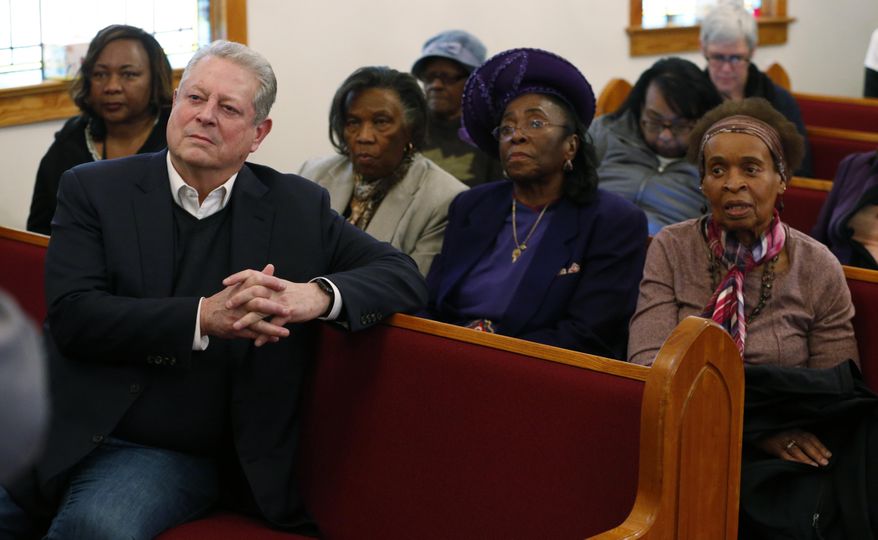
AP caption: Former Vice President Al Gore, left, listens to speakers during a meeting at the Grove Missionary Baptist Church in Buckingham, Va., Tuesday, Feb. 19, 2019. Gore visited the area that is the proposed site for a compressor station for the Atlantic Coast Pipeline. (AP Photo/Steve Helber)
Should be obviously silly for anyone to argue former divinity student Al Gore is evil, as this film implies despite the demurrer. It should also be obviously that it’s evil to call Gore wrong on these issues; but that doesn’t stop brown Earther critics of scientists and Al Gore.

I warned you about it earlier. Crank science sites across the internet feature news of another cheap hit on Rachel Carson and science in movie form.

“Not Evil, Just Wrong” is slated for release on October 18. This is the film that tried to intrude on the Rachel Carson film earlier this year, but managed to to get booked only at an elementary school in Seattle, Washington — Rachel Carson Elementary, a green school where the kids showed more sense than the film makers by voting to name the school after the famous scientist-author.

The film is both evil and wrong.

Errors just in the trailer:

  1. Claims that Al Gore said sea levels will rise catastrophically, “in the very near future.” Not in his movie, not in his writings or speeches. Not true. That’s a simple misstatement of what Gore said, and Gore had the science right.
  2. ” . . . [I]t wouldn’t be a bad thing for this Earth to warm up. In fact, ice is the enemy of life.” “Bad” in this case is a value judgment — global warming isn’t bad if you’re a weed, a zebra mussel, one of the malaria parasites, a pine bark beetle, any other tropical disease, or a sadist. But significant warming as climatologists, physicists and others project, would be disastrous to agriculture, major cities in many parts of the world, sea coasts, and most people who don’t live in the Taklamakan or Sahara, and much of the life in the ocean. Annual weather cycles within long-established ranges, is required for life much as we know it. “No ice” is also an enemy of life.
  3. “They want to raise our taxes.” No, that’s pure, uncomposted bovine excrement.
  4. “They want to close our factories.” That’s more effluent from the anus of male bovines.
  5. The trailer notes the usual claim made by Gore opponents that industry cannot exist if it is clean, that industry requires that we poison the planet. Were that true, we’d have a need to halt industry now, lest we become like the yeast in the beer vat, or the champagne bottle, manufacturing alcohol until the alcohol kills the yeast. Our experience with Rivers and Harbors Act of 1899, the Clean Air Acts and the Clean Water Act is that cleaning the environment produces economic growth, not the other way around. A city choked in pollution dies. Los Angeles didn’t suffer when the air got cleaner. Pittsburgh’s clean air became a way to attract new industries to the city, before the steel industry there collapsed. Cleaning Lake Erie didn’t hurt industry. The claim made by the film is fatuous, alarmist, and morally corrupt.

    When the human health, human welfare, and environmental effects which could be expressed in dollar terms were added up for the entire 20-year period, the total benefits of Clean Air Act programs were estimated to range from about $6 trillion to about $50 trillion, with a mean estimate of about $22 trillion. These estimated benefits represent the estimated value Americans place on avoiding the dire air quality conditions and dramatic increases in illness and premature death which would have prevailed without the 1970 and 1977 Clean Air Act and its associated state and local programs. By comparison, the actual costs of achieving the pollution reductions observed over the 20 year period were $523 billion, a small fraction of the estimated monetary benefits.

  6. “Some of the environmental activists have not come to accept that the human is also part of the environment.” Fatuous claim. Environmentalists note that humans uniquely possess the ability to change climate on a global scale, intentionally, for the good or bad; environmentalists choose to advocate for actions that reduce diseases like malaria, cholera and asthma. We don’t have to sacrifice a million people a year to malaria, in order to be industrial and productive. We don’t have to kill 700,000 kids with malaria every year just to keep cars.
  7. “They want to go back to the Dark Ages and the Black Plague.” No, that would be the film makers. Environmentalists advocate reducing filth and ignorance both. Ignorance and lack of ability to read, coupled with religious fanaticism, caused the strife known as “the Dark Ages.” It’s not environmentalists who advocate an end to cheap public schools.
  8. The trailer shows a kid playing in the surf on a beach. Of course, without the Clean Water Act and other attempts to keep the oceans clean, such play would be impossible. That we can play again on American beaches is a tribute to the environmental movement, and reason enough to grant credence to claims of smart people like Al Gore and the scientists whose work he promotes.
  9. “I cannot believe that Al Gore has great regard for people, real people.” So, this is a film promoting the views of crabby, misanthropic anal orifices who don’t know Al Gore at all? Shame on them. And, why should anyone want to see such a film? If I want to see senseless acts of stupidity, I can rent a film by Quentin Tarantino and get some art with the stupidity. [Update, November 23, 2009: This may be one of the most egregiously false charges of the film. Gore, you recall, is the guy who put his political career and presidential ambitions on hold indefinitely when his son was seriously injured in an auto-pedestrian accident; Gore was willing to sacrifice all his political capital in order to get his son healed. My first dealings directly with Gore came on the Organ Transplant bill. Gore didn’t need a transplant, didn’t have need for one in his family, and had absolutely nothing to gain from advocacy for the life-saving procedure. It was opposed by the chairman of his committee, by a majority of members of his own party in both Houses of Congress, by many in the medical establishment, by many in the pharmaceutical industry, and by President Reagan, who didn’t drop his threat to veto the bill until he signed it, as I recall. Gore is a man of deep, human-centered principles. Saying “I can’t believe Al Gore has great regard for real people” only demonstrates the vast ignorance and perhaps crippling animus of the speaker.]

That’s a whopper about every 15 seconds in the trailer — the film itself may make heads spin if it comes close to that pace of error.

Where have we seen this before? Producers of the film claim as “contributors” some of the people they try to lampoon — people like Ed Begley, Jr., and NASA’s James E. Hansen, people who don’t agree in any way with the hysterical claims of the film, and people who, I wager, would be surprised to be listed as “contributors.”

It’s easy to suppose these producers used the same ambush-the-scientist technique used earlier by the producers of the anti-science, anti-Darwin film “Expelled!

Here, see the hysteria, error and alarmism for yourself:

Ann McElhinney is one of the film’s producers. Her past work includes other films against protecting environment and films for mining companies. She appears to be affiliated with junk science purveyors at the Competitive Enterprise Institute, an astro-turf organization in Washington, D.C., for whom she flacked earlier this year (video from Desmogblog):

Remember, too, that this film is already known to have gross inaccuracies about Rachel Carson and DDT, stuff that high school kids could get right easily.

Anyone have details on McElhinney and her colleague, Phelim McAlee?

More:

Related posts, at Millard Fillmore’s Bathtub:


Cool stuff: Richard Wiseman’s Top 10 Science Party Tricks for Christmas

December 9, 2009

I especially like pouring the carbon dioxide to put out the candles:

Wiseman’s blog is worth visiting from time to time — especially if you’re a teacher.


Who invented Santa Claus? Who really wrote the “Night Before Christmas?”

December 7, 2009

An encore post from 2007

Thomas Nast invented Santa Claus? Clement C. Moore didn’t write the famous poem that starts out, “‘Twas the night before Christmas, and all through the house . . . ?”

The murky waters of history from Millard Fillmore’s Bathtub soak even our most cherished ideas and traditions.

But isn’t that part of the fun of history?

Santa Claus delivers to Union soldiers, "Santa Claus in Camp" - Thomas Nast, Harper's Weekly, Jan 3, 1863
Thomas Nast’s first published drawing featuring Santa Claus; for Harper’s Weekly, “A Journal of Civilization,” January 3, 1863 Nast portrayed the elf distributing packages to Union troops: “Santa Claus in camp.” Nast (1840-1904) was 23 when he drew this image.

Yes, Virginia (and California, too)! Thomas Nast created the image of Santa Claus most of us in the U.S. know today. Perhaps even more significant than his campaign against the graft of Boss Tweed, Nast’s popularization of a fat, jolly elf who delivers good things to people for Christmas makes one of the great stories in commercial illustration. Nast’s cartoons, mostly for the popular news publication Harper’s Weekly, created many of the conventions of modern political cartooning and modeled the way in which an illustrator could campaign for good, with his campaign against the graft of Tammany Hall and Tweed. But Nast’s popular vision of Santa Claus can be said to be the foundation for the modern mercantile flurry around Christmas.

Nast is probably ensconced in a cartoonists’ hall of fame. Perhaps he should be in a business or sales hall of fame, too.  [See also Bill Casselman’s page, “The Man Who Designed Santa Claus.]

Nast’s drawings probably drew some inspiration from the poem, “Account of a Visit from St. Nicholas,” traditionally attributed to Clement C. Moore, a New York City lawyer, published in 1822. The poem is among the earliest to describe the elf dressed in fur, and magically coming down a chimney to leave toys for children; the poem invented the reindeer-pulled sleigh.

Modern analysis suggests the poem was not the work of Moore, and many critics and historians now attribute it to Major Henry Livingston, Jr. (1748-1828) following sleuthing by Vassar College Prof. Don Foster in 2000. Fortunately for us, we do not need to be partisans in such a query to enjoy the poem (a complete copy of which is below the fold).

The Library of Congress still gives Moore the credit. When disputes arise over who wrote about the night before Christmas, is it any wonder more controversial topics produce bigger and louder disputes among historians?

Moore was not known for being a poet. The popular story is that he wrote it on the spur of the moment:

Moore is thought to have composed the tale, now popularly known as “The Night Before Christmas,” on December 24, 1822, while traveling home from Greenwich Village, where he had bought a turkey for his family’s Christmas dinner.

Inspired by the plump, bearded Dutchman who took him by sleigh on his errand through the snow-covered streets of New York City, Moore penned A Visit from St. Nicholas for the amusement of his six children, with whom he shared the poem that evening. His vision of St. Nicholas draws upon Dutch-American and Norwegian traditions of a magical, gift-giving figure who appears at Christmas time, as well as the German legend of a visitor who enters homes through chimneys.

Again from the Library of Congress, we get information that suggests that Moore was a minor celebrity from a well-known family with historical ties that would make a good “connections” exercise in a high school history class, perhaps (”the link from Aaron Burr’s treason to Santa Claus?”): (read more, below the fold)

Clement Moore was born in 1779 into a prominent New York family. His father, Benjamin Moore, president of Columbia University, in his role as Episcopal Bishop of New York participated in the inauguration of George Washington as the nation’s first president. The elder Moore also administered last rites to Alexander Hamilton after he was mortally wounded in a tragic duel with Aaron Burr.

A graduate of Columbia, Clement Moore was a scholar of Hebrew and a professor of Oriental and Greek literature at the General Theological Seminary in Manhattan. [See comment from Pam Bumsted below for more on Moore.] He is said to have been embarrassed by the light-hearted verse, which was made public without his knowledge in December 1823. Moore did not publish it under his name until 1844.

Tonight, American children will be tucked in under their blankets and quilts and read this beloved poem as a last “sugarplum” before slipping into dreamland. Before they drift off, treat them to a message from Santa, recorded by the Thomas Edison Company in 1922.

Santa Claus Hides in Your Phonograph
By Arthur A. Penn, Performed by Harry E. Humphrey.
Edison, 1922.
Coupling date: 6/20/1922. Cutout date: 10/31/1929.
Inventing Entertainment: The Motion Pictures and Sound Recordings of the Edison Companies

Listen to this recording (RealAudio Format)

Listen to this recording (wav Format, 8,471 Kb)

But Henry Livingston was no less noble or historic. He hailed from the Livingtons of the Hudson Valley (one of whose farms is now occupied by Camp Rising Sun of the Louis August Jonas Foundation, a place where I spent four amazing summers teaching swimming and lifesaving). Livingston’s biography at the University of Toronto site offers another path for a connections exercise (”What connects the Declaration of Independence, the American invasion of Canada, the famous poem about a visit from St. Nick, and George W. Bush?”):

Henry Livingston Jr. was born in Poughkeepsie, New York, on Oct. 13, 1748. The Livingston family was one of the important colonial and revolutionary families of New York. The Poughkeepsie branch, descended from Gilbert, the youngest son of Robert Livingston, 1st Lord of Livingston Manor, was not as well off as the more well-known branches, descended from sons Robert and Philip. Two other descendants of Gilbert Livingston, President George Walker Herbert Bush and his son, President-Elect George W. Bush, though, have done their share to bring attention to this line. Henry’s brother, Rev. John Henry Livingston, entered Yale at the age of 12, and was able to unite the Dutch and American branches of the Dutch Reformed Church. At the time of his death, Rev. Livingston was president of Rutgers University. Henry’s father and brother Gilbert were involved in New York politics, and Henry’s granduncle was New York’s first Lt. Governor. But the law was the natural home for many of Henry’s family. His brother-in-law, Judge Jonas Platt, was an unsuccessful candidate for governor, as was his daughter Elizabeth’s husband, U.S. Supreme Court Justice Smith Thompson. Henry’s grandson, Sidney Breese, was Chief Justice of the Illinois Supreme Court.

Known for his encyclopedic knowledge and his love of literature, Henry Livingston was a farmer, surveyor and Justice of the Peace, a judicial position dealing with financially limited criminal and civil cases. One of the first New Yorkers to enlist in the Revolutionary Army in 1775, Major Henry Livingston accompanied his cousin’s husband, General Montgomery, in his campaign up the Hudson River to invade Canada, leaving behind his new wife, Sarah Welles, and their week-old baby, on his Poughkeepsie property, Locust Grove. Baby Catherine was the subject of the first poem currently known by Major Livingston. Following this campaign, Livingston was involved in the War as a Commissioner of Sequestration, appropriating lands owned by British loyalists and selling them for the revolutionary cause. It was in the period following Sarah’s early death in 1783, that Major Livingston published most of his poems and prose, anonymously or under the pseudonym of R. Ten years after the death of Sarah, Henry married Jane Patterson, the daughter of a Dutchess County politician and sister of his next-door neighbor. Between both wives, Henry fathered twelve children. He published his good-natured, often occasional verse from 1787 in many journals, including Political Barometer, Poughkeepsie Journal, and New-York Magazine. His most famous poem, “Account of a Visit from St. Nicholas,” was until 2000 thought to have been the work of Clement Clarke Moore (1779-1863), who published it with his collected poems in 1844. Livingston died Feb. 29, 1828.

More on Henry Livingston and his authorship of the Christmas poem here.

Thomas Nast, Merry Old Santa Claus, Harper's Weekly, Jan 1, 1881

Our views of Santa Claus owe a great deal also to the Coca-Cola advertising campaign. Coca-Cola first noted Santa’s use of the drink in a 1922 campaign to suggest Coke was a year-round drink (100 years after the publication of Livingston’s poem). The company’s on-line archives gives details:

In 1930, artist Fred Mizen painted a department store Santa in a crowd drinking a bottle of Coke. The ad featured the world’s largest soda fountain, which was located in the department store of Famous Barr Co. in St. Louis, Mo. Mizen’s painting was used in print ads that Christmas season, appearing in The Saturday Evening Post in December 1930.

1936 Coca-Cola Santa cardboard store display

  • 1936 Coca-Cola Santa cardboard store display

Archie Lee, the D’Arcy Advertising Agency executive working with The Coca-Cola Company, wanted the next campaign to show a wholesome Santa as both realistic and symbolic. In 1931, The Coca-Cola Company commissioned Michigan-born illustrator Haddon Sundblom to develop advertising images using Santa Claus — showing Santa himself, not a man dressed as Santa, as Mizen’s work had portrayed him.
1942 original oil painting - 'They Remembered Me'

  • 1942 original oil painting – ‘They Remembered Me’

For inspiration, Sundblom turned to Clement Clark Moore’s 1822 poem “A Visit From St. Nicholas” (commonly called “‘Twas the Night Before Christmas”). Moore’s description of St. Nick led to an image of Santa that was warm, friendly, pleasantly plump and human. For the next 33 years, Sundblom painted portraits of Santa that helped to create the modern image of Santa — an interpretation that today lives on in the minds of people of all ages, all over the world.

Santa Claus is a controversial figure. Debates still rage among parents about the wisdom of allowing the elf into the family’s home, and under what conditions. Theologians worry that the celebration of Christmas is diluted by the imagery. Other faiths worry that the secular, cultural impact of Santa Claus damages their own faiths (few other faiths have such a popular figure, and even atheists generally give gifts and participate in Christmas rituals such as putting up a decorated tree).

For over 100 years, Santa Claus has been a popular part of commercial, cultural and religious life in America. Has any other icon endured so long, or so well?

________________________
Below:
From the University of Toronto Library’s Representative Poetry Online

Major Henry Livingston, Jr. (1748-1828)

Account of a Visit from St. Nicholas

1 ‘Twas the night before Christmas, when all thro’ the house,
2 Not a creature was stirring, not even a mouse;
3 The stockings were hung by the chimney with care,
4 In hopes that St. Nicholas soon would be there;
5 The children were nestled all snug in their beds,
6 While visions of sugar plums danc’d in their heads,
7 And Mama in her ‘kerchief, and I in my cap,
8 Had just settled our brains for a long winter’s nap –
9 When out on the lawn there arose such a clatter,
10 I sprang from the bed to see what was the matter.
11 Away to the window I flew like a flash,
12 Tore open the shutters, and threw up the sash.
13 The moon on the breast of the new fallen snow,
14 Gave the lustre of mid-day to objects below;
15 When, what to my wondering eyes should appear,
16 But a miniature sleigh, and eight tiny rein-deer,
17 With a little old driver, so lively and quick,
18 I knew in a moment it must be St. Nick.
19 More rapid than eagles his coursers they came,
20 And he whistled, and shouted, and call’d them by name:
21 “Now! Dasher, now! Dancer, now! Prancer, and Vixen,
22 “On! Comet, on! Cupid, on! Dunder and Blixem;
23 “To the top of the porch! to the top of the wall!
24 “Now dash away! dash away! dash away all!”
25 As dry leaves before the wild hurricane fly,
26 When they meet with an obstacle, mount to the sky;
27 So up to the house-top the coursers they flew,
28 With the sleigh full of Toys — and St. Nicholas too:
29 And then in a twinkling, I heard on the roof
30 The prancing and pawing of each little hoof.
31 As I drew in my head, and was turning around,
32 Down the chimney St. Nicholas came with a bound:
33 He was dress’d all in fur, from his head to his foot,
34 And his clothes were all tarnish’d with ashes and soot;
35 A bundle of toys was flung on his back,
36 And he look’d like a peddler just opening his pack:
37 His eyes — how they twinkled! his dimples how merry,
38 His cheeks were like roses, his nose like a cherry;
39 His droll little mouth was drawn up like a bow.
40 And the beard of his chin was as white as the snow;
41 The stump of a pipe he held tight in his teeth,
42 And the smoke it encircled his head like a wreath.
43 He had a broad face, and a little round belly
44 That shook when he laugh’d, like a bowl full of jelly:
45 He was chubby and plump, a right jolly old elf,
46 And I laugh’d when I saw him in spite of myself;
47 A wink of his eye and a twist of his head
48 Soon gave me to know I had nothing to dread.
49 He spoke not a word, but went straight to his work,
50 And fill’d all the stockings; then turn’d with a jerk,
51 And laying his finger aside of his nose
52 And giving a nod, up the chimney he rose.
53 He sprung to his sleigh, to his team gave a whistle,
54 And away they all flew, like the down of a thistle:
55 But I heard him exclaim, ere he drove out of sight –
56 Happy Christmas to all, and to all a good night.

Online text copyright © 2005, Ian Lancashire for the Department of English, University of Toronto. Published by the Web Development Group, Information Technology Services, University of Toronto Libraries. Be sure to visit this site for more information on this poem, on Maj. Livingston, and on poetry in general.


Quote of the moment: Mark Twain, a majority of fools

December 7, 2009

Illustration from The Adventures of Huckleberry Finn, 1884 edition - the King, "Travelling by Rail" - Wikimedia

Illustration from The Adventures of Huckleberry Finn, 1884 edition - the King, "Travelling by Rail" - Wikimedia. (The "King" is being tarred, feathered, and "ridden out of town on a rail.")

Well, the king he talked him blind; so at last he give in, and said all right, but said he believed it was blamed foolishness to stay, and that doctor hanging over them.

But the king says: “Cuss the doctor! What do we k’yer for HIM? Hain’t we got all the fools in town on our side? And ain’t that a big enough majority in any town?”

Mark Twain, The Adventures of Huckleberry Finn, Chapter XXVI


What if Al Gore were wrong about global warming? That would be great news.

December 6, 2009

It’s a point that the denialists just don’t get.  If Gore were wrong, if warming isn’t occurring, or if the warming were found to be part of a deeper cycle and all we need to do is hang on for another five or six years until the cycle shifts, that would be great news.

No one would complain about a study that actually showed that.

But no study shows that.  And the e-mails that somebody purloined from an English research center, if the worst allegations about scientists were true, can’t affect warming.  In fact, as I understand it, the chart that was “doctored” got its new, non-tree-ring data from actual thermometer readings — which, of course, show warming.

Worse, the chart’s predictions for following years turn out to be low!  Warming is outpacing some of the pessimists’ predictions.

Johann Hari, a columnist with the internet-fueled London Independent, discusses how good the news would be, in a missive at Huffington Post.

Every day, I pine for the global warming deniers to be proved right. I loved the old world – of flying to beaches wherever we want, growing to the skies, and burning whatever source of energy came our way. I hate the world to come that I’ve seen in my reporting from continent after continent – of falling Arctic ice shelves, of countries being swallowed by the sea, of vicious wars for the water and land that remains. When I read the works of global warming deniers like Nigel Lawson or Ian Plimer, I feel a sense of calm washing over me. The nightmare is gone; nothing has to change; the world can stay as it was.

But then I go back to the facts. However much I want them to be different, they sit there, hard and immovable. Nobody disputes that greenhouse gases trap heat in the atmosphere, like a blanket holding in the Sun’s rays. Nobody disputes that we are increasing the amount of those greenhouse gases in the atmosphere. And nobody disputes that the world has become considerably hotter over the past century. (If you disagree with any of these statements, you’d fail a geography GCSE).

Alas, there is no significant or credible evidence that warming is not occurring, nor that we humans are not playing a huge role.

So, in Copenhagen where the world’s leaders and other policy makers are meeting this week to discuss the situation, there will be no champagne to toast an end to global warming.

That would be good news.  It’s not the news we get.

Also see:


Black Forest Cafe and the “Too Fat Polka”

December 6, 2009

Foray to the Container Store a success, the question:  What to do about dinner?

Kathryn asked, “How about that little German joint in back of Half Price Books?”

The Black Forest Cafe and Bakery.  Legendary for its Black Forest Cake.  For years it had a small shop inside the “mother ship” of Half Price Books a half-block away.  Before Starbucks, in Dallas there was the Black Forest Cafe.

It’s really more like a delicatessan.  Out of the way.  A real hidden kitchen of Dallas.  A refuge for Germans and lovers of German meats, mustards, chocolates.

Not immune to kitsch, though.

We were surprised to find the place packed late on a Friday.  At a couple of tables, obviously a part.  A private function?  We found a table at the rear of the cafe.

And along the way we passed the guy in leiderhosen.  He carried a large, burgundy-colored accordion with a German-sounding name.

Soon after we got our seat, he stood up at a microphone in a corner of the place, said a few things and I heard “most popular song of 1957.”  Vic Damone on an accordian?  Frank Sinatra?  Buddy Holly?

“Too Fat Polka!”  Kathryn and I both laughed.  We knew it from Bob Wills’ repertoire, old cowboy movies.  In a crowd of mostly young Dallasites, we would be the only ones to recall it (1957?).

From the opening notes and especially through the chorus, the entire crowd sang along.

Who knew?

The Hungarian-spiced bratwursts exploded with flavor, and the mustard was perfect.

Note: No, it was 1947.  An Arthur Godfrey success, McGuire Sisters.   And anyone else who had a band and a recording contract in 1947.


Geography quiz: In space, who will accept your teeming masses?

December 3, 2009

Lady Liberty from space, European Space Agency photo

What is this famous landmark?

This could be an interesting geography or history bell ringer.  What are these famous sites pictured above?

Answer below the fold.

Read the rest of this entry »


Encore post: Rosa Parks, December 1, 1955

December 1, 2009

Rosa Parks being fingerprinted, Library of Congress

Rosa Parks: “Why do you push us around?”

Officer: “I don’t know but the law is the law and you’re under arrest.”

From Rosa Parks with Gregory J. Reed, Quiet Strength
(Grand Rapids, MI: Zondervan Pub. House, 1994), page 23.

Photo: Mrs. Parks being fingerprinted in Montgomery, Alabama; photo from New York World-Telegram & Sun Collection, Library of Congress

Today in History at the Library of Congress states the simple facts:

On the evening of December 1, 1955, Rosa Parks, an African American, was arrested for disobeying an Alabama law requiring black passengers to relinquish seats to white passengers when the bus was full. Blacks were also required to sit at the back of the bus. Her arrest sparked a 381-day boycott of the Montgomery bus system and led to a 1956 Supreme Court decision banning segregation on public transportation.

Rosa Parks made a nearly perfect subject for a protest on racism. College-educated, trained in peaceful protest at the famous Highlander Folk School, Parks was known as a peaceful and respected person. The sight of such a proper woman being arrested and jailed would provide a schocking image to most Americans. Americans jolted awake.

Often lost in the retelling of the story are the threads that tie together the events of the civil rights movement through the 1940s, 1950s and 1960s. As noted, Parks was a trained civil rights activist. Such training in peaceful and nonviolent protest provided a moral power to the movement probably unattainable any other way. Parks’ arrest was not planned, however. Parks wrote that as she sat on the bus, she was thinking of the tragedy of Emmet Till, the young African American man from Chicago, brutally murdered in Mississippi early in 1955. She was thinking that someone had to take a stand for civil rights, at about the time the bus driver told her to move to allow a white man to take her seat. To take a stand, she remained seated. [More below the fold]

Read the rest of this entry »