Blogger shadow cabinet

May 31, 2010

It was Jim Benton’s idea (he posts here occasionally as PRUP).  It blossomed at Cogitamus and Dispatches from the Culture Wars.

A shadow cabinet made up of bloggers.

Not having had to suffer through any of my lectures, Jim suggested me for Secretary of Education.  As the powerless go, high school teachers and Secretary of Education are on a par.  Sort of a lateral move.

But I’m flattered to have been thought of at all.

Sir Charles at Cogitamus:

Also, my list is way too laden with white dudes.  I know that there are more women bloggers and bloggers of color who would enhance any cabinet, but I’m having a hard time coming up with those who have a distinct policy area — likely the fault of not reading widely enough.

Anyway, here are a few thoughts, but I definitely want to hear your line-ups.

  1. Secretary of State – Josh Marshall – Why? Because I said so.
  2. Secretary of Treasury – Atrios – Really is there any other choice
  3. Sec. of Health and Human Services – Ezra Klein — who else is going to read all those regs.
  4. Attorney General – Scott Lemieux — And no, not a fucking chance.
  5. Secretary of Transportation – Matt Yglesias — Supertrain! (Or maybe HUD)
  6. Secretary of the Interior – Our own minstrel hussein boy — He’s got the rez cred and he can cook.
  7. EPA Director – litbrit – She’d be all over those pollutin’ muthafuckas
  8. Secretary of Education – ari — Maybe he’d have to arm wrestle Eric Rauchway for it.
  9. Secretary of Labor – Who do you think? Nathan Newman, of course.
  10. Chairman of the EEOC – Pam Spaulding – (Chairperson?)
  11. Chairman of the Fed – Bill McBride of Calculated Risk
  12. National Endowment of the Arts – Roy Edroso

And how about Amanda as Chief of Staff — she’d be tough with the right people — and Markos as the DNC Chair.

How about your suggestions for fantasy blogger cabinet?

Best deal:  Track those posts down.  As I did, you’ll find some good blogs that should be on your reading list, but probably aren’t.  Ideas, now those are powerful things.


This is Memorial Day: Please fly your flag

May 31, 2010

Flags at DFW National Cemetery - IMGP4169 photo by Ed Darrell

U.S. flags wave at DFW National Cemetery, May 30, 2010. Photo by Ed Darrell

Our local Rotary Club provides a U.S. flag planted in your yard for flag-flying events from Memorial Day through Labor Day, for an annual subscription of about $15.00.  Local groups, including especially Boy Scouts, Cub Scouts and Girl Scouts, take a route and plant the flags.

As a consequence, our town is loaded with flags on a weekend like this one.

But even if you don’t subscribe to a flag service, please remember to fly your flag today.

Memorial Day honors people who died in defense of the nation.  Armed Forces Day honors those who serve currently, celebrated  the third Saturday in May.  Veterans Day honors the veterans who returned.

On Memorial Day itself, flags on poles or masts should be flown at half-staff from sunrise to noon. At noon, flags should be raised to full-staff position.

When posting a flag at half-staff, the flag should be raised to the full-staff position first, with vigor, then slowly lowered to half-staff; when retiring a flag posted at half-staff, it should be raised to the full staff position first, with vigor, and then be slowly lowered. Some people attach black streamers to stationary flags, though this is not officially recognized by the U.S. Flag Code.

On Memorial Day, 3:00 p.m. local time is designated as the National Moment of Remembrance.

_____________

Update: Honoring our war dead makes unusual bedfellows, no? Agreement on honorable things creates hope that we can agree on more things, on other important things.


Dan Valentine: Memorial Day, Part I

May 31, 2010

By Dan Valentine

Memorial Day.

War is about death. Plain and simple. It’s been said before. In the past. Many times. It will be said again. In the future. Many times.

After 9/11 I wrote a lot of anti-war songs. There wasn’t a market for them then. There isn’t much of a market for them now.

THREE FRIENDS
(c) 2010 Daniel Valentine

THREE FRIENDS on an airplane,
Passing over streets and squares in their hometown …
THREE FRIENDS on an airplane,
Two looking what’s below them just before touching down …

One says, “Look, there’s the shopping mall.”
One points out the new town hall.
One says not a word at all.

Three fam’lies together,
Bonded by a war and intertwining lives …
Three fam’lies together,
Hearts in a near-crazed frenzy till their dear one arrives …

One thanks God for a son’s safe trip.
One’s with child with babe on hip.
One fights tears and bites a lip.

On the jet’s PA
A flight attendant says,
“Please return your tray …
Put all electronic devices away.
We’ll be landing soon.
Hope you have a nice day.”

THREE FRIENDS now deplaning,
Two of whom are cheered, embraced, and kissed heartfelt.
THREE FRIENDS now deplaning,
One in a flag-draped coffin on a conveyor belt …

One’s come home on a two-week leave.
One has got a pinned-up sleeve.
One was killed on Christmas Eve.

THREE FRIENDS on an airplane …

LONELY ROOM
(c) 2010 Daniel Valentine

There’s a LONELY ROOM on the second floor
Where a mother cries when she shuts the door,
Where she dries her eyes and then weeps some more,
Hurting, her heart broke in two.

There’s an empty bed where the mother read
To a little boy, where his prayers were said,
Where she tucked him in and then kissed his head,
Lovingly like mothers do.

There’s a closet where gremlins used to hide.
By a window, there is a tree outside
With a bright yellow ribbon around it tied
With a perfect bow, tho’ the boy he died.

And three Marines,
Standing tall–
One a chaplain–
Grand and all,
Brought the tragic news.

In the LONELY ROOM is an empty chair
Where the boy would chat on his cell and share
Secrets with his girl and at times just stare,
Dreaming of all he would do.

There are bedside books and a glove and ball;
Fam’ly photos, framed; posters on the wall:
One of George and Ringo and John and Paul
And one of Spider Man 2.

All is in its place, all is like it was
When he left to do what a soldier does.
Only now it is lonely and sad because
Wednesday last his mom heard the doorbell buzz.

And three Marines,
Taut and tall–
One a chaplain–
Caught her fall
When she heard the news.

[Memorial Day, Part II, here]

Graves at DFW National Cemetery, photo by Ed Darrell - IMGP4180

Graves at DFW National Cemetery, May 30, 2010 - photo by Ed Darrell (you may use with attribution)


Dan Valentine: Economic recovery? Check the cigarette butts and panty hose

May 30, 2010

By Dan Valentine

Good news! “The economy is growing again!” So said President Obama, just the other day.

Of course, his opponents would have you believe otherwise. But there are certain solid economic indicators that prove him right.

Like, for instance, cigarette butts.

That’s the word from a little-known tobacco expert who calls himself West Virginia Slim. When the economy went bust, he took time off from his job to tour North America–by thumb–after he found a pink slip on the desk of his corner office overlooking Broad & Wall.

I ran into him outside of Hussong’s Cantina here in Ensenada, said to be the oldest bar in the west. He was smoking a Cuban cigar.

And he says he has definite proof that the U.S. economy is, in the words of the President, “picking up considerable speed”. He can tell by the half-smoked cigarette butts strewn across the land.

“After the bust,” he told me during an exclusive interview, ‘cigarette butts flicked on the side of the nation’s streets were short. People took more puffs and got the most out of each cigarette before tossing it.”

But ever since Obama took office, he has noticed that the cigarette butts are getting, slowly but surely, longer. “People are throwing ‘em away, half-smoked,” he says.

30-foot cigarette butt in London - National Geographic photo

30-foot cigarette butt in London, England. Is this an indicator that England is undergoing a huge recovery? National Geographic photo

And this, he assures me, is definite proof, regardless of what the naysayers say, that good times are upon us.

Slim isn’t the only economic wizard who says so. A woman by the name of Gertrude, who made jillions in the stock market before she lost jillions in the market, can prove without a doubt that the country is, in Obama’s words, “beginning to turn the corner.”

Gertrude, who now makes a living as a waitress–she was here to buy duty-free Tequila to take back over the border–uses the “Parsley Principle” to judge prosperity, or the lack of it.

“During the last few months of Bush’s presidency,” says Gertrude, “customers ate the funny little green garnishes that chefs like to place on the sides of dishes as tho’ they were going out of style. Fact is, we couldn’t keep enough parsley in stock during the last days of the Bush Administration.”

But now, in Obama’s second year, very few people, if any, eat the tiny, little parsley garnishes. And this, she says, is a sure-sign that, in Obama’s words: ‘the worst of the storm is over.’”

Another economist, who uses a somewhat different barometer, says times are getting “much” better.

Her name is Olive. She spends a good part of her day going through suit pockets. She works in a dry cleaning establishment in L.A. It’s her job to empty the pockets of the suits before they are dry cleaned.

Says this full-time pocket-picker: “When times are good, people leave all sorts of coins in their pockets. But during bad times, practically no money can be found at all.”

Since the stimulus package was passed, says Olive, “the pocket-picking has been mighty good.” So good that she could afford a 3-day cruise from San Diego to Ensenada on the “Fun Ship”!

Interior of Hussong's Cantina, Ensenada, Mexico

Economics seminar at Hussong's Cantina, Ensenada, Mexico

Another little-known economic expert, a cop from Chicago, told me that he can measure the economic atmosphere of the nation by pantyhose.

He told me this over several rounds of Margaritas. (Some people drive hundreds of miles to visit the birthplace of Abe Lincoln. He flew hundreds of miles, here to Ensenada, to visit the birthplace of the Margarita. But, anyway …

Said this Chicago cop, after years on the force, “When times are good, bank robbers tend to wear expensive, luxury pantyhose over their heads to cover up their mugs. They like the confident, silky-soft feel that expensive pantyhose give them during a hold-up.”

But when times are bad bank robbers tend to buy generic or no-brand pantyhose for a bank job.

“I remember one time,” he told me, “during the last days of the Bush years, we arrested this bank robber at the scene of the crime and he had several runs in the pair of pantyhose pulled over his face. I really felt embarrassed for the fella.”

But the cop added: “Right now, since Obama took over, you hardly ever see a bank robber with runs.”

Add to FacebookAdd to NewsvineAdd to DiggAdd to Del.icio.usAdd to StumbleuponAdd to RedditAdd to BlinklistAdd to TwitterAdd to TechnoratiAdd to Furl


Wikipedia loses Sen. Arthur V. Watkins – can you help with the rescue?

May 30, 2010

Utah Sen. Arthur V. Watkins on the cover of Time Magazine, 1954; copyright Time, Inc.

Utah Sen. Arthur V. Watkins on the cover of Time Magazine, 1954 (copyright Time, Inc.) Can Wikipedia find enough information here to add to Watkins’s biography?  Are we really to believe a Time cover subject has disappeared from history?

Utah’s Sen. Arthur V. Watkins, a Republican, made the history books in 1954 when he chaired a special committee of the U.S. Senate that investigated actions by Wisconsin’s Sen. Joseph McCarthy with regard to hearings McCarthy conducted investigating communists in the U.S. Army.

This is all the biography at Wikipedia is, now, in May 2010:

Arthur Vivian Watkins (December 18, 1886 – September 1, 1973) was a Republican U.S. Senator from 1947 to 1959. He was influential as a proponent of terminating federal recognition of American Indian tribes.

[edit] References

  • Klingaman., William The Encyclopedia of the McCarthy Era, New York : Facts on File, 1996 ISBN 0816030979. Menominee Termination and Restoration [1]

[edit] External links

What is there is of little use.  It doesn’t even mention the work Watkins is most famous for, the brave action that brought him fame and electoral defeat, the censure of Sen. Joseph McCarthy during the Red Scare.  As a biography, it’s insultingly small, trivial, and misleading.

Here in Texas we have a school board that wishes to promote Joe McCarthy to hero status, to sweep under the rug the actual history of what he did, the inaccurate and vicious claims he made against dozens of people including his own colleagues in the U.S. Senate.  Good, readily available biographies of the people who stopped McCarthy, and good, readily available histories of the time can combat that drive for historical revisionism.

Wikipedia, in its extreme drive to prevent error, is preventing history in this case.  Wikipedia is no help.  For example, compare the article on Watkins with the article on Vermont Sen. Ralph Flanders, the man who introduced the resolution of censure against McCarthy. Flanders’s article is enormous by comparison, and no better documented. Why the snub to Watkins?

It’s odd.  Here I am providing a solid example of the evils of Wikipedia to warm the cockles of the heart of Douglas Groothuis, if he has a heart and cockles.   Facts and truth sometimes take us on strange journeys with strange traveling companions, even offensive companions.  Ultimately, I hope Wikipedia will wake up and choose to reinstate a useful and revealing biography of Watkins, to make Groothuis frostier than usual.

What to do?

Here is what follows, eventually below the fold:  I’ve copied one of the old biographies of Watkins from Wikipedia. Much of the stuff I recognize from various sources.  If there are inaccuracies, they are not intentional, nor are they done to impugn the reputation of any person (unlike the purging of Watkins’ biography, which unfortunately aides the dysfunctional history revisionism of Don McLeroy and the Texas State Soviet of Education).  I have provided some links to on-line sources that verify the claims.

Can you, Dear Reader, provide more and better links, and better accuracy?  Please do, in comments.  Help rescue the history around Sen. Watkins from the dustbin.

Will it spur Wikipedia to get its biographer act together and fix Watkins’s entry?  Who knows.

Here is the Wikipedia bio, complete with editing marks, and interspersed with some of my comments and other sources:

”’Arthur Vivian Watkins”’ (December 18, 1886 – September 1, 1973) was a Republican [[United States Senate|U.S. Senator]] from 1947 to 1959. He was influential as a proponent of terminating [[Federally recognized tribes|federal recognition]] of [[Native Americans in the United States|American Indian]] [[Indian tribe|tribes]] in order to allow them to have the rights of citizens of the United States.

Watkins’s life is available in basic outline form at a number of places on-line.  A good place to start is with the biographical directory of past members available from the U.S. Congress.  These sketches are embarrassingly short, but Watkins’s entry is four times the size of the Wikipedia entry, with about 20 times the information.  There is the Utah History Encyclopedia, with an article by Patricia L. Scott.  Her biography is copied by the Watkins Family History Society.

Watkins was born in [[Midway, Utah]]. He attended [[Brigham Young University]] (BYU) from 1903 to 1906, and [[New York University]] (NYU) from 1909 to 1910. He graduated from [[Columbia University Law School]] in 1912, and returned to Utah. There he was admitted to the bar the same year and commenced practice in [[Vernal, Utah]].

He engaged in newspaper work in 1914 (”The Voice of Sharon”, which eventually became the ”Orem-Geneva Times”, a weekly newspaper in [[Utah County, Utah|Utah County]].) [Sharon is an area in what is now Orem, Utah; the local division of the Church of Jesus Christ of Latter-day Saints is called the Sharon Stake, where Watkins was a member. ]In 1914 Watkins was appointed assistant county attorney of [[Salt Lake County, Utah|Salt Lake County]]. He engaged in agricultural pursuits 1919-1925 with a <span style=”white-space:nowrap”>600&nbsp;acre&nbsp;(2.4&nbsp;km²)</span> [[ranch]] near [[Lehi, Utah | Lehi]].

Watkins served as district judge of the Fourth Judicial District of Utah 1928-1933, losing his position in the [[Franklin Delano Roosevelt|Roosevelt]] Democratic landslide in 1932. An unsuccessful candidate for the [[Republican Party (United States)|Republican]] nomination to the Seventy-fifth Congress in 1936, Watkins was elected as a Republican to the [[United States Senate]] in 1946, and reelected in 1952. He served from January 3, 1947, to January 3, 1959. An [[Elder (LDS Church)|elder]] in [[The Church of Jesus Christ of Latter-day Saints]], Watkins was widely respected in Utah. {{Fact|date=August 2007}}

In 1954, Watkins chaired the committee that investigated the actions of Wisconsin Senator [[Joseph McCarthy]] to determine whether his conduct as Senator merited censure. As Chairman, Watkins barred [[television]] cameras from the hearings, and insisted that McCarthy conform to Senate protocol. When McCarthy appeared before the Watkins committee in September 1954 and started to attack Watkins, the latter had McCarthy expelled from the room.

This material comes from an oft-repeated, probably cut-and-pasted story, such as this biography of Watkins at the alumni association of his old high school, the experimental Brigham Young High.  It is confirmed in a thousand places, and one wonders why Wikipedia thought it undocumented, or inaccurate.  See Time’s contemporary report, for example (with a co-starring turn from a young Sen. Sam Ervin, D-North Carolina — the man who would later chair the Senate’s Watergate hearings).

The committee recommended censure of Senator McCarthy. Initially, the committee proposed to censure McCarthy over his attack on General [[Ralph Zwicker]] and various Senators, but Watkins had the charge of censure for the attack on General Zwicker dropped. The censure charges related only to McCarthy’s attacks on other Senators, and excluded from criticism McCarthy’s attacks on those outside of the Senate.

Watkins’s appearance on the cover of Time was the October 4, 1954, edition, reporting McCarthy’s censure.  The story accompanying that cover is here.  The Senate Resolution censuring McCarthy is designated as one of the 100 most important documents in American history by the National Archives and Records Administration — see the document and more history, here.  See more at the Treasures of Congress exhibit’s on-line version.

McCarthy’s anti-communist rhetoric was popular with Utah’s electorate, however. Former [[Governor of Utah|Utah Governor]] [[J. Bracken Lee]] took the opportunity in 1958 to oppose Watkins for the nomination in the senatorial election. Though Watkins won the Republican [[primary election|primary]], Lee ran as an [[independent (politics)|independent]] in the [[general election]]. This caused a split in the Republican vote and allowed Democrat [[Frank E. Moss]] to win the seat. Lee went on to a long career as [[mayor]] of [[Salt Lake City, Utah|Salt Lake City]]. Moss served three terms in the Senate, losing to Republican [[Orrin Hatch]] in 1976.

I’m not sure why Wikipedia’s editors rejected that historical paragraph.  Most of the points can be confirmed on Wikipedia, just following who sat where in the Senate.  Time Magazine covered the election shenanigans of 1958, with an article, “Feud in the desert,” detailing the fight between Watkins and Lee — July 14, 1958.

Watkins served as chair of the [[United States Senate Committee on Indian Affairs|Senate Interior Committee Subcommittee on Indian Affairs]]. He advocated [[Indian termination policy|termination]] of [[List of Native American Tribal Entities|Indian Tribal Entities]] in the belief that it was better for tribal members to be integrated into the rest of American life. He believed that they were ill-served by depending on the federal government for too many services.

Watkins called his policy the “freeing of the Indian from wardship status” and equated it with the Emancipation Proclamation, which freed slaves during the Civil War. Watkins was the driving force behind termination. His position as chairman of the Senate Subcommittee on Indian Affairs gave him tremendous leverage to determine the direction of federal Indian policy. His most important achievement came in 1953 with passage of House Concurrent Resolution No. 108, which stated that termination would be the federal government’s ongoing policy. Passage of the resolution did not in itself terminate any tribes.

That had to be accomplished one tribe at a time by specific legislation. The [[Bureau of Indian Affairs]] (BIA) began to assemble a list of tribes believed to have developed sufficient economic prosperity to sustain themselves after termination. The list was headed by the Menominee Tribe of Wisconsin. One reason the BIA chose the Menominee was that the tribe had successful forestry and lumbering operations which the BIA believed could support the tribe economically. Congress passed an act in 1954 that officially called for the termination of the Menominee as a federally recognized Indian tribe.

Termination for the Menominee did not happen immediately. Instead, the 1954 act set in motion a process that would lead to termination. The Menominee were not comfortable with the idea, but they had recently won a case against the government for mismanagement of their forestry enterprises, and the $8.5 million award was tied to their proposed termination. Watkins personally visited the Menominee and said they would be terminated whether they liked it or not, and if they wanted to see their $8.5 million, they had to cooperate with the federal government{{Fact|date=February 2009}}. Given this high-handed and coercive threat{{POV assertion|date=June 2009}}, the tribal council reluctantly agreed.

To set an example, Watkins pushed for termination of Utah Indian groups, including the Shivwits, Kanosh, Koorsharem, and Indian Peaks Paiutes. Once a people able to travel over the land with freedom and impunity, they were forced to deal with a new set of unfamiliar laws and beliefs. He terminated them without their knowledge or consent.

After Watkins left the Senate, he served as a member of the U.S. Indian Claims Commission from 1959 to 1967. He retired to Salt Lake City, and in 1973, to Orem.

In 1969 Watkins published a book about his investigation of McCarthy, ”Enough Rope: The Inside Story of the Censure of Senator Joe McCarthy by his Colleagues: The Controversial Hearings that Signaled the End of a Turbulent Career and a Fearsome Era in American Public Life”, (Englewood Cliffs, New Jersey: Prentice-Hall, 1969).

It’s astounding to me that mentions of Watkins’s book would be struck by Wikipedia, as if it were questionable that Watkins and the book ever existed.  Did the editor who cut that reference doubt sincerely?

Caption from the Utah Historical Society: Arthur Watkins (seated, center), a United States Senator from Utah, is shown here at a book signing for his book, "Enough Rope" at Sam Weller's Bookstore."Enough Rope" was a book about Joe McCarthy and the red scare. Rights management Digital Image (c) 2004 Utah State Historical Society. All Rights Reserved. (use here allowed by UHS, for education)

Caption from the Utah Historical Society: Arthur Watkins (seated, center), a United States Senator from Utah, is shown here at a book signing for his book, “Enough Rope” at Sam Weller’s Bookstore.”Enough Rope” was a book about Joe McCarthy and the red scare. Rights management Digital Image (c) 2004 Utah State Historical Society. All Rights Reserved. (use here allowed by UHS, for education)

State and local historical groups curate remarkable collections of images, now digitized and available free, online.  The Utah Historical Society offers a wealth of images in their collection.  Among them, we find a 1969 photograph of former-Sen. Watkins at a book signing at Sam Weller’s Zion Bookstore, the Salt Lake City monument to bookophilia and still one of the best bookstores in the world.  (Mormons read a lot, but Weller’s is not an official outlet of Mormon ideas; the store is a bastion of learning in a learned culture that pushes the envelope by challenging that culture at many turns; Weller’s bookstore is a nightmare to people who wish to cover up history).  Watkins is the guy seated at the table signing books — the other two men are not identified.  What more proof would one need of the existence of the book?

The book is referenced at the U.S. Congress biographical guideYou can find it at Amazon.com, though you’d have to buy it used or remaindered (hey! Call Sam Weller’s Zion Bookstore!)

A project of the [[United States Bureau of Reclamation|U.S. Bureau of Reclamation]], the Arthur V. Watkins Dam north of [[Ogden, Utah]], created Willard Bay off of the [[Great Salt Lake]]

U.S. Bureau of Reclamation, Christopher J. McCune, “The Weber Basin Project,” Historic Reclamation Projects Book; accessed May 29, 2010.  Scientific Commons lists Watkins’s papers, at Brigham Young University.  That listing can lead you to the Western Waters digital library, which contains an astonishing amount of information, including photos and newspaper clippings.   Watkins’s lifelong work in water and irrigation was the spur to name the BuRec dam after him.  (The Western Waters Digital Project is a good exemplar of the exquisite detail possible in a publicly-available, online archive.)

Watkins died in [[Orem, Utah]].

His son, Arthur R. Watkins, was a professor of German at [[Brigham Young University]] for more than 25 years.

I offered material to Wikipedia’s article on Watkins more than two years ago, when I discovered the article was little more than a repeat of the Congressional biography guide.  At the time I had a couple of inquiries from reporters and others watching elections in Utah, especially the reelection of Orrin Hatch, to the seat Watkins held (from 1946 to today, that seat has been held by just three people, Watkins, Ted Moss, and Hatch).  It was historical curiosity.

Recently in Texas we’ve seen that absence of good history can lead to distortions of history, especially distortions in the history to be taught in public schools.  It would serve the evil ends of the Texas Taliban were Arthur V. Watkins to be “disappeared” from history.  (See this astoundingly biased account from a guy named Wes Vernon; according to Vernon, McCarthy was improperly lynched.)

Let’s not let that happen, at least, not at Wikipedia.

_____________

Update: A reader more savvy than I in the ways of Wikipedia has restored most of the old biography.  Now it’s an effort to beef up references.

Wow.  Ask, and it’s done.  Good friends make things much better.

Add to FacebookAdd to NewsvineAdd to DiggAdd to Del.icio.usAdd to StumbleuponAdd to RedditAdd to BlinklistAdd to TwitterAdd to TechnoratiAdd to Furl

Save

Save


DDT: One of the 50 worst inventions

May 30, 2010

Time Magazine recently proposed a list of the “50 worst inventions.”

Wouldn’t you know it?  The piece was published on May 27, the anniversary of Rachel Carson’s birth (just to give fuel to the fire of the conspiratorialists), and DDT was listed as one of the 50 worst inventions.

After the war, use exploded: from 1942 to 1972, some 1.35 billion lb. of DDT were used in the U.S.

But absent from the DDT mania was consideration of the environmental effects of dumping millions of pounds of potent pesticides each year. Rachel Carson’s seminal 1962 environmental tract Silent Spring was the first to call attention to the nasty little fact that DDT produced fertility and neurological problems in humans and accumulated up the food chain in wildlife, poisoning birds. Use of the compound plummeted, and in 1972, DDT was banned in the U.S. entirely.

The list is more humorous than accurate, but it’s nice to see a journal that doesn’t suffer from DDT poisoning to make it claim, against the facts, that DDT is a miracle chemical with no harms.
Other inventions among the 50 worst, according to Time:

Dan Valentine – Moses parts the Red Sea, in Nashville

May 29, 2010

By Dan Valentine

Back to Nashville again and my one-night stand. (Never been fond of one-night stands. Who can stand that long?)

The doors of Operation Stand Down opened up. I had an MCI calling card on me with a few remaining minutes on it, in case an emergency should arise. Standing at a pay phone, I called my sister, Valerie, in France. Told her my predicament.

“Broke!!! Danny, how can you be broke?”

“I only have a few minutes on my card, Val.”

“Homeless! Danny, how did you become homeless!”

“Val, you’re using up my few remaining minutes.”

“Nashville! What are you doing in Nashville?”

(To be fair to my sister, I had said almost the very same things to my brother, Jimmy, when he was in need. If you’ve never been homeless, you don’t have a clue.)

“Money?!” she said. “I don’t have any.”

That was news to me. Last I heard she was a millionaire. Just like I once was. Well, stuff happens, as they say.

“Just $600! For the hostel here. For a month’s stay.”

Well, to make a long, minute-munching call short, she said she’d see what she could do.

Tossing my card in the nearest trash–no remaining minutes left–I made my way to the hostel where I had stayed for a month before going bust. I told Ron, the owner, my plight. Told him my sister was sending money. He offered me board and breakfast in exchange for helping out at the hostel.

That morning I had waffles with Nutella. Most enjoyable, to say the least.

I had a Net 10 cell phone, with minutes on it. Not usable for calls overseas. I phoned an old friend from my New York days. Don’t ask me why.

“Danny!!!” She was happy to hear from me. She is a composer. Very talented. She’s a graduate from the Manhattan School of Music. We were teamed together at the BMI Musical Workshop. We collaborated on what I think are some very good songs. Only one prob: She’s a multiple. Besides her wonderful, talented self, she has some six different, distinct personalities. Each with her/his own, individual name. Of course!

And only one writes music!

One personality acts as protector, one is an elderly woman, one is a little boy, one manages all the others. The last, a very important role–time-consuming!

Not to disturb anyone, I walked from the hostel, cell in hand, to the end of the block, telling her my plight of the last few nights, when suddenly a “crazy black man”, brandishing a baseball bat in his fist, came storming out of the bushes, screaming obscenities and more at me. My talking must have disturbed his sleep–what little sleep a homeless person gets. I could sympathize.

He was in attack mode. I backed away, told my former New York partner what was happening. She could hear him screaming at me. “Gotta go,” I said. “Call you right back.”

He chased me to the edge of the hostel grounds. Like a fool, I screamed, “Help, police! Someone call the police!”

A couple came out of one of the dorms. Saw me. Saw him. Stepped back inside.

Lesson learned: Never shout Police! Shout Fire!

Finally, after what seemed an eternity, the enraged man shouted one or two more remaining things on his mind and walked down the street, out of view, with his bat.

Whew! Close call! I phoned my friend back. And she (the protector, the manager, pick one from a hat) said, “I’m sorry, Danny, but I can’t take the stress!”

She can’t take the stress?!!

“I’m at a very sensitive time in my life.”

So is I!!, to coin a phrase.

“I’d prefer it if you wouldn’t call. Take care, Danny.” Don’t take any wooden nickels.

Click.

A couple of days later I’m walking down a busy street in Nashville, close by Vanderbilt University, when I hear a booming voice in back of me. “Mutherf**kers, clear the way. I’m comin’ through.”

I recognized the voice immediately. It was him! Baseball bat in hand.

He walked by, not knowing me from Adam. Just another white man in a sea of white faces. The enemy. All of us, a major threat. One call on a cell and he could be arrested. For what? Pick a charge out of a white cop’s helmet. Whites are given warnings. I was. Black men are rounded up, locked up, and the key thrown away. It happens! That little bit of knowledge alone can make you crazy.

I watched him walk down the street, head held high, shoulders back, baseball bat in hand. Proud. Bottom of the ninth. Team down four-zip. Bases loaded. Two outs.

Without hesitation, all along the boulevard, couples window-shopping; coeds on their way to class (on their cells, tweeting, of course); businessmen and women scurrying to luncheons; camera-toting tourists, with sites to pose in front; they all cleared a wide, wide path for him.

Moses, baseball bat in hand, parting the Red Sea.

And I like to think: It gave him great joy!


Hired back, Mississippi teacher promises to continue leading prayers in classroom

May 29, 2010

Religious terrorists kidnapped the First Amendment while it was visiting Meadville, Mississippi, last week.

Local resident’s expressed support for the kidnappers.

The teacher whose job was on the block for leading prayers in violation of federal law protecting students from school-imposed religion, was hired back on a technicality:  There was no formal, written warning to her that leading prayers is against the law (though it’s in every teacher training program).

The teacher, Alice Hawley, promised to continue to lead prayers in class, in violation of the law.

The newspaper did not ask whether she will follow any laws in her classroom.

On the other hand, one might take some hope that a teacher who flagrantly flouts the law in this case makes the path clear for Texas teachers to flout the standards voted in by the Texas State Soviet of Education, who would nominally be colleagues-in-crucifying to Ms. Hawley.  If you can’t fire a teacher for violating the Constitution and rulings of the U.S. Supreme Court, certainly you can’t fire a teacher for teaching history instead of Don McLeroy’s claim that the U.S. Constitution says the federal government can dictate religion to us.

Mississippi:  Fighting for its ranking among U.S. states, in educational achievement.  (Last place)


Republicans snub Vietnam vet (again – Connecticut this time)

May 29, 2010

Details here, with Gail Collins.


Memorial Day 2010: Fly your flag, study history, honor the dead

May 29, 2010

(Much of this post is encore material, from Memorial Day 2009.)

Please fly your flag this weekend, and especially Monday, to honor those who gave up their lives in defense of the nation and our freedoms.

Memorial Day, traditionally observed on May 30, now observed the last Monday in May, honors fallen veterans of wars. Traditionally, family members visit the cemetery where loved ones are interred and leave flowers on the grave.

Memorial Day honors people who died in defense of the nation.  Armed Forces Day honors those who serve currently, celebrated  the third Saturday in May.  Veterans Day honors the veterans who returned.

On Memorial Day itself, flags on poles or masts should be flown at half-staff from sunrise to noon. At noon, flags should be raised to full-staff position.

When posting a flag at half-staff, the flag should be raised to the full-staff position first, with vigor, then slowly lowered to half-staff; when retiring a flag posted at half-staff, it should be raised to the full staff position first, with vigor, and then be slowly lowered. Some people attach black streamers to stationary flags, though this is not officially recognized by the U.S. Flag Code.

On Memorial Day, 3:00 p.m. local time is designated as the National Moment of Remembrance.

Got another week of school? Here’s a quiz about the history of Memorial Day that might make a warm-up, provided by Carolyn Abell writing in the Tifton (Georgia) Gazette:

1. Memorial Day was first officially proclaimed by a general officer. His name was: A. Robert E. Lee; B. John A. Logan; C. Douglas MacArthur D. George Washington.

2. The first state to officially recognize Memorial Day was A. Virginia; B. Rhode Island; C. New York; D. Georgia.

3. The use of poppies to commemorate Memorial Day started in A. 1870 B. 1915 C. 1948; D. 1967.

4. The original date of Memorial Day was A. May 30; B. July 4; C. May 28; D. Nov 11.

5. Which U.S. Senator has tried repeatedly to pass legislation that would restore the traditional day of Memorial Day observance? A. John McCain B. Ted Kennedy C. Saxby Chambliss D. Daniel Inouye.

The answers, again provided by the Tifton Gazette:

OK, now for the answers. General John Logan, national commander of the Grand Army of the Republic, proclaimed May 30, 1968 as Memorial Day in his General Order Number 11, issued on May 5, 1868. The purpose was to honor the dead from both sides in the War Between the States. Subsequently flowers were placed on the graves of both Union and Confederate soldiers in Arlington National Cemetery on May 30 of that year.

New York was the first state to officially recognize the Memorial Day, in 1873. Southern states, though paying tribute to their dead on separate dates, refused to use May 30 as the official date until after World War I, when the holiday was broadened to honor those who died in any war.

In 1915 a woman named Moina Michael, inspired by the poem, “In Flanders Fields,” (by Canadian Colonel John McRae) began wearing red poppies on Memorial Day to honor our nation’s war dead. The tradition grew and even spread to other countries. In 1922 the VFW became the first veterans’ organization to sell the poppies made by disabled veterans as a national effort to raise funds in support of programs for veterans and their dependents. In 1948 the US Post Office issued a red 3-cent stamp honoring Michael for her role in founding the national poppy movement.

As stated above, May 30 was the original Memorial Day. In 1971, with the passage of the national Holiday Act, Congress changed it so that Memorial Day would be celebrated on the last Monday of May. Some citizens feel that turning it into a “three-day weekend” has devalued the importance and significance of this special holiday. In fact, every time a new Congress has convened since 1989, Senator Daniel Inouye of Hawaii has introduced a bill to the Senate calling for the restoration of May 30th as the day to celebrate Memorial Day.

In his 1999 introductory remarks to the bill, Senator Inouye declared:

“Mr. President, in our effort to accommodate many Americans by making the last Monday in May, Memorial Day, we have lost sight of the significance of this day to our nation. Instead of using Memorial Day as a time to honor and reflect on the sacrifices made by Americans in combat, many Americans use the day as a celebration of the beginning of summer. My bill would restore Memorial Day to May 30 and authorize the flag to fly at half mast on that day.

In addition, this legislation would authorize the President to issue a proclamation designating Memorial Day and Veterans Day as days for prayer and ceremonies honoring American veterans. This legislation would help restore the recognition our veterans deserve for the sacrifices they have made on behalf of our nation.” (from the 1999 U.S. Congressional Record).

Flat at half-staff, U.S.Capitol in background - from Flag Bay

Other sources:

Image of flag and U.S. Capitol from Flags Bay.


Why Texas social studies standards matter: Tea Party misuse of history

May 27, 2010

Something to think about from “The Tea Party Challenge,” by Erik Christiansen and Jeremy Sullivan, at Inside Higher Ed:

When considering the political scene of the moment, it is difficult not to see how historical allegory plays an important role in the public spectacle known as the Tea Party movement. From the name itself, an acronym (Taxed Enough Already) that fuses current concerns to a patriotic historical moment, to the oral and written references by some of its members to Stalin and Hitler, the Tea Party appears to be steeped (sorry) in history. However, one has only to listen to a minute of ranting to know that what we really are talking about is either a deliberate misuse or a sad misunderstanding of history.

Misuse implies two things: first, that the Partiers themselves know that they are attempting to mislead, and second, that the rest of us share an understanding of what accurate history looks like. Would that this were true. Unfortunately, there is little indication that the new revolutionaries possess more than a rudimentary knowledge of American or world history, and there is even less reason to think that the wider public is any different. Such ignorance allows terms like communism, socialism, and fascism to be used interchangeably by riled-up protesters while much of the public, and, not incidentally, the media, nods with a fuzzy understanding of the negative connotations those words are supposed to convey (of course some on the left are just as guilty of too-liberally applying the “fascist” label to any policy of which they do not approve). It also allows the Tea Partiers to believe that their situation – being taxed with representation – somehow warrants use of “Don’t Tread On Me” flags and links their dissatisfaction with a popularly elected president to that of colonists chafing under monarchical rule.

While the specifics of the moment (particularly, it seems, the fact of the Obama presidency) account for some of the radical resentment, the intensity of feeling among the opposition these days seems built upon a total lack of historical perspective.

It’s worth a read at Inside Higher Ed.

Tip of the old scrub brush to the May History Carnival at the Vapour Trail.


Dan Valentine – From the files

May 27, 2010

By Dan Valentine

I had to toss most of my writing when I become homeless again, box after box, file after file, each filled to capacity with hand-scribbled note upon note on menus, cocktail napkins, matchbook covers, etc.

I was hoping I had transcribed much of it onto my laptop. Not to be. Tho’ I did find file upon file with other notes. Files tagged D.C., Dad, Driving, Mom, Vietnam, 1950s, Hatch, NYC, so on and so on.

(My friend swims. I take notes.)

From the Friendswood, TX. file: “Goodbye, Motel 6! It’s been real!! My bestest friend to the dogs: ‘Girls, we’re moving.’ Excited. “Yes, we’re moving.”

From the Friendswood file: “3 bed, 2 bath, heated in ground pool, ceramic tile throughout, granite counter tops, 2 car detached garage, covered porch, 14,4050 sq. ft. treed lot, formal living room, formal dining room; refrigerator, washer, and dryer, 2,111 sq. ft, built in 1969, in the Wedgewood neighborhood.”

From the file: “Woke up to hear a woodpecker pecking in the backyard, the sound leaf-blowers in front …”

From the file: “Watched (my friend) swim: one arm floating out of the water, the other following. The dogs barking and chasing after her on the side of the pool. A Rockwell painting.

From the file: “Vote for Delay signs are popping up all over our neighborhood. Delay!! He’s our representative.

From the file: “Not a place where you take a stroll. Had a beer can thrown at my head from a passing car. Couple of weeks ago, a firecracker.”

I had forgotten about that. That’s why I take notes.

From the file: “I-Hop. Dinner. Gay waiter took our order. Black, with two earrings. Name tag: Peaches. Wife to her husband in next booth: ‘And they let him have his name on his name tag? I mean, this is a family restaurant, for f**k sake!’ Idea for sit-com: Peaches in Pearland. Black Will and Grace, Texas-style.”

From the file: Texan complaining in the supermarket check-out line about how much it had cost him to fill up his SUV. Gas was getting so expensive that he’d given up driving his truck at night and was using his motorcycle instead.”

From the file: “Line for future song: Clearing brush gives Texans a rush”

From the file:

“Sign: Moving boxes. (I picture people inside chasing after them.)

“Sign on back of school bus: Watch for Children. (As if they may harm you.)

“Sign in window: Office space available. Welcome to month-to-month! Says it all about the present times. You know it! We know it! Let’s not play games! Your business is going to fail!)”

From the file: “Mosquitoes out in force.”

From the file: “For sure, Texans are friendly. I’m standing at the urinal in the Men’s room at the Olive Garden when a jovial Texan bursts through the door. ‘Howdy!–as if he were greeting a buddy at a rodeo.’”

From the file: “Idea for the perfect Texas business: Bar-B-Que Motors.”

From the file: “Mosquitoes everywhere.”

From the file: “Just returned from Veterans Hospital. Took me 40 buses. Houston. No decent transit system. And proud of it!”

From the file: “Bumper sticker seen on back of car: Vote against Metro-rail! Stop the homeless before they get to our neighborhoods.”

And so on and so on …


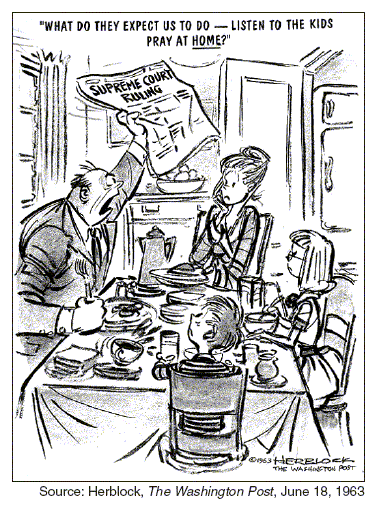
Stupid teacher tricks: No, teachers can’t lead prayers

May 26, 2010

What devilry gets into a tiny few teachers to make them think they alone are immune from the First Amendment?

In a public classroom, teachers are the government.  They may not lead prayers, not even if all the students consent.

Down in Meadville, Mississippi, a Franklin County High School teacher, Alice Hawley,  lost her teaching contract because she led daily prayers in her classes.

She agreed to stop the illegal practice, and has been invited back.

I understand fans on Facebook have come unglued.  I haven’t found that link.

Herblock cartoon of June 18, 1963 - school prayer

Probably still under copyright - Herblock in the Washington Post, June 18, 1963 (school prayer)


Record of error on climate continues at Powerline

May 26, 2010

So, this Hinderaker guy at Powerline:  Does he ever acknowledge his goofs?

Since we last visited the issue, a month after the record was in that his claims of no warming were wrong, he’s talked about the issue at least twice.

Hinderaker didn’t fix his error here, in December.

Hinderaker didn’t fix his error here, in February, and in fact proceeded as if he’d been right instead of wrong.

This is Sith-strength denialism on Hinderaker’s part, don’t you think?  It never was about the science at Powerline, but instead has always been about the politics.

How does the moniker “Baghdad Bob John” fit?


Dan Valentine – He makes me laugh

May 26, 2010

By Dan Valentine

My dad was a big man. Six-two, some two-hundred-and-thirty pounds. He was two-eighty or so at one time.

Once, he went on a public diet, along with other hefty local celebs–a radio deejay or two; a politician or three; John Mooney, the Trib’s sports’ columnist. I think Herman Franks, manager of the old Salt Lake Bees and former New York Giant catcher was one. All wanted to thin down. They called themselves the “Blubber Brigade”. Once a week my dad would report to the reading public their weekly success or failure.

When my mom first fell in love with my dad, friends would say, “But he’s fat.” My mom would answer, “But he makes me laugh.”

HE MAKES ME LAUGH
(c) 2010 by Daniel Valentine

There are men of worldly means,
Earthly goods, and riches,
Who’d have set me up in suites,
Each with household staff.

But my love I chose because
He keeps me in stitches.
He is not a man of wealth,
But HE MAKES ME LAUGH.

There are men of world renown,
Household names with money,
Who’d have handed me blank checks
With their autograph.

But my love I chose because
He’s bust-a-gut funny.
He is not a man of fame,
But HE MAKES ME LAUGH.

Friends wonder why
I’m no taken with the guy.
He’s not much to look at.
Not by half.
Some would even say he’s fat
And ask themselves, “What’s with that?”
Well, HE MAKES ME LAUGH.

There are notables I know
Who are sitting pretty.
Each of whom I said no to.
All must think me daff’.

But my love I chose because
He’s side-splitting witty.
He is far from well-to-do,
But HE MAKES ME LAUGH–
My, how that man can make me laugh!–
And he thinks I’m funny too.

YOU’RE HALFWAY HOME
(c) 2010 by Daniel Valentine

If you can make a woman laugh
In this world of ours gone daff’,
My friend,
YOU’RE HALFWAY HOME.

If you can roll her in the aisle,
Turn concern into a smile,
My friend,
YOU’RE HALFWAY HOME.

Sure, you’d love to wine-and-dine ‘er,
Buy her clothes by some designer,
Send her flowers, bring her candy.
All of which is fine and dandy.
But you’re broke! Not to choke.
Make her laugh. Tell a joke.

If you can make her slap her knee,
Grab her sides, go tee-hee-hee,
My friend,
YOU’RE HALFWAY HOME.

If you can bring tears to her eyes,
Make her laugh until she cries,
My friend,
YOU’RE HALFWAY HOME.

So you’ve none of earthly riches–
Pal, just keep your gal in stitches.
You don’t need a lotta money.
All you gotta be is funny.
Never mind that you’re broke.
Make her laugh. Tell a joke.

If you can make her spill her beer
While she’s grinning ear-to-ear,
My friend,
YOU’RE HALFWAY HOME.

If you can make her roll about,
On the verge of passing out,
My friend,
YOU’RE HALFWAY HOME.

Fill her heart and home with laughter,
Head to toe, floorboard to rafter.
Let the others buy her toddies,
Spend their dough as though their Saudis.
So you’re broke! Not to choke.
Perfect time for a joke.

If you can make her stamp her feet,
‘Fraid ‘a falling off her seat,
My friend,
YOU’RE HALFWAY HOME.

No need to buy a long-stemmed rose.
No box of chocks, no card with poem.
Just make her snort milk from her nose.
Make her laugh
And YOU’RE HALFWAY HOME
To happily-ever-af’.