More wisdom: From Burlington, Vermont, grassroots ideas on fighting global warming

April 10, 2011

Another local newspaper op-ed, this time from Burlington, Vermont (yeah, I know — a Gannett paper — still, smaller than Dallas). This comes from the March 4 edition of the Burlington Free Press’s “I Believe” series:

I Believe: ‘We have a responsibility to learn about climate change

by Joan Knight

“If politicians remain at loggerheads, citizens must lead.”
— Dr. James E. Hansen, physicist, director of NASA Goddard Institute

I was impressed when I attended a recent meeting with a group of volunteer activists forming a Vermont chapter of the Citizens Climate Lobby. This group is different, I thought. It might actually work. As a newly retired 72-year-old, I was looking for a new focus, and found it.

Religious groups use the word “creation.” Most people say “nature.” Academics speak of global ecology. Deep ecologists who view Earth as one living being say “Gaia,” in reverential tones, meaning our planet and its atmosphere is a living “body.” Its “cells” include us humans, plants, forests, microbes. All life is tied together by dynamic, interdependent relationships. Most native peoples sense that all beings are like sisters and brothers — members of the same family.

I understand. It started for me as a young child with what Rachel Carlson called a sense of wonder. Grasses back-lit by the setting sun; starfish in tide pools crawling about among colorful mats of living plants and fungi. It was a more spiritual experience than was going to church under parental orders. Nature really mattered.

Growing older, I revered the writing of Rachel Carson, David Brower, John Muir, Aldo Leopold, Wendell Berry and so many more. I still feel abiding love for it all. I believe in Earth as a planetary living being.

It is clear that our family of All Beings is suffering.

Climate change. Global warming. Is it real? Is it a problem? Why are the changes happening? There is controversy about the answers to these questions. The collapse of climate and energy legislation last year in Congress was a relief to some in big business.

Natural laws or physics and chemistry are in action. The climate is warming faster than it ever has. Weather patterns are strange and tragic. Species are becoming extinct. Predictions of the end of nature (Bill McKibben’s 1984 book title) are common now. What if the scientists are right? We don’t need all the answers to figure out that something awful is going on.

Can we slow down the rate of change? Yes. Can we stop the climate from warming too much? It’s not likely, but I believe we must try. Should we let it happen while we enjoy our greenhouse-gas-producing lifestyles? Some family members deny the reality that their loved one has a serious illness and is likely to die prematurely. We humans have an interesting default to denial. This does happen. Might some of us, similarly, deny that our planet is critically ill?

Most of us agree that conservation of energy and resources is good for us and for the environment. We are changing our personal lifestyles. We have changed our light bulbs to compact fluorescents; we vacation closer to home; we’re working to improve the efficiency of our buildings.

Many of us also become members of environmental organizations. We read their magazines, put in bird feeders to enjoy nature, donate money and sign petitions in the attempt to show our legislators how we would like them to vote. Here in Vermont, we even talk with state legislators and are proud we are the “green state” — cherishing our remaining cows in pastoral landscapes and our forests for both wildlife and recreation. We’re thankful our delegation to the Congress “gets it.”

There are many grassroots activists successfully influencing lawmakers on a town and state level. But we know that states tend to make changes in laws and budgets in response to constraints brought on by federal legislation and financing. Are there ways to really influence federal representatives and senators? Paid lobbyists do it on a massive scale. Money speaks. But what about us?

The Citizens Climate Lobby believes in an approach by which ordinary people influence the federal “deciders” enough to sometimes change their votes. The influential people take the trouble to learn about and appreciate some things an individual legislator has done, seek to discover common ground, listen respectfully and talk in a collaborative way. After discovering what information would be relevant, they come back to provide it. In this comfortable way of relating, ordinary people do make a difference.

As citizens of this country we have a responsibility to learn about climate change, solutions and how to take part in the democratic process. We can sit down for a conversation and tell our legislators what we care about and why. We can write letters. It’s really our job as citizens to share these thoughts with our legislators, if we ever hope to be truly represented by them.

That’s where the new Citizens’ Climate Lobby comes in. The group gives us the tools we need. There is a monthly conference call with a leading thinker who will help keep us informed of the latest issues, and an opportunity to practice speaking with each other about those issues. We work together to help our legislators hear the non-confrontational message: We want a healthy planet for our kids and grandkids.

If I dare to step forward to lobby my representative, I want to learn how, to practice, to feel supported by kindred spirits, to know it’s OK to make mistakes and keep on gaining new knowledge and skills. I’m up for it. And I hope many of you will consider joining us as we begin making our voices heard where it matters most.

Check out the Citizens Climate Lobby website, and get information about how to join in on the next national conference call. This one will be focused on messaging — the importance of context and delivery. This organization seeks to empower each of us to have breakthroughs in our personal power, to be heard and to be counted. It feels good to be a part of a supportive web of passionate citizens.

Join us. Talk with an active member on the phone, go to the website (www.citizensclimatelobby.org), find the lobby on Facebook.

It’s not too late to make a difference. We have been lazy in hoping someone else would do the right thing, that sending a check to an organization and signing an online petition was enough. It’s time for folks, including myself, to step up and be heard.

Real grass roots politics, from a woman concerned enough about the issue to think historically, and to read broadly about it.

Citizenship is wonderful to behold, when it is practiced so nobly and elegantly.

What else might we learn, if we really listened to the people?

Citizens Climate Lobby masthead

Masthead for the home page of Citizens Climate Lobby - click to see


Only in small towns, where leaders have time to think . . .

April 7, 2011

Years ago when I staffed a U.S. senator’s office, one of my tasks was to look through all the weekly newspapers in the state.    Back then subscriptions were cheap, and most senators would take out a subscription to these weeklies more to flatter the editors and publishers than to read.  We put them to use, first checking to see whether the clipping services were getting all the clips (mostly), and then on a hunch, to see what issues were raging in the state, well below the radar of the big city daily newspapers and broadcast outlets.

You can learn a lot.

Many of those old weekly newspapers are gone, now, victims to local populations that turn over in every recession, and to electronic news gathering services — and to general alienation:  People are not so sure they want to know what their neighbors are up to, these days.  Heck, many people aren’t sure they want to know their neighbors.

My own electronic news gatherers occasionally pull out something to think about from a minor news outlet.  For example, below is an opinion piece out of the Carrboro Citizen from Dan Coleman, a member of the town council in Carrboro, North Carolina.  I gather from the paper it is rather close to Chapel Hill, the home of the University of North Carolina (I haven’t checked a map).

But look at what this guy says.  He questions the wisdom of Adam Smith.  Adam Smith! It appears Coleman wasn’t led astray by all those Adam Smith neckties that were so popular in the Reagan administration.  He questions the true need for profits from corporations, and he wonders if there isn’t a higher duty for a corporation.

How many others like Dan Coleman are there, out there in America, relatively sane on all other accounts, and thinking?

How many bottom lines do we really need?

April 7, 2011 | Posted in: Opinion | 0 Responses

By Dan Coleman

Did you know that Carrboro’s Town Code incorporates a principle devised by Shell Oil? That’s right, the same Shell Oil that has been accused of human rights violations in Nigeria, including summary execution, crimes against humanity, torture, inhumane treatment and ­collaborating in the execution of Nigerian activist Ken Saro-Wiwa. The same Shell Oil that has despoiled the Niger delta and was responsible for the largest freshwater oil spill ever.

With a record like this, it is little wonder that Shell came up with one of the corporate world’s more effective public relations concepts of recent years: the Triple Bottom Line (TBL), also known as People, Planet, Profit. It’s as if Shell was saying, sure you can criticize our environmental and humanitarian record but don’t forget, we have to make a profit.

Efforts to value people have dogged profiteering for over a century. The late 19th and early-to-mid-20th centuries were marked by many thousands of strikes by workers, more than 1,400 in the year 1886 alone. Many of these were met by violent strikebreakers backed up at times by military force. This is a struggle that continues in 2011 in Wisconsin and other states.

William Blake, Biography Online

William Blake

Through the efforts of these men and women, much of value was created: the weekend, workplace-safety standards, health care for workers, vacation and sick leave, etc. And each of these was wrested from the one bottom line that corporate America really cares about.

Despite William Blake offering the image of “dark satanic mills” as far back as 1804, the environmental impacts of industrial capitalism began to be understood with Rachel Carson’s 1962 publication of The Silent Spring. Within a decade, there was Earth Day, the Environmental Protection Agency, the Clean Water Act and much more, each a challenge to the profit-focused priorities of capital.

Given the pre-eminent importance of profit-maximization, it is not surprising that corporations touting the Triple Bottom Line often oppose measures to combat global warming, oppose workers’ rights and oppose regulatory mechanisms to protect the health of people and planet.

History has taught us that Adam Smith was wrong when he offered the justification for prioritizing profit that “by pursuing his own interest [the businessman] frequently promotes that of the society more effectually than when he really intends to promote it.” If Smith were correct, companies like Shell would not have such a devastating impact on society and nature. In part, this impact results from profit being measured in a short timeframe, a year or even a quarter of a year, while sustainability requires a vision spanning, as the Iroquois put it, as much as seven generations.

But Smith was right that profit ought to serve human well-being. Therefore, it must be understood within an ethical system that places people and planet first. This holds true for the vague term “stakeholder value” that some, including Carrboro, use instead of profit. Who are the stakeholders if not people and planet?
The TBL offers nothing to help us navigate the inevitable contradictions between profit on the one hand and people/planet on the other. But, really, why should we have any social or political bottom lines at all?

It was social ecologist Murray Bookchin who bemoaned the cultural turn to the “grubby language” of the market economy, which has “replaced our most hallowed moral and spiritual expressions. We now ‘invest’ in our children, marriages, and relationships. … We live in a world of ‘trade-offs’ and we ask for the ‘bottom line’ of any emotional ‘transaction.’”

There are a variety of frameworks that speak to a more fundamental commitment to the well-being of all life. In an 1854 speech, Chief Seattle offered the notion of a web of life: “Humankind has not woven the web of life. We are but one thread within it. Whatever we do to the web, we do to ourselves.”

Aldo Leopold, in Arizona

Aldo Leopold, in Arizona, Arizona State Parks image

A century after Chief Seattle, Aldo Leopold articulated his land ethic in Sand County Almanac, “A thing is right when it tends to preserve the integrity, stability and beauty of the biotic community. It is wrong when it tends otherwise.” The biotic community, of course, includes humans.

We need the ability to truly place people and planet first and to reject the false, self-serving homilies offered by those who spread pavement and poverty in pursuit of the almighty dollar. Rather than seek simplistic nostrums, we may have to take the time to look hard at each decision, and bring a clear ethical sensibility, like that of Seattle or Leopold, to bear.

Dan Coleman is a member of the Carrboro Board of Aldermen.

Coleman may want to check the provenance of the Chief Seattle quote — but the thought is solid.

What do you think?


A Seussian fable, about how tests ruin school reform

April 7, 2011

Look, you really need to go to TeacherSabrina’s blog, Failing Schools, where she first posted this, and take a look at many of her posts.

But I can’t resist putting the video here, because I know a few old-timers would be confused by the link, and some people will think they don’t have the time to make two clicks instead of one.

So, here, in its Seussian glory and demand for Flash Animation, is TeacherSabrina’s story of D.C.’s late Queen of the Schools, Michelle Rhee, and her desire to get D.C.’s kids to score well on an increasing battery of tests  [Got a good joke about assault and battery we can insert here?]:  “Rhee the Reformer:  A Cautionary Tale.”

Tip of the old scrub brush to Accountable Talk.


Slow posting – apologies

April 6, 2011

Oh, there’s plenty to write about.

But:  Crunch at school.  Lots of other spring activities for various organizations.  I’ve got a rip-roaring sinus infection.

Feel free to comment, with links, to stuff we should be covering.


It’s on: Obama opened the campaign for 2012

April 4, 2011

I get e-mail — with a few million others, I’m sure:

2012

Ed —

Today, we are filing papers to launch our 2012 campaign.

We’re doing this now because the politics we believe in does not start with expensive TV ads or extravaganzas, but with you — with people organizing block-by-block, talking to neighbors, co-workers, and friends. And that kind of campaign takes time to build.

So even though I’m focused on the job you elected me to do, and the race may not reach full speed for a year or more, the work of laying the foundation for our campaign must start today.

We’ve always known that lasting change wouldn’t come quickly or easily. It never does. But as my administration and folks across the country fight to protect the progress we’ve made — and make more — we also need to begin mobilizing for 2012, long before the time comes for me to begin campaigning in earnest.

As we take this step, I’d like to share a video that features some folks like you who are helping to lead the way on this journey. Please take a moment to watch:

In the coming days, supporters like you will begin forging a new organization that we’ll build together in cities and towns across the country. And I’ll need you to help shape our plan as we create a campaign that’s farther reaching, more focused, and more innovative than anything we’ve built before.

We’ll start by doing something unprecedented: coordinating millions of one-on-one conversations between supporters across every single state, reconnecting old friends, inspiring new ones to join the cause, and readying ourselves for next year’s fight.

This will be my final campaign, at least as a candidate. But the cause of making a lasting difference for our families, our communities, and our country has never been about one person. And it will succeed only if we work together.

There will be much more to come as the race unfolds. Today, simply let us know you’re in to help us begin, and then spread the word:

http://my.barackobama.com/2012

Thank you,

Barack


Ironic anniversary: Marshall Plan, April 3, 1948

April 4, 2011

Texas Republicans rammed through their radical budget cut program on April 3, 2011 — ironically on the anniversary of another legislative decision made in the depths of deficit spending.

President Truman signing legislation to create the Marshall Plan, 1948 - Library of Congress, Averill Harriman collection

Caption from Library of Congress: "Surrounded by members of Congress and his cabinet, on April 3, 1948, President Harry S Truman (1884-1972) signed the Foreign Assistance Act, the legislation establishing the Marshall Plan. His official statement said, "Few presidents have had the opportunity to sign legislation of such importance. . . . This measure is America's answer to the challenge facing the free world today." The Marshall Plan was a bipartisan effort--proposed by a Democratic president and enacted into law by a Republican Congress in a hotly contested presidential election year. The plan's supporters shown in the photograph are (l-r) Senator Arthur Vandenberg (R--Mich.), Treasury Secretary John Snyder, Representative Charles Eaton (R--N.J.), Senator Tom Connally (D--Tex.), Secretary of the Interior Julius A. Krug, Representative Joseph Martin (R--Mass.), Representative Sol Bloom (D--N.Y.),and Attorney General Tom Clark." Copyprint from The Marshall Plan at the Mid-Mark. Averell Harriman Papers, Manuscript Division

April 3 is the traditional anniversary of the Marshall Plan.  From the U.S. Census Bureau:

SUNDAY, APRIL 3: MARSHALL PLAN

Profile America — Sunday, April 3rd.  One of the major programs that helped to shape history after World War II was signed into law on this date in 1948.  The European Recovery Program — far better known as the Marshall Plan, was suggested a year earlier by Secretary of State George Marshall. It had become clear that the economies of the nations battered by the war were not recovering on their own, and millions of people were not only jobless, but were also going hungry.  The Marshall Plan lasted for four years, distributing some 130 billion in today’s dollars, and helped many nations on the road to recovery.  Recently, the U.S. has given nearly $34 billion a year in economic aid and some $15.5 billion in military aid to countries around the world.  Profile America is in its 14th year as a public service of the U.S. Census Bureau.

Sources:  Chase’s Calendar of Events 2011, p. 204

Statistical Abstract of the United States 2011, t. 1298

Profile America is produced by the Public Information Office of the U.S. Census Bureau. These daily features are available as produced segments, ready to air, on a monthly CD or on the Internet at http://www.census.gov (look for “Multimedia Gallery” by the “Newsroom” button).

SOURCE U.S. Census Bureau

Read more: http://www.sacbee.com/2011/04/02/3523990/us-census-bureau-daily-feature.html#ixzz1IY7ec6mu

On that date in 1948, the U.S. faced the greatest deficits the nation had ever seen, leftover from World War II. Faced with the choice of deeper deficits or no Marshall Plan, Members of Congress chose to borrow the money to rebuild nations hammered by the war,  including our enemies, Germany, Italy and Japan.

What would have happened had the U.S. said “we can’t afford a Marshall Plan?”  Santayana’s Ghost shakes his head.  The U.S. would not have had the aid of growing, free-market economics in France, Germany, Italy, England and Japan, during the Cold War.  Advantages would have been conceded to the Soviet Union and communism, worldwide.

Notice the photograph includes Republicans and Democrats.

What are Texas and U.S. legislators thinking these days?

Resources:


Texas House votes to maim education, cripple health care, send the aged off to ice floes

April 4, 2011

Where anyone can find an ice floe in Texas is a powerful question, but the search will be on to find some soon, if the budget approved by the Texas House of Representatives cannot be fixed.

Texas House Democrats sent out a notice shortly after the vote, explaining some of the cuts:

An hour ago, Texas House Republicans forced through some of the most destructive budget cuts in Texas history.  On a party line vote, 101 House Republicans trampled on the priorities of regular, middle-class Texas families. [1]

Tonight, Republicans voted to:

  • Eliminate 335,000 Texas jobs in both the public and private sectors, threatening our fragile economic recovery [2]
  • Lay off up to 100,000 teachers and school support workers, crowding dozens of kids into unruly classrooms [3]
  • Kick 100,000 kids out of full day Pre-Kindergarten [4]
  • Close half of the state’s nursing homes, leaving thousands of seniors with no place to go [5]
  • Create a ripple effect that will force local governments like cities, counties and local school districts to raise taxes [6]
  • Cut off access to financial aid for thousands of graduating high school seniors [7], while forcing up college tuition through cuts. [8]

They didn’t have to cut this deeply into the priorities set by most Texas families.  They chose to make the deepest cuts public education since the creation of our school finance system in 1949. [9]

For months, Republicans have been yelling “Cuts! Cuts!” and they have ignored the thousands of office visits, letters, emails and phone calls of average Texans protesting these hurtful cuts.

Democrats offered plenty of creative solutions that would keep schools open, spare nursing homes from closing, and keep our promise to graduating seniors who have worked hard for a chance to earn a college education. Republicans shot them down one by one in favor of deeper cuts.
Anybody can swing an axe and slash budgets across the board.  Texas needs people who can lead, set priorities, and protect those priorities.

Remember, Republicans chose to make these cuts. Help us hold them accountable for costing jobs, hurting families, and for choosing to sacrifice the future of too many Texas kids.

Sincerely,

Cliff Walker
Texas HDCC

  1. http://www.capitol.state.tx.us/BillLookup/History.aspx?LegSess=82R&Bill=HB1
  2. http://www.beaumontenterprise.com/news/article/Budget-cuts-could-slash-hundreds-of-thousands-of-1291051.php
  3. http://www.kvue.com/home/117522288.html
  4. http://www.newschannel10.com/Global/story.asp?S=14368977
  5. http://www.reporternews.com/news/2011/mar/09/democrats-cuts-will-hit-homes/?print=1
  6. http://www.star-telegram.com/2011/03/08/2906285/unfunded-mandates-from-the-texas.html
  7. http://blog.mysanantonio.com/texas-politics/2011/03/house-budget-writers-ok-bill-that-would-trim-23-billion/
  8. http://www.newswest9.com/Global/story.asp?S=14310923
  9. http://www.businessweek.com/ap/financialnews/D9MBC0PG1.htm

Fewer teachers when more are needed, bigger classrooms when smaller classrooms are needed, less health care in the state with the largest uninsured population of any state, the highest proportion of uninsured people.

Cleaver prop from YourProps.com

Texas Republicans chose the meat cleaver over the scalpel to try to balance Gov. Rick Perry's $27 billion deficit. Many cuts appear targeted to do the most damage possible to education and other "liberal" state functions. Cleaver prop from YourProps.com

Prisons, highways, state parks, and other programs suffered serious cuts, too.

Had a foreign power done this to Texas, it would be considered an act of war.  How will Texas citizens respond?

More:


Boston Tea Party: An anti-corporation protest?

April 3, 2011

Thom Hartmann said so.  In Hartmann’s reading, the 1773 Boston Tea Party was as much a protest against corporate oligarchy as a protest against government — quite the opposite of the way most Neo Tea Partiers see things.   Is he right?  Historians, what say you?

Hartmann relies on his copy of George R. T. Hewes’ book, A retrospect of the Boston tea-party, with a memoir of George R. T. Hewes, a survivor of the little band of patriots who drowned the tea in Boston harbour in 1773 (1834). Are you familiar with the book?

George R. T. Hewes in 1835, a veteran of the 1773 Boston Tea Party - CUNY image

George Robert Twelves Hewes in 1835 at age 93, a veteran of the 1773 Boston Tea Party. Painting by Joseph G. Cole. CUNY image

More, and resources:


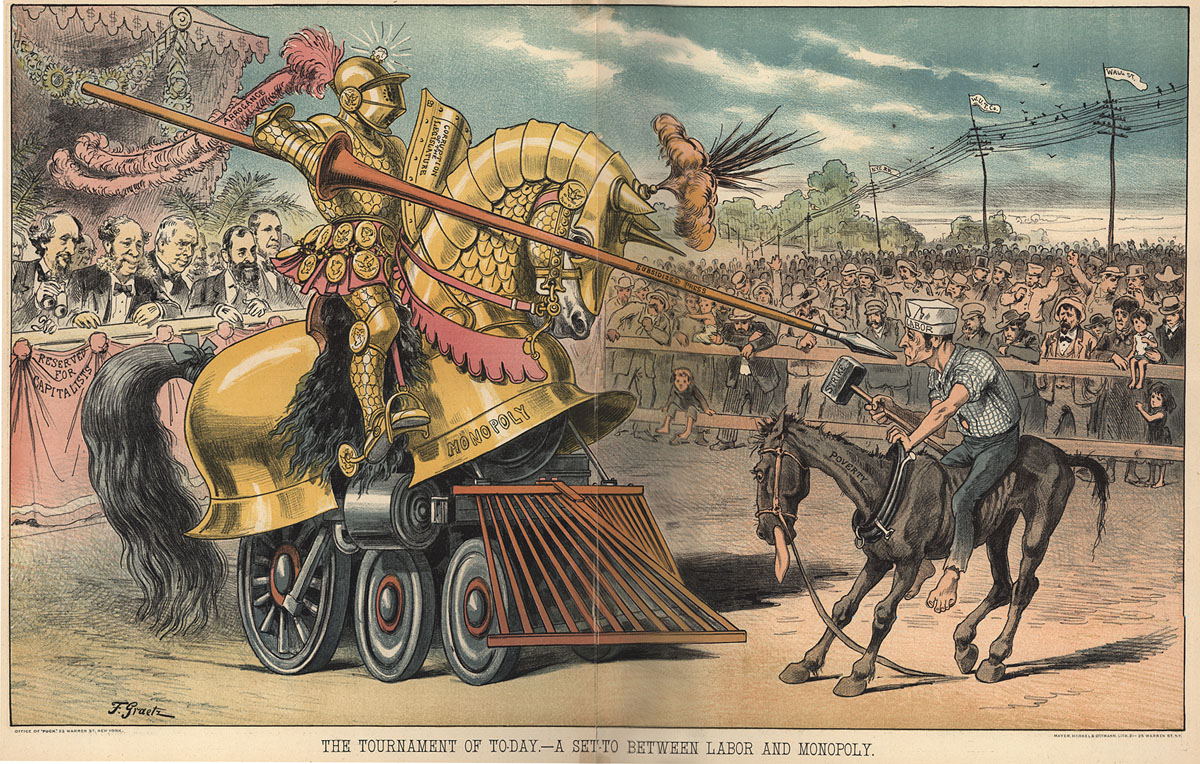
Then and now: Capitalism vs. Labor 1883, and today

April 2, 2011

Alas, it’s almost exactly the same now as then:

"Tournament of Today:  A set-to between Labor and Monopoly," Cartoon by Frederick Graetz, Puck Magazine, August 1, 1883 (from files of Georgia State University); click image for a larger view at Georgia State

“Tournament of Today: A set-to between Labor and Monopoly,” Cartoon by Frederick Graetz, Puck Magazine, August 1, 1883 (from files of Georgia State University); click image for a larger view at Georgia State

Information on the cartoon, from SuperITCH: Frederick Graetz, a chromolithograph that was the center spread for Puck Magazine‘s issue of August 1, 1883.  Monopolists portrayed are, from left to right, “businessman, financier and telecommunications pioneer Cyrus Field; railroad tycoon William Vanderbilt; shipbuilding magnate John Roach; financier, railroad mogul, and speculator Jay Gould; and an unknown monopolist.”  Some might say that the “unknown monopolist” bears a striking resemblance to one of the Koch brothers, but that’s fanciful thinking.

Cartoon - Labor vs Monopoly, Graetz, Puck 8-1-1883 (GSU image)

Labor vs Monopoly – click on this image for a larger version of this historic Puck Magazine cartoon

Tip of the old scrub brush to One Penny Sheet’s “condemned to repeat” feature.

More:


A salute to Medal of Honor winner Rodolfo Hernandez

April 1, 2011

No television cameras.  No professional photographers.  An employee of American Airlines, Andres Otero, standing by, caught the event, probably with his phone camera.

Here’s the picture, published in the obscure Queens Gazette:

Congressional Medal of Honor Winner Rodolfo Hernandez March 25, 2011.  Photo by Andres Otero, American Airlines

Congressional Medal of Honor Winner Rodolfo Hernandez received a salute from active duty military, as he boarded an American Airlines flight to Washington, D.C., for Medal of Honor Day, March 25. Photo by Andres Otero, American Airlines

[Click through to the Queens Gazette for a larger image.]

The rest of the story?

California-native Corporal Rodolfo P. Hernandez served in the U.S. Army, and saw action in the Korean conflict.  He and his unit came under attack near Wontong-ni, Korea, on May 31, 1951.  Here’s the citation, from the Congressional Medal of Honor Society:

Cpl. Hernandez, a member of Company G, distinguished himself by conspicuous gallantry and intrepidity above and beyond the call of duty in action against the enemy. His platoon, in defensive positions on Hill 420, came under ruthless attack by a numerically superior and fanatical hostile force, accompanied by heavy artillery, mortar, and machine gun fire which inflicted numerous casualties on the platoon. His comrades were forced to withdraw due to lack of ammunition but Cpl. Hernandez, although wounded in an exchange of grenades, continued to deliver deadly fire into the ranks of the onrushing assailants until a ruptured cartridge rendered his rifle inoperative. Immediately leaving his position, Cpl. Hernandez rushed the enemy armed only with rifle and bayonet. Fearlessly engaging the foe, he killed 6 of the enemy before falling unconscious from grenade, bayonet, and bullet wounds but his heroic action momentarily halted the enemy advance and enabled his unit to counterattack and retake the lost ground. The indomitable fighting spirit, outstanding courage, and tenacious devotion to duty clearly demonstrated by Cpl. Hernandez reflect the highest credit upon himself, the infantry, and the U.S. Army.

Congressional Medal of Honor awardee Cpl. Rodolfo P. Hernandez - CMOHS image

Congressional Medal of Honor awardee Cpl. Rodolfo P. Hernandez - Congressional Medal of Honor Society image

Cpl. Hernandez received the Congressional Medal of Honor on April 21, 1962.

No, I had not heard of Medal of Honor Day, either.

Here are some details from MedalofHonorNews.com, so you can get a head start on next year’s observation:

Sunday, March 13, 2011

National Medal of Honor Day: Let’s not forget our heroes on March 25th, 2011


National Medal of Honor Day is officially observed on March 25th. The Medal of Honor is the highest distinction that can be awarded by the President, in the name of the Congress, to members of the Armed Forces who have distinguished themselves conspicuously by gallantry and intrepidity at the risk of their lives above and beyond the call of duty.

“This holiday should be one of our most revered. Unfortunately all too many Americans are not even aware of its existence.” Home of Heroes

The date of March 25th was chosen because the first Medals of Honor were awarded to members of Andrew’s Raiders on March 25, 1863, for their actions during the “Great Locomotive Chase.”

Col. Robert Howard (USA Ret.) president of the Congressional Medal of Honor Society on National Medal of Honor Day states:

“Hard times ask us to put a greater good before our own interests. It is sometimes physically or emotionally painful. Yet throughout history, you will find common men and women who fought selflessly in a variety of ways for something so much larger than just their own benefit.

Today, we’re fighting terrorism and the spread of tyranny. We’re challenged by market upheaval, joblessness and perhaps hunger. But the human spirit is resilient and can withstand more than sometimes we are able to immediately comprehend.

It’s up to each of us to not lay and wait for better days, but instead look for opportunities to make the lives of those around us better. National Medal of Honor Day is not a celebration. It is a solemn time to reflect on the freedom we enjoy, its price, and how our own bravery can improve the world around us.”

Home of Heroes, a premier resource of Medal of Honor information on the internet suggests:

“National Medal of Honor day is celebrated in some communities, however for the most part the occasion comes and goes with little notice. As a patriotic American there are a few things you can do to commemorate this day:

  • Fly your flag with pride and patriotism on this day.
  • Remember our heroes. As a gesture of your appreciation, why not take just a few moments in the week prior to National Medal of Honor Day to mail a “Thank You” card to one of our living Medal of Honor recipients. You can find a list of the living as well as information on writing to them among the pages of the Home of Heroes website or contact the Congressional Medal of Honor Society who will forward the letter to the Medal of Honor Recipient.
  • Inform your local media. Most newspapers aren’t even aware that this special day exists. Why not tip your local media to the occasion. Before you do, check out the Home of Heroes database for Medal of Honor recipients from your city and state as well as any who might be buried in your city. This information can give your media a “local angle” that can increase the probability that they will consider doing a story to remind Americans of our heroes.
  • If there is a Medal of Honor recipient buried in your home town, get a school class, scout troop, or other youth organization to “adopt a grave site”.

Please visit the Home of Heroes website and the Educational Resources section of Medal of Honor News.

Also read our upcoming article: Lesson plans for History and Social Studies teachers on National Medal of Honor Day, March 25th, 2011


Updates on Wisconsin, the War on Education, the War on Americans in Unions, the assault on public employees by Wisconsin Republicans, etc., etc.

April 1, 2011

First, be sure to read Zeno’s work over at Halfway There.  Zeno’s writing will make your mouth water, your pupils expand, your pulse quicken, your hands go all Galvanic on you, and otherwise get your attention — but in this case, his topic is important, too.  Zeno explains the American Legislative Exchange Council (ALEC) with a peek inside ALEC’s  sumptuous, legislator-seducing red tent.   He’s got documents from ALEC, secured through not completely legitimate means (but neither are they illegal), and he lays the group bare.  It’s not a pleasant sight if you’re not fond of adipose tissue and necrosis.

Second, at Desmogblog you should check out John Mashey’s work on loose political organizations joined to politically oppose scientists learning about global warming, to oppose publication of findings about global warming, and to oppose government action to do anything to stop global warming.  Interestingly enough, Mashey informs me, the current cast of malefactors in Wisconsin, appear earlier as malefactors in the discussions and actions about global warming.  Coincidence?

And then stay tuned.  There is more to come on the issue of the Republican Party’s rebirth of McCarthyism, and the witch hunt they wish to conduct against historian Bill Cronon, I’m sure.