It seems like just a few months ago that Kathryn the Trophy Wife™ and I honeymooned in Yellowstone National Park, for a glorious January week. On more than one occasion we had Old Faithful all to ourselves — it seemed like such an indulgence.
Seems just a few months ago, but that was before the 1988 fires, before our 1989 vacation there, before our 2004 ceremony casting the ashes of brother Jerry and his wife Barbara to the Yellowstone winds.
Will Yellowstone be there for our children, and for our grandchildren, as it has been for my lifetime? The Nature Conservancy produced a 16-minute film showing much of the glory of winter of the place, and talking about the problems.
For the deer, elk and pronghorn in and around Yellowstone National Park, surviving the winter means finding adequate food and areas with low snow accumulation. But this critical winter range is increasingly threatened by energy and residential development. At stake is the very future of the Greater Yellowstone region’s iconic wildlife. This film highlights the voices of those working together to save these magnificent herds: ranchers, conservationists, scientists and others. http://www.nature.org/yellowstone
Growing up in the Mountain West, I learned to appreciate the stark beauty of the cold northern desert — but seldom is that beauty captured on film so well as it is here. Phlogiston Media, LLC, made a remarkable, beautiful film, about a remarkable, beautiful land threatened by gritty, banal and mundane development.
This movie has been viewed only 542 times when I posted it. Spread the word, will you?
Spread the word; friends don't allow friends to repeat history.
Nature Notes #16 from the good people at Yosemite National Park: Sky Islands.
Throughout the Sierra Nevada, high flat plateaus are found at elevations around twelve and thirteen thousand feet. These isolated sky islands are the home to unique plant communities that are found nowhere else.
A little sketch in her notebook, an off-the-top-of-her-head list of common phrases. Common today, but originating with William Shakespeare.
Becky's quick summary of some of the best-known phrases we use everyday, invented by Shakespeare. From Becky, age 20, in London.
Becky’s quick work caught a lot of eyes. One of NPR’s blogs brought it to my attention. English teachers, take notice (maybe someone at your school has a large format printer, and can make for you a poster . . .)
I thought I’d posted this when I first saw it in July. Can’t find it. It deserves a wider audience, I think: “The Michelle Bachmann Song” by Hockey Mama for Obama.
Spread the word; friends don't allow friends to repeat history.
Short video demonstrating the Indoor Residual Spraying program in Mali, financed by funding from the U.S. Agency for International Development (USAID). Note there is no ban on DDT, note that fighting malaria, even with poisons for mosquitoes, requires more than just spraying poison.
The video is in French.
539 views, September 18, 2011
Spread the word; friends don't allow friends to repeat history.
It’s horrifyingly ironic if you think about it: Republicans opposed expanding access to the health care system with a false claim that the Democratic plan included rationing of health care in a “death panels” clause. Completely untrue. The bill barely passed.
But did you see what happened last week at the Republican Party’s event featuring their candidates for president? Here a citizen responds to the Republicans:
In their silence, Republicans appear to support rolling back current health care, foregoing “death panels” as not harsh enough, and moving on to “let ’em all die.”
Charts in government and civics texts always amuse me for what they leave out — mostly the political machinations. Anyone who worked or works in the halls of Congress knows the process is never so clean as Bismarck pretended with his old, misattributed bon mot (actually John Godfrey Saxe, not Bismarck) (and would Bismarck be chagrined at my using a French phrase to describe his words?).
Sometimes the legislative process is a little more confusing than I’m Just a Bill. As Margaret mentioned in The Curious History of the 2011 Debt Ceiling Legislation earlier this week, sometimes the legislative process takes interesting turns. Christine also blogged about the unique situation of vehicle bills. The poster below details the various status steps legislation can take, including Introductory, Committee, Discharge, Calendar, Floor, Conference, and Presidential Steps.
For tips on THOMAS that can relate to the legislative process, you can subscribe to the RSS feed or via email alert. There is also a glossary in THOMAS to help.
Is the poster available? I asked, and got this response from Mr. Weber:
This is what it says at the bottom right of the poster:
Committee on House Administration
Wayne L. Hays, Chairman
Prepared by House Information Systems Staff
Frank B. Ryan, Director
If you can find a link to this chart that makes the wording and details legible, or if you happen to find it and can photograph it so we can read it, will you let us know here?
Spread the word; friends don't allow friends to repeat history.
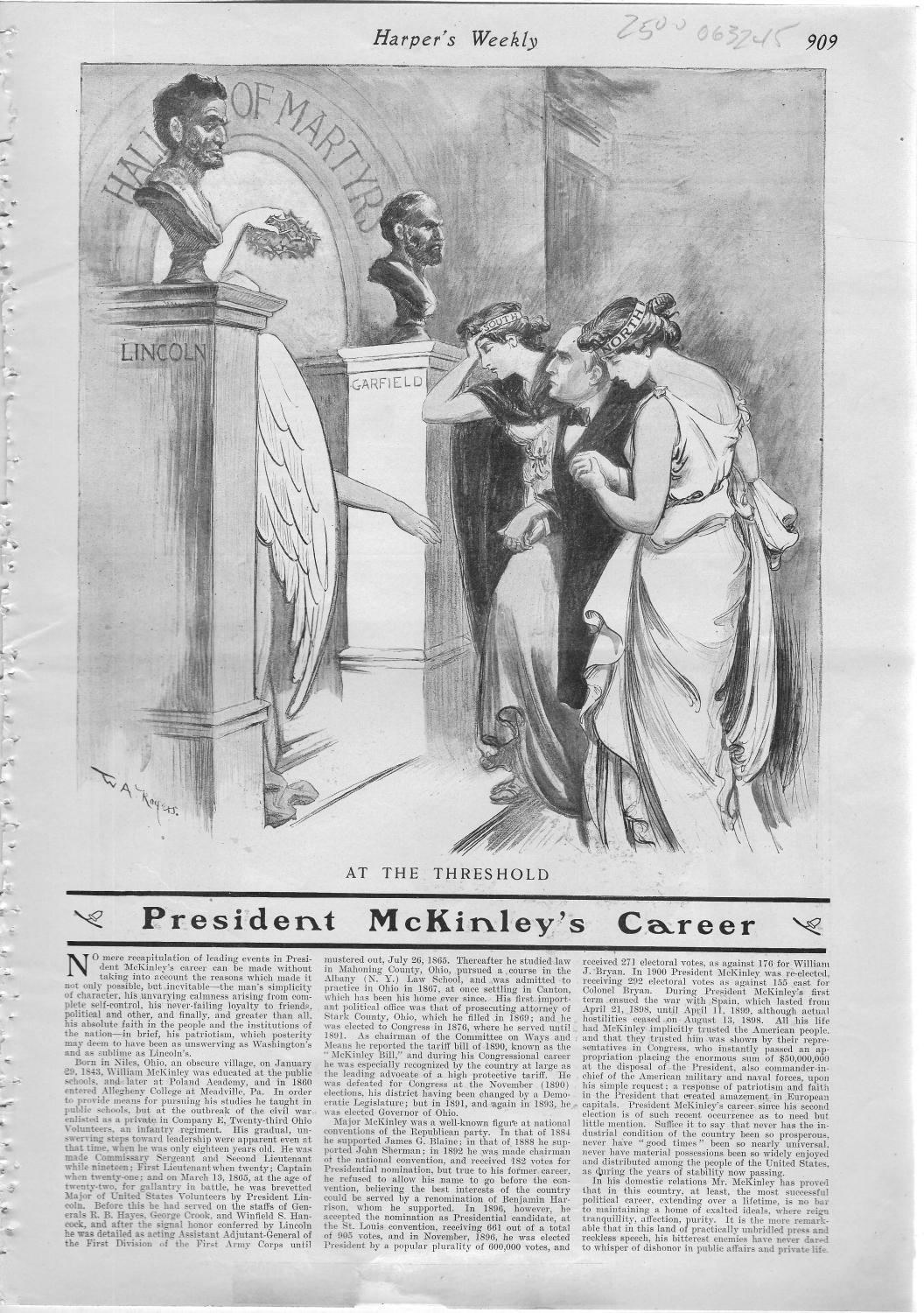
Image from Harper’s Magazine, September 14, 1901 -= McKinley “At the Threshold” of Martyrs’ Hall
Teachers should be mining the “On This Day” feature at the New York Times, which usually features an historic cartoon or illustration from an antique Harper’s Weekly. It is a favorite feature, to me.
his post-dated cartoon was published as President William McKinley lay dying from an assassin’s bullet. He had been shot on September 6, 1901, by anarchist Leon Czolgosz (pronounced chol-gosh) at the Pan-American Exposition in Buffalo, New York. The president died on September 14. Here, McKinley is led to the Hall of Martyrs by grief-stricken personifications of the North and South. Between pillars topped by busts of the two previously slain presidents, Abraham Lincoln and James Garfield, the angel of death prepares to place a laurel wreath of honor upon McKinley’s head. (Images related to Garfield’s assassination also showed a reconciled North and South.)
There is much more at the Times site.
Robert Lincoln, the son of Abraham Lincoln, was present when McKinley was shot. Accounts I have read but not confirmed say that Robert Lincoln had been invited to attend Ford’s Theatre with his father and mother, the night his father was shot. As a member of President James Garfield’s cabinet, Robert Lincoln had been awaiting Garfield’s arrival at Union Station in Washington, D.C., when Garfield was shot.
And as a visitor in Buffalo, Robert Lincoln had as a matter of respect lined up to shake President William McKinley’s hand.
Astounding if true. Four U.S. presidents have been assassinated. Robert Lincoln was close to the first, the assassination of his father, and present for the next two. Where can we confirm that story?
McKinley’s death catapulted the do-gooder, Theodore Roosevelt, into the presidency, probably to the great chagrin of corrupt Republican politicians who had hoped that by getting him nominated to the vice presidency they could get him out of New York politics.
You may get a free copy of the 2011 U.S. Statistical Abstract, on CD.
Available January 2011
On the CD-ROM version are Excel spreadsheet files for each of the individual tables.
In many cases the files contain more detailed information than is found in the book. Also, in some cases the Excel files contain more recent and revised data that were released by the source after publication of the printed version of the Abstract. You will also find the same Adobe Acrobat files for each section which you find on this web site.
Additional information—
While supplies last, single copy FREE (one per customer) by calling Customer Services at 1-800-923-8282.
Spread the word; friends don't allow friends to repeat history.
Magician Marco Tempest pushes the boundaries on use of iPhones in magic tricks — is it magic, pure electronics, or what we want to see?
Tell us in comments how you could use this shorter-than-usual TEDS video as a bell-ringer, teachers — or as an ice-breaker, meeting facilitators and corporate trainers:
Tip of the old scrub brush to Michelle Gardiner, who suffered my bass playing with quiet equanimity.
Spread the word; friends don't allow friends to repeat history.
(b) Proclamation.— The President is requested to issue each year a proclamation calling on— (1) State and local governments and the people of the United States to observe Patriot Day with appropriate programs and activities;
(2) all departments, agencies, and instrumentalities of the United States and interested organizations and individuals to display the flag of the United States at halfstaff on Patriot Day in honor of the individuals who lost their lives as a result of the terrorist attacks against the United States that occurred on September 11, 2001; and
(3) the people of the United States to observe a moment of silence on Patriot Day in honor of the individuals who lost their lives as a result of the terrorist attacks against the United States that occurred on September 11, 2001.
Patriot Day formerly occurred earlier in the year; information on flag flying has not been added to the Flag Code portions of U.S. law, and consequently this news gets missed.
Fly your flag today, at half-staff. Remember when flying a flag at half-staff, it is first raised to full staff, then slowly lowered to the half-staff position. When the flag is retired at the end of the day, it should again be crisply raised to the full-staff position before being lowered.
A flag attached to a pole that does not allow a half-staff position should be posted as usual.
A National Day of Service
Also, September 11 is also designated as a national day of service, under the Edward M. Kennedy Serve America Act, Public Law 111-13 (April 21, 2009). The Corporation for National and Community Service is charged with encouraging appropriate service in honor of the day and in honor of those who died.
Description
On April 21, 2009, President Barack Obama signed legislation that for the first time officially established September 11 as a federally recognized National Day of Service and Remembrance.
By pledging to volunteer, perform good deeds, or engage in other forms of charitable service during the week of 9/11, you and your organization will help rekindle the remarkable spirit of unity, service and compassion shared by so many in the immediate aftermath of the attacks. And you’ll help create a fitting, enduring and historic legacy in the name of those lost and injured on 9/11, and in tribute to the 9/11 first responders, rescue and recovery workers, and volunteers, and our brave military personnel who continue to serve to this day.
Check in your own community to find opportunities for service projects.
Spread the word; friends don't allow friends to repeat history.
The case they make for their cause by now enjoys the status of conventional wisdom. Student achievement has been stagnant or declining for decades, even as money poured into public schools to improve teacher salaries, pensions, and working conditions (reducing class sizes, or hiring aides to give teachers more free time). Teachers typically have abysmally low standards, especially for minorities and other disadvantaged students, who predictably fall to the level of their teachers’ expectations. Although teachers’ quality can be estimated by the annual growth of their students’ scores on standardized tests of basic math and reading skills, teachers have not been held accountable for performance. Instead, they get lifetime job security even if students don’t learn. Brill observes a union-protected teacher in a Harlem public school bellowing “how many days in a week?,” caring little that students pay him no heed and wrestle on the floor instead.
Protecting this incompetence are teacher unions, whose contracts prevent principals from firing inadequate (and worse) teachers. The contracts also permit senior teachers to choose their schools, which further undermines principals’ authority. Union negotiations have produced perpetually rising salaries, guaranteed even to teachers who sleep through their careers. Breaking unions’ grip on public education is “the civil rights issue of this generation,” and some hard-working, idealistic Ivy Leaguers and their allies have shown how.
And then knocks him down with:
Central to the reformers’ argument is the claim that radical change is essential because student achievement (especially for minority and disadvantaged children) has been flat or declining for decades. This is, however, false. The only consistent data on student achievement come from a federal sample, the National Assessment of Educational Progress. Though you would never know it from the state of public alarm about education, the numbers show that regular public school performance has skyrocketed in the last two decades to the point that, for example, black elementary school students now have better math skills than whites had only 20 years ago. (There has also been progress for middle schoolers, and in reading; and less, but not insubstantial, progress for high schoolers.) The reason test score gaps have barely narrowed is that white students have also improved, at least at the elementary and middle school levels. The causes of these truly spectacular gains are unknown, but they are probably inconsistent with the idea that typical inner-city teachers are content to watch students wrestle on the classroom floor instead of learning.
The question we need to ask is “Is our media learning?” (to steal a phrase from Little Lord Pontchartrain).
Maybe they are . . .
Brill, God bless him, proposed to shake up public schools in America a few weeks ago in a long article in the Weekend Wall Street Journal. His solution? Make AFT local leader Randi Weingarten superintendent of New York’s public schools.
Actually, his story was much better than his advocacy. But I hope to get more commentary on that proposal, and this continuing War on Education and War on Americans, soon.
Spread the word; friends don't allow friends to repeat history.
BBC map showing location of Wagah and Punjab, divided between Pakistan and India, south of Kashmir
Written accounts cannot possibly do justice to the ceremonies that mark the daily close of business at the border between India and Pakistan. I had understood it was quite a good show, rivaling the changing of the guard at Buckingham Palace.
But, you don’t expect Monty Python to break out at these affairs, do you? Here’s a video of the ceremony as it was conducted prior to July 2010, I believe, which I found at Wimp.com. It’s a video clip from BBC Worldwide, narrated by comedian Sanjeev Bhaskar.
Vodpod videos no longer available.
(If that one doesn’t work, try this one — a bit lower quality video):
(Or, here’s a shorter, YouTube version of Baskar’s film.)
Where in the world is this? It’s in a town and area called Wagah, in Punjab, divided between India and Pakistan since the 1947 independence of those nations (links to Wikipedia left in for your convenience).
Wagah (Punjabi: ਵਾਘਾ, Hindi: वाघा, Urdu: واہگہ) is the only road border crossing between India and Pakistan[1], and lies on the Grand Trunk Road between the cities of Amritsar, India and Lahore, Pakistan. Wagah itself is a village through which the controversial Radcliffe Line was drawn. The village was divided by independence in 1947. Today, the eastern half of the village remains in the Republic of India while the western half is in Pakistan.
While both nations and local residents fully recognize the silliness, it also stands as a symbol of the deep divisions between the two nations.
The Wagah border, often called the “Berlin wall of Asia”,[2] is a ceremonial border on the India–Pakistan Border where each evening there is a retreat ceremony called ‘lowering of the flags’,[3] which has been held since 1959.[4] At that time there is an energetic parade by the Border Security Force (B.S.F) of India and the Pakistan Rangers soldiers. It may appear slightly aggressive and even hostile to foreigners but in fact the paraders are imitating the pride and anger of a Cockerel.[1][5][6] Troops of each country put on a show in their uniforms with their colorful turbans.[7] Border officials from the two countries sometimes walk over to the offices on the other side for day to day affairs. The happenings at this border post have been a barometer of the India-Pakistan relations over the years.[1]
Did someone say “Pythonesque?”
Here’s Michael Palin narrating another view of the ceremony for one of his BBC enterprises, Himalaya with Michael Palin:
Would you be surprised to hear that local people refer to this as “the dance of the roosters?”
Events at this crossing reflect some minor easing of tension between the two nations in the last decade, and in 2010 both nations announced they would tone down the retreat ceremonies. Surely some scholar has analyzed this retreat ceremony and its history, to determine whether it helped ease the tension, or increased the conflict between the two nations. Could soldiers who participate in such goings-on actually shoot at each other?
Has anyone got a more recent viewing of the ceremony?
How will you explain this to your sophomore world history class? Is there anything sillier than humans in conflict?
Video via VodPod.
An astonished tip of the old scrub brush to Judith Shields.
Or, until that account is unsuspended by the forces supporting Donald Trump: Follow @FillmoreWhite, the account of the Millard Fillmore White House Library
We've been soaking in the Bathtub for several months, long enough that some of the links we've used have gone to the Great Internet in the Sky.
If you find a dead link, please leave a comment to that post, and tell us what link has expired.
Thanks!
Retired teacher of law, economics, history, AP government, psychology and science. Former speechwriter, press guy and legislative aide in U.S. Senate. Former Department of Education. Former airline real estate, telecom towers, Big 6 (that old!) consultant. Lab and field research in air pollution control.
My blog, Millard Fillmore's Bathtub, is a continuing experiment to test how to use blogs to improve and speed up learning processes for students, perhaps by making some of the courses actually interesting. It is a blog for teachers, to see if we can use blogs. It is for people interested in social studies and social studies education, to see if we can learn to get it right. It's a blog for science fans, to promote good science and good science policy. It's a blog for people interested in good government and how to achieve it.
BS in Mass Communication, University of Utah
Graduate study in Rhetoric and Speech Communication, University of Arizona
JD from the National Law Center, George Washington University


 Posted by Ed Darrell






 Millard Fillmore's Bathtub