Have you heard any of the most frantic, frenetic, dedicated birthers ask for the birth certificates of Newt Gingrich, Ron Paul, Mitt Romney or Rick Santorum?
Why all the tough questions for the Democrat, for the non-lunatic, for the Chicago guy, for the kid from the single-parent household, and none for the White Anglo-Saxon Catholic/Mormon/Lapsed Lutherans?
If only Congress would get the message that America’s president is president of all of America, and their efforts to bring down the nation to “get” Obama are not working, and should be stopped, I’d be a lot happier guy.
Minor update, March 17, 2012: Sorta as I feared/expected/realized-from-years-of-experience, the birthers are letting the current group of Republicans slide, so far as I, or they, can tell. Most of them are completely unaware that at least one candidate has a foreign-born father, most of them don’t know where or when the candidates were born or naturalized, and of course, because the Republicans are not Obama, they don’t really care. One birther claims to be sure that “others” are looking hard into these questions, experts. Shades of that other Harrison Ford movie, “Raiders of the Lost Ark:” What experts? “Top experts.” And shame on me for even asking the questions calling their bluff.
P.P.S. For even more campaign updates, like TFN on Facebook and follow #SBOE2012 on Twitter.
Good idea.
For years, when people asked me about my opinions “in the really important races” I’d first ask them which school district they lived in, usually pointing out that I don’t know their district. Local school board races are probably the most important most people will vote in (or fail to vote) in their lifetimes. Since coming to Texas and fighting the Texas State Board of Education, I wonder sometimes if the state board races aren’t even more important than your local school board. Santayana’s Ghost agrees with the sentiments on the TFN logo above.
Einstein’s famous formula. “E” is energy. “m” is mass of the particle or particles; “c” is the speed of light, or a fantastically large number. Energy equals the mass multiplied by the speed of light squared. Accidentally very accurate, the equation notes the idea that matter and energy are the same thing, and can be converted one to the other. (Image from PBS)
Happy Einstein Day (a day late)! Almost fitting that he was born on π Day, no? I mean, is there an E=mc² Day?
Albert Einstein was born on March 14, 1879, in Ulm, Germany, to Hermann and Pauline Einstein. 26 years later, three days after his birthday, he sent off the paper on the photo-electric effect; that paper would win him the Nobel Prize in Physics in another five years, in 1921. In that same year of 1905, he published three other papers, solving the mystery of Brownian motion, describing what became known as the Special Theory of Relativity and solving the mystery of why measurements of the light did not show any effects of motion as Maxwell had predicted, and a final paper that noted a particle emitting light energy loses mass. This final paper amused Einstein because it seemed so ludicrous in its logical extension that energy and matter are really the same stuff at some fundamental point, as expressed in the equation demonstrating an enormous amount of energy stored in atoms, E=mc².
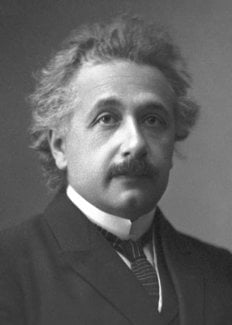
Einstein in 1921, the year he was awarded the Nobel Prize in Physics for the photoelectric effect.
Any one of the papers would have been a career-capper for any physicist. Einstein dashed them off in just a few months, forever changing the field of physics. And, you noticed: Einstein did not win a Nobel for the Special Theory of Relativity, nor for E=mc². He won it for the photo electric effect. Irony in history.
106 years later Einstein’s work affects us every day. Relativity theory at some level I don’t understand makes possible the use Global Positioning Systems (GPS), which revolutionized navigation and mundane things like land surveying and microwave dish placement. Development of nuclear power both gives us hope for an energy-rich future, and gives us fear of nuclear war. Sometimes, even the hope of the energy rich future gives us fear, as we watch and hope nuclear engineers can control the piles in nuclear power plants damaged by earthquakes and tsunami in Japan.
If Albert Einstein was a genius at physics, he was more dedicated to pacifism. He resigned his German citizenship to avoid military conscription. His pacifism made the German Nazis nervous; Einstein fled Germany in the 1930s, eventually settling in the United States. In the U.S., he was persuaded by Leo Szilard to write to President Franklin Roosevelt to suggest the U.S. start a program to develop an atomic weapon, because Germany most certainly was doing exactly that. But Einstein refused to participate in the program himself, sticking to his pacifist views. Others could, and would, design and build atomic bombs. (Maybe it’s a virus among nuclear physicists — several of those working on the Manhattan Project were pacifists, and had great difficulty reconciling the idea that the weapon they worked on to beat Germany, was deployed on Japan, which did not have a nuclear weapons program.)
Einstein was a not-great father, and probably not a terribly faithful husband at first — though he did think to give his first wife a share of a Nobel Prize should he win it in the divorce settlement. Einstein was a good violinist, a competent sailor, an incompetent dresser, and a great character. His sister suffered a paralyzing stroke. For many months Albert spent hours a day reading to her the newspapers and books of the day, convinced that mute and appearing unconscious, she would benefit from hearing the words. He said he did not hold to orthodox religions, but could there be a greater show of faith in human spirit?
Einstein in 1950, five years before his death.
When people hear clever sayings, but forget to whom the bon mots should be attributed, Einstein is one of about five candidates to whom all sorts of things are attributed, though he never said them. (Others include Lincoln, Jefferson, Mark Twain and Will Rogers). Einstein is the only scientist in that group. So, for example, we can be quite sure Einstein never claimed that compound interest was the best idea of the 20th century. This phenomenon is symbolic of the high regard people have for the man, even though so few understand what his work was, or meant.
A most interesting man. A most important body of work. He deserves more study and regard than he gets.
Or, until that account is unsuspended by the forces supporting Donald Trump: Follow @FillmoreWhite, the account of the Millard Fillmore White House Library
We've been soaking in the Bathtub for several months, long enough that some of the links we've used have gone to the Great Internet in the Sky.
If you find a dead link, please leave a comment to that post, and tell us what link has expired.
Thanks!
Retired teacher of law, economics, history, AP government, psychology and science. Former speechwriter, press guy and legislative aide in U.S. Senate. Former Department of Education. Former airline real estate, telecom towers, Big 6 (that old!) consultant. Lab and field research in air pollution control.
My blog, Millard Fillmore's Bathtub, is a continuing experiment to test how to use blogs to improve and speed up learning processes for students, perhaps by making some of the courses actually interesting. It is a blog for teachers, to see if we can use blogs. It is for people interested in social studies and social studies education, to see if we can learn to get it right. It's a blog for science fans, to promote good science and good science policy. It's a blog for people interested in good government and how to achieve it.
BS in Mass Communication, University of Utah
Graduate study in Rhetoric and Speech Communication, University of Arizona
JD from the National Law Center, George Washington University


 Posted by Ed Darrell







 Millard Fillmore's Bathtub