2012 Anniversary of Pearl Harbor, still “infamous”

December 7, 2012

Encore and traditional post, mostly, from December 7, 2006 with updates.

1941 AP file photo, small boat rescues victims from U.S.S. West Virginia

Caption from Naval History and Heritage Command: Photo #: 80-G-19930
Pearl Harbor Attack, 7 December 1941
Sailors in a motor launch rescue a survivor from the water alongside the sunken USS West Virginia (BB-48) during or shortly after the Japanese air raid on Pearl Harbor.
USS Tennessee (BB-43) is inboard of the sunken battleship.
Note extensive distortion of West Virginia’s lower midships superstructure, caused by torpedoes that exploded below that location.
Also note 5″/25 gun, still partially covered with canvas, boat crane swung outboard and empty boat cradles near the smokestacks, and base of radar antenna atop West Virginia’s foremast.
Official U.S. Navy Photograph, National Archives Collection.

Today is the 71st anniversary of Japan’s attack on the U.S.’s Pacific Fleet at Pearl Harbor, Hawaii.

Many Americans fly their U.S. flags today.  The date is not one specified in law for flag-flying.  President Obama issued a proclamation asking citizens to fly flags at half-staff today.

Our local newspaper, The Dallas Morning News, ran a front-page story on survivors of the attack in 2006, who have met every five years in reunion at Pearl Harbor. [December 7, 2006] was their last official reunion. The 18-year-olds who suffered the attack, many on their first trips away from home, are in their 80s now. Age makes future reunions impractical.

In 2010, it is estimated that fewer than 4,000 veterans of Pearl Harbor still live to remember, though, of course those surviving do.

From the article:

“We’re like the dodo bird. We’re almost extinct,” said Middlesworth, now an 83-year-old retiree from Upland, Calif., but then – on Dec. 7, 1941 – an 18-year-old Marine on the USS San Francisco.

Nearly 500 survivors from across the nation were expected to make the trip to Hawaii, bringing with them 1,300 family members, numerous wheelchairs and too many haunting memories.

Memories of a shocking, two-hour aerial raid that destroyed or heavily damaged 21 ships and 320 aircraft, that killed 2,390 people and wounded 1,178 others, that plunged the United States into World War II and set in motion the events that led to atomic bombings of Hiroshima and Nagasaki.

“I suspect not many people have thought about this, but we’re witnessing history,” said Daniel Martinez, chief historian at the USS Arizona Memorial. “We are seeing the passing of a generation.”

Another article notes the work of retired history professor Ron Marcello from the University of North Texas, in Denton, in creating oral histories from more than 350 of the survivors. This is the sort of project that high school history students could do well, and from which they would learn, and from which the nation would benefit. If you have World War II veterans in your town, encourage the high school history classes to go interview the people. This opportunity will not be available forever.

There is much to be learned, Dr. Marcello said:

Dr. Marcello said that in doing the World War II history project, he learned several common themes among soldiers.

“When they get into battle, they don’t do it because of patriotism, love of country or any of that. It’s about survival, doing your job and not letting down your comrades,” he said. “I heard that over and over.”

Another theme among soldiers is the progression of their fear.

“When they first got into combat, their first thought is ‘It’s not going to happen to me.’ The next thought is ‘It might happen to me,’ and the last thought is ‘I’m living on borrowed time. I hope this is over soon,’ ” Dr. Marcello said.

Dr. Marcello said the collection started in the early 1960s. He took charge of it in 1968. Since Dr. Marcello has retired, Todd Moye has taken over as the director.

Other sources:

While this is not one of the usual dates listed by Congress, you may fly your U.S. flag today.

End of 2006 post —

Other resources (2007):

USS Missouri Memorial – Main Battery - from the Panoramas of World War II site

USS Missouri Memorial – Main Battery – from the Panoramas of World War II site

More, 2012:


Millard Fillmore: Victim of yet another hoax

December 6, 2012

The Washington Post’s usually great blog on politics, The Fix, features a list of the best presidential biographies.  This comes just in time for the holidays, of course.  It could be a guide to getting the book for that wonk you know, the one who says Franklin Pierce is underrated, or the woman you know who is fixated on what might have been had Warren G. Harding not died in San Francisco.

The list links to good versions of obscure and arcane history, as well as some major stuff — any good biography of Thomas Jefferson, George Washington, Abraham Lincoln, or Teddy Roosevelt, has to have some major chops going for it, in those crowded niches of good biographies of important people.

English: 1938 u.s. postage stamp of Millard Fi...

1938 U.S. postage stamp of Millard Fillmore, a 13-cent stamp for our 13th president – Wikipedia image

Then there is poor old, hapless Millard Fillmore.

We can excuse Natalie Jennings and Sean Sullivan, perhaps.  After all, there are not many books on Millard Fillmore.  Pickings are slim.

Ever since America’s favorite curmudgeon, H. L. Mencken, created a World War I hoax on the gullibility of the public, with a completely invented history that claimed the only thing of note ever done by Millard Fillmore was putting a bathtub in the White House, against the advice of the American Medical Association, poor Fillmore has been the butt of jokes, but more often the cruel butt of unintended slights when people cite the fictions of his life rather than his accomplishments.  We approach the anniversary of the Mencken “Fillmore’s Bathtub” Hoax, on December 28.

I said the pickings on Fillmore books were slim.  The list at The Fix  includes a parody history of some five years back by George Pendle, The Remarkable Millard Fillmore: The Unbelievable Life of a Forgotten President.

At Amazon, we learn of Pendle’s book:

Millard Fillmore has been mocked, maligned, or, most cruelly of all, ignored by generations of historians–but no more! This unbelievable new biography finally rescues the unlucky thirteenth U.S. president from the dustbin of history and shows why a man known as a blundering, arrogant, shallow, miserable failure was really our greatest leader.

In the first fully researched portrait of Fillmore ever written, the reader can finally come face-to-face with a misunderstood genius. By meticulously extrapolating outrageous conclusions from the most banal and inconclusive of facts, The Remarkable Millard Fillmore reveals the adventures of an unjustly forgotten president. He fought at the Battle of the Alamo! He shepherded slaves to freedom on the Underground Railroad! He discovered gold in California! He wrestled with the emperor of Japan! It is a list of achievements that puts those of Washington and Lincoln completely in the shade.

Refusing to be held back by established history or recorded fact, here George Pendle paints an extraordinary portrait of an ordinary man and restores the sparkle to an unfairly tarnished reputation.

Of course it’s parody!  There’s no indication Fillmore, never a member of the military, fought at the Alamo.  Fillmore never made it to California, nor was he the Mormon who discovered gold at Sutter’s Mill.  In one of his greatest acts, Fillmore dispatched Commodore Perry to Japan to coerce that nation to open its doors to American sailing ships, and trade with the rest of the world.  Fillmore himself did not journey to Japan, and never met the Japanese emperor, let alone wrestled the man. (After his presidency, Fillmore visited Europe; Queen Victoria is attributed with having said he was one of the handsomest men she’d ever met; he refused an honorary degree because, he said, he couldn’t read the Latin it was written in — you can’t make up the real stuff.)

Despite its clearly being a parody, however, there it is on the list of The Fix, as the best biography of Millard Fillmore.

Fillmore parody history listed as best Fillmore biography

Screen clip showing parody Fillmore biography on The Fix’s list of best presidential biographies

H. L. Mencken lifts a beer to toast end of Prohibition

H. L. Mencken at approximately 12:30 a.m., April 7, 1933, at the Rennert Hotel, corner of Saratoga and Liberty Streets, 17 years later, not neglecting a sudsy anniversary – Baltimore Sun photo

The Ghost of H. L. Mencken notes that this item appeared on December 5, 2012, the anniversary of the end of Prohibition — and knocks back a brew.  Every other president gets a serious biography mentioned; for Millard Fillmore, The Fix lists a hoax book as his “best presidential biography.”

More:

A note on fairness to Mr. Pendle:  Pendle has argued here before that his book does contain real history, and it’s there despite the embellishments which he says at least get the book sold.  Earlier, in comments he said:

Dear Sir,

I am the author of the recently published ‘The Remarkable Millard Fillmore’, which I have just discovered has been mentioned by your website on a couple of occasions. Judging by your website’s wonderful name, and your obvious interest in making people more aware of American history, I was slightly troubled to see that you thought I treated Millard Fillmore unfairly in my book.

I don’t know if you have had a chance to read ‘TRMF’ yet, but I can assure you that while it is a faux-biography, and does indeed poke fun at Millard Fillmore’s perceived image (or lack of it), its larger target is that of presidential biographies that are unthinkingly reverential of the office of the president. The cynical revision of history, in which one man is placed at the center of the world’s events is a historical fallacy, as you are probably well aware. Yet it is one which – unlike my book – many historians perpetrate with a straight face.

In ‘TRMF’ I attempted to mock this school of biography by extrapolating the most ridiculous situations from the most basic and inconclusive of historical facts. For instance, I have Millard Fillmore stowing away to Japan, and Sumo-wrestling with the Mikado’s champion, because in real life Fillmore opened up Japan to western trade (albeit from a safe distance in Washington D.C.).

Lest you think I am playing too fast and loose with the truth (some readers have complained that they did not realize my book was a spoof, despite the picture of Millard Fillmore riding a unicorn on its cover!) my book also includes a large appendix of strange but true historical notes to show that many of the ridiculous situations I place Fillmore in were actually based on fact. By reading them I hope one can discover that even the most staid of human lives can be touched by the fantastic.

In short I come not to bury Fillmore, but to praise him, and all those forgottens who have not been granted a role as a ‘Great Man of History’ by the Academy. I very much hope that although ‘The Remarkable Millard Fillmore’ is primarily a spoof and designed to make people giggle, readers will, possibly without being aware of it, come away from the book with a better knowledge of American History than when they started it.

Yours sincerely,
George Pendle

So we are left with a little mystery.  Did the WaPo reporters know that Pendle’s book is a parody, and are they saying it works wonderfully as a tool of history telling?  Or, did they not know?

_____________

Update:  Comes word this morning that The Fix changed its listing for Fillmore, to the Rayback book (Thanks, Lea).  The column says only that it’s been “updated,” but doesn’t explain where or why.   Mr. Pendle might argue his book should be there:  How many books are there on Fillmore after all?


Before the fight: Ford and Reagan, October 31, 1974

December 5, 2012

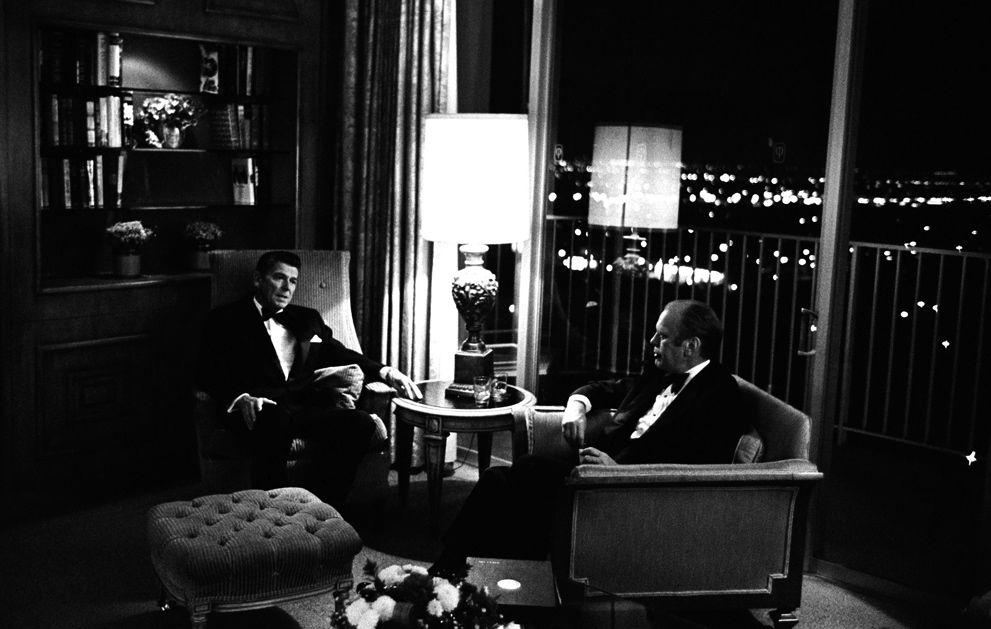
Historian Michael Beschloss Tweeted out a wonderful photo:

President Gerald Ford, former-Gov. Ronald Reagan, October 31, 1974, Century Plaza

October 31, 1974: President Gerald Ford, right, met with former-California Gov. Ronald Reagan, at the Century Plaza Hotel, Los Angeles. Photo courtesy Micheal Beschloss.

Who took the photo?  What was the event?  Beschloss asks on Twitter, why two drinks on Ford’s side of the table, and none on Reagan’s?

Looks like it’s a photo by David Hume Kennerly, the White House photographer in the Ford administration.  The photograph was taken with film, probably in black and white to save money and because it was the best way to get images for print media at the time.  Few newspapers ran color photos as a regular feature.  Electronic still photography at the time occurred in laboratories as tests.  As a pragmatic matter, media to store such photographs electronically were impractical — a large mainframe computer might have 256 kilobytes of memory for such storage, or enough for photo of poor resolution.

Kennerly’s site said this meeting came around a black-tie Republican fund-raiser in Los Angeles, at the then-swanky Century Plaza Hotel.

Vanity Fair’s David Friend called it “L.A. Noir” in a 2007 article on a book of photos by Kennerly:

Today, the image conveys a touch of Rat Pack swagger, an architectural elegance, and a hint of the California glamour that Reagan would eventually import to Washington. At the time, however, Kennerly, who had won a Pulitzer for his work in Vietnam, considered the picture too dark and brooding; he almost overlooked the frame on his contact sheet. But that darkness captured something of the spirit of the time: less than three months before, Watergate had forced Richard Nixon from office; inflation, unemployment, and gas prices were on the rise; and the U.S. was facing defeat in Vietnam.

The picture also caught the sometimes frosty relationship between the two leaders. Both Reagan and Ford, after all, would nix the 1980 “dream ticket” idea, floated by some Republican mandarins, to draft Ford as Reagan’s vice president. And Ford, during his unsuccessful 1976 campaign against Jimmy Carter, resented Reagan’s political infighting. “Truthfully,” Ford confessed to Kennerly years later, “I was upset when he challenged me [for the ’76 Republican nomination]. I thought it was unwise for a Republican to challenge a sitting Republican president. We had a pretty bitter contest. It was a head-to-head, knock-down, drag-out affair.”

“I study this picture now,” says Kennerly, “and it looks like a scene from The Godfather”—which had won the best-picture Oscar the year before.

Were I to guess, with a bit of education, I’d say both glasses belonged to Ford, one a cocktail, one water.  Reagan tended to avoid alcohol.

A great photograph, a tribute to the artistry and craftsmanship of Kennerly, especially with film; it also poses as a time capsule, freezing convention in GOP big-money fundraising, dress for men of influence and means, architecture, and so much more.

David Kennerly

Pulitzer Prize-winning war photographer, and White House photographer, David Hume Kennerly; TEDxBend image


Not before the deluge, not after it, but during the storm.  Nixon was three-months gone from the White House.  Vietnam’s peace agreement was a year-old, but it was seven months to the final invasion of South Vietnam by the communist North that would force the U.S. retreat, and “reunify” Vietnam under communist rule.  The Cold War still raged.  Iran was considered a U.S. puppet.  Mao Zedong still ruled in China.  Elvis Presley still ruled in Memphis.  AIDS was unknown.  Computers were accounting machines taking floors of entire buildings.  Portable telephones were expensive devices that hogged power and generally required at least an automobile to be attached to power the thing.

Barack Obama was 13.

It was a different time.

More:


Typewriter of the moment: Mark Twain’s Hammond

December 5, 2012

Still hoping to find a photo of Samuel Clemens at work on a typewriter.

But until then, this one will have to do:

Mark Twain's Hammond typewriter, Jerry J. Davis photo

A Hammond typewriter that once belonged to Samuel Clemens, or Mark Twain. Photographed by Jerry J. Davis, in an unstated location, probably Hannibal, Missouri

A Hammond typewriter, from oobject.com; perhaps not the typewriter that WAS pictured above; but Twain used this one, and the link to the photo above has died but good.

A Hammond typewriter, from oobject.com; perhaps not the typewriter that WAS pictured above; but Twain used this one, and the link to the photo above has died but good.

Other photos of Twain’s typewriter must exist; and since we know of at least two such machines, there must be some photos of each of them, no?  I wish museums and historians would consider the value of images of some of these objects, and make high quality photos of some of these famous machines.

Twain’s fascination with technology shines clearly in his work.  From his earliest writings we get lyrical and accurate descriptions of the mechanical workings of Mississippi riverboats, for one example.  A Connecticut Yankee in King Arthur’s Court paints a long paean to technology of the late 19th century, transplanted in the tale several centuries earlier.

Some accounts claim The Adventures of Huckleberry Finn to be the first manuscript completed by typewriter — this one, perhaps? TwainQuotes.com features what may be a description of this history:

…I will now claim — until dispossessed — that I was the first person in the world to apply the typewriter to literature…The early machine was full of caprices, full of defects — devilish ones. It had as many immoralities as the machine of today has virtues. After a year or two I found that it was degrading my character, so I thought I would give it to Howells…He took it home to Boston, and my morals began to improve, but his have never recovered.

– “The First Writing Machines”

As a publisher and investor, Twain pushed the development of automated typesetting machines to quickly publish the memoirs of former President Ulysses S Grant.  Though the books were set quickly, and the best-selling memoirs provided an income for Grant’s widow, the technology was still balky and cost Twain his own fortune.

Mark Twain's Hammond typewriter - TwainQuotes.com

Twain’s Hammond at the Mark Twain Museum in Hannibal, Missouri. Image from TwainQuotes.com. Is this the same machine pictured above? There are similarities, but differences more than just the angle.

We shouldn’t be surprised with his acerbic comments on the machines; Twain’s caustic humor targeted everything in modern life.  TwainQuotes.com notes a fraction of a letter to his longtime friend:  Twain’s Hammond at the Mark Twain Museum in Hannibal, Missouri. Image from TwainQuotes.com

The machine is at Bliss’s, grimly pursuing its appointed mission, slowly & implacably rotting away at another man’s chances for salvation.

I have sent Bliss word not to donate it to a charity (though it is a pity to fool away a chance to do a charity an ill turn), but to let me know when he has got his dose, because I’ve got another candidate for damnation. You just wait a couple of weeks & if you don’t see the TypeWriter coming tilting along toward Cambridge with the raging hell of an unsatisfied appetite in its eye, I lose my guess.

– Letter to William Dean Howells, 25 June 1875

Were things really so bad?

I regret to note that in our visit to Hannibal last June I did not encounter any typewriters.  Clearly, I’ll have to go back.

Tip of the old scrub brush to OObjects.

More:


Rachel Carson biography, On a Farther Shore, one of best books of 2012

December 4, 2012

Kirkus Reviews listed as one of 2012’s top 25 books William Souder’s biography of Rachel Carson, On a Farther Shore.

William Souder, author of On a Farther Shore. MPR  image

William Souder, author of On a Farther Shore. Minnesota Public Radio image

Rachel Carson often gets credit for starting the modern environmental movement.  In highly cynical political times, Carson is under cruel smear attack from people who wish the environmental movement did not exist, and who appear to think that we could poison Africa to prosperity if only we’d use enough DDT, contrary to all scientific work and medical opinion.

Souder’s book, issued on the 50th anniversary of the publication of Carson’s best-known book, Silent Spring, lays out the facts.

Nice to see that book lovers like Souder’s work, too.  Carson’s work was painstakingly accurate as science, but also a wonderful read.  Silent Spring has a larger following among lovers of literature than science, a tribute to her writing ability.  Souder’s book plows both veins, science and writing.

Cover of On a Farther Shore, by William Souder

Cover of On a Farther Shore, by William Souder

In circles serious about science, the environment, human health, and literature, Souder’s book is the book of the 50th anniversary of Silent Spring.  There is irony there.  Pesticide manufacturers mounted a campaign against Silent Spring and Rachel Carson calculated to have cost $500,000 in 1962, when that book was published.  Souder’s book fights propaganda from Astro-turf™ organizations like Africa Fighting Malaria, a pro-DDT group that collects money from chemical manufacturers and anti-environmental political sources for a propaganda campaign that costs well over $500,000/year.  Despite all the paid-shill shouting against Rachel Carson and her work, it is the voice of On a Farther Shore that stands out.

More:


Flash mob in the BYU library

December 2, 2012

When flash mobs go Mormon, and invade sacred spaces like libraries, in Provo, Utah . . . well, that’s pushing the boundaries a bit, and telling the aging of the ritual, too.

How many times have you sung in the atrium of a library and thought it would be a great place for a choir?

Notes from the BYU Singers at YouTube (I added links, except for the first YouTube link):

http://youtu.be/LkE_vk86fq0?t=1h7m10s is the link to hear the BYU Singers perform it in concert!

The BYU Singers appear out of the crowd to sing O Sapientia in the BYU Library. For a brief minute, the library stood still! The audience was captivated, and asked for more. We told them that it sounds better live and invited them to our concert!

And, in comments:

Thank you so much for listening to the BYU Singers! Some viewers asked for a recording of us singing “O Sapientia” by Bob Chilcott without the background noise of the library. We’ve put a link into this video’s description, as well as in an annotation during the first 10 seconds of the video. The link goes directly to us singing “O Sapientia” during a broadcast of our concert on Saturday, November 17, 2012 in the DeJong Concert Hall at BYU. Thank you again for listening!

When I attended college at Utah’s senior (and superior) educational institution (back when Dinosaur Jim Jensen was hunting them live in Central Utah), J. Willard Marriott gave $1 million to the University of Utah to finish the library, and a couple of years later gave $1 million to BYU to finish the basketball center.  We noted that Marriott was a good judge of where the priorities lay at each institution.  Since then, BYU built a new library which is, I hear, quite glorious as a study location.  Except, of course, it’s located on the campus of BYU.  If you’re studying late nights there, let’s just say you’d better have had a good night’s sleep the previous week, because caffeine is going to be hard to come by.

I think the Franklin Stewart Harris Fine Arts Center, home of the DeJong Concert Hall, is the only college building in this nation named after a relative of mine.  In the center of an academic institution that often troubled me deeply, it was the site of many a pleasant day in extension classes (here’s to you, Max Golightly), student performances, and debate headquarters.  I’ve taken solace in the building’s being dedicated to arts and performance, which transcends all the other problems I have with the school.

Those kids sing pretty well, don’t you think?

Did you also notice?  No one shushed them.  I mean, it sounded pretty noisy for a library — but it’s still a library!

Tip of the old scrub brush to Evelyn Earl Jeffries.

More:


Twain aboard ship – 1896 photo, 1897 etching

December 1, 2012

One of my favorite images of Mark Twain I found several years ago.  It’s a photograph of Twain, with a genuine smile of some contentment, seated in a deck chair on a ship, feet on the rail, gazing out to sea.

Correspondent J. A. Higginbotham tracked down the origin of the photograph through the Gutenberg Project, and found a nice etching from the photograph at twainquotes.com, with sleuthing by Barbara Schmidt, the curator of that site.

Here’s the photo, from the Gutenberg Project’s version of the 1898 American Publishing Company edition of Following the Equator:

Mark Twain, aboard ship, 1896; photo by Walter G. Chase of Boston

Mark Twain, aboard ship in 1896. Photo by Walter G. Chase, of Boston. This photo provided the frontispiece for the 1898 American Publishing Company edition of Following the Equator.

Who was Walter Chase?  So far as I have found, he was a Boston-based photographer.

Samuel L. Clemens, the man behind Mark Twain, undertook a world-wide speaking tour, to restore his fortune after bankruptcy, and to take his mind off the death of his daughter Susy, in August 1896.  At the same time, there was demand for newspaper columns and books on travel.  The resulting book, Following the Equator in the U.S., ended the series of travelogues Twain wrote.  Columns and the book covered his and his family’s adventures in 1896 and 1897; this photo must have originated in late 1896, in the early part of the tour.  We know from Chapter 1 that the land part of the trip, by train, “westward out of New York,” took 40 days.  Twain wrote that it took seven days to get to Hawaii.  We might be safe in saying the photograph shows him gazing at the Pacific.

Without knowing more, we might be tantalized by the prospect that Chase accompanied Twain on much of this tour, and took other photographs.  Twain wrote about games played among the travelers aboard ship, with notes indicating a key player was someone named “Chase.”  We have a photo of Twain posing for a sculptor in Vienna, from this trip. Somewhere, there may be a trunk of photographs . . .

According to Barbara Schmidt’s sleuthing, William Henry Warren Bicknell created the etching from the photograph, for the 1899 uniform edition of Following the Equator.  Bicknell was one of several illustrators used, including Boy Scout founder Daniel Beard.

Mark Twain in the Pacific, etching by W. H. W. Bicknell, from 1896 photograph by Walter G. Chase,

W. H. W. Bicknell’s etching from the 1896 Walter G. Chase photograph of Mark Twain, aboard a ship in the Pacific Ocean.

Schmidt uses a colored version of the etching on her website’s own frontispiece.  No doubt she describes it in more detail, but I have not found that description.

A color version of an etching of Mark Twain, based on Chase's 1896 photograph.  Image via twainquotes.com, Barbara Schmidt's site.

A color version of an etching of Mark Twain, based on Chase’s 1896 photograph. Image via twainquotes.com, Barbara Schmidt’s site.

A fitting way to end a day of commemorating Mark Twain’s birthday, to discover the origins of one of my favorite images of the man.

New question:  With the exception of the color image, each version includes Twain’s autograph, “Be good & you will be lonesome,” with his signature.  Was this an autograph done solely for the book, or was it an autograph to the publisher, editor, or photographer?

Tip of the old scrub brush to correspondent J. A. Higginbotham.

More:

Mark Twain

Mark Twain (Photo credit: Wikipedia) – Another, earlier image of Twain, origins to sleuth down!