Query: Who wrote this first? Two novels that change a 14 year-old’s life, Lord of the Rings and Atlas Shrugged

February 7, 2013

Eye of Sauron, or John Galt?

Lord of the Rings features a time when evil almost wins. Atlas Shrugged celebrates such dystopia.

I first heard this within the past couple of years.  As with too many really good lines that get passed around the internet, it came to me first with no source listed.

It’s rather brilliant.  To whom do we properly give credit for its invention?

There are two novels that can change a bookish fourteen-year old’s life: The Lord of the Rings and Atlas Shrugged. One is a childish fantasy that often engenders a lifelong obsession with its unbelievable heroes, leading to an emotionally stunted, socially crippled adulthood, unable to deal with the real world. The other, of course, involves orcs.

Update:  In comments, Ellie and Liam both point to John Rogers at Kung Fu Monkey, March 19, 2009.  Sounds good.  Can anyone pin it on anyone else, earlier?

More:


What’s in a name? A Texas town by any other name . . . (redux)

February 7, 2013

. . . would still be a Texas town.

(This is an encore post of a piece that is five years old, and borrowed from a kid who has since graduated from Texas schools on gone on to Princeton; see bottom for additional, updated information.)

But Texas towns have some of the best names of towns in the U.S. Plus, there are a lot of Texas towns, plus 254 Texas counties.

Freckles Cassie at Political Teen Tidbits has a great list:

texas-road-map-tripinfodotcom.gif

Need to be cheered up?

Happy, Texas 79042
Pep, Texas 79353
Smiley, Texas 78159
Paradise, Texas 76073
Rainbow, Texas 76077
Sweet Home, Texas 77987
Comfort, Texas 78013
Friendship, Texas 76530

Go see the entire list — and maybe add a few of your favorites in the comments. An ambitious geography teacher could make a couple of great exercises out of those lists. “What’s the shortest distance one would have to drive to visit Paris, Italy, Athens and Santa Fe? How many could you visit in the shortest time?”

Texas counties, all 254 of 'em, from Geography.com

Texas counties, all 254 of ’em, from Geography.com

More, and updated information:

Read the rest of this entry »


Time machine! For Digital Learning Day

February 6, 2013

Screen shot from HHMI's iPad app, Earth Viewer -- the time machine function.

Screen shot from HHMI’s iPad app, Earth Viewer — the time machine function.

Stealing the entire post from P. Z. Myers at Pharyngula:

I’ve been playing with it for a while. It turns out that when you go back to Cretaceous Morris, you need to be able to swim really well, but Cambrian Morris is high and dry on a fairly small landmass (whoa, but oxygen is way down and carbon dioxide way up). You can have your own time machine, too — it’s the EarthViewer app for iPad, and it’s free from HHMI Here’s what it has:

• Data and continental reconstructions dating back billions of years

• Climate and carbon dioxide data for the last 100 years

• The ability to manipulate the globe and zoom to any location

• Track the location of modern cities back over 500 million years

• In depth features on major geological and biological events in Earth history

• Clickable details on geologic eons, eras, and periods

• Automated play modes

• An extensive reference list

• Suggestions for classroom use

• Tutorial videos

Did I mention that it’s free? This HHMI thing is pretty danged sweet.

There is no creationist/Noah’s Flood version.

No Windows version, yet, either.

Did we mention the Howard Hughes Medical Institute made this and related apps free?


Getting a more complete picture of Herbert Hoover: His dog liked him

February 6, 2013

Not sure how to file this.  Should it go under “Things we didn’t know about Herbert Hoover,” or “Hoover the mensch,” or “Some campaign photo ops never change?”

This is a campaign photo from 1928, Herbert Hoover and his dog, King Tut:

Herbert Hoover and dog, King Tut, in 1928 campaign photo

Campaign photo from 1928, of Republican candidate Herbert Hoover and his dog, King Tut. Image from Hoover Presidential Library and Museum, National Archives.

Tip of the old scrub brush to The Hoover Blackboard, a blog of the Hoover Library.

More:

Hoover Library

Herbert Hoover was Secretary of Commerce in the Harding and Coolidge administrations. What else don’t we remember about Hoover, most of the time? Hoover Library display, photo by akasped.


Boy Scout membership standards decision delayed for more discussion

February 6, 2013

Dallas’s Circle 10 Council, BSA, issued this statement from Council Chief Executive Pat Currie, about the discussion of changes in BSA membership policies. FYI.

BSA - Circle Ten Council logo - 550 px wide

February 6, 2013

Dear Circle Ten Family,

We appreciate your participation and support of Scouting as we help equip children with the life skills to become a good, strong citizen. This year we will celebrate Circle Ten’s 100th anniversary, and our focus has remained the same, working together to deliver the nation’s foremost youth program of character development and values-based leadership training. I would also like to take this opportunity to update you on the recent discussions within the Scouting family regarding our membership standards policy.

After careful consideration and extensive dialogue within the Scouting family, along with comments from those outside the organization, the volunteer officers of the Boy Scouts of America’s National Executive Board concluded that due to the complexity of this issue, the organization needs time for a more deliberate review of its membership policy.

To that end, the executive board directed its committees to further engage representatives of Scouting’s membership and listen to their perspectives and concerns. This will assist the officers’ work on a resolution on membership standards. The approximately 1,400 voting members of the national council will take action on the resolution at the national meeting in May 2013.

America needs Scouting, and our policies must be based on what is in the best interest of our kids. We believe good people can disagree and still work together to accomplish great things for youth.

Going forward, we will work to stay focused on that which unites us. Be a part of this discussion by staying engaged and continuing your role in Scouting. The kids in your community need you.

Sincerely,

Pat

Pat Currie
Scout Executive/CEO
Circle Ten Council, Boy Scouts of America


Trombone time: Dave Finlayson and GoPro on the slide

February 6, 2013

Trombone players are nice guys, usually.  Something about the mellow tone, the difficulty of mastering a non-push-button (valve) instrument, and having to fill in the low parts where the egotistical trumpets can’t go.

My older brother Wes played trombone, and that sucked me in — the junior high band didn’t have any trombones, and some neighborhood fink ratted out that I had one in my closet.  My playing ended in college.  Younger son James played first chair in the Duncanville Wind Ensemble, a group that steps a lot of musicians right into pro slots; older son Kenny switched from trumpet to baritone in the same group (you can hear Kenny in that recording of the Wind Ensemble).  In Kathryn’s family, it’s almost required be a trombonist.  Uncle Darrell plays, still, in a symphony in Utah County, with various other uncles and cousins staffing bands from Ogden south to Provo in Utah.

So, of course, Dave Finlayson’s marriage of a short piece and a GoPro camera appealed to me right off:

You don’t recognize Dave Finlayson?

From GoPro’s site:

David Finlayson set out to make a GoPro video with his trombone and ended up with a surprise – a viral video with hits numbering over one million! Check out the extended cut David and GoPro produced — orchestra night, anyone? David is a trombonist with the New York Philharmonic – check out David’s channel for more videos at http://goo.gl/y1Hrj

More:


Quote of the moment: Herbert Hoover, on credit, in Des Moines, Iowa, 1932

February 4, 2013

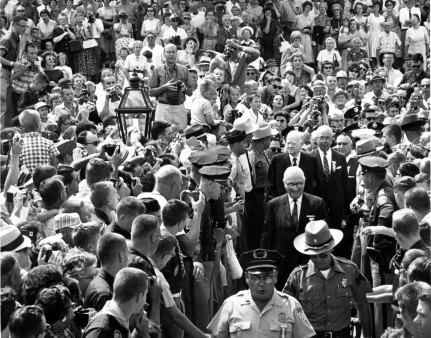
Herbert Hoover and crowd in West Branch, Iowa, 1932 - dedication of Hoover Library

Herbert Hoover, 88, attended the opening of the Hoover Library in West Branch, Iowa, on August 10, 1962, 30 years after his speech in Des Moines defending actions to shore up the credit of the U.S.  At this 1962 event, former President Harry Truman came to pay respects, mensch that he was; Truman is walking ahead of Hoover here.  Photo from Travel Iowa blog, and probably from the Hoover Library and Museum

Let me remind you that credit is the lifeblood of business, the lifeblood of prices and jobs.

  • Herbert Hoover, address at Des Moines, Iowa, October 4, 1932. — The Public Papers of the Presidents of the United States: Herbert Hoover, 1932–1933, p. 467.  (courtesy of Wikiquote)

_____________

Just a month before he would be crushed at the polls by Franklin Roosevelt, President Herbert Hoover returned to Iowa, his proud home state, to deliver this speech in Des Moines, detailing actions his administration had taken over the previous 18 months to save the U.S. and world economies.  Much of this action had been out of the glare of popular press.  Hoover hoped that by explaining the difficult battles his administration fought behind the huge oak doors of boardrooms and international diplomacy, Americans might appreciate more what he had accomplished, and not focus so much on the fact that the Great Depression still ravaged millions of Americans.

In today’s anti-credit political environment, it is interesting to see one of our most ardent businessman presidents defend credit. In an irony unappreciated in today’s political discussions, much of the discussion in 1932 between Hoover and Roosevelt was over which one could better manage to get to and keep a balanced budget.

The full speech is available at The American Presidency Project housed at the University of California – Santa Barbara. Politics wonks, history fans, and economists will want to look at the full speech this line is ripped from, contextually bereft. Context, in this case, does not change the meaning, but deepens the complexity of the issues and time.  Hoover bragged about keeping the U.S. on the gold standard, because so many contracts and mortgages were written to be payable in gold, and not currency.  So leaving the gold standard could have enormous disrupting influence on credit.

The first of these perils was the steady strangulation of credit through the removal of $3 billions of gold and currency by foreign drains and by the hoarding of our own citizens from the channels of our commerce and business. And let me remind you that credit is the lifeblood of business, the lifeblood of prices and of jobs.

Much of the rest of the speech defended Hoover’s use of government in ways that would cause apoplexy among Tea Partiers and a blizzard of critical press releases from Republicans, today:

Hoover addresses a large crowd in his 1932 cam...

Hoover addresses a large crowd in his 1932 campaign. (Photo credit: Wikipedia)

Now, we have fought an unending war against the effect of these calamities upon our people in America. This is no time to recount the battles on a thousand fronts. We have fought the fight to protect our people in a thousand cities from hunger and cold.

We have carried on an unceasing campaign to protect the Nation from those unhealing class bitternesses which arise from strikes and lockouts and industrial conflict. We have accomplished this through the willing agreement of employer and labor which placed humanity before money through the sacrifice of profits and dividends before wages.

We have defended millions from the tragic result of droughts. We have mobilized a vast expansion of public construction to make work for the unemployed. We fought the battle to balance the budget. We have defended the country from being forced off the gold standard, with its crushing effect upon all who might be in debt. We have battled to provide a supply of credits to merchants and farmers and industries. We have fought to retard falling prices. We have struggled to save homes and farms from foreclosure of mortgages, battled to save millions of depositors and borrowers from the ruin caused by the failure of banks, fought to assure the safety of millions of policyholders from failure of their insurance companies, and fought to save commerce and employment from the failure of railways.

We have fought to secure the disarmament and to maintain the peace of the world. We have fought for stability in other countries whose failure would inevitably injure us. And, above all, we have fought to preserve the safety, the principles, and the ideals of American life. We have builded the foundations of recovery.

Now, all these battles, related and unrelated, have had a single strategy and a single purpose. That was to protect your living, your comfort, and the safety of your fireside. They have been waged and have succeeded in protecting you from infinitely greater harm that might have come to you.

Thousands of our people in their bitter distress and losses today are saying that “things could not be worse.” No person who has any remote understanding of the forces which confronted this country during these last 18 months ever utters that remark. Had it not been for the immediate and unprecedented actions of our Government things would be infinitely worse today.

Instead of moving forward we would be degenerating for years to come, even if we had not gone clear over the precipice, with the total destruction of every ideal we hold dear.

Let no man tell you that it could not be worse. It could be so much worse that these days now, distressing as they are, would look like veritable prosperity.

In all these great efforts there has been a constant difficulty of translating the daily action into terms of public understanding. The forces in motion have been so gigantic, so complex in character, the instrumentalities and actions that we must undertake to deal with them have been so involved, the figures we must use are so astronomical as to seem to have but little relation to the family in the apartment or the cottage or on the farm.

English: Franklin Delano Roosevelt and Herbert...

Five months after Hoover’s Des Moines speech, Franklin Delano Roosevelt and Herbert Hoover in convertible automobile on way to U.S. Capitol for Roosevelt’s inauguration, March 4, 1933 (Photo credit: Wikipedia)

If Hoover made that speech today, every fellow at the Hoover Institution would sign a petition demanding his impeachment, never mind that he’s not president any more.

____________

A few notes about the photograph at the top:  This photo shows two former presidents, Herbert Hoover and Harry S Truman, walking through a crowd at the dedication of the Hoover Presidential Library and Museum, in West Branch, Iowa, in 1962.  One might pay careful attention to how lax security was, generally — the crowd is allowed within an arm’s length of the two former presidents — and this was after an assassination attempt had been made on Truman, in Washington, years before.  Insignia on the uniforms of the police are difficult to discern, but from the uniforms it looks as if there was a combination of local police, possibly a county sheriff’s staff, and Iowa state highway patrol troopers.  I found it interesting to note that several of the younger men appear to be Explorer Scouts, BSA — one wearing what appears to be an Eagle Scout neckerchief. Cameras were special event tools, but generally not of the quality that could get a decent photograph at an event like this, except for professionals with professional cameras.  Still, visible are double-lens reflex cameras held up in hope of a proper aim, small Kodaks, one man winding film in a 35-mm single-lens reflex, and a tiny handful of home movie cameras (with three lenses on the front — wide angle, normal and modest telephoto).  Click on the photo for an expanded view, and see what else you may.  If by chance you know anything about this photo, Dear Reader, please tell, in comments.

Tip of the old scrub brush to Henry Mowry at Mowryblog.

More, and resources:

Presidents Harry Truman and Herbert Hoover at the dedication of the Herbert Hoover Presidential Library and Museum on August 10, 1962 (Photo credit: Wikipedia)

Presidents Harry Truman and Herbert Hoover at the dedication of the Herbert Hoover Presidential Library and Museum on August 10, 1962 (Photo credit: Wikipedia)


Mystery white dove

February 3, 2013

It was last April.  Kathryn’s garden near the patio needed some work, and of course there are all the plants in pots, including the orange tree (which has since been joined by a pomegranate).

Birds visit often — we hang three or four birdfeeders.  Cardinals, house finches, the Carolina wren and her family, and a lot of white-winged doves commonly hang around.

Of a sudden a flutter of wings — and there he was:

White dove

Where did this dove come from? For a few weeks in the spring, it haunted our yard.

We assumed it was male, but we have no way of knowing for sure.  At one point it seemed to make mating advances on some of the white-winged doves — but who knows.

The bird followed Kathryn around.  It ignored the feeders farther out in the yard, and concentrated on the feeders on the patio.  Then it would land on our patio table and watch.

Sometimes it splashed in the birdbaths.

White dove in the yard.

The bird appeared at ease around people. It would watch us work or play in the back yard.

Difficult to miss — the white was positively glowing.  When it flew in, it’s path suggested it came from a house up the alley a ways.  Was it a refugee from some cote, an escapee?  Or was it a trained bird just out for exercise?

A few times it arrived in the morning, and hung around for an hour or two.    Its usual pattern was to arrive in the early evening, grab a few seeds, do a lot of watching, and disappear.

With its color, we feared it would be a target for hawks.

White dove ron the roof.

Where it flew to roost, we couldn’t determine.

One day it flew off, and didn’t return.

The mystery dove.  Where did it come from, was it tame?  Why was it here?  Where did it go?

More:


So, you want to be an astronaut?

February 2, 2013

What’s it like to be an astronaut?

You gotta learn how to cook and eat snake.

A discovery engine for meaningful knowledge, fueled by cross-disciplinary curiosity.
Edited by Maria Popova for Lore.
Twitter: @explorer

Art & Design Science & Technology Culture & Society History & Literature Creativity & Innovation Media & Communication Thought & Opinion About

Science & TechnologyHistory & Literature
What’s it like to be an astronaut? An animated first-hand account by NASA’s Jerry Carr, who tells his fascinating life story.

Complement with Sally Ride’s first-hand account of what it’s like to take off on a Space Shuttle, and this illustrated chronology of the Space Age.

Do kids dream of being an astronaut any more?  It’s a great, character-building dream.

Tip of the old scrub brush to BrainPicker, at Explore.

More:


Four freedoms really at risk in America?

February 1, 2013

I found a photo that reminded me of Norman Rockwell‘s “Freedom from Want,” and wrote about it.

Then I ran into a tweet from Texas educator Bonnie Lesley:

That in turn led to an Alternet post, displayed at Reader Supported News (RSN), by a guy who claims that, compared to 1941 and the progress made on the Four Freedoms, all four of them are in danger, in America, today.

Could that be right?  In was in his State of the Union address in January 1941 that Roosevelt described the four freedoms he said the U.S. should work to secure around the world — this was clearly a philosophical foundation-laying for going to war on the side of Britain, and against Germany, in the World War that was already raging, but which the U.S. had managed to stay out of for five years in Asia and two years in Europe.

Near the end of the speech on January 6, 1941, Roosevelt explained why freedom needed to be fought for, what was important to us, as Americans in the freedom of others in other nations.

Here is an excerpt of the speech, the final few paragraphs:

I have called for personal sacrifice, and I am assured of the willingness of almost all Americans to respond to that call. A part of the sacrifice means the payment of more money in taxes. In my budget message I will recommend that a greater portion of this great defense program be paid for from taxation than we are paying for today. No person should try, or be allowed to get rich out of the program, and the principle of tax payments in accordance with ability to pay should be constantly before our eyes to guide our legislation.

If the Congress maintains these principles the voters, putting patriotism ahead of pocketbooks, will give you their applause.

In the future days, which we seek to make secure, we look forward to a world founded upon four essential human freedoms.

Norman Rockwell's

Norman Rockwell’s “Freedom from Fear,” 1943 painting based on FDR’s 1941 State of the Union address, “The Four Freedoms.” This painting was used on posters urging Americans to buy War Bonds.

The first is freedom of speech and expression — everywhere in the world.The second is freedom of every person to worship God in his own way everywhere in the world.

The third is freedom from want, which, translated into world terms, means economic under- standings which will secure to every nation a healthy peacetime life for its inhabitants — everywhere in the world.

The fourth is freedom from fear, which, translated into world terms, means a world-wide reduction of armaments to such a point and in such a thorough fashion that no nation will be in a position to commit an act of physical aggression against any neighbor — anywhere in the world.

That is no vision of a distant millennium. It is a definite basis for a kind of world attainable in our own time and generation. That kind of world is the very antithesis of the so-called “new order” of tyranny which the dictators seek to create with the crash of a bomb.
To that new order we oppose the greater conception — the moral order. A good society is able to face schemes of world domination and foreign revolutions alike without fear.

Since the beginning of our American history we have been engaged in change, in a perpetual, peaceful revolution, a revolution which goes on steadily, quietly, adjusting itself to changing conditions without the concentration camp or the quicklime in the ditch. The world order which we seek is the cooperation of free countries, working together in a friendly, civilized society.

This nation has placed its destiny in the hands and heads and hearts of its millions of free men and women, and its faith in freedom under the guidance of God. Freedom means the supremacy of human rights everywhere. Our support goes to those who struggle to gain those rights and keep them. Our strength is our unity of purpose.

To that high concept there can be no end save victory.

War Bonds poster showing all of Rockwell's

Posters showing all four of Rockwell’s paintings also were printed for the War Bonds Drive. Image from the digital collection of the libraries at the University of North Texas

This speech inspired Norman Rockwell to create a series of paintings in tribute to the four freedoms, which paintings were used as posters for War Bond drives.

Paul Bucheit argues we’re losing those four freedoms, which we as a nation fought to secure, in the Pacific, in the Atlantic, in Africa, Europe and Asia:

The 2013 version shows how our freedoms have been diminished, or corrupted into totally different forms.

  • Freedom from want? Poverty keeps getting worse. . .
  • Freedom from fear? The new Jim Crow. . .
  • Freedom of worship? Distorted by visions of the Rapture. . .
  • Freedom of speech? No, surveillance and harassment. . .

Mr. Bucheit offers longer explanations.  I don’t think I agree completely, but I’m interested in your opinion:  Are we losing the Four Freedoms we fought for?

Tip of the old scrub brush to Bonnie Lesley, @EdFocus on Twitter.

More:

Herblock cartoon, August 13, 1951, whatever happened to freedom from fear?

“Say, whatever happened to ‘Freedom from Fear?'” Herblock cartoon in the Washington Post, August 13, 1951, on McCarthyism and the hunt for communists in government jobs. CJR290 image; click image for more information.


Lunch at Woolworth’s, with a side of non-violence and civility: North Carolina, February 1, 1960

February 1, 2013

Today is the 53rd anniversary of the Greensboro sit-in. Be sure to read Howell Raines‘ criticism of news media coverage of civil rights issues in a 2010 article in the New York Times: “What I am suggesting is that the one thing the South should have learned in the past 50 years is that if we are going to hell in a handbasket, we should at least be together in a basket of common purpose.”

This is mostly an encore post; please holler quickly if you find a link that does not work.

Four young men turned a page of history on February 1, 1960, at a lunch counter in a Woolworth’s store in Greensboro, North Carolina.

Ezell A. Blair, Jr. (now Jibreel Khazan), Franklin E. McCain, Joseph A. McNeil, and David L. Richmond, sat down at the counter to order lunch. Because they were African Americans, they were refused service. Patiently, they stayed in their seats, awaiting justice.

On July 25, nearly six months later, Woolworth’s agreed to desegregate the lunch counter. One more victory for non-violent protest.

Ezell A. Blair, Jr. (now Jibreel Khazan), Franklin E. McCain, Joseph A. McNeil, and David L. Richmond leave the Woolworth store after the first sit-in on February 1, 1960. (Courtesy of Greensboro News and Record)

Caption from Smithsonian Museum of American History: Ezell A. Blair, Jr. (now Jibreel Khazan), Franklin E. McCain, Joseph A. McNeil, and David L. Richmond leave the Woolworth store after the first sit-in on February 1, 1960. (Courtesy of Greensboro News and Record)

News of the “sit-in” demonstration spread. Others joined in the non-violent protests from time to time, 28 students the second day, 300 the third day, and some days up to 1,000. The protests spread geographically, too, to 15 cities in 9 states.

On the second day of the Greensboro sit-in, Joseph A. McNeil and Franklin E. McCain are joined by William Smith and Clarence Henderson at the Woolworth lunch counter in Greensboro, North Carolina. (Courtesy of Greensboro News and Record)

Smithsonian caption: “On the second day of the Greensboro sit-in, Joseph A. McNeil and Franklin E. McCain are joined by William Smith and Clarence Henderson at the Woolworth lunch counter in Greensboro, North Carolina. (Courtesy of Greensboro News and Record)”

Part of the old lunch counter was salvaged, and today is on display at the Smithsonian Institution’s Museum of American History. The museum display was the site of celebratory parties during the week of the inauguration as president of Barack Obama.

Part of the lunchcounter from the Woolworths store in Greensboro, North Carolina, is now displayed at the Smithsonians Museum of American History, in Washington, D.C.

Part of the lunch counter from the Woolworth’s store in Greensboro, North Carolina, now displayed at the Smithsonian’s Museum of American History, in Washington, D.C.- photo from Ted Eytan, who wrote: [“Ever eaten at a lunch counter in a store?”] The words . . . were said by one of the staff at the newly re-opened National Museum of American History this morning to a young visitor. What she did, very effectively, for the visitor and myself (lunch counters in stores are even before my time) was relate yesterday’s inequalities to those of today, by explaining the importance of the lunch counter in the era before fast food. This is the Greensboro, North Carolina lunch counter, and it was donated to the Smithsonian by Woolworth’s in 1993.

Notes and resources:

Student video, American History Rules, We Were There – First person story related by Georgie N. and Greg H., with pictures:

Associated Press interview with Franklin E. McCain:

More, in 2013: