January 5 is Fair Deal Day; thanks to Harry Truman

January 5, 2014

Front page of the New York Times on January 6, 1949, with news of President Truman's State of the Union message.  Oddly, via Conservapedia

Front page of the New York Times on January 6, 1949, with news of President Truman’s State of the Union message. Oddly, via Conservapedia

President Harry Truman delivered his State of the Union address to Congress on January 5, 1949, the first after he’d won election to the presidency in his own right (he succeeded to the presidency on the death of Franklin Roosevelt on April 12, 1945, remember).

Campaign button from the 1948 presidential campaign; on January 5, 1949, Truman presented a more detailed program backing the slogan, in his State of the Union Address

Campaign button from the 1948 presidential campaign; on January 5, 1949, Truman presented a more detailed program backing the slogan, in his State of the Union Address

Not a barn-burner of a speech, but an important one.  He appealed to history and the Square Deal of Teddy Roosevelt and the New Deal of Franklin Roosevelt; he appealed to Americans’ innate patriotism, and he appealed to a nation grateful to the soldiers who had defended freedom and democracy in World War II.  Truman called for a Fair Deal for all Americans, because they’d earned it, and it was the American thing to do.

This was barely eight weeks since Truman pulled out a stunning re-election win against the “do-nothing Congress.”  In many, many ways, the problems of 1949 look stunningly familiar to us today.  He spoke of the successes of the country in World War II, and the successes in business and finance since the war, and he said:

Reinforced by these policies, our private enterprise system has reached new heights of production. Since the boom year of 1929, while our population has increased by only 20 percent, our agricultural production has increased by 45 percent, and our industrial production has increased by 75 percent. We are turning out far more goods and more wealth per worker than we have ever done before.

This progress has confounded the gloomy prophets–at home and abroad who predicted the downfall of American capitalism. The people of the United States, going their own way, confident in their own powers, have achieved the greatest prosperity the world has even seen.

But, great as our progress has been, we still have a long way to go.

As we look around the country, many of our shortcomings stand out in bold relief.

We are suffering from excessively high prices.

Our production is still not large enough to satisfy our demands.

Our minimum wages are far too low.

Small business is losing ground to growing monopoly.

Our farmers still face an uncertain future. And too many of them lack the benefits of our modern civilization.

Some of our natural resources are still being wasted.

We are acutely short of electric power, although the means for developing such power are abundant.

Five million families are still living in slums and firetraps. Three million families share their homes with others.

Our health is far behind the progress of medical science. Proper medical care is so expensive that it is out of the reach of the great majority of our citizens.

Our schools, in many localities, are utterly inadequate.

Our democratic ideals are often thwarted by prejudice and intolerance.

Each of these shortcomings is also an opportunity-an opportunity for the Congress and the President to work for the good of the people.

Hello, boy howdy!  Prices aren’t so stifling as they were considered to be, then, and inflation is far from the plate of problems we face.

But the rest?

Perhaps we should look back to see what Congress, and the nation, did in 1949, as instructive to us in 2014.  Did Americans get a Fair Deal then?  Do they deserve one now?

From “Today in History” at American Memory, the Library of Congress:

On January 5, 1949, President Harry Truman used his State of the Union address to recommend measures including national health insurance, raising the minimum wage, strengthening the position of organized labor, and guaranteeing the civil rights of all Americans. Referencing the popular “New Deal” programs of his predecessor, Franklin Delano Roosevelt, Truman styled his reform package the “Fair Deal.”

A few months earlier the president’s career seemed over.  Political pundits of the time agreed that Truman needed a miracle to win his 1948 bid for reelection against the popular Republican governor from New York, Thomas E. Dewey. Adding to the incumbent’s troubles, a revived Progressive Party attempted to attract left-leaning Democrats, while segregationist “Dixiecrats” broke with the Democrats to run South Carolina Governor Strom Thurmond for president. Responding to the competition, Truman embarked on a campaign tour by train, delivering “whistle-stop” speeches to thousands of voters in small communities throughout the United States. This tactic proved effective, and President Truman was reelected by a slim margin. Still, the Chicago Daily Tribune was so confident of the president’s defeat it went to press with the November 3, 1948 headline “DEWEY DEFEATS TRUMAN.”

Truman had begun to push for Fair Deal-type legislation following the end of World War II in 1945. However, Congress resisted his plans for the extension of federal social and economic programs. Concerned about the transition from a wartime to a peacetime economy, lawmakers ultimately accepted the role of government in maintaining full employment and stabilizing the economy, but rejected Truman’s proposals for national health insurance, educational aid, and federally-supported housing programs. Even after Truman’s successful 1948 campaign, the mandate for expanded social programs remained weak. The minimum wage rose and social security coverage broadened, but few Fair Deal programs were enacted.

On July 26, 1948, President Harry Truman issued two executive orders. One instituted fair employment practices in the civilian agencies of the federal government; the other provided for “equality of treatment and opportunity in the armed services without regard to race, color, religion, or national origin.”

Gib Crockett cartoon on Truman's Fair Deal, 1949.  May still be under copyright

Gib Crockett cartoon on Truman’s Fair Deal, 1949. May still be under copyright

More:


January 5, 1502: A deal is a deal, with Columbus’s most prized possession

January 5, 2014

Who can you trust, if not the king and queen?

Columbus feared that King Ferdinand and Queen Isabella would not honor pledges they had made to him as recompense and honor for his great work of discovery on their behalf.  Before his final voyage, he assembled a legal document showing those promises made to him, and his work for Spain.

This illustrates, once again, the human dimension of the great drama of the age of exploration, of Columbus’s stumbling on to the America’s in his efforts to get to China.

The Library of Congress and the History Channel team up again to show off these grand snippets of history:

On January 5, 1502, prior to his fourth and final voyage to America, Columbus gathered several judges and notaries in his home in Seville. The purpose? To have them authorize copies of his archival collection of original documents through which Isabel and Fernando had granted titles, revenues, powers and privileges to Columbus and his descendants. These 36 documents are popularly called “Columbus’ Book of Privileges.” Four copies of his “Book” existed in 1502, three written on vellum and one on paper. The Library’s copy, one of the three on vellum, has a unique paper copy of the Papal Bull Dudum siquidem of September 26, 1493, which extended the Spanish claim for future explorations.

512 years ago today.

Borrowed with permission from Mr. Darrell’s Wayback Machine. This has also appeared at Millard Fillmore’s Bathtub before.


Flying your U.S. flag for Utah’s statehood? Don’t make this error, and fly it backwards!

January 4, 2014

Last year I discovered Holly Munson’s write up from the Constitution Center about Utah’s perhaps odd path to statehood, certainly complementary to my reminder that you could fly your flags on January 4, to honor Utah’s statehood, under the U.S. Flag Code.  Munson’s piece was distributed on Yahoo! News.

Her report is very solid, even though brief.  Utah history is nothing if not a convoluted path to statehood through what amounted to a civil war, the Mexican War, the discovery of gold in California, the transcontinental railroads, mining and immigration, Indian wars, old west shootouts, rampant environmental destruction with sheep grazing and mineral extraction and smelting, union strife, astonishing agricultural applications, and a lot of books written from tens of thousands of Mormon pioneer journals — Mormonism appears to be impossible without ink and paper and time to write.

Go read her story.

What caught my eye was the George W. Reed photograph of the Salt Lake City Temple of the Church of Jesus Christ of Latter-day Saints — the LDS, or Mormon church.  The Temple and the Tabernacle, also in the photo, both have their own unique architectural histories, and quirks that make them noteworthy purely from an architectural-historical view.  (This George W. Reed should not be confused with the Civil War Medal of Honor winner, George W. Reed)

Reed was an early photographer for newspapers in Salt Lake City, and he took some wonderful photos for posterity.  He was also a founder of the leading non-Mormon paper in the state, The Salt Lake Tribune.  At points in its history, it’s been known as an anti-Mormon paper.  The University of Utah’s library holds about five dozen of his photos in their collection, indexed electronically if not quite available yet; there Reed is described:

A pioneer in the development of Utah newspapers, George Reed was originally employed by the Deseret News and in 1871 helped in establishing the Salt Lake Tribune. His photographs include nineteenth century views of Salt Lake City, individuals at Reed’s Avenue home, Wasatch Resort in Little Cottonwood Canyon, and a photograph of the American flag hung on the Salt Lake Temple in 1896 to commemorate Utah’s statehood.

In the collection of Utah State University, in Logan, Reed has yet more papers.  There we get a bit more of his history:

A pioneer in Utah journalism, George W. Reed was born in London, England, on April 7, 1833. He emigrated to Utah in 1862 and became manager of the Deseret News, a position he held until 1871 when he founded the Salt Lake Tribune. In 1882, after a decade at the Tribune, Reed sold his interest in the paper to P. H. Lannan. He married Elizabeth Tuddenham in 1866 and passed away December 1, 1909.

U.S. flag on the Mormon Temple, at Utah statehood in 1896

The Mormon Temple in Salt Lake City, Utah, draped with a U.S. flag in 1896, commemorating the completion of Utah’s statehood campaign when President Grover Cleveland declared Utah a member of the Union. Photo by George W. Reed; Reed worked for the Deseret News, and helped found the Salt Lake Tribune. I do not know whether this photo was published in either paper.  From the George W. Reed Collection, University of Utah Libraries.

Yes, you’re right!  That flag is backwards.  Well, it’s backwards according to the modern U.S. Flag Code, which specifies that when hung from a building, the flag’s union should always be in the viewer’s upper left corner (“northwest” corner were it a standard map).  In the photograph, the union is in the opposite corner.  No, we know the photo is not reversed, because it accurately portrays the location of the Tabernacle, to the west and slightly south of the Temple.

But we hear the protests:  The U.S. Flag Code did not exist in 1896!  How can that be a violation of a code that did not exist?

That’s right, too.

That is an indication that the traditions of flag display that some people get riled up about, that many people think we should amend the Constitution to protect, are new inventions more than old traditions.  Flag code violations are legion by well-meaning citizens celebrating the flag and patriotism, and rare by anyone with any malignant motives.

After a 49-year fight for statehood, through wars with the U.S., fighting with the U.S. forces in Mexico, the administrations of several presidents and 25 different U.S. Congresses, and pledges to change the rules of the church to ban polygamy and put that ban in the state constitution,  the people of Utah, especially the Mormon officials, were not trying to insult America by displaying the flag incorrectly.  Somebody said ‘fly the flag from the Temple,’ and some engineer or custodian got it done.  By 1896, most of the First Amendment litigation done in the U.S. had involved whether Mormons could keep their marriage policies (Mormons lost).  There was no intent to violate any rule of separation of church and state — nor would that be considered a violation today.  Churches may fly the nation’s flag with all the approval that suggests; it’s the government which may not fly a church’s flag.

Finally, there is no grand story in the flag’s being flown backwards.  It’s just one of those historical footnotes that mark the changing mores of the times, in this case, for standards of how to fly the U.S. flag.

Perhaps Utah history textbooks should make note of the day the U.S. flag was flown, backwards, to honor statehood.

More, and related resources:

Oh, yes! This is an encore post, too. We’re in the business of remembering history around here.


Fly your flag today for Utah statehood, January 4, 1896

January 4, 2014

Utah Capitol, with flags

South entrance (main) to the Utah State Capitol, with U.S. and Utah flags flying on the single flag poll, and the snow-dusted Wasatch Mountains in the background. Utah State Law Library photo.

Utah joined the Union on January 4, 1896.  It had been a 49-year slog to statehood for Deseret, the Mormon settlement in the Desert.  The size had been pared down, so it would not be the biggest state, incorporating parts of what is now Nevada, Arizona, Oregon, Idaho, Colorado and New Mexico.  New capitals had been tried and cast aside (Fillmore, Utah).  Democratic Party rule was broken when LDS church authorities went door-to-door, calling every other family to the Republican Party, and party parity.  The Mormon Church abandoned polygamy, and adopted a state constitution that gave the vote to women.

Finally, Utah became the 45th state.

You may fly your U.S. flag today for Utah statehood, especially if you’re in Utah.

Happy birthday, Utah!  118 years old today.

More:

U.S. flag in Capitol Reef NP

U.S. flag flying at Capitol Reef National Park, in Utah. Photo by longyang0369, via Flickr

Much of this material appeared here before; this is an annual event, after all.


Can’t get it together; it IS together

January 2, 2014

Earth on January 1, 2014.  Looks pretty good from this angle.

Can we make it look this good down here on the ground?

NASA caption: Happy New Year! This image shows the Earth today, January 1, 2014, a few hours into the new year, as seen by the Geostationary Operational Environmental Satellites (GOES) satellite. Geostationary describes an orbit in which a satellite is always in the same position with respect to the rotating Earth. This allows GOES to hover continuously over one position on the Earth’s surface, appearing stationary. As a result, GOES provide a constant vigil for the atmospheric “triggers” for severe weather conditions such as tornadoes, flash floods, hail storms, and hurricanes. Image Credit: NASA/NOAA GOES Project #nasa #earth #space #goes #irl #today #happynewyear #planets #solarsystem #newyear #2014 #nye #home

More, perhaps related:


Insta-Millard: GOP lied? Not 5 million losing insurance to cancellations, but 10 thousand.

January 2, 2014

Hey, the numbers are off only by a factor of 500.

Gotta give credit to the GOP propaganda machine to have gotten so many Americans so soundly disinformed and het up about such a small number, smaller than anyone expected.

Should this qualify as a hoax?  If Obama had screwed up a number by 500, what would the headlines be?

Parody of James Montgomery Flagg's World War I recruiting poster, suggesting that Uncle Same wants people to have access to health care, affordably.  New reports suggest it's going to happen, and that reports of massive health insurance cancellations are inaccurate.

Parody of James Montgomery Flagg’s World War I recruiting poster, suggesting that Uncle Same wants people to have access to health care, affordably. New reports suggest it’s going to happen, and that reports of massive health insurance cancellations are inaccurate.

More:


Blog carnivals? The Carnival of Evolution lives on!

January 1, 2014

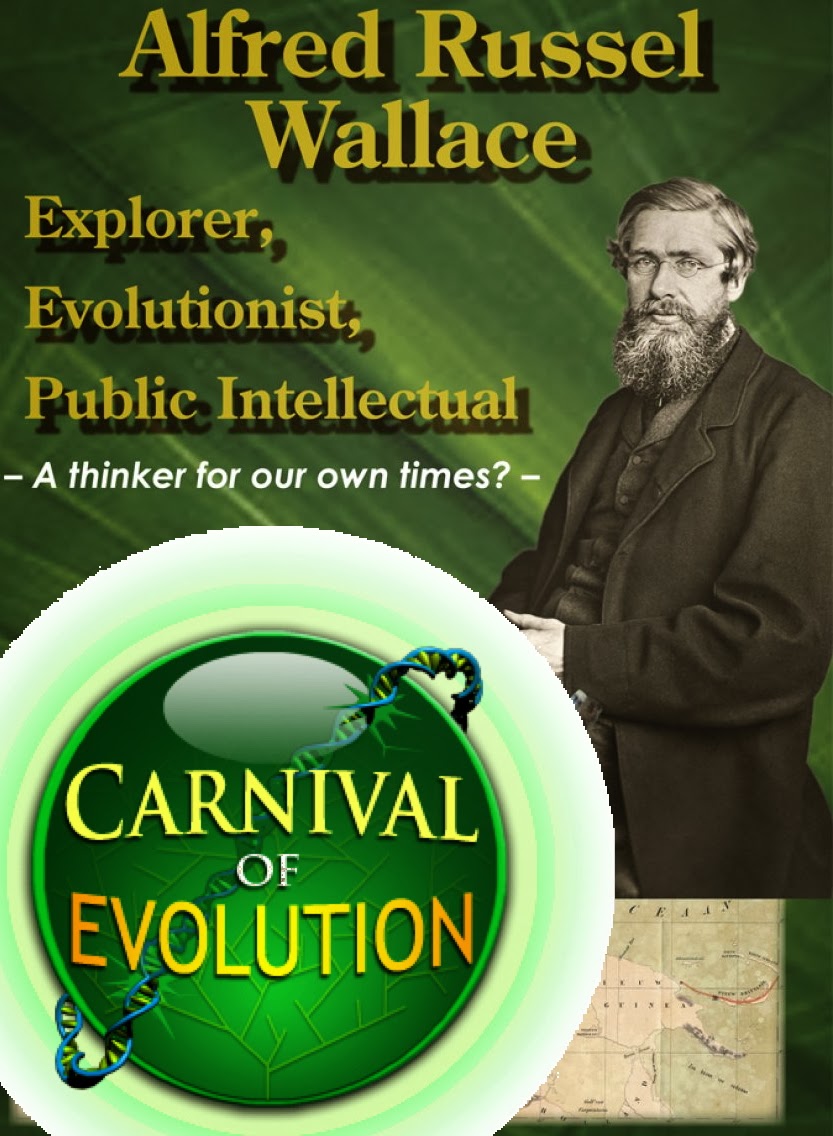
Carnival of Evolution #67 is up at The Genealogical World of Phylogenetic Networks.

Carnival of Evolution, No. 67 — Wallace centenary edition

Carnival of Evolution #67 at Genealogical World of Phylogenetic Networks - Alfred Russel Wallace  Centenary Edition

Carnival of Evolution #67 at Genealogical World of Phylogenetic Networks – Alfred Russel Wallace Centenary Edition

Charles Darwin’s Tree of Life metaphor (from 1859) has become world-famous. However, Alfred Russel Wallace, who independently developed the idea of evolution by means of natural selection, had already used a very similar image in 1855, when he noted: “the analogy of a branching tree [is] the best mode of representing the natural arrangement of species … a complicated branching of the lines of affinity, as intricate as the twigs of a gnarled oak … we have only fragments of this vast system, the stem and main branches being represented by extinct species of which we have no knowledge, while a vast mass of limbs and boughs and minute twigs and scattered leaves is what we have to place in order, and determine the true position each originally occupied with regard to the others”.

This past year has been one in which many people commemorated the death of Wallace (1823-1913), and so it seems appropriate to join them for the final summary of 2013’s posts at the Carnival of Evolution.

Wallace spent 1848-1852 collecting in the Amazon, and 1854-1862 doing the same in South-East Asia. He is best known today for his studies of biogeography, but he also worked on what we now call environmental issues, and even what is now known as exobiology. More controversially, he also involved himself in social criticism, and atheistic spiritualism. At his death, he was as well known as any living biologist; but since then he has sadly been eclipsed by Darwin.

Blog carnivals have fallen out of favor, it seems to me; but this is one that lay people can use to better understand evolution and the real issues that scientists discuss about evolution.  You’ll want to read several of the stories and posts in this collection:

All in all, it’s a pretty good collection of stuff.  Go see.

Another reason to visit this collection of blog posts on evolution:  You can be fairly certain that you’ll encounter few Republicans or Tea Party members in the comment threads.

More:

Unlikely, but were Darwin and Wallace ever photographed together?  Anyone know?