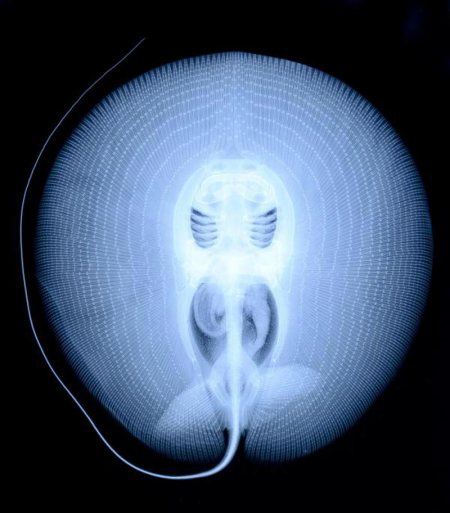
Beauty in nature: Stingray x-ray

December 13, 2015

A stunning photograph, with much to think about.  It wandered around the internet a couple of years ago, and it’s good enough, it’s going around again.

It’s an x-ray of a stingray. Consider what Charles Darwin might have thought about such an image. It’s a species discovered only in the last decade, imaged by a means of photography not known to be possible until more than a decade after Darwin’s death. What would he make of the discovery of a species, and the ability to see inside the thing, showing the cartilaginous skeleton (compare with the rays’ cousins, the sharks), and showing the organs Darwin knew would be there if evolution was, in fact, accurate.

21st century science brings such beauty:

x-ray-of-a-stingray

Caption from TwistedSifter: “The photograph above is an x-ray of a freshwater stingray species discovered in 2011 in the Amazon rain forest. The discovery was made by the research team of Nathan Lovejoy, a biologist at the University of Toronto in Scarborough; and Marcelo Rodrigues de Carvalho of the University of Sao Paolo in Brazil. The new species is known as Heliotrygon gomesi. Besides the pancake-like appearance, the ray is big, with slits on its belly and a tiny spine on its tail.” Photo by Ken Jones.

More:


Anti-Saloon League, December 8, 1921

December 8, 2015

The Anti-Saloon League held many large meetings in their campaign to bring a prohibition on alcohol consumption to the U.S. Meetings continued for a time after the 18th Amendment’s ratification, and the Volstead Act, which took effect January 17, 1920.

At the time of this meeting, in Washington, D.C., on December 8, 1921, Prohibition had been in effect for almost two years. The banner showing the number 18 probably celebrates the passage of the 18th Amendment.

Anti-Saloon League at Washington, D.C., Dec. 8, 1921. J. M. Naiman, photographer. Library of Congress image

Anti-Saloon League at Washington, D.C., Dec. 8, 1921. J. M. Naiman, photographer. Library of Congress image. Click image for a larger version.

Sadly, as much time as I spent along Pennsylvania Avenue in Washington, I can’t identify the building and location of the photo.

Political dissension crippled the League in the late 1930s, partly caused by the Leagues attacks on drinking by ethnic groups, such as Germans, and hostility towards Catholics; at one point the League seemed allied with the Ku Klux Klan.

Eventually moving from Washington to Westerville, Ohio, where it had a legendarily large publishing house cranking out anti-drinking pamphlets, the League still exists today as the American Council on Alcohol Problems.

More:


December 7, 2015: Fly your flags for Pearl Harbor Remembrance, for Delaware statehood — and at half staff

December 7, 2015

Flag flies at half-staff over the USS Utah, in Pearl Harbor (2004 photo – Pearl Harbor, Hawaii (May 31, 2004) – Sailors assigned to ships based at Pearl Harbor bring the flag to half-mast over the USS Utah Memorial on Ford Island in honor of Memorial Day May 31, 2004. U.S. Navy photo)

Flag flies at half-staff over the USS Utah, in Pearl Harbor (2004 photo – Pearl Harbor, Hawaii (May 31, 2004) – Sailors assigned to ships based at Pearl Harbor bring the flag to half-mast over the USS Utah Memorial on Ford Island in honor of Memorial Day May 31, 2004. U.S. Navy photo)

December 7 is a two-fer flag-flying day.

By public law, December 7 is Pearl Harbor Remembrance Day, and Americans fly the U.S. flag in memory of those who lost their lives at Pearl Harbor on December 7, 1941. U.S. flags should be flown at half-staff.

Under the U.S. Flag Code, residents of the relevant state should fly their U.S. flag on the date the state joined the union.

And in 2015, flags at all public buildings fly half-staff through December 7 in respect to the victims of the shootings at San Bernardino, California, on December 2. If you can fly your flag at half-staff, you should; if you cannot, fly the flag anyway.

In 1787 Delaware quickly and promptly elected delegates to the former colony’s convention to ratify the Constitution proposed at the Philadelphia convention just over three months earlier. The ratification of the Constitution won opposition from strong factions in almost every state. Pols anticipated tough fights in New York, Virginia, and other states with large populations. They also expected other states would wait to see what the bigger states did.

Delaware didn’t wait.  On December 7 Delaware became the first of the former British colonies to ratify the Constitution. Perhaps by doing so, it guaranteed other states would act more favorably on ratification.

Because Delaware was first, it is traditionally granted first position in certain ceremonies, such as the parades honoring newly-inaugurated presidents. Delaware’s nickname is “The First State.”

In Delaware and the rest of the nation, fly your flags on December 7, 2015.

The most famous portrayal of a U.S. flag flying in Delaware is in the painting by Emanuel Leutze (American, 1816–1868).

The most famous portrayal of a U.S. flag flying in Delaware is in the painting by Emanuel Leutze (American, 1816–1868). “Washington Crossing the Delaware,” 1851. The Metropolitan Museum of Art, New York, Gift of John Stewart Kennedy, 1897 (97.34) Among other problems with this portrayal: The flag depicted had not been designated on the date of the crossing, Christmas 1776.


School in distant, difficult classrooms: Kenya

December 4, 2015

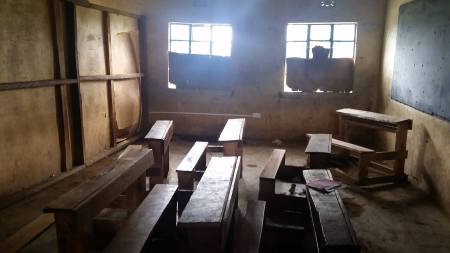
Photo from Heidi Totten, who is spearheading a campaign to get desks for schools like this one in Kenya:

Tenkees School, in the Mau region of Kenya. Photo by Heidi Totten

Tenkees School, in the Mau region of Kenya. Photo by Heidi Totten

Ms. Totten, working with a group called 100 Humanitarians (Entrepreneurs Changing the World), posted this in November, for a November 27 fundraising project.

Our next $5 Friday Fundraiser will be for additional desks for this school in the Mau region of Kenya. This is a very remote area that we visited. The school serves over 300 students with very few desks that they cram into.

They also have two latrines for each gender. With 300 kids you can imagine the sanitary conditions.

*   *   *   *   *

Our hope is to start with adding more desks, then rebuilding the kitchen and adding latrines. Just $5 can go far!

Please feel free to click over to this group and contribute.

How well would you or your kids learn in this school?

More:


25 most-viewed presidents’ documents at the American Presidency Project

December 4, 2015

Every U.S. history teacher is familiar with a great on-line resource assembled by John Woolley and Gerhard Peters at the University of California – Santa Barbara, The American Presidency Project.  Or, if by some oversight any teacher is not familiar with it, someone should do them a favor and let them know.

It’s an ambitious project of cataloging and making available in one place all the official papers of the presidents of the United States, speeches, press conferences, executive orders, and miscellaneous material including election speeches. The project started in 1999, and as of today contains more than 111,000 documents.

Masthead photo collage from the American Presidency Project at the University of California - Santa Barbara

Masthead photo collage from the American Presidency Project at the University of California – Santa Barbara

In 2008, the project started counting access to the documents, and can now give us seven years of data as to which documents of presidents, from George Washington to Barack Obama, are the most popularly accessed.

Before you read further, ponder this question: Which presidential speeches, documents and miscellanea do you think should be in the top 25 documents people look in a decade? Surely students and scholars, and policy wonks, would be interested in Lincoln’s inspiring words at Gettysburg, perhaps his two inaugural addresses, or the Emancipation Proclamation. FDR’s first inaugural address, “nothing to fear but fear itself,” ought to be among the top. Wilson’s 14 Points, perhaps? Washington’s Farewell? John Kennedy’s inaugural? Lyndon Johnson’s Great Society speech? Eisenhower’s farewell, warning of the “military-industrial complex?”

Now look at the list. What does it tell us that these are the top 25 sought-after documents from the American Presidency Project? What does it tell us that what we might expect to be in the top 25, are not? Tell us in comments what you think.

Here’s the top 25 Most Viewed Documents since 2008 at the American History Project; hotlinks go to the document at AHP:

The 25 Most Viewed Documents Since 2008
#1 John F. Kennedy
Inaugural Address
#2 Republican Party Platforms
Republican Party Platform of 1956
#3 Democratic Party Platforms
2008 Democratic Party Platform
#4 Republican Party Platforms
2008 Republican Party Platform
#5 John F. Kennedy
Executive Order 10990 – Reestablishing the Federal Safety Council
#6 Democratic Party Platforms
2012 Democratic Party Platform
#7 Republican Party Platforms
2012 Republican Party Platform
#8 George W. Bush
Address to the Nation on the Terrorist Attacks
#9 Ronald Reagan
Inaugural Address
#10 John F. Kennedy
Executive Order 11110 – Amendment of Executive Order No. 10289 as Amended, Relating to the Performance of Certain Functions Affecting the Department of the Treasury
#11 Franklin D. Roosevelt
Fireside Chat on Banking
#12 Barack Obama
Inaugural Address
#13 Franklin D. Roosevelt
Letter on the Resolution of Federation of Federal Employees Against Strikes in Federal Service
#14 John F. Kennedy
Remarks at a Dinner Honoring Nobel Prize Winners of the Western Hemisphere
#15 Franklin D. Roosevelt
1944 State of the Union Message to Congress
#16 Franklin D. Roosevelt
Inaugural Address
#17 Barack Obama
Executive Order 13603 – National Defense Resources Preparedness
#18 Franklin D. Roosevelt
Executive Order 6102 – Requiring Gold Coin, Gold Bullion and Gold Certificates to Be Delivered to the Government
#19 Republican Party Platforms
Republican Party Platform of 1860
#20 George Bush
Executive Order 12803 – Infrastructure Privatization
#21 Abraham Lincoln
Inaugural Address
#22 George Washington
First Annual Message to Congress on the State of the Union
#23 William J. Clinton
Inaugural Address
#24 Democratic Party Platforms
Democratic Party Platform of 1960
#25 John F. Kennedy
Address of Senator John F. Kennedy Accepting the Democratic Party Nomination for the Presidency of the United States – Memorial Coliseum, Los Angeles

December 3 is Illinois Statehood Day; let your flags fly

December 3, 2015

American Experience reminded us at Facebook that December 3 is the anniversary of the day Illinois was admitted to the union in 1818, the 21st state.

Under the U.S. flag Code, Americans should fly their U.S. flags on the statehood day of their state.

You flying ’em, Illinois?  If you’re in this area, you should be!

Map of the Illinois territory, about 1818, the year the state was admitted to the union, on December 3.

Map of the Illinois territory, about 1818, the year the state was admitted to the union, on December 3.

At the American Memory site at the Library of Congress, we get a good, brief dose of the events leading to statehood.

Land of Lincoln

Springfield, Illinois, 1867. Drawn from Nature. A. Ruger, 1867. Map Collections of the Library of Congress

Springfield, Illinois, 1867. Drawn from Nature. A. Ruger, 1867. Map Collections of the Library of Congress

Illinois entered the Union on December 3, 1818. The twenty-first state takes its name from the Illinois Confederation—a group of Algonquian-speaking tribes native to the area. An Algonquian word, “Illinois” means “tribe of superior men.”

Remnants of a much earlier Algonquin civilization thought the most sophisticated prehistoric society north of Mexico, are preserved at the Cahokia Mounds State Historic Site in the southwestern part of the state.

French explorers Louis Jolliet and Jesuit Father Jacques Marquette entered the Illinois region in 1673. Control of the territory passed to Great Britain in 1763. When the United States acquired the land that became Illinois Territory in 1783, most European settlers there were of French descent. In 1788, the Continental Congress received information concerning the inhabitants of the Illinois area. “There are sundry French settlements on the river Mississippi within the tract,” the committee reported:

Near the mouth of the river Kaskaskies, there is a village which appears to have contained near eighty families from the beginning of the late revolution. There are twelve families in a small village at la Prairie duRochers, and near fifty families—the Kahokia village. There are also four or five families at fort Chartres and St. Philips, which is five miles farther up the river. The heads of families in those villages appear each of them to have had a certain quantity of arable land allotted to them, and a proportionate quantity of meadow and of woodland or pasture. The Committee…referred the memorial of George Morgan…respecting a tract of land in the Illinois, June 20, 1788.
Documents from the Continental Congress and Constitutional Convention, 1774-1789

Twenty years later, Congress organized the Illinois Territory. Pioneers from Kentucky, Virginia, and Tennessee settled the southern part of the territory, while New Englanders ventured to northern Illinois via the Erie Canal.

Land of Lincoln, the state slogan, pays homage to famous son Abraham Lincoln. Born in Kentucky, Lincoln came to Illinois in 1830. He was instrumental, along with his colleagues in the Illinois legislature, in moving the state capital from Vandalia to Springfield. Settling there in 1837, Lincoln married socially prominent resident Mary Todd, practiced law, and built the political career that brought him the presidency in 1861.

Chicago, a minor trading post at the southwestern tip of Lake Michigan until the 1830s, developed into a railroad hub and industrial center. After the Civil War, industrialization attracted a new wave of immigrants. People from all over the U.S. and the world ventured to Chicago to work in the meat-packing and steel industries. Even the Great Conflagration of 1871 failed to prevent the Windy City from becoming one of the largest urban centers in the country. It remains the third most populous city and metropolitan area in the United States.

Learn more about Illinois:

Lotta history there.

U.S., Illinois and City of Chicago flags in a stiff breeze at the Navy Pier, Chicago. Photo by John Junker, at flickr.

U.S., Illinois and City of Chicago flags in a stiff breeze at the Navy Pier, Chicago. Photo by John Junker, at flickr. (copyright to Junker, too)
Even more:

This is an encore post.
Yes, this is an encore post. Defeating ignorance takes patience and perseverance.