Sri Lanka declared malaria-free, without DDT

March 6, 2018

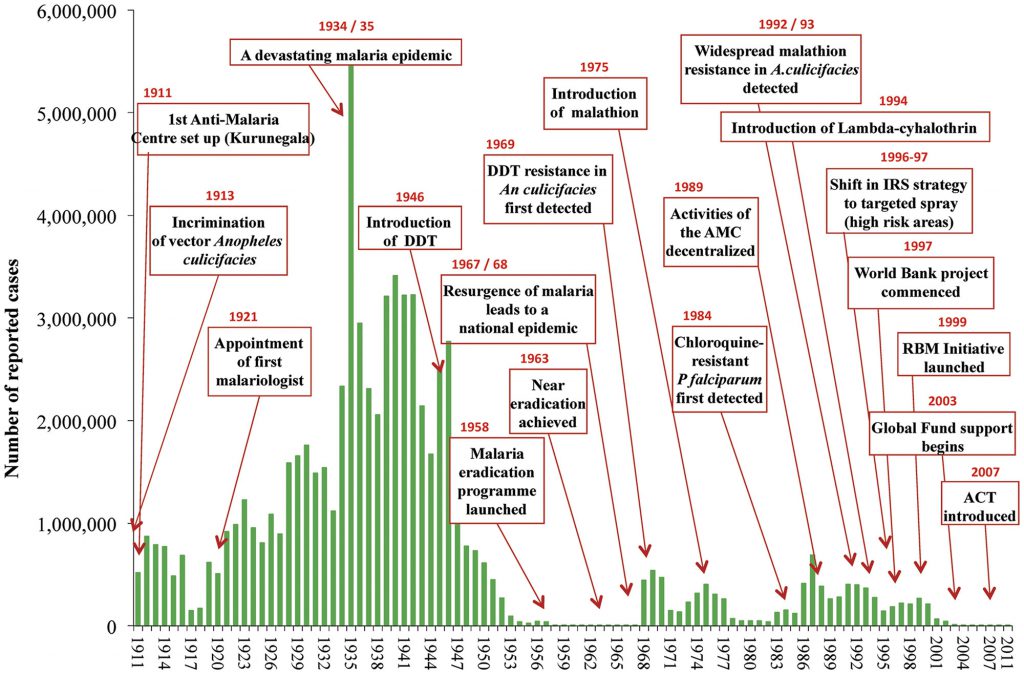
Chart from the India Foundation shows the ups and downs of fighting malaria in Sri Lanka in the 20th and 21st centuries. Sri Lanka is malaria-free since 2016.

Sri Lanka pushed malaria out of the country, and is certified by the World Health Organization (WHO) as malaria-free, as of September 2016.

If you follow the fight against malaria, this may not be news to  you. If you’re a victim of the pro-DDT, anti-WHO and anti-Rachel Carson hoaxes, you may be surprised.

Sri Lanka once got malaria to almost nothing, with heavy use of DDT in Indoor Residual Spraying. Then the budget hawks stopped the anti-malaria program (“Success!”) to save money. Malaria came roaring back as it will when vigilance relaxes — but by then the mosquitoes were mostly resistant to DDT, and a civil war kept the nation from mounting any public health campaigns in much of the country.

With the advent of new medicines, ABC therapy, and new methods to diagnose the disease, and using bednets and targeted pesticides other than DDT, Sri Lanka beat the disease. The news was carried in Britain’s The Guardian.

The World Health Organisation has certified that Sri Lanka is a malaria-free nation, in what it called a truly remarkable achievement.

WHO regional director Poonam Khetrapal Singh said in a statement that Sri Lanka had been among the most malaria-affected countries in the mid-20th century.

But, the WHO said, the country had begun an anti-malaria campaign that successfully targeted the mosquito-borne parasite that causes the disease, not just mosquitoes. Health education and effective surveillance also helped the campaign.

https://www.theguardian.com/society/2016/sep/05/sri-lanka-malaria-free-world-health-organisation

This is a blow to the anti-WHO pro-DDT forces. Sri Lanka has been a key story in their tales of how only DDT could fix malaria, stories told long after DDT stopped working. One more example shot down.

More:

Tip of the old scrub brush to The Guardian.


Spring comes a month earlier than it did for our grandparents. That is an annual disaster.

March 4, 2018

What are you doing about it?

In 2018, Spring is early in the west and east, but later than normal in the southeast. Overall, springs come earlier these days.

A map of plant growth, including the emergence of leaves and blooms, updated daily tracks the arrival of spring compared to normal seasonal timing over a 50-year period. USGS

A map of plant growth, including the emergence of leaves and blooms, updated daily tracks the arrival of spring compared to normal seasonal timing over a 50-year period. USGS

Generally, since 1900, spring has arrived a few minutes earlier every year, on average. But each spring is unique, and in 2018 variation covers almost 40 days, 20 days on either side of a “normal” spring arrival in a location.

Yale Environment 360 explains the observations and consequences.

The early spring arrival coincides with a slew of other odd weather trends happening across the globe, from a heat wave in the Arctic, where temperatures reached 43 degrees Fahrenheit in February, to a cold snap in Europe.

An early spring comes with consequences: Disease-carriers such as ticks and mosquitoes emerge sooner, the USGS warns, and it can trigger a longer, more intense pollen season. In addition, if flowers bloom earlier than normal, it “can disrupt the critically important link between wildflowers and the arrival of birds, bees, and butterflies” that is critical to the pollination of crops and other plants, the USGS wrote.

While generally these trackers show the earlier springs over decades, I am delighted by the dramatic variation in some places. Where we live in Dallas, for example, spring is delayed this year — according to the maps. Sure enough, last year most of our spring-blossoming trees were already abloom, only to lose blossoms for fruit in later winds and cold. See my post from last year on Mexican plums, link below. This year the Mexican plum is budded, but not blossoming yet.

In contrast, the daffodil/narcissus plants are up earlier than usual, some already blossoming. Again, in the past two years they’ve been even earlier.

More:

Tip of the old scrub brush to Yale Environment 360’s Twitter feed.


Fly the U.S. flag in March 2018?

March 2, 2018

Members of the New York City Fire Department carry 343 U.S. flags honoring the 343 NYFD members killed on 9/11, in the St. Patrick's Day Parade. New York Post caption:

Members of the New York City Fire Department carry 343 U.S. flags honoring the 343 NYFD members killed on 9/11, in the St. Patrick’s Day Parade. New York Post caption: “Despite the cold and gray morning, parade-goers turned out for St. Patrick’s Day to celebrate Irish heritage in New York City on March 17, 2014. FDNY members set the pace as they marched down 5th Avenue holding American flags for the annual event. SHANNON STAPLETON/Reuters”

I usually put up a post near the first of the month listing the occasions upon which U.S. laws urge us to fly Old Glory. March sometimes slips by without such a post.

No good reason, other than in most years, March offers no regular national commemorations upon which flag flying is urged. The odd year is when Easter comes early. Easter is one of the holidays the Flag Code says flags should be flown.

But, most years, Easter falls in April, as it does in 2018.

The Flag Code urges residents of states to fly the U.S. flag on the anniversary of their state’s entering the union, on statehood day. Those are the only dates in March, most years. In March, we have four statehood days in the first four days of the month. If I dawdle, we miss most of the dates.

Flag fly dates, for March (some already past, in 2018):

  • March 1, Ohio statehood (1803, 17th state)
  • March 1, Nebraska statehood (1867, 37th state)
  • March 3, Florida (1845, 27th state)
  • March 4, Vermont statehood (1791, 14th state)
  • March 15, Maine statehood (1820, 23rd state)

Many St. Patrick’s Day revelers and parade marchers display the U.S. flag, but it’s not an official U.S. observance.

I keep hoping, but I get little traction for a law urging flying the flag to observe Freedom Day, on the birth anniversary of the Father of the Constitution, James Madison (he was born March 16, 1751).

People gathered on the lawn of James Madison's home in Montpelier, Virginia, to display the U.S. flag in a card display, 2011. AP photo?

People gathered on the lawn of James Madison’s home in Montpelier, Virginia, to display the U.S. flag in a card display, 2011. AP photo?

Much irony, and great history, in the U.S. colors being shown so dramatically on St. Patrick’s Day, a day relatively uncommemorated in Ireland, and commemorated in the U.S. chiefly to help overcome bias against Irish immigrants.

Some irony in the unmarked birthday of the Father of the Constitution.

Sure, you may fly the U.S. flag every day in March. You need not wait for sanction from a Presidential Proclamation or a Congressional Resolution. You may fly the flag every day. (Just follow flag etiquette when you do.)

I’ll try to keep up better, next year. (I said that last year.)

U.S. colors led the St. Patrick's Day parade in Seattle, Washington, in 2014. Photo from IrishClub.org

U.S. colors led the St. Patrick’s Day parade in Seattle, Washington, in 2014. Photo from IrishClub.org


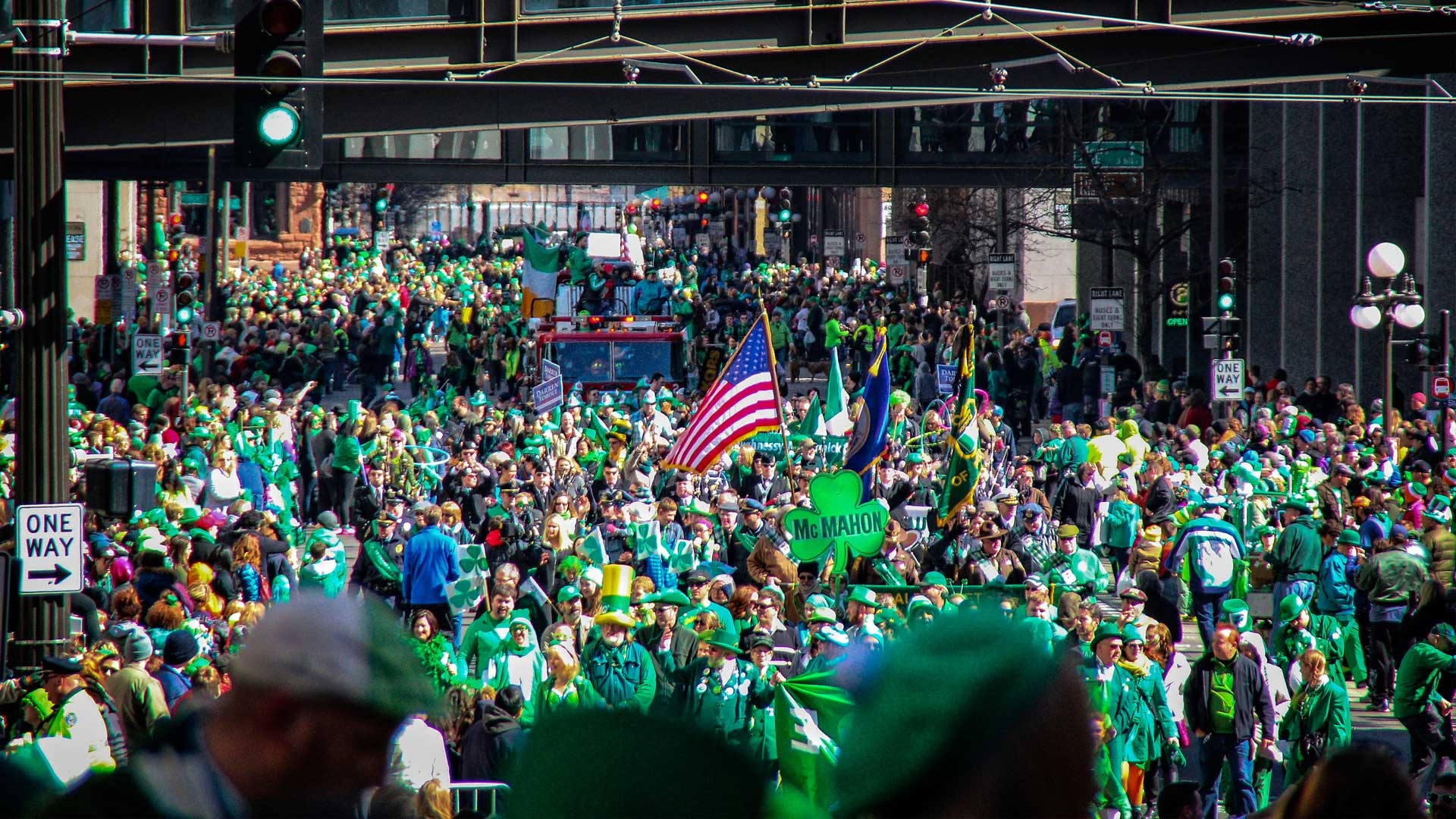
U.S. colors stood out in a field of green at the St. Paul, Minnesota, St. Patrick's Day parade, 2015(?). Photo from VisitStPaul.com.

U.S. colors stood out in a field of green at the St. Paul, Minnesota, St. Patrick’s Day parade, 2015(?). Photo from VisitStPaul.com.

More

This is an encore post.

Yes, this is a bit of an encore post. Defeating ignorance takes patience and perseverance.