Annals of global heating: Heating is coming faster

February 10, 2022

Neil R. Kaye toils in the Met Office, the weather service for Great Britain. He tracks global heating as a vocation, and does very good explanations.

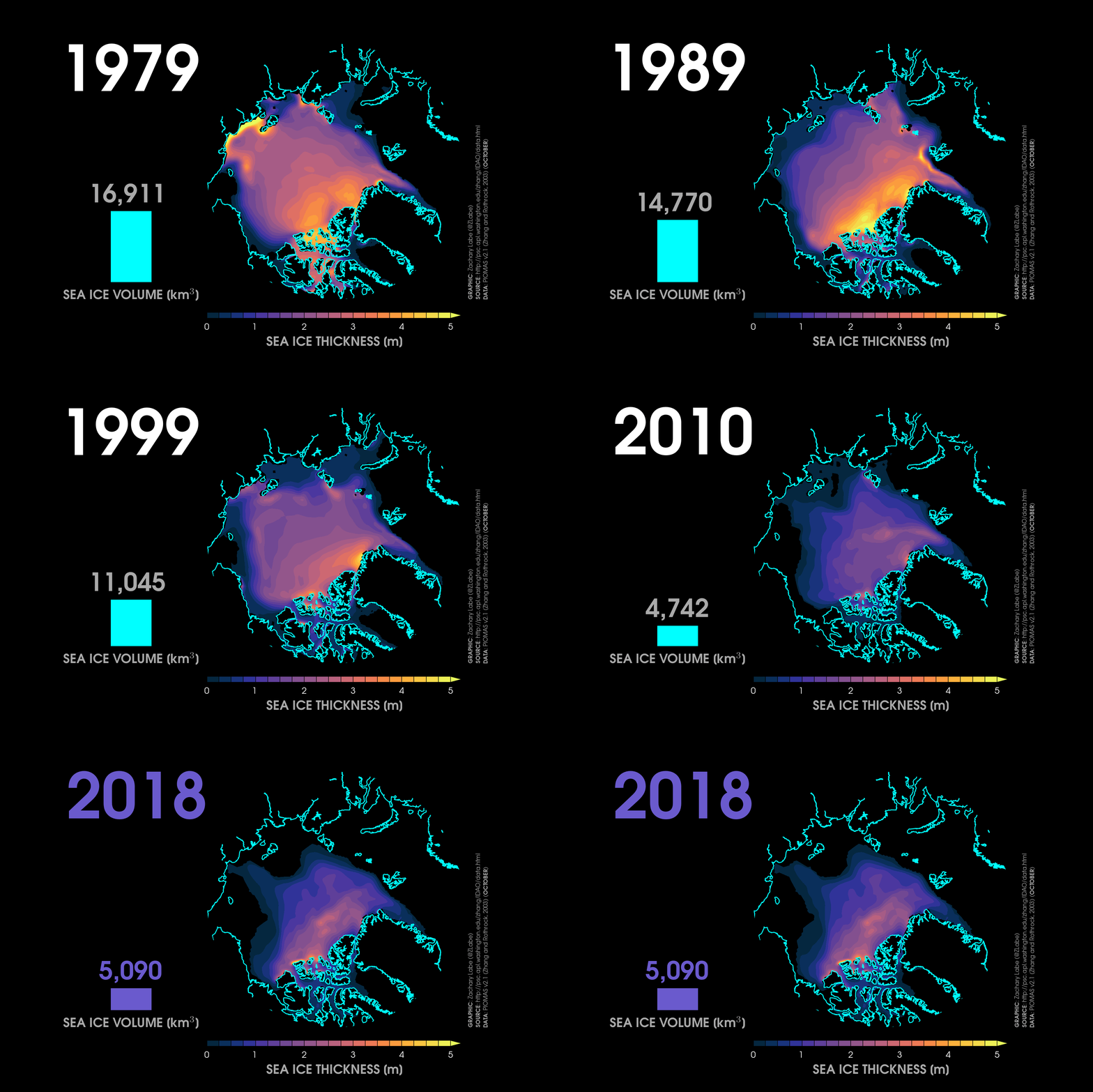
Recently he posted on Twitter, with a great little movie:

Lesson is, we need to act now. The faster and harder we can act to block global heating, the greater chance we have of saving a place for humans on this planet without massive loss.

Check out his thread on Twitter.

See this chart by a frequent quality poster @TheDisproof, a static graph of heating since 1880.


Polar bears demand Goldilocks ice; she’s baked to death in the sun

March 9, 2018

Zachary Labe's animation showing decline of long-term ice in the Arctic.

Zachary Labe’s animation showing decline of long-term ice in the Arctic. Long-term variability and loss of February #Arctic sea ice volume (left) and thickness (right) during the satellite era. Data from PIOMAS, graphic by Zachary Labe.

Polar bears need Goldilocks ice. There isn’t much.

Zachary Labe’s .gif shows the decline in ice thick enough from which polar bears can hunt, right up to 2018. Hunting areas for the bears decline, and bears will go hungry and cubs will die.

Polar bear researcher Andrew Derocher told us on Twitter what the graphic means:

Great graphic to refute deniers spouting that there’s more sea ice in the Arctic. For , it’s a Goldilocks scenario: sea ice can’t be too thick, too thin, too much, too little, it has to be just right. Of course, too thick isn’t an issue anymore.

Though the dangers to polar bears “isn’t an issue anymore” among scientists, it is also true that denialists, especially on blogs, Twitter and Facebook, drive opinion contrary to science and against the interest of the survival of polar bears. A paper by a group of scientists including members of the Polar Bear Specialist Group recently detailed that the internet legions of denial convince many people polar bears are not in trouble, making it difficult to work to save the animals.

Abstract

Increasing surface temperatures, Arctic sea-ice loss, and other evidence of anthropogenic global warming (AGW) are acknowledged by every major scientific organization in the world. However, there is a wide gap between this broad scientific consensus and public opinion. Internet blogs have strongly contributed to this consensus gap by fomenting misunderstandings of AGW causes and consequences. Polar bears (Ursus maritimus) have become a “poster species” for AGW, making them a target of those denying AGW evidence. Here, focusing on Arctic sea ice and polar bears, we show that blogs that deny or downplay AGW disregard the overwhelming scientific evidence of Arctic sea-ice loss and polar bear vulnerability. By denying the impacts of AGW on polar bears, bloggers aim to cast doubt on other established ecological consequences of AGW, aggravating the consensus gap. To counter misinformation and reduce this gap, scientists should directly engage the public in the media and blogosphere.

Reduced ice means smaller, less healthy cubs, hungrier less healthy mothers, hungrier, more-likely-to-eat-cubs males.


While denialists rage, the Earth still warms. Eppure, lei si scalda.

Tip of the old scrub brush to Andrew Derocher on Twitter.


How can we not allow undeveloped nations and the poor to use fossil fuel energy?

December 18, 2017

Greenpeace and Tcktcktck volunteers raise a wind turbine on the beach at dawn in Durban, South Africa. Microgrid News image

Greenpeace and Tcktcktck volunteers raise a wind turbine on the beach at dawn in Durban, South Africa. Microgrid News image

How can we not allow undeveloped nations to catch the first world with fossil fuel energy? Katharine Hayhoe explains at Global Weirding.

More: 


Annals of Global Warming: XKCD explains warming over the eons

September 13, 2016

XKCD often makes us think; the strip’s forays into science and social policy often rank near the top of my personal list of salient and clear educational devices on tough issues.

Here’s a timeline of Earth’s average atmospheric temperature, going back a few years before your mother was born (though she was born a long, long time ago!).

See where this is headed? No one else has done it much better.

I did wonder when I saw this earlier, on September 12: Did the creator of XKCD learn this stuff in Edward Tufte’s course?

Earth Temperature Timeline, From XKCD, September 2016

Earth Temperature Timeline, From XKCD, September 2016

Save


Global warming changes local bird populations, matching scientists’ predictions

April 3, 2016

Phys.org caption: The American robin, a familiar species across much of continental USA, has declined in some southern states such as Mississippi and Louisiana, but increased in north-central states, such as the Dakotas. Credit: US Fish & Wildlife Service

Phys.org caption: The American robin, a familiar species across much of continental USA, has declined in some southern states such as Mississippi and Louisiana, but increased in north-central states, such as the Dakotas. Credit: US Fish & Wildlife Service Read more at: http://phys.org/news/2016-03-strong-effects-climate-common-bird.html#jCp

Most serious birdwatchers can tell you about global warming and climate change, just from watching the birds at their feeders, and when those birds migrate.

Now comes a study to confirm with data and controlled observation what the birders have been saying all along. Phys.org reported:

Scientists have shown for the first time that common bird populations are responding to climate change in a similar pronounced way in both Europe and the USA.

An international team of researchers led by Durham University, UK, found that populations of bird species expected to do well due to climate change had substantially outperformed those expected to do badly over a 30 year period from 1980 to 2010.

The research, conducted in collaboration with the RSPB and the United States Geological Survey (USGS), is published in the journal Science.

It is the first real demonstration that climate is having a similar, large-scale influence on the abundance of common birds in widely separated parts of the world, the researchers said.

Among the species showing pronounced effects of climate change are common woodland and garden birds such as the wren, in Europe, and the American robin in the USA.

(Read more at: http://phys.org/news/2016-03-strong-effects-climate-common-bird.html#jCp)

Biologists especially work to predict effects of warming on plants and animals, both to help plan changes in activities such as farming and hunting, and to protect species that are endangered now, or are likely to become so due to changing climate factors.

This study shows scientists can predict with accuracy some of the wildlife effects.

These changes are consistent with changing climate suitability within those areas, the researchers said.

Other factors, such as the size of the birds, the habitats they live in and their migratory behaviour, all affect , but did not differ systematically between groups advantaged or disadvantaged by climate change.

Therefore, only climate change could explain the differences between average population trends in advantaged and disadvantaged groups, the researchers said.

The study’s lead authors, Dr Stephen Willis and Dr Philip Stephens, of Durham University’s School of Biological and Biomedical Sciences, said the findings showed there was a large-scale, consistent response by bird populations to climate change on two continents.

The study was published in the April 1, 2016 issue of Science, “Consistent response of bird populations to climate change on two continents.

Science  01 Apr 2016:
Vol. 352, Issue 6281, pp. 84-87
DOI: 10.1126/science.aac4858

Tip of the old scrub brush to Svein T veitdal:


Can’t fool the birds: Migratory birds in North America react to climatic warming

February 12, 2009

Generally it would be an insult to call someone a bird brain.  We may need to revise that thinking.  In contrast to climate change denialists, 177 species of migratory birds in North America have adjusted their migrations because of a warming climate.  The birds know something the denialists don’t.

The news comes from the National Audubon Society, after analysis of 40 years of bird count data.

Migrations has the story, along with the map that is appearing in U.S. newspapers this week.  Cornell University’s ornithology blog, Round Robin, provides history to the study and a couple more links to science reports.

How will denialists spin this?  It’s difficult for them to claim that the birds have been hornswoggled by inaccurate newspaper accounts, since these are not the birds whose cages are lined with newspapers.

Eastern Meadowlark, photo by FWS/John and Karen Hollingsworth

Eastern Meadowlark, photo by FWS/John and Karen Hollingsworth

We don’t have a canary in a mine warning us, this time.  It’s the meadowlark on the prairie. Will we listen, in time?

Eastern and Western Meadowlark: These popular robin-sized grassland birds form winter flocks and always feed on the ground. Neither species has been wintering farther north over the past 40 years, probably because the quality of northern grasslands is not sufficient to support these birds through the winter. The Eastern Meadowlark is one of Audubon’s Common Birds in Decline; its population has plummeted 72% in population over the last 40 years.

Also see this earlier post, “Plants refuse to listen to climate change skeptics.”