Saint Louis Art Museum, St. Louis, Missouri George Caleb Bingham (American, 1811–1879). The County Election, 1852. Oil on canvas. 38 x 52 in. (96.5 x 132.1 cm). Gift of Bank of America.
Every polling place should be flying the U.S. flag today. You may fly yours, too. In any case, if you have not voted already, go vote today as if our future depends upon it, as if our nation expects every voter to do her or his duty.
Today the nation and world listen to the most humble of citizens. Speak up, at the ballot box.
The whole world is watching.
Spread the word; friends don't allow friends to repeat history.
A couple of recent studies show the moral, intellectual and educational bankruptcy of the so-called No Child Left Behind Act. The groundswell necessary to scrap the thing has not caught up to the urgency of doing so, alas.
I ponder the research I’ve seen over the years, both inside the Department of Education and out, and the statistical and anecdotal stories that show art training and education (not the same thing) improve academic performance, and I wonder what squirrels have eaten the brains of “reformers” who kill arts programs for the stated purposes of “improving test performance.” Einstein played the violin. Feynman drummed. Churchill painted, as did Eisenhower. Edison and his team had a band, and jammed when they were stuck on particular problems, or just for fun. When will education decision makers see the light?
The piece just premiered — I hope some lucky recording company has the good sense to take the tapes of the Dallas Symphony’s performances this past week, and release them quick.
And also on that day, the U.S.S. Maddox reported it had been attacked by gunboats of the North Vietnamese Navy, in the Gulf of Tonkin. The Gulf of Tonkin incident led to the Gulf of Tonkin Resolution, which gave Johnson the authority to expand and escalate the war in Vietnam, which he did.
The Dallas Symphony commissioned the work, from composer Steven Stucky and librettist Gene Scheer, in commemoration of President Johnson’s 100th birth anniversary — he would have been 100 on August 27.
The music is outstanding, especially for a modern piece. The Dallas Symphony was at its flashiest and most sober best, under the baton of new conductor Jaap van Zweden. It was a spectacular performance. According to the New York Times:
Mr. van Zweden, hailed in his debut as music director a week before, scored another triumph here. And the orchestra’s assured and gritty performance was rivaled by that of the large Dallas Symphony Chorus, both corporately and individually, in shifting solo snippets charting the course of the fateful day.
The strong cast, mildly amplified, was robustly led by the Johnson of Robert Orth, last heard as another president in John Adams’s “Nixon in China” in Denver in June. Laquita Mitchell and Kelley O’Conner, wearing period hats, were touching as Mrs. Chaney and Mrs. Goodman. Understandably, the taxing role of a high-strung McNamara took a small toll on the tenor of Vale Rideout in his late aria.
The entire thing deserves more commentary, perhaps soon. There is stellar history in the choral piece. And there is this: Consider that Lyndon Johnson, the best legislator and second most-effective executive we ever had as president, got hit with these two crises the same day. On the one hand the nation got the Voting Rights Act, the Fair Housing Act, executive orders and government support to end segregation and the evils it created. On the other hand, we got stuck with the disaster of the Vietnam War.
How would the nation fared had a lesser person been in the White House on that day?
Spread the word; friends don't allow friends to repeat history.
NPR’s series, “Road Trip: Songs to Drive By,” featured five classical and jazz tunes about specific places in the U.S., some from larger works, in the June 10 program. Each of these works should be featured in U.S. history classes, at least. They represent music forms and tunes students should be familiar with.
At this time of year, you have to get up around 4 a.m. to experience the full effect of sunrise over the Grand Canyon. When Ferde Grofé saw it as a young musician on the road, he was so bowled over that he sat down and wrote “Sunrise,” the first movement of what turned into his “Grand Canyon Suite.” Grofé had something interesting in common with Aaron Copland — both of them were New York City natives who became famous for composing music about the American West. The best-known movement of Grofé’s Grand Canyon Suite, “On the Trail,” is a different kind of road trip: The loping gait of the music describes the ride down to the bottom of the Canyon on the back of a mule.
“Cattle” & “The Homesteader”
Artist: Angel Gil-Ordóñez
Album: Virgil Thompson: The Plow that Broke the Plains; The River
Song: The Plow That Broke the Plains, film score
Nothing brings home how vast this country is quite like driving across the Great Plains, an area that was devastated during the Great Depression. In the middle of the Depression, the U.S. Department of Agriculture put out a half-hour documentary about the dust bowl called “The Plow That Broke the Plains” — the first government film produced for commercial release. Director Pare Lorentz shot footage in Montana, Wyoming, Colorado, Texas, and Kansas, and he got a suitable composer to write the score for the film: Virgil Thomson, who was born in Kansas City, Mo.
A Breeze from Alabama, march & ragtime two-step for piano
Artist: Dick Hyman
Album: Joplin:Piano Works
Song: A Breeze from Alabama
No one’s exactly sure where Scott Joplin was born. It was probably in northeast Texas, but Texas wasn’t a state back then. After Joplin became a pianist, he started traveling, mostly around the Midwest, as far north as Chicago — and eventually even to New York. “A Breeze from Alabama” is one of Joplin’s quieter rags. You can practically smell the camellias.
“Putnam’s Camp”
Artist: Various
Album: The Orchestral Music of Charles Ives: World Premieres and First Editions
Song: Orchestral Set No. 1: Three Places in New England, for orchestra, S. 7 (K. 1A5)
Charles Ives was the quintessential New Englander, growing up in Danbury, Conn., in the late 1800s, when Danbury was the hat-making capitol of the country. In this piece, Ives paints three unique musical portraits of a spot in Connecticut, and two in neighboring Massachusetts. The middle portrait, “Putnam’s Camp, Redding,” describes a Fourth of July picnic in Redding, Conn., where General Israel Putnam and his men made camp during the American Revolution — and where Ives had a summer home. It’s full of raucous quotations, including Ives’ own “Country Band March” and his “Overture and March 1776.”
On the Town–“Times Square”
Artist: Leonard Bernstein
Album: Bernstein: Serenade after Plato’s Symposium; Fancy Free; On the Town Dance Episodes
Song: On the Town: “Times Square”
Leonard Bernstein may have been born in New England, but it didn’t take him long to move to New York. No one epitomized the energy of the City — or captured it in his music — more than he did. Bernstein’s ballet Fancy Free, about three sailors on shore leave in New York, became the Broadway Musical On the Town. If New York is the pulse of the East Coast, then Times Square is the pulse of New York, and you can hear all the madness of midtown Manhattan in “Times Square,” the last of Bernstein’s Three Dance Episodes from On the Town.
Spread the word; friends don't allow friends to repeat history.
A generalization: Many creationists complain that evolution “can’t be true” because it doesn’t exalt humans enough. This is the old Bishop Wilberforce whine, about whether you are related to the monkeys on your mother’s side or father’s side.
“Nothing good can come from humble beginnings” is the thrust of the creationist argument, apparently with the creationists who make the claim losing every neuron they ever had that held the story of Jesus in their memory.
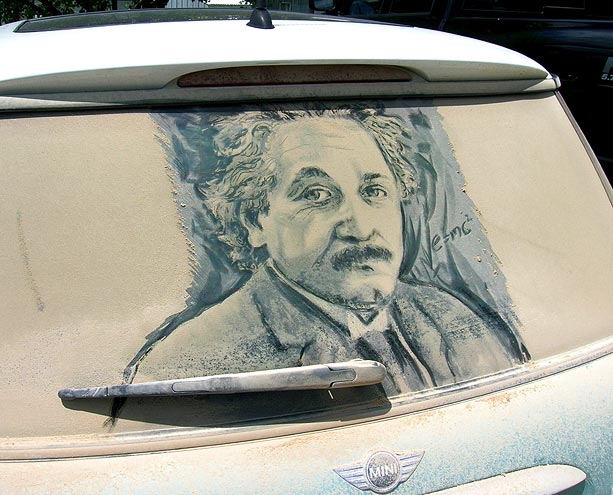
Nature, art, and life, keep pounding home the fact that the creationist argument is seriously in error. But as Robert Frost wondered, how many times did the apple have to fall before Newton took the hint? Scott Wade has taken the rebuttal to the creationists’ argument to new heights, and made art out of it. From dust, is art:
Coming out of the display on Lucy at the Houston Museum of Natural Science, coming back down the staircase, this is the painting on the wall. In my imagination, this is what Lucy saw will see as they carried carry her, crated up, out of the building. In reality they probably took will carry her down a freight elevator.
This one’s for you, P.Z. — drop into the Houston museum next time you’re down there:
Spread the word; friends don't allow friends to repeat history.
In the meantime, I’ll post a photo of a jellyfish I crocheted from plastic yarn recently (I’ve felt that I have the brains of a jellyfish when I get home from work lately). It is loosely modeled on Pelagia spp. jellyfish, and I created the yarn from newspaper wrappers that friends at work saved for me. I used the hyperbolic crochet technique for the tentacles, and a simple cap pattern for the bell. All parts were crocheted using a size L hook.
In case you were wondering what to do to keep those plastic bags your newspaper comes in from ending up as junk/food that will kill a turtle in the Gulf of Mexico, I offer this jellyfish, from Guadelupe Storm-Petrel. (I think this may be a Texas blogger.)
Spread the word; friends don't allow friends to repeat history.
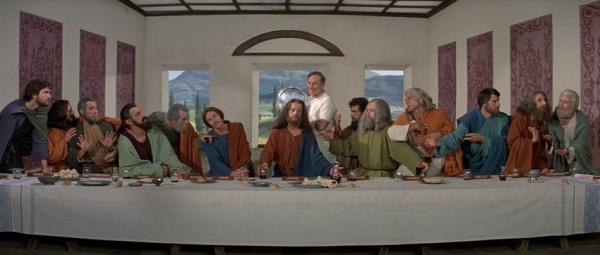
If you need a 20 minute lesson on the influence of Renaissance art on contemporary art, this is one many high school kids may find interesting, if not amazingly historically informative. I suspect there is a great lesson plan hiding in there about 20th century history as reflected in parody art.
It’s a brilliant and subtle demonstration of the power of DaVinci’s art that there are so many copy cat pictures, don’t you think?
I did notice, however, that Barker left out the Mel Brooks version, from “History of the World, Part I.” It may not fit the meme.
Science, arts and social studies teachers especially, go look. What local museums are you overlooking? Which museums should you plan a long-distance trip to see?
Duncanville ISD teachers sometimes require “field experience” for students, including visits to local museums. I doubt we’d have gotten our kids into the African American Museum otherwise; I think too few kids bother with the Frontiers of Flight Museum (or the C. R. Smith Museum closer to DFW Airport), and I know way too few bother with the Jack Harbin Museum of Scouting, a great shining gem obscured by its working class, Scout camp location and the proximity of the National Scouting Museum in Irving, Texas.
The Times’s section makes me lust for Star Trek™-style transporters that take a whole classroom of kids, cheaply, to see the real stuff. Be sure to check out the on-line videos and slide shows, too.
Spread the word; friends don't allow friends to repeat history.
Po’pay was a leader of the revolt against oppressive Spanish rule over New Mexico’s native inhabitants between 1675 and 1681, a century before the American Revolution.
In 1997, the New Mexico Legislature selected Po’pay as the subject of the state’s second statue for the National Statuary Hall Collection and created the New Mexico Statuary Hall Commission, whose members were appointed by Governor Gary Johnson. Four sculptors were selected to create maquettes, and Cliff Fragua was awarded the commission in December 1999. It will be the seventh statue of a Native American in the collection; the others are King Kamehameha I, Will Rogers (who had Cherokee ancestors), Sakakawea, Sequoyah, Washakie, and Sarah Winnemucca.
The seven-foot-high statue was carved from pink Tennessee marble (making it the only colored marble statue in the collection) and stands on a three-foot-high pedestal comprised of a steel frame clad in black granite. It is the first marble statue contributed to the collection since that of South Dakota’s Joseph Ward, which was given in 1963; the other statues given since that time have been bronze. Its acceptance marked the first time at which every state in the Union has been represented by two statues in the collection. In addition, Po’pay is historically the first person represented in the collection to be born on what would become American soil.
No image or written description of Po’pay is known to exist. Sculptor Cliff Fragua describes the statue thus:
In my rendition, he holds in his hands items that will determine the future existence of the Pueblo people. The knotted cord in his left hand was used to determine when the Revolt would begin. As to how many knots were used is debatable, but I feel that it must have taken many days to plan and notify most of the Pueblos. The bear fetish in his right hand symbolizes the center of the Pueblo world, the Pueblo religion. The pot behind him symbolizes the Pueblo culture, and the deerskin he wears is a humble symbol of his status as a provider. The necklace that he wears is a constant reminder of where life began, and his clothing consists of a loin cloth and moccasins in Pueblo fashion. His hair is cut in Pueblo tradition and bound in a chongo. On his back are the scars that remain from the whipping he received for his participation and faith in the Pueblo ceremonies and religion.
Fragua, an Indian from Jemez Pueblo, studied sculpture in Italy, California, and New Mexico; he created his first stone sculpture in 1974.
Sarah Winnemucca
[facsimile of her signature, “Sarah Winnemucca Hopkins”]
1844–1891
Nevada
Defender of Human rights
Educator
Author of first book by a Native woman
Each state may have two statues in the collection.
My work on the Senate staff often required that I walk the Capitol, especially between the Senate and House Press Galleries. I often lamented that it was not available or accessible to students. This collection of statues is one of the better unsung galleries of history in Washington, D.C. It is heavily influenced by politics and current fashion. Selections illustrate how state legislatures try to make their state’s reputation, and can be very quirky. For example, Pennsylvania’s statues include Robert Fulton, an inventor of the steamboat, and John Peter Gabriel Muhlenberg — but not Ben Franklin or William Penn. Why? There could be a paper done on the politics of the choices of each of the 50 states.
Today CBS Evening News and other outlets report some enterprising building owner in London who recognized Banksy’s work, preserved it, and has auctioned it away on eBay. It fetched $407,000 US. (CBS video here)
The work, depicting an artist in old-fashioned clothes putting the finishing touches on the word “BANKSY” spray-painted in red, was scrawled on a wall on the Portobello Road in the west London district of Notting Hill.
It was offered for sale on the e-Bay auction site and went for 208,100 pounds after attracting 69 bids.
The winner of the auction may well get the painting and the wall it is on, but they will have to calculate how to get the whole work delivered and pay to replace the wall.
“I am selling the wall because I can’t really justify owning a piece of art worth as much as it is,” said Luti Fagbenle, the owner of the property on which the graffiti is sprayed.
A political cartoon changed the life of one London building owner.
Spread the word; friends don't allow friends to repeat history.
Thomas Nast helped bring down the crooks at Tammany Hall with cartoons. Boss Tweed, the chief antagonist of Nast, crook and leader of the Tammany Gang, understood that Nast’s drawings could do him in better than just hard hitting reporting — the pictures were clear to people who couldn’t read.
But a cartoon has to get to an audience to have an effect.
Here’s one below, a comment on the security wall being built in Israel, that got very little circulation in the west at Christmas time. Can you imagine the impact had this drawing run in newspapers in Europe, the U.S., and Canada?
It’s a mashup of a famous oil painting related to the Christian Nativity, from a London-based artist who goes by the name Banksy. (Warning: Banksy pulls no punches; views shown are quite strong, often very funny, always provocative, generally safe for work unless you work for an authoritarian like Dick Cheney who wants no counter opinions.)
Or, until that account is unsuspended by the forces supporting Donald Trump: Follow @FillmoreWhite, the account of the Millard Fillmore White House Library
We've been soaking in the Bathtub for several months, long enough that some of the links we've used have gone to the Great Internet in the Sky.
If you find a dead link, please leave a comment to that post, and tell us what link has expired.
Thanks!
Retired teacher of law, economics, history, AP government, psychology and science. Former speechwriter, press guy and legislative aide in U.S. Senate. Former Department of Education. Former airline real estate, telecom towers, Big 6 (that old!) consultant. Lab and field research in air pollution control.
My blog, Millard Fillmore's Bathtub, is a continuing experiment to test how to use blogs to improve and speed up learning processes for students, perhaps by making some of the courses actually interesting. It is a blog for teachers, to see if we can use blogs. It is for people interested in social studies and social studies education, to see if we can learn to get it right. It's a blog for science fans, to promote good science and good science policy. It's a blog for people interested in good government and how to achieve it.
BS in Mass Communication, University of Utah
Graduate study in Rhetoric and Speech Communication, University of Arizona
JD from the National Law Center, George Washington University


 Posted by Ed Darrell












 Millard Fillmore's Bathtub