Quote of the moment: Jonathan Weiner’s Pulitzer-winning explanation of mosquitoes developing immunity to DDT

April 30, 2010

When evolutionists study these worldwide resistance movements, they see four classes of adaptations arising, because an insect under attack has four possible routes to survival.

Jonathan Weiner, author of The Beak of the Finch

Jonathan Weiner, author of The Beak of the Finch, a story of evolution in our time

First, it can simply dodge. Strains of malarial mosquitoes in Africa used to fly into a hut, sting someone, and then land on the hut wall to digest their meals. In the 1950s and 1960s health workers began spraying hut walls with DDT. Unfortunately in every village there were always a few mosquitoes that would fly in through the window, bite, and fly right back out. Millions of mosquitoes died, but these few survived and multiplied. Within a short time almost all of the mosquitoes in the villages were hit-and-run mosquitoes.

Second, if an insect cannot dodge, it can evolve a way to keep the poison from getting under its cuticle. Some diamondback moths, if they land on a leaf that is tainted with pyrethroids, will fly off and leave their poisoned legs behind, an adaptive trick known as “legdrop.”

Third, if the insect can’t keep the poison out, it may evolve an antidote. A mosquito species called Culex pipiens can now survive massive doses of organophosphate insecticides. The mosquitoes actually digest the poison, using a suite of enzymes known as esterases. The genes that make these esterases are known as alleles B1 and B2. Many strains of Culex pipiens now carry as many as 250 copies of the B1 allele and 60 copies of the B2.

Because these genes are virtually identical, letter by letter, from continent to continent, it seems likely that they came from a single lucky mosquito. The mutant, the founder of this particular resistance movement, is thought to have lived in the 1960s, somewhere in Africa or Asia. The genes first appeared in Californian mosquitoes in 1984, in Italian mosquitoes in 1985, and in French mosquitoes in 1986.

Cover of Jonathan Weiner's book, The Beak of the Finch, a story of evolution in our time

Finally, if the insect can’t evolve an antidote,it can sometimes find an internal dodge. The poison has a target somewhere inside the insect’s body. The insect can shrink this target, or move it, or lose it. Of the four types of adaptations, the four survival strategies, this is the hardest for evolution to bring off — but [entomologist Martin] Taylor thinks this is how Heliothis [virescens, a cotton boll-eating moth] is evolving now.

“It always seems amazing to me that evolutionists pay so little attention to this kind of thing,” says Taylor. “And that cotton growers are having to deal with these pests in the very states whose legislatures are so hostile to the theory of evolution. Because it is evolution itself they are struggling against in their fields each season. These people are trying to ban the teaching of evolution while their own cotton crops are failing because of evolution. How can you be a creationist farmer any more?”

Jonathan Weiner, The Beak of the Finch, a story of evolution in our time, Alfred A. Knopf 1994, pp. 254-255. The book won the Pulitzer Prize for general non-fiction in 1995.


Idle thinking, among the bookporn

March 28, 2010

Night out for the boys — well, for Kenny and me — while Kathryn had some of the girls over.

Kenny introduced me to a Dallas sushi venue, Asian Mint.  His appearing-to-be deep-fried Texas Roll was a pleasant, crunchy blend of oriental and Texas.  The mango sauce added a sweet smoothness.  My more standard tuna came with a little internal heat — the wasabi perfectly blended (Kenny is the one who doesn’t like horseradish heat, having somehow missed that gene from my grandfather).

Asian Mint is a Dallas hit (“Asian fusion”).  It’s not Salt Lake City’s Takashi, but for 1,000 miles from the Wasatch Front, it’s a good place for Saturday night.  We got there early.  Families were lined up waiting when we left.

We closed off the night at Half-Price Books, at the store on Northwest Highway fans and employees fondly deem “the mother ship.”  (Years ago, across the street to the east, the store was in an old, converted restaurant which had a pirate’s ship inside; the store kept the ship as a kids’ reading area.  Was that the origin of “mother ship?”)

Books?  Today?

I don’t read enough.  20 years ago I found a study that said if you read one book a month, 12 books a year, you’re in the 99th percentile of readers.

The coffee mug with Einstein on it says “Coffee makes me smart.”  Kenny, our family’s most-tech savvy early-adopter — a high commendation in a family where Mom and Dad have been in computers since mainframes were the way to go — agreed that it’s more likely books that make us smart.  We don’t read enough, but we stay in the 99th percentile.

What an easy, easy way to get ahead!  Get a book:  Read it.

Michael D. Green, the real estate impresario for Murray Hill who formerly headed the Louis August Jonas Foundation when I had so much fun there, used to say that he was not educated, but he read the book reviews.  Reading the book reviews would be better than not knowing.  At a Manhattan cocktail party he could hold his ground with just about anyone.  I’ve never found a topic on which he didn’t know something, usually cutting-edge.  His book recommendations are always epiphanies.

Bookstores are full of them, epiphanies.

So are libraries.  Idle Think’s “bookporn” series cheers me up enormously, most of the time.


Jerry Coyne in San Marcos: Why evolution is true, even if some Texans don’t think so

March 17, 2010

Steve Schafersman sends along a press release; Texas college biology departments continue to advance science and education despite foggings from the State Board of Education.  Odd thought:  You can be relatively certain that you can avoid Don McLeroy, David Bradley or Cynthia Dunbar, by being at the Alkek Library Teaching Theatre on the evening of March 23; learning will be occurring there at that time, and so it is a cinch that the leaders of the Austin Soviet will not be there:

Evolution expert to deliver lecture at Texas State

SAN MARCOS — Jerry A. Coyne, professor in the Department of Ecology and Evolution at the University of Chicago, will present an evening talk and book signing at 7 p.m. Tuesday, March 23, at the Alkek Library Teaching Theatre on the campus of Texas State University-San Marcos.

Jerry Coyne and friend

Jerry Coyne and friend (image stolen from Larry Moran's Sandwalk; pretty sure he won't mind)

Coyne’s presentation is titled Why Evolution is True (and why many think that it’s not) and is based on his latest similarly-titled book.

Admission is free and doors will open at 6:30 p.m. A book signing with light refreshments will take place following the lecture.

Coyne is an evolutionary biologist whose work focuses on understanding the origin of species. He has written more than 100 peer-reviewed scientific papers on the subject.

In addition, he is a regular contributor to The New Republic, the Times Literary Supplement, and other periodicals. He runs the popular Why Evolution is True blog, and is an internationally known defender of evolution and critic of creationism and intelligent design.

The book Why Evolution is True has received widespread praise for providing a clear explanation of evolution, while succinctly summarizing the facts supporting this revolutionary theory.

Coyne’s lecture is sponsored by the Department of Biology and the Philosophy Dialogue Series at Texas State. Contact Noland Martin (512) 245-3317 for more information. For more information about Coyne and his book, please visit his blog: http://www.jerrycoyne.uchicago.edu. [and Why Evolution is True]

This lecture is part of a larger series on philosophy and science, featuring a few lectures that appear designed solely to irritate P. Z. Myers:

Philosophy dialogue to take up evolution, identity

031410gordon1

Texas State philosopher Jeffrey Gordon will be among the speakers at the university’s Philosophy Dialogue Series in the next two weeks. Texas State photograph.

STAFF REPORT

The Philosophy Dialogue Series at Texas State will present evolution and identity as its discussion topic for the next two weeks in Room 132 of the Psychology Building on campus.

Following is the schedule of events, giving the discussion titles, followed by the speakers.

March 16: 12:30 p.m. – Evolution and the Culture Wars, Victor Holk and Paul Valle (Dialogue students). 3:30 p.m. – Arabic Culture 101: What You Need to Know, Amjad Mohammad (Arabic Language Coordinator).

March 17: 2 p.m. – Phenomenology of Humor, Jeffrey Gordon (Philosophy)

March 18: 12:30 p.m. – Stayin’ Alive: Does the Self Survive? Blaze Bulla and Sky Rudd (Dialogue students).

March 19: 10 a.m. – Sustainability group, topic be announced, Laura Stroup (Geography). 12:30 p.m. – Talk of the Times, open forum.

March 23: 12:30 p.m. – Evolution: An Interdisciplinary Panel Discussion, Harvey Ginsberg (Psychology), Peter Hutcheson (Philosophy), Kerrie Lewis (Anthropology), Rebecca Raphael (Philosophy & Religious Studies). Special guest panelist, Jerry Coyne, University of Chicago (Evolutionary Biology). Evening lecture – Why Evolution is True, Jerry Coyne, University of Chicago, time and place to be announced.

March 25: 12:30 p.m. – Constructing a Masculine Christian Identity: Sex, Gender, and the Female, and Martyrs of Early Christianity, L. Stephanie Cobb, Hofstra University (Religion and Women’s Studies).

March 26: 10 a.m. – Sustainability Group: Civic Ecology, and The Human Rights of Sustainability, Vince Lopes (Biology), Catherine Hawkins (Social Work). 12:30 p.m. – Talk of the Times, open forum.

Sponsors of the Philosophy Dialogue Series include: the American Democracy Project, the College of Liberal Arts, Common Experience, the Gina Weatherhead Dialogue Fund, the New York Times, the National Endowment for the Humanities, Phi Sigma Tau, University Seminar, the University Honors Program, the Provost and Vice President for Academic Affairs and the Vice President for Student Affairs.

For more information about this topic, contact Beverly Pairett in the Department of Philosophy at (512) 245-2285, or email philosophy@txstate.edu. A complete schedule of discussion topics and presentations can be found at http://www.txstate.edu/philosophy/dialogue-series/Dialogue-Schedule.html.

Probably can’t make it to San Marcos from Dallas on a school night.  San Marcos biology and social studies students, and teachers, should plan to be there.


Typewriter of the moment: L. Frank Baum, in 1899

February 7, 2010

L. Frank Baum, the author of The Wizard of Oz and other stories, at work at his typewriter in 1899, the year before his first Oz book was published.

L. Frank Baum at his typewriter in 1899

L. Frank Baum at his typewriter in 1899. Where?

Bonus: I found the photograph illustrating an essay by Kennesaw State University historian David B. Parker in the Bluegrass Express, a reprint of his 1994 article in The Journal of the Georgia Association of Historians, on the claim that The Wizard of Oz was written as a populist parable.

Every history teacher ought to read that article.

http://thebluegrassspecial.com/archive/2009/october2009/ozpoppycockoct09.php


Typewriter of the moment: Sylvia Plath

February 5, 2010

Sylvia Plath at her typewriter

Sylvia Plath, author and poet, at her typewriter - photographer unknown to me

Is it a Royal typewriter?  Why is it so many photos of people at typewriters show them outdoors — and will there be many pictures of authors at their computers, let alone at their computers outdoors?

Mystery solved?  Update December 30, 2011 — looking at the photo of Rob’s Hermes, in comments below, it sure looks to me that Plath’s machine is a Hermes.


Edith Wharton on Facebook: What a horrible thought!

January 3, 2010

Nancy Sharon Colllins, reporting after her recent work at the Harry Ransom Center at the University of Texas, including reading some original letters and other writings of Edith Wharton, wonders what would be the effect on history and literary studies, had Edith Wharton used Facebook instead of keeping her journal and writing copious numbers of letters.

And that got me thinking: What if Edith Wharton had Facebooked? Had she lived in our time and communicated digitally, I wonder what her literature would be like. Looking at five days of cursive writing and personal letters made me realize that her compulsion to jot down her thoughts was no different than ours today when we tweet about what we had for lunch or share some fab link we just discovered. The difference between a letter written longhand and a Facebook post is that one takes a little bit longer (and leaves a more lasting trace), but the purpose is the same. Whether we live on a grand, Whartonian scale or a quieter, more ordinary one, we feel more significant when we share intimacies about ourselves with others.

There’s a good warm-up and/or journaling exercise in there for literature teachers.


Chet Raymo on Rachel Carson

December 20, 2009

Sad fact:  More people read and believe as a matter of faith the sour, misanthropic and pro-obfuscation sites about Rachel Carson than read either Silent Spring or Linda Lear’s excellent biography of the woman.

Chet Raymo is reading Lear’s book, and has comments.  Fans of science writing will recognize Raymo’s name.

More:


Quote of the moment: Mark Twain, a majority of fools

December 7, 2009

Illustration from The Adventures of Huckleberry Finn, 1884 edition - the King, "Travelling by Rail" - Wikimedia

Illustration from The Adventures of Huckleberry Finn, 1884 edition - the King, "Travelling by Rail" - Wikimedia. (The "King" is being tarred, feathered, and "ridden out of town on a rail.")

Well, the king he talked him blind; so at last he give in, and said all right, but said he believed it was blamed foolishness to stay, and that doctor hanging over them.

But the king says: “Cuss the doctor! What do we k’yer for HIM? Hain’t we got all the fools in town on our side? And ain’t that a big enough majority in any town?”

Mark Twain, The Adventures of Huckleberry Finn, Chapter XXVI


150 years ago, a book that changed history: Charles Darwin, Origin of Species

November 25, 2009

150 years ago today Charles Darwin’s “big book,” On the Origin of Species, was first published.  The entire publication run of more than a thousand copies sold out within a few days, making it a certified best-seller of its day.

A rare copy of the first edition, found in the loo of an old house, sold at auction at Christie’s for US$172,000.

Olivia Judson’s already got her day-after blog post up at the New York Times site, talking about a key issue in evolution:  Extinction.  She already blogged on the importance of the Big Book.

And the “Origin” changed everything. Before the “Origin,” the diversity of life could only be catalogued and described; afterwards, it could be explained and understood. Before the “Origin,” species were generally seen as fixed entities, the special creations of a deity; afterwards, they became connected together on a great family tree that stretches back, across billions of years, to the dawn of life. Perhaps most importantly, the “Origin” changed our view of ourselves. It made us as much a part of nature as hummingbirds and bumblebees (or humble-bees, as Darwin called them); we, too, acquired a family tree with a host of remarkable and distinguished ancestors.

The reason the “Origin” was so powerful, compelling and persuasive, the reason Darwin succeeded while his predecessors failed, is that in it he does not just describe how evolution by natural selection works. He presents an enormous body of evidence culled from every field of biology then known. He discusses subjects as diverse as pigeon breeding in Ancient Egypt, the rudimentary eyes of cave fish, the nest-building instincts of honeybees, the evolving size of gooseberries (they’ve been getting bigger), wingless beetles on the island of Madeira and algae in New Zealand. One moment, he’s considering fossil animals like brachiopods (which had hinged shells like clams, but with a different axis of symmetry); the next, he’s discussing the accessibility of nectar in clover flowers to different species of bee.

At the same time, he uses every form of evidence at his disposal: he observes, argues, compares, infers and describes the results of experiments he has read about, or in many cases, personally conducted. For example, one of Darwin’s observations is that the inhabitants of islands resemble — but differ subtly from — those of the nearest continents. So: birds and bushes on islands off the coast of South America resemble South American birds and bushes; islands near Africa are populated by recognizably African forms.

Of course you –you cognescenti, you — know Judson is the wit behind Dr. Tatiana’s Sex Advice to All Creation, a thoroughly delightful, funny and scientifically accurate book.  Which brings to my mind this question:  Why are scientists, and especially evolutionary scientists, so funny and charming, in stark contrast to the dull proles of creationism?

And, were he not ill at the time, can you imagine what a fantastic dinner guest Charles Darwin himself would be?

Darwin's hand-drawn "tree of life"

Darwin's hand-drawn "tree of life"

Meanwhile, at PBS, NOVA already featured “Darwin’s Darkest Hour” earlier this year.  NOVA research Gaia Remerowski alerts us to a coming production, “What Darwin Never Knew,” featuring progress made in evolutionary development, “evo-devo.”   Science marches on.

Remerowski illustrated her post with Darwin’s quick, hand drawing of a “tree of life,” a drawing that has become iconic in biology circles — like the one to your right.  This one comes from the website of “Speaking of Faith,” another PBS production that featured Darwin earlier this year.  SOF offered an online tour of some of the work of Darwin, too — other drawings from Darwin’s own hand.  Nice exhibit.

Our country’s advocates for good science education, the National Center for Science Education (NCSE) carried Origin Day greetings and a rundown of a dozen projects commemorating the 150th year of the book, and the 200th anniversary of Darwin’s birth.

Happy Origin Day, indeed.


Creationist: Murdering Jews may be preferable to lying to prevent the murder

November 14, 2009

I’m cutting the monster a lot of slack with the headline.

P. Z. Myers publicized the e-mail exchange involving Bodie Hodge, a minor deity at the anti-science, creationist organization Answers in Genesis (AiG).  Myers was nice to the guy, contrary to the usual creationist cartoon of Myers as somehow immoral for being a non-worshipper of gods.  Well, he was nicer than I would have been.  But Myers expects Christians to exhibit no sense of shame, no common sense, and twisted morality.  I expect bettter of them.

A reader posed that age-old question to Hodge:  Is the Christian rule against lying so strong that a Christian should tell Nazi troops where Jewish families are hiding?  Hodge weasels later by saying he hopes he never has to make such a choice, and that he really doesn’t know how he’d act in that situation.  But this comes only after he says that telling  a lie to Nazis to save Jews will get one burned in hell.  And then he goes on to note it’s better to be in good with God than to act morally.

In other words, better to become an accomplice in the murder of Jews than to stand up against murderers.

I don’t get how these charlatans of religion, reason to such a point.

What would Jesus do?  We know.  When the crowd was threatening to stone to death a woman guilty of adultery and she sought refuge with Jesus, Jesus stood up to the mob and saved her life.  Just execution of Biblical law or shelter the accused, Jesus stood against the murder, even murder sanctioned by the religious rules of the community.

We also know that scripture endorses deception from time to time.  You know these AiG clowns are charlatans when they say stupid stuff like this.  Hodge tries to explain away another case of deception by inventing a scenario not found in scripture in which the lie doesn’t get told.

He’s forgotten the story of Jacob and Esau, and how Jacob and his mother conpsired to deceive Isaac in order to steal away Esau’s birthright (Esau and Jacob were twins, by the way).  Jacob got away with the deed, was then blessed by God.  He took a new name:  Israel.  He lived on to be the seed of Judaism, the religion Jesus followed and the foundation of Christianity.

To AiG, it appears that scripture is just a dusty old book, except when they can twist it to support their bigotry.  Here’s irony for you:  The story of Jacob is in Genesis.  You know, as in “Answers in Genesis.”  They don’t even know their own namesake book!

Here in America, as a nation we overcame that morality-or-religion problem with Huck Finn.  The ill-educated young teen, an absentee to grammar, faces the moral decision as he floats down the Mississippi with Jim, an escaped slave who has saved Huck’s life and is in other ways a very good friend.  Huck notes that the preachers are all agreed that Huck’s moral duty is to turn Jim in as an escaped slave, to condemn Jim to a continued life of slavery, should Jim survive the lashing.  Huck Finn puts the dilemma squarely:  Whether to obey God and turn in Jim to the authorities, or to burn in hell and let Jim live the life of a free man.  Huck agonizes, but decides:  He’ll burn in hell rather than give away his friend.

Myers wrote:

As a non-Bible believing amoral godless atheist, my first thought was that this is trivial: you lie your pants off. The ‘crime’ of telling a lie pales into insignificance against the crime of enabling the death of fellow human beings.

According to Bodie Hodge of AiG, though, I’m wrong. The good Christian should reject lies, Satan’s tools, in all circumstances, and should immediately ‘fess up the location of the Jews. He backs it up with Bible quotes, too.

If we love God, we should obey Him (John 14:15). To love God first means to obey Him first–before looking at our neighbor. So, is the greater good trusting God when He says not to lie or trusting in our fallible, sinful minds about the uncertain future?

Consider this carefully. In the situation of a Nazi beating on the door, we have assumed a lie would save a life, but really we don’t know. So, one would be opting to lie and disobey God without the certainty of saving a life–keeping in mind that all are ultimately condemned to die physically. Besides, whether one lied or not may not have stopped the Nazi solders from searching the house anyway.

As Christians, we need to keep in mind that Jesus Christ reigns. All authority has been given to Him (Matthew 28:18), and He sits on the throne of God at the right hand of the Father (Acts 2:33; Hebrews 8:1). Nothing can happen without His say. Even Satan could not touch Peter without Christ’s approval (Luke 22:31). Regardless, if one were to lie or not, Jesus Christ is in control of timing every person’s life and able to discern our motives. It is not for us to worry over what might become, but rather to place our faith and obedience in Christ and to let Him do the reigning. For we do not know the future, whereas God has been telling the end from the beginning (Isaiah 46:10).

Gosh. I never thought of it that way. So…all those Christians who sheltered Jews during WWII are actually burning in hell right now for their sinful wickedness? That is so counterintuitive, it must be true!

One more time we should side with morality, and against creationist distortions of Christianity and morality.

With all the learning they get at that reeking cesspool the creationism museum, you’d think they could demonstrate the moral fiber of a tobacco-chewing, food-stealing, school-cutting runaway teen, Huckleberry Finn.

Full AiG post below the fold (I expect them to strike it down when they rethink; let all Christians pray to God they do rethink).

Add to FacebookAdd to NewsvineAdd to DiggAdd to Del.icio.usAdd to StumbleuponAdd to RedditAdd to BlinklistAdd to TwitterAdd to TechnoratiAdd to Furl

Read the rest of this entry »


What books and papers literally turned history around?

November 6, 2009

Debating the effects  of Rachel Carson’s Silent Spring got me wondering about the true influence of that book.  That quickly turned into wondering about the true influence of other writings, books and papers that might be credited with having turned around history in a given field, or in the United States (I’m focusing on U.S. history this year since that’s what I’m teaching).

What books and writings — not events, not inventions — literally changed U.S. history?

I have a quick list, not in chronological order, nor any other order, really:

  1. The Jungle, by Upton Sinclair
  2. Common Sense,” Tom Paine’s broadside
  3. Adam Smith’s Wealth of Nations
  4. Federalist Papers and Antifederalist Papers
  5. Uncle Tom’s Cabin, by Harriett Beecher Stowe
  6. Das Kapital, by Karl Marx
  7. On the Origin of Species, Charles Darwin
  8. Perhaps The Bible, at least after 1880 during the rise of fundamentalism
  9. Einstein’s five papers in 1905 (which led to a cascade of events to nuclear weapons, and more)
  10. John Maynard Keynes’ General Theory on Employment, Interest and Money (or would his Treatise on Money be the one to look at?)
  11. Ludwig von Mises (which writing?)
  12. Crick’s and Watson’s paper on DNA in 1953
  13. Silent Spring, by Rachel Carson
  14. Lincoln’s “Gettysburg Address” in the way it recast the Declaration of Independence

What about Profiles in Courage? Did it have so much influence?  Any influence at all?

I didn’t include Twain’s Adventures of Huckleberry Finn, but I wonder if it should be there.  I regard it as the novel in which America came of age, when Huck decides he’ll go ahead and burn in hell by not turning Jim in as an escaped slave, because Jim is a man and a good friend.  (I don’t think a discussion of the validity of Huck’s religious beliefs gets at the issue here, where he does what is right assuming bad consequences, but maybe that’s a greater influence later on.)

Oh, surely I’ve overlooked some very important contribution by someone.  De Tocqueville perhaps?  Were there other books that were greatly influential in their time, that we now generally don’t consider?  Ida Tarbell’s work, perhaps?  Did Edwin Hubble have a fundamental publication we can point to?  How about Alpher, Herman and Gamow and Big Bang?

A follow-on question might be music, plays and movies that had similar results —  not sure of any that qualify, though I wonder about the influence of “Show Boat” in the campaign for desegregation and civil rights, and I wonder about the influence of “Our Town” on our view of civic government and small town life especially given that so many thousands of people participated in local and school productions of the thing over the years.  “Hair!?”

I’m looking for sources to use to provide genuine light to a high school student in U.S. history.  Some of these sources we touch on, but others are completely ignored in all current U.S. history texts for public schools.

What do you think?


Democrats take solid South

October 25, 2009

Bob Moser says they can.  He’s talking about how to do it at SMU this week.

Can’t make it?  Buy the book.

The William P. Clements Center for Southwest Studies
and the
Geurin-Pettus Program in the Department of Political Science
at Southern Methodist University
invite you to


Bob Moser, editor of the Texas Observer and an award-winning political reporter for The Nation, has chronicled Southern politics for nearly two decades.

In Blue Dixie he argues that the Democratic Party needs to jettison outmoded prejudices about the South if it wants to build a lasting national majority.  With evangelical churches preaching  a more expansive social gospel and a massive left-leaning demographic shift to African Americans, Latinos, and the young, the South is poised for a Democratic revival. Moser shows how a volatile mix of unprecedented economic prosperity and abject poverty are reshaping the Southern vote. By returning to a bold, unflinching message of economic fairness, the Democrats can in in the nation’s largest, most diverse region and redeem themselves as a true party of the people.

Books will be available for purchase.

THURSDAY, October 29, 2009

Noon to 1 pm
Texana Room, DeGolyer Library
6404 Hilltop Ln. & McFarlin Blvd
Bring your own brown bag lunch!

Better, make it to the lecture, buy the book, listen to Moser and let him autograph it for you.

For more information, please call 214-768-2526 or email carberry AT smu DOT edu

Invite a friend to a brown-bag lunch:

Add to FacebookAdd to NewsvineAdd to DiggAdd to Del.icio.usAdd to StumbleuponAdd to RedditAdd to BlinklistAdd to TwitterAdd to TechnoratiAdd to Furl


Quote of the moment: Eric Blair (George Orwell) on lies becoming history

October 25, 2009

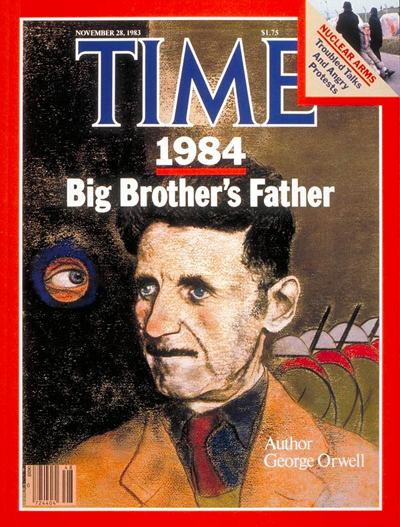
George Orwell (Eric Blair) on cover of Time Magazine, Novmber 28, 1983

George Orwell (Eric Blair) on cover of Time Magazine, Novmber 28, 1983

And if all others accepted the lie which the Party imposed—if all records told the same tale—then the lie passed into history and became truth. ‘Who controls the past’ ran the Party slogan, ‘controls the future: who controls the present controls the past.’

— George Orwell, 1984

Tip of the old scrub brush to Kate at The Urban Primate

If Big Brother is watching, why not let him watch all of us? Spread the word:

Add to FacebookAdd to NewsvineAdd to DiggAdd to Del.icio.usAdd to StumbleuponAdd to RedditAdd to BlinklistAdd to TwitterAdd to TechnoratiAdd to Furl


So, did you hear the one about burning Bibles on Halloween?

October 24, 2009

No kidding.  Some group in North Carolina plans to burn Bibles on Halloween.

Funny part, or ironic part:  It’s a church doing the burning.

And in case you’re hungry, “We will be serving Bar-b-Que chicken, fried chicken, and all the sides.”

Tip of the old scrub brush to Dispatches from the Culture Wars — great comments there, including this one, a favorite of mine:  “I’m going to have to address the menu, however: Chicken is not even mentioned in Leviticus.

Add to FacebookAdd to NewsvineAdd to DiggAdd to Del.icio.usAdd to StumbleuponAdd to RedditAdd to BlinklistAdd to TwitterAdd to TechnoratiAdd to Furl


Neil Shubin describes your “inner fish” – the evolutionary journey of the human body

October 23, 2009

More resources: