Last week, self proclaimed “geek,” Miss California, Alyssa Campanellamade beauty pageant history…by default. When the interviewer posed a Theory of Evolution question, she was one ofonly two delegates to use the scientific definition of the word “theory” in her response.
The honey-drenched, colloquial definition that the majority of her competitors clung to was, yes, diplomatic. Miss California, now Miss USA, however, did not aim to please or to appease the 60% of Americans that a 2009 Gallup Poll concluded do not believe in Evolution. Rather than aiming to please or appease an ignorant majority, The future Miss USA delivered a response that supported an empirical evidence based definition of specified phenomena: the scientific definition of the word, “theory.”
Brains is beauty, it seems to me. We should certainly run our schools as if intelligence and learning are great virtues in themselves.
Spread the word; friends don't allow friends to repeat history.
Other fronts in the War on Education may have earned more attention here in the Bathtub, lately — and in state legislatures. Threats from the dilution and elimination of good, hard science courses continue to pose problems, especially from creationists and their shyer, camouflage troops from the Chapel of Intelligent Design.
We need to stay aware of the creationist/creationism threat. At its heart, creationism requires adherents to reject the facts of science, to reject the workings of science, and to reject the functions of debate about what is real, and what is not. It is to me a rather simple discussion of the quality of evidence.
Eugenie Scott and her colleagues from the National Center for Science Education provide a great update in what is going on, with a great video, and an informative and troubling explanation of the links between creationism and the “unbelievers” in climate change.
Be sure to watch the first ten minutes, to see the video update on the fight to keep good science education in schools, especially the teaching of evolution.
Spread the word; friends don't allow friends to repeat history.
December 27 is one of those days — many of us are off work, but it’s after Boxing Day, and it’s not yet on to New Year’s Eve or Day. We should have celebrated, maybe.
We should celebrate it as a day of portent: A good embarkation, and a good, safe end to a nation-encouraging trip to almost touch the Moon.
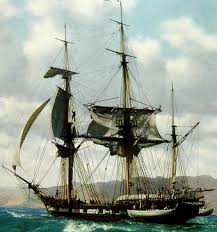
HMS Beagle, on a voyage of discovery
On December 27, 1831, Charles Darwin and H.M.S. Beagle set sail on an around-the-world voyage of discovery that would change all of science, and especially biology, forever.
December 27 1831
After a few delays, H.M.S. Beagle headed out from Plymouth with a crew of 73 under clear skies and a good wind. Darwin became sea-sick almost immediately.
Darwin never fully overcame his seasickness, but he fought it well enough to become the single greatest collector of specimens in history for the British Museum and British science, a distinction that won him election to science societies even before his return from the trip — and cemented his life in science, instead of in the church. Darwin’s discoveries would have revolutionized biology in any case. In analyzing what he had found, a few years later and with the aid of experts at the British Museum, Darwin realized he had disproved much of William Paley’s hypotheses about life and its diversity, and that another, more basic explanation was possible. This led to his discovery of evolution by natural and sexual selection.
Mini-sheet from the Royal Mail in 2009 honoring Darwin's discoveries in the Galapagos Islands
On December 27, 1968, Apollo 8 splashed down after a successful and heartening trip to orbit the Moon. The three crewmen, Commander Frank Borman, James A. Lovell, Jr., and William A. Anders, had orbited the Moon, a very important milestone in the methodological race to put humans on the Moon (which would be accomplished seven months later). 1968 was a terrible year for the U.S., with the North Korean capture of the U.S.S. Pueblo, assassinations of Rev. Martin Luther King, Jr., and Sen. Robert F. Kennedy during the presidential campaign, riots in dozens of American cities, nasty political conventions with riots at the Democratic Convention in Chicago, a contentious and bitter election making sore the nation’s divide over Vietnam policy, and other problems. On Christmas Eve, Borman, Lovell and Anders broadcast from orbit around the Moon, a triumphant and touching moment for the Apollo Program and Americans around the world. Their safe return on December 27 raised hopes for a better year in 1969.
In 1968, NASA engineers were scrambling to meet President Kennedy’s challenge to land a man on the moon by decade’s end. Because delays with the lunar module were threatening to slow the Apollo program, NASA chose to change mission plans and send the crew of Apollo 8 all the way to the moon without a lunar module.
Exactly 42 years ago, the three astronauts of Apollo 8 became the first humans to orbit another celestial object. As they came around the dark side for the third time, Frank Borman, the commander, finally turned their capsule around. And then they saw the Earth.
Borman: Oh my God! Look at that picture over there! Here’s the Earth coming up. Wow, is that pretty.
Anders: Hey, don’t take that, it’s not scheduled.
Borman: (laughing) You got a color film, Jim?
Anders: Hand me that roll of color quick, will you…
One of the resulting photos taken by Anders on a Hasselblad camera became one of the world’s most iconic images.
As Bill Anders recalls it:
I just happened to have one with color film in it and a long lens. All I did was to keep snapping… It’s not a very good photo as photos go, but it’s a special one. It was the first statement of our planet Earth and it was particularly impressive because it’s contrasted against this startling horizon… After all the training and studying we’d done as pilots and engineers to get to the moon safely and get back, [and] as human beings to explore moon orbit, what we really discovered was the planet Earth.
Yeah, we missed toasting it on time in 2010. Plan to raise a glass on December 27, 2011, to Good Trip Day for the human race. December 27 is a day we should remember, for these achievements.
Spread the word; friends don't allow friends to repeat history.
Lightism is just a theory — an atheistic belief based on arbitrary presuppositions. No one has ever seen a so-called “electron,” and no one really knows what causes light bulbs to function as they do.
In an incredible, Sisyphean effort, he pushes it uphill from there. Seriously. Go read.
Spread the word; friends don't allow friends to repeat history.
It is interesting to contemplate a tangled bank, clothed with many plants of many kinds, with birds singing on the bushes, with various insects flitting about, and with worms crawling through the damp earth, and to reflect that these elaborately constructed forms, so different from each other, and dependent upon each other in so complex a manner, have all been produced by laws acting around us. These laws, taken in the largest sense, being Growth with reproduction; Inheritance which is almost implied by reproduction; Variability from the indirect and direct action of the conditions of life, and from use and disuse; a Ratio of Increase so high as to lead to a Struggle for Life, and as a consequence to Natural Selection, entailing Divergence of Character and the Extinction of less improved forms. Thus, from the war of nature, from famine and death, the most exalted object which we are capable of conceiving, namely, the production of the higher animals, directly follows. There is grandeur in this view of life, with its several powers, having been originally breathed by the Creator into a few forms or into one; and that, whilst this planet has gone circling on according to the fixed law of gravity, from so simple a beginning endless forms most beautiful and most wonderful have been, and are being evolved.
And the “Origin” changed everything. Before the “Origin,” the diversity of life could only be catalogued and described; afterwards, it could be explained and understood. Before the “Origin,” species were generally seen as fixed entities, the special creations of a deity; afterwards, they became connected together on a great family tree that stretches back, across billions of years, to the dawn of life. Perhaps most importantly, the “Origin” changed our view of ourselves. It made us as much a part of nature as hummingbirds and bumblebees (or humble-bees, as Darwin called them); we, too, acquired a family tree with a host of remarkable and distinguished ancestors.
The reason the “Origin” was so powerful, compelling and persuasive, the reason Darwin succeeded while his predecessors failed, is that in it he does not just describe how evolution by natural selection works. He presents an enormous body of evidence culled from every field of biology then known. He discusses subjects as diverse as pigeon breeding in Ancient Egypt, the rudimentary eyes of cave fish, the nest-building instincts of honeybees, the evolving size of gooseberries (they’ve been getting bigger), wingless beetles on the island of Madeira and algae in New Zealand. One moment, he’s considering fossil animals like brachiopods (which had hinged shells like clams, but with a different axis of symmetry); the next, he’s discussing the accessibility of nectar in clover flowers to different species of bee.
At the same time, he uses every form of evidence at his disposal: he observes, argues, compares, infers and describes the results of experiments he has read about, or in many cases, personally conducted. For example, one of Darwin’s observations is that the inhabitants of islands resemble — but differ subtly from — those of the nearest continents. So: birds and bushes on islands off the coast of South America resemble South American birds and bushes; islands near Africa are populated by recognizably African forms.
Of course you –you cognescenti, you — know Judson is the wit behind Dr. Tatiana’s Sex Advice to All Creation, a thoroughly delightful, funny and scientifically accurate book. Which brings to my mind this question: Why are scientists, and especially evolutionary scientists, so funny and charming, in stark contrast to the dull proles of creationism?
And, were he not ill at the time, can you imagine what a fantastic dinner guest Charles Darwin himself would be?
Evolution Expert Philip D. Gingerich to Speak at SMU on Oct. 7
Philip D. Gingerich, a leading expert in the evolution of primates and whales, will speak at 5 p.m. Wednesday, Oct. 7, in Dallas Hall’s McCord Auditorium.
Philip D. Gingerich
Gingerich’s lecture on “Darwinian Pursuit in Paleontology: Origin and Early Evolution of Whales” is part of SMU’s year-long celebration of naturalist Charles Darwin’s 200th birthday and the 150th anniversary of his world-changing publication, On the Origin of Species.
Gingerich, the Darwin Year Visiting Scholar for SMU’s Institute for the Study of Earth and Man, is Case Collegiate Professor of Paleontology at the University of Michigan. He also is professor of geological sciences and director of UM’s Museum of Paleontology. A recipient of UM’s 1997 Distinguished Faculty Achievement Award, he teaches courses on primate and mammalian evolution and supervises undergraduate and graduate student research on mammals and evolution.
His research focuses on vertebrate paleontology, especially the origin of modern orders of mammals and quantitative approaches to paleobiology and evolution.
A winner of numerous awards, Gingerich is a member of the National Geographic Society Committee for Research and Exploration, associate editor of American Journal of Science, and co-editor of Causes and Consequences of Globally Warm Climates in the Early Paleogene. In 2001 he was a scientific adviser to “Walking with Prehistoric Beasts,” a television documentary produced by the BBC and aired on the Discovery Channel.
Spread the word; friends don't allow friends to repeat history.
BOSTON, MA—This fall, NOVA celebrates the 200th anniversary year of Darwin’s birth and the 150th anniversary of the publication of his famous book the Origin of Species with three evolution-themed programs.
Each film will approach the topic of evolution in a different way. To kick off NOVA’s fall season on October 6, Henry Ian Cusick (Lost) and Frances O’Connor (Mansfield Park) star in “Darwin’s Darkest Hour,” a two-hour scripted drama that presents the remarkable story behind the birth of Darwin’s radically controversial theory of evolution and reveals his deeply personal crisis: whether to publish his earthshaking ideas, or to keep quiet to avoid potential backlash from the Church. In November, NOVA premieres “Becoming Human,” a three-part special on human evolution. The series combines interviews with world renowned anthropologists and paleoanthropologists and the most recent, groundbreaking
discoveries with vivid images of our earliest ancestors to present a comprehensive picture of our human past. Then, on December 29, “What Darwin Never Knew” reveals answers to evolutionary questions that even Darwin couldn’t explain. Scientists are beginning to expose nature’s biggest secrets on the genetic level, with the hope of one day answering the crucial question: How does evolution really work?
Following are descriptions for NOVA films in fall 2009:
Darwin’s Darkest Hour (2 hrs) – Tuesday, October 6
NOVA and National Geographic Television present the extraordinary human drama that led to the birth of the most influential scientific theory of all time. Acclaimed screenwriter John Goldsmith (David Copperfield, Victoria and Albert) brings to life Charles Darwin’s greatest personal crisis: the anguishing decision over whether to “go public” with his theory of evolution. Darwin, portrayed by Henry Ian Cusick (Lost), spent years refining his ideas and penning his book the Origin of Species. Yet, daunted by looming conflict with the orthodox religious values of his day, he resisted publishing—until a letter from naturalist Alfred Wallace forced his hand. In 1858, Darwin learned that Wallace was ready to publish ideas very similar to his own. In a sickened panic, Darwin grasped his dilemma: To delay publishing any longer would be to condemn all of his work to obscurity—his voyage on the Beagle, his adventures in the Andes, the gauchos and bizarre fossils of Patagonia, the finches and giant tortoises of the Galapagos. But to come forward with his ideas risked the fury of the Church and perhaps a rift with his own devoted wife, Emma, portrayed by Frances O’Connor (Mansfield Park, The Importance of Being Earnest, Steven Spielberg’s “Artificial Intelligence”), who was a strong believer in the view of creation and honestly feared for her husband’s soul. Darwin’s Darkest Hour is a moving drama about the birth of a great idea seen through the inspiration and personal sufferings of its brilliant originator.
Hubble’s Amazing Rescue – Tuesday, October 13
In the spring of 2009, NASA sent a shuttle crew on a risky mission to service the Hubble Space Telescope for the last time. Hubble has enthralled scientists and the public by capturing deep views of the cosmos and a wealth of data from distant galaxies. It has helped lead the search for alien planets and is a key tool in cosmology’s quest to investigate and map the universe’s mysterious dark matter. The astronaut servicing team carried out the first-ever in-space repairs of Hubble’s defective instruments, a task that required ingenious engineering fixes and the most intensive NASA spacewalk ever. From training to launch, NOVA presents the inside story of the mission and the extraordinary challenges faced by the rescue crew.
Lizard Kings – Tuesday, October 20
Though they may look like dragons and inspire stories of man-eating, fire-spitting monsters with long claws, razor-sharp teeth and muscular, whip-like tails, these creatures are actually monitor lizards, the largest lizards to walk the planet. With their acute intelligence—including the ability to plan ahead— these lizards are a very different kind of reptile, blurring the line between reptiles and mammals. And even though these bizarre reptiles haven’t changed all that much since the dinosaurs, they are a very successful species, versatile at adapting to all kinds of settings. Lizard Kings will look at what makes these tongued reptiles so similar to mammals and what has allowed them to become such unique survivors. But while the creatures can find their way around many different habitats, finding them is no easy task. Natural loners, and always on guard, they sense anything or anyone from hundreds of feet away. NOVA will follow expert lizard hunter Dr. Eric Pianka as he tracks the elusive creatures through Australia’s heartland with cutting-edge “lizard cam” technology for an unparalleled close encounter with these amazingly versatile “living dragons.”
Becoming Human: Unearthing Our Earliest Ancestors – Tuesday, November 3, 10, 17
NOVA presents a three-part, three-hour special—investigating explosive new discoveries that are transforming the picture of how we became human. The first program explores fresh clues about our earliest ancestors in Africa, including the stunningly complete fossil nicknamed “Lucy’s Child.” These three-million-year-old bones from Ethiopia reveal humanity’s oldest and most telltale trait—upright walking rather than a big brain. The second program tackles the mysteries of how our ancestors managed to survive in a savannah teeming with vicious predators, and when and why we first left our African cradle to colonize every corner of the Earth. In the final program, NOVA probes a wave of dramatic new evidence, based partly on cutting-edge DNA analysis, that reveals new insights into how we became the creative and “behaviorally modern” humans of today, and what really happened to the enigmatic Neanderthals who faded into extinction. Shot “in the trenches” where discoveries were unearthed throughout Africa and Europe, each hour of Becoming Human unfolds with a forensic investigation into the life and death of a specific hominid ancestor, such as “Lucy’s Child.” Dry bones spring back to vivid life with stunning animation, the product of a unique NOVA collaboration between top anthropologists and a talented team of movie animators.
What Are Dreams? – Tuesday, November 24
What are dreams and why do we have them? NOVA joins the leading dream researchers as they embark on a variety of neurological and psychological experiments to investigate the world of sleep and dreams. Delving deep into the thoughts and brains of a variety of dreamers, scientists are asking important questions about the purpose of this mysterious world we escape to at night. Do dreams allow us to get a good night’s sleep? Do they improve our memory? Do they allow us to be more creative? Can they solve our problems or even help us survive the hazards of everyday life? NOVA follows researchers like the Massachusetts Institute of Technology’s Matthew Wilson who is literally ‘eavesdropping’ on the dreams of rats and takes viewers into a sleep lab for a first-hand look at how scientists do their best to eavesdrop on human dreams. From those who violently act out their dreams to those who can’t stop their nightmares, from sleepwalking cats to people who can’t dream, each fascinating experiment contains a vital clue to the age-old question: What are dreams?
What Darwin Never Knew (2 hours) – Tuesday, December 29
Earth teems with a staggering variety of animals, including 9,000 kinds of birds, 28,000 types of fish, and more than 350,000 species of beetles. What explains this explosion of living creatures—1.4 million different species discovered so far, with perhaps another 50 million to go? The source of life’s endless forms was a profound mystery until Charles Darwin’s revolutionary idea of natural selection, which he showed could help explain the gradual development of life on Earth. But Darwin’s radical insights raised as many questions as they answered. What actually drives evolution and turns one species into another? And how did we evolve?
Now, on the 150th anniversary of Darwin’s the Origin of Species, NOVA reveals answers to the riddles that Darwin couldn’t explain. Stunning breakthroughs in a brand-new science—nicknamed “evo devo”— are linking the enigma of origins to another of nature’s great mysteries, the development of an embryo. To explore this exciting new idea, NOVA takes viewers on a journey from the Galapagos Islands to the Arctic, and from the Cambrian explosion of animal forms half a billion years ago to the research labs of today. Here scientists are finally beginning to crack nature’s biggest secrets at the genetic level. And, as NOVA shows in this absorbing detective story, the results are confirming the brilliance of Darwin’s insights while exposing clues to life’s breathtaking diversity in ways the great naturalist could scarcely have imagined.
Spread the word; friends don't allow friends to repeat history.
In contrast to Dreher’s previous defenses of intelligent design and other sciency woo, in this piece he mostly gets Darwin correct — which, alas, means he doesn’t talk much about what Darwin actually said. That makes the errors more glaring, to me. But, what do you think?
For example: Dreher discusses abuses of Darwin:
Take Charles Darwin. In 1859, the publication of his On the Origin of Species was an event so earth-shaking that 150 years later, the trembling still reverberates. In their recent book Darwin’s Sacred Cause, Adrian Desmond and James Moore argue that the Darwin family’s deep roots in the British anti-slavery movement caused young Charles to start asking questions about the common origins of humanity. “It is the key to explain why such a gentleman of wealth and standing should risk all to develop his bestial ‘monkey-man’ image of our ancestry in the first place,” they write.
The authors make a case that Darwin, who was never himself a social activist, undermined racial prejudice with his discoveries. That is true – to a point.It is also true that Darwin’s work on evolution and natural selection, as it became popularized, inspired scientists and laymen to take more interest in racial differences, an intellectual passion that would have sinister consequences in the science of eugenics – founded in the late 19th century by Darwin’s cousin, Francis Galton.
Did Dreher read Desmond and Moore? Did they get the events right? Britain’s abolishment of slavery occurred when Darwin was a young man. It was a hot controversy while he was asea aboard the Beagle. Was it that controversy that caused Darwin to ask whether humans have a common origin? At the same time, Darwin was quizzing “Jeremy Button,” a dark-skinned native of the area around Tierra del Fuego, who had been essentially kidnapped on a previous voyage of the ship, and who was being returned home on the voyage Darwin was part of. As I’ve read Darwin, I see that he finds hard evidence of evolution in plants, in sea creatures, in other animals — and then wonders how humans could have been exempt from such actions. I don’t see Darwin starting from slavery and reasoning backwards.
But second, I still wait for someone to point me to any clear indication that eugenics advocates were particularly inspired by Darwin, or that eugenics was related in any serious way to the genocides of Europe in the early 20th century. Hitler didn’t think he was improving any race, but was instead getting rid of people he didn’t like. The link from Darwin to genocide gets particularly strained for the genocide of the Armenians in 1915 (regardless the cause). When asked to justify genocide against German Jews, Hitler didn’t refer to Darwin, but instead asked who remembered the Armenians, 25 years later. The question wasn’t, “Is this the thing to do to improve the race,” but was instead, “Can we get away with it?”
It makes me lament again the DMN’s having killed their once-great science section. A newspaper that doesn’t do enough reporting on a subject never feels compelled not to comment on it, but such commentary always suffers from its reading audience having little background in the topic. Full of sound and fury, as Shakespeare wrote.
Spread the word; friends don't allow friends to repeat history.
Christian Apologetics (SWBTS #PHILO 4373 – Fall 2009)
<> New as of 09.16.09!Dear Class, I want to share with you a few things: (1) For extra credit I’d like you to go to SMU on September 24th. On that day there are two back-to-back events at SMU celebrating Darwin — go to smu.edu/smunews/darwin/events.asp and scroll down to September 24th. I don’t want you going there merely as spectators but will indicate in class how you might actively participate and engage the Darwin-lovers you’ll find there.
* * * * *
Intelligent Design or Unintelligent Evolution (SWBTS #PHILO 2483 – Fall 2009)
<> New as of 09.16.09!Dear Class, I want to share with you a few things: (1) For extra credit I’d like you to go to SMU on September 24th. On that day there are two back-to-back events at SMU celebrating Darwin — go to smu.edu/smunews/darwin/events.asp and scroll down to September 24th. I don’t want you going there merely as spectators but will indicate in class how you might actively participate and engage the Darwin-lovers you’ll find there.
You gotta wonder just what would happen if one of those abused students were to actually pay attention to the science, turn honest, and become a defender of science and Darwin. SWBTS students are not required to swear to honesty, however, so it’s unlikely they will turn (not at the tuitions they pay!).
SMU’s Year of Darwin programs feature the NOVA episode on the Pennsylvania trial on evolution and intelligent design. The NOVA piece will be screened, and discussions will include the Honorable John E. Jones, the federal judge who presided over the trial and has since been maligned unfairly by Dembski and other religionists who reject the views of science. Other lecturers include reporter Laurie Lebo and the team that produced the NOVA episode:
Sept. 24, 2009
Reception 10 a.m.
Lecture 10:30 a.m.
DeGolyer Library
The Friends of the SMU Libraries/Colophon and The Friends of KERA Invite the public to a special event in celebration of the 150th anniversary of the publication of On the Origin of Species and the 200th birthday of its author, Charles Darwin. Featured speakers will be Paula Apsell, senior executive producer of NOVA, and Melanie Wallace, senior series producer of NOVA. Please RSVP to 214-768-3225 or cruppi@smu.edu, Complimentary Valet Parking.
Sept. 24, 2009
4-6 p.m.
O’Donnell Hall
Owen Art Center
Screening of “Judgment Day: Intelligent Design on Trial,” a NOVA documentary. Introduction by Paula Apsell, senior executive producer of NOVA, who received an honorary degree from SMU in 2008.
Sept. 24, 2009
Reception 6-7 p.m.
Panel 7-8:30 p.m.
Caruth Auditorium
Owen Art Center
A panel discussion on the legal, ethical and journalistic issues surrounding the making of NOVA’s documentary film, Judgment Day: Intelligent Design on Trial. Participants include John E. Jones, the federal judge who barred a Dover, Pa., public school district in 2005 from teaching “intelligent design”; Paula Apsell and Melanie Wallace, NOVA producers of the documentary; plaintiff’s council Eric Rothschild; and Laurie Lebo, author of The Devil in Dover.
Sept. 25, 2009
10:30 a.m. – noon
Karcher Auditorium
Storey Hall
“Intelligent Design in the Classroom,” a panel discussion on First Amendment issues featuring Judge John E. Jones III, Eric Rothschild (Pepper Hamilton, LLP), Hiram Sasser (Liberty Legal Institute) and Lackland Bloom, SMU’s Dedman School of Law.
Sept. 25, 2009
10-11:30 a.m.
3531 Garson
Owens Art Center
Master class on Documentary Film Making, taught by Paula Apsell and Melanie Wallace of NOVA. Strictly by RSVP (to Teri Trevino, trevinot@mail.smu.edu)
Sept. 25, 2009
2-3 p.m.
Hughes-Trigg Forum
Lauri Lebo will speak on “From Dover to Texas: Reporting on Extremist Views in a Fair and Balanced World” followed by a book signing of her book, The Devil in Dover.
I have attended sessions around Dallas where Dembski and other ID creationists were the featured speakers. We know one thing for certain: Dembski’s students will be given a more polite and mannerly reception at SMU than Dembski and his crew give scientists and critics at their own sessions. For years, since 1991 at least, SMU has allowed Dembski and his accomplices to use the facilities and good offices of SMU to promote their anti-science screeds, though Dembski’s views are not shared by Methodists, and are contrary to positions taken by the Methodist General Assembly.
It is impossible to imagine that SWBTS would allow Methodists to do the same thing, teaching and promoting science and especially evolution theory, at the seminary.
SMU’s program is open to the public (go to the SMU site above to see more events set over the next few months).
Dembski is teaching apologetics. Creationist apologists are not licensed, and generally cannot be sued for pedagogical or theological malpractice, even by their students. Standards for apologetics don’t exist. Scientists, on the other hand, are subject to peer review, and if using federal funds, prosecution should they tell falsehoods.
I wait in vain for a condemnation of Newton’s laws of motion, since they account for so many deaths in virtue of their description of how bullets, speeding automobiles, and the like generate so much energy of impact. F=MA must be immoral.
Why is it Darwin gets all the flack from fundamentalists, when it was Newton who pushed the angels out of the heavens, Hubble who peeked into the universe’s running without gods?
Or, until that account is unsuspended by the forces supporting Donald Trump: Follow @FillmoreWhite, the account of the Millard Fillmore White House Library
We've been soaking in the Bathtub for several months, long enough that some of the links we've used have gone to the Great Internet in the Sky.
If you find a dead link, please leave a comment to that post, and tell us what link has expired.
Thanks!
Retired teacher of law, economics, history, AP government, psychology and science. Former speechwriter, press guy and legislative aide in U.S. Senate. Former Department of Education. Former airline real estate, telecom towers, Big 6 (that old!) consultant. Lab and field research in air pollution control.
My blog, Millard Fillmore's Bathtub, is a continuing experiment to test how to use blogs to improve and speed up learning processes for students, perhaps by making some of the courses actually interesting. It is a blog for teachers, to see if we can use blogs. It is for people interested in social studies and social studies education, to see if we can learn to get it right. It's a blog for science fans, to promote good science and good science policy. It's a blog for people interested in good government and how to achieve it.
BS in Mass Communication, University of Utah
Graduate study in Rhetoric and Speech Communication, University of Arizona
JD from the National Law Center, George Washington University


 Posted by Ed Darrell






 Millard Fillmore's Bathtub