Annals of Global Warming: It didn’t start with the hockey stick . . .

December 12, 2011

Peter Sinclair comes through with a good explanation of the history of concern about global warming — how the warming trend was discovered.

It wasn’t scientists trying to get government grants.  It was the U.S. Air Force, trying to beat the commies and keep America safe for democracy and, ironically, safe for dissent from such applications of science.


9,996

Real history couldn’t be published as fiction, which is one way we can tell real history from the stuff that gets made up.  In the story told in this video, note carefully the serendipity of figuring out the CO2 issues:  Who could invent a story about warfare leading to the discovery of global warming?  As with the coincidence of John Adams and Thomas Jefferson both dying on the 50th anniversary of the Declaration of Independence, no editor of fiction would accept it as believable.

More:

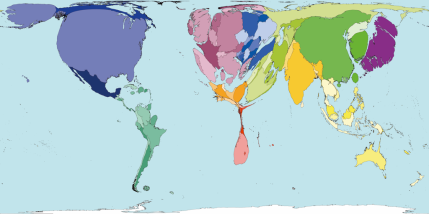
Why we worry, why policy makers are involved:  Carbon Emissions, 2000 – from WorldMapper, with a serendipitous tip of the old scrub brush to Petra Tschakert at Penn State.

Carbon emissions 2000, from worldmapper.org - creative commons license

Carbon Emissions 2000, from worldmapper.org - creative commons license

Carbon Emissions 2000 © Copyright 2006 SASI Group (University of Sheffield) and Mark Newman (University of Michigan). “We welcome use of our maps under the Creative Commons conditions by educational, charitable and other non-profit organisations.”

Progress from Durban?

December 11, 2011

Meeting in Durban, South Africa, government officials from many nations worked to find solutions to human causation of destructive climate change, in the framework of proposed treaties under United Nations aegis.

Negotiations at Durban, South Africa, December 10, 2011 - UK DECC photo

Negotiators at the COP17 Climate Conference in Durban work late into the night to reach agreement on a roadmap to a legally binding deal, 10 December 2011. UKDECC photo and caption

Did anyone expect good reports out of these meetings?

From the UK Department of Energy and Climate Change, we get this press release, dated Sunday, December 11, 2011:

Road open to new global legal climate treaty

  • Global agreement achieved on a roadmap to a legally binding deal
  • Second commitment period of Kyoto Protocol to be agreed next year
  • Green Climate Fund to be set up

The UN climate talks in South Africa have been heralded a success after a climate change deal was struck in the early hours of Sunday morning.194 parties have spent the past two weeks in Durban discussing how to cut emissions to limit global temperature rise to below two degrees to avoid dangerous climate change.

In a major realignment of support, well over 120 countries formed a coalition behind the EU’s high ambition proposal of a roadmap to a global legally binding deal to curb emissions. African states together with the least developed countries such as Bangladesh and Gambia, and small island states vulnerable to rising sea levels, like the Maldives, joined with the EU to put forward a timetable which would see the world negotiate a new agreement by 2015 at the latest.

The talks resulted in a decision to adopt the second commitment period of the Kyoto Protocol next year in return for a roadmap to a global legal agreement covering all parties for the first time. Negotiations will begin on the agreement early next year.

Energy and Climate Change Secretary Chris Huhne said:

“This is a significant step forward in curbing emissions to tackle global climate change. For the first time we’ve seen major economies, normally cautious, commit to take the action demanded by the science.

“The EU’s proposal for the roadmap was at the core of the negotiations and the UK played a central role in galvanising support. This outcome shows the UNFCCC system really works and can produce results. It also shows how a united EU can achieve results on the world stage and deliver in the UK’s best interests.

“There are still many details to be hammered out, but we now need to start negotiating the new legal agreement as soon as possible and there are still many details to be hammered out.”

Also the conference agreed to get the Green Climate Fund up and running, this will help deliver financial support to developing countries to reduce emissions and adapt to the effects of climate change.

Notes to editors:

Further details on the Durban climate talks can be found at: www.unfccc.int

Visit the Durban COP 17 pages of the DECC website www.decc.gov.uk/durban

Call me skeptical that this report is completely accurate, but as I refuse to be “skeptical” of the reality that the Earth warms, call me hopeful, too.  It’s an agreement to keep talking.

More:


Save the babies. Oh, and fight global warming, too

December 3, 2011

I wonder exactly how the “warming skeptics” will complain about this?

Just a reminder, cleaning the air to fight global warming also has immediate health benefits.

From the American Lung Association:

You know they will  complain about, for some trumped up reason.

Tip of the old scrub brush to James Kaliway at Everything Wrong with Today’s Youth.  He’s got more to say at his blog.


If stupid and arrogance shone like the Sun . . .

December 3, 2011

. . . we could solve all energy crises forevermore.

Over at Watt’s Up With That, the leading anti-science blog on the web, Anthony Watt turned the podium over to the indefatigable, often inscrutable, sometimes-funny-but-almost-always wrong, Willis Eschenbach, who worries about when solar power may run out:

Their study includes “renewable” sources like solar, although I’ve never found out exactly how they plan to renew the sun once it runs out.

In a just and sane world, Dave Barry would be preparing to sue Eschenbach for infringing on Barry’s humor patent.

Just when will energy from Old Sol run out?  The Sun will die one day, but well after President Obama’s second term has expired, and long after all current photo-voltaic devices have worn out from providing cheap energy.

The facts:

Our Sun won’t last forever. Dr. Carolyn Brinkworth explains the ramifications for our home planet in this ‘Ask an Astronomer’ video.

Vodpod videos no longer available.

What Will Happen to the Earth When the Sun Dies?, posted with vodpod

Shorter Eschenbach:  Don’t worry about cleaning the air to fight global warming, because in the looooooooooooooooooooooooooooong run, we’re all dead.  Certainly after 4 billion years.


Quote of the moment: Al Gore on facing reality

November 25, 2011

Michael Tobis says Gore said it — that’s good enough citation for me:

Reality of climate change crises, Matt Mahurin for Rolling Stone

Matt Mahurin in Rolling Stone, June 11, 2011

Even writing an article like this one carries risks; opponents of the president will excerpt the criticism and strip it of context.

But in this case, the President has reality on his side. The scientific consensus is far stronger today than at any time in the past. Here is the truth: The Earth is round; Saddam Hussein did not attack us on 9/11; Elvis is dead; Obama was born in the United States; and the climate crisis is real. It is time to act.

Al Gore, in Rolling Stone, June 22, 2011

Actually, Real Aspen has audio of Gore saying stuff like that, and you’ll probably want to listen.  NPR has a story on Gore’s essay in Rolling Stone.


Stupid-Boy-Cries- “Wolf” Department: Thieves release more e-mails stolen from climate scientists

November 23, 2011

In his clear style, Tim Lambert at Deltoid lays out the basic facts:

Some more of the emails stolen from the Climate Research Centre in 2009 have been released. This time they are accompanied by a readme with out-of-context quotes that asserts the purpose of the release is information transparency, but that’s an obvious lie, since they’ve sat on them for two years and released them just before Durban conference. The timing suggests that the people behind the theft and release have a financial interest in preventing mitigation of greenhouse gas emissions. It is most unlikely that there is anything incriminating in these emails — if there was, it would have been released two years ago.

Gavin Schmidt is providing context for the emails, Brendan DeMelle has an extensive roundup and Stephan Lewandowsky writes about the real scandal.

I remind readers that the last round revealed wrong-doing only by accomplices and friends of the thieves, and revealed no wrong-doing on the part of climate scientists.

Especially, the last round revealed no data to show warming is not happening, nor any data to show anything but righteous and noble concern to mitigate or stop the human contribution to the pollution that causes unnatural global warming.  This round of releases will do the same, I predict.

Joe Romm illustrated his post on the issue (which you will want to read) with this cartoon from Drew Sheneman of the Newark Star-Ledger:

Drew Sheneman, Newark Star-Ledger, on politics around findings of global warming

Drew Sheneman, Newark Star-Ledger, on politics around findings of global warming; polar bears won't read the stolen e-mails, refuse to be convinced findings of warming comprise a hoax

(Does anyone have the date on that cartoon?  Is it, like this one from Tom Toles, so old it indicates denialists do nothing new under the sun?)

In the two years since the last release of stolen e-mails, a few hundred studies on global warming have been published confirming the fact that warming occurs, and confirming the links to human activity as a cause of unnatural warming.  Even Anthony Watts’s work was published, but when analyzed, it also showed global warming and not miscalculations of data or misreadings of data  (Watts denies the results from his data).

So, in two years, climate change denialists have been unable to find any significant chunk of data to support any of their claims, while the planet continues to warm at an increasingly alarming rate. 

How many times do we allow the miscreant to call “wolf” falsely?  Why would we believe him on any other issue?

More, Resources: 


Naomi Oreskes on the political need for truth-telling in climate change

November 11, 2011

The too-often odious Huffington Post features an interview with Naomi Oreskes, one of the authors of Merchants of Doubt.

You should read the interview (and the book, if you haven’t yet):

[Kerry Trueman]:The real mystery, then, is how to persuade American skeptics that we face profound disruptions in our own lifetime and that of our children. Can you describe, in a lay-person friendly way, some of the scenarios we might anticipate?

[Naomi Oreskes]: Well, the best example is the “monster storm” that just hit Alaska, described by one media outlet as a storm of “epic proportions.” Climate change is underway, it is affecting American citizens, and it is going to become increasingly costly and disruptive.

We are no longer talking about the future, about people far away in time and space. We are talking about us, now. I think this is what Americans do not yet understand. But if current trends continue, they will soon. Climate change is all around us, and most of it is not good.

More, there.

More at the Bathtub:


What were scientists saying about global warming in 1971?

November 3, 2011

What did scientists know and say about climate change and global warming in the 1970s?  I keep running into claims by modern climate change denialists that scientists in the 1970s firmly predicted a pending ice age.  This is usually posited to establish that scientists are fools, and that concerns about warming now are probably displaced because the same scientists were in error 40  years ago.

I worked in air pollution studies way back then.  That’s not how I remember it at all.  I remember great, good-natured debates between Ph.Ds in the Department of Biology at the University of Utah, and other scientists from other institutions passing through and working in the field with us.  Greenhouse effect was very well understood even back then, and the discussions were on the nature of just how much human pollution would affect climate, and in which way.

Savvy scientists then well understood that there were two competing trends in air pollution:  Greenhouse gases and particulates and aerosols.  Greenhouse gases would warm the climate, but they were offset by particulates and aerosols that reflect solar radiation back into space before warming can occur.  At least, back then, the particulates and aerosols counteracted the greenhouse gases.

Manhattan skyline enveloped in heavy smog, May 1973: Chester Higgins/NARA. via Mother Jones

EPA collection, Manhattan skyline enveloped in heavy smog, May 1973: Chester Higgins/NARA. via Mother Jones

Looking for something else, I took off my shelf a book we used as a text in air pollution courses at the University of Utah in the 1970s, Whatever Happened to Fresh Air? by Michael Treshow.  Treshow taught at Utah.  He was deeply involved in several research projects on air pollution.  He was also a great conversationalist and competitive tennis player.  His book was a good text, but he intended it to be read by lay people, especially policy makers, also.  It’s easy to fathom, intentionally so.

Here, below, is what Treshow wrote in the early pages about carbon dioxide as an air pollutant, in sketching the global problems of air pollution.  Notice that, while he makes note of the predictions of what would happen with uncontrolled particulate and aerosol pollution, he gives the science straight up, telling what pollution can do, depending on local circumstances and global circumstances.  Treshow notes the research that the denialists cite now, but he explains enough of the science so that any reasonable person should be able to see that, if one form of pollution is controlled and another is not, the effects might be different.

Michael Treshow:

Over the past several million years, the earth’s animal and plant life have reached a workable equilibrium in sharing this atmosphere and keeping the oxygen and carbon dioxide concentrations in balance.  But man, by burning fossil fuels (particularly coal) at an accelerated rate and by removing vegetation at the prodigious rate of 11 acres per second in the U.S., may be upsetting this equilibrium.  Many scientists believe this carbon dioxide build-up is one of the major threats to man’s environment.

Carbon dioxide (CO2) is occasionally regarded as an air pollutant for this reason, even though it is a natural and essential component of the atmosphere.  Certainly the present concentrations are not dangerous; but what would happen if the amount of carbon dioxide in the atmosphere should increase appreciably?  What hazards would be imposed?

An increase in carbon dioxide would benefit the green plants since they need it for photosynthesis.  But what effect would it have on man and animals?  Or on the physical environment?  The main hazard lies in the effect that carbon dioxide has in absorbing the infrared radiation which normally radiates from the earth back to the atmosphere.  If the carbon dioxide content of the lower atmosphere were to increase, it would prevent the infrared heat absorbed by the earth from the sun from reradiating into the atmosphere.  Heat energy would accumulate and cause a general increase in the earth’s temperature.  Such an increase in temperature, often called the “greenhouse effect,” could cause the ice caps to melt, raising the level of the oceans and flooding most of the world’s major cities.

It is awesome to realize that sea level is actually rising.  It is now 300 feet above what it was 18,000 years ago, and is reportedly rising nearly nine inches higher each century.  Beaches are being wasted away and tides lap ever closer to the steps of coastal homes.  But is the displacement of our beaches more closely related to increasing carbon dioxide concentrations or to the normal warming process between ice ages?

Not everyone agrees that carbon dioxide is to blame.  Concentrations vary greatly around the world.  Near urban areas, where fossil fuels are burned, concentrations are high; over forested areas, where plants are rapidly removing the gas, they are low.  Concentrations also vary with the height above the ground, the latitude, whether over the ocean or land and even with the time of day and season of the year.  All of these variables make it difficult to agree on a reasonable average carbon dioxide concentration.

Despite some disagreement, it is generally conceded that carbon dioxide has been added to the atmosphere at an alarming rate during the past century.  Actual measurements show that between 1857 and 1956, carbon dioxide concentrations increased from an average of 0.0293 to 0.0319 percent; 360 X [10 to the 9th] tons of carbon dioxide have been added to the atmosphere by man during this period.  Upwards of a trillion tons will be added by the year 2000.  Such  a tremendous release of carbon dioxide would increase the atmospheric concentrations appreciably unless some mechanism is available to absorb the surplus and to maintain equilibrium.

Extensive measurements suggest that carbon dioxide concentrations near the earth’s surface have increased about 10 percent since 1900.  During this same time, fossil fuel consumption increased about 15 percent.  This is a remarkably, close, meaningful relationship.  The 5 percent difference is readily accounted for, since this much would be absorbed by the ocean or by rocks and living organisms, particularly plants, which absorb much of the surplus carbon dioxide.  In fact, green plants probably have the capacity to absorb and utilize far more carbon dioxide than man is likely to release.

Calculations presented by Gordon MacDonald of the University of California at Santa Barbara show that a 10 percent increase in the total carbon dioxide content theoretically should cause an increase of 0.4° F in the average temperature of the earth.  Although the carbon dioxide content is being increased about 0.06 percent each year by the combustion of fossil fuels, no temperature increase has been demonstrated.  Rather, the average temperature appears to be decreasing.  During the past 25 years, when the addition of carbon dioxide has been most rapid, the average temperature has dropped half a degree.

This temperature drop has been thought to result from the increase in the amount of submicron sized particulates which remain suspended in the atmosphere. These aerosols obstruct the entrance of the sun’s heat and light rays, thereby disrupting the earth’s energy balance.  The effect is one of less heat and lower temperatures.  Dr. William E. Cobb of the National Oceanic and Atmospheric Agency predicts the possibility of another ice age.

Whatever Happened to Fresh Air, Michael Treshow, University of Utah Press, 1971, pp. 3-6.

What changed since then?  The Clean Air Act provided the legal drive to clean particulates and aerosols out of the air.  Alas, we did not then have good controls for greenhouse gases.  The success of the Clean Air Act, and similar laws worldwide, rather left the pollution field open for greenhouse gases.  Without pollution to offset the effects of GHG, warming became the stronger trend.

I think Treshow was quite prescient back then.  His work is still accurate, when we adjust for the events of history that came after he wrote the book.

Time Magazine cover for January 27, 1967, photo by Larry Lee. The photo shows a typical Los Angeles day at 3:30 p.m., with photochemical smog restricting visibility dramatically. Particulate pollution, and sulfates, added to the visibility problems, and made air pollution a greater health hazard. An accompanying story was titled,

Time Magazine cover for January 27, 1967, photo by Larry Lee. The photo shows a typical Los Angeles day at 3:30 p.m., with photochemical smog restricting visibility dramatically. Particulate pollution and sulfates added to the visibility problems, and made air pollution a greater health hazard. An accompanying story was titled, “Ecology: The Menace in the Skies.”

It’s popular among those opposed to the science of climate change to claim scientists don’t know what they’re talking about, because ‘back in the 1970s they predicted a new ice age, and they were wrong.’

Dr. Treshow’s book presents the state of the science of air pollution in the early 1970s. He didn’t “predict” an ice age. He noted that particulate pollution was a major problem, and that particulates and other pollution created a cooling effect that could offset and perhaps overpower the warming effects of CO2, as he discusses in the passage above. In lay terms, in a few brief passages, Treshow notes the conflicting results of different types of pollution.

CO2’s warming effects were well known, and acknowledged. If particulates and other aerosols won the battle to pollute the skies, the Earth would cool. If GHGs won the battle, the Earth would warm.

Claiming scientists “predicted” an ice age tells only half the story, and thereby becomes a grossly misleading, whole lie.

More:


Annals of global warming: Deja vu all over again (Tom Toles cartoon from 2004)

October 28, 2011

Events of the past two weeks, in the community of scientists and cargo scientists who fail to recognize global warming, sadly, were portrayed in this cartoon by Tom Toles. Whiplash realization moment: Toles’s cartoon is from 2004. (Yes, this is an encore post.)

Tom Toles cartoon on global warming inaction, from 2004

A Tom Toles cartoon from 2004

Insert a definition of “filibuster” here.

Then pray for action.

Then call your congressman, and him/her to act, now.

_____________

Note on Tom Toles from the Department of Earth Sciences, G-107 Environmental Geology, Indiana University-Purdue University at Indianapolis (IUPUI): “A political cartoon from the Washington Post on climate change. Tom Toles, a political cartoonist, often pens cartoons on environmental issues. His cartoons are often reprinted in other newspapers (Washington Post/Universal Press Syndicate).”


Bathtub reading for the World Series, and autumn’s appearance (finally!)

October 20, 2011

Busy as a teacher with 450 papers to grade each week.

That blue color in GE Reveal™ lightbulbs that just turned 10 years old?  Neodymium.  Embedded in the glass, not a coating.  Who knew?  Need to learn a lot more about neodymium — where is it mined, how toxic is it, what else can it do?

How will Rand Paul work up a whine about Reveal lightbulbs?  What will he complain about?

While we’re trolling GE’s press releases, we note the Climate Denialist™ reports of the death of wind power suffer from exaggeration Mark Twain warned us against.

Chart showing effects of 9-9-9 tax plan of Herman Cain

Chart showing effects of 9-9-9 tax plan of Herman Cain, Washington Post

Chart shows Herman Cain’s 9-9-9 tax plan overwhelmingly benefits the very rich, while raising taxes on the poor.  Give the man some credit:  Cain’s business acumen was in serving unhealthy food to poor people; gouging money from the poor is probably something he can figure out in his sleep.

Physics fun:  See what you can do with a bunch of pendulums on different lengths of string.  Video at bottom of this post.  Same idea, but with bolt nuts, paper clips, and colored pieces of paper to make it flash in darker light.  Physics fun on the cheap.

Business Insider has charts showing the economic change and job troubles that justify the Occupy Wall Street people.  When Cicero spoke, the people said how well he spoke.  When Demosthenes spoke, the people said, “Let us march!”  Demosthenes seems to have the ear of those protesters.  How long was your last job search?  Is?

Republican super-strategist David Frum calls it quits from Marketplace radio commentaries:  Can’t voice the Republican tripe anymore.  Robert Reich, Frum’s “liberal sparring partner” at the show, eviscerates the philosophy behind the logic that Frum should quit because the Republicans have moved from where Frum feels comfortable — only good and bad politics, Reich says, not right or left politics.  Hate to see Frum go, especially for the state reasons.  Reich is right.  Maybe those Rhodes Scholars should get a good hearing once in a while.

You thought that might be accurate?  No, cosmic rays do not cause global warming — it’s still our fault, and we must act to stop it, if disaster is to be averted.  Yeah, that’s from 2007. Here cosmic ray/cloud expert, Jasper Kirkby explains that his paper does not claim cosmic rays cause clouds and thereby global warming as the Climate Denialists™ claimed.

Worse, as the Yale Climate Forum explains, warming is nearly forever (35,000 years is longer than I expect to live).

Norwegian study published in the Journal of the American Medical Association shows that adequate supplies of folic acid to mothers, pre-natal, leads to normal language development in the baby three years out.  One supplement that keeps on working in study after study.

Washington Post’s Fact Checker looks like a useful tool to have around in an election year.  Glenn Kessler’s done a good job so far.

“Neanderthals still walk the Earth:  Climate deniers don’t believe in evolution, either.”  The National Center for Science Education takes on another goblin stunting our nation’s collective mental development.

Yale Climate Forum, again, takes on some misconceptions about carbon dioxide.

An entertaining post on lies your English teacher told you about writing.  Heck, this is about polishing writing — how do we get teenagers to write at all, today?

U.S.’s NASA and Japanese scientists teamed up to produce an even better, zowie-grosso topographical map of the world.  Scouts everywhere will be impressed.

Why is there gridlock in Congress?  Not sure, Bucky, but you’ll be excited to know that Sen. Jim DeMint  (R-SC) proposes to stop women from communicating with their physicians about abortion on the internet.  Jobs may be the top concern of Americans, but Sen. DeMint can’t be distracted from his task at hand dastardly work.  What?  First Amendment?  Doctor/Patient privilege?  Good health care?  Women’s health and rights?  Sanity?  No, those weren’t mentioned in the amendment.  I don’t think the good senator worries about such things.

Should have seen this one coming:  It’s the fastest growing industry in the U.S.  We export products from it to China.  It employs more than 100,000 people in 5,000 different companies, mostly small businesses.  It helps reduce carbon footprints of everyone, it contributes to making our nation energy independent.  If things continue as they are, there could be as many as 37,000 new jobs added in the next year, and continuing things as they are requires no new federal spending.  So, of course, the Republicans are trying to kill the solar energy industry.  Did someone strike them with a stupid stick?

Ungodly and unholy silence from conservatives and Christians about this terrorist-supporting claim from a pillar of right-wing thought.  No wonder Jesus weeps (not past tense).  On October 18, Limbaugh went back to the topic to laugh about it.  Cold blooded creature, isn’t he?

Update, 10/20:  Even the usually cluelessly callous Oklahoma Sen. James Inhofe takes Limbaugh to task — but gently (see 1:45:00 into the C-SPAN video).

Occupy Sesame Street?

Yeah, that chart to the right goes on forever — big, big tax cuts to the richest Americans from Herman Cain’s 9-9-9 idea.

Scroll to the bottom to see the pendulum video.


Fight the Nerd Loop – science education and communication for a troubled and troubling world

October 14, 2011

See Hank Roberts’ comment in the post on another repeat of the old DDT/Rachel Carson hoaxes.

Clearly, performing the science and writing the journal articles isn’t getting the messages out that need to be gotten out, not on the continuing destruction of our environment, which leads to the continuing destruction of our climate, nor on health care, nor sex education, nor the destruction of public education in the name of “teacher accountability, nor evolution as the vastly superior and more accurate portrayal of life than creationism, nor the failure of supply-side economics, nor on a number of other issues.

Remember Flock of Dodos?  Andrew Revkin at Dot.Earth, a New York Times blog, interviewed Randy Olson about the Nerd Loop.  Specifically, Olson thinks we need to avoid it.  I like Olson’s use of graphics in this interview.

You should read Olson’s post at his blog, too:  “The Nerd Loop:  Why I’m losing interest in communicating climate change.”

Alas, Olson doesn’t offer us any pixie dust.  Maybe we need to stop waiting for pixie dust, eh?

What do you think?


Annals of Global Warming: Arctic ice at second lowest level ever measured

October 12, 2011

Two years ago warming denialists claimed the Earth is actually cooling, and they predicted dramatic cooling by late 2010.

Instead, warming continues, overcoming the temporary mediation caused by increased particulate and sulfate emissions from coal burned in uncontrolled fashion in China, as evidence by things like the continued shrinking of Arctic ice below 20th century averages.  See this press release from NASA:

RELEASE : 11-337 – October 4, 2011

 Arctic Sea Ice Continues Decline, Hits Second-Lowest Level

WASHINGTON — Last month the extent of sea ice covering the Arctic Ocean declined to the second-lowest extent on record. Satellite data from NASA and the NASA-supported National Snow and Ice Data Center (NSIDC) at the University of Colorado in Boulder showed that the summertime sea ice cover narrowly avoided a new record low.

The Arctic ice cap grows each winter as the sun sets for several months and shrinks each summer as the sun rises higher in the northern sky. Each year the Arctic sea ice reaches its annual minimum extent in September. It hit a record low in 2007.

The near-record ice-melt followed higher-than-average summer temperatures, but without the unusual weather conditions that contributed to the extreme melt of 2007. “Atmospheric and oceanic conditions were not as conducive to ice loss this year, but the melt still neared 2007 levels,” said NSIDC scientist Walt Meier. “This probably reflects loss of multiyear ice in the Beaufort and Chukchi seas as well as other factors that are making the ice more vulnerable.”

Joey Comiso, senior scientist at NASA’s Goddard Space Flight Center in Greenbelt, Md., said the continued low minimum sea ice levels fits into the large-scale decline pattern that scientists have watched unfold over the past three decades.

“The sea ice is not only declining, the pace of the decline is becoming more drastic,” Comiso said. “The older, thicker ice is declining faster than the rest, making for a more vulnerable perennial ice cover.”

While the sea ice extent did not dip below the 2007 record, the sea ice area as measured by the microwave radiometer on NASA’s Aqua satellite did drop slightly lower than 2007 levels for about 10 days in early September, Comiso said. Sea ice “area” differs from extent in that it equals the actual surface area covered by ice, while extent includes any area where ice covers at least 15 percent of the ocean.

Arctic sea ice extent on Sept. 9, the lowest point this year, was 4.33 million square kilometers (1.67 million square miles). Averaged over the month of September, ice extent was 4.61 million square kilometers (1.78 million square miles). This places 2011 as the second lowest ice extent both for the daily minimum extent and the monthly average. Ice extent was 2.43 million square kilometers (938,000 square miles) below the 1979 to 2000 average.

This summer’s low ice extent continued the downward trend seen over the last 30 years, which scientists attribute largely to warming temperatures caused by climate change. Data show that Arctic sea ice has been declining both in extent and thickness. Since 1979, September Arctic sea ice extent has declined by 12 percent per decade.

“The oldest and thickest ice in the Arctic continues to decline, especially in the Beaufort Sea and the Canada Basin,” NSIDC scientist Julienne Stroeve said. “This appears to be an important driver for the low sea ice conditions over the past few summers.”

Climate models have suggested that the Arctic could lose almost all of its summer ice cover by 2100, but in recent years, ice extent has declined faster than the models predicted.

NASA monitors and studies changing sea ice conditions in both the Arctic and Antarctic with a variety of spaceborne and airborne research capabilities. This month NASA resumes Operation IceBridge, a multi-year series of flights over sea ice and ice sheets at both poles. This fall’s campaign will be based out of Punta Arenas, Chile, and make flights over Antarctica.  NASA also continues work toward launching ICESat-2 in 2016, which will continue its predecessor’s crucial laser altimetry observations of ice cover from space.

To see a NASA data visualization of the 2011 Arctic sea ice minimum as measured by the Advanced Microwave Scanning Radiometer – Earth Observing System (AMSR-E) on Aqua, visit:

http://www.nasa.gov/topics/earth/features/2011-ice-min.html  [I have changed the link to one that works for me.]

Here is that visualization, presented by Cryosphere Program Manager, Tom Wagner:

On Sept. 9th, 2011, Arctic sea ice most likely hit its minimum extent for the year. On Sept. 20th, NASA’s Cryosphere Program Manager, Tom Wagner, shared his perspectives on the ice with television audiences across the country.

On the top of the world, a pulsing, shifting body of ice has profound effects on the weather and climate of the rest of the planet. Every winter as temperatures dip, sea ice freezes out of cold Arctic Ocean waters, and every summer the extent of that ice shrinks as warm ocean temperatures eat it away. Ice cover throughout the year can affect polar ecosystems, world-wide ocean currents, and even the heat budget of the Earth.

During the last 30 years we’ve been monitoring the ice with satellites, there has been a consistent downward trend, with less and less ice making it through the summer. The thickness of that ice has also diminished. In 2011 Arctic sea ice extent was its second smallest on record, opening up the fabled Northwest Passages and setting the stage for more years like this in the future. In this video, NASA’s Cryosphere Program Manager, Tom Wagner, shares his perspectives on the 2011 sea ice minimum.

More data and animation versions here, at Goddard Multimedia.


Sky islands in Yosemite National Park

September 19, 2011

Nature Notes #16 from the good people at Yosemite National Park:  Sky Islands.

Throughout the Sierra Nevada, high flat plateaus are found at elevations around twelve and thirteen thousand feet. These isolated sky islands are the home to unique plant communities that are found nowhere else.


Fighting global warming would save energy, cost less, and create jobs

September 12, 2011

From the Climate Denial Crock of the Week:

Of course this flies right in the face of most conservative, and denialist, claims about fighting global warming.


Ethics in climate science: How do we know what we know?

August 12, 2011

It’s almost an arcane fight, but it’s an important one — if you’re going to discuss climate science and the policies required to clean up pollution that causes destruction of our planet, can we at least agree to stick to the facts, the real facts?

John Mashey is a computer smart guy who jumped into the fray to point out that most opponents to doing anything to stop the destruction have a social or economic interest in stopping the action and continuing the destruction, something Mashey determined from looking at the networks linking the people involved.  There’s a lot of howling about Mashey’s pointing out that the emperor is a crook.  So far he’s been proved correct.

An academic group you probably never heard of, the National Association of Scholars, has an elected leader who decided to take after Mashey, rather than clean up the house.  Peter Wood writes a column for the  Chronicle of Higher Education, and sadly, their editorial mavens appear not to have fact checked it.  To their credit, they allowed Mashey’s response.

Comments are brutal.

Here’s how Tim Lambert described it at Deltoid:

John Mashey and Rob Coleman have a guest post at The Chronicle of Higher Education‘s blog replying to Peter Wood’s hit piece.

Wood’s article misused the platform of CHE. Its relevance to the concerns of CHE was minimal. It had little purpose but to damage the reputation of one of us, John Mashey, and the climate scientist Michael Mann, whom Wood has often denigrated elsewhere. The political false-association tactics were obvious. Climate scientists are under incessant attack, a fact strongly decried the day before Wood’s article by the AAAS Board. The muddy battlefield of blogs and media has now arrived on the CHE premises, easily seen in the comments.

If one tells the truth in climate science, one needs thick skin.  Go read Mashey’s piece before you read the comments.  More background from Lambert, here.

And the context you need:  Only one study on climate change has actually been retracted over the past couple of years — no, not any of those noting that warming occurs, not any of those that use the graph famously described as “a hockey stick,” but the piece that pulled together all the criticism of the science, at the behest of Republicans on the environment committees in the U.S. Congress, called the Wegman Report.  And it was John Mashey who assembled the extensive and sometimes elegant case that the Wegman Report was plagiarized and wrong.

This is, indeed, a case of trying to kill the messenger’s reputation.

Am I the only one suspicious that the National Association of Scholars may have been named to foster confusion about the authority of reports, say from the National Academy of Sciences, the long-time science advisory group to presidents whose reports urge action to stop climate change?  Notice their acronyms are the same.