D-Day, remembered by the men who fought there

June 7, 2009

Before we move past remembrances of D-Day, let’s take a moment to think about and memorialize the soldiers who fought there, so many of whom died there.

From the National Guards feature, This Day in National Guard History:  Circular written by General Dwight D. Eisenhower explaining the importance of the Normandy invasion on winning the war. These were distributed to every member of the attacking force the night prior to the D-Day landings. Sergeant J. Robert Bob Slaughter, a Guard member of Virginias Company D, 116th Infantry, passed his copy around among the members of Company D to get their signatures (front and back) as they waited to load aboard the landing craft that would take them to Omaha Beach. By nightfall of June 6, about half of these men were dead or wounded. Courtesy John R. Slaughter

From the National Guard's feature, This Day in National Guard History: "Circular written by General Dwight D. Eisenhower explaining the importance of the Normandy invasion on winning the war. These were distributed to every member of the attacking force the night prior to the D-Day landings. Sergeant J. Robert "Bob" Slaughter, a Guard member of Virginia's Company D, 116th Infantry, passed his copy around among the members of Company D to get their signatures (front and back) as they waited to load aboard the landing craft that would take them to Omaha Beach. By nightfall of June 6, about half of these men were dead or wounded. Courtesy John R. Slaughter"

National Guard’s “Today in History” explains the story for June 6, 1944:

Normandy, France — The Allied invasion of France, commonly known as “D-Day” begins as Guardsmen from the 29th Infantry Division (DC, MD, VA) storm onto what will forever after be known as “bloody Omaha” Beach. The lead element, Virginia’s 116th Infantry, suffers nearly 80% casualties but gains the foothold needed for the invasion to succeed. The 116’s artillery support, the 111th Field Artillery Battalion, also from Virginia, loses all 12 of its guns in high surf trying to get on the beach. Its men take up arms from the dead and fight as infantrymen. Engineer support came from the District of Columbia’s 121st Engineer Battalion. Despite high loses too, its men succeed in blowing holes in several obstacles clearing paths for the men to get inland off the beach. In the early afternoon, Maryland’s 115th Infantry lands behind the 116th and moves through its shattered remnants to start the movement in off the beach. Supporting the invasion was the largest air fleet known to history. Among the units flying missions were the Guards’ 107th (MI) and 109th (MN) Tactical Reconnaissance Squadrons The Normandy campaign lasted until the end of July with four Guard infantry divisions; the 28th (PA), 29th, 30th (NC, SC, TN) and the 35th (KS, MO, NE) taking part along with dozens of non-divisional units all earning the “Normandy” streamer.

Be sure to read the other posts in this series about Eisenhower’s Order of the Day:D-Day, 65 years ago today,” and “Quote of the moment:  Eisenhower, duty and accountability.


D-Day: 65 years ago today

June 6, 2009

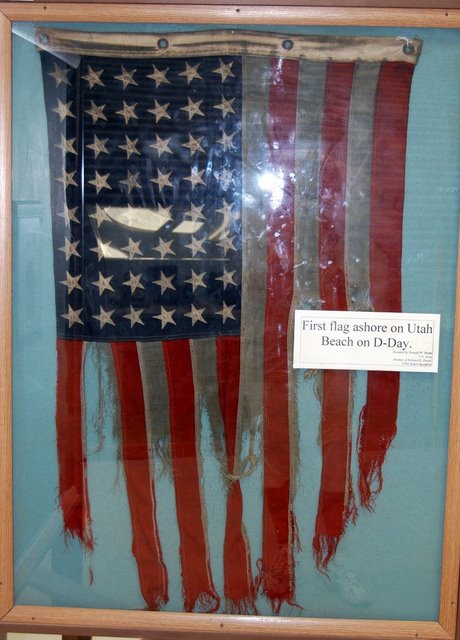
First Flag on Utah Beach, June 6, 1944

First U.S. flag on Utah Beach, Normandy, D-Day, June 6, 1944; Pima Air Museum, Tucson, Arizona

This mostly an encore post.  A reader sent an e-mail with a question:  Does U.S. law suggest the flying of the U.S. flag on the anniversary of D-Day?

Today is the 65th anniversary of the Invasion of Normandy in World War II, a date generally called D-DayNo, you don’t have to fly your flag. This is not one of the days designated by Congress for flag-flying.

But you may, and probably, you should fly your flag.  If you have any D-Day veterans in your town, they will be grateful, as will their spouses, children, widows and survivors. A 22-year-old soldier on the beach in 1944 would be 87 today, if alive.  These men and their memories of history fade increasingly fast.  Put your flag up.  You may be surprised at the reaction.

If you do run into a D-Day veteran, ask him about it.  Keep a record of what he says.

First Wave at Omaha:  The Ordeal of the Blue and the Gray by Ken Riley:  Behind them was a great invasion armada and the powerful sinews of war. But in the first wave of assault troops of the 29th (Blue and Gray) Infantry Division, it was four rifle companies landing on a hostile shore at H-hour, D-Day -- 6:30 a.m., on June 6, 1944. The long-awaited liberation of France was underway. After long months in England, National Guardsmen from Virginia, Maryland and the District of Columbia found themselves in the vanguard of the Allied attack. In those early hours on the fire-swept beach the 116th Infantry Combat Team, the old Stonewall Brigade of Virginia, clawed its way through Les Moulins draw toward its objective, Vierville-sur-Mer. It was during the movement from Les Moulins that the battered but gallant 2d Battalion broke loose from the beach, clambered over the embankment, and a small party, led by the battalion commander, fought its way to a farmhouse which became its first Command post in France. The 116th suffered more than 800 casualties this day -- a day which will long be remembered as the beginning of the Allies Great Crusade to rekindle the lamp of liberty and freedom on the continent of Europe.  Image from National Guard Heritage series, from which the caption was borrowed.

"First Wave at Omaha: The Ordeal of the Blue and the Gray" by Ken Riley: Behind them was a great invasion armada and the powerful sinews of war. But in the first wave of assault troops of the 29th (Blue and Gray) Infantry Division, it was four rifle companies landing on a hostile shore at H-hour, D-Day -- 6:30 a.m., on June 6, 1944. The long-awaited liberation of France was underway. After long months in England, National Guardsmen from Virginia, Maryland and the District of Columbia found themselves in the vanguard of the Allied attack. In those early hours on the fire-swept beach the 116th Infantry Combat Team, the old Stonewall Brigade of Virginia, clawed its way through Les Moulins draw toward its objective, Vierville-sur-Mer. It was during the movement from Les Moulins that the battered but gallant 2d Battalion broke loose from the beach, clambered over the embankment, and a small party, led by the battalion commander, fought its way to a farmhouse which became its first Command post in France. The 116th suffered more than 800 casualties this day -- a day which will long be remembered as the beginning of the Allies' "Great Crusade" to rekindle the lamp of liberty and freedom on the continent of Europe. Image from National Guard Heritage series, from which the caption was borrowed.


Quote of the moment: Eisenhower on D-Day (encore post)

June 5, 2009

Eisenhower talks to troops of invasion force, June 5 -- before D-Day[Encore post from 2007.]

Soldiers, Sailors, and Airmen of the Allied Expeditionary Force: You are about to embark upon the Great Crusade, toward which we have striven these many months. The eyes of the world are upon you.

Order of the Day, 6 June, 1944 (some sources list this as issued 2 June)


McCain on Eisenhower’s two letters

September 27, 2008

In the first of the 2008 debates between presidential candidates, Sen. John McCain pointed to Gen. Dwight Eisenhower’s two letters, written on the eve of the D-Day invasion in June 1944.  One letter would be released.  The first letter, the “Orders of the Day,” commended the troops for their work in the impending invasion, giving full credit for the hoped-for success of the operation to the men and women who would make it work.

The second letter was to be used if the invasion failed.  In it, Eisenhower commended the troops for their valiant efforts, but said that the failure had been in the planning — it was all Eisenhower’s fault.  (It was not a letter of resignation.)

You can find the first letter, the one that was released, through links at this post at the Bathtub, “Quote of the Moment:  Eisenhower at D-Day Eve.”

The second letter, you’ll find in image and text with links to other sources at this Bathtub post, “Quote of the Moment:  Eisenhower, duty and accountability.”  Last year I wrote:

In a few short sentences, Eisenhower commended the courage and commitment of the troops who, he wrote, had done all they could. The invasion was a chance, a good chance based on the best intelligence the Allies had, Eisenhower wrote. But it had failed.

The failure, Eisenhower wrote, was not the fault of the troops, but was entirely Eisenhower’s.

He didn’t blame the weather, though he could have. He didn’t blame fatigue of the troops, though they were tired, some simply from drilling, many from war. He didn’t blame the superior field position of the Germans, though the Germans clearly had the upper hand. He didn’t blame the almost-bizarre attempts to use technology that look almost clownish in retrospect — the gliders that carried troops behind the lines, the flotation devices that were supposed to float tanks to the beaches to provide cover for the troops (but which failed, drowning the tank crews and leaving the foot soldiers on their own).

There may have been a plan B, but in the event of failure, Eisenhower was prepared to establish who was accountable, whose head should roll if anyone’s should.

Eisenhower took full responsibility.

Our landings in the Cherbourg-Havre area have failed to gain a satisfactory foothold and I have withdrawn the troops. My decision to attack at this time and place was based upon the best information available. The troop, the air [force] and the navy did all that bravery and devotion to duty could do. If any blame or fault attaches to the attempt, it is mine alone.

Who in the U.S. command would write such a thing today?

It was a case of the Supreme Commander, Allied Forces, taking upon himself all responsibility for failure.

McCain has called for the resignation of the chairman of the Securities and Exchange Commission, which he points to as part of his plan for accountability.  The analogy fails, I think.  The proper analogy would be George Bush taking blame for the current financial crisis.  In his speech earlier this week, Bush blamed homebuyers, mortgage writers, bankers and financiers.  If Bush took any part of the blame himself, I missed it.

I wonder if McCain really understands the Eisenhower story.  I still wonder:  Who in the U.S. command would write such a thing today?


Interactive panoramic images of World War II sites

August 13, 2007

Spectacular images of World War II historical sites are available at two websites every history or geography teacher should have bookmarked, and use frequently.

The first is D-Day spots, which features satellite photo/map hybrids, and dozens of Quicktime interactive panoramas of dozens of sites all along the beaches of Normandy.

D-Day Spots image of Utah Beach

The panoramic images are made up of digital photos, usually very high quality, which would be useful images even were they not part of the interactive, panoramic feature; see the image of the West Pointe du Hoc cliffs at right.

West Utah Beach Many beach shots are there, of course — the panoramic images also include a few other sites around the beaches, and some of those images are spectacular all on their own, such as the interior of a local church, Sainte Mére-Eglise.

Sainte Mere-Eglise Church interior, D-Day Panoramas

The second site is Panoramas of World War II Landmarks 1945-2007.

These landmarks feature many battlefield sites, and they offer interactive, Quicktime panoramas of some sites that are not so well known as they ought to be, such as the graveyard at Al Alamein in Egypt (see photo below). To U.S. audiences, some of these sites may be relatively unknown — it’s a good excuse to explore the sites and get more familiar with the European view of World War II.

Al Alamein War Memorial, Egypt

This site also features photos of the war in the Pacific, with a series of photos from Hiroshima (see below), Nagasaki and Tokyo, but also including Pearl Harbor and Okinawa.

Integrating these sites into directed teaching should be easy, if you have a computer and projector. At the D-Day site, many of the panoramas are downloadable. For the Landmarks site, an active internet connection may be required.


Hiroshima, under the dome


Quote of the Moment: Eisenhower, duty and accountability

June 13, 2007

Eisenhower's unused

This quote actually isn’t a quote. It was never said by the man who wrote it down to say it. It carries a powerful lesson because of what it is.

A few days ago I posted Gen. Dwight Eisenhower’s “order of the day” to the troops about to conduct the Allied invasion of Normandy to establish the toehold in Europe the Allies needed to march to Berlin, and to end World War II in Europe. As a charge to the troops, it was okay — Eisenhower-style words, not Churchill-style, but effective enough. One measure of its effectiveness was the success of the invasion, which established the toe-hold from which the assaults on the Third Reich were made.

When Eisenhower wrote his words of encouragement to the troops, and especially after he visited with some of the troops, he worried about the success of the operation. It was a great gamble. Many of the things the Allies needed to go right — like weather — had gone wrong. Victory was not assured. Defeat strode the beaches of Normandy waiting to drive the Allies back into the water, to die. [Photo shows Eisenhower meeting with troops of the 101st Airborne Division, 502nd Parachute Infantry Regiment, on the eve of the invasion. It was these men whose courage he lauded. Update: Someone “took hostage” the photo I linked to — a thumbnail version is appended; I leave the original link in hopes it might be liberated] eisenhower-with-paratrooper-eve-of-d-day.jpg

Eisenhower wrote a second statement, a shorter one. This one was directed to the world. It assumed the assault had failed. In a few short sentences, Eisenhower commended the courage and commitment of the troops who, he wrote, had done all they could. The invasion was a chance, a good chance based on the best intelligence the Allies had, Eisenhower wrote. But it had failed.

The failure, Eisenhower wrote, was not the fault of the troops, but was entirely Eisenhower’s.

He didn’t blame the weather, though he could have. He didn’t blame fatigue of the troops, though they were tired, some simply from drilling, many from war. He didn’t blame the superior field position of the Germans, though the Germans clearly had the upper hand. He didn’t blame the almost-bizarre attempts to use technology that look almost clownish in retrospect — the gliders that carried troops behind the lines, the flotation devices that were supposed to float tanks to the beaches to provide cover for the troops (but which failed, drowning the tank crews and leaving the foot soldiers on their own).

There may have been a plan B, but in the event of failure, Eisenhower was prepared to establish who was accountable, whose head should roll if anyone’s should.

Eisenhower took full responsibility.

Our landings in the Cherbourg-Havre area have failed to gain a satisfactory foothold and I have withdrawn the troops. My decision to attack at this time and place was based upon the best information available. The troop, the air [force] and the navy did all that bravery and devotion to duty could do. If any blame or fault attaches to the attempt, it is mine alone.

Who in the U.S. command would write such a thing today?

  • The message may also be viewed here. Yes, it’s incorrectly dated July 5 — should have been June 5.

Quote of the Moment: Eisenhower at D-Day Eve

June 9, 2007

Eisenhower talks to troops of invasion force, June 5 -- before D-Day

Soldiers, Sailors, and Airmen of the Allied Expeditionary Force: You are about to embark upon the Great Crusade, toward which we have striven these many months. The eyes of the world are upon you.

Order of the Day, 6 June, 1944 (some sources list this as issued 2 June)


D-Day – fly your flag if you wish

June 6, 2007

Normandy landing, June 6, 1944, from an LST

D-Day landing taken by Chief Photographer’s Mate (CPHOM) Robert F. Sargent of the United States Coast Guard (USCG) Greatest Generation D-day landing

June 6, 2007, is the 63rd anniversary of D-Day, the massive invasion of Normandy by the U.S., Canada and Britain, Free France and Poland, to start the push toward final defeat of Germany in World War II (more formally known as the Battle of Normandy). Germany’s defeat would come ten months later.

The day is not formally listed by law as a day to fly the U.S. flag. Citizens may fly the flag on any day. Many veterans’ groups urge flying the flag today, especially in honor of the thousands who gave their lives in the invasion.

On the Allied side, 29,000 U.S. soldiers, 5,000 Canadian soldiers, 11,000 United Kingdom soldiers,  died between June 6 and August 25, 1944, the formal end of the battle.  France lost more than 12,000 civilians in the fight for freedom, too.

  • Photo: Assault landing One of the first waves at Omaha Beach as photographed by Robert F. Sargent. The U.S. Coast Guard caption identifies the unit as Company E, 16th Infantry, 1st Infantry Division.