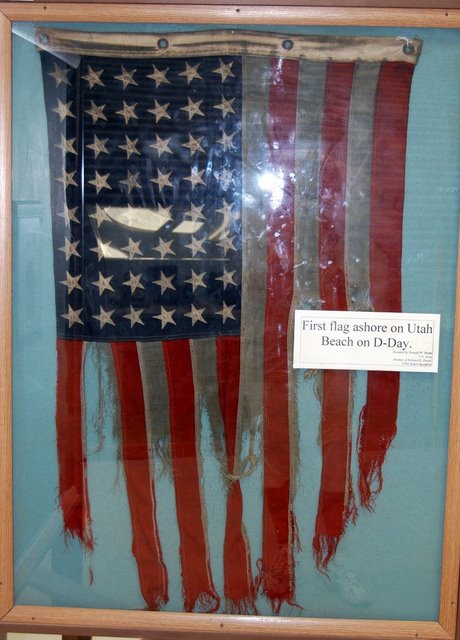
First U.S. flag on Utah Beach, Normandy, D-Day, June 6, 1944; Pima Air Museum, Tucson, Arizona
This mostly an encore post. A reader sent an e-mail with a question: Does U.S. law suggest the flying of the U.S. flag on the anniversary of D-Day?
Today is the 65th anniversary of the Invasion of Normandy in World War II, a date generally called D-Day. No, you don’t have to fly your flag. This is not one of the days designated by Congress for flag-flying.
But you may, and probably, you should fly your flag. If you have any D-Day veterans in your town, they will be grateful, as will their spouses, children, widows and survivors. A 22-year-old soldier on the beach in 1944 would be 87 today, if alive. These men and their memories of history fade increasingly fast. Put your flag up. You may be surprised at the reaction.
If you do run into a D-Day veteran, ask him about it. Keep a record of what he says.
- Image of flag, above: First U.S. flag on Utah Beach, at the Pima Air and Space Museum in Tucson, Arizona

"First Wave at Omaha: The Ordeal of the Blue and the Gray" by Ken Riley: Behind them was a great invasion armada and the powerful sinews of war. But in the first wave of assault troops of the 29th (Blue and Gray) Infantry Division, it was four rifle companies landing on a hostile shore at H-hour, D-Day -- 6:30 a.m., on June 6, 1944. The long-awaited liberation of France was underway. After long months in England, National Guardsmen from Virginia, Maryland and the District of Columbia found themselves in the vanguard of the Allied attack. In those early hours on the fire-swept beach the 116th Infantry Combat Team, the old Stonewall Brigade of Virginia, clawed its way through Les Moulins draw toward its objective, Vierville-sur-Mer. It was during the movement from Les Moulins that the battered but gallant 2d Battalion broke loose from the beach, clambered over the embankment, and a small party, led by the battalion commander, fought its way to a farmhouse which became its first Command post in France. The 116th suffered more than 800 casualties this day -- a day which will long be remembered as the beginning of the Allies' "Great Crusade" to rekindle the lamp of liberty and freedom on the continent of Europe. Image from National Guard Heritage series, from which the caption was borrowed.




[…] D-Day: 66 years ago today First U.S. flag on Utah Beach, Normandy, D-Day, June 6, 1944; Pima Air Museum, Tucson, Arizona […]
LikeLike
Great question. There is no exemption for historical artifacts in the flag code.
I suppose that means that if a flag desecration amendment is ever passed, the Pima Air and Space Museum and the Smithsonian Museum of American History — where the shards and shreds of the flag from Fort McHenry resides — among others, will have to be prosecuted.
In a rational world, we’d note that historical significance trumps the simple replacement of a tattered flag — and we might note that neither of these flags is flying as a symbol of our nation these days, a technical way out.
LikeLike
“When a flag is so worn it is no longer fit to serve as a symbol of our country, it should be destroyed by burning in a dignified manner.” — per U.S. flag etiquette
Special case for historical artifacts? Or is it that we still consider it fit to serve as a symbol of our country due to the special significance, despite its being worn?
Just askin’.
LikeLike
[…] sure to read the other posts in this series about Eisenhower’s Order of the Day: “D-Day, 65 years ago today,” and “Quote of the moment: Eisenhower, duty and […]
LikeLike