LBO of GOP complete, impeaching the hand that helped you

September 3, 2012

Steve Sack cartoon in the Minneapolis Star-Tribune

Steve Sack, Minneapolis Star-Tribune

Maureen Dowd, in the New York Times (and other venues), “Cruel Conservatives Throw a Masquerade Ball”:

As I wandered the hall Tuesday night, past cowboy hats and cheeseheads, I ran into Christopher Shays, a delegate and former congressman. I asked the Connecticut moderate if he felt lonely at the conservative masquerade ball.

He laughed and then said wistfully, “Our biggest crime was trying to impeach the one president who was working with us.”

[All links added here.]


Biden vs. Ryan, on a homeless guy

September 1, 2012

Oh, so THAT’s how you get a Tweet to look like a Tweet on a blog!

This isn’t real Biden vs. Ryan, though from my experience with Biden his side is pretty clear; and from what the GOP folk said from Tampa, Ryan’s side it pretty clear, too:

https://twitter.com/EdDarrell/status/241947670443343873

Obama’s tax proposal

August 16, 2012

The White House argues that the best path for the nation, right now, is to extend tax cuts for the middle class. Here’s a graphic with much of the arguments for the actions President Obama proposes (click image for a larger, more readable version):

White House graphic, Obama's tax plan

Click image for a larger version (one that is much more readable).


Taking from the poor to give to the rich, 1979-2007

August 14, 2012

For honest seekers of economic truth, the question about what went wrong that led to the recent great economic collapse has deep roots — but not complicated roots.

Our increases in wealth came at the expense of the poor and especially middle class, and they went to the tiny fraction of people at the very top who now own much of your nation.

Redistribution of wealth, Paul Krugman from CBO figures

Paul Krugman’s graphic of redistribution of wealth in the U.S., figures from the Congressional Budget Office

Our most vocal Nobel-winning economist, Paul Krugman noted at his blog:

The top quintile excluding the top 1 percent – which is basically the abode of the well-educated who aren’t among the very lucky few – has only kept pace with the overall growth in incomes. Just about all of the redistribution has taken place from the bottom 80 to the top 1 (and we know that most of that has actually gone to the top 0.1).

Much of our current difficulty in climbing out of recession can be told from this chart.  People who would normally be spending money for food, gasoline, clothing, cars, home repairs and incidentals, simply don’t have the money to spend.  Consequently, demand is down.  Consequently, the top 1% will not invest their money in the U.S. to meet that non-existent demand.  This is the ultimate failure of “supply-side” economics writ large.  The very rich can consume only so much.  Additional wealth stashed away, even in domestic accounts, will not be spent for more food, or more housing, or more transportation.  Even the very rich can eat only so much, travel so much, and few of them behave exactly like Saddam Hussein, with palaces they will never even see.  Meanwhile, the bottom 80%, which includes the middle class, lacks money to spend on education, housing, durable goods, and transportation — despite needing more of all of those things.

Below the fold, the CBO report’s highlights press release, from the Congressional Budget Office.

Read the rest of this entry »


Obama a socialist? You’re kidding, of course . . . Milos Forman

July 24, 2012

Wrote movie director Milos Forman, for The New York Times:

Milos Forman, PBS image

Milos Forman, PBS image, American Masters

When I was asked to direct One Flew Over the Cuckoo’s Nest, my friends warned me not to go anywhere near it. The story is so American, they argued, that I, an immigrant fresh off the boat, could not do it justice. They were surprised when I explained why I wanted to make the film. To me it was not just literature but real life, the life I lived in Czechoslovakia from my birth in 1932 until 1968. The Communist Party was my Nurse Ratched, telling me what I could and could not do; what I was or was not allowed to say; where I was and was not allowed to go; even who I was and was not.

Now, years later, I hear the word “socialist” being tossed around by the likes of Rick Perry, Newt Gingrich, Rick Santorum, Sean Hannity, Rush Limbaugh and others. President Obama, they warn, is a socialist. The critics cry, “Obamacare is socialism!” They falsely equate Western European-style socialism, and its government provision of social insurance and health care, with Marxist-Leninist totalitarianism. It offends me, and cheapens the experience of millions who lived, and continue to live, under brutal forms of socialism.

. . . Whatever his faults, I don’t see much of a socialist in Mr. Obama or, thankfully, signs of that system in this great nation.

Tip of the old scrub brush to Fred Clark writing at Slacktivist.

More information:


Mitt’s economic policy: Hair of the dog

July 7, 2012

As is often the case, Ben Sargent makes vague things crystal clear, in this case, Romney’s economic program:

Ben Sargent in the Austin American-Statesman, Romney's economic hair of the dog

Ben Sargent, in the Austin American-Statesman, May 17, 2012


Bush/Romney-onomics: Disaster redux?

July 2, 2012

BushRomney-onomics.  It worked so well in 2008, didn’t it?

Mike Peters in the Dayton Daily News - King Features Syndicate, "Miss me yet"

Mike Peters in the Dayton Daily News, and King Features Syndicate, May 25, 2012. Did your local newspaper carry this cartoon? Why not? Call them and ask.  More editorial cartoons, click the cartoon.

Peters’s editorial cartoons in the Dayton Daily News is one feature that distinguishes the newspaper, still, as one of America’s great daily papers.  Here’s to the editors who keep doing it right.


Romney’s record on improving employment, holding taxes down

June 16, 2012

George Santayana warned people “who cannot remember the past are condemned to repeat it.”

Don’t forget this history.  Forward to those you care about.


Tom Toles cartoon pegs ecoRomics

May 20, 2012

Tom Toles Cartoon

Tom Toles, for the Washington Post, May 18, 2012


Two presidents, 26 years: The Reagan/Obama plan

April 15, 2012

MoveOn.org wonders whether Warren Buffett is a time traveler.  I wonder about that old adage about an idea whose time has come.

I still think we need to pay more attention to making good jobs, and making jobs we have, pay better.   More taxpayers in the middle class reduces everyone’s tax burden and balances budgets.


Did taxpayers finance Romney’s wealth?

April 14, 2012

Mitt Romney’s fortune comes mostly from his work at Bain Capital Management.

Capital management?  What is capital management, exactly, you ask?

Prof. Robert Reich explained how private equity firms like Bain make their money, and fortunately MoveOn.org had a camera running when he did, “How exactly did Mitt Romney Get So Obscenely Rich? Robert Reich explains The Magic of Private Equity in 8 Easy Steps”:

Any questions?

Oh, I have one:  Prof. Reich, can you explain how Warren Buffett got so obscenely rich, and tell us the differences in the methods Buffett used, from those Romney used?

I have another question, too, but I’m not sure where to direct it:  Romney says he wants to “help out” the U.S. with his budgeting expertise; to whom does he expect to sell the U.S. government once he’s wrung out all the savings?

More, and Related articles:


More good news about the Affordable Care Act (Obamacare): CBO says it will save money

March 22, 2012

President Barack Obama's signature on the heal...

President Barack Obama's signature on the health insurance reform bill at the White House, March 23, 2010. The President signed the bill with 22 different pens. CBO projections in March 2012 indicate savings under the bill will increase beyond earlier projections, offsetting increased costs from continuing economics woes. (Photo credit: Wikipedia)

Remember, without the Affordable Care Act, the U.S. was experiencing health care cost inflation of about 15%annually.

You might not know it if you read conservative blogs, watch Fox News, or listen to the Republican candidates for president — all of whom seem to have their fact panties on wrong — but the Congressional Budget Office (CBO) projects the bill will reduce federal spending, still, even after accounting for recent changes in law and changes in the economy that will increase costs of the bill’s provisions.

Yeah, Obamacare saves money.

The new law will  not eliminate the problem of people not having insurance coverage to guarantee access to health care, a sad result of Republican efforts to cut the bill’s effectiveness.  But it’s a great first step to making America better, healthier, and economically more sound.  Here’s the blog post from the CBO discussing the bill, and CBO’s continuing studies of the effects of the law:

CBO Releases Updated Estimates for the Insurance Coverage Provisions of the Affordable Care Act

March 13, 2012

In preparing the March 2012 baseline budget projections, CBO and the staff of the Joint Committee on Taxation (JCT) have updated estimates of the budgetary effects of the health insurance coverage provisions of the Affordable Care Act (ACA)—the health care legislation enacted in March 2010. Those provisions:

  • Establish a mandate for most legal residents of the United States to obtain health insurance;
  • Create insurance “exchanges” through which certain individuals and families may receive federal subsidies to substantially reduce the cost of purchasing health insurance;
  • Significantly expand eligibility for Medicaid;
  • Impose an excise tax on certain health insurance plans with relatively high premiums;
  • Establish penalties on certain employers who do not provide minimum health benefits to their employees; and
  • Make other changes to prior law.

The most recent previous estimate of those effects was prepared in March 2011. For more details on the insurance coverage provisions of the ACA, you can see CBO’s cost estimate for the health care legislation, which was issued in March 2010.

The Estimated Net Cost of the Insurance Coverage Provisions Is Smaller Than Estimated in March 2011

CBO and JCT now estimate that the insurance coverage provisions of the ACA will have a net cost of just under $1.1 trillion over the 2012-2021 period-about $50 billion less than the agencies’ March 2011 estimate for that 10-year period. (For comparison with previous estimates, these numbers cover the 2012-2021 period; estimates including 2022 can be found below.)

The net costs–specifically the combined effects on federal revenues and mandatory spending–reflect:

  • Gross additional costs of $1.5 trillion for Medicaid, the Children’s Health Insurance Program (CHIP), tax credits and other subsidies for the purchase of health insurance through the newly established exchanges and related costs, and tax credits for small employers,
  • Offset in part by about $0.4 trillion in receipts from penalty payments, the new excise tax on high-premium insurance plans, and other budgetary effects (mostly increases in tax revenues).

Those amounts do not encompass all of the budgetary impacts of the ACA. They do not include federal administrative costs, which will be subject to future appropriation action. Also, they do not include the effects of the many other provisions of the law, including some that will cause significant reductions in Medicare spending relative to that under prior law and others that will generate added tax revenues relative those under prior law.

CBO and JCT have previously estimated that the ACA will, on net, reduce budget deficits over the 2012-2021 period; that estimate of the overall budgetary impact of the ACA has not been updated.

Gross Costs Are Higher, but Offsetting Budgetary Effects Are Also Higher

The current estimate of the gross costs of the coverage provisions—$1,496 billion through 2021—is about $50 billion higher than last year’s projection; however, the other budgetary effects of those provisions, which partially offset those gross costs, also have increased in CBO’s and JCT’s estimates—to $413 billion—leading to the small decrease in the net 10-year tally.

Over the 10-year period from 2012 through 2021, enactment of the coverage provisions of the ACA was projected last March to increase federal deficits by $1,131 billion, whereas the March 2012 estimate indicates that those provisions will increase deficits by $1,083 billion.

The net cost was boosted by:

  • An additional $168 billion in estimated costs for Medicaid and CHIP, and
  • $8 billion less in estimated revenues from the excise tax on certain high-premium health insurance plans.

But those increases were more than offset by a reduction of:

  • $97 billion in the projected costs for the tax credits and other subsidies for health insurance provided through the exchanges and related spending
  • $20 billion in the projected costs for tax credits for small employers, and
  • $107 billion in deficits from the projected revenue effects of changes in taxable compensation and penalty payments and from other small changes in estimated spending.

The Revisions in Estimates Reflect Legislative, Economic, and Technical Changes

The major sources for the differences between the March 2011 and March 2012 projections are the following:

  • New Legislation. Several laws were enacted during the past year that changed the estimated budgetary effects of the insurance coverage provisions of the ACA.
  • Changes in the Economic Outlook. The March 2012 baseline incorporates CBO’s macroeconomic forecast published in January 2012, which reflects a slower recovery when compared with the forecast published in January 2011 (which was used in producing the March 2011 baseline).
  • Technical Changes. The March 2012 baseline incorporates updated projections of the growth in private health insurance premiums, reflecting slower growth than the previous projections. In addition, CBO and JCT made a number of other technical changes in their estimating procedures.

The Number of the Nonelderly Uninsured Is Higher Than Previously Estimated

CBO and JCT’s projections of health insurance coverage have changed since last March. Fewer people are now expected to obtain health insurance coverage from their employer or in insurance exchanges; more are now expected to obtain coverage from Medicaid or CHIP or from nongroup or other sources. More are expected to be uninsured. The extent of the change in insurance coverage varies from year to year.

Compared with prior law, the ACA is now estimated by CBO and JCT to reduce the number of nonelderly people without health insurance coverage by 30 million to 33 million in 2016 and subsequent years, leaving 26 million to 27 million nonelderly residents uninsured in those years (see Table 3 at the end of the report). The share of legal nonelderly residents with insurance is projected to rise from 82 percent in 2012 to 93 percent in 2016 and subsequent years. That share rose to 95 percent in CBO and JCT’s previous estimate.

According to the current estimates, from 2016 on, between 20 million and 23 million people will receive coverage through the new insurance exchanges, and 16 million to 17 million additional people will be enrolled in Medicaid and CHIP as a result of ACA. Also, 3 million to 5 million fewer people will have coverage through an employer compared with the number under prior law

Estimates Through Fiscal Year 2022

This report also presents estimates through fiscal year 2022, because the baseline projection period now extends through that additional year. The ACA’s provisions related to insurance coverage are now projected to have a net cost of $1,252 billion over the 2012-2022 period; that amount represents a gross cost to the federal government of $1,762 billion, offset in part by $510 billion in receipts and other budgetary effects (primarily revenues from penalties and other sources).

The addition of 2022 to the projection period has the effect of increasing the costs of the coverage provisions of the ACA relative to those projected in March 2011 for the 2012-2021 period because that change adds a year in which the expansion of eligibility for Medicaid and subsidies for health insurance purchased through the exchanges will be in effect. CBO and JCT have not estimated the budgetary effects in 2022 of the other provisions of the ACA; over the 2012-2021 period, those other provisions were previously estimated to reduce budget deficits.

If we could get another stimulus program to goose the economy into quicker recovery, the cost savings would likely grow much faster.  What conservative budget chopper wouldn’t prefer that solution?

Barack Obama signing the Patient Protection an...

Barack Obama signing the Patient Protection and Affordable Care Act at the White House Español: Barack Obama firmando la Ley de Protección al Paciente y Cuidado de Salud Asequible en la Casa Blanca (Photo credit: Wikipedia)

How did your favorite media outlets report the CBO cost projections?

More, Resources (with help from Zemanta and WordPress):


Stimulus spending: Texans remember how the CCC helped save the nation

January 20, 2012

New video history piece from the Texas Parks & Wildlife people:

63

Uploaded by on Jan 17, 2012

The Civilian Conservation Corps provided jobs for over 3 million young men during the Great Depression and helped establish the foundation of our nation’s park system. 70 years after the creation of the CCC, Conservation Corps veterans reunite in one of the parks they helped build, sharing stories and rekindling old memories.

A pictorial map showing Texas State Parks with significant work performed by the CCC:

Map of Civilian Conservation Corps Legacy Parks in Texas - TPWD image

Map of Civilian Conservation Corps Legacy Parks in Texas - TPWD image - Click on map for original, larger version


Quote of the moment: Gold standard a “barbarous relic” – Keynes

January 18, 2012

Portrait of John Maynard Keynes as a younger man

Portrait of John Maynard Keynes as a younger man (who is the artist? where does it hang?)

  • In truth, the gold standard is already a barbarous relic.
    • John Maynard Keynes, Monetary Reform (1924), p. 172

    Did Keynes foresee the rise of Ron Paul, even in 1924?

    Gold Key, weighing one kilogram is used to acc...

More, resources:


Happy 254th birthday, Alexander Hamilton!

January 11, 2012

Today, January 11,  is Alexander Hamilton’s birthday — had he lived so long, he’d be 254 years old today!

Alexander Hamilton on the U.S. ten dollar note - Guardian image

Alexander Hamilton on the U.S. ten dollar note - Guardian image

But of course, the bullet from Aaron Burr’s gun cut Hamilton’s life short, after the duel in Weehawken, New Jersey. Hamilton died of the wound on July 12, 1804. He was 47 years old.

Had Hamilton survived the duel, would he have been elected president? Some people think so. In any case, Hamilton’s wise management of the new nation’s finances, and his establishment of the idea that government should have a working bank, and that good government is a key to economic success of a nation, leave a great legacy for the nation, and the world.

Hamilton’s portrait adorns the U.S. $10 bill.
Read Hamilton’s biography from the U.S. National Archives’ feature on “America’s Founding Fathers/Charters of Freedom” exhibit:

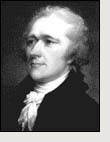
Alexander Hamilton

Alexander Hamilton

Hamilton was born in 1757 on the island of Nevis, in the Leeward group, British West Indies. He was the illegitimate son of a common-law marriage between a poor itinerant Scottish merchant of aristocratic descent and an English-French Huguenot mother who was a planter’s daughter. In 1766, after the father had moved his family elsewhere in the Leewards to St. Croix in the Danish (now United States) Virgin Islands, he returned to St. Kitts while his wife and two sons remained on St. Croix.

The mother, who opened a small store to make ends meet, and a Presbyterian clergyman provided Hamilton with a basic education, and he learned to speak fluent French. About the time of his mother’s death in 1768, he became an apprentice clerk at Christiansted in a mercantile establishment, whose proprietor became one of his benefactors. Recognizing his ambition and superior intelligence, they raised a fund for his education.

In 1772, bearing letters of introduction, Hamilton traveled to New York City. Patrons he met there arranged for him to attend Barber’s Academy at Elizabethtown (present Elizabeth), NJ. During this time, he met and stayed for a while at the home of William Livingston, who would one day be a fellow signer of the Constitution. Late the next year, 1773, Hamilton entered King’s College (later Columbia College and University) in New York City, but the Revolution interrupted his studies.

Although not yet 20 years of age, in 1774-75 Hamilton wrote several widely read pro-Whig pamphlets. Right after the war broke out, he accepted an artillery captaincy and fought in the principal campaigns of 1776-77. In the latter year, winning the rank of lieutenant colonel, he joined the staff of General Washington as secretary and aide-de-camp and soon became his close confidant as well.

In 1780 Hamilton wed New Yorker Elizabeth Schuyler, whose family was rich and politically powerful; they were to have eight children. In 1781, after some disagreements with Washington, he took a command position under Lafayette in the Yorktown, VA, campaign (1781). He resigned his commission that November.

Hamilton then read law at Albany and quickly entered practice, but public service soon attracted him. He was elected to the Continental Congress in 1782-83. In the latter year, he established a law office in New York City. Because of his interest in strengthening the central government, he represented his state at the Annapolis Convention in 1786, where he urged the calling of the Constitutional Convention.

In 1787 Hamilton served in the legislature, which appointed him as a delegate to the convention. He played a surprisingly small part in the debates, apparently because he was frequently absent on legal business, his extreme nationalism put him at odds with most of the delegates, and he was frustrated by the conservative views of his two fellow delegates from New York. He did, however, sit on the Committee of Style, and he was the only one of the three delegates from his state who signed the finished document. Hamilton’s part in New York’s ratification the next year was substantial, though he felt the Constitution was deficient in many respects. Against determined opposition, he waged a strenuous and successful campaign, including collaboration with John Jay and James Madison in writing The Federalist. In 1787 Hamilton was again elected to the Continental Congress.

When the new government got under way in 1789, Hamilton won the position of Secretary of the Treasury. He began at once to place the nation’s disorganized finances on a sound footing. In a series of reports (1790-91), he presented a program not only to stabilize national finances but also to shape the future of the country as a powerful, industrial nation. He proposed establishment of a national bank, funding of the national debt, assumption of state war debts, and the encouragement of manufacturing.

Hamilton’s policies soon brought him into conflict with Jefferson and Madison. Their disputes with him over his pro-business economic program, sympathies for Great Britain, disdain for the common man, and opposition to the principles and excesses of the French revolution contributed to the formation of the first U.S. party system. It pitted Hamilton and the Federalists against Jefferson and Madison and the Democratic-Republicans.

During most of the Washington administration, Hamilton’s views usually prevailed with the President, especially after 1793 when Jefferson left the government. In 1795 family and financial needs forced Hamilton to resign from the Treasury Department and resume his law practice in New York City. Except for a stint as inspector-general of the Army (1798-1800) during the undeclared war with France, he never again held public office.

While gaining stature in the law, Hamilton continued to exert a powerful impact on New York and national politics. Always an opponent of fellow-Federalist John Adams, he sought to prevent his election to the presidency in 1796. When that failed, he continued to use his influence secretly within Adams’ cabinet. The bitterness between the two men became public knowledge in 1800 when Hamilton denounced Adams in a letter that was published through the efforts of the Democratic-Republicans.

In 1802 Hamilton and his family moved into The Grange, a country home he had built in a rural part of Manhattan not far north of New York City. But the expenses involved and investments in northern land speculations seriously strained his finances.

Meanwhile, when Jefferson and Aaron Burr tied in Presidential electoral votes in 1800, Hamilton threw valuable support to Jefferson. In 1804, when Burr sought the governorship of New York, Hamilton again managed to defeat him. That same year, Burr, taking offense at remarks he believed to have originated with Hamilton, challenged him to a duel, which took place at present Weehawken, NJ, on July 11. Mortally wounded, Hamilton died the next day. He was in his late forties at death. He was buried in Trinity Churchyard in New York City.

Image: Courtesy of The National Portrait Gallery, Smithsonian Institution

Post mostly borrowed, with express permission, from Mr. Darrell’s Wayback Machine.

Remember to watch for progress on “The Alexander Hamilton Mixtape,” a hip-hop version of Alexander Hamilton’s life by Lin-Manuel Miranda, seen here performing Aaron Burr’s soliloquey, at the White House.
