Legislation by Sen. Leland Yee, D-San Francisco, seeks to protect the nation’s largest public school population from the revised social studies curriculum approved in March by the Texas Board of Education. Critics say if the changes are incorporated into textbooks, they will be historically inaccurate and dismissive of the contributions of minorities.
* * * * * *
Under Yee’s bill, SB1451, the California Board of Education would be required to look out for any of the Texas content as part of its standard practice of reviewing public school textbooks. The board must then report any findings to both the Legislature and the secretary of education.
The bill describes the Texas curriculum changes as “a sharp departure from widely accepted historical teachings” and “a threat to the apolitical nature of public school governance and academic content standards in California.”
“While some Texas politicians may want to set their educational standards back 50 years, California should not be subject to their backward curriculum changes,” Yee said. “The alterations and fallacies made by these extremist conservatives are offensive to our communities and inaccurate of our nation’s diverse history.”
Bully for California and Rep. Leland Yee.
Tip of the old scrub brush to HeyMash.
Spread the word; friends don't allow friends to repeat history.
Social studies curricula climb the scaffold to the gallows set by the “conservative” majority of the Texas State Board of Education today. If they get their way — and signs are they will — they will hobble social studies education for at least a half generation.
As The Dallas Morning News explains this morning, lame-duck board members fully intend to change Texas and American culture with their rewriting of history, de-emphasis of traditional history education, and insertion of what they consider pro-patriotic ideas in social studies.
AUSTIN – When social conservatives on the State Board of Education put the final touches on social studies curriculum standards this week, it will be a significant victory in their years-long push to imprint their beliefs upon what Texas students learn.
We in the part-time blogosphere can’t cover the meeting as it deserves — nor have we been able to mobilize pro-education forces to do what was needed to stop the board — yet.
McLeroy will make the most of his remaining time on the panel. He proposed several additions to the social studies standards for the board to consider this week. One would require students to “contrast” the legal doctrine of separation of church and state with the actual wording in the Bill of Rights that bars a state-established religion.
McLeroy has resurrected the old Cleon Skousen/David Barton/White Supremecist argument that “separation of church and state” does not appear in the Constitution, disregarding what the document and its amendments actually say. Jefferson warned that such discussions poison children’s education, coming prematurely as this one would be as McLeroy wants it.
Watch that space. Tony Whitson at Curricublog will cover it well, and probably timely — read his stuff. Steve Shafersman’s work will be informative. The Texas Tribune offered great coverage in the past. Stay tuned. And the Texas Freedom Network carries the flag and works hard to recruit the troops and keep up morale.
It is discouraging. Under current history standards, Texas kids should know the phrase “shot heard ’round the world,” but they do not get exposure to the poem from which the phrase comes, nor to the poet (Emerson), nor exposure to Paul Revere whose ride inspired Longfellow later to write a poem that children have read ever since — except in Texas.
But under the new standards, Texas children will learn who Phyllis Schlafly is. Patriots are out; hypocrites and demagogues are in.
Spread the word; friends don't allow friends to repeat history.
Republicans in Maine voted to scrap the Republican platform and write a new one — not enough unholy discrimination in the old one, too much Eisenhower, too much Lincoln, or something like that. The convention spilled out into a local middle school for some of the platform writing shenanigans.
In one 8th grade classroom, the Maine Republicans found something they objected to, something they don’t want taught to 8th graders: The U.S. Constitution.
The Republicans were particularly incensed by a poster showing a collage used to open a project assigned to the Portland 8th graders. The 8th graders make poster collages elaborating on the Four Freedoms speech of Franklin Roosevelt, and the accompanying posters by Norman Rockwell. Norman Rockwell. You know. The guy who started his professional career as art director for the Boy Scouts of America . . .
“Brainwashing” the Republicans called U.S. history. Brainwashing.
Speaking of the children, they got into the act Tuesday after a note from “a Republican” was found in Clifford’s classroom. “A Republican was here,” it read. “What gives you the right to propagandize impressionable kids?”
Responded eighth-grader Lilly O’Leary, one of several students who sent e-mails to this newspaper decrying the behavior of their weekend guests, “I am not being brainwashed in his class under any circumstances. I am being told that I have the right to my own opinion.”
She added, “These people were adults and they were acting very immaturely.”
Remember when Republicans used to complain that we can’t jail flag-burning protesters? When did those guys get kicked out of the party, and who are these new thugs?
When did it become the Re-Poe-blican Party? When did they take up the Blackshirt tactics?
C’mon, Republicans. Come back to America. Repent now.
And — as for us Texans? This is the stuff Don McLeroy wants to see happen in Texas social studies standards — vandalism of the U.S. Constitution and American law and tradition.
As a Scouter, as a teacher, as a fan of the U.S. Constitution, I’m concerned. Should I be scared?
“I saw nothing in the room — and nobody pointed out anything in the room — that appeared to give a more balanced view,” [Knox County Republican Party Chairman William] Chapman said.
[Teacher Paul] Clifford and the school’s principal, Mike McCarthy, pointed out in media accounts that the posters were part of projects on freedom and free expression. [Bangor Daily News]
Maine Public Broadcast Network coverage of the story — Republicans have apologized. The main story notes that collages from Mr. Clifford’s classes will go on display at the Portland Public Library on June 4. Watch for Tea Party protesters.
Norman Rockwell, poster of his paintings on the Four Freedoms (Library of Congress image). This is part of what the Maine Tea Party Republicans objected to.
Keith Tucker, WhatNowToons.com, via Tennessee Guerrilla Women
In a series of articles at George Mason University’s History News Network, historians from Texas and across the nation make a powerful case against the changes in social studies standards proposed by the politicians at the Texas State Board of Education.
Together, this is a powerful indictment of the actions of the SBOE, and strong repudiation of the raw political purposes and tactics employed in the War on Education by the “conservative” faction, including especially lame duck, anti-education crusader/jihadist Don McLeroy.
I get e-mail, this time from the Texas Freedom Network:
The State Board of Education meeting is next week, and we need YOU to make a difference.
“Am I a religious fanatic? Absolutely. You’d have to be to do what I do.”
– State Board of Education member Don McLeroy
Don't White Out Our History! - Texas Freedom Network
Is this who you want to decide what Texas schoolchildren learn? Or would you rather entrust that task to someone who believes public education is a “tool of perversion,” as board member Cynthia Dunbar believes? Or maybe any one of the board members who believe the separation of church and state is a myth?
If this is not what you want for Texas children, NOW is the critical time to take a stand.
The controversial social studies curriculum process is coming to an end. Public testimony will be heard at the State Board of Education meeting on Wednesday, May 19, and we expect a vote on these standards to take place the following day. We need you to stand up to the State Board of Education by attending our rally on Wednesday, May 19. Or testifying in front of the board. Or both!
Also on Wednesday, the State Board of Education will hear public testimony on the social studies curriculum standards. Since you are already planning to be at the William B. Travis building for the rally, you can also sign up to testify! Read below for more information on registering to testify with the Texas Education Agency. (Testimony will begin in the morning and likely stretch into the evening — so if you wish to testify, be prepared for a long day.)
We look forward to seeing you next week. If you have any questions, e-mail Judie or call us at 512-322-0545.
Spread the word; friends don't allow friends to repeat history.
“This country doesn’t value teachers, and that upsets me,” she said. “Teachers don’t earn much, and this country worships making money. In China, teachers don’t earn a lot either, but it’s a very honorable career.”
Ms. Zheng said she spent time clearing up misconceptions about China.
“I want students to know that Chinese people are not crazy,” she said. For instance, one of her students, referring to China’s one-child-per-family population planning policy, asked whether the authorities would kill one of the babies if a Chinese couple were to have twins.
Some students were astonished to learn that Chinese people used cellphones, she said. Others thought Hong Kong was the capital.
Barry Beauchamp, the Lawton superintendent, said he was thrilled to have Ms. Zheng and two other Chinese instructors working in the district. But he said he believed that the guest teachers were learning the most from the cultural exchange.
I get e-mail from the NAACP; the rest of the nation is paying attention to the follies run by the conservative bureaucrats at the SBOE:
Ed,
I wouldn’t want to be a Texas State Board member this week.
Last week, we asked you to write to your representative, telling him or her that rewriting Texas history textbooks is ignorant and unpatriotic.
Over 1,500 people have already written in, filling the inboxes of our school leaders.
This week, we’d like to offer you one more chance to get involved. The NAACP is planning rallies, hearings and press conferences in Texas to stop the state board from rewriting history. But we can’t do it without you.
An issue as controversial as rewriting history elicits strong emotions, and we want to give you the chance to speak out. Do you have something you would like to say at the hearing?
The NAACP works to ensure equal rights and to eliminate discrimination against all racial and ethnic groups. The proposed changes to our textbooks threaten our mission. This is not about Republicans or Democrats — it’s about our shared history as Texans. That’s why we want to use the words of our Texas supporters to turn the tide.
The Texas textbook vote is just two weeks away, so we need to push ourselves harder now than ever before.
The future of our children’s education is in the hands of just a few State Board members. Your voice could be the one to tip the scale.
Take a moment to tell us what you think about the Texas State Board rewriting history. The best submissions will be read at the hearing on May 19th.
I first met Ravitch a couple of decades ago when I worked for Checker Finn at the Office of Educational Research and Improvement. Ted Bell’s idea of a commission to look at education quality, and it’s 1983 report, saved the Reagan administration and assured Reagan’s reelection in 1984. She was one of the most prodigious and serious thinkers behind education reform efforts, then a close friend of Finn (who was Assistant Secretary of Education for Research) — a position that Ravitch herself held in the administration of George H. W. Bush.
Ravitch now criticizes the end result of all that turmoil and hard work, the No Child Left Behind Act, and the way it has distorted education to keep us in the crisis we were warned of in 1983. Then, the “rising tide of mediocrity” came in part because we didn’t have a good way to compare student achievement, state to state. Today, the mediocrity is driven by the tests that resulted from legislative efforts to solve the problem.
Conditions in education in America have changed. We still have a crisis after 27 years of education reform (how long do we have a crisis before it becomes the norm), but for the first time, Ravitch said, “There is a real question about whether public education will survive.” The past consensus on the value of public education and need for public schools, as I would put it, now is challenged by people who want to kill it.
“The new issue today: Will we have a public education system bound by law to accept all children.”
Ironic, no? The No Child Left Behind Act has instead created a system where many children could be forced to the rear.
I took an evening in the middle of a week of TAKS testing — the Texas Assessment of Knowledge and Skills. With ninth through twelfth grades, we had four days of testing which essentially requires the shutdown of the education for the week (we had Monday to review for the test). It was a week to reflect on just how far we have strayed from the good intentions of public education advocates who pushed the Excellence in Education Commission’s report in 1983.
Ravitch spoke for over an hour. I’ll have more to report as I get caught up, after a month of meetings, test prep, testing, and little sleep.
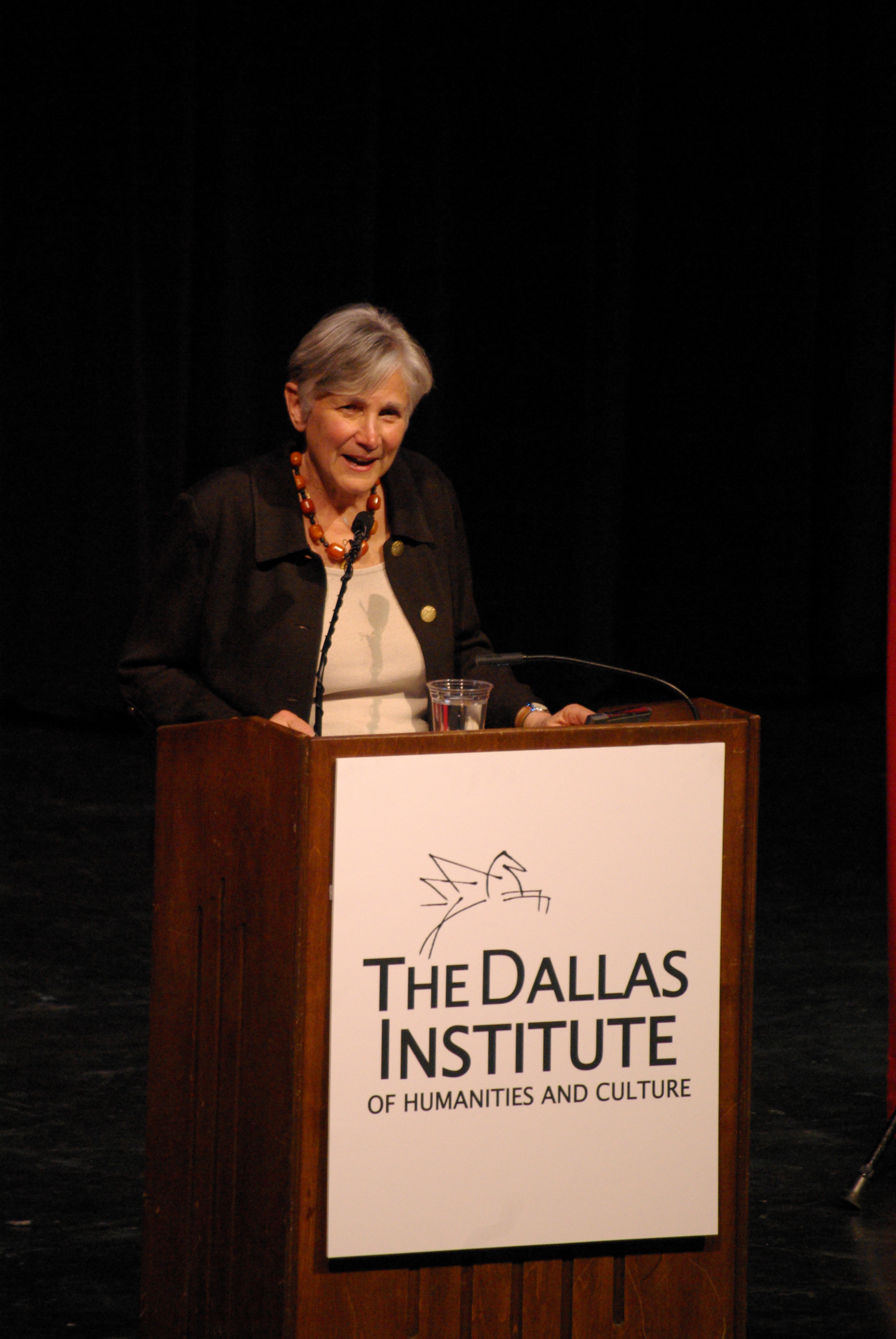
Dr. Diane Ravitch, one of the principal education theorists behind the No Child Left Behind Act, will speak twice in Dallas over the next two days — telling how NCLB is not working
Both public events, tonight at 7:00 p.m., and Thursday at the Dallas Institute of Culture and Humanities, are sponsored by the Dallas Institute.
Note that registration is required for tonight’s session:
To All Staff RE: The Dallas Institute of Culture and Humanities presents: Education Forum: What Makes a Good Education?
Two Public Events: Wednesday, April 28, at 7 p.m., and Thursday, April 29, at 7 p.m.
Wednesday, April 28, 2010, 7 p.m. Evening Forum and Book Signing at the Booker T. Washington High School for the Performing and Visual Arts Montgomery Arts Theater, 2501 Flora Street, Dallas, 75201
Keynote Speaker: Dr. Diane Ravitch, Education Historian
In this age of productivity models and minimum standards, the topic of a good education often
gets lost, but it evokes the century-long quarrel between the practical and the academic
curricula in our public discourse. Today, if we want to build a school system that will serve our
youth not only in their schooling but throughout life, we need to place what makes a good education
at the center of our discussion.
Beginning this conversation during our inaugural Education Forum are two noted authorities in the teaching profession: Dr. Diane Ravitch and Dr. Louise Cowan
Dr. Diane Ravitch, one of the nations leading education historians and author of the
#1 bestselling book on education, The Death and Life of the Great American School System: How Testing and Choice Are Undermining Education.
In it, Dr. Ravitch explains why she is recanting many of the views she held as U.S. Assistant Secretary of Education. Based on the data, she claimed in a recent interview on The Diane Rehm show, the remedies are not working and will not give us the educated citizens that we all want. Dr. Ravitch will explore what makes a good education and how to fulfill our commitment to a democratic future.
Dr. Louise Cowan, a Founding Fellow of the Dallas Institute and former dean at the University of Dallas, created the Institutes nationally recognized Teachers Academy programs from her vision of what makes a good education. For 27 years, these programs have challenged area school teachers to assume their full authority and responsibility as teaching professionals.
SEATING FOR THE EVENING FORUM IS LIMITED – ADMISSION BY RESERVATION ONLY
Teachers Admission – $15 / General Admission – $25
Deadline to register is noon, Wednesday, April 28.
If you’re teaching world history, or art, or government, or environmental science, or geography, this might be a great blog to track.
Senegal is a very interesting place. Note on the map how it completely surrounds its neighbor nation of The Gambia.
Senegal, map courtesy of the U.S. Federal Aviation Administration (FAA)
France held the nation as a colony once upon a time, from 1850 to independence of the Mali Federation in 1960 — one of the national languages is French, but regional languages are numerous, Wolof, Soninke, Seereer-Siin, Fula, Maninka, and Diola. The Mali Federation was short-lived, and Senegal broke off in August of 1960.
If you listen to NPR, you’ve probably heard their reporter signing off in that distinct way she does, “Tthis is Ofeibea Quist-Arcton, for NPR, in Dah-KAHHH!” (Not to be confused with Dacca, Pakistan).
The French colonies of Senegal and the French Sudan were merged in 1959 and granted their independence as the Mali Federation in 1960. The union broke up after only a few months. Senegal joined with The Gambia to form the nominal confederation of Senegambia in 1982, but the envisaged integration of the two countries was never carried out, and the union was dissolved in 1989. The Movement of Democratic Forces in the Casamance (MFDC) has led a low-level separatist insurgency in southern Senegal since the 1980s, and several peace deals have failed to resolve the conflict. Nevertheless, Senegal remains one of the most stable democracies in Africa. Senegal was ruled by a Socialist Party for 40 years until current President Abdoulaye WADE was elected in 2000. He was reelected in February 2007, but has amended Senegal’s constitution over a dozen times to increase executive power and weaken the opposition, part of the President’s increasingly autocratic governing style. Senegal has a long history of participating in international peacekeeping and regional mediation.
The country is tropical, hot and humid. Geographically, it is low, rolling plains.
Dakar is about as far west as one can go on the African continent. (See the map inset — Senegal is in dark green).
Senegal has iron ores, and phosphorus (ancient bird droppings?). It’s not a rich nation, but it’s better off than many developing countries.
Adkins is in for a great adventure, no?
Africa, showing Senegal - CIA Factbook
Spread the word; friends don't allow friends to repeat history.
Utah has a movement out to slander education and the Constitution, with a pointless claim that the Constitution cannot be called a “democracy,” damn Lincoln, Hamilton, Madison, Washington, both Roosevelts, and Reagan.
Sadly, it started in my old school district, the one where I got the last nine years of public school education, Alpine District, in the north end of Utah County.
They even have a website, Utah’s Republic. (No, Utah was never an independent republic before it was a state — it’s not like the Texas Republic wackoes, except in their wacko interpretations of law and history, where they are indistinguishable.)
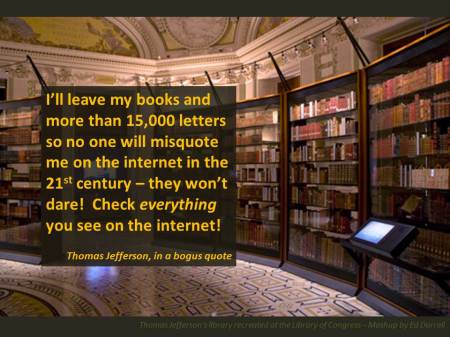
Can you vouch for any of these “quotes?” Is any one of them accurate?
The Jefferson “mob rule” quote isn’t in any Jefferson data base that I can find. I find it also attributed to George Washington — but almost always without any citation, so you can’t check.
That maneuver is one of the key indicators of Bogus Quotes, the lack of any citation to make it difficult to track down. All of these quotes come without citation:
As for a moral people, Washington said there could be no morality without religion and called it the “indispensable support,” not education. Obviously Jefferson and the Founders wanted education of the constitution to take place but we are very far removed from it in our education system.
Democracy… while it lasts is more bloody than either aristocracy or monarchy. Remember, democracy never lasts long. It soon wastes, exhausts, and murders itself. There is never a democracy that did not commit suicide. – John Adams
A democracy is nothing more than mob rule, where fifty-one percent of the people may take away the rights of the other forty-nine. – Thomas Jefferson
The democracy will cease to exist when you take away from those who are willing to work and give to those who would not. – Thomas Jefferson
Democracy is two wolves and a lamb voting on what to have for lunch. Liberty is a well-armed lamb contesting the vote. – Benjamin Franklin
Democracy is the most vile form of government… democracies have ever been spectacles of turbulence and contention: have ever been found incompatible with personal security or the rights of property: and have in general been as short in their lives as they have been violent in their deaths. – James Madison
As I would not be a slave, so I would not be a master. This expresses my idea of democracy. – Abraham Lincoln
The last one is probably accurate, but irrelevant to this discussion (nice red herring, there, Oak). Can you offer links to verify any of them?
Is this what I suspect? The “Utah Republic” drive is not only a tempest in a teapot (though perhaps caused by other more serious maladies), but also a tempest based on false readings of history?
Funny: Nowhere do these guys discuss one of the greatest drivers of the republic, over more egalitarian and more democratic forms of government. Remember, Hamilton preferred to have an aristocracy, an elite-by-birth group, who would rule over the peasants. He didn’t trust the peasants, the people who he saw as largely uneducated, to make critical decisions like, who should be president. Norton doesn’t trust the peasants to get it right, and so he wants to dictate to them what they are supposed to know, in Nortonland.
Just because Oak Norton slept through high school history and government is no reason to shut down Utah’s Alpine School District or any other school; he’s not offered much evidence that everyone else missed that day in class, nor evidence that it has any significant effect.
Jefferson’s advice on quotes found on the internet, backdropped by his books now held by the Library of Congress.
Spread the word; friends don't allow friends to repeat history.
Jeff Danziger cartoon, for the New York Times Syndicate, on Texas State Board of Education “changes” to Texas social studies texts.
People for the American Way have joined the fight for good education in Texas, pushing better social studies education standards. The Texas State Board of Education will conduct final votes on social studies standards in May.
Grotesque slashes damaged social studies standards in the last round of amendments. Conservatives will probably try to keep secret their proposed changes, offering a flurry of last-minute amendments carefully designed to gut serious education and make the standards work as indoctrination for young conservatives instead.
PFAW has good reason to fear. Here’s their letter. from PFAW President Michael Keegan:
Dear People For Supporter,
Thomas Jefferson banned in Texas schools? Maybe… if the Right has its way. The fight is still on to keep absurd changes out of the Texas social studies textbook standards, with the final standards set to be adopted by the Texas State Board of Education (SBOE) on May 21.
Right-wing members of the SBOE are using the textbook standards in Texas to rewrite history in a way that could impact students across the U.S., tossing out facts in favor of propaganda like:
America is a Christian country, founded on “Biblical principles.”
Conservative icons from Ronald Reagan to Newt Gingrich, Phyllis Schlafly, the Moral Majority and even Sen. Joseph McCarthy are history’s “good guys,” but progressives and progressive values are at odds with what it means to be “American.”
Words like “democracy” (sounds like “Democrat!”) have nothing to do with America — we’re a Republic — In fact, “capitalism” has sort of a negative connotation to some, so they want that word to be universally replaced with “free market.”
Some of the major contributions of Thomas Jefferson — arguably America’s greatest thinker — are on the chopping block, as are the contributions of other important figures not favored by the zealots on the Texas State Board of Education, like Cesar Chavez and Thurgood Marshall. (Who’s next? Martin Luther King? FDR?)
Texas is just ground zero for what is clearly a national effort. We need to make sure that whatever standards are adopted in Texas, they do not affect the social studies textbooks used by students in other states.
The Texas State Board of Education traditionally has tremendous power in determining the content of textbooks not only for Texas students but for students across the U.S. Texas reviews and adapts textbook standards for the major subjects every six years, and because of the size of the state’s market, textbook publishers often print books consistent with the Texas standards. Last year, they attracted national ridicule for trying to inject creationism into science textbooks. This year, they’re voting on social studies standards.
The right-wing majority on the State Board wants indoctrinate Texas students into this new perverse revisionist history. PFAW is supporting our allies on the ground in Texas who are working to make sure students have the chance to learn history as it occurred, not how the Far Right wish it had happened. But we need to do all we can to make sure this is not exported to other states and school districts as well. Help us take extremism out of textbook decision making and let our children learn the truth in the classroom.
“Follow the Money” is a video summarizing the results from the project by Northwestern University grad students Daniel Grady and Christian Thiemann. Using data from the website Where’s George?, they have been able to track the movement of U.S. paper currency. What can you learn from this? That there are natural borders within the U.S. that don’t necessarily follow state borders, and it can also be used to predict the spread of disease because it maps movement of people within the U.S.
From Maria Popova on BrainPickings.org: This may sound like dry statistical uninterestingness, but the video visualization of the results is rather eye-opening, revealing how money — not state borders, not political maps, not ethnic clusters — is the real cartographer drawing our cultural geography. The project was a winner at the 2009 Visualization Challenge sponsored by the National Science Foundation and AAA.
I am forever grateful for that nameless White female, who, in her clunky shoes and calf-length tweed skirts, passed out poems on mimeograph paper to her first-grade students. When talking to students myself, I often tell the story of the very prim and ebony Mrs. Covington who challenged her junior high school English class to memorize “Invictus” before telling us who had authored the poem.
Words to teach by. “Invictus?” You know it, even if you don’t think you do.
Out of the night that covers me,
Black as the pit from pole to pole,
I thank whatever gods may be
For my unconquerable soul.
In the fell clutch of circumstance
I have not winced nor cried aloud.
Under the bludgeonings of chance
My head is bloody, but unbowed.
Beyond this place of wrath and tears
Looms but the Horror of the shade,
And yet the menace of the years
Finds and shall find me unafraid.
It matters not how strait the gate,
How charged with punishments the scroll,
I am the master of my fate:
I am the captain of my soul.
At the age of 12, Henley became a victim of tuberculosis of the bone. A few years later, the disease progressed to his foot, and physicians announced that the only way to save his life was to amputate directly below the knee. It was amputated at the age of 25. In 1867, he successfully passed the Oxford local examination as a senior student. In 1875, he wrote the “Invictus” poem from a hospital bed. Despite his disability, he survived with one foot intact and led an active life until his death at the age of 53.
Signe Wilkinson, Philadelphia Daily News, March 17, 2010 - Texas education board cuts Enlightenment from curriculum
Signe Wilkinson cartoons for the Philadelphia Daily News. She won a Pulitzer for political cartoons in 1992, the first woman to win that award (about time!).
Spread the word; friends don't allow friends to repeat history.
Or, until that account is unsuspended by the forces supporting Donald Trump: Follow @FillmoreWhite, the account of the Millard Fillmore White House Library
We've been soaking in the Bathtub for several months, long enough that some of the links we've used have gone to the Great Internet in the Sky.
If you find a dead link, please leave a comment to that post, and tell us what link has expired.
Thanks!
Retired teacher of law, economics, history, AP government, psychology and science. Former speechwriter, press guy and legislative aide in U.S. Senate. Former Department of Education. Former airline real estate, telecom towers, Big 6 (that old!) consultant. Lab and field research in air pollution control.
My blog, Millard Fillmore's Bathtub, is a continuing experiment to test how to use blogs to improve and speed up learning processes for students, perhaps by making some of the courses actually interesting. It is a blog for teachers, to see if we can use blogs. It is for people interested in social studies and social studies education, to see if we can learn to get it right. It's a blog for science fans, to promote good science and good science policy. It's a blog for people interested in good government and how to achieve it.
BS in Mass Communication, University of Utah
Graduate study in Rhetoric and Speech Communication, University of Arizona
JD from the National Law Center, George Washington University


 Posted by Ed Darrell









 Millard Fillmore's Bathtub