Encore post: Recognizing bogus history, 2

July 3, 2007

Editor’s Note:  I’m traveling this week, celebrating our independence 231 years on.  While mostly out of pocket, I’ll feature some encore posts, material that deserves another look to keep it from fading from memory.  This post, below, is the second of a two-part series from August 2006.

Recognizing bogus history, 2

Bogus history infects political discussions more than others, though there are some areas where bogus history strays into the realm of science (false claims that Darwin and Pasteur recanted, for example).

1. The author pitches the claim directly to the media or to organizations of non-historians, for pay.

Historians are detectives, and they like to share what they find. One historian working in the papers of one figure from history will find a letter from another figure, and pass that information on to the historian working on the second figure. Historians teach history, write it up for scholarly work, and often spin it in more fascinating tales for popular work. Most years there are several good works competing for the Pulitzer Prize in history. Academic historians, those tied to universities and other teaching institutions, join societies, attend meetings, and write their material in journals — all pitched to sharing what they have learned.

Bogus historians tend to show up at conferences of non-historians. Douglas Stringfellow’s tales of World War II derring do were pitched to civic clubs, places where other historians or anyone else likely to know better, generally would not appear (Stringfellow’s stories of action behind enemy lines in World War II won him several speaking awards, and based on his war record, he was nominated to a seat in Congress for Utah, in 1952, which he won; a soldier who knew Stringfellow during the war happened through Salt Lake City during the 1954 re-election campaign, and revealed that Stringfellow’s exploits were contrived; he was forced to resign the nomination). Case in point: David Barton speaks more often to gun collectors than to history groups.

2. The author says that a powerful establishment is trying to suppress his or her work.

Sen. Joseph McCarthy insisted that anyone who opposed his claims that communists dominated certain government agencies, or that any given person was a communist, was because those who challenged him were, themselves, part of the greater conspiracy, trying to silence him. Utah Sen. Arthur V. Watkins, who chaired the committee that recommended censure for Sen. McCarthy, lost his own re-election campaign in 1958 in part to the belief by Utah voters that such a conspiracy existed and had succeeded in suppressing McCarthy.

But there was no organized campaign against McCarthy.  Individual Americans, spurred by patriotism, the Boy Scout Law, or just a sense that truth is valuable, spoke up against him, time and again in many different forums.  Sen. Watkins powerfully opposed communism.  Later historians found any truth in McCarthy’s claims against the State Department and other government agencies, and his critics, got there accidentally, below the usual levels of coincidence.

3. The sources that verify the new interpretation of history are obscure; if they involve a famous person, the sources are not those usually relied on by historians.

Most internet hoaxes simply don’t list sources. Bogus quotes circulating that have been attributed to Madison, Jefferson, Washington, Lincoln, and others, often list a year, and nothing else. When I staffed the Senate, several times a year I’d get letters to work on with claims that the Supreme Court had ruled in 1892 that the U.S. is, officially, a “Christian nation.” Usually there there was no case name attached, but I came to understand that the case referred to was the Church of the Holy Trinity vs. U.S. 1892 was far enough back that it was a difficult case for people outside of a decent law library to get — and then, it is couched in 1892 legalese, which makes it difficult to understand. It is an obscure enough case that most of the time it won’t be checked out. If the case can be produced, rarely will it be among lawyers who can interpret what happened from the fog of the language of the decision. The case is not listed at the Cornell University Law School’s on-line Legal Information Institute, nor at Findlaw.com — the databases they rely on go back to 1893. There is a full text copy at the Justicia website. [This was written in 2007.]

The case involved a law that prohibited the importing of laborers, and the Court ruled that the law probably was not intended to apply to a white, white collar worker, a preacher from England (the law was probably aimed at Chinese workers, coming as it did in that time when immigration from China was prohibited). It appears from the case that the church had argued some First Amendment justification to be exempt, and the U.S. Solicitor General had argued in response that the First Amendment requires the courts to assume that the government is hostile to religion; Justice David Brewer wrote at length about how the nation had accommodated religion over the years, especially Christianity, in dismissing the Solicitor General’s argument (he did not accept the church’s argument, either). This sort of writing is called obiter dicta in legal studies — words of an opinion wholly unnecessary to the decision. The case is cited rarely, and never for its religious “ruling,” because that was not what was ruled, and the language was not applied as law then, nor has it been since.  The Supreme Court ruled that importing preachers from England was not covered by the law. The ruling makes no mention of religion.

A bit of reflection on what really happened in history should make this clear: Consider the effect of such a ruling by the Supreme Court on later cases involving textbooks, busing of parochial students, student prayer, Bible readings, etc. Had such a precedent existed, lawyers would have sniffed it out regardless its obscurity.

4. Evidence for the history is anecdotal.

America’s founders carefully wrote laws that assure religious freedom, largely by creating a separation of state and church. To those unhappy with such a separation, every utterance of a founder in which God is praised, or invoked in any way, becomes “proof” that the founders did not mean what they wrote in the laws. Anecdote trumps any other evidence, to these people.
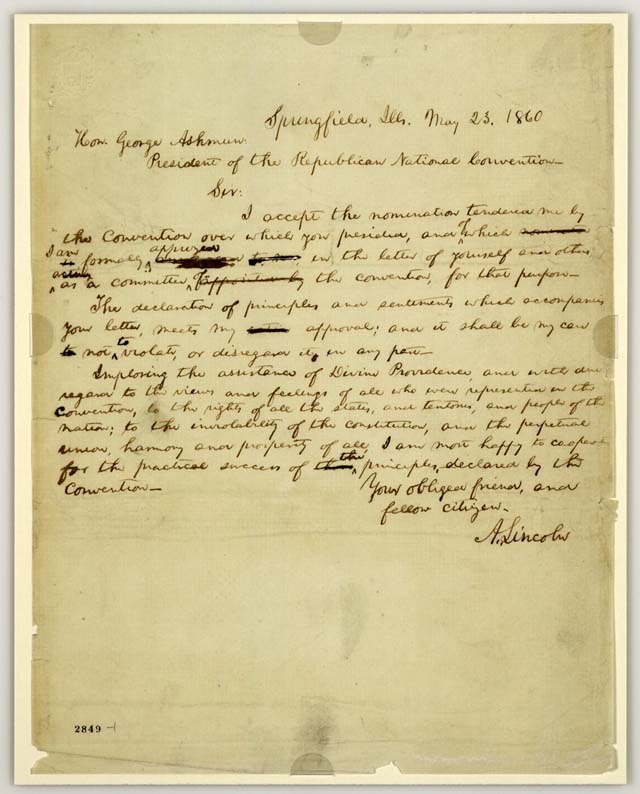
Abraham Lincoln's letter to the president of the Republican National Convention of 1860, accepting the convention's nomination for the presidency.

Abraham Lincoln’s letter to the president of the Republican National Convention of 1860, accepting the convention’s nomination for the presidency. It was written, you will note, from Springfield, Illinois, 200 miles away from Chicago where the convention was held.

To prove to me the piety of Abraham Lincoln, a fellow showed me photograph of a plaque on a church in Chicago, said to be the church where Abraham Lincoln said his prayers every morning during the Republican Convention of 1860, at which Lincoln got the nomination for president. Other records — newspapers, Lincoln’s letters and other documents, show that, as was the fashion in 1860, Lincoln did not attend the convention in Chicago, but as a candidate for president, stayed at home in Springfield, nearly 200 miles away.

Most real history can be read in documents, and does not need to rely on folk retellings exclusively.

5. The author says a belief is credible because it has endured for some time, or because many people believe it to be true.

Faced with the evidence that a dozen quotes he had attributed to figures such as James Madison, George Washington and Patrick Henry were whole cloth inventions, Texas quote-purveyor David Barton issued a statement urging people not to rely on them because they were “questionable.

A great example of belief triumphing over fact presents itself as the Cardiff Giant, now on display at the Farmers’ Museum in Cooperstown, New York (go visit when you visit the Baseball Hall of Fame). After an argument with a cleric over whether the Bible’s claim that giants once existed, a tobacconist named George Hull hired stonecarvers to carve a giant; then he hired a farmer to bury the carving on his farm, and claim to have struck it when planting. Once discovered the “petrified man” was put on display, for a fee. Hull got lucky: Syracuse businessmen offered to buy it from him for an enormous sum.

Paleontologist Othniel Marsh inspected it on display, and pronounced it a hoax. For some odd reason, that increased the popularity of the attraction. Carnival and side show entrepreneur P. T. Barnum offered $60,000 for the carving, but was refused. Barnum then had a plaster replica made and put on display. The owners of the original hoaxed carving sued, but the suit was thrown out because they could not demonstrate the “genuineness” of their own hoax.  Barnum made more money than the original.  A hoaxed hoax is even more popular than the truth.

A photo (staged?) of the 1869 unearthing of the Cardiff Giant (Cardiff, New York). Photograph courtesy Farmers Museum via Associated Press, and via National Geographic.

A photo (staged?) of the 1869 unearthing of the Cardiff Giant (Cardiff, New York). Photograph courtesy Farmers Museum (where the carving now rests, on display to museum visitors)  via Associated Press, and via National Geographic.

6. The author has worked in isolation.

Historians often help each other. Good historians put out queries to many sources, the better to assure accuracy. So, conversely, if there are only a few people who know anything about an account, that fact alone may cause suspicion. Clifford Irving’s hoax biography of Howard Hughes, while remarkably accurate in some regards, was unraveled when enough people familiar with Hughes called the bluff — including, of course, Hughes himself. The book got as far as it did with extreme secrecy on Irving’s part. Working alone makes error easier, and is essential for intentional frauds.

7. The author must propose a new interpretation of history to explain an observation.

Various conspiracy claims require that key people act counter to their known character. If Franklin Roosevelt had “allowed” Pearl Harbor to occur in order to get the U.S. into war, his actions over the previous six years to support Britain start to make little sense. Had Lyndon Johnson been part of a conspiracy to assassinate John Kennedy, his later carrying out the legislative plan of Kennedy runs contrary to all such motivations. If the founders of the U.S. actually intended to make Christianity the state religion, their efforts to disestablish the churches in all 13 colonies, efforts to write bills of rights for each state including freedom of religion, and efforts to create the First Amendment in the Bill of Rights seem like incredible, repeated errors.

Bogus history is much like the conjectured problems that result from time travel: Change one jot of history, and there is a cascading effect on later events. In many cases,were the bogus histories accurate, what follows could not be so, and we wouldn’t be here to discuss it.

Those are the seven warning signs of bogus history. Bogus, or voodoo history should be suspected if two or more of the signs are present — though it is quite possible for actual history to show more than two signs (perhaps actual history could show all seven signs — but I’d have to see an example before stating it’s so).

More:


Dembski’s blog caught hoaxing again

June 30, 2007

An acquaintance sends word he’s happy to be back in the mountains with his hammer again, breaking rocks as a geologist in support of a mining venture. The price of gold is high, a few advances in technology have helped the process, and our friend was tapped by suits with money to help keep the actual gold mining operation in the proper vein, so to speak.

Mining is best done with a good scientist on hand to make sure the hole dug out is done right, and to be sure that the digging keeps going for the genuine nuggets.

William Dembski’s blog, Uncommon Descent, has no scientists with any geology training, it appears. But again they’ve been mining, for quotes instead of useful ore, and they’ve come up with fool’s information. Unable to tell the difference between fool’s information and the real stuff, they’ve published the fool’s information for the world to see.

A wise person does not allow fool’s information into one’s information banks. Read the rest of this entry »


Fisking “Junk Science’s” campaign FOR the poison DDT, against Rachel Carson: Point #8, mosquito resistance to DDT

June 29, 2007

This is the second in a series of Fisks of “100 things you should know about DDT,” a grotesquely misleading list of factoids about DDT put up a site called JunkScience.com. While one would assume that such a site would be opposed, this particular site promotes junk science. I’m not taking the points in order.The “100 things” list is attributed to Steven Milloy, a guy who used to argue that tobacco use isn’t harmful, and who has engaged in other hoaxes such as the bizarre and false claim that Compact Fluorescent Lightbulbs (CFLs) can pose serious toxic hazards in your home (and therefore, you should continue to waste energy with less efficient bulbs); and to J. Gordon Edwards, a San Jose State University entomologist who, despite being a great entomologist, was a bit of a nut on some political things; Edwards assisted Lyndon Larouche’s group in their campaign against Rachel Carson before his death in 2004. (Did Edwards actually have a role in the development of this list?)

100 things you should know about DDT

Claim #8. Some mosquitoes became “resistant” to DDT. “There is persuasive evidence that antimalarial operations did not produce mosquito resistance to DDT. That crime, and in a very real sense it was a crime, can be laid to the intemperate and inappropriate use of DDT by farmers, especially cotton growers. They used the insecticide at levels that would accelerate, if not actually induce, the selection of a resistant population of mosquitoes.”

[Desowitz, RS. 1992. Malaria Capers, W.W. Norton & Company]

Cover of The Malaria Capers, by Robert S. Desowitz

Cover of The Malaria Capers, by Robert S. Desowitz

This was what Rachel Carson warned about. Indiscriminate use of DDT, such as broadcast application on crops to kill all insect, arthropod or other pests, would lead to mosquitoes and other dangerous insects developing resistance to the chemical. Of course, resistance developed as a result of overspraying of crops has exactly the same result, in the fight against malaria, as overuse in the fight against malaria.  Cover of The Malaria Capers, by Robert S. Desowitz

Worse, such overuse also killed predators of mosquitoes, especially birds. In an integrated pest management program, or in a well-balanced ecosystem, birds and other insect predators would eliminate a large number of mosquitoes, holding the population in check and preventing the spread of malaria. Unfortunately, when the predators are killed off, the mosquitoes have a population explosion, spreading their range, and spreading the diseases they carry.

Assuming Milloy quoted the book accurately, and assuming the book actually exists, this point says nothing in particular in favor of DDT; but it reaffirms the case Rachel Carson made in her 1962 book, Silent Spring. Contrary to suggestions from the campaign against Rachel Carson, she urged that we limit use of DDT to tasks like preventing malaria, around humans, to preserve the effectiveness of DDT and prevent overspraying.

And then, there is this: Milloy doesn’t bother to quote the first part of the paragraph he quotes, on page 214 of Malaria Capers. Here is what the paragraph actually says:

There were a number of reasons for the failure, not least that the anophaline vector mosquitoes were becoming resistant to the action of DDT both physiologically — they developed the enzymes to detoxify the insecticide — and behaviorally — instead of feeding and wall-resting, they changed in character to feed and then quickly bugger off to the great outdoors. [from this point, Milloy quotes correctly]

In other words, the DDT-based campaign against malaria failed because DDT failed; mosquitoes became resistant to it.  DDT’s declining ability to kill mosquitoes is one of the major reasons DDT use plunged after 1963, and continues to decline to no use at all.

To combat the dastardly campaign of calumny against Rachel Carson and science, you should also read: Deltoid, here, here and here, and the rest of his posts on the topic; Bug Girl, here, at least, and here, and the rest of her posts; denialism, here; and Rabett Run, here.

Save

Save


Cold, Clear and Deadly

June 28, 2007

Title of a book that documents and discusses the omnipresence of DDT and related pesticides in waters all over the world, even in places far from any known application, such as the Arctic and Antarctic.

Author Melvin J. Visser wrote a tribute to Rachel Carson at his blog, also called Cold, Clear and Deadly.

Cover of Cold, Clear and Deadly, by Melvin J. Visser.  Michigan State University Press

Cover of Cold, Clear and Deadly, by Melvin J. Visser. Michigan State University Press; at Thrift Books

More:


Didn’t know insanity is contagious: Sen. Tom Coburn

June 27, 2007

Several outbursts of insanity in Washington, D.C., lately make one wonder if there is some contagious disease that prompts these outbursts.

Although, I must admit, this outburst was before the Cheney/Snow claims that the nation’s chief executive and vice chief executive are not executive branch members.

In a flash of irony that shattered irony meters across libraries, laboratories and the research facilities in Oklahoma universities, Oklahoma’s U.S. Sen. Tom Coburn placed a hold on the bill to name a post office in honor of Rachel Carson, accusing Carson of “junk science.” What Coburn failed to say — or, God forbid, failed to notice — is that the criticisms of Carson are truly junk science.

In the Washington Post Coburn offered this inexplicable explanation:

In a statement on his Web site yesterday, Coburn (R) confirmed that he is holding up the bill. In the statement, he blames Carson for using “junk science” to turn public opinion against chemicals, including DDT, that could prevent the spread of insect-borne diseases such as malaria, which is spread by mosquitoes.

Coburn, whose Web site says he is a doctor specializing in family medicine, obstetrics and allergies, said in the statement that 1 million to 2 million people die of malaria every year.

“Carson was the author of the now-debunked ‘The Silent Spring,’ ” Coburn’s statement reads. “This book was the catalyst in the deadly worldwide stigmatization against insecticides, especially DDT.”

This issue is arcane enough that history aficionados reading may not be fully aware of the problems with Coburn’s claims. Let me explain.

First, Carson didn’t complain about insecticides, but instead pointed out that overuse of some insecticides is damaging to the environment, and ultimately frustrates their use as intended. As Carson pointed out, DDT was ceasing to be effective in the fight against malaria due to this overuse. In other words, Carson’s advocacy, if it was as effective as Coburn imagines, saved DDT as an effective tool in the fight against malaria. But Coburn blames her for the opposite. It’s as if he were treating a kid who fell out of a tree, and he blamed the broken arm on a cold virus, because the kid’s nose was running.

Second, DDT is a deadly killer. It’s not like DDT is perfectly harmless. Carson, using studies by insecticide manufacturers and entomologists accumulated over the previous 20 years, pointed out that broadcast use of DDT to protect cotton from boll weevils not only failed to protect the cotton, it also endangered humans. Overuse of any insecticide tends to drive evolution of resistance in the insects targeted, and this is exactly what happened, and what Carson reported. That’s not junk science in any form. It’s accurate, real science, that benefits humans.

Had Carson’s book not appeared when it did, it is quite possible, maybe even likely, that it would have been rendered completely useless against insects.

But even worse, animals don’t evolve resistance as quickly as insects can, and the levels of DDT and its daughter compounds were multiplied in living things as they were higher in a local food chain. DDT is absorbed into living tissues very effectively, so it does not remain floating about, say, in the water of a swamp where it is sprayed for mosquitoes. Instead it is absorbed by other insects, by plants, and then by the animals that consume those insects and plants, and then by the predators at the top of the food chains. Carson was way ahead of her time in understanding this relationship, but the science at the time supported her conclusions exactly, and every study done since then has reinforced Carson’s reporting of the scientific conclusions.

This was important because, as concentrated especially in birds, DDT and its daughters cause eggs to be non-viable, and it even changes the behaviors of birds in raising their young. DDT kills the next generation of birds. It is especially deadly against raptors at the top of the food chain — America’s symbol, the bald eagle, for example, was driven to the brink of extinction by DDT — but it also kills the songbirds which, in a well-balanced ecosystem, keep mosquito populations down and prevent the spread of mosquito-borne diseases like malaria or dengue fever.

So DDT use, as Sen. Coburn appears to defend it, would have left the world malaria and mosquito-ridden, exactly the opposite of his claims.

Third, Carson’s book has been verified in hundreds of studies. To call it “debunked” is either a total purchase of junk science, or a dastardly distortion of the the facts. Carson worried that DDT might be a cause of cancer, a carcinogen. Knowledge of carcinogens was so limited when she wrote that Congress and the medical establishment — two groups Coburn belongs to — endorsed the Delaney Clause to the Food and Drug Act in 1957, ordering that nothing that caused cancer be allowed as an additive in foods or food supplements. This seems almost naive today, when we know that some things, like selenium, are both essential nutrients and carcinogenic, and when we can detect vanishingly small traces of carcinogens in almost everything. Carson called our attention to potential dangers of DDT.

And, it turns out, she was mostly right about DDT and cancer. The good news is that DDT is not a potent carcinogen in humans that we know. Coburn appears to rest his entire case on a misunderstanding of that last sentence. Anti-Carson screeds tend to note that DDT has not been found to be a major cause of breast cancer in women. While true, that study leaves these facts: DDT is a known carcinogen in mammals (and we know of no carcinogen that affects other mammals that is not also a carcinogen for humans, who are mammals); DDT’s effects would be expected to show up in liver cancer, because DDT is a toxin and toxins damage the liver even as the organ does its job in cleaning the toxin out; DDT is a known toxin to human livers, causing liver damage leading to liver disease. Liver disease is a frequent precursor to liver cancer. We need more studies, but it is simply false to say that we know DDT is not a carcinogen. DDT is a carcinogen; the only thing we don’t know is how potent it is in humans.

So here we have Sen. Coburn, an MD in the Senate, a man who has the training of a scientist, a guy who used to practice medicine, helping people avoid things that harm or kill them, falling victim to junk science claims about Rachel Carson and her work, and DDT and what it does, and how it does it.

It ain’t the things we don’t know that get us into trouble, some wag once said: It’s the things we know that ain’t so.

Perhaps you could drop Dr. Coburn a letter, gently inform him of the facts, and ask that he release the hold on honoring Rachel Carson, winner of the Presidential Medal of Freedom, the woman who saved DDT from becoming a useless limb in the war against insect-borne disease? It would be the patriotic thing to do.


Insanity spreads through Article II agencies

June 26, 2007

From the Chicago Tribune:

White House press secretary Tony Snow said the president and vice president are not executive “agencies” and are therefore not covered under the executive order, but he stopped short of placing Cheney exclusively in the legislative branch. Snow He said the vice president has served “in an executive capacity delegated to him by the president” and noted that, constitutionally “there are no specified executive activities for the vice president,” and that his role “is a wonderful academic question.”

Chicago Tribune, “Emanuel seeks to cut funding for Cheney’s office, home,” June 26, 2007

Constitution of the United States, Article II, Section 1:

The executive Power shall be vested in a President of the United States of America. He shall hold his Office during the Term of four Years, and, together with the Vice President, chosen for the same Term, be elected, as follows . . .


Rachel Carson’s honor defended

June 25, 2007

Bug Girl sleuthed around a bit, and found information from official sources that really demonstrates the critics of Rachel Carson are using Gillette Foamy to make us think “mad dog!”

DDT concentration in the food chain - USFWS

Chart from US Fish and Wildlife Service (USFWS) illustrates biomagnification, by which a minuscule dose of DDT to small plankton gets magnified a few million times by the time the top predators in the food chain get it.

So the evidence continues to pile up that Rachel Carson was simply a fine writer, a good scientist, and correct about DDT’s dangers.

Check out the Fish and Wildlife Service’s site, here; notice especially their structure of the site, to dispel the falsehoods.

FWS quotes Carson on DDT use:

In Audubon magazine she wrote, “We do not ask that all chemicals be abandoned. We ask moderation. We ask the use of other methods less harmful to our environment” (4). Countering claims that she was advocating a back-to-nature philosophy, she said, “We must have insect control. I do not favor turning nature over to insects. I favor the sparing, selective and intelligent use of chemicals. It is the indiscriminate, blanket spraying that I oppose” (5).

Evidence mounts that claims against Rachel Carson are sheer calumny. While the political motivations of this smear campaign are not clear, we don’t need to know for certain who is telling lies about a great American hero, or why. As Americans, as concerned citizens, as teachers and parents — as patriots — we only need to know that the claims against Rachel Carson are false.

And now it is our duty to call on Oklahoma’s Sen. Tom Coburn to stop the campaign against Carson. Coburn is the point man in the smear campaign right now: He has put a committee hold on the well-intentioned, justified bill to name a post office in her hometown after Rachel Carson. It is time for Tom Coburn to stand up and do the right thing for a great American. Sen. Coburn needs to lift his committee hold and allow committee action on this minor honor.

Other sources of note:

Bruce Watson, “Sounding the Alarm,” Smithsonian Magazine, September 2002. (Watson, Bruce. Sounding the alarm. Smithsonian, v. 33, Sept. 2002: 115-117.   AS30.S6)

“The Berry and the Poison,” about methyl bromide and its ban, Smithsonian Magazine, December 1997.


Quote of the Moment: Barry Commoner and presidential campaigns

June 19, 2007

Barry Commoner turned 90 on May 28. He is profiled in The New York Times Science section on June 19, 2007 (if your local newspaper has a science section half as good, I’d love to hear about it). Commoner is a plant physiologist and great eminence at Washington University in St. Louis for 34 years, now at Queens College. He was a key informant of public opinion during the rise of ecological awareness in the 1960s and 1970s, probably the nation’s best known “ecologist.”

Barry Commoner on cover of Time, 2-2-1970

In 1980 he helped found the Citizens’ Party, and ran for the presidency their ticket.

He explained to the Times:

The peak of the campaign happened in Albuquerque, where a local reporter said to me, “Dr. Commoner, are you a serious candidate or are you just running on the issues?”

Time Magazine cover from February 2, 1970; Time sells replicas of historic covers.


Quote of the Moment: Eisenhower, duty and accountability

June 13, 2007

Eisenhower's unused

This quote actually isn’t a quote. It was never said by the man who wrote it down to say it. It carries a powerful lesson because of what it is.

A few days ago I posted Gen. Dwight Eisenhower’s “order of the day” to the troops about to conduct the Allied invasion of Normandy to establish the toehold in Europe the Allies needed to march to Berlin, and to end World War II in Europe. As a charge to the troops, it was okay — Eisenhower-style words, not Churchill-style, but effective enough. One measure of its effectiveness was the success of the invasion, which established the toe-hold from which the assaults on the Third Reich were made.

When Eisenhower wrote his words of encouragement to the troops, and especially after he visited with some of the troops, he worried about the success of the operation. It was a great gamble. Many of the things the Allies needed to go right — like weather — had gone wrong. Victory was not assured. Defeat strode the beaches of Normandy waiting to drive the Allies back into the water, to die. [Photo shows Eisenhower meeting with troops of the 101st Airborne Division, 502nd Parachute Infantry Regiment, on the eve of the invasion. It was these men whose courage he lauded. Update: Someone “took hostage” the photo I linked to — a thumbnail version is appended; I leave the original link in hopes it might be liberated] eisenhower-with-paratrooper-eve-of-d-day.jpg

Eisenhower wrote a second statement, a shorter one. This one was directed to the world. It assumed the assault had failed. In a few short sentences, Eisenhower commended the courage and commitment of the troops who, he wrote, had done all they could. The invasion was a chance, a good chance based on the best intelligence the Allies had, Eisenhower wrote. But it had failed.

The failure, Eisenhower wrote, was not the fault of the troops, but was entirely Eisenhower’s.

He didn’t blame the weather, though he could have. He didn’t blame fatigue of the troops, though they were tired, some simply from drilling, many from war. He didn’t blame the superior field position of the Germans, though the Germans clearly had the upper hand. He didn’t blame the almost-bizarre attempts to use technology that look almost clownish in retrospect — the gliders that carried troops behind the lines, the flotation devices that were supposed to float tanks to the beaches to provide cover for the troops (but which failed, drowning the tank crews and leaving the foot soldiers on their own).

There may have been a plan B, but in the event of failure, Eisenhower was prepared to establish who was accountable, whose head should roll if anyone’s should.

Eisenhower took full responsibility.

Our landings in the Cherbourg-Havre area have failed to gain a satisfactory foothold and I have withdrawn the troops. My decision to attack at this time and place was based upon the best information available. The troop, the air [force] and the navy did all that bravery and devotion to duty could do. If any blame or fault attaches to the attempt, it is mine alone.

Who in the U.S. command would write such a thing today?

  • The message may also be viewed here. Yes, it’s incorrectly dated July 5 — should have been June 5.

Accuracy, more valuable than gold

June 13, 2007

When was the last time you saw something like this, “This is the way science should always work,” in a history journal?

If it were your error, would you be big enough to publicize it loud and far, as Dr. Hall has done?

Is there some medal for honesty that we could award Dr. Hall?


What’s the difference between school and prison?

June 5, 2007

Kevin Siers of the Charlotte Observer, in the Star-Courier, Highlands-Crosby, Texas, March 11, 2004

Give up?

Yeah, often the students give up, too. If you don’t know the answer, your school may resemble a prison.

Gary Stager’s post with jarring comparisons is here, at District Administration’s Pulse! blog. [District Administration purges its archives about every three years, it turns out; here is a copy of Mr. Stager’s column courtesy the Wayback Machine – Internet Archive.]

When the elder Fillmore’s Bathtub son attended intermediate school, he complained of the discipline. So did a lot of other good kids. We got a call from a parent asking if we’d join in a meeting with the new principal, and hoping to learn things were really hunky dory and offer assurances to our son, we went.

Read the rest of this entry »

Typewriter of the Moment: Legal clip art for the classroom

June 5, 2007

Royal Typewriter, from legal clip art

Visit Clipart ETC for a great collection of clipart for students and teachers.

There you go: Legal clip art, properly attributed (though not necessarily properly footnoted — that’s another topic). How can you get more licensed clip art? See below the fold.

Read the rest of this entry »


Voting machine soap opera: Fire, faulty machines, new election?

May 19, 2007

City elections in Aurora, Texas, may need to be re-run after spectacular failures of two of three Diebold voting machines, and a fire that damaged the impounded units after 38 votes were completely erased and Diebold technicians were unable to hack results out of their own machines. Do you even need to be told the fire’s cause is undetermined?

Is your local government considering voting machines with no paper back up?

The voting machines don’t work even when there isn’t a great partisan prize at stake; the first explanation from the Justice Department for mess-ups in personnel there is that dismissed people were not aggressively enough pursuing a campaign against minority voting; a federal conviction of a campaign worker in Wisconsin turns out to have been a bogus case created by a U.S. attorney appointed to bring exactly such bogus cases . . .

How great must the assault on the Constitution and rights of Americans be, before there is a general clamor for justice, and change?


Honoring heroes: Armed Forces Day 2007

May 19, 2007

1951 poster for Armed Forces Day

May 19, 2007, is Armed Forces Day. Fly your U.S. and state flags today.

Great Irony: The Defense Department website for Armed Forces Day is not exactly up to date, and suffers from lack of attention (just try to find events in your area from the page set up to do just that).

Which only makes the point: We have to support our troops — heaven knows the current government isn’t going to. Write a letter to the troops; join an event run by your local American Legion or Veterans of Foreign Wars — or an event to support the troops in a way the American Legion and VFW don’t support, but which is okay, too. Fly your flag. Do the right thing to honor those we send into harm’s way, for little pay and not enough thanks. (That site is much better maintained than the Armed Forces Day site.)

History stuff for classrooms, below the fold. Read the rest of this entry »


War on science: Spinning DDT, slandering the dead

May 17, 2007

What rational person would have thought irrationality could be in such surplus?

My post on the silly opposition to naming a post office after Rachel Carson produced a minor response. Reader Electratig took me to task at his blog.

Criticism is based on interesting claims that millions have died unnecessarily because the entire planet was driven to ban DDT, which is really not toxic to humans, and which really is the panacea that would rid the world of malaria. I’m surprised that DDT isn’t implicated as a cure for the designated hitter rule, too. The criticisms don’t hold so much water as the critics claim, I find. Read the rest of this entry »
