Who is this man?

July 25, 2007

President Abraham Lincoln meeting soldiers following the Battle of Antietam

And, are you ready to celebrate the bicentennial of his birth in your classroom?

  • Photo: P_________ _______ _______ meets soldiers from the Union forces, following the Battle of Antietam, in Maryland, October 3, 1862. With the man in the hat are, from left, Col. Alexander S. Webb, Chief of Staff, 5th Corps.; Gen. George B. McClellan; Scout Adams; Dr. Jonathan Letterman, Army Medical Director; an unidentified person; and standing behind Lincoln, Gen. Henry J. Hunt. Photo and caption from _______ _______ Bicentennial 2009.
  • Read the rest of this entry »

Encore post: Ernie Pyle’s typewriter

July 16, 2007


PBS’s series, “History Detectives,” featured a mystery involving a typewriter alleged to have belonged to World War II reporter-hero Ernie Pyle. This is an encore post from May 1, 2007, originally entitled “Typewriter of the moment: Ernie Pyle.” Extra links are posted at the end.

This typewriter, a Corona (before the merger made Smith-Corona), belonged to Ernie Pyle, the columnist famous for traveling with the the foot soldiers of all services in World War II. Pyle won a Pulitzer Prize in 1944 for his columns in 1943, published collectively in the books Here is Your War and Brave Men. Pyle was killed covering the end of World War II in the Pacific, on an island named Ie Shima, on April 18, 1945.

The typewriter rests in the Albuquerque Museum. It comes with a story.

Ernie Pyle's typewriter, rescued from a foxhole in Italy in 1944; Albuquerque Museum From the Albuquerque Museum’s exhibit, “America’s Most Loved Reporter”:

[Quote] Ernie Pyle interviewed Sergeant Don Bell, a rodeo rider, in June or July 1944 outside of St. Lo, France. Bell recalled that the foxhole they shared caved in during German shelling. Pyle said, “I have my notes, but my little portable typewriter is buried in that hole.” They hurriedly abandoned the foxhole, leaving the typewriter behind.

Sgt. Bell later salvaged it, kept it through the war, and donated it to the Museum in 1990. A photograph of Pyle in Normandy, typing on an Underwood, may have been taken after this event.

Bell recalled the interview as comforting. He wrote, “…Ernie had taken my ma’s wisdom and turned it into a soldier’s lesson: to find strength in battle you take hold of strength you’ve known at home…and of the faith that underlies it.” [End quote]


Additional on-line sources about Ernie Pyle and his typewriters, July 16, 2007:


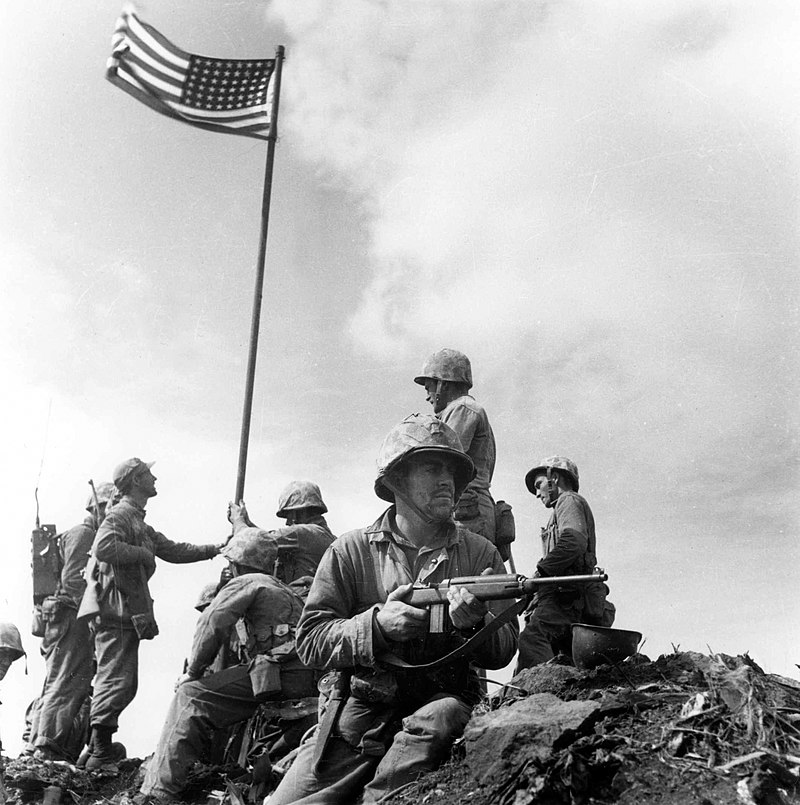
Charles Lindberg, first Iwo Jima flag raising

June 26, 2007

1st flag raising on Iwo Jima, photo by Sgt Lou Lowery, Leatherneck Magazine

First raising of the U.S. flag on Iwo Jima on February 23, 1945. Photo by Sgt. Lou Lowery, Leatherneck Magazine

This photo doesn’t look like the Joe Rosenthal photo that won the Pulitzer Prize, and then inspired the book and movie, Flags of Our Fathers?

It’s not the same photo. Different photographer. Different group of Marines.

This is the first flag raising on Mt. Suribachi, the highest point of the island that was known then as Iwo Jima. This shows the mean of Easy Company, including Charles Lindberg of Grand Forks, North Dakota, raising a flag they carried on a pipe they found. The photo was taken by Sgt. Lou Lowery of Leatherneck Magazine.

Charles Lindberg, one of the Marines in the photo, died this week. He was 86 years old.

In addition carrying a name made famous by that other guy, the pilot, few people believed him when he said his company raised the flag first on Iwo. He wasn’t in the Rosenthal photo. But Lindberg told the truth.

From his obituary on the Associated Press wire (in The Washington Post):

Three of the men in the first raising never saw their photos. They were among the more than 6,800 U.S. servicemen killed in the five-week battle for the island.

By Mr. Lindberg’s account, his commander ordered the first flag replaced and safeguarded because he worried someone would take it as a souvenir. Mr. Lindberg was back in combat when six men raised the second, larger flag about four hours later.

Rosenthal’s photo of the second flag-raising became one of the most enduring images of the war and the model for the U.S. Marine Corps memorial in Washington.

Rosenthal, who died last year, always denied accusations that he staged the photo, and he never claimed it depicted the first raising of a flag over the island.

Mr. Lindberg was shot through the arm March 1 and evacuated. After his discharge in 1946, Mr. Lindberg went home to Grand Forks, N.D. He moved to Richfield, Minn., in 1951 and became an electrician.

If you’re over 45, if you read James Brady’s Flags of Our Fathers, if you saw the Clint Eastwood movie version, or if you’re a fan of Johnny Cash’s Ballad of Ira Hayes, you know the stories of heroism and sorrow and tragedy that accompany Joe Rosenthal’s photo. As so often happens in history, there is a back story, a bit of a correction — and it has some of the same bittersweet flavors.

Lindberg was 24 years old when his company landed on Iwo Jima. That was 62 years ago. Those who were eyewitnesses are mostly gone. We need to seek out those few remaining, brave survivors, and let them tell what they remember, what they saw, how they felt and how they feel.  Of the twelve men who raised the two flags, Lindberg was the last survivor.  Three of the men from each group died in battle action after raising the flags.

Here’s to the memory of Charles Lindberg, a good American, a good soldier. Thank you, Mr. Lindberg.

Charles Lindberg in 1999, holding a copy of Sgt. Lou Lowery's photo of the first Iwo Jima flag raising Charles Lindberg holding the photo taken by Sgt. Lou Lowery of Leatherneck Magazine, of the first U.S. flag raising on Iwo Jima, by Easy Company. Lindberg is the soldier standing in back, on the right of the photo. Lowery’s photo was taken about four hours before the second flag raising, captured by Joe Rosenthal, which photo won the Pulitzer Prize. This photo of Lindberg, left, is from 1999, by Associated Press photographer Jackie Lorentz.

Lindberg’s citation for the Silver Star is below the fold.

Read the rest of this entry »


Quote of the Moment: James Madison, on the growth of education

June 18, 2007

Two Madison quotes today: James Madison dollar, as struck for circulation

I congratulate you on the foundation thus laid for a general System of Education, and hope it presages a superstructure, worthy of the patriotic forecast which has commenced the Work. The best service that can be rendered to a Country, next to that of giving it liberty, is in diffusing the mental improvement equally essential to the preservation, and the enjoyment of the blessing.

James Madison letter to Littleton Dennis Teackle, March 29, 1826; from the Madison Papers at the University of Virginia

No feature in the aspect of our Country is more gratifying, than the increase and variety of Institutions for educating the several ages and classes of the rising generation, and the meritorious patriotism which improving on their most improved forms extends the benefit of them to the sex heretofore, sharing too little of it. Considered as at once the fruits of our free System of Government, and the true means of sustaining and recommending it, such establishments are entitled to the best praise that can be offered.

James Madison letter to Gulian C. Verplanck, February 14, 1828; from the Madison Papers at the University of Virginia

Both quotes are contained in James Madison’s “Advice to My Country,” edited by David B. Mattern, University Press of Virginia, 1997

Image: James Madison Presidential Dollar as struck, image from the U.S. Mint (Department of the Treasury) via About.com


Quote of the Moment: Eisenhower, duty and accountability

June 13, 2007

Eisenhower's unused

This quote actually isn’t a quote. It was never said by the man who wrote it down to say it. It carries a powerful lesson because of what it is.

A few days ago I posted Gen. Dwight Eisenhower’s “order of the day” to the troops about to conduct the Allied invasion of Normandy to establish the toehold in Europe the Allies needed to march to Berlin, and to end World War II in Europe. As a charge to the troops, it was okay — Eisenhower-style words, not Churchill-style, but effective enough. One measure of its effectiveness was the success of the invasion, which established the toe-hold from which the assaults on the Third Reich were made.

When Eisenhower wrote his words of encouragement to the troops, and especially after he visited with some of the troops, he worried about the success of the operation. It was a great gamble. Many of the things the Allies needed to go right — like weather — had gone wrong. Victory was not assured. Defeat strode the beaches of Normandy waiting to drive the Allies back into the water, to die. [Photo shows Eisenhower meeting with troops of the 101st Airborne Division, 502nd Parachute Infantry Regiment, on the eve of the invasion. It was these men whose courage he lauded. Update: Someone “took hostage” the photo I linked to — a thumbnail version is appended; I leave the original link in hopes it might be liberated] eisenhower-with-paratrooper-eve-of-d-day.jpg

Eisenhower wrote a second statement, a shorter one. This one was directed to the world. It assumed the assault had failed. In a few short sentences, Eisenhower commended the courage and commitment of the troops who, he wrote, had done all they could. The invasion was a chance, a good chance based on the best intelligence the Allies had, Eisenhower wrote. But it had failed.

The failure, Eisenhower wrote, was not the fault of the troops, but was entirely Eisenhower’s.

He didn’t blame the weather, though he could have. He didn’t blame fatigue of the troops, though they were tired, some simply from drilling, many from war. He didn’t blame the superior field position of the Germans, though the Germans clearly had the upper hand. He didn’t blame the almost-bizarre attempts to use technology that look almost clownish in retrospect — the gliders that carried troops behind the lines, the flotation devices that were supposed to float tanks to the beaches to provide cover for the troops (but which failed, drowning the tank crews and leaving the foot soldiers on their own).

There may have been a plan B, but in the event of failure, Eisenhower was prepared to establish who was accountable, whose head should roll if anyone’s should.

Eisenhower took full responsibility.

Our landings in the Cherbourg-Havre area have failed to gain a satisfactory foothold and I have withdrawn the troops. My decision to attack at this time and place was based upon the best information available. The troop, the air [force] and the navy did all that bravery and devotion to duty could do. If any blame or fault attaches to the attempt, it is mine alone.

Who in the U.S. command would write such a thing today?

  • The message may also be viewed here. Yes, it’s incorrectly dated July 5 — should have been June 5.

Quote of the Moment: Eisenhower at D-Day Eve

June 9, 2007

Eisenhower talks to troops of invasion force, June 5 -- before D-Day

Soldiers, Sailors, and Airmen of the Allied Expeditionary Force: You are about to embark upon the Great Crusade, toward which we have striven these many months. The eyes of the world are upon you.

Order of the Day, 6 June, 1944 (some sources list this as issued 2 June)


Typewriter of the moment: Ernie Pyle

May 1, 2007

This typewriter, a Corona (before the merger made Smith-Corona), belonged to Ernie Pyle, the columnist famous for traveling with the the foot soldiers of all services in World War II. Pyle won a Pulitzer Prize in 1944 for his columns in 1943, published collectively in the books Here is Your War and Brave Men. Pyle was killed covering the end of World War II in the Pacific, on an island named Ie Shima, on April 18, 1945.

The typewriter rests in the Albuquerque Museum. It comes with a story.

Ernie Pyle's typewriter, rescued from a foxhole in Italy in 1944; Albuquerque Museum From the Albuquerque Museum’s exhibit, “America’s Most Loved Reporter”:

[Quote] Ernie Pyle interviewed Sergeant Don Bell, a rodeo rider, in June or July 1944 outside of St. Lo, France. Bell recalled that the foxhole they shared caved in during German shelling. Pyle said, “I have my notes, but my little portable typewriter is buried in that hole.” They hurriedly abandoned the foxhole, leaving the typewriter behind.

Sgt. Bell later salvaged it, kept it through the war, and donated it to the Museum in 1990. A photograph of Pyle in Normandy, typing on an Underwood, may have been taken after this event.

Bell recalled the interview as comforting. He wrote, “…Ernie had taken my ma’s wisdom and turned it into a soldier’s lesson: to find strength in battle you take hold of strength you’ve known at home…and of the faith that underlies it.” [End quote]


PT Boat vets hold last meeting

April 30, 2007

Fading memories of World War II — In December it was the Pearl Harbor Veterans who held their last planned reunion — too many of the vets wer too old to think many could comfortably travel to another reunion. This week, it’s the PT boat veterans who held their last planned gathering, for the same reasons. Those who have the most vivid memories of the war dwindle in number to a precious few.

According to the Associated Press in the Navy Times:

The 16 elderly survivors — down from 21 last year — of Peter Tare, Inc., an organization for former officers of PT boats, lined up next to the boat Friday, taking one last sail down memory lane.

For them, World War II is really almost over now.

“It’s sort of pitiful the way the crowd has dwindled,” said William Paynter, 90, who commanded both a PT boat and a squadron in the South Pacific.

“The executive secretary is just getting over a stroke and it seemed like the best time to do it,” he said of this past week’s reunion.

The group, which began meeting in 1947, has better than $25,000 in assets, Paynter said. Originally the plan was to turn the assets over to the sole survivor, but as the years passed, that seemed impractical.

Of course, there’s a story about “Peter Tare,” too:  Read the rest of this entry »


“April is the cruellest month” – poem for the moment

April 25, 2007

No, not here.

Clio Bluestocking has it up at her blog; Eliot and Picasso, together — go see. An interesting partnering of painting and poetry, for another National Poetry Month celebration.


Celebrating April 19: Paul Revere, “shot heard ’round the world”

April 20, 2007

April 19. Does the date have significance? Paul Revere's ride, from Paul Revere House

Among other things, it is the date of the firing of the “shot heard ’round the world,” the first shots in the American Revolution. On April 19, 1775, American Minutemen stood to protect arsenals they had created at Lexington and Concord, Massachusetts, against seizure by the British Army then occupying Boston.

April is National Poetry Month. What have we done to celebrate poetry?

What have we done to properly acknowledge the key events of April 18 and 19, 1775?  Happily, poetry helps us out in history studies, or can do.

In contrast to my childhood, when we as students had poems to memorize weekly throughout our curriculum, modern students too often come to my classes seemingly unaware that rhyming and rhythm are used for anything other than celebrating materialist, establishment values obtained sub rosa. Poetry, to them, is mostly rhythm; but certainly not for polite company, and never for learning.

Poems slipped from our national curriculum, dropped away from our national consciousness.

And that is one small part of the reason that Aprils in the past two decades turned instead to memorials to violence, and fear that violence will break out again. We have allowed darker ideas to dominate April, and especially the days around April 19.

You and I have failed to properly commemorate the good, I fear. We have a duty to pass along these cultural icons, as touchstones to understanding America.

So, reclaim the high ground. Reclaim the high cultural ground.

Read a poem today. Plan to be sure to have the commemorative reading of “Paul Revere’s Ride” in your classes next April 18 or 19, and “The Concord Hymn” on April 19.

We must work to be sure our heritage of freedom is remembered, lest we condemn our students, our children and grandchildren to having to relearn these lessons of history, as Santayana warned.

Texts of the poems are below the fold, though you may be much better off to use the links and see those sites, the Paul Revere House, and the Minuteman National Historical Park.

Read the rest of this entry »


True story: Yellow Rose of Texas, and the Battle of San Jacinto

April 15, 2007

After suffering crushing defeats in previous battles, and while many Texian rebels were running away from Santa Anna’s massive army — the largest and best trained in North America — Sam Houston’s ragtag band of rebels got the drop on Santa Anna at San Jacinto, on April 21, 1836. Most accounts say the routing of Santa Anna’s fighting machine took just 18 minutes.

San Jacinto Day is April 21. Texas history classes at Texas middle schools should be leading ceremonies marking the occasion — but probably won’t since it’s coming at the end of a week of federally-requested, state required testing.

Surrender of Santa Anna, Texas State Preservation Board Surrender of Santa Anna, painting by William Henry Huddle (1890); property of Texas State Preservation Board. The painting depicts Santa Anna being brought before a wounded Sam Houston, to surrender.

San Jacinto Monument brochure, with photo of monument

The San Jacinto Monument is 15 feet taller than the Washington Monument

How could Houston’s group have been so effective against a general who modeled himself after Napoleon, with a large, well-running army? In the 1950s a story came out that Santa Anna was distracted from battle. Even as he aged he regarded himself as a great ladies’ man — and it was a woman who detained the Mexican general in his tent, until it was too late to do anything but steal an enlisted man’s uniform and run.

That woman was mulatto, a “yellow rose,” and about whom the song, “The Yellow Rose of Texas” was written, according story pieced together in the 1950s.

Could such a story be true? Many historians in the 1950s scoffed at the idea. (More below the fold.) Read the rest of this entry »


Battle of Vimy Ridge

April 10, 2007

Canadian history?  Yeah, it’s important.  You’ve never heard of the Battle for Vimy Ridge?

Start here:  “The Easter Monday that Changed the World.”

Tip of the old scrub brush to Sigmund, Carl and Alfred.


Nimitz party follow-up

February 25, 2007

So, how was the party in Fredricksburg?  Admiral Nimitz did not put in an appearance, from all accounts.

Can you imagine some of the possibilities for study in small groups at the National Museum of the Pacific War?

Among other things, the Nimitz Hotel has been renovated (founded by Adm. Nimitz’s grandfather).

What’s there?

The site has grown into a 34,000-square-foot site featuring indoor exhibit space. Located on six acres now, the center includes the George Bush Gallery, the Admiral Nimitz Museum, the Plaza of the Presidents, the Veterans’ Walk of Honor and Memorial Wall, the Japanese Garden of Peace, the Pacific Combat Zone and the Center for Pacific War Studies.

With the conclusion of this large renovation project that began in 2004, museum coordinators are turning their attentions to another big project. An additional 40,000-square-foot expansion is planned in the future, with ground-breaking set this spring.

I can’t find, but I hope that, the renovations include space for scholars to study, and especially for high school students to learn.  Austin-area high schools would be lining up to make overnight field trips — but for the restrictions put on teaching and learning by Texas’ testing system, the limiting list of Texas Essential Knowledge and Skills (TEKS), and the test, the Texas Assessment of Knowledge and Skills (TAKS) .

Maybe teacher training.  Liberty FundBill of Rights Institute?  Are you guys watching this?


Battle of Medina (Texas) entry revised

December 23, 2006

Since I posted on the Battle of Medina last August, the entry has consistently been hit by educational institutions and what appear to be students looking for information on the events. I have updated the entry, correcting a couple of minor errors and some narrative difficulties, and adding links to sources students and teachers should find useful.

You’ll find the improved post here, “Forgotten Texas History: The Battle of Medina.”


Joe Rosenthal – Iconic Iwo Jima photo revealed a lot about war and Americans

August 22, 2006

Photo by Joe Rosenthal, Associated Press


Joe Rosenthal died. He took the photo of the U.S. flag-raising atop Mount Suribachi on Iwo Jima that became an icon of the Pacific War, of dedication to duty, and of the deeper, sometimes darker currents of war and life in the U.S.

The Los Angeles Times captured the basics of the story, noting that the photo Rosenthall took was the second raising of a larger flag, a smaller one having been raised a bit earlier. (Other worthwhile stories include those in the Seattle Times, Scotsman.com, and The San Francisco Times.)

Mt. Suribachi, though little more than a large mound on the island, is the highest point there and visible all around the island. The raising of the flag on that spot was a morale booster for U.S. troops and a morale-buster for holdout Japanese troops engaged in one of the nastiest, bloodiest battles of a nasty, bloody war. As the LA Times noted, a third of all U.S. Marines to die in the war died on Iwo Jima: 5,931. Nearly 7,000 U.S. servicemen died, in total — and, fighting to the death from deeply hidden tunnels, nearly all of the Japanese defenders died. Read the rest of this entry »
