Encore post: Jefferson on religious freedom, “infidels of every denomination”

July 31, 2008

Jefferson on religious freedom

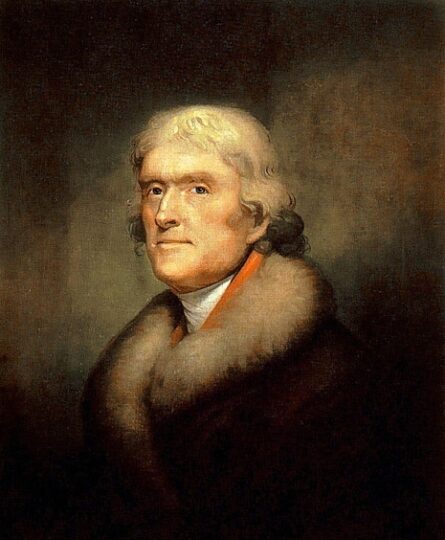
Thomas Jefferson

August 1, 2006

 *

In his Autobiography Jefferson recounted the 1786 passage of the law he proposed in 1779 to secure religious freedom in Virginia, the Statute for Religious Freedom:

The bill for establishing religious freedom, the principles of which had, to a certain degree, been enacted before, I had drawn in all the latitude of reason and right. It still met with opposition; but, with some mutilations in the preamble, it was finally passed; and a singular proposition proved that its protection of opinion was meant to be universal. Where the preamble declares, that coercion is a departure from the plan of the holy author of our religion, an amendment was proposed, by inserting the word “Jesus Christ,” so that it should read, “a departure from the plan of Jesus Christ, the holy author of our religion;” the insertion was rejected by a great majority, in proof that they meant to comprehend, within the mantle of its protection, the Jew and the Gentile, the Christian and the Mahometan, the Hindoo, and the Infidel of every denomination.

Life and Selected Writings of Thomas Jefferson, Modern Library 1993 edition, pp. 45 and 46.

* Image is a photo of detail from a painting of Jefferson by Rembrandt Peale, courtesy of the New York Historical Society by way of the Library of Congress.

[Encore post from August 1, 2006]

An encore post; fighting ignorance takes repetition.

Save

Save


Quote of the moment: William Pitt, on the crime of being young

July 22, 2008

One of the philosophers of Rising Sun (CRS – LA Jonas Foundation) observed that it is impossible to be both young and brave, and old and wise. Age of our leaders often equates to experience. Age becomes an issue in election campaigns — Ronald Reagan, the previous record holder of the oldest person ever to run for a first term as president of the United States before John McCain, headed off arguments that he was “too old” with a zinger in a debate with Walter Mondale in Reagan’s campaign for reelection in 1984.

It was the second debate in 1984, from Kansas City’s Municipal Auditorium (To confuse our foreign readers, we should note that this is in Kansas City, Missouri; Kansas City, Kansas, is on the western side of the river, and is a city of less consequence than Kansas City, Missouri, in population, and in most discussions. We confuse our foreign readers in revenge for English politics, which pertains to the Quote of the Moment, but cannot be explained by or to a person who is not intoxicated). The debate focused on foreign policy and the future of the world. Among the panel of journalists doing the questioning in this deformed type of debate, was the late Henry Trewhitt, then diplomatic correspondent for The Baltimore Sun, one of America’s historically great newspapers, and still great.

About 20 minutes into the debate, Trewhitt asked this question:

REPORTER: Mr. President, I want to raise an issue that I think has been lurking out there for two or three weeks, and cast it specifically in national security terms. You already are the oldest President in history, and some of your staff say you were tired after your most recent encounter with Mr. Mondale. I recall, yes, that President Kennedy, who had to go for days on end with very little sleep during the Cuba missile crisis. Is there any doubt in your mind that you would be able to function in such circumstances?

Reagan sealed his reputation for wit, and probably sealed the election, with this previously-scripted (we know now) zinger:

REAGAN: Not at all, Mr. Trewhitt and I want you to know that also I will not make age an issue of this campaign. I am not going to exploit for political purposes my opponent’s youth and inexperience. If I still have time, I might add, Mr. Trewhitt, I might add that it was Seneca or it was Cicero, I don’t know which, that said if it was not for the elders correcting the mistakes of the young, there would be no state.

Former Vice President Walter Mondale, a great statesman in his own right, and no youth at the time, had a solid response, but not an election-winning response: It won no laughter. (It’s interesting, in 2008, to remember that Mondale was criticizing Reagan for his failure to act to prevent a terrorist attack on U.S. forces in Lebanon, that killed more than 200 Marines.):

REPORTER [Henry Trewhitt]: Mr. Mondale, I’m going to hang in there. Should the President’s age and stamina be an issue in the political campaign?

MONDALE: No. And I have not made it an issue nor should it be. What’s at issue here is the President’s application of his authority to understand what a President must know to lead this nation, secure our defense and make the decisions and judgments that are necessary. A minute ago, the President quoted Cicero, I believe. I want to quote somebody a little closer home, Harry Truman. He said the buck stops here. We just heard the President’s answer for the problems at the barracks in Lebanon where 241 Marines were killed. What happened? First, the Joint Chiefs of Staff, with the President, said don’t put those troops there. They did it. And then five days before the troops were killed, they went back to the President, through the Secretary of Defense, and said please, Mr. President, take those troops out of there because we can’t defend them. They didn’t do it. And we know what’s – what happened. After that, once again our embassy was exploded. This is the fourth time this has happened – an identical attack in the same region, despite warnings even public warnings from the terrorists. Who’s in charge? Who’s handling this matter. That’s my main point.

Which brings us to William Pitt’s remarks.

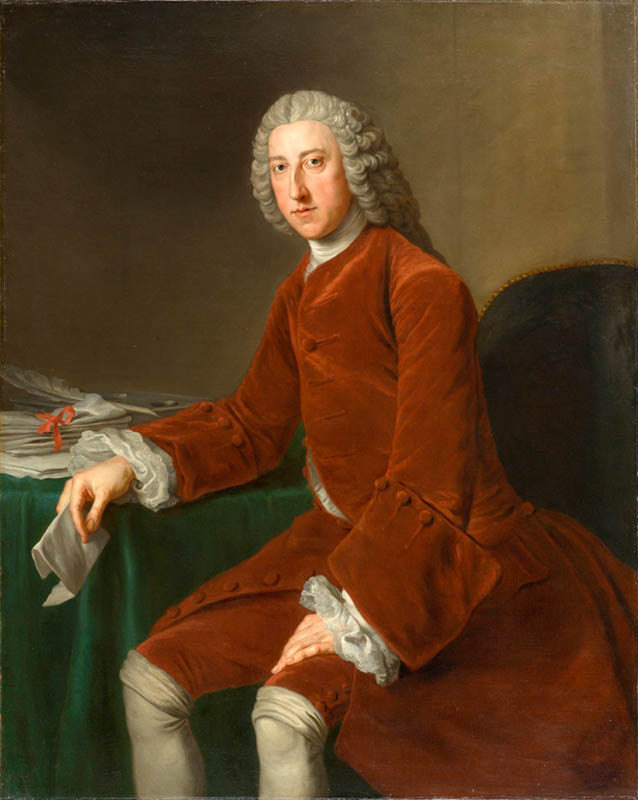
William Pitt, later Earl of Chatham, was 32 years old, and already a powerful member of the Whig opposition to England’s de facto first, and longest-serving Prime Minister, Robert Walpole, (who also was a Whig — see what I mean about English politics?). Though leading the opposition to Walpole, Pitt and a few of his colleagues were known as the Patriot Boys (Kansas City residing mostly in Missouri pales in comparison to these complexities of British politics).

Walpole, 32 years older than Pitt, leader of the House of Commons, complained at some point about Pitt’s youth. Walpole played dirty against Pitt, getting Pitt’s commission in the military cancelled. The two would dispute for a few years yet — finally, Pitt’s side prevailed, and Walpole lost a vote of confidence.

But on March 6, 1741, Pitt rose in the House of Commons and responded to Walpole’s charges:

“The atrocious crime of being a young man, which the honorable gentleman [Walpole] has with such spirit and decency charged upon me, I shall neither attempt to palliate nor deny; but content myself with wishing that I may be one of those whose follies may cease with their youth, and not of that number who are ignorant in spite of experience.”*

Walpole, Massachusetts, founded in 1724, is named after Robert Walpole. Pittsburgh, Pennsylvania, is named after William Pitt (the elder), as are Pittsfield County, Virginia, Chatham County, North Carolina (remember, Pitt was later Earl of Chatham), Pittsburg, New Hampshire, Chatham, New Jersey, and Chatham University, in Pittsburgh, Pennsylvania.

William Pitt, later Earl of Chatham

William Pitt, later Earl of Chatham

* Did Pitt ever actually utter these words? There was no official reporting service for debates in the House of Commons in 1741. Some speeches were written out before hand, some were carefully noted. This speech, alas, comes to us reported by the essayist and literature critic Samuel Johnson, who was famous for writing great speeches for members of the House of Commons, after the fact. Of this particular speech, Bartlett’s Familiar Quotations, 17th ed. carries this footnote: “This was the composition of Johnson, founded on some note or statement of the actual speech. Johnson said, ‘That speech I wrote in a garret, in Exeter Street'” – Boswell, Life of Johnson [1791]. If only Walter Mondale had Samuel Johnson whispering in his ear. Barack Obama may need the whisperings of Johnson in the current campaign.


Quote of the moment: Sallust, on “mental excellence”

July 21, 2008

Thus spake Gaius Sallustius Crispus, the Roman historian known as Sallust (86-34 B.C.):

The renown which riches or beauty confer is fleeting and frail; mental excellence is a splendid and lasting possession.

From The War with Catiline, 1

Statue of Sallust near the Austrian Parliament, by Haslinger Willibald

Statue of Sallust near the Austrian Parliament, photo by Haslinger Willibald

Photo rights: Creative Commons License
Creative Commons Attribution iconCreative Commons Share Alike icon

This file is licensed under the Creative Commons Attribution ShareAlike 2.5 License. In short: you are free to share and make derivative works of the file under the conditions that you appropriately attribute it, and that you distribute it only under a license identical to this one. Official license


Quote of the moment: T. H. Huxley

June 29, 2008

From Smithsonian.com:
June 29, 1895: T.H. Huxley Dies

Thomas Henry Huxley, a British biologist and firm believer in evolution, dies at age 70. The greatest defender of Darwinism in Britain, he once said,

“The deepest sin against the human mind is to believe things without evidence.”


Quote of the Moment: John Kennedy, June 26, 1963 (Encore Post)

June 26, 2008

Rare color photograph of President John Kennedy addressing a crowd in the then-divided city of Berlin, June 26, 1963

Rare color photograph of President John Kennedy addressing a crowd in the then-divided city of Berlin, June 26, 1963

From the Smithsonian Magazine site:

June 26, 1963: “Ich bin ein Berliner”

In West Berlin, President John F. Kennedy delivers the famous speech in which he declares, “Ich bin ein Berliner.” Meaning literally “I am a citizen of Berlin,” the statement shows U.S. solidarity with democratic West Berlin, surrounded by communist territory.

View a video of President Kennedy’s speech at American Rhetoric, Top 100 Speeches.

Photo of President Kennedy addressing Berlin’s citizens, photographer unidentified; from American Rhetoric site.

[end of encore post]

Kennedy’s entire speech was good. It was well drafted and well delivered, taking advantage of the dramatic setting and the dramatic moment. John Kennedy well understood how to give a speech, too.

Below is most of the speech, nearly five minutes’ worth, from a YouTube file — another indication that schools need to open up their filters to allow at least some of the best YouTube material through:

You may also want to note these posts:


28 poems on living life to the fullest, today

June 25, 2008

So, you just graduated from [pick one: high school, college, business school, law school, medical school, flight school, cooking school, firefighters academy, police academy] and you’re looking for a job. But here you are cruising the web instead of knocking on the doors of employers.  Carpe diem poems for making the most of time

You have come to the right place. To keep you in the flow where you need to be to get that job, let me suggest this article from the Academy of American Poets, “Carpe Diem: Poems for making the most of time.” And most especially, let me suggest the 28 poems they list there on plucking the day. The chief list of 28 you will find below the fold.

The Latin phrase and a lot of the history of the idea in poetry gets a lithe explanation in the essay there:

The Latin phrase carpe diem originated in the “Odes,” a long series of poems composed by the Roman poet Horace in 65 B.C.E., in which he writes:

Scale back your long hopes

to a short period. While we
speak, time is envious and

is running away from us.
Seize the day, trusting
little in the future.

Various permutations of the phrase appear in other ancient works of verse, including the expression “Eat, drink, and be merry, for tomorrow we die,” which is derived from the Biblical book of Isaiah. At the close of “De rosis nascentibus,” a poem attributed to both Ausonius and Virgil, the phrase “collige, virgo, rosas” appears, meaning “gather, girl, the roses.” The expression urges the young woman to enjoy life and the freedom of youth before it passes.

Since Horace, poets have regularly adapted the sentiment of carpe diem as a means to several ends, most notably for procuring the affections of a beloved by pointing out the fleeting nature of life . . .

The careful reader will find another three poems on the topic hidden in the list at the end of the article.

Graduates, you’d be happy with just a little per diem at the moment. I can’t give you that. You might find that these poets give you much more. Seize the opportunity, and see for yourself.

Read the rest of this entry »


Campaign underwater? (and classroom DVD offer)

June 19, 2008

Who are these guys?

Who are these guys in the pool? Can you identify them?

Can they swim?

(Answers below the fold.)

Read the rest of this entry »


Quote of the moment: Sir Francis Bacon, creation as testament

May 30, 2008

Sir Francis Bacon (source unidentified)

Sir Francis Bacon (January 22, 1561 – April 9, 1626)

For certain it is that God worketh nothing in nature but by second causes: and if they would have it otherwise believed, it is mere imposture, as it were in favour towards God; and nothing else but to offer the Author of Truth the unclean sacrifice of a lie. But farther, it is an assured truth, and a conclusion of experience, that a little or superficial knowledge of Philosophy may incline the mind of man towards Atheism, but a farther proceeding therein doth bring the mind back again to Religion: for in the entrance of philosophy, when the second causes, which are next the senses, do offer themselves unto the mind of man, if it swell and stay there it may induce some oblivion of the highest cause; but when a man passeth on further, and seeth the dependence of causes, and the works of Providence, then, according to the allegory of the poets, he will easily believe that the highest link of Nature’s chain must needs be tied at the foot of Jupiter’s chair. To conclude therefore, let no man upon a weak conceit of sobriety or an ill-applied moderation think or maintain, that a man can search too far, or be too well studied in the Book of God’s Word, or in the Book of God’s Works—Divinity or Philosophy. But rather, let men endeavour an endless progress or proficience in both; only let men beware that they apply both to charity, and not to swelling [pride]; to use and not to ostentation; and again that they do not unwisely mingle or confound those learnings together.

Francis Bacon, Advancement of Learning (1605), Bk I. [for example, here]

Tip of the old scrub brush to John Stockwell commenting at Constructive Curmudgeon


“A house divided.” Lincoln, right?

May 12, 2008

You’re a good student of history. You know that when someone says, “a house divided,” they’re talking about Lincoln’s famous, troubling speech from June 1858. Right?

Look below the fold.

Read the rest of this entry »


The Wrong Stuff, on purpose: Weikart misquotes Darwin

May 10, 2008

Richard Weikart is an arm of the Discovery Institute’s disinformation brigade. A couple of years ago he published a book attempting to link Darwin to the Holocaust in a blame-sharing arrangement. This book and some of its arguments appear to be the foundation of the text used to write the script for the mockumentary movie “Expelled!” featuring Nixon speechwriter Ben Stein.

Which is to say, the basis for the movie is dubious. Weikart’s scholarship creating links between Darwin, science and Hitler is quite creative. It is also based on arguments created from Darwin’s writings that mislead the innocent about evolution, science and history, or which get Darwin and evolution exactly wrong.

Michael Ruse published an op-ed in a Florida paper in February — a piece which is no longer available there (anybody got a copy? Nebraska Citizens for Science preserved a copy) — and Weikart responded, restating his creative claims. Alas for the truth, Weikart’s canards are still available at the Discovery Institute website, putting an interesting twist on Twain’s old line: The truth will go to bed at night while a falsehood will travel twice around the world as the truth kicks off its slippers.

Looking for Ruse’s piece, I found Weikart’s response here and here. I composed a quick response pointing out the problems, which I would like to posit here for the record — partly because I doubt Darwiniana gets much traffic, partly because the censor-happy folks at Discovery Institute don’t allow free discussion at their site, and partly so I can control it to make sure it’s not butchered as Weikart butchers Darwin’s text.

At Darwiniana I said:

Weikart’s strip quoting of Darwin is most disappointing. [Weikart wrote:]

Darwin claimed in chapter two of The Descent of Man that there were great differences in moral disposition and intellect between the “highest races” and the “lowest savages.” Later in Descent he declared, “At some future period, not very distant as measured by centuries, the civilised races of man will almost certainly exterminate and replace throughout the world the savage races.” Racial inegalitarianism was built into Darwin’s analysis from the start.

Darwin argued the differences in intellect and manners between the “highest” of men and the “lowest” of men did NOT change the fact that we are are all related — legally, Darwin’s argument would evidence a claim absolutely the opposite of what Weikart claims. Here are Darwin’s words from Chapter II of Descent of Man, as Darwin wrote them, without Weikart’s creative editing:

Nor is the difference slight in moral disposition between a barbarian, such as the man described by the old navigator Byron, who dashed his child on the rocks for dropping a basket of sea-urchins, and a Howard or Clarkson; and in intellect, between a savage who uses hardly any abstract terms, and a Newton or Shakespeare. Differences of this kind between the highest men of the highest races and the lowest savages, are connected by the finest gradations. Therefore it is possible that they might pass and be developed into each other. [emphasis added]

That’s not inegalitarianism at all — Darwin’s saying they are the same species, related closer than the poets allow. If we stick to the evidence, and [do] not wander off into poetic philosophy, we must acknowledge that Darwin’s own egalitarian spirit shows here in the science, too. It would be an odd kettle of fish indeed that a crabby guy like Hitler, who shared the antiscience bias of Weikart’s organization, would suddenly accept the science of a hated Englishman that ran contrary to his other philosophies. Who makes the error here, Hitler or Weikart? If they both think Darwin endorsed racism, they both do — but there is not an iota of evidence that Hitler based his patent racism on science, let alone the science of an Englishman.

As to the second quote, Weikart leaves the context out, and the context is everything. Darwin is not arguing that “savages” (the 19th century word for “aboriginals”) were less human, nor that they are a different species. He was arguing that in some future time there would appear creationists like Dr. Weikart’s colleagues at the Discovery Institute who will deny evolution because, once Europeans and others with guns conduct an unholy genocide (which Darwin writes against in the next chapter), and once humans wipe out chimpanzees, orangs and gorillas, the other great apes, the creationists can [then] dishonestly look around, blink their eyes and say, “Where are the links? There cannot be evolution between (Animal X) and humans!”

Darwin wrote:

At some future period, not very distant as measured by centuries, the civilised races of man will almost certainly exterminate, and replace, the savage races throughout the world. At the same time the anthropomorphous apes, as Professor Schaaffhausen has remarked (18. ‘Anthropological Review,’ April 1867, p. 236.), will no doubt be exterminated. The break between man and his nearest allies will then be wider, for it will intervene between man in a more civilised state, as we may hope, even than the Caucasian, [emphasis added] and some ape as low as a baboon, instead of as now between the negro or Australian and the gorilla.

In the end, Darwin wrote against genocide, against racism, and in favor of the higher thinking abilities of all dark-skinned people. He wrote in favor of Christian morality. Darwin himself remained a faithful, tithing Christian to the end of his life.

Such a man, and such amazing science, deserve accurate history, not the fantastic, cowardly and scurrilous inventions Dr. Weikart has given them. We should rise to be “man in a more civilized state” as Darwin had hoped.

Update, July 24, 2008, nota bene:  To anyone venturing here from the Blogcatalog discussion on intelligent design: Get over to the site of Donald Johanson’s Institute for Human Origins, and especially look at the presentation “On Becoming Human.”  Also check out the Evolution Gateway site at Berkeley, especially this page which explains what evolution is, and this page which offers some introduction for what the evidence for evolution really is.  One quick answer to a question someone asked there:  Between H. erectus and modern humans, H. sapiens, in the time sequence we have fossils of H. heidelbergensis and H. neanderthalensis.  It’s pretty clear that Neandertal is not ancestral to modern humans, but instead lived alongside modern humans for 50,000 years or so from the Middle East through Southern Europe.  To the question of actual transitional fossils, you’d need to hit the paleontology journals — there are a lot.  You may also benefit from taking a look at the articles at this special Nature site.


Bogus history: Engraved in stone

March 3, 2008

Quotes from patriots engraved on the walls greet visitors to the Texas State History Museum in Austin.

Unfortunately, in one case the engraved quote is now known to be bogus, a piece of fiction originally created for a children’s book.

Kent Biffle’s weekly article on Texas History in the Dallas Morning News reports the story:

Scholarly sleuth James E. Crisp will formally reveal to historians this week a jarring error literally carved in stone at the Bob Bullock Texas State History Museum.

In the sweeping lobby of the 6-year-old museum, a few steps from the state Capitol, visitors read on the wall stirring words of Tejano hero José Antonio Navarro:

“I will never forsake Texas and her cause. I am her son.”

The quote is a permanent feature of the museum – or was. Dr. Crisp says Señor Navarro (1795-1871) didn’t utter those words. But he will tell us who did.

Dr. Crisp reports his findings at the 2008 convention of the Texas State Historical Association, in Corpus Christi.

Read the rest of this entry »


Quote of the moment: Abraham Lincoln: A war that’s gone on too long

February 24, 2008

Siege of Vera Cruz, U.S. Mexican War

Image: Battle of Vera Cruz, artist unknown by me.

U.S. Rep. Abraham Lincoln, Whig-Ill., speaking on the floor of the House of Representatives, January 12, 1848:

If the prossecution of the war has, in expenses, already equalled the better half of the country, how long it’s future prosecution, will be in equalling, the less valuable half, is not a speculative, but a practical question, pressing closely upon us. And yet it is a question which the President seems to never have thought of. As to the mode of terminating the war, and securing peace, the President is equally wandering and indefinite. First, it is to be done by a more vigorous prossecution of the war in the vital parts of the enemies country; and, after apparently, talking himself tired, on this point, the President drops down into a half despairing tone, and tells us that “with a people distracted and divided by contending factions, and a government subject to constant changes, by successive revolutions, the continued success of our arms may fail to secure a satisfactory peace[.]” Then he suggests the propriety of wheedling the Mexican people to desert the counsels of their own leaders, and trusting in our protection, to set up a government from which we can secure a satisfactory peace; telling us, that “this may become the only mode of obtaining such a peace.” But soon he falls into doubt of this too; and then drops back on to the already half abandoned ground of “more vigorous prossecution.[“] All this shows that the President is, in no wise, satisfied with his own positions. First he takes up one, and in attempting to argue us into it, he argues himself out of it; then seizes another, and goes through the same process; and then, confused at being able to think of nothing new, he snatches up the old one again, which he has some time before cast off. His mind, tasked beyond it’s power, is running hither and thither, like some tortured creature, on a burning surface, finding no position, on which it can settle down, and be at ease.

Again, it is a singular omission in this message, that it, no where intimates when the President expects the war to terminate. At it’s beginning, Genl. Scott was, by this same President, driven into disfavor, if not disgrace, for intimating that peace could not be conquered in less than three or four months. But now, at the end of about twenty months, during which time our arms have given us the most splendid successes–every department, and every part, land and water, officers and privates, regulars and volunteers, doing all that men could do, and hundreds of things which it had ever before been thought men could not do,–after all this, this same President gives us a long message, without showing us, that, as to the end, he himself, has, even an imaginary conception. As I have before said, he knows not where he is. He is a bewildered, confounded, and miserably perplexed man. God grant he may be able to show, there is not something about his conscious, more painful than all his mental perplexity!


Barbara Jordan’s birthday, February 21

February 21, 2008

Barbara Jordan would have been 72 today.

Barbara Jordan statue, Austin Chronicle hoto

Thanks to Pam for alerting me to the anniversary.

In her stirring keynote address at the 1976 Democratic National Convention, held in New York City in Madison Square Garden, Jordan said:

A government is invigorated when each of us is willing to participate in shaping the future of this nation.

In this election year we must define the common good and begin again to shape a common good and begin again to shape a common future. Let each person do his or her part. If one citizen is unwilling to participate, all of us are going to suffer. For the American idea, though it is shared by all of us, is realized in each one of us.

I covered that convention as a stringer for a western television station. I recall the spirit in the hall when Jordan spoke, and the great spirit that enveloped the entire convention and the City of New York. After the convention every night the cops would stop taxis so delegates could ride. I remember watching two cops help a woman out of a wheel chair and into a cab, and the cabbie saying that the cops had never done that before — and he liked it. Jimmy Carter came out of that convention, and won the election, defeating Gerald Ford.

32 years ago. Barbara Jordan didn’t live to see her party come up with a woman and an African American man as the top two candidates for the nomination. That’s too bad. She could have given a great, appropriate speech. Maybe the Dems oughtta just run a film of Jordan from 1976.

Also:


Sinclair Lewis on patriotism, the flag, and fascism

February 16, 2008

Oh, my.

Sun dog on US flag, Sinclair Lewis quote on fascism

When fascism comes to America, it will be wrapped in a flag and carrying a cross.

Sinclair Lewis

You can’t purchase the actual poster anywhere. It’s a photographic political cartoon. From our friends at Hot Dogs, Pretzels, and Perplexing Questions. (Bob, in Austin)

Did Lewis actually say that?  I’ve not sourced it yet.

Wave the flag for real:

Add to FacebookAdd to NewsvineAdd to DiggAdd to Del.icio.usAdd to StumbleuponAdd to RedditAdd to BlinklistAdd to TwitterAdd to TechnoratiAdd to Furl


Barbara Jordan

February 12, 2008

Rereading the Gettysburg Address and the Cooper Union speech of Lincoln, I wondered for a few moments whether there are others with similar gifts for words who might be on film or tape. It got me thinking about the vast gulf between religion on the one hand, and faith and justice on the other hand.

Then I got a notice of a link from this post about Barbara Jordan, at Firedoglake.

It’s a nice collection of links, a Barbara Jordan tribute all bundled up ready to unwrap. Sometimes truth does go marching on.

Who since Jordan?

(Thanks to Phoenix Woman at Firedoglake for the post, and for the link here.)

The Cooper Union speech of Lincoln was 148 years ago, on February 27.