Flying your flags in Illinois today? December 3 is Illinois Statehood Day

December 3, 2014

American Experience reminded us at Facebook that December 3 is the anniversary of the day Illnois was admitted to the union in 1818, the 21st state.

Under the U.S. flag Code, Americans should fly their U.S. flags on the statehood day of their state.

You flying ’em, Illinois?  If you’re in this area, you should be!

Map of the Illinois territory, about 1818, the year the state was admitted to the union, on December 3.

Map of the Illinois territory, about 1818, the year the state was admitted to the union, on December 3.

At the American Memory site at the Library of Congress, we get a good, brief dose of the events leading to statehood.

Land of Lincoln

Map of Springfield, Illinois
Springfield, Illinois, 1867. Drawn from Nature.
A. Ruger, 1867.
Map Collections

Illinois entered the Union on December 3, 1818. The twenty-first state takes its name from the Illinois Confederation—a group of Algonquian-speaking tribes native to the area. An Algonquian word, “Illinois” means “tribe of superior men.”

Remnants of a much earlier Algonquin civilization thought the most sophisticated prehistoric society north of Mexico, are preserved at the Cahokia Mounds State Historic Site in the southwestern part of the state.

French explorers Louis Jolliet and Jesuit Father Jacques Marquette entered the Illinois region in 1673. Control of the territory passed to Great Britain in 1763. When the United States acquired the land that became Illinois Territory in 1783, most European settlers there were of French descent. In 1788, the Continental Congress received information concerning the inhabitants of the Illinois area. “There are sundry French settlements on the river Mississippi within the tract,” the committee reported:

Near the mouth of the riverKaskaskies, there is a village which appears to have contained near eighty families from the beginning of the late revolution. There are twelve families in a small village at la Prairie duRochers, and near fifty families—the Kahokia village. There are also four or five families at fort Chartres and St. Philips, which is five miles farther up the river. The heads of families in those villages appear each of them to have had a certain quantity of arable land allotted to them, and a proportionate quantity of meadow and of woodland or pasture. The Committee…referred the memorial of George Morgan…respecting a tract of land in the Illinois, June 20, 1788.
Documents from the Continental Congress and Constitutional Convention, 1774-1789

Twenty years later, Congress organized the Illinois Territory. Pioneers from Kentucky, Virginia, and Tennessee settled the southern part of the territory, while New Englanders ventured to northern Illinois via the Erie Canal.

Land of Lincoln, the state slogan, pays homage to famous son Abraham Lincoln. Born in Kentucky, Lincoln came to Illinois in 1830. He was instrumental, along with his colleagues in the Illinois legislature, in moving the state capital from Vandalia to Springfield. Settling there in 1837, Lincoln married socially prominent resident Mary Todd, practiced law, and built the political career that brought him the presidency in 1861.

Bird's-eye view of Chicago
Bird’s-Eye View of Chicago
,
c 1913.
Taking the Long View: Panoramic Photographs, 1851-1991

Chicago, a minor trading post at the southwestern tip of Lake Michigan until the 1830s, developed into a railroad hub and industrial center. After the Civil War, industrialization attracted a new wave of immigrants. People from all over the U.S. and the world ventured to Chicago to work in the meat-packing and steel industries. Even the Great Conflagration of 1871 failed to prevent the Windy City from becoming one of the largest urban centers in the country. It remains the third most populous city and metropolitan area in the United States.

General view of  Illinois Central Railroad freight terminal
General View of Illinois Central Railroad Freight Terminal, Chicago, Illinois,
Jack Delano, photographer, April 1943.
America from the Great Depression to World War II: Photographs from the FSA and OWI, ca. 1935-1945

Learn more about Illinois:

Lotta history there.

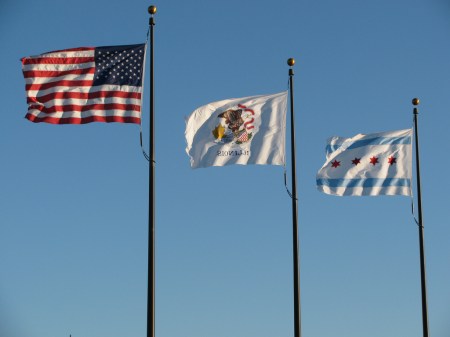
U.S., Illinois and City of Chicago flags in a stiff breeze at the Navy Pier, Chicago. Photo by John Junker, at flickr.

U.S., Illinois and City of Chicago flags in a stiff breeze at the Navy Pier, Chicago. Photo by John Junker, at flickr. (copyright to Junker, too)


Thanksgiving 2014 – Fly your flag today!

November 26, 2014

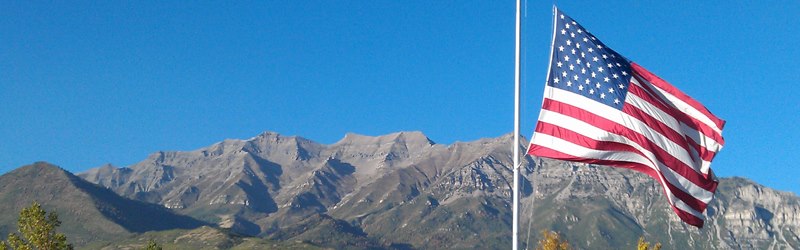
Mt. Timpanogos and the U.S. flag. Photo by Bob Walker of Orem, Utah; from Orem, circa September 2012. That's Mt. Baldy on the left. This site is about six miles from our old home in Pleasant Grove, Utah.

Mt. Timpanogos and the U.S. flag. Photo by Bob Walker of Orem, Utah; from Orem, circa September 2012. That’s Mt. Baldy on the left. This site is about six miles from our old home in Pleasant Grove, Utah, where we celebrated a few dozen Thanksgivings.

Fly  your flag on Thanksgiving — it’s one of about a score of dates Congress designated specially to fly the flag, in the U.S. flag code.

Americans load up this particular holiday with significance, often for no particular reason.  As a holiday, it is really rather uniquely American.  There were feasts of thanksgiving from time to time throughout recorded history, but most often they were one-shot affairs, after a particular event.

In America, Americans eagerly seized on the idea of one day set aside “to give thanks,” both with the religious overtones some wanted to see, and with the commercial overtones others wanted, especially during the Great Depression.  In our 238th year since the Declaration of Independence, the 225th year since the Constitution was enacted, we come to Thanksgiving as a major period of travel to old family homesteads, to Thanksgiving as a period of genuine thanks to American troops fighting in foreign lands half a world away, and as a commercial celebration that sucks the sobriety and spirituality out of all but the most dedicated of profiteers, or bargain hunters.

Vintage Thanksgiving greeting card, from HubPages

In the early 20th century, some people sent greeting cards for Thanksgiving; this is a tradition overtaken by Christmas, Hanukkah and New Years cards, today. (Image from HubPages, unknown year — credit for cards, “Images courtesy VintageHolidayCrafts.com

Thanksgiving often stumbled into controversy.  George Washington issued proclamations calling for a day of thanks, but struck out all references to Christianity.  Some president’s issued similar proclamations up to the Civil War, When Abraham Lincoln used the holiday as a time to remind  Americans that they had a lot to be thankful for, partly as a means to keep Americans focused on the war to be won, and keep supporting troops in the field.  During the Great Depression, Franklin D. Roosevelt juggled dates for Thanksgiving, moving it earlier in November to create a longer Christmas shopping season, hoping to stimulate sales, and thereby push America further out of the Depression.

In 2001 George W. Bush urged Americans to go shopping so terrorists would know America was not defeated by the attack on the World Trade Center, knowing that a stimulus to the economy would help garner support for other policies.

Vintage thanksgiving card, Boy riding turkey with American flag, from HubPages, original date unknown

Children riding large turkeys, waving American flags, made popular images in several years of the early 20th century.

2012 saw controversy over Big Box stores and other major, national retailers pushing their post- Thanksgiving, Christmas sales, into Thanksgiving day itself.  Is this fair to employees?  Is this too much emphasis on purchasing, and too little emphasis on family and giving thanks?

In 2014, we have the same arguments about Big Box stores pushing “Black Friday” into the holiday, and even more arguments about Christmas creep reducing the importance of Thanksgiving to Americans.

You can be sure of one thing:  It’s probably safe to fly your American flag on Thanksgiving, as Congress suggested.  It won’t make your turkey more moist  or your pumpkin pie taste any better.  It won’t boost your sales, if you’re a retailer, nor find you a bargain, if you’re a shopper.

If you have the flag, it costs nothing.  Flying the flag makes no particular religious statement, supports no particular political party, supports no one’s favorite football team.  Flying the flag earns you nothing, usually.

But as a free act of patriotism, support for our nation, and our troops, and a demonstration that even after a divisive election, we’re all one nation, it’s a pretty good deal.

Fly your flag today.

More:


November dates for flag flying

November 14, 2014

Already in November we’ve passed two of the month’s dates for which we are urged to fly the U.S. flag, election day, the first Tuesday after the first Monday in November by law (flag dates including local elections on whatever date, especially at polling places), and Veterans Day, or Armistice Day, on November 11, commemorating the date set for the armistice of World War I.

What could be left?

According to the U.S. Flag Code, 4 USC 1, sec. 6, we should fly the flag on all national holidays, which includes Thanksgiving, though most patriots are busier with turkey baking, football and family that day.

Several states entered the union in November; citizens and residents of those states fly the U.S. flag on those statehood days.

Most states would hope you’d fly the state’s flag on its statehood day, too.  But how many people actually have a state flay for their own state?  (We have a Texas flag; Texas may be the most state-flag-flying state; we also have a Maryland flag, which used to make for great displays when we flew both flags at our Maryland home.)

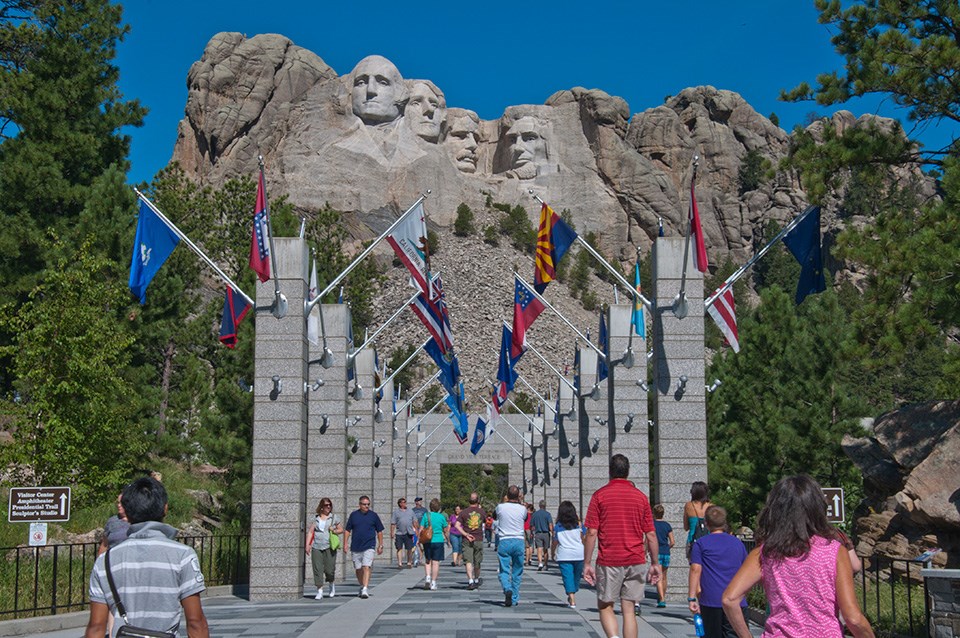
Avenue of the Flags at the Mt. Rushmore National Monument. National Park Service photo.

Avenue of the Flags at the Mt. Rushmore National Monument. Displayed are flags of all 50 states, plus territories, commonwealths and the federal district of the United Sates. National Park Service photo.

This year you may have missed a few already:

  • North Dakota, November 2 (1889, the  39th or 40th state), the same day as
  • South Dakota, November 2 (1889, the  39th or 40th state)
  • Montana, November 8 (1889, the 41st state)
  • Washington, November 11 (1889, the 42nd state) (but, hey, you were already flying your flag, right, Washingtonians?)

You can still catch two states’ statehood days:

  • Oklahoma, November 16 (1907, the 46th state)
  • North Carolina, November 21 (1789, the 12th state)

Veterans Day 2014 – Fly your flag today

November 11, 2014

Veterans Day in the U.S. falls on November 11, the date of the armistice that ended hostilities in World War I.  Under the U.S. flag code, and specific presidential proclamations, it is one of those days U.S. residents get called to fly their flags.

Veterans Day poster for 2014, from the U.S. Veterans Administration

Veterans Day poster for 2014, from the U.S. Veterans Administration

President Barack Obama issues a proclamation on Veterans Day every year.

Presidential Proclamation — Veterans Day, 2014

VETERANS DAY, 2014
– – – – – – –
BY THE PRESIDENT OF THE UNITED STATES OF AMERICA

A PROCLAMATION

Since the birth of our Nation, American patriots have stepped forward to serve our country and defend our way of life.  With honor and distinction, generations of servicemen and women have taken up arms to win our independence, preserve our Union, and secure our freedom.  From the Minutemen to our Post-9/11 Generation, these heroes have put their lives on the line so that we might live in a world that is safer, freer, and more just, and we owe them a profound debt of gratitude.  On Veterans Day, we salute the Soldiers, Sailors, Airmen, Marines, and Coast Guardsmen who have rendered the highest service any American can offer, and we rededicate ourselves to fulfilling our commitment to all those who serve in our name.

Today, we are reminded of our solemn obligation:  to serve our veterans as well as they have served us.  As we continue our responsible drawdown from the war in Afghanistan and more members of our military return to civilian life, we must support their transition and make sure they have access to the resources and benefits they have earned.  My Administration is working to end the tragedy of homelessness among our veterans, and we are committed to providing them with quality health care, access to education, and the tools they need to find a rewarding career.  As a Nation, we must ensure that every veteran has the chance to share in the opportunity he or she has helped to defend.  Those who have served in our Armed Forces have the experience, skills, and dedication necessary to achieve success as members of our civilian workforce, and it is critical that we harness their talent.

Across our country, veterans who fought to protect our democracy around the globe are strengthening it here at home. Once leaders in the Armed Forces, they are now pioneers of industry and pillars of their communities.  Their character reflects our enduring American spirit, and in their example, we find inspiration and strength.

This day, and every day, we pay tribute to America’s sons and daughters who have answered our country’s call.  We recognize the sacrifice of those who have been part of the finest fighting force the world has ever known and the loved ones who stand beside them.  We will never forget the heroes who made the ultimate sacrifice and all those who have not yet returned home.  As a grateful Nation, let us show our appreciation by honoring all our veterans and working to ensure the promise of America is within the reach of all who have protected it.

With respect for and in recognition of the contributions our service members have made to the cause of peace and freedom around the world, the Congress has provided (5 U.S.C. 6103(a)) that November 11 of each year shall be set aside as a legal public holiday to honor our Nation’s veterans.

NOW, THEREFORE, I, BARACK OBAMA, President of the United States of America, do hereby proclaim November 11, 2014, as Veterans Day.  I encourage all Americans to recognize the valor and sacrifice of our veterans through appropriate public ceremonies and private prayers.  I call upon Federal, State, and local officials to display the flag of the United States and to participate in patriotic activities in their communities. I call on all Americans, including civic and fraternal organizations, places of worship, schools, and communities to support this day with commemorative expressions and programs.

IN WITNESS WHEREOF, I have hereunto set my hand this seventh day of November, in the year of our Lord two thousand fourteen, and of the Independence of the United States of America the two hundred and thirty-ninth.

BARACK OBAMA

More:


Navy Day 2014, October 27 – Fly your flag today

October 27, 2014

1945 Navy Day poster. NHHC Photograph Collection, NH 72280-KN (Color) via CrashMacDuff

1945 Navy Day poster. NHHC Photograph Collection, NH 72280-KN (Color) via CrashMacDuff

Navy Day, October 27, is designated in the U.S. Flag Code as one of those days Americans may, or should, fly our flags.

History of Navy Day from the U.S. Department of Defense:

Navy Day was established on October 27, 1922 by the Navy League of the United States. Although it was not a national holiday, Navy Day received special attention from President Warren Harding. Harding wrote to the Secretary of the Navy Edwin Denby:

“Thank you for your note which brings assurance of the notable success which seems certain to attend the celebration of Navy Day on Friday, October 27, in commemoration of past and present services of the Navy. From our earliest national beginnings the Navy has always been, and deserved to be, an object of special pride to the American people. Its record is indeed one to inspire such sentiments, and I am very sure that such a commemoration as is planned will be a timely reminder.”

“It is well for us to have in mind that under a program of lessening naval armaments there is a greater reason for maintaining the highest efficiency, fitness and morale in this branch of the national defensive service. I know how earnestly the Navy personnel are devoted to this idea and want you to be assured of my hearty concurrence.”

October 27 was suggested by the Navy League to recognize Theodore Roosevelt’s birthday. Roosevelt had been an Assistant Secretary of the Navy and supported a strong Navy as well as the idea of Navy Day. In addition, October 27 was the anniversary of a 1775 report issued by a special committee of the Continental Congress favoring the purchase of merchant ships as the foundation of an American Navy.

Navy Day was last observed on Oct. 27, 1949.

But, of course, it’s still designated in the Flag Code.

More:


Navy Day, October 27, 2014 — fly your flag

October 17, 2014

Navy Day poster from unidentified year. Navy Day is October 27 of each year.  508th Parachute Infantry Regiment image

Navy Day poster from unidentified year. Navy Day is October 27 of each year. 508th Parachute Infantry Regiment image

Navy Day comes on October 27th, one of the increasing number of October “Fly Your Flag Today” dates, and one of the score designated in the U.S. Flag Code.


Fly your flag today: Columbus Day, 2014

October 13, 2014

Feel free to put your political brickbats in comments.

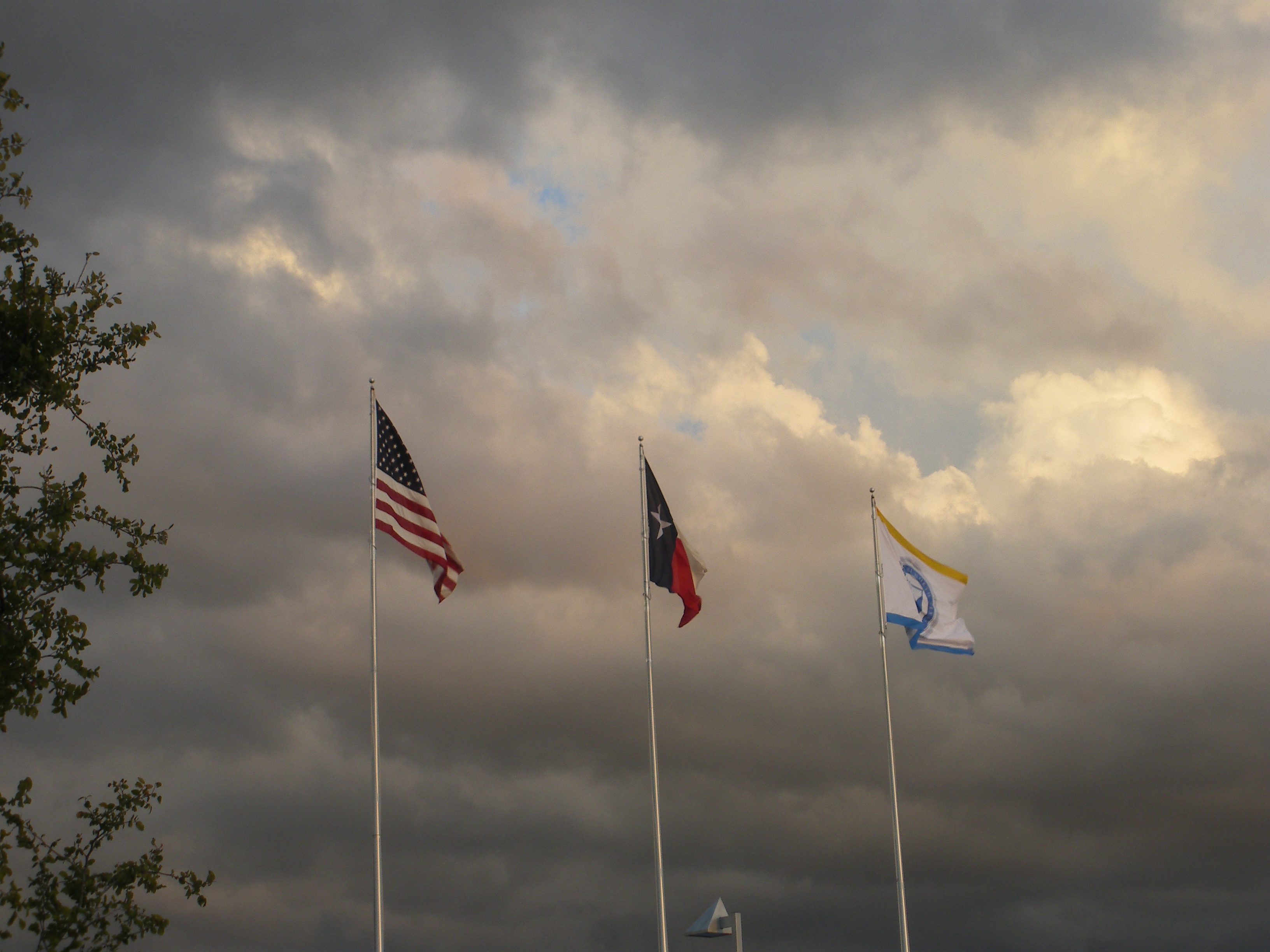
U.S., Texas and University of North Texas at Dallas flags flying on campus, with storm clouds to the South. Photo by Ed Darrell; use encouraged with attribution.

U.S., Texas and University of North Texas at Dallas flags flying on campus, with storm clouds to the South. Photo by Ed Darrell; use encouraged with attribution.

October 12 is the traditional, old calendar date upon which Columbus’s journals show he “discovered” land west of the Atlantic, after sailing from Spain. (Surely there is an explanation for why the date was not altered to conform with the new calendar, but I digress.)  In the finite wisdom of Congress, the holiday is designated on the “second Monday of October,” in order to promote three-day weekends and avoid holidays in the middle of the week.

The U.S. Flag Code urges Americans to fly their U.S. flags in honor of certain days.  Columbus Day is a traditional (since the 19th century) holiday (especially for descendants of Italian immigrants), and one of the score of dates denoted in the Flag Code.

Fly your flag today.

More:

Or, if you’re in South Dakota, fly your flag for Native American Day.


2014’s Constitution Day – Fly your flag

September 17, 2014

Happy Constitution day!  (Remember to fly your flag today.)

Have you read the U.S. Constitution lately?

Contrary to what your local Tea Party claims, it hasn’t changed.  But most people need a refresher from time to time.

First page of the U.S. Constitution, National Archives and Records Administration photo

First page of the U.S. Constitution, National Archives and Records Administration photo

Okay, maybe that’s a little tough to read.  Check out the on-line display of the National Archives and Records Administration in the Charters of Freedom section:

More:


Rotunda for the charters of Freedom at Nationa...

Rotunda for the charters of Freedom at National Archives (NARA) building in Washington, D.C. Here displayed are the Declaration of Independence, the Bill of Rights, and the U.S. Constitution. (Photo credit: Wikipedia)

This is an encore post.

This is an encore post.


Patriot Day, September 11, 2014: Fly your flag at half staff today

September 11, 2014

U.S. flag at half-staff, in Brighton, New York

U.S. flag at half-staff, in Brighton, New York

To honor those who died on September 11, 2001, flags in the U.S. fly at half-staff on September 11.  Known as Patriot Day, the date is not in the Flag Code, but is listed in a separate law.

In the United States, Patriot Day, observed as the National Day of Service and Remembrance, occurs on September 11 of each year in memory of the 2,977 killed in the 2001 September 11 attacks.

To further honor the dead, and survivors, many people participate in a day of service to others.

President Barack Obama issued a proclamation ordering all federal facilities to fly flags at half-staff:

PATRIOT DAY AND NATIONAL DAY OF SERVICE AND REMEMBRANCE, 2014

– – – – – – –

BY THE PRESIDENT OF THE UNITED STATES OF AMERICA

A PROCLAMATION

America will never forget the September tragedy that shook our Nation’s core 13 years ago.  On a day that began like so many others, a clear blue sky was pierced by billowing black smoke as a wave of grief crashed over us.  But in one of our darkest moments, we summoned strength and courage, and out of horrible devastation emerged the best of our humanity.  On this solemn anniversary, we pause in remembrance, in reflection, and once again in unity.

On September 11, 2001, nearly 3,000 men, women, and children — friends and neighbors, sisters and brothers, mothers and fathers, sons and daughters — were taken from us with a heartbreaking swiftness and cruelty.  As we come together once more to mourn their loss, we also recall how the worst terrorist attack in our history brought out the true character of the American people.  Courageous firefighters rushed into an inferno, brave rescue workers charged up stairs, and coworkers carried others to safety.  Americans in distant cities and local towns united in common purpose, demonstrating the spirit of our Nation; people drove across the country to volunteer, donors lined up to give blood, and organizations collected food and clothing.  And in our Nation’s hour of need, millions of young Americans raised in a time of peace volunteered to don the uniforms of our country’s military and defend our values around the world.

As we remember all those we lost on that day and the Americans who made the ultimate sacrifice in the wars that followed, we must strive to carry forward their legacy.  On this National Day of Service and Remembrance, we take up their unfinished work and pay tribute to their lives with service and charity.  Through these acts and quiet gestures, we can honor their memory and reclaim our sense of togetherness.  I encourage all Americans to visit www.Serve.gov or www.Servir.gov to learn more about service opportunities across our country.

In the face of great terror, some turned to God and many found comfort in family and friends — but all Americans came together as one people united not only in our grief, but also in our determination to stand with one another and support the country we love.  Today and all days, we remember the patriots who endure in the hearts of our Nation and their families who have known the awful depths of loss.  In their spirit, let us resolve to move forward together and rededicate ourselves to the ideals that define our Union as we work to strengthen our communities and better our world.

By a joint resolution approved December 18, 2001 (Public Law 107-89), the Congress has designated September 11 of each year as “Patriot Day,” and by Public Law 111-13, approved April 21, 2009, the Congress has requested the observance of September 11 as an annually recognized “National Day of Service and Remembrance.”

NOW, THEREFORE, I, BARACK OBAMA, President of the United States of America, do hereby proclaim September 11, 2014, as Patriot Day and National Day of Service and Remembrance.  I call upon all departments, agencies, and instrumentalities of the United States to display the flag of the United States at half-staff on Patriot Day and National Day of Service and Remembrance in honor of the individuals who lost their lives on September 11, 2001.  I invite the Governors of the United States and its Territories and interested organizations and individuals to join in this observance.  I call upon the people of the United States to participate in community service in honor of those our Nation lost, to observe this day with appropriate ceremonies and activities, including remembrance services, and to observe a moment of silence beginning at 8:46 a.m. Eastern Daylight Time to honor the innocent victims who perished as a result of the terrorist attacks of September 11, 2001.

IN WITNESS WHEREOF, I have hereunto set my hand this  tenth day of September, in the year of our Lord two thousand fourteen, and of the Independence of the United States of America the two hundred and thirty-ninth.

BARACK OBAMA

Do you plan any special service today?


September 9, California Statehood Day; Golden Staters, fly your flags!

September 8, 2014

U.S. Flag Code guidelines list specific days Americans should fly U.S. flags, and generically, urges people in states to fly flags on their state’s day of achieving statehood.

It’s fun to read through the list of statehood dates and ponder just how such a date is calculated (consider the first 13 colonies and their becoming states); but however it was calculated, September 9 is California’s day.

U.S. and California flags flying from the same flagpole.

U.S. and California flags flying from the same flagpole.

Fly your flags, California.

3-cent stamp honoring California's statehood centennial, in 1950.  Image from Rockhounds.com

3-cent stamp honoring California’s statehood centennial, in 1950. Image from Rockhounds.com

California was the 31st state admitted; 31-star flags were in use until Minnesota’s statehood in 1858.  Here’s a unique design on the 31-star motif:

31-start flag with stars arranged in

31-star flag with stars arranged in “Great Star” constellation suggested by War of 1812 Navy hero Samuel Reid, a wearer of the Congressional Medal of Honor. Reid urged 13 stripes instead of 15, which Congress accepted; but he also urged the Great Star design, which was not accepted. Placement of stars in the field remained unencumbered by rules until the Eisenhower administration. Photo from Jeff R. Bridgman Antiques.


September is a flag-waving month

September 7, 2014

U.S. flag displayed in the National Center for the Constitution, Philadelphia.  Photo by Jeffrey M. Vinocur, via Wikimedia. Constitution Day is September 17.

U.S. flag displayed in the National Center for the Constitution, Philadelphia. Photo by Jeffrey M. Vinocur, via Wikimedia. Constitution Day is September 17.

Flag flying dates in September?  Three more (you flew your flag for Labor Day, right?):

  • September 9, for California statehood
  • September 11, for Patriot Day (not listed in the U.S. Flag Code, but encouraged in other law. Public Law No. 107-89)
  • September 17,for Constitution Day

Ready?

More:

Trivia note:  The U.S. flag is not mentioned in the U.S. Constitution.


Fly your flag for Labor Day 2014

September 1, 2014

Remember to fly your flag today for Labor Day, to honor all laborers, and especially those in the union movement to whom we owe gratitude for the concepts and reality of safe work places, good pay, benefits (including health benefits), and vacations.

Members of the Silver Platers and Metal Polishers Union carry a large flag in Rochester’s (New York) 1918 Labor Day Parade. A poster depicting Uncle Sam can be seen to the rear of the marchers. Albert R. Stone Photo Collection, Monroe County Library System

Members of the Silver Platers and Metal Polishers Union carry a large flag in Rochester’s (New York) 1918 Labor Day Parade. A poster depicting Uncle Sam can be seen to the rear of the marchers. Photograph by Albert R. Stone, Albert R. Stone Photo Collection, Monroe County Library System

2014 notes the 100th anniversary of the Ludlow, Colorado Massacre.  Labor Day should give us all pause to consider those who lost their lives campaigning for good wages, for decent working hours, for good and safe working conditions, and for the right of workers to negotiate collectively the companies who employ them for these things.

Have a good Labor Day.  Celebrate with family and coworkers.  Kick off the 2014 elections.

And remember.

Monument in Haymarket Square, Chicago, noting the 1886 Haymarket Riot and the workers who died or were murdered later.

Monument in Haymarket Square, Chicago, noting the 1886 Haymarket Riot and the workers who died or were murdered later. Photo by TRiver on flickr, Creative Commons license, via AtlasObscura.

More:


Remember to fly your flag for Labor Day 2014, September 1

August 30, 2014

Still important in 2014: Fly your flag for American labor, Monday.

Free Labor Will Win, poster from 1942, (Library of Congress)

Poster from the Office of War Information, 1942

(Okay, you may fly your flag all weekend — especially if you’re a union member.  We get the whole weekend, but Labor Day itself is Monday.)

Labor Day 2014 in the United States is a federal holiday, and one of those days Americans are urged to fly the U.S. flag.

“Free Labor Will Win,” the poster said, encouraging a theme important during World War II, when unions were encouraged to avoid strikes or any action that might interrupt work to build the “arsenal of democracy” believed necessary to win the war.  Labor complied, the war was won, and organized labor was the stronger for it. In 2012, some have difficulty remembering when all Americans knew that our future rides on the backs of organized labor.

The poster was issued by the Office of War Information in 1942, in full color. A black-and-white version at the Library of Congress provides a few details for the time:

Labor Day poster. Labor Day poster distributed to war plants and labor organizations. The original is twenty-eight and one-half inches by forty inches and is printed in full color. It was designed by the Office of War Information (OWI) from a photograph especially arranged by Anton Bruehl, well-known photographer. Copies may be obtained by writing the Distribution Section, Office of War Information [alas, you can’t get a copy from the Office of War Information in 2012]

Even down here in deepest, darkest-right-to-work Texas, patriots fly their flags to honor Labor today. It’s heartening.

Flags fly all around in 1882 at the first Labor Day Parade in New York City’s Union Square; lithograph from USC’s Dornsife History Center, via Wikipedia, artist unidentified

This is partly an encore post, a Labor Day tradition.

More, Other Resources:

This is an encore post.

This is an encore post, a Labor Day tradition.


Fly your flag August 21, for Hawaii Statehood 55 years ago

August 21, 2014

A newsboy happily hawks the Honolulu Star-Bulletin with the headline showing the state had achieved statehood, August 21, 1959.  Star-Bulletin photo

13-year-old paperboy Chester Kahapea happily hawks a commemorative edition of the Honolulu Star-Bulletin with the headline showing the state had achieved statehood after the U.S. House of Representatives passed the law authorizing Hawaii as a state. Star-Bulletin photo by Murray Befeler.

Hawaii’s official statehood day is August 21, commemorating the day in 1959 when Hawaii was recognized as a member of the union of the United States of America.  Hawaiians should fly their flags to day in honor of the date (you may, too).

Hawaii formally celebrates the day on the third Friday in August (last Friday, for 2013).  I hope you joined in the festivities (it’s a holiday in Hawaii) — but under the U.S. Flag Code, you may certainly fly your flags on August 21, regardless which day of the week that is.

Specimen copy of the ballot used by Hawaiians in a June 27, 1959, plebiscite to approve conditions of statehood.  Image from Hawaii Magazine, 2009

Specimen copy of the ballot used by Hawaiians in a June 27, 1959, plebiscite to approve conditions of statehood. Image from Hawaii Magazine, 2009

After the U.S. annexed Hawaii in 1898 (in action separate from the Spanish-American War) attempts at getting Hawaii admitted as a state got rolling.  After World War II, with the strategic importance of the islands firmly implanted in Americans’ minds, the project picked up some steam.  Still, it was 14 years after the end of the war that agreements were worked out between the people of Hawaii, the Hawaiian royal family, Congress and the executive branch.  The deal passed into law had to be ratified by a plebiscite among Hawaiian citizens.  The proposition won approval with 94% of votes in favor.

Some native Hawaiian opposition to statehood arose later, and deference to those complaints has muted statehood celebrations in the 21st century.

Other than the tiny handful of loudmouth birthers, most Americans today are happy to have Hawaii as a state, the fifth richest in the U.S. by personal income.  The nation has a lot of good and great beaches, but the idea of catching sun and surf in Hawaii on vacation might be considered an idealized part of the American dream.

U.S. and Hawaii flags flying together.

U.S. and Hawaii flags flying together.

More:

From Prologue, the blog of the National Archives: This petition, rolled onto a wooden spool, was signed by 116,000 supporters of Hawaii statehood and presented to the U.S. Senate on February 26, 1954. (RG 46, Records of the U.S. Senate)

From Prologue, the blog of the National Archives: This petition, rolled onto a wooden spool, was signed by 116,000 supporters of Hawaii statehood and presented to the U.S. Senate on February 26, 1954. (RG 46, Records of the U.S. Senate)

U.S. postage stamp issued in 2009 commemorating the 50th anniversary of Hawaii's admission to the union.

U.S. postage stamp issued in 2009 commemorating the 50th anniversary of Hawaii’s admission to the union.

Contrast the first class postage price above with the airmail postage price of this stamp issued in 1959 — August 21, 1959 7¢ Rose Hawaii Statehood C55 26432. Wikipedia image

Contrast the first class postage price above with the airmail postage price of this stamp issued in 1959 — August 21, 1959 7¢ Rose Hawaii Statehood stamp. Wikipedia image

This is an encore post.

This is an encore post.


July 4, 1826: Astonishing coincidences on the 50th anniversary of the Declaration

July 4, 2014

You know the story, don’t you? If you don’t, you should commit this one to memory.  It’s not fiction, and if you proposed it for fiction, the editors would reject it as too improbable, or too sappy, a tug on your heartstrings and tear ducts.  It’s true, better than the faux patriot fiction we often get on July 4.

July 4, 2014, is the 238th anniversary of the announcement of the Declaration of Independence.  I hope you’re thinking about how you’ll fly the flag this weekend in honor of the Declaration of Independence.

The resolution proposed by Richard Henry Lee calling for independence of the 13 colonies passed the Continental Congress on July 2, 1776.  The Declaration would be Thomas Jefferson’s crowning achievement, outshining even his presidency and the Louisiana Purchase.   John Adams wrote to his wife, Abigail, that July 2 would forever be marked by patriotic displays.

But the Declaration itself, which gave teeth to the resolution, was adopted two days later on July 4.  That has come to be the day we celebrate.

Detail, John Trumbull's Signing of the Declaration of Independence - Theodor Horydczak photo, Library of Congress

Detail, John Trumbull’s Signing of the Declaration of Independence – The committee of five presents the Declaration of Independence to John Hancock, the President of the Second Continental Congress; from left, the committee is John Adams, Robert Livingston, Roger Sherman, Thomas Jefferson, and Ben Franklin.  Theodor Horydczak photo, Library of Congress

Adams didn’t miss a beat.  Who quibbles about a couple of days when the celebrating is so good?

Adams and Jefferson were two of the five-member committee the Congress had tasked to write a declaration.  Adams and Ben Franklin quickly determined to leave it up to Jefferson, who had a grand flair with words, and who had just written a couple of stirring documents for Virginia.  Roger Sherman and Robert Livingston, the other two members, went along.  And so it was that the Declaration of  Independence is almost completely the work of Thomas Jefferson.

Adams and Jefferson became friends only later, when they both served the nation at war as ambassadors to France, and then for Adams, to England.  A widower, Jefferson was taken in by Abigail Adams who worried about him.  After the war, Jefferson was in England when Adams was to meet King George III in a grand ceremony in which the king would accept the credentials of all the ambassadors of foreign nations to England.  As the king strode down the line, each ambassador or delegation would bow, the king would acknowledge them, the papers would be passed, and the king would move on.  Adams and Jefferson bowed.  King George moved on, ignoring them completely.

In such a case of such a snub, the snubbed foreigners usually made a quick exit.  Adams and Jefferson did not.  They stood at attention as if the king had treated them like all the rest, reversing the snub.  From the beginning, Americans and the United States pushed for more practical, reasonable, and compassionate government and relations.  Standing together, against the snub of the British King one more time, Adams and Jefferson formed a silent bond that held them the rest of their lives.

Back in America in peacetime, and both members of the administration of George Washington, Adams and Jefferson fell out.  Secretary of State Jefferson favored a more limited federal government; Vice President Adams favored a more powerful one.  By the end of Washington’s second term, party politics had been well developed.  Adams defeated Jefferson in the election of 1796.  As was the law then, Jefferson was vice president as the runner-up vote getter in the electoral college; but Adams kept Jefferson out of all government affairs.  Perhaps because he didn’t have Jefferson to help, Adams’s presidency did not go well.  In the rematch election in 1800, one of  the bitterest election fights ever, Jefferson’s party defeated Adams.  The gleeful Democratic-Republican electors all voted one ballot for Jefferson, the presidential candidate, and one ballot for Aaron Burr, the party’s vice presidential candidate.

Alas, that produced a tie vote in the electoral college.  Adams’s party, the Federalists, still held the House of Representatives before the new Congress came in.  A tie vote goes to the House for decision.  They could not bring themselves to vote for Jefferson, and the deadlock continued for 37 ballots.  Finally Jefferson’s former friend but now arch-enemy Alexander Hamilton intervened, explaining that Burr was clearly the greater scoundrel, and the House elected Jefferson.  Adams slunk out of town, avoiding the inauguration.

It wasn’t until after 1809 when Benjamin Rush hoodwinked Jefferson into writing to Adams, and Adams to Jefferson, that the two became friendly again.  For the next 17 years Jefferson and Adams carried on perhaps the greatest series of correspondence in history between two great minds.  Letters went out almost daily, from Monticello, Virginia,  to Braintree, Massachusetts, and from Braintree to Monticello.  They discussed the weather, their families, old times, farming — but especially the republic they had been most instrumental in creating, and how it might be preserved, and made to prosper.  Eventually the letters became harder to read, both because their eyesight was failing, and because their penmanship deteriorated, too.

The ideas, however, flowed like a great river of freedom.  Perhaps this correspondence was the river flowing justice the prophet Amos foretold.

Letter from Thomas Jefferson to John Adams, August 15th, 1820 - Library of Congress image

Letter from Thomas Jefferson to John Adams, August 15th, 1820. From The Thomas Jefferson Papers at the Library of Congress, Thomas Jefferson Papers Series 1. General Correspondence. 1651-1827. Library of Congress image

Both men took ill early in 1826.  This was a landmark year, 50 years since the Declaration of Independence.  In Massachusetts, a grand display of fireworks was planned to cap off a day of feasting and celebration.  Adams hoped he might attend.  In Virginia, a week before, it became clear Jefferson was too ill to venture even as close as Charlottesville for the celebration.  Jefferson sent his regrets to invitations from several celebrations.  Jefferson slept through most of July 3, but awoke about 9:00 p.m., and asked, “This is the fourth?”  It was not.  These are the last significant, recorded words of Jefferson.  He awoke at about 4:00 a.m. on the Fourth of July, 1826, but could not make a rally.  He died at 12:50 in the afternoon.

Adams, too, was too ill to attend the celebrations.  In the late afternoon or early evening of the Fourth, he awoke, and heard the celebration in the town.  Almost as if he had worked just to live to see that particular day, he checked the date.  Realizing he was near the end, happy that he’d seen 50 years after the Declaration, and unaware of the events a few hours earlier that day in Virginia, Adams said, “Thomas Jefferson still survives.”  Adams, too, died on July 4, 1826.

Fly your flag July 4th. Remember John Adams and Thomas Jefferson.  Remember their great work in creating the nation that protects our freedoms today.  Remember their great friendship.  Write a letter to a good friend you’ve not written to lately.

It is Independence Day, a day created and celebrated by great men like John Adams and Thomas Jefferson.  Their spirit survives in us, as we celebrate, and if we remember why we celebrate as friends.

More: