Looking up to Finland

May 30, 2007

Commenter Bernarda sent a link to a Washington Post story by Robert Kaiser about Finland, a nation who redesigned its education system with rather dramatic, beneficial results. Among other things, the Finns treat teachers as valuable members of society, with high pay, great support, and heavy training.

Finland is a leading example of the northern European view that a successful, competitive society should provide basic social services to all its citizens at affordable prices or at no cost at all. This isn’t controversial in Finland; it is taken for granted. For a patriotic American like me, the Finns present a difficult challenge: If we Americans are so rich and so smart, why can’t we treat our citizens as well as the Finns do?

Why not? Why can’t we treat our citizens as well as the Finns? Their system boosts their economy and leads to great social progress — which part of that do we not want?


Mining the Internet Archive: Tobacco, history and controversy

May 22, 2007

European Union rules require member states to do something about indoor air pollution. European states are banning smoking in public places. Gone soon will be days when we can joke about Britons and their Player’s cigarettes, or the French and their Galois habits.

Every once in a while as I recount the great Tobacco/Health Wars, my kids remind me that they never saw a cigarette commercial on television. Once, we caught a showing of past ads, and I was truck nostalgic by Fred Flintstone’s testimony for Winston cigarettes — the kids gasped: “Fred Flintstone used to smoke!”

Everybody smoked, once upon a time, it seemed. 1940s and 1950s magazines have ads in which doctors and athletes claim cigarette smoking is either unharmful, sheer pleasure, or even health promoting. Got a cigarette cough? Switch to menthol cigarettes! Mouth burns? Try a filter cigarette.

Today, kids wonder why Virginia did so well selling tobacco to Britain — who in their right mind would have smoked? they ask.

The Internet Archive has an abundance of film material on tobacco. The films come from the University of California – San Francisco: Read the rest of this entry »


Quote of the moment: Lincoln on Labor

May 12, 2007

Abraham Lincoln, president-elect, on Feb. 23, 1861 - History Place

Labor is prior to, and independent of,capital.  Capital is only the fruit of labor, and could not have existed if labor had not first existed.  Labor is the superior of capital, and deserves much the higher consideration.

Lincoln in the Annual Message to Congress, December 3, 1861

The photograph shows Lincoln as president-elect; it is one of a series taken on February 23, 1861; from The History Place.


Carnival catch-up

April 16, 2007

Uh-oh. Running behind.

One of the reasons I list various carnivals is to make sure I have a note of the good ones somewhere easy to find. Busy-ness in the last week just kept me away from the keyboard.

Carnivals you ought to check out:

Oekologie 4.1: Over at Behavioral Ecology. Lots on climate change, of course, and some very nice bird photos.

Carnival of the Godless at Neural Gourmet has a good run down of the Blog Against Theocracy, and complaints about it, too.

Carnival of the Liberals #36 is up at Truth in Politics. Well, that’s an obvious pairing. Free speech, the president and the Constitution, tyranny in the Middle East, and quite a bit more.

Carnival of Education #114 is back at The Education Wonks.  State legislatures may be wrapping up their sessions, but education issues are heating up.

Skeptics’ Circle #58 finds a hangout at Geek Counterpoint, with several posts that get at how we know what is true — good stuff for historians and economists to ponder.

This is as good a time as any to remind you that that Fiesta de Tejas! #2 is coming up on May 2 — deadline for  post nominations April 30.  You may e-mail entries to me (edarrellATsbcglobalDOTnet), or submit them at the Blog Carnival portal to the Fiesta.


Want the facts? Go buy a newspaper

March 21, 2007

Truman showing incorrect headline

President Harry S Truman shows a headline from the Chicago Tribune, a headline incorrectly calling the previous day’s election for Truman’s opponent.

If textbook fights, school curricula litigation and constant internet sniping got you thinking the clash between science and religion is a tough problem to work on, you should look at the clash between news gathering organizations and their financiers who argue that economics says news should be dead.

Not all should be doom and gloom in the news biz. Tim J. McGuire, dean of the Cronkite School of Journalism at Arizona State University, argues that the delivery of the news still needs newspapers, and that newspaper economics show that profits can be produced by good, mainstream news outlets: “Writing off newspapers is premature, irresponsible.”

McGuire doesn’t ignore the bad news:

The circulation declines are undeniable. Some metropolitan newspapers have lost 10 percent of their circulation in the past three years. Classified revenues at some big newspapers are off by $50 million to $100 million in the same period. Layoffs and news-hole reductions are breathtaking. Short-sighted corporations are trying to cut their way to better profit margins.

He points to a different view:   Read the rest of this entry »


Blue Bell Ice Cream, a tastier part of Texas history

March 18, 2007

My first visit to Texas in the early 1980s, to visit friends in Houston and in-laws in Dallas, I met Blue Bell Ice Cream. It was love at first bite, of course.

Bluebell Creamery's ad, barn and blue sky

Blue Bell Creamery ad, barn and blue sky, and their memorable slogan

Ice cream plays an important role in my family. Family reunions, or just any celebration in summer, were excuses to pull out several hand-cranked ice cream makers, and freeze away. Homemade vanilla delights the palate, and family gourmands grind vanilla beans to add a little extra oomph. When grandfather Leo Stewart had peaches from his orchard, or later just peaches from our backyard tree in Pleasant Grove, Utah, fresh peaches went into the mix. Only someone who experienced my father’s peaches in my mother’s custard, frozen in a hand-cranked freezer, could fully appreciate Willie Stark‘s lines about peach ice cream in Robert Penn Warren’s book, All the King’s Men.

White Mountain 6-quart hand crank ice cream freezer

White Mountain 6-quart hand crank ice cream freezer, one of the better freezers

Homemade ice cream is a bother. Better freezers are not cheap, and they don’t travel well. My mother’s mini-freezer disappeared sometime in one of her later-life moves. My father’s much larger, two-gallon colossus simply wore out, with most of the ferrous metal parts rusting away, and even the wood of the barrel crumbling to dust. Proper salt to get the solution colder than freezing is sporadically available in city supermarkets. My mother’s recipe for the custard, unwritten as all her better recipes, died with her.

Bluebell Peaches and Homemade Vanilla

Bluebell Peaches and Homemade Vanilla

Utah is a haven for ice cream makers. Snelgrove’s on 33rd South in Salt Lake City is tradition in many families (Snelgrove is now owned by Dreyer’s, but still operates as Snelgrove in Utah) (Update, July 2008: Snelgrove’s is dead). My wife’s family is partial to Farr’s in Ogden, “Farr better ice cream” — and it is very, very good. Trips to visit family include stops at Farr’s.

Blue Bell Homemade Vanilla tastes like my mother’s custard frozen in a hand-cranked freezer. It is consistently the best-tasting ice cream, for a very reasonable price.

Blue Bell celebrates its 100th anniversary as a company in 2007, the “little creamery” in Brenham, Texas, where Blue Bell is made.

Even better, the company wants you to suggest new flavors, and is holding a contest to get good, local flavors. Winners of the Taste of the Country Flavor Contest get a trip to Brenham for the 100th anniversary celebration.

Plus, winners get a year’s supply of Blue Bell ice cream.

Blue Bell is a nice local company making good. Though the production is limited (and I believe it is still true that all the ice cream is made in Brenham), so it is available only in 17 states concentrated in the southeast, the brand is the third best-selling brand in the U.S.

If you’re near Houston, you would be well advised to make a side trip to Brenham to tour the Blue Bell ice cream factory (plus, the bluebonnets will be in bloom shortly).

North America is a big continent, with international brands that work for international consistency of products, so that the company’s customers get the same experience regardless where the customers are — think McDonalds, Burger King, and Coca-Cola. Large conglomerates often own even nominally regional brands. As I noted earlier, Snelgrove’s in Salt Lake City is now run by a national ice cream giant — even Ben & Jerry’s brand is now owned, produced and marketed by a national marketing giant. Blue Bell is a standout, an almost-local brand, with limited distribution. Part of the joy of a well-working free enterprise system is finding a well-run local company, with a unique product.

Blue Bell could make a fortune bottling their success formula, too, in addition to their ice cream.

Bluebell logo

Glen Dromgoole at the Abilene Reporter-News reviewed the book about Blue Bell’s history in his column February 18, 2007, “Blue Bell Ice Cream, a Texas Staple, Turns 100.”


Quote of the Moment: Nikita Khruschev, whose side is history on?

March 15, 2007

About the capitalist states, it doesn’t depend on you whether or not we exist. If you don’t like us, don’t accept our invitations, and don’t invite us to come and see you. Whether you like it or not, history is on our side. We will bury you.*

Nikita Sergeyevich Khruschev (1894-1971); reported statement at a reception for Wladyslaw Gomulka at the Polish Embassy, Moscow, November 18, 1956

Khruschev enjoys a hot dog in Iowa, 1959

Soviet Premier Nikita Khruschev enjoying a hot dog in Des Moines, Iowa, during his 1959 tour of the U.S. (Photo from American Meat Institute, National Hot Dog & Sausage Council, http://www.hot-dog.org)

* The exact phrasing of the last line is debatable. As Bartlett’s Familiar Quotations, 16th Edition has it, “Neither the original nor the translation of the last two sentences appeared in either Pravda or the New York Times, which carried the rest of the text. Another possible translation of the last sentence is: We shall be present at your funeral, i.e., we shall outlive you; but the above is the familiar version.”


Tom Peters, good leadership, or the lack of it

March 10, 2007

My aging process keeps jumping up to nip at my heels and remind me that time doesn’t just pass; time zips along well over the posted speed limit.

In a couple of my past incarnations Tom Peters was part of my daily reading. At AMR’s Committing to Leadership, we purchased parts of Tom’s “In Search of Excellence” video as jumping off points for key leadership techniques. I was especially fond of Tom’s take on training at Disney, and I loved the retail wisdom of Stew Leonard at Stew Leonard’s Dairy in Connecticut. (The other segments we used detailed the work of a woman who turned around a GM plant — she took a buyout package midway through the first year of our use of the stuff — and the turnaround at Harley Davidson. The Disney stuff became cliche, I haven’t heard much of Stew Leonard lately, GM is clearly on the ropes, but everybody still likes Harley Davidson. There was also a segment on a principal in New Hampshire who had gotten great results from management-by-wandering around; I have no idea where he is today, or how his school is doing.*)

Good business consultants should know what Peters said. I have run into a few managers who claim Peters is not au currante with their business or methods, and I know a few consultants who think they know better and know more. I don’t like to work with those people. They are often wrong about other things, too.

Mentioning Peters and his uncanny resemblance to Millard Fillmore a couple of posts ago reminded me to check to see what he’s up to recently. Hard core bloggers will not be impressed by his blog output. If you do not find something useful in the last ten posts, however, you may want to have your physician check out your cynicism level.

Peters’ theme since he left McKinsey — heck, for a good deal of time while he was there — is the search for excellent performance. Some of the organizations he’s profiled have later failed. Bob Dylan noted, “the first one now will later be last/the times, they are a-changin'” and it’s still true. We can learn a lot by focusing on the first one, now, and how and why she is not last, now (we can learn a lot by studying the later fall, too).

Peters also tends to note things that are good and potentially useful, without over analysis. Contrast Peters’ comments about wikis, here, with the comments by the cynical and overweeningly self-righteous “Constructive Curmudgeon.” Peters wouldn’t run from a title of curmudgeon, I think. But he’d make sure that he was an effective and genuinely constructive curmudgeon.

We can observe a lot just by watching, Yogi Berra said.

I lament that so many in education, teachers and administrators, don’t take a more business-like attitude in appropriate things. Often when I mention Tom Peters in education meetings, I get blank looks. Peters’ first books mention “management by wandering around,” which is a great technique. Recently I mentioned to a colleague that a principal had not visited my classroom in several weeks. She looked a little tired, and said that he’d not visited her classroom to see her teach, ever. Not in years. A quick survey of other colleagues found similar results, but also got the opinion that the only time the principal did visit a classroom, it was bad news.

How can such a leader defend and represent his team in administrators’ meetings?

Educators, go read Tom Peters.

In a Twitter exchange with Tom Peters in 2013, @Tom_Peters, I learned this principal has moved from public schools to a private school in Connecticut.  That’s not really good news, I think.


Slowdown for study

January 25, 2007

Posting will be light this weekend — I’m off to Pasadena, California, for a Liberty Fund seminar on the “Hoover-Roosevelt Conversation,” regarding the debates between Herbert Hoover and Franklin Roosevelt between 1928 and 1945.  Good fun, great company, hoped-for good stuff for future lesson plans.

But little time for blogging (and who knows how well the connections work).

Discuss.


Berlin Wall’s 45th

August 13, 2006

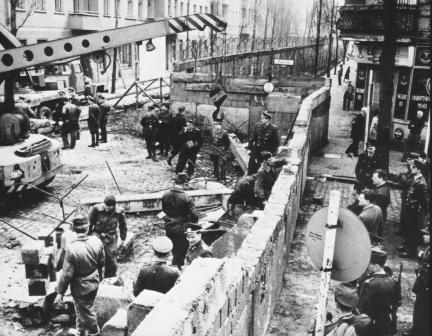
August 13, 2006, is the 45th “anniversary” of the erection of the Berlin Wall, the totem of the Cold War that came down in 1989, pushing the end of the Cold War. Residents of Berlin awoke on this day in 1961 to find the communist government of East Germany erecting what would become a 96-mile wall around the “western quarters” of the city — not so much to lay siege to the westerners (that had been tried in 1948, frustrated by the Berlin Airlift) as to keep easterners from “defecting” to the West. The Brandenburg Gate was closed on August 14, and all crossing points were closed on August 26.

From 1961 through 1991 1989, teachers could use the Berlin wall as a simple and clear symbol for the differences between the communist Eastern Bloc, the Soviet Union and her satellite states, and the free West, which included most of the land mass of Germany, England, France, Italy, the United States and other free-market nations — the North Atlantic Treaty Organization (NATO) countries. I suspect most high school kids today know very little about the Wall, why it was there, and what its destruction meant, politically.

This era of history is generally neglected in high school. Many courses fail to go past World War II; in many courses the Cold War is in the curriculum sequenced after the ACT, SAT and state graduation examinations, so students and teachers have tuned out.

But the Wall certain had a sense of drama to it that should make for good lessons. When I visited the wall, in early 1988, late at night, there were eight fresh wreaths honoring eight people who had died trying to cross the Wall in the previous few weeks (in some places it was really a series of walls with space in between to make it easier for the East German guards to shoot people trying to escape) — it’s an image I never forget. Within a year after that, East Germans could travel through Hungary to visit the West, and many “forgot” to return. Within 18 months the wall itself was breached.

The Wall was a great backdrop for speeches, too — President John F. Kennedy visited Berlin in June 1963, and expressed his solidarity with the walled-in people of both West and East Berlin, with the memorable phrase, “Ich bin ein Berliner, which produced astounding cheers from the tens of thousands who came to hear him. There are a few German-to-English translators who argue that some of the reaction was due to the fact that “Berliner” is also an idiomatic phrase in Berlin for a bakery confection like a jelly doughnut — so Kennedy’s words were a double entendre that could mean either “I am a citizen of Berlin,” or “I am a jelly doughnut.”  [Be sure to see the comments below, from Vince Treacy (9/28/2010).]  Ronald Reagan went to the same place Kennedy spoke to the Berlin Wall, too, to the Brandenburg Gate, in his famous June 1987 speech which included a plea to the Soviet Union’s Premier Mikhail Gorbachev: “Mr. Gorbachev, tear down this wall!”

Construction of the Berlin Wall, photol collected by Corey S. Hatch

Construction of the Berlin Wall in August 1961 –photo from University of Utah, by Corey Hatch.

Update March 9, 2007: Berlin Airlift information and lesson plans are available from the Truman Library, here, here and here.

Update November 9, 2009: Notes on the 20th anniversary of the fall of the Wall

Please share this post:

Add to FacebookAdd to NewsvineAdd to DiggAdd to Del.icio.usAdd to StumbleuponAdd to RedditAdd to BlinklistAdd to TwitterAdd to TechnoratiAdd to Furl