History repeating: Chamberlain, or Churchill?

August 31, 2006

Santayana’s warning to the ill-educated rests, sometimes uneasily, at the opening of this blog — a warning to get history, and get history right.

Presidents in sticky situations have occasionally suggested their domestic critics were less than patriotic.  Some claim the current administration has made this a standard claim against almost all criticism of foreign policy.  In speeches to the American Legion meeting in Salt Lake City, Utah, both Secretary of Defense Donald Rumsfeld and President George Bush criticized their critics.  (Here’s the transcript of Rumsfeld’s remarks, from Stars & Stripes; here is the transcript of Bush’s remarks from Salt Lake City’s Deseret News.)

Here are Rumsfeld’s words that sent so many to their history books; Rumsfeld said:

It was a time when a certain amount of cynicism and moral confusion set in among Western democracies. When those who warned about a coming crisis, the rise of fascism and nazism, they were ridiculed or ignored. Indeed, in the decades before World War II, a great many argued that the fascist threat was exaggerated or that it was someone else’s problem. Some nations tried to negotiate a separate peace, even as the enemy made its deadly ambitions crystal clear. It was, as Winston Churchill observed, a bit like feeding a crocodile, hoping it would eat you last.

There was a strange innocence about the world. Someone recently recalled one U.S. senator’s reaction in September of 1939 upon hearing that Hitler had invaded Poland to start World War II. He exclaimed:

“Lord, if only I had talked to Hitler, all of this might have been avoided!”

I recount that history because once again we face similar challenges in efforts to confront the rising threat of a new type of fascism. Today — another enemy, a different kind of enemy — has made clear its intentions with attacks in places like New York and Washington, D.C., Bali, London, Madrid, Moscow and so many other places. But some seem not to have learned history’s lessons.

(Someone has already wondered whether Rumsfeld got the quote right, and to what senator it might be blamed; Idaho’s Sen. William Borah is the likely candidate, according to The American Prospect.)

Rumsfeld’s example should get your blood heated up, if not boiling.  Problem is, according to Keith Olberman, part of the example should cut against Rumsfeld:  It was Neville Chamberlain’s government who criticized Winston Churchill as being in error.  Had the government only listened to the dissenters, many lives might have been saved, the war shortened, etc., etc.  Olberman’s opinion is worth reading through to the end, and it’s available at Crooks and Liars.

Sometimes it’s necessary to know more than the history; it’s necessary to know literature, too.  “Oh, what a tangled web we weave, when first we practice to deceive!” wrote Sir Walter Scott.

Tip o’ the old scrub brush to Pharyngula.


Burying Brown and the Board of Education, too

August 30, 2006

WordPress now alerts bloggers to other blog posts with similar content.  Sometimes it pulls one out of the past, and sometimes the posts pulled up make one shudder.

Reports last April said Nebraska’s unicameral legislature passed a law that will effectively resegregate Omaha’s school system.  Appletree has the story here.  How did it turn out?  I haven’t found much other news on it.

The news and the figures reported are troubling, regardless the final outcome (and I suspect the motion did not proceed exactly as the version reported).  Some of us have long suspected that the anti-education drive, manifested in proposals for charter schools, and especially for vouchers, is simply a masked version of segregation, a way to deprive people of color and people in poverty of a chance for a good education. 

One almost wishes Ronald Reagan were still alive to remind these people that, while a rising tide raises all boats, punching holes in the bottom of the boats sinks them, and in a drought, the entire lake goes dry.  The best ideals of the United States have been expressed in the drive for almost-free, universally-available primary and secondary education, for nearly 200 years.  The U.S. education system remains the model the rest of the world strives to copy.  Getting Americans to commit to keeping that system, and keeping it up to date in a world gone flat (see Tom Friedman) is an important political task for the next quarter-century.

Every kid deserves a chance to achieve as much as she or he can.  We need to focus more on making that happen, for all kids.


Mermelstein: Holocaust remembrance hero

August 28, 2006

In early August 1985, Melvin Mermelstein struck a powerful blow against bogus history and historical hoaxes. Mel won a decision in a California court, in a contract case.

A group of Holocaust deniers had offered a $50,000 reward for anyone who could prove that the Holocaust actually happened. Mermelstein had watched his family marched to the gas chambers, and could testify. He offered his evidence. The Holocaust deniers, of course, had no intention of paying up. They dismissed any evidence offered as inadequate, and continued to claim no one could prove that the Holocaust actually occurred.

Mermelstein, however, was a businessman. He knew that the offer of the reward was a sweepstakes, a form of contract. He knew it was enforceable in court. And he sued to collect. The issue in court would be, was Mermelstein’s evidence sufficient?

Mermelstein’s lawyer had a brilliant idea. He petitioned the court to take “judicial note” of the fact of the Holocaust. Judicial note means that a fact is so well established that it doesn’t need to be evidenced when it is introduced in court — such as, 2+2=4, the freezing point of water is 32 degrees Fahrenheit, 0 degrees Celsius, etc.

The court ruled that the evidence presented overwhelmingly established that the Holocaust had occurred — the court made judicial note of the Holocaust. That ruling meant that, by operation of law, Mermelstein won the case. The only thing for the judge to do beyond that was award the money, and expenses and damages.

You can read the case and other materials at the Nizkor Holocaust remembrance site.

Appalachian State University takes the Holocaust seriously — there is a program of study on the issue, recently reported by the Mountain Times (the school is in Boone, North Carolina — not sure where the newspaper is).

Teaching the Holocaust to Future Generations

Mountain Times, August 17, 2006

As co-directors of Appalachian State University’s Center for Judaic, Holocaust and Peace Studies, Rennie Brantz and Zohara Boyd are always eager to expand and improve the center’s methods of education. Seldom, though, does this involve airfare.

Brantz and Boyd recently visited Israel to participate in the Fifth International Conference for Education: Teaching the Holocaust to Future Generations. The four-day conference was held in late June at Yad Vashem, an institute and museum in Jerusalem that specializes in the Nazi Holocaust.

“Yad Vashem is an incredible institute,” Brantz said. “It was founded in the ’50s to remember and commemorate those who perished in the Holocaust, and has been the premier international research institute dealing with the Holocaust.”

As Santayana advises, we remember the past in order to prevent its recurring. Clearly, this is a past we need to work harder at remembering.


Colorado flag flap update

August 26, 2006

Update, August 28:  Interesting discussion at The Education Wonks.

The 7th grade world geography teacher in Lakewood, Colorado, Eric Hamlin, reached a compromise agreement with the school district over the display of foreign flags in his classroom, according to a couple of reports I heard last night after I posted on the controversy.  The World, a co-production of BBC, Public Radio International and WGBH in Boston, carried a thorough report, in audio.

But then he decided to resign from the school anyway, according to Matthew Rothschild at the online ProgressiveDenver Post columnist Jim Spencer added a few details, including the very temporary way the flags were mounted (the Colorado law bans “permanent” displays).  Lots of comments, including the text of the law, at Reason.com’s Hit and Run. (I have the complete text of the law below the fold.)

It would be difficult to write parody like this. Read the rest of this entry »


Flagging enthusiam in Colorado

August 25, 2006

One wishes this were a Dave Barry column, but of course, it’s not.  It’s a report from Denver’s Channel 7 news, the ABC affiliate.

A middle school teacher in Lakewood, Colorado, has been suspended for hanging flags in the world geography room.  They were the flags of Mexico and China. 

No kidding.  Colorado has a law against “permanent” display of foreign flags.  I write it off to mass Dobson disease.

“Under state law, foreign flags can only be in the classroom because it’s tied to the curriculum. And the principal looked at the curriculum, talked to the teacher, and found that there was really no curriculum coming up in the next few weeks that supported those flags being in the classroom,” said Jeffco Public Schools spokeswoman Lynn Setzer.

But Hamlin said although his curriculum may not speak specifically about those flags, they are used as reference tools for world geography.

“It’s much along the lines of a science teacher who puts up a map of the solar system. They may not spend every day and every lesson talking about Mars, but they want the students to see that and to see the patterns of the planets and the order, and the students will observe that and absorb that learning visually,” Hamlin said.

It’s a silly law, unjustly applied in this case.  Pray for sanity to come back to Colorado.

(Tip o’ the backscrub brush to Flashpoint.)


Forgotten Texas history: Battle of Medina

August 19, 2006

1813?

Reporter Art Chapman in today’s Fort Worth Star-Telegram makes a plea to remember the deadliest battle for Texas independence, fought years before the Texas Revolution.

On Aug. 19, a group of battle re-enactors will commemorate the Battle of Medina, fought in 1813 between Spanish forces and members of the Gutiérrez-Magee Expedition. (Austin American-Statesman photo and caption)


Read the rest of this entry »


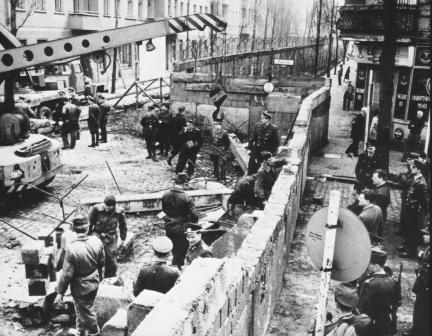
Berlin Wall’s 45th

August 13, 2006

August 13, 2006, is the 45th “anniversary” of the erection of the Berlin Wall, the totem of the Cold War that came down in 1989, pushing the end of the Cold War. Residents of Berlin awoke on this day in 1961 to find the communist government of East Germany erecting what would become a 96-mile wall around the “western quarters” of the city — not so much to lay siege to the westerners (that had been tried in 1948, frustrated by the Berlin Airlift) as to keep easterners from “defecting” to the West. The Brandenburg Gate was closed on August 14, and all crossing points were closed on August 26.

From 1961 through 1991 1989, teachers could use the Berlin wall as a simple and clear symbol for the differences between the communist Eastern Bloc, the Soviet Union and her satellite states, and the free West, which included most of the land mass of Germany, England, France, Italy, the United States and other free-market nations — the North Atlantic Treaty Organization (NATO) countries. I suspect most high school kids today know very little about the Wall, why it was there, and what its destruction meant, politically.

This era of history is generally neglected in high school. Many courses fail to go past World War II; in many courses the Cold War is in the curriculum sequenced after the ACT, SAT and state graduation examinations, so students and teachers have tuned out.

But the Wall certain had a sense of drama to it that should make for good lessons. When I visited the wall, in early 1988, late at night, there were eight fresh wreaths honoring eight people who had died trying to cross the Wall in the previous few weeks (in some places it was really a series of walls with space in between to make it easier for the East German guards to shoot people trying to escape) — it’s an image I never forget. Within a year after that, East Germans could travel through Hungary to visit the West, and many “forgot” to return. Within 18 months the wall itself was breached.

The Wall was a great backdrop for speeches, too — President John F. Kennedy visited Berlin in June 1963, and expressed his solidarity with the walled-in people of both West and East Berlin, with the memorable phrase, “Ich bin ein Berliner, which produced astounding cheers from the tens of thousands who came to hear him. There are a few German-to-English translators who argue that some of the reaction was due to the fact that “Berliner” is also an idiomatic phrase in Berlin for a bakery confection like a jelly doughnut — so Kennedy’s words were a double entendre that could mean either “I am a citizen of Berlin,” or “I am a jelly doughnut.”  [Be sure to see the comments below, from Vince Treacy (9/28/2010).]  Ronald Reagan went to the same place Kennedy spoke to the Berlin Wall, too, to the Brandenburg Gate, in his famous June 1987 speech which included a plea to the Soviet Union’s Premier Mikhail Gorbachev: “Mr. Gorbachev, tear down this wall!”

Construction of the Berlin Wall, photol collected by Corey S. Hatch

Construction of the Berlin Wall in August 1961 –photo from University of Utah, by Corey Hatch.

Update March 9, 2007: Berlin Airlift information and lesson plans are available from the Truman Library, here, here and here.

Update November 9, 2009: Notes on the 20th anniversary of the fall of the Wall

Please share this post:

Add to FacebookAdd to NewsvineAdd to DiggAdd to Del.icio.usAdd to StumbleuponAdd to RedditAdd to BlinklistAdd to TwitterAdd to TechnoratiAdd to Furl


God we trust, to Girard we owe

August 12, 2006

Steel engraving of Stephen Girard, with his signature, by Alonzo Chappel,

Steel engraving of Stephen Girard, the man who personally saved the United States, with his signature, by Alonzo Chappel,”National Portrait Gallery of Eminent Americans from original full length portraits by Alonzo Chappel” Vol I, New York: Johnson, Fry & Co. 1862 “The Cooper Collections” via Wikipedia

Irony strikes the White House.

I mean, you can’t really make stuff like this up.

To be sure, the humor is quite Santayanaesque — if you don’t know the history, you won’t see the irony.

President Bush issued a proclamation noting the 50th anniversary of one of our national mottoes, “In God We Trust.” No big deal, these presidential proclamations. Note the occasion, say it’s worth commemorating, urge citizens to commemorate it “appropriately.”

Somebody in the White House communications commissariat decided to dress it up a little, add some history — you know, pad the proclamation to please the partisan pundits. What better thing to mention than, say, the “Star-Spangled Banner,” our national anthem, which has a line in it, “in God is our trust?” Read the rest of this entry »


More on vouchers, history and creationism

August 7, 2006

Mark Olson is a veteran blogger on issues of concern to conservatives and to Christians, at Pseudo-Polymath. He’s responded to my earlier post on vouchers. Marks calls it ‘a bit of a quibble.’

His first complaint goes to history: I wrote that once we had a broad consensus on the value of education. Mark wrote:

In colonial (and I presume probably pre-Civil War Virginia) the Chesapeake bay/plantation folkway had a … hegemonic attitude toward education. In fact, while the plantation “masters” were 100% literate, the servants and other classes in the society (white) were some 70% illiterate. It was something of a point of pride that public education was not generally available. Literacy and education as well, was not emphasised in the backcountry as well (which continues (I think) today in Appalachia for example). So of the four folkways which made up our early nation, only two held that education was of value.

That official policy prevented education as a mark of oppression and/or racism only makes the point. Infamously, some states and localities at various times had laws against teaching slaves to read, or to educate slaves formally in other ways. Denying education is a traditional form of oppression. This does not change the consensus that education is valuable, but instead is a dramatic demonstration that the policy makers regarded education as valuable and as a political tool for change. At the same time that these governments forbade educating slaves, they established schools for other people. Read the rest of this entry »


James Madison, go-to guy

July 31, 2006

School starts soon. History classes will study the founding of the United States. And especially under the topical restrictions imposed by standardized testing, many kids will get a short-form version of history that leaves out some of the most interesting stuff.

James Madison gets short shrift in the current canon, in my opinion. Madison was the fourth president, sure, and many textbooks note his role in the convention at Philadelphia that wrote the Constitution in 1787. But I think Madison’s larger career, especially his advocacy for freedom from 1776 to his death, is overlooked. Madison was the “essential man” in the founding of the nation, in many ways. He was able to collaborate with people as few others in order to get things done, including his work with George Mason on the Virginia Bill of Rights, with George Washington on the Constitution and national government structure, Thomas Jefferson on the structure and preservation of freedom, Alexander Hamilton on the Constitution and national bank, and James Monroe on continuing the American Revolution.

We need to look harder at the methods and philosophy, and life, of James Madison. This is an opinion I’ve held for a long time. Below the fold I reproduce a “sermon” I delivered to the North Texas Church of Freethought in November 2001. Read the rest of this entry »


The meaning of “Liberty”

July 19, 2006

Ed Brayton and Mark Olson have been discussing the meaning of the word “liberty” especially with regard to the Declaration of Independence and what the Americans may have thought they were fighting for in the American Revolution. The whole discussion is linked at Positive Liberty, and Jason Kuznicki carries the analysis deeper — a good addition to the discussion, since Kuznicki is actually a historian.

Kuznicki’s post is here: http://positiveliberty.com/2006/07/olson-and-brayton-on-the-meanings-of-liberty.html


Fisking a Flag-Fold Flogging

July 19, 2006

Update, March 24, 2007: Be sure to see the updated flag ceremony, which you can find through this post on the news of the its release.

Yes, the flag amendment is dead, again. Yes, the Fourth of July is past. False history continues to plague the U.S. flag, however. When my wife forwarded to me the post below, it was the fourth time I had gotten it, recently. Bad history travels fast and far. Let’s see if we can steer people in a better direction with real facts.

A flag folding at a funeral for a military person carries great weight, without any script at all.  Wikimedia image from DOD release:  Members of the U.S. Navy Ceremonial Guard fold the American flag over the casket bearing the remains of sailors killed in the Vietnam War during a graveside interment ceremony at Arlington National Cemetery on May 2, 2013. Lt. Dennis Peterson, from Huntington Park, Calif.; Ensign Donald Frye, from Los Angeles; and Petty Officers 2nd Class William Jackson, from Stockdale, Texas, and Donald McGrane, from Waverly, Iowa, were killed when their SH-3A Sea King helicopter was shot down on July 19, 1967, over Ha Nam Province, North Vietnam. All four crewmembers were assigned to Helicopter Squadron 2.

A flag folding at a funeral for a military person carries great weight, without any script at all. Wikimedia image from DOD release: Members of the U.S. Navy Ceremonial Guard fold the American flag over the casket bearing the remains of sailors killed in the Vietnam War during a graveside interment ceremony at Arlington National Cemetery on May 2, 2013. Lt. Dennis Peterson, from Huntington Park, Calif.; Ensign Donald Frye, from Los Angeles; and Petty Officers 2nd Class William Jackson, from Stockdale, Texas, and Donald McGrane, from Waverly, Iowa, were killed when their SH-3A Sea King helicopter was shot down on July 19, 1967, over Ha Nam Province, North Vietnam. All four crewmembers were assigned to Helicopter Squadron 2.

Here is the post as it came to me each time — I’ve stripped it of the sappy photos that are occasionally added; note that this is mostly whole cloth invention:

Did You Know This About Our Flag

Meaning of Flag Draped Coffin.

All Americans should be given this lesson. Those who think that America is an arrogant nation should really reconsider that thought. Our founding fathers used God’s word and teachings to establish our Great Nation and I think it’s high time Americans get re-educated about this Nation’s history. Pass it along and be proud of the country we live in and even more proud of those who serve to protect our “GOD GIVEN” rights and freedoms.

To understand what the flag draped coffin really means……

Read the rest of this entry »


4th of July

July 4, 2006

Independence Day is one of the best holidays of the year, especially for those of us who love fireworks. In the first few years of our marriage we lived in and very near Washington, D.C., where there is one of the grandest fireworks displays annually, against one of the most arresting set of backdrops possible. When we lived on Capitol Hill it was a short walk to the Capitol, to watch the display at the Washington Monument, with the Lincoln Memorial and Lee’s Mansion at Arlington National Cemetery in the background. Once we hiked to the Lincoln Memorial to get the opposite view.

There are other grand displays. Baltimore annually has a grand fireworks program on Baltimore Harbor, near Fort McHenry whose shelling was the inspiration to Francis Scott Key to write what is now our national anthem. In the Norfolk area there is a fine show at the Yorktown National Battlefield site. New York City has great stuff, as do Boston, Philadelphia, and Chicago.

But the best part of the holiday is the annual retelling of the story of freedom, of the Declaration of Independence, and of its chief author Thomas Jefferson, and the friendships that included Benjamin Franklin, James Madison, George Washington, Alexander Hamilton, and especially John Adams. The story of the friendship, falling out, reconciliation and great love between Adams and Jefferson is one of the finest stories in American history. After having reconciled a few years after their great falling out during the bitter election of 1800, they continued to correspond to their deaths. The series of letters is a great explication of democracy, how to form a republic, and the duties and privileges of citizens in a free nation. To add to the poignancy, both Adams and Jefferson died on July 4, 1826, 50 years to the day that the Declaration of Independence was published. Ed Brayton of Dispatches from the Culture Wars has a fine post on the day, the Declaration, and the friendship between Adams and Jefferson, here.