Great Arctic sea ice hoax exposed

July 26, 2009

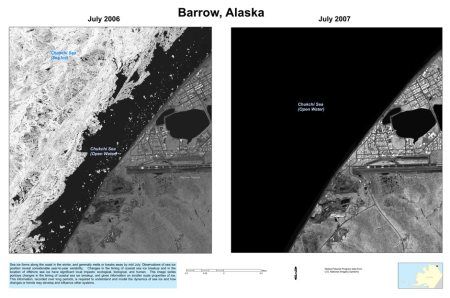
Look at the photos and see for yourself.  From 2006 to 2007, did sea ice at Barrow, Alaska, increase or decrease?

A comparison of polar sea ice at Barrow, Alaska -- July 2006 on the left, July 2007 on the right - public domain photo from U.S. military satellites.

A comparison of polar sea ice at Barrow, Alaska -- July 2006 on the left, July 2007 on the right - public domain photo from U.S. military satellites. Click for larger view from The Guardian.

These photos appeared in The Guardian — did they appear in any U.S. papers? — with a story that said the photos had been withheld by the Bush administration, and were recently released by the Obama administration.  (Bet these photos never show up on Anthony Watts’s blog.)*

Graphic images that reveal the devastating impact of global warming in the Arctic have been released by the US military. The photographs, taken by spy satellites over the past decade, confirm that in recent years vast areas in high latitudes have lost their ice cover in summer months.

The pictures, kept secret by Washington during the presidency of George W Bush, were declassified by the White House last week. President Barack Obama is currently trying to galvanise Congress and the American public to take action to halt catastrophic climate change caused by rising levels of carbon dioxide in the atmosphere.

One particularly striking set of images – selected from the 1,000 photographs released – includes views of the Alaskan port of Barrow. One, taken in July 2006, shows sea ice still nestling close to the shore. A second image shows that by the following July the coastal waters were entirely ice-free.

The photographs demonstrate starkly how global warming is changing the Arctic. More than a million square kilometres of sea ice – a record loss – were missing in the summer of 2007 compared with the previous year.

Spin, from the presidency?  Who knew?

Climate change skeptics (read:  deniers) say that ice has come back in record amounts in 2008.  According to the news article, that isn’t exactly the case.

Nor has this loss shown any sign of recovery. Ice cover for 2008 was almost as bad as for 2007, and this year levels look equally sparse.

Science News noted the declassification, but without the hint of skullduggery on the part of the Bush administration.  The poster above comes from the USGS, which also included three more posters, one of the Beaufort Sea and two of glaciers — all of them showing declines in ice.

Stories that Arctic sea ice is expanding seem to be premature.

So all the claims that global warming has ended, that ice is threatening to extend its range and plunge us back into a cooling period — just hoax? Yep, just hoax.

Tip of the old scrub brush to Watching the World from Nicaraugua.

Update, 7-27-2009: A story going around the internet claims the poster at the top of this post is faked.  The poster comes from the U.S. Geological Survey, so I doubt it’s faked — they have no dog in the fight to fake it.  I think this goes to show that climate change “skeptics” have been sucked in by their own denial virus, and they will not even entertain information to the contrary of their beliefs.

*   Happy update, 8-2-2009: I’m happy to report I erred.  Actually, Anthony Watts reported on the release of the photos on July 15.  He didn’t use the Barrow photos, and he certainly did not claim that they are hoax photos.  He noted that the previously classified data have been released, and he seemed to think that there is no monkeying around with them.   It’ll be interesting to see how he deals with the photos from here on in.

Spread the news!

Add to FacebookAdd to NewsvineAdd to DiggAdd to Del.icio.usAdd to StumbleuponAdd to RedditAdd to BlinklistAdd to TwitterAdd to TechnoratiAdd to Furl


Trouble at the Texas State Board of Education: Social studies curriculum

July 15, 2009

I’m posting on the run from an AP Summer Institute at Texas Christian University, so just the facts.

Today’s Fort Worth Start Telegram featured a story on the social studies curriculum battles in the Texas State Board of Education.  It’s one of those stories that does well in presenting the facts, but for the sake of “objectivity” treats the yahoos of the review committee — David Barton and Peter Marshall in particular — as respected academics.

Of particular note, a very brief summary of the credientials and comments of the “expert” reviewing panel.

Should Texas be worried?

See immediately previous post with the address to listen to live webcasts of the Board’s meetings this week.


Is Texas the state most vulnerable to global climate change?

June 6, 2009

John Mashey occasionally graces these pages with his comments — a cool, reasoned head on hot issues like global warming/global climate change, despite his history in computers or maybe because of it (which would put the lie to the idea that computer programming explains why so many computer programmers are wacky intelligent design advocates).

Mashey offered a comment over at RealClimate on a post about hoaxer and science parodist Christopher Monckton — a comment you ought to read if  you think about Texas ever, and especially if you like the place.  It’s comment #413 on that Gigantor blog.

Monckton wrote a letter to the New York Times and attached to it a graph.  The graph, it turns out, probably would need to be classified in the fiction section of a library or book store, were it a book.  Much discussion occurs, absent any appearance by Monckton himself who does not defend his graphs by pointing to sources that might back what his graphs say, usually.

In short, the post and the extensive comments shed light on the problems of veracity which plague so many who deny either that warming is occurring, or that air pollution from humans might have anything to do with it, or that humans might actually be able to do anything to mitigate the changes or the damage, or that humans ought to act on the topic at all.

So I’ve stolen Mashey’s comment lock, stock and barrel, to give it a little more needed highlight.

If you follow environmental issues much, you probably know Count Christopher Monckton as a man full of braggadocio and bad information on climate.  He is known to have worked hard to hoodwink the U.S. Congress with his claims of expertise and policy legitimacy, claiming to be a member of the House of Lords though he is not (some climate change deniers in Congress appear to have fallen for the tale).  He pops up at denialist conferences, accuses scientists of peddling false information, and he is a shameless self-promoter.

After much discussion, Mashey turned his attention to claims that Texans don’t know better than Monckton, and other things; Mashey notes that denialists cite Monckton’s performance at a conservative political show in Texas, instead having paid attention to real climate scientists who were meeting just up the road, for free:

AGW’s impact depends on where you live
OR
Texas is Not Scotland, even when a Scottish peer visits

1) SCOTLAND
Viscount Monckton lives in the highlands of Scotland (Carie, Rannoch, 57degN, about the same as Juneau, AK, but warmer from Gulf Stream.)

a) SEA LEVEL, STORMS
Most of Scotland (esp the highlands) is well above sea level, and in any case, from Post-Glacial Rebound, it’s going up. [Not true of Southern England.]

b) PRECIPITATION
Scotland gets lots of regular precipitation. From that, he likely gets ~1690mm or more rainfall/year, noticeably more than Seattle or Vancouver.

Scotland has complex, variable weather systems, with more rain in West than in East, but has frequent precipitation all year.

c) TEMPERATURE
Scotland’s climate would likely be better with substantial warming. See UK Met Office on Scotland, which one might compare with NASA GISS Global Annual Mean Surface Air Temperature Change. Scotland average maximum temperatures are 18-19C in the summer, i.e., in most places it might occasionally get up to 70F, although of course it varies by geography. +3C is no big deal. The record maximum was 32.9C (91F), set in 2003. Maybe there is yet a good future for air-conditioning/cooling vendors.

If one does a simple linear regression on both sets of annual data, one finds that SLOPE(Scotland) = .0071C/year, SLOPE(world) = .0057C/year, i.e., Scotland is warming slightly faster than the world as a whole.

d) AGRICULTURE
The combination of b) and c) is, most likely *good* for agriculture in Scotland. There is plenty of rain, and higher temperatures mean less snow and a longer growing season. Great!

In addition, the British geoscientist/vineyard archaeologist Richard Selley thinks that while it may be too hot for good vineyards in Southern England by 2080, it will be fine for some areas of Scotland.
Future Loch Ness Vineyard: great!

e) OIL+GAS, ENERGY
Fossil fuel production (North Sea oil&gas) is very important to the Scotland economy. Wikipedia claims oil-related employment is 100,000 (out of total population of about 5M).

Scotland has not always been ecstatic to be part of the UK.

2) TEXAS
The Viscount Monckton spoke for Young Conservatives of Texas, April 28 @ Texas A&M, which of course has a credible Atmospheric Sciences Department. Of course, many of them were unable to hear the Viscount because they were in Austin at CLIMATE CHANGE Impacts on TEXAS WATER, whose proceedings are online. See especially Gerald North on Global Warming and TX Water.

Monckton delivered his message: “no worries, no problems” which might well fit Scotland just fine, at least through his normal life expectancy.

The message was delivered to Texans typically in their 20s, many of whom would expect to see 2060 or 2070, and whose future children, and certainly grandchildren, might well see 2100.

Texas is rather different from Scotland, although with one similarity (oil+gas).

a) SEA LEVEL, STORMS

Texas has a long, low coastline in major hurricane territory.
Brownsville, TX to Port Arthur is a 450-mile drive, with coastal towns like Corpus Christi, Galveston, and Port Arthur listed at 7 feet elevations. The center of Houston is higher, but some the TX coast has subsidence issues, not PGR helping it rise. The Houston Ship Canal and massive amounts of infrastructure are very near sea level. More people live in the Houston metropolitan area + rest of the TX coast than in all of Scotland.

Of course, while North Sea storms can be serious, they are not hurricanes. IF it turns out that the intensity distribution of hurricanes shifts higher, it’s not good, since in the short term (but likely not the long term), storm surge is worse than sea level rise.

Hurricane Rita (2005) and Hurricane Ike (2008) both did serious damage, but in some sense, both “missed” Houston. (Rita turned North, and hit as a Category 3; Ike was down to Category 2 before hitting Galveston).

Scotland: no problem
TX: problems already

b) RAINFALL
Texas is very complex meteorologically, and of course, it’s big, but as seen in the conference mentioned above (start with North’s presentation), one might say:

– The Western and Southern parts may well share in the Hadley-Expansion-induced loss of rain, i.e., longer and stronger droughts, in common with NM, AZ, and Southern CA. Many towns are dependent on water in rivers that come from the center of the state, like the Brazos.

– The NorthEast part will likely get more rain. [North’s comment about I35 versus I45 indicates uncertainty in the models.]

– Rain is likely to be more intense when it happens, but droughts will be more difficult.

Extreme weather in TX already causes high insurance costs, here, or here.

Scotland: no problem
Texas: problems.

c) TEMPERATURE

Texas A&M is ~31degN, rather nearer the Equator than 57degN.
Wikipedia has a temperature chart. It is rather warmer in TX, but is also more given to extremes.

Scotland: +3C would be dandy,
Texas: +3C not so dandy.

d) AGRICULTURE
Between b) and c), less water in dry places, more water in wet places, more variations in water, and higher temperatures (hence worse evaporation/precipitation difference) are not good news for TX agriculture, or so says Bruce McCarl, Professor of Agricultural Economics at TAMU.

For audiences unfamiliar with Texas A&M, the “A” originally stood for Agriculture, and people are called Aggies. One might assume that agricultural research is valued.
Politically, “Aggie-land” would not be considered a hotspot of hyper-liberal folks prone to becoming climate “alarmists”.

Scotland: warmer, great! Wine!
Texas: serious stress.

d) OIL+GAS, ENERGY
Here, there is more similarity: fossil fuels are economically important.

On the other hand, Scotland was settled long before the use of petroleum, and while places like the highlands are very sparse, cities like Edinburgh and Glasgow are relatively dense, and many villages are quite walkable. Warmer temperatures mean *lower* heating costs.

Texas has naturally developed in a very different style, and with forthcoming Peak Oil, this may be relevant. In 2006, according to EIA, Texas was #1 in energy consumption, 5th per-capita (after AK, WY, LA, ND) and uses 2X/capita of states like NY or CA. Some of that is inherent in different climate and industry.

Sprawling development in a state with water problems, subject to dangerous weather extremes, and already seriously-dependent on air-conditioning, may end being expensive for the residents.

Scotland: makes money from fossil energy, but it was mostly built without it. Warmer temperatures reduce energy use.
Texas: already uses ~2.5-3X higher energy/capita, compared to Scotland. Warmer temperatures likely raise energy use.

3. SUMMARY

Gerald North’s talk ended by asking:
“Is Texas the most vulnerable state?”

That sounds like an expert on trains, hearing one coming in the distance, standing on the tracks amidst a bunch of kids, trying to get them off the tracks before there’s blood everywhere.

On the other side, someone safely away from tracks keeps telling the kids that experts are wrong, there is no danger, so they can play there as long as they like.
You will be well informed if you also read Mashey’s comments at #120 and #132.


Insanity at Texas state school board – economics, geography and history

May 27, 2009

Tim Ritz cartoon, for Americans United

Tim Ritz cartoon, for Americans United

Texas Freedom Network’s Insider blog reports that embattled chairman Don McLeroy is working to create a panel of experts to review studies curricula.  The experts he has proposed so far are all well-known cranks in academia, people who bring their axes to grind on the minds of innocent children.

This panel is a bold insult to Texas’s community of economists, historians, and other practitioners of fields of social studies, not to mention educators.  A more qualified panel of experts could be assembled in the coffee break rooms of the history departments at most of Texas’s lesser known state colleges and universities.

Why does Don McLeroy hate Texas so?

I’ve been buried in teaching, grading, planning and the other affairs of the life of a teacher, and had not paid much attention to the movement on this issue (“movement” because I cannot call it “progress”).  My students passed the state tests by comfortable margins, more than 90% of them; this news from SBOE makes me despair even  in the face of the news that our achievements are substantial in all categories.

The panel lacks knowledge and experience in economics, geography and history.  The panel is grotesquely unbalanced — at least two of the panel members remind me of Ezra Taft Benson, who was Secretary of Agriculture for Dwight Eisenhower.  When he resigned from that post, he complained that Eisenhower was too cozy with communism.  Barton and Quist lean well to the right  of Ezra Taft Benson.  Quist has complained of socialist and Marxist leanings of Reagan administration education policy and policy makers.

Samuel Morse sent the first telegraphic message on May 24, 1844:  “What hath God wrought?”

Sitting here on the morning of May 27, 2009, I wonder what rot hath Don.


Climate Denial Crock of the Week: Ocean levels

May 10, 2009

Blue Ollie carried a YouTube video that got me to look at Peter Sinclair’s marvelous series of amateur videos, “Climate Denial Crock of the Week.” Sinclair posts under the handle GreenMan at YouTube.

Here’s the Climate Denial Crock of the Week video on ocean levels, and the denial that they are rising — in line with my post a few hours ago about peoples in the South Pacific and in Alaska losing their homes to climate change:

Pat Frank’s work keeps reminding us that, in science, it’s often difficult to establish a clear, indisputable proximate cause.  Something is going on in Newtok, Alaska, and in the Carteret Islands, Papua New Guinea.  Those things should not be ignored, and cannot be ignored safely for long.

(Teachers:  Note most of these videos are around 5 minutes in length — more than suitable for classroom use, perhaps even as a bell ringer.  Notice also that, if you don’t know how to make these videos, as I don’t, you’re behind the curve.)


Polluted waters near your home, 6-legged frogs, and you

April 19, 2009

It was a reference to the “environmental movement” in government and politics — seniors take the class in Texas.  “What does that mean?”

We have maybe ten minutes in the block to stray.  No time for discovery learning to get this point across in government.

“The movement, the grass-roots political organizing to express concern for clean air, clean water, preservation of green space, preservation of endangered species, protection from toxic chemicals and poisons.  Things really took off after Rachel Carson’s book, Silent Spring. ”

“That’s a funny title.  What’s it about?”  I pause.  It’s dangerous territory to ask what high school kids don’t know these days.

“Is there anyone here who does not know about DDT and its role in threatening our national symbol, the bald eagle?”

Every hand went up.

How can children get to their senior year and not know about Rachel Carson, DDT, or “environmentalism?”

Comes Frontline on PBS this week.  Government and politics teachers, your students should watch and report.

FRONTLINE
http://www.pbs.org/frontline/

This Week: “Poisoned Waters” (120 minutes),
April 21st at 9pm on PBS (Check local listings)

———————-

For years, Pulitzer Prize-winning journalist Hedrick Smith has reported from the corridors of power in Washington, on Wall Street, and overseas.  But these days, he’s worried about something that he’s found much closer to home — something mysterious that’s appeared in waters that he knows well:  frogs with six legs, male amphibians with ovaries, “dead zones” where nothing can live or grow.

What’s causing the trouble? Smith suspects the answers might lie close to home as well.

This Tuesday night, in a special two-hour FRONTLINE broadcast –“Poisoned Waters”– Smith takes a hard look at a new wave of pollution that’s imperiling the nation’s waterways, focusing on two of our most iconic:  the Chesapeake Bay and Puget Sound.  He also examines three decades of environmental regulation that are failing to meet this new threat, and have yet to clean up the ongoing mess of PCBs, the staggering waste from factory farms, and the fall-out from unchecked suburban sprawl.

“The environment has slipped off our radar screen because it’s not a hot crisis like the financial meltdown, war, or terrorism,” Smith says.  “But pollution is a ticking time bomb. It’s a chronic cancer that is slowly eating away the natural resources that are vital to our very lives.”

Among the most worrisome of the new contaminants are “endocrine disruptors,” chemical compounds found in common household products that mimic hormones in the human body and cause freakish mutations in frogs and amphibians.

“There are five million people being exposed to endocrine disruptors just in the Mid-Atlantic region,” a doctor at the Johns Hopkins School of Public Health tells Smith.  “And yet we don’t know precisely how many of them are going to develop premature breast cancer, going to have problems with reproduction, going to have all kinds of congenital anomalies of the male genitalia that are happening at a broad low level so that they don’t raise the alarm in the general public.”

Can new models of “smart growth” and regulation reverse decades of damage?  Are the most real and lasting changes likely to come from the top down, given an already overstretched Obama administration?  Or will the greatest reasons for hope come from the bottom up, through the action of a growing number of grassroots groups trying to effect environmental change?

Join us for the broadcast this Tuesday night.  Online, you can watch “Poisoned Waters” again, find out how safe your drinking water is,  and  learn how you can get involved.

Ken Dornstein
Senior Editor

————————

Funding for FRONTLINE is provided through the support  of PBS viewers. Major funding for FRONTLINE is provided by The John D. and Catherine T. MacArthur Foundation. Additional funding is provided by the Park Foundation. Major funding for Poisoned Waters is provided by The Seattle Foundation, The Russell Family Foundation, The Wallace Genetic Foundation, The Morris and Gwendolyn Cafritz Foundation, The Keith Campbell Foundation for the Environment, The Merrill Family Foundation, The Abell Foundation, The Bullitt Foundation, the Park Foundation, and The Rauch Foundation.  Additional funding is provided by The Town Creek Foundation, The Clayton Baker Trust, The Lockhart Vaughan Foundation, The Curtis and Edith Munson Foundation, The Chesapeake Bay Trust, Louisa and Robert Duemling, Robert and Phyllis Hennigson, Robert Lundeen, The Eugene and Agnes E. Meyer Foundation, The Prince Charitable Trusts, Ron and Kathy McDowell, Valerie and Bill Anders, Bruce and Marty Coffey, The Foundation for Puget Sound, Janet Ketcham, Win Rhodes, The Robert C. and Nani S. Warren Foundation, Jim and Kathy Youngren, Vinton and Amelia Sommerville and Laura Lundgren.

————————

FRONTLINE is a registered trademark of the WGBH Educational Foundation.

See a preview, and read more, here.  Another preview below.  You can watch the entire program online after April 21.


Texas Citizens for Science supports stripping powers from state board

April 14, 2009

Another press release, FYI.  I’ve added some links in for your convenience.  Remember, teachers of social studies, social studies is next on the SBOE chopping block — with rumors that SBOE is disbanding the expert panels rather than simply ignore the recommendations.  Will they expunge slavery and Native Americans from the history books?  Will they rewrite the Vietnam War?  Consider Senate Bill 2275, and call your legislator:

PRESS RELEASE

For Immediate Release

Texas Citizens for Science
2009 April 13

Contact:
Steven D. Schafersman, Ph.D.
432.352.2265
tcs@texscience. org

Texas Citizens for Science strongly supports Senate Bill 2275 which transfers authority for curriculum standards and textbook adoption from the State Board of Education (SBOE) to the Texas Commissioner of Education.

For decades, members of the SBOE have censored, qualified, distorted, damaged, manipulated, and rejected curriculum standards and textbooks. All of this was done for political, ideological, and religious reasons, never for educational or pedagogical reasons. In the past, this activity was done secretly, behind closed doors, but now it is being done publicly in full view of the public and press. Recently, inaccurate, censored, and pedagogically- inferior English Language Arts and Science curriculum standards have been written by the SBOE using their power of amendment. This year, the Social Studies standards will be attacked by some SBOE members for non-educational reasons that support their political and ideological agendas.

For textbooks, in the past the SBOE chair would secretly “negotiate” with publishers to make them change the content of their textbooks under the implied threat of being rejected; publishers readily submitted to save multimillion dollar textbook contracts with the state. In numerous instances, textbook content was replaced by watered-down, inferior, and often misleading, inaccurate, and incomplete information. This activity continues today, albeit more openly with both press and public attention. Science textbooks censorship by the SBOE has occurred sinc the 1960s, as has censorship of social studies and other textbooks.

Dr. Steven Schafersman, President of Texas Citizens for Science, says this:

“The Texas State Board of Education has been an embarrassment and a disgrace to Texas for many decades. This Board’s activities that censor and corrupt the accuracy and reliability of specific topics in mainstream Science, Social Studies, and Health Education are well-known to educators throughout the United States as well as in Texas. All educators are aware of the negative and damaging influence the Texas State Board of Education has on textbooks used in Texas and other states.”

“Texas Citizens for Science has opposed the State Board of Education since 1980 in our effort to defend the accuracy and reliability of science education in Texas. We have repeatedly had to defend Biology and Earth Science textbooks from the Board’s predatory efforts to damage their content about such subjects as evolution, the origin of life, the age of the Earth and Universe, the true nature of the fossil record, and several other scientific topics.”

“Although largely successful in the past, only this past month TCS was unable to prevent the State Board of Education from amending the excellent science standards produced by science teachers, professors, and scientists. The State Board’s subsequent amendments created several flawed standards that, while not overtly unscientific, were confusing, unnecessary, poorly-written, and opened the door to insertion of pseudoscientific information, including bogus arguments supporting Intelligent Design Creationism. Among others things the Board accomplished during this exercise in pseudoscience was to remove the e-word and the ancient age of the universe from the standards. These accomplishments were petty, disgraceful, and clear proof of their anti-scientific and pro-Fundamentalist bias. A modern, technologically- advanced state such as Texas does not need such anti-science activity from a state board.”

Texas Citizens for Science urges the Senate Education Committee to approve SB 2275 and send it to the full Senate, the House, and then hopefully signed into law.

Resources:


Social studies on the ‘net

April 13, 2009

A note from one of our school’s librarians:

Here are some web sites for Social Studies teachers:

Center for History and New Media – http://chnm.gmu.edu

Cyberschoolbus: United Nations – http://www.cyberschoolbus.un.org – international issues and the United Nations

Digital History – http://www.digitalhistory.uh.edu – US History

Famous Trials – http://www.law.umkc.edu/faculty/projects/ftrials/ftrials.htm

History/Social Studies for K-12 Teachers – http://home.comcast.net/~dboals1/boals.html – links to SS issues

Humanities-Interactive – http://www.humanities-interactive.org/a_base_UD.html

HyperHistory Online – http://www.hyperhistory.com/online_n2/History_n2/a.html – world history

iEARN – http://www.iearn.org – online projects

Internet History Sourcebooks Project – http://www.fordham.edu/halsall – ancient, medieval history, modern history

The Learning Page…Especially for Teachers – http://lcweb2.loc.gov/learn

National Geographic Education Guide – http://www.nationalgeographic.com/education

Newsweek Education Program – http://www.newsweekeducation.com

SCORE: History/Social Science – http://score.rims.k12.ca.us

Special Projects: Understanding World Events – http://www.esrnational.org/sp/we/world.htm

Gee, didn’t I note most of those sites?  If I did, it wasn’t recently enough.  A good reminder (my AP government students used the UMKC site for their projects on the Scopes Trial last month).  Check out each of those sites and let us know which ones you find particularly valuable.


California unemployment map, for economics classrooms

March 20, 2009

The Sacramento Bee, one of America’s great newspapers which we hope can stay in business through these tough times, today put up a map of California unemployment, county by county.  The map shows unemployment changes over the past year with an interactive slide that makes it great for classroom use in economics, but makes it impossible for me to embed here (it’s in Adobe Flash).

California’s unemployment is at about 11% statewide.  Colusa County’s unemployment is 26.6%.  Two counties away, in Marin County, it’s only 6.8%

California economics classes can use their knowledge of agriculture and industry in the state to make educated guesses about what is going on in each county.  Surely there are uses the rest of us can find.  Colusa and Imperial Counties are two of the hardest hit — with the internet, can your students tell what that is going to mean for prices on fresh produce and processed foods?

This is where computers and the internet step out ahead in the education tilts, with tools like this interactive map.  Thank you, SacBee.  Can you give teachers a download?

Another unemployment map, national, for December 2008, The Swordpress

Another unemployment map, national, for December 2008, The Swordpress


Mapping Africa

February 25, 2009

Here’s a great tool for geography study of Africa.

AfricaMap is based on the Harvard University Geospatial Infrastructure (HUG) platform, and was developed by the Center for Geographic Analysis to make spatial data on Africa easier for researchers to discover and explore.

Harvards Africa Map, sample image, via Google Maps Mania

Harvard's Africa Map, sample image, via Google Maps Mania

It’s an interactive tool.  You can capture images (another add-on might be necessary) — but look at all the different layers you can use, live, on your computer.

Good source for student projects, no?

Tip of the old scrub brush to Google Maps Mania.


Abraham Lincoln, inventor

February 24, 2009

Any visitor to Thomas Jefferson’s home at Monticello knows of Jefferson’s wide-ranging interests, and work in science and invention.  I was rather surprised to discover the depth of George Washington’s inventive work, in a seminar sponsorred by the Bill of Rights Institute at Mount Vernon a few years ago.

Abraham Lincoln, too?

Lincoln lived along the Sangamon River, and he saw development of the river for commercial navigation to be a boon for his district’s economic growth.  Unfortunately, the Sangamon is not deep; boats had difficult times navigating over the many logs and snags, and shallows.

So, Mr. Lincoln offered a technical solution, for which he was granted a patent in 1849.  Details below, from Google Patents:

lincoln-patent-for-buoying_vessels_over_shoals

lincoln-patent-for-boat-buoying-in-jpg


Waiting for the New President: Doctoring data on global warming

December 16, 2008

ArborDay.org map showing changes in hardiness zones between 1990 and 2006

ArborDay.org map showing changes in hardiness zones between 1990 and 2006, a map climate change denialists wish did not exist.

We need a new category of urban myth or urban legend.  Jan Brunvand’s inventions and development of the study of folk stories that people claim to be true long enough that they become legends, needs to be updated to include internet stupidity that just won’t die.  Especially, we need a good, two-word label for politically-motivated propaganda that should go away, but won’t.

Perhaps I digress.

One might be filled with hope at the prospect of the administration of President Obama. Science issues that have been ignored for too long may once again rise to due consideration.  Friends in health care worry that it will take four or eight terms of diligent work to undo the damage done to medical science by neglect of spending and budgeting during the last eight years.

I take a little hope in this:  Maybe we can get an update of the planting zones maps relied on by farmers, horticulturists, and backyard gardeners.

New maps were delayed through the Bush administration.  The last serious update, officially, was 1990.  Perhaps much has changed in climate in the last generation, and perhaps that is why the new maps were delayed, though they had been painstakingly prepared by the American Horticulture Society.

Why?

Plants cannot be fooled by newspaper reports.  Plants are not partisan in political issues. Plants both respond to and clearly demonstrate climate change.  To those who wished to suppress or deny climate change, suppressing the hardiness zone maps may have seemed like a good way to win a political debate.

Robust discussion based on the facts, a casualty of the past eight years, ready to be resurrected.

Resources:


Geography lesson: New York City

November 19, 2008

Bookmark this site, geography teachers:  Farm School is going to New York City for the “American Thanksgiving” holiday.  Check out the long list of rich resources.

Any student or teacher doing a project on modern New York City should send a note of Thanksgiving to Farm School, eh?


Atomic history, nuclear future

October 19, 2008

We’re going to see more nuclear power plants in the U.S., it’s a safe bet.  Both presidential candidates support developing alternatives to oil and coal.  Nuclear power is one of the alternatives.

John McCain kept repeating his comfort words, that ‘storage of wastes is not a problem.’ There is not a lot of evidence to support his claims.  With turmoil in financial markets, however, the nuclear power issue has gotten very little serious attention or scrutiny.  From the push to get compensation for radiation victims of atomic weapons and development in the U.S., I learned that the issue is not really whether wastes and other materials can be safely used and wastes stored. The issues are entirely issues of will.

Advantage to Obama, I think.  He’s not claiming that the storage problems are all solved.  A clear recognition of reality is good to have in a president.

Son Kenny sent a link to a history site, Damn Interesting, and it tells the story of the Techa River in the old Soviet Union — a place condemned for generations by the nuclear excesses of the past.

To make the story briefer, in their rush to produce nuclear weapons, the Soviets did nothing to protect Russia from radioactive waste products until it was much too late.  Efforts to reduce radioactive emissions, by storing them in huge underwater containers, resulted in massive explosions that released more radiation than Chernobyl (What?  You hadn’t heard of that, either?).

It’s a reminder that safety and security with peaceful uses of nuclear power depend on humans doing their part, and thinking through the problems before they arise.

Can we deal with radioactive wastes?  We probably have the technology.  Do we have the will? Ask yourself:  How many years has the U.S. studied Yuccan Mountain to make a case to convince Nevadans to handle the waste?  How many more decades will it take?

How is our history of dealing with nuclear contamination issues?  Not good.

Last spring SMU’s history department sponsored a colloquium on a power generation in the southwest, specifically with regard to coal and uranium mining on the Navajo Reservation.   We’ve been there before.

One of the photos used in one of the lectures, by Colleen O’Neill of Utah State, showed two Navajo miners outside a uranium mine during a previous uranium boom.  Neither one had a lick of protective equipment.  Underground uranium mining exposes miners to heave concentrations of radon gas, and if a miner is unprotected by breathing filters at least, there is a nearly 100% chance the miner will get fatal lung cancers.

Of the 150 Navajo uranium miners who worked at the uranium mine in Shiprock, New Mexico until 1970, 133 died of lung cancer or various forms of fibrosis by 1980 ([Ali, 2003] ).

Our Senate hearings on radiation compensation, in the 1970s, produced dozens of pages of testimony that Atomic Energy Commission officials understood the dangers, but did nothing to protect Navajo miners (or other miners, either).  It is unlikely that anyone depicted in those photos is alive today.

AP Photo  (borrowed from ehponline.org)

"Mine memory - Navajo miners work the Kerr-McGee uranium mine, 7 May 1953. Today, uranium from unremediated abandoned mines contaminates nearby water supplies. image: AP Photo" (borrowed from ehponline.org) This photo is very close to the one used by Prof. O'Neill. It may have been taken at nearly the same time. If you know of any survivors from this photo, please advise.

At a refining facility on the Navajo Reservation, highly radioactive wastewater was stored behind an inadequate earthen dam.  The dam broke, and the wastes flowed through a town and into local rivers.  Contamination was extensive.

Attempts to collect for the injuries to Navajo miners and their families were thrown out of court in 1980, on the grounds that the injuries were covered under workers compensation rules (where injury compensation was also denied, generally).

Navajos organized to protest the power plant. One wonders whether they can win it.

Sen. McCain seems cock sure that radioactive wastes won’t kill thousands of Americans in the future as they have in the past.  The uranium mining and uranium tailings issues occurred in Arizona, the state McCain represents.  Does he know?

We regard ourselves in the U.S. as generally morally superior to “those godless communists.”  Can we demonstrate moral superiority with regard to development of peacetime nuclear power, taking rational steps to protect citizens and others, and rationally, quickly and fairly compensating anyone who is injured?

That hasn’t happened yet.

When [uranium] mining [on the Navajo Reservation] ceased in the late 1970’s, mining companies walked away from the mines without sealing the tunnel openings, filling the gaping pits, sometimes hundreds of feet deep, or removing the piles of radioactive uranium ore and mine waste. Over 1,000 of these unsealed tunnels, unsealed pits and radioactive waste piles still remain on the Navajo reservation today, with Navajo families living within a hundred feet of the mine sites. The Navajo graze their livestock here, and have used radioactive mine tailings to build their homes. Navajo children play in the mines, and uranium mine tailings have turned up in school playgrounds (103rd Congress, 1994 ).

Think of the story of Techa River as a warning.

Resources:


“See ya Red States,” and a paean to Texas

October 16, 2008

You’ve seen it before — the letter saying toodle-oo to the red states, as the blue states muster the courage to let them go.  Somebody passed it along, I forwarded it to a few people I thought hadn’t seen it.

A discussion broke out.  Part of the discussion centered on Texas’s second secession from the U.S., and how nasty things can be in Texas (“It’s not the heat and humidity; it’s the hate and stupidity”).

A couple of exchanges in, I started to wince.  God knows Texas has its problems.  I haven’t even started in on the latest three months of lunacy at the State Board of Education where Creationist-in-Chief Don McLeroy is loosening his belt to drop his pants (figuratively, of course) and moon every kid in Texas before he eviscerates science education.

But — you know? — Texas has a couple of things going for it, reasons to smile while you’re stuck here.

Below the fold, the “So long, Red States” letter — but before that, a modest defense of Texas, as I wrote back:

I do regret that [y’all have] had such a difficult and unhappy time in Texas.  Texas is far from my ideal place, especially for the weather and lack of mountains (I appear to be losing the retirement fight – I wanted Jackson Hole, Kathryn wants Kanab.  Red rock wins with the family.)

And Yellowstone is a part of my soul, especially after we (probably illegally) scattered my brother’s ashes there in the last great family reunion before this past summer.

But, you know, Texas has some fine points that shouldn’t get overlooked. Especially, it doesn’t deserve to get every redneck.

Here are some of the great things about Texas:

It’s been a rather miserable 21 years in Texas for us, for a lot of reasons.  There are good things and good people in Texas.  It ain’t all gloomy.

Wildflowers not only do blossom where they grow:  They must blossom there.

Which reminds me, there are a dozen other wildflowers better than bluebonnets, and we haven’t even started on the magnificent grasses like big bluestem, little bluestem and side-oats grama.

(More humor below the fold.)

Read the rest of this entry »
