We need your help to keep divisive politics out of Texas’ classrooms.
From now until May 14th, the State Board of Education is accepting public comments on its proposed curriculum changes.
The SBOE has proposed removing Thomas Jefferson from a part of the curriculum. They are also planning to exclude references to Hispanics who fought Santa Anna and died at the Alamo.
During the primaries, Texans voted against the most extreme and hyper-political SBOE candidates, sending a clear message about their approach of injecting politics into our classrooms.
Last month, I called on Rick Perry to ask his appointed chair of the SBOE to either send changes back to expert review teams or delay the vote until new board members are seated.
Perry’s response has been to say that he’s not going to “try to outsmart” the SBOE. He declined to show leadership, refusing to ask his appointed chair of SBOE to rein in the hyper-political curriculum amendment process.
Our next governor should be a leader who ensures our schools prepare young Texans for college and their careers. I am committed to improving education and working for our future.
Thank you for taking the time to weigh in.
Sincerely,
Bill White
P.S. If you would like to send your comments directly to the SBOE, click here.
Spread the word; friends don't allow friends to repeat history.
If you’re teaching world history, or art, or government, or environmental science, or geography, this might be a great blog to track.
Senegal is a very interesting place. Note on the map how it completely surrounds its neighbor nation of The Gambia.
Senegal, map courtesy of the U.S. Federal Aviation Administration (FAA)
France held the nation as a colony once upon a time, from 1850 to independence of the Mali Federation in 1960 — one of the national languages is French, but regional languages are numerous, Wolof, Soninke, Seereer-Siin, Fula, Maninka, and Diola. The Mali Federation was short-lived, and Senegal broke off in August of 1960.
If you listen to NPR, you’ve probably heard their reporter signing off in that distinct way she does, “Tthis is Ofeibea Quist-Arcton, for NPR, in Dah-KAHHH!” (Not to be confused with Dacca, Pakistan).
The French colonies of Senegal and the French Sudan were merged in 1959 and granted their independence as the Mali Federation in 1960. The union broke up after only a few months. Senegal joined with The Gambia to form the nominal confederation of Senegambia in 1982, but the envisaged integration of the two countries was never carried out, and the union was dissolved in 1989. The Movement of Democratic Forces in the Casamance (MFDC) has led a low-level separatist insurgency in southern Senegal since the 1980s, and several peace deals have failed to resolve the conflict. Nevertheless, Senegal remains one of the most stable democracies in Africa. Senegal was ruled by a Socialist Party for 40 years until current President Abdoulaye WADE was elected in 2000. He was reelected in February 2007, but has amended Senegal’s constitution over a dozen times to increase executive power and weaken the opposition, part of the President’s increasingly autocratic governing style. Senegal has a long history of participating in international peacekeeping and regional mediation.
The country is tropical, hot and humid. Geographically, it is low, rolling plains.
Dakar is about as far west as one can go on the African continent. (See the map inset — Senegal is in dark green).
Senegal has iron ores, and phosphorus (ancient bird droppings?). It’s not a rich nation, but it’s better off than many developing countries.
Adkins is in for a great adventure, no?
Africa, showing Senegal - CIA Factbook
Spread the word; friends don't allow friends to repeat history.
Utah has a movement out to slander education and the Constitution, with a pointless claim that the Constitution cannot be called a “democracy,” damn Lincoln, Hamilton, Madison, Washington, both Roosevelts, and Reagan.
Sadly, it started in my old school district, the one where I got the last nine years of public school education, Alpine District, in the north end of Utah County.
They even have a website, Utah’s Republic. (No, Utah was never an independent republic before it was a state — it’s not like the Texas Republic wackoes, except in their wacko interpretations of law and history, where they are indistinguishable.)
Can you vouch for any of these “quotes?” Is any one of them accurate?
The Jefferson “mob rule” quote isn’t in any Jefferson data base that I can find. I find it also attributed to George Washington — but almost always without any citation, so you can’t check.
That maneuver is one of the key indicators of Bogus Quotes, the lack of any citation to make it difficult to track down. All of these quotes come without citation:
As for a moral people, Washington said there could be no morality without religion and called it the “indispensable support,” not education. Obviously Jefferson and the Founders wanted education of the constitution to take place but we are very far removed from it in our education system.
Democracy… while it lasts is more bloody than either aristocracy or monarchy. Remember, democracy never lasts long. It soon wastes, exhausts, and murders itself. There is never a democracy that did not commit suicide. – John Adams
A democracy is nothing more than mob rule, where fifty-one percent of the people may take away the rights of the other forty-nine. – Thomas Jefferson
The democracy will cease to exist when you take away from those who are willing to work and give to those who would not. – Thomas Jefferson
Democracy is two wolves and a lamb voting on what to have for lunch. Liberty is a well-armed lamb contesting the vote. – Benjamin Franklin
Democracy is the most vile form of government… democracies have ever been spectacles of turbulence and contention: have ever been found incompatible with personal security or the rights of property: and have in general been as short in their lives as they have been violent in their deaths. – James Madison
As I would not be a slave, so I would not be a master. This expresses my idea of democracy. – Abraham Lincoln
The last one is probably accurate, but irrelevant to this discussion (nice red herring, there, Oak). Can you offer links to verify any of them?
Is this what I suspect? The “Utah Republic” drive is not only a tempest in a teapot (though perhaps caused by other more serious maladies), but also a tempest based on false readings of history?
Funny: Nowhere do these guys discuss one of the greatest drivers of the republic, over more egalitarian and more democratic forms of government. Remember, Hamilton preferred to have an aristocracy, an elite-by-birth group, who would rule over the peasants. He didn’t trust the peasants, the people who he saw as largely uneducated, to make critical decisions like, who should be president. Norton doesn’t trust the peasants to get it right, and so he wants to dictate to them what they are supposed to know, in Nortonland.
Just because Oak Norton slept through high school history and government is no reason to shut down Utah’s Alpine School District or any other school; he’s not offered much evidence that everyone else missed that day in class, nor evidence that it has any significant effect.
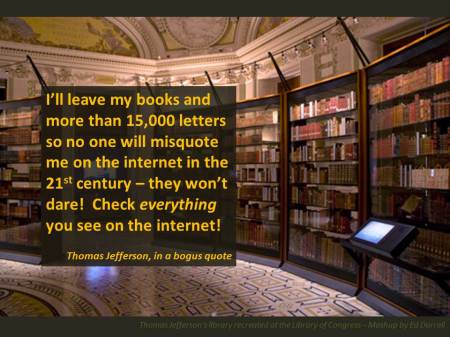
Jefferson’s advice on quotes found on the internet, backdropped by his books now held by the Library of Congress.
Spread the word; friends don't allow friends to repeat history.
Informing Georgia Supreme Court Chief Justice Carol W. Hunstein that Georgia is a republic, not a democracy; recognizing the great differences between these two forms of government; and for other purposes.
WHEREAS, on March 16, 2010, Georgia Supreme Court Chief Justice Carol W. Hunstein appeared before the Georgia General Assembly for the State of the Judiciary address, and in her speech Chief Justice Hunstein mistakenly called the State of Georgia a democracy; and
WHEREAS, the State of Georgia is, in fact, a republic and it is important that all Georgians know the difference between a republic and a democracy -– especially the Chief Justice of the Georgia Supreme Court; and
WHEREAS, the word “republic” comes from the Latin res publica, which means “the public thing” or “the law,” while the word “democracy” comes from the Greek words demos and kratein, which translates to “the people to rule”; and
WHEREAS, most synonymous with majority rule, democracy was condemned by the Founding Fathers of the United States, who closely studied the history of both democracies and republics before drafting the Declaration of Independence and the Constitution; and
WHEREAS, the Founding Fathers recognized that the rights given to man by God should not be violated by an unrestrained majority any more than they should be restrained by a king or monarch; and
WHEREAS, it is common knowledge that the Pledge of Allegiance contains the phrase “and to the Republic”; and
WHEREAS, as he exited the deliberations of the so-called Constitutional Convention of 1787, Founding Father Benjamin Franklin told the awaiting crowd they have “A republic, if you can keep it”; and
WHEREAS, a republic is a government of law, not of man, which is why the United States Constitution does not contain the word democracy and mandates that “the United States shall guarantee to every State in this Union a Republican Form of Government”; and
WHEREAS, in 1928, the War Department of the United States defined democracy in Training Manual No. 2000–25 as a “government of the masses” which “[r]esults in mobocracy,” communistic attitudes to property rights, “demagogism, … agitation, discontent, [and] anarchy”; …
NOW, THEREFORE, BE IT RESOLVED BY THE HOUSE OF REPRESENTATIVES that the members of this body recognize the difference between a democracy and a republic and inform Georgia Supreme Court Chief Justice Carol W. Hunstein that the State of Georgia is a republic and not a democracy….
Tip of the scrub brush to the Volokh Conspiracy, where you’ll find erudite and entertaining comment, and where Eugene Volokh wrote:
Now maybe this is just a deep inside joke, but if it’s meant to be serious then it strikes me as the worst sort of pedantry. (I distinguish this from my pedantry, which is the best sort of pedantry.)
Whatever government Georgia has, and whatever government the English language has, it is not government by ancient Romans, ancient Greeks, the War Department Training Manual, or even the Pledge of Allegiance. “Democracy” today includes, among other meanings, “Government by the people; that form of government in which the sovereign power resides in the people as a whole, and is exercised either directly by them (as in the small republics of antiquity) or by officers elected by them. In mod. use often more vaguely denoting a social state in which all have equal rights, without hereditary or arbitrary differences of rank or privilege.” That’s from the Oxford English Dictionary, but if you prefer the American Heritage Dictionary, try “Government by the people, exercised either directly or through elected representatives.” Government by the people’s representatives is included within democracy, as is government by the people directly.
“Joke” is an accurate description, but one that escapes the sponsors and irritates the impedants on the Texas SBOE.
When legislatures have too much time on their hands, and engage in such hystrionics, one wonders whether the legislature wouldn’t be better off left in the dark by not inviting the views of the Chief Justice in the future. Perhaps the Chief Justice should decline any invitation offered.
What we now know is that some Georgia legislators are all het up about the difference between a republic and a democracy, though I’ll wager none of them could pass an AP world history or European history quiz on Rome and Greece. And what is really revealed is that some Georgia legislators don’t know their burros from a burrow.
You can also be sure of this: Such action is exactly what the so-called conservatives on the Texas SBOE wish to have happen from their diddling of social studies standards.
Spread the word; friends don't allow friends to repeat history.
The frequently quotable Oliver Wendell Holmes, Jr., circa 1930. Edited photograph from the Library of Congress Prints and Photographs Division. Original photo by Harris & Ewing. LC-USZ62-47817. Copyright expired.
I like paying taxes. With them I buy civilization.
Justice Oliver Wendell Holmes, Jr., attributed. (see Felix Frankfurter, Mr. Justice Holmes and the Supreme Court, Harvard University Press, 1961, page 71.)
I found reference to the quote in a book about eminent economists, through Google Scholar:
Eminent Economists: Their Life Philosophies
By Michael Szenberg
Published by Cambridge University Press, 1993
320 pages
On page 201, Szenberg refers Holmes’s view of “taxation as the price of liberty.” In a footnote, he points to Justice Frankfurter’s book. The quote is dolled up a little. According to Szenberg’s footnote:
More precisely, he rebuked a secretary’s query of “Don’t you hate to pay taxes?” with “No, young fellow, I like paying taxes, with them I buy civilization.”
Frankfurter is a reliable source. It’s likely Holmes said something very close to the words Friedman used.
Environmental Protection Agency (EPA) — Obama’s EPA, we can say, now — announced today it will review pet flea and tick products, to prevent abuse and errors of use.
The flea and tick lobby will be upset, of course. Will the rabid Nobamistas join them? I expect someone will complain that this is creeping socialism, unless they say it’s running communism.
Before they get too far down that road, let’s note that pet ownership, and pet protection, were not exactly a high priority of the Soviet Union, nor are they great concerns of the Peoples Republic of China, nor of the Peoples Republic of Korea, nor Cuba, nor Vietnam. On the political continuum, protecting pets from pesticide abuse is about as bourgeois as it gets, rather the opposite of socialism.
How badly do the heathen want to yowl? Watch that space.
A couple of months can make a big difference. Can.
A difference which way?
Two months ago the Texas State Board of Education suspended its revamping of social studies standards — the efforts to grind the standards into a right-wing crutch were so controversial that hearings, discussion and amending proposed standards took up more time than allotted. SBOE delayed final votes until March 10.
How will those primary losses affect them and their work on the board?
In addition, other members of the culture war ring are retiring, including Cynthia Dunbar. Will the lame ducks be content to vote up the changes urged by history and economic professionals and professional educators, or will they do as McLeroy suggested they need to do earlier, and fight against the recommendations of experts?
Most of us watching from outside of Austin (somebody has to stay back and grade the papers and teach to the test . . .) expect embarrassments. On English and science standards before, the culture war ring tactics were to make a flurry of last-minute, unprinted and undiscussed, unannounced amendments apparently conspired to gut the standards of accuracy (which would not make the right wing political statements they want) and, too often, rigor. Moderates on the board have not had the support mechanisms to combat these tactics successfully — secret e-mail and telephone-available friends standing by to lend advice and language on amendments. In at least two votes opponents of the culture war voted with the ring, not knowing that innocent-sounding amendments came loaded.
In a test of the No True Scotsman argument, religious people will be praying for Texas kids and Texas education. Meanwhile, culture warriors at SBOE will work to frustrate those prayers.
Oy.
Thomas Jefferson toyed with the idea of amendment the U.S. Constitution to provide a formal role for the federal government in guaranteeing education, which he regarded as the cornerstone of freedom and a free, democratic-style republic. Instead, American primary and secondary education are governed by more than 15,000 locally-elected school boards with no guidance from the national government on what should be taught. Alone among the industrial and free nations of the world, the U.S. has no mechanism for rigorous national standards on what should be taught.
For well over a century a combined commitment to educating kids better than their parents helped keep standards high and achievement rising. Public education got the nation through two world wars, and created a workforce that could perform without peer on Earth in producing a vibrant and strong economy.
That shared commitment to quality education now appears lost. Instead we have culture warriors hammering teachers and administrators, insisting that inaccurate views of Jefferson and history be taught to children, perhaps to prevent them from ever understanding what the drive for education meant to freedom, but surely to end Jeffersonian-style influences in the future.
Texas’s SBOE may make the case today that states cannot be trusted with our children’s future, and that we need a national body to create academic rigor to preserve our freedom. Or they will do the right thing.
Voters last week expressed their views that SBOE can’t be trusted to do the right thing. We’re only waiting to see how hard McLeroy is willing to work to put his thumb in the eye of Big Tex.
Texas Freedom Network gives you the background; watch TFN’s blog, TFN Insider, for more timely updates (heck, head over there now and learn a lot about today’s meeting). When you read the New York Times piece, you noted incisive comments by Kathy Miller — she’s the director of TFN. TFN is the tape that has held together the good parts of education standards so far, against the swords of the culture warriors. TFN’s blog will probably be updated through the meeting.
Image by Derek Bacon, copyright The Economist 2010
Barack Obama announced his candidacy for president in Springfield, Illinois, on ground often trod by Abraham Lincoln. As did Teddy Roosevelt, Obama studies Lincoln’s life and career, and presidency. We know he devouredTeam of Rivals, Doris Kearn Goodwin’s detailed history of Lincoln’s high-powered cabinet, all of who came to respect his leadership, and most to call him friend.
The Economist scores with another astonishing graphic for the cover of the print edition covering the week of February 18 — Lincoln’s exasperation apparent (image at right).
ACCORDING to Paul Krugman, the winner of a Nobel prize for economics and a columnist for the New York Times, modern America is much like 18th-century Poland. On his telling, Poland was rendered largely ungovernable by the parliament’s requirement for unanimity, and disappeared as a country for more than a century. James Fallows, after several years in China as a writer for the Atlantic Monthly, wrote on his return that he found in America a vital and self-renewing culture that attracts the world’s talent and “a governing system that increasingly looks like a joke”. Tom Friedman, another columnist for the New York Times, reported from the annual World Economic Forum in Davos last month that he had never before heard people abroad talking about “political instability” in America. But these days he did.
The growing idea among influential pundits that America is “ungovernable” is being driven in large part by Barack Obama’s failure so far to pass some of the main laws he wants to. And it is, indeed, a puzzle. Here, after all, is a president who only just over a year ago won a handsome mandate: 53% of the popular vote and big majorities in both the House of Representatives and the Senate. He bounded into office with a mountainous agenda, including plans to overhaul America’s health-care system and cut its greenhouse emissions. He seemed until quite recently to be doing reasonably well. In a folksy December interview with Oprah Winfrey he awarded himself “a good, solid B-plus”.
Is America now ungovernable? What are the limits of a federal system, and have the states capitulated too much power to Washington? Is anything else feasible with our economy in the mess it’s in?
I can imagine a discussion of the limits of the Articles of Confederation to start, noting the requirement of unanimity from the states to do anything major — and how that hamstrung the growth of America until George Washington pushed Alexander Hamilton and James Madison to change things. Washington’s goals were only partly noble, to see a new, unified nation. That unified nation he saw as necessary to open settlement of the Ohio Valley, where Washington had several thousand acres of land he couldn’t sell until settlers moved in.
How does the current set of impasses affect business? Consider any small business, or big business, which offers health care plans to its employees. Health reform is stalled — a Blue Cross affiliate in California raised rates by nearly 40%. Health care is the one section of the economy where growth — meaning costs — grew through the depths of our financial difficulties in 2008 and 2009. The need should be clear, but there are blocks to getting anything done about fixing the system.
Or consider international affairs. Pentagon analysts worry about governmental instability created by the effects of global warming — drought, weather disaster, shifting crop yields (up in a few places, dramatically down where a few billion people live). Thieves stole e-mails from the scientists studying the issue, and subsequent propaganda based on the theft alone has stalled climate talks, worldwide, giving a huge economic advantage to China and India.
What should be the role of government regulation for clean air? Is the Clean Air Act sufficient? (Texas initiated suit against the federal government last week, claiming that the science behind reducing air pollution is wrong, a suit given as a gift to Texas’s major industries, some of which depend on the ability to dump garbage in the air with impunity.)
Is the problem more organically rooted in our inability to defeat incumbents in Congress? 2010 is a Census year — we count Americans to see how many representatives there should be for each state in the House of Represtentatives. The bitter redistricting fights will come in state legislatures next year. Can we save the system when politicians design seats more to secure a safe majority for their own party, rather than to see that every American is adequately represented?
What about media? Traditionally newspapers, aided by television, played the watchdog role on Washington politicians. Americans aren’t reading newspapers much, anymore. News holes shrink, and serious reporting on issues goes away. Can an open democracy survive without healthy newspapers? And if not, who can do what about it?
Go to The Economist and check out the stories (better if you’re a subscriber — the stories usually go away for non-paying browsers after a few days). What can you do with them in the classroom?
What do you think? What’s gone wrong in Washington?
Spread the word; friends don't allow friends to repeat history.
MORAVIA — When the U.S. Mint wanted to unveil a new $1 Millard Fillmore coin, it went to the 13th president’s birthplace to do the honors.
That’s this town of 4,000 in the Finger Lakes, where about a quarter of the population turned out Thursday to pay tribute to their favorite son.
But what about Buffalo, where he served as the University of Buffalo’s first chancellor and helped found a historical society and a hospital?
No problem. The same U.S. Mint official came to Buffalo to hold a second unveiling in Fillmore’s adopted hometown, where about three dozen people showed up at City Hall.
MORAVIA – With close to 1,000 witnesses watching, a young Millard Fillmore impersonator and his equally sprite make-believe wife Abigail poured from a wooden bucket a stream of coins bearing the face of the 13th president and Moravia native.
The United States Mint Thursday released its 13th presidential dollar coin, honoring Millard Fillmore, at a ceremony in the Moravia Junior Senior School cafeteria, which was not large enough to accommodate the crowd of community members who had come to celebrate a president whose national legacy is not legendary, but whose roots are their roots.
“This is a grand, grand event,” Moravia Mayor Gary Mulvaney said, as he waited in a line that started at the cafeteria doors and wound through the school.
James P. McCoy’s photos of the unveiling and the large mockup of the dollar itself are good (you could steal them for a PowerPoint in your classroom), but I especially enjoyed the pictures in the Auburn paper, by Sam Tenney. Two middle school students played Abigail and Millard Fillmore at the ceremony in Moravia.
Caption from the Auburn, New York, Citizen: "Eleanor Younger, 10, and Colton Langtry, 12, portraying Abigail Powers Fillmore and Millard Fillmore, help Andy Brunhart, deputy director of the United States Mint, pour a bucket of $1 coins bearing Fillmore's likeness during a ceremony celebrating the release of the coin Thursday morning at Moravia High School. The Fillmore coin is the 13th in a series honoring past presidents." Photo by Sam Tenney, Auburn, NY, Citizen
Uncharacteristically, the U.S. Mint offered some of the $1.00 coins to students for free — perhaps the only recorded time that the Mint has handed out money for free.
Looks like they had a good time.
Spread the word; friends don't allow friends to repeat history.
On January 24, 1950, the U.S. Patent Office awarded Percy L. Stevens patent # 2,495,429, for his “Method of Treating Foodstuffs” with waves from a magnetron oscillator. Sixty years ago today Percy Stevens changed culinary life forever.
You guessed it: The microwave oven.
Patent for "Method for Treating Foodstuffs," granted January 24, 1950, to Percy L. Stevens of the Raytheon Corp. - the microwave oven. Image via FreePatentsOnline.com
On CBS “Sunday Morning” Charles Osgood said that in 1975 microwave oven sales surpassed conventional oven sales for the first time. This is more remarkable because the first commercial microwave in 1955 was too big for home kitchens, and at $1,300, too pricey. Japanese modifications of the magnetron to shrink it made microwave ovens much like those we have today ready for the market for the first time in 1967. Eight years from market entry to majority of the market.
It only makes sense: Today offices on every floor of every office building have microwave ovens in their break rooms, but almost none ever had conventional ovens. College students have microwaves in their dormitory rooms. Even gasoline stations offer foods for microwaving by customers.
Spencer’s invention makes it possible to heat foods quickly with a relatively small device, in thousands of places where no conventional oven would work well, or be welcomed.
According to legend — accurate? — Spencer got the idea after working with magnetron tubes while carrying a chocolate bar in his pocket. He noticed the chocolate bar melted. Within a short time he had demonstrated the ability to pop popcorn and burst an egg with the microwaves from the tube.
Sign of the changing times: Many children today do not know how to pop popcorn without a microwave. Legend has it that children in elementary school ask where the Massachusetts natives kept the microwaves with which they popped the corn that delighted the settlers of the Plymouth Colony.
Microwave oven inventor Percy Spencer with early microwave equipment at Raytheon - photo from Spencer family archive
Managing the agencies who carry out the policies requires a focus on what government is supposed to do. Democrats tend to make better managers, because they wish government to work well and efficiently. Republicans prefer government to go away, and too often since Dwight Eisenhower’s administration, Republicans have intentionally created havoc for agencies, to stymie their operation at all.
So, how has Obama done in his first year? A couple of radio hosts in Washington, D.C., asked expert opinion.
Federal News Radio asked Joe Ferrara, Associate Dean at Georgetown University’s Public Policy Institute, to give the President a report card on the Chief Executive’s effect on federal employees and the operation and business of government.
Here are the Dean’s grades and a few comments:
Overall grade: B
“In terms of some of the initiatives he’s been pushing: stabilizing the economy, pushing health care.”
Federal Government Management Issues
Effort: A
“They have definitely shown a lot of energy in pushing initiatives on contracting, transparency, modernizing technology, etc.”
Results: C
“In part because it’s still early. Yes, he has been in office for a year, but as you well know, it takes time for changes to sort of filter through a bureaucracy as large as the federal government.”
Overall Planning
“If you look at the last couple of administrations, certainly Bush and Cheney…their umbrella concept was the President’s Management Agenda. They ran it out of the White House. They ran it out of OMB. Clinton and Gore had Reinventing Government. They ran that out of the White House, not necessarily OMB, but a task force made up largely of career federal employees. But they had an over-arching concept: Reinventing Government.”
The lack of a stated overall approach is “worrisome.” “As a former federal employee, I worry about your average federal manager out there seeing the initiative of the day coming forth from OMB, coming forth from the White House, and wondering how does this all fit together.
Transparency
“I know they’ve published this Open Government directive. I think that’s definitely a step in the right direction.” Data.gov and the recovery and stimulus fund websites make it “easier for Congress, your average citizen, people in industry to figure out where’s all the money going and what are agencies doing.”
One caveat: “politicians themselves, from the President on down” have to be transparent in pronouncements and the way they make decisions. “It’s not just the technology solution to transparency. That’s an important part of it, but there’s also political solution and I think ultimately you need those two to go together for citizens to really have a strong sense of trust in what the Government’s doing.”
Cybersecurity
The delay in announcing a selection for cybersecurity coordinator “more viewed as sort of the Obama-style of gathering inputs, mulling over options, getting second opinions, getting third opinions – a very extensive vetting process kind of like what we saw with the Afghanistan decision. On the one hand, there’s nothing wrong with that.” On the other hand, said Ferrara, the longer you take to make decisions the more likely it is people will think you don’t put a high priority on the subject.
Cybersecurity “is a very complex bundle of policy issues” and could explain the apparent delay.
Joe Ferrara is Associate Dean at Georgetown University’s Public Policy Institute.
President Obama’s self-reporting report card to Congress, the State of the Union address, is scheduled to be delivered a week from today, January 27th, at 9 pm EST.
Adults dressing up as things they are not can be entertaining at a masquerade. It’s generally pretty ugly when they dress up as things they are not, for purposes of deception.
Joe Carter, the superstar blogger of evangelical Christians, posted at First Things, pretending to be upset that Democrats and others who work to control and ameliorate global warming, are missing the boat (so to speak) by not complaining about air pollution from ships, especially super-sized cargo ships.
(Even the title of the thing is offensive, either in or out of context: “Sink a ship, save a planet.” Ah, the humor of the conservative, reality- and humor-challenged. I’m sure al Quaeda would be happy to oblige Carter and the headline writers.)
Carter thinks he’s caught environmentalists in some sort of hypocritical stance, worrying about global warming and urging clean air everywhere but from the ships that bring us oil: ‘If you’re so gosh-darn concerned about global warming, why not worry about the pollution from ships, smarty-pants?’ Joe laments.
You’d think he’d have bothered to Google the issue first, before pretending he’s the only one who noticed.
Joe wrote:
Changing the emissions regulations on the shipping industry seems like a modest, commonsense step toward reducing air pollution. So why doesn’t it get more political attention? Why do hypothetical concerns about potential catastrophic problems always trump those that are causing massive deaths right now?
With all the focus on man-made global warming, its easy to overlook the fact that man-made pollution is already killing millions of people every year.
* * * * * * * *
Imagine the effect we could have on pollution if we spent as much time, energy, and money on solutions that make a difference for other people’s lives rather than those that merely make us feel good about ourselves.
Imagine, indeed. The gall of those environmentalists, warning about global warming but letting their friends in the shipping business get off scot-free, no?
In 1997, the United States and most countries signed an international agreement known as MARPOL Annex VI, setting extremely modest controls on air pollution from ships. The agreement did not enter into force until 2005, and the United States took until July 21, 2008, to enact legislation to implement it (P.L. 110-280). Negotiations to strengthen Annex VI accelerated in 2008, however, and discussions regarding GHG emissions have also begun. While awaiting congressional action and international agreement, the Environmental Protection Agency (EPA), port cities, and states have begun to act on their own. In the 110th Congress, legislation was introduced (S. 1499 / H.R. 2548) to require EPA to dramatically strengthen ship emission standards under the Clean Air Act. S. 1499 was reported, but no further action was taken.
I suppose it’s too much to expect hard-core rightists to pay attention to international news, but marine air pollution is a topic of international concern, obviously indicated by the MARPOL treaty, but with a lot of other indicators for anyone who chooses to look and study the issue.
Ships pour out great quantities of pollutants into the air in the form of sulphur and nitrogen oxides.
The emissions from ships engaged in international trade in the seas surrounding Europe – the Baltic, the North Sea, the north-eastern part of the Atlantic, the Mediterranean and the Black Sea – were estimated to have been 2.3 million tonnes of sulphur dioxide and 3.3 million tonnes of nitrogen oxides a year in 2000.
In contrast to the progress in reducing emissions from land-based sources, shipping emissions of sulphur and nitrogen oxides are expected to continue increasing by 40-50 per cent up to 2020. In both cases, by 2020 the emissions from international shipping around Europe will have surpassed the total from all land-based sources in the 27 EU member states combined.
Joe Carter is right that air pollution from ships should be of great concern. He would be wise to listen to those like former U.S. Rep. Hilda Solis, who sponsored a bill in the 110th Congress to fight marine air pollution.
And, now that we’ve established that cleaning up marine air pollution is a good idea, and the liberals and environmentalists and Obama administration are already on the job, wouldn’t it also be great if the conservatives who look at these issues, too, listen to these same people when they warn about the dangers of global warming, and of the dangers of failing to act soon to stop it?
Joe Carter identified a problem, and he’s discovered that the environmentalists and Democrats he wished to ding for not paying enough attention instead were there before him, and resolved much of the difficulty.
Anyone want to bet whether Carter will give credit to Obama, EPA and the Democrats in Congress for solving the problems?
Spread the word; friends don't allow friends to repeat history.
More than just as tribute to the victims, more than just a disaster story, the Triangle Shirtwaist Co. fire, and the following events including the trial of the company owners, lay out issues students can see clearly. I think the event is extremely well documented and adapted for student projects. In general classroom use, however, the event lays a foundation for student understanding.
A couple of good websites crossed my browser recently, and I hope you know of them.
Cartoon about 1911 Triangle Shirtwaist Fire, New York Evening Journal, March 31, 1911
Events around the fire illuminate so much of American history, and of government (which Texas students take in their senior year):
Labor issues are obvious to us; the incident provides a dramatic backdrop for the explanation of what unions sought, why workers joined unions, and a sterling example of a company’s clumsy and destructive resistance to resolving the workers’ issues.
How many Progressive Era principles were advanced as a result of the aftermath of the fire, and the trial?
Effective municipal government, responsive to voters and public opinion, can be discerned in the actions of the City of New York in new fire codes, and action of other governments is clear in the changes to labor laws that resulted.
The case provides a dramatic introduction to the workings and, sometimes, misfirings of the justice system.
With the writings from the Cornell site, students can climb into the events and put themselves on the site, in the courtroom, and in the minds of the people involved.
Newspaper clippings from the period demonstrate the lurid nature of stories, used to sell newspapers — a working example of yellow journalism.
Newspapers also provide a glimpse into the workings of the Muckrakers, in the editorial calls for reform.
Overall, the stories, the photos, the cartoons, demonstrate the workings of the mass culture mechanisms of the time.
Use the sites in good education, and good health.
Spread the word; friends don't allow friends to repeat history.
I’m not sure what to make of this. No amount of dopeslapping or head:desk banging is going to help these people get a clue.
And while I haven’t read Sarah Palin’s book, I’ll wager they won’t get a clue there, either. Listening to the interviews one wonders whether they would be able to read Palin’s book. Most of the kids who work hard to fail my classes look like geniuses next to these people.
And then a horrifying thought bubbles up: Dear God, these people might actually vote! They probably view Jay Leno’s “Jaywalking” sequences with astonished looks and great confusion. They can’t tell what’s wrong with the answers, and they miss the humor.
I found this piece at Canadian Cynic (from whom I stole the headline) — he confessed he could only stand just under two minutes of this torture.
For Palin groupies, here are a couple of issues to consider while watching this video:
While it’s done by New Left Media, it’s astonishing that anyone could find so many babbling idiots at one gathering, anywhere in America. This was Ohio? Yeah, Columbus; I know people in Columbus. I fear for their lives, now.
Palin has never made any particular defense of the First Amendment, nor of any of the five freedoms it enumerates. When people say she stands for “freedom to speak,” or “freedom of religion,” they are making stuff up.
“Realness” is not a policy.
Tax cutting isn’t generally a great policy when people aren’t making enough to pay any taxes at all. Tax cutting contributed to our current mess.
Socialism is not “giving away money.”
Obama’s two books do not portray Marxism in a good light. They don’t mention Marxism as a potential path for any American, anywhere.
“Czar” is a shorter word for a headline than “Administrator of the Environmental Protection Agency,” or “Special Assistant to the President for Energy Policy.” People who are called “czars” by headline writers do not have any special powers beyond being right when they speak to the president (among many other advisors). The real power is held by agency heads, like the Secretary of Defense, and the Secretary of Treasury. The President’s Cabinet is not a wooden device in which he keeps his dinnerware.
Talk of martial law? Not from Obama. Not in the administration. Not in any agency. Not in Congress. Only in wingnut dens.
Illegal aliens cannot be naturalized under current law. No illegal aliens are being naturalized. When found, they are being deported.
Obama is an American citizen; even the courts are getting testy about that, tossing the crazy lawsuits out with harsh comments for people who are so gullibly dumb.
It’s 700 miles from Sarah Palin’s home to the nearest point in Russia. “Seeing Russia from the backyard” is a figure of speech, and not accurate in any way.
The Governor of Alaska is not the first defense against any attack from a foreign nation on the U.S., coming through Alaska. The U.S. Air Force has jurisdiction, and still patrols that area, along with satellite and radar surveillance. In an attack, the official role of the Governor of Alaska is to duck and stay out of the way.
The Governor of Alaska has no special security clearance that no other governor has. I’m not sure that any governor has a security clearance as governor.
People for the Ethical Treatment of Animals (PETA) is not a player in the protection of polar bears, nor any other animal on listed as threatened or endangered.
No proposal is before Congress to change current law on “partial birth” abortion. Since there is a law on the topic, it would take a new law, passed by Congress, to change current law. Obama can’t touch it without Congressional action. (This is basic civics, you know?)
Are you afraid of what’s happening in America? After you listen to these yahoos, you may have cause to fear what would happen if their views were to carry an election.
Are people still lining up for lobotomies? Do they directly from the operating table to a Sarah Palin book signing?
We can hope New Left Media edited out all the cogent, intelligent remarks. I have this nagging fear that they didn’t have to edit at all.
Spread the word; friends don't allow friends to repeat history.
Or, until that account is unsuspended by the forces supporting Donald Trump: Follow @FillmoreWhite, the account of the Millard Fillmore White House Library
We've been soaking in the Bathtub for several months, long enough that some of the links we've used have gone to the Great Internet in the Sky.
If you find a dead link, please leave a comment to that post, and tell us what link has expired.
Thanks!
Retired teacher of law, economics, history, AP government, psychology and science. Former speechwriter, press guy and legislative aide in U.S. Senate. Former Department of Education. Former airline real estate, telecom towers, Big 6 (that old!) consultant. Lab and field research in air pollution control.
My blog, Millard Fillmore's Bathtub, is a continuing experiment to test how to use blogs to improve and speed up learning processes for students, perhaps by making some of the courses actually interesting. It is a blog for teachers, to see if we can use blogs. It is for people interested in social studies and social studies education, to see if we can learn to get it right. It's a blog for science fans, to promote good science and good science policy. It's a blog for people interested in good government and how to achieve it.
BS in Mass Communication, University of Utah
Graduate study in Rhetoric and Speech Communication, University of Arizona
JD from the National Law Center, George Washington University


 Posted by Ed Darrell






 Millard Fillmore's Bathtub