More good news about Obamacare: No pre-existing conditions clause

May 31, 2012

More:


NIH notes progress against malaria on World Malaria Day 2012

April 28, 2012

Press release from the National Institutes of Health, for World Malaria Day (April 25, 2012):

For Immediate Release
Tuesday, April 24, 2012

NIH statement on World Malaria Day – April 25, 2012

B. F. (Lee) Hall, M.D., Ph.D., and Anthony S. Fauci, M.D.
National Institute of Allergy and Infectious Diseases

On World Malaria Day, we stand at a critical juncture in our efforts to control a global scourge. This year’s theme “Sustain Gains, Save Lives: Invest in Malaria” stresses the crucial role of continued investment of resources to maintain hard-won gains. Lives have indeed been saved. According to World Health Organization (WHO) estimates, annual deaths from malaria decreased from roughly 985,000 in 2000 to approximately 655,000 in 2010. Improvements were noted in all regions that WHO monitors, and, since 2007, four formerly malaria-endemic countries — the United Arab Emirates, Morocco, Turkmenistan and Armenia — have been declared malaria-free. However, about half of the world’s population is at risk of contracting malaria, and the disease continues to exact an unacceptably high toll, especially among very young children and pregnant women.

The National Institute of Allergy and Infectious Diseases (NIAID), part of the National Institutes of Health (NIH), is committed to maintaining the research momentum needed to eradicate this mosquito-borne parasitic disease. Our investments include programs designed to strengthen research capacity in those countries most affected by malaria. For example, through the 2010 International Centers of Excellence for Malaria Research initiative, NIAID has established 10 research centers in malaria-endemic regions around the world. NIAID also provides access for U.S. and international scientists to multiple research resources as well as training for new investigators. Additionally, NIAID supports the Global Malaria Action Plan (GMAP), an international framework for coordinated action designed to control, eliminate and eradicate malaria.

NIAID’s research portfolio includes an array of projects aimed at better understanding the disease process and finding new and improved ways to diagnose and treat people with malaria, control the mosquitoes that spread it, and prevent malaria altogether through vaccination.

Earlier this month, an international team including NIAID-funded investigators reported that resistance to artemisinin — a frontline malaria drug — has spread from Cambodia to the border of Thailand and Burma, underscoring the importance of continued efforts to detect artemisinin resistance and slow its spread. Other grantees have identified a major region of the malaria parasite genome associated with artemisinin resistance, raising the possibility that scientists will have a new way to monitor the spread of drug resistance in the field.

The spread of artemisinin-resistant malaria highlights the need for new and improved malaria drugs. Two recently completed drug screening projects offer some hope. In one project, NIH scientists screened nearly 3,000 chemicals, and found 32 that were highly effective at killing numerous genetically diverse malaria parasite strains. Another screening project identified a new class of compounds that inhibits parasites in both the blood stage and in the liver. The research could lead to the development of malaria drugs that attack the parasite at multiple stages in its lifecycle, which would hamper the parasite’s ability to develop drug resistance.

Work continues on a novel anti-malaria compound, NITD609, first described by NIAID-supported researchers in 2010. A mid-stage clinical trial to assess NITD609’s activity in people began in Thailand this year. Research on NITD609 is a continuing collaboration among NIH-funded scientists, the pharmaceutical company Novartis, and the nonprofit Medicines for Malaria Venture.

Because the risk of childhood malaria is related to exposure before birth to the malaria parasite through infected mothers, NIAID scientists recently initiated a program on malaria disease development in pregnant women and young children that could yield new preventive measures and treatments for these most vulnerable groups.

The mosquitoes that spread malaria are also the target of NIAID-supported science. In 2011, researchers identified bacteria that render mosquitoes resistant to malaria parasites. Further study is needed, but it may one day be possible to break the cycle of infection by reducing the mosquito’s ability to transmit malaria parasites to people.

A vaccine to prevent malaria has been frustratingly elusive, and so initial positive results reported last year by the PATH Malaria Vaccine Initiative, GlaxoSmithKline Biologicals and their collaborators came as welcome news. In a late-stage clinical trial in approximately 6,000 African children, the candidate vaccine, known as RTS,S, reduced malaria infections by roughly half. Currently, eight other vaccine candidates are being tested in NIAID-supported clinical trials. One of them uses live, weakened malaria parasites delivered intravenously to prompt an immune response against malaria. An early-stage clinical trial of this vaccine candidate began at NIH earlier this year.

Whether the remarkable returns on investment in malaria control will continue in years ahead depends on our willingness to commit needed financial and intellectual resources to the daunting challenges that remain. On World Malaria Day, we join with our global partners in affirming that commitment and rededicating ourselves to the efforts to defeat malaria worldwide.

For more information on malaria, visit NIAID’s malaria Web portal.

Lee Hall, M.D., Ph.D., is Chief of the Parasitology and International Programs Branch in the NIAID Division of Microbiology and Infectious Diseases. Anthony S. Fauci, M.D., is Director of the National Institute of Allergy and Infectious Diseases at the National Institutes of Health in Bethesda, Maryland.

NIAID conducts and supports research — at NIH, throughout the United States, and worldwide — to study the causes of infectious and immune-mediated diseases, and to develop better means of preventing, diagnosing and treating these illnesses. News releases, fact sheets and other NIAID-related materials are available on the NIAID Web site at http://www.niaid.nih.gov.

About the National Institutes of Health (NIH): NIH, the nation’s medical research agency, includes 27 Institutes and Centers and is a component of the U.S. Department of Health and Human Services. NIH is the primary federal agency conducting and supporting basic, clinical, and translational medical research, and is investigating the causes, treatments, and cures for both common and rare diseases. For more information about NIH and its programs, visit www.nih.gov.

NIH…Turning Discovery Into Health


Is the anti-vaccine movement dangerous?

April 24, 2012

I get e-mail from Bob Park, the physicist curmudgeon/philosopher at the University of Maryland (I’ve added links):

Robert L. Park

Robert L. Park (Photo credit: Wikipedia)

“DEADLY CHOICES”: PAUL OFFIT EXPOSES THE ANTI-VACCINE MOVEMENT.

There was never a time before people knew that falling trees and large animals with teeth can kill.  Microbes are another matter. They had been killing us for perhaps 200,000 years before Antonie van Leeuwenhoek showed them to us. Paul Offit and two colleagues worked for 25 years to develop a vaccine for the rotavirus, a cause of gastroenteritis that kills as many as 600,000 children a year worldwide, mostly in underdeveloped countries.  The vaccine is credited with saving hundreds of lives a day.  Offit wrote “Autism’s False Prophets” in 2008 exposing British physician Andrew Wakefield for falsely claiming the MMR vaccineis linked to autism.

H. Fred Clark and Paul Offit, the inventors of...

H. Fred Clark and Paul Offit, the inventors of RotaTeq. (Photo credit: Wikipedia)

Vaccination prevents more suffering than any other branch of medicine, but is still opposed by the scientifically ignorant who accept the upside-down logic of the alternative medicine movement.  Because vaccination of schoolchildren against virulent childhood infections is ubiquitous, crackpots, scoundrels and gullible reporters get away with linking it to unrelated health problems as they did in the 1980s with the ubiquitous power lines.  We still hear echoes of the power-line scare in the cell phone/cancer panic. Paul Offit has just written “Deadly Choices: How The Anti-Vaccine Movement Threatens Us All.”  We need to do everything we can to stop it.

You don’t subscribe to Bob Park’s “What’s New?”  You should.

THE UNIVERSITY OF MARYLAND.
Opinions are the author’s and not necessarily shared by the
University of Maryland, but they should be.

Archives of What’s New can be found at http://www.bobpark.org
What’s New is moving to a different listserver and our subscription process has changed. To change your subscription status please visit this link:
http://listserv.umd.edu/cgi-bin/wa?SUBED1=bobparks-whatsnew&A=1

You’ll be smarter for reading his little missiles missives missiles.

More:

Measles cases reported in the United States be...


ObamaCare: Making stuff up to complain about

April 17, 2012

Collected on Facebook, April 16, 2012:

Van painted with hoax claim that Obama and Congress exempt from ObamaCare, Page 114 Line 22. Not so.

It even offers a page and a line — page 114, line 22.  But that page has nothing to do with what the caption on the truck says.  Congress, the President and their families, are not exempt from the Affordable Care Act. The Grassley Amendment expressly puts them in the plan, though they would have been left with their employer-provided plans without that special inclusion clause.

Here’s the text from H.R. 3200, the Affordable Care Act, on page 114.  Where’s the language this guy complains about?

17 ‘‘(b) LIMITATIONS ON USE OF DATA.—Nothing in this
18 section shall be construed to permit the use of information
19 collected under this section in a manner that would ad
20 versely affect any individual.
21 ‘‘(c) PROTECTION OF DATA.—The Secretary shall en
22 sure (through the promulgation of regulations or otherwise)
23 that all data collected pursuant to subsection (a) are—
24 ‘‘(1) used and disclosed in a manner that meets
25 the HIPAA* privacy and security law (as defined in

[continuing to page 115]

1 section 3009(a)(2) of the Public Health Service Act),
2 including any privacy or security standard adopted
3 under section 3004 of such Act; and
4 ‘‘(2) protected from all inappropriate internal
5 use by any entity that collects, stores, or receives the
6 data, including use of such data in determinations of
7 eligibility (or continued eligibility) in health plans,
8 and from other inappropriate uses, as defined by the
9 Secretary.

That GPO version of the bill is searchable in .pdf form — searching for “Congress” I find no reference to any part that exempts Congress.  Searching for “exemption,” I find no mention of any exemption from any provision that applies to Congress or the President.

So, what are the anti-ObamaCare fanatics really concerned about?  Is there language in the bill that exempts either Congress or the President, from any provision?

Some guy is so obsessed with hatred for President Obama and health care reform that he paints the offending part on his truck.  But he gets the law wrong.

Nothing in the Affordable Care Act exempts Congress, nor the President, from its terms.

Dear Reader, what am I missing?  Can you explain?

I wonder if the guy is into tattoos.

_____________

*  HIPAA is The Health Insurance Portability and Accountability Act of 1996 (HIPAA; Pub.L. 104-191, 110 Stat. 1936, enacted August 21, 1996)

_____________

PPS:  Here’s the text of H. R. 3590, the number of the bill that finally passed.  I can’t find any more light there, either.

_____________

Update: In comments, blueollie refers us to a Forbes blog article that both reveals the truth of the matter — Congress and the President get no special treatment — and the origins of the hoax.

So, here’s the real deal –As things currently stand, Members of Congress and their staff, until 2014, will continue to participate in the Federal Employees Health Benefits Program (FEHBP). This program, considered among the best in the nation, allows federal employees- including Members of Congress and their staff- to choose from a wide range of health plans and select the one that best suits their needs. Note that the current plan is neither ‘government’ insurance, ‘free’ insurance nor any other sort of sweet deal that the public has been led to believe is the case. The federal employee’s program involves private insurance policies with premiums, deductibles, co-pays, etc.

Here’s the surprise – come 2014, when the lion’s share of the ACA provisions come on line, Members of Congress and their staff will be required to buy their health insurance on an exchange. In fact, their choices will be even more limited than our own. While it is expected that some 24 million people will elect to purchase their health care policy on a state run exchange, we are not required by law to do so. Members of Congress and their staff, however, must buy their insurance in this way.

There you have it.  That guy, whoever he is, had his truck painted erroneously.  We hope he doesn’t have a close relationship with the tattoo parlor.

_____________

So many hoaxes relating to Barack Obama; do you think there’s a shop somewhere with a dozen people sitting around dreaming up these hoaxes?  What else explains the sheer number of Obama-related hoaxes?

_____________

Welcome to readers of The LOLBRARY.  What do you think?  (Tip of the old scrub brush to CapnUnderpants, who must be a great guy.)

_____________

Dear Readers, in 2013 – how about leaving a note in comments to tell me from where you’re coming?  Who referred you to this set of facts?


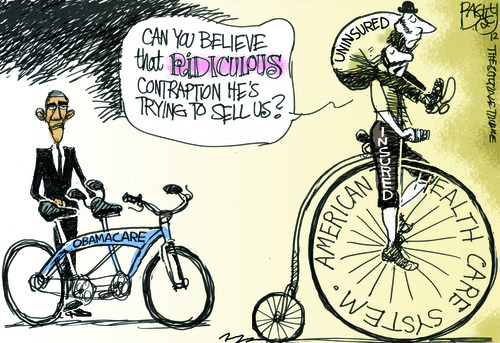
Bagley’s cartoon on criticizing Obamacare

April 6, 2012

Generally the Pulitzer Prize committees look at specific works submitted by candidates.  Bagley‘s day-in, day-out brilliance must make it difficult for editors to choose what to nominate, no?

This cartoon is just perfect, in so many ways:


Criticism of ObamaCare. Cartoon by Pat Bagley, Salt Lake Tribune, March 28, 2012.

I hope these cartoons get picked up by newspapers far outside of Utah. They deserve to be seen more broadly. Click cartoon to go to Salt Lake Tribune’s archives of Bagley’s work. Cartoon of March 28, 2012.

President Obama’s campaign film, “The Road We’ve Traveled”

April 1, 2012

Some encouragement for those who follow Santayana’s Ghost, and recall history; some information to change the minds of those who don’t:


More good news about the Affordable Care Act (Obamacare): CBO says it will save money

March 22, 2012

President Barack Obama's signature on the heal...

President Barack Obama's signature on the health insurance reform bill at the White House, March 23, 2010. The President signed the bill with 22 different pens. CBO projections in March 2012 indicate savings under the bill will increase beyond earlier projections, offsetting increased costs from continuing economics woes. (Photo credit: Wikipedia)

Remember, without the Affordable Care Act, the U.S. was experiencing health care cost inflation of about 15%annually.

You might not know it if you read conservative blogs, watch Fox News, or listen to the Republican candidates for president — all of whom seem to have their fact panties on wrong — but the Congressional Budget Office (CBO) projects the bill will reduce federal spending, still, even after accounting for recent changes in law and changes in the economy that will increase costs of the bill’s provisions.

Yeah, Obamacare saves money.

The new law will  not eliminate the problem of people not having insurance coverage to guarantee access to health care, a sad result of Republican efforts to cut the bill’s effectiveness.  But it’s a great first step to making America better, healthier, and economically more sound.  Here’s the blog post from the CBO discussing the bill, and CBO’s continuing studies of the effects of the law:

CBO Releases Updated Estimates for the Insurance Coverage Provisions of the Affordable Care Act

March 13, 2012

In preparing the March 2012 baseline budget projections, CBO and the staff of the Joint Committee on Taxation (JCT) have updated estimates of the budgetary effects of the health insurance coverage provisions of the Affordable Care Act (ACA)—the health care legislation enacted in March 2010. Those provisions:

  • Establish a mandate for most legal residents of the United States to obtain health insurance;
  • Create insurance “exchanges” through which certain individuals and families may receive federal subsidies to substantially reduce the cost of purchasing health insurance;
  • Significantly expand eligibility for Medicaid;
  • Impose an excise tax on certain health insurance plans with relatively high premiums;
  • Establish penalties on certain employers who do not provide minimum health benefits to their employees; and
  • Make other changes to prior law.

The most recent previous estimate of those effects was prepared in March 2011. For more details on the insurance coverage provisions of the ACA, you can see CBO’s cost estimate for the health care legislation, which was issued in March 2010.

The Estimated Net Cost of the Insurance Coverage Provisions Is Smaller Than Estimated in March 2011

CBO and JCT now estimate that the insurance coverage provisions of the ACA will have a net cost of just under $1.1 trillion over the 2012-2021 period-about $50 billion less than the agencies’ March 2011 estimate for that 10-year period. (For comparison with previous estimates, these numbers cover the 2012-2021 period; estimates including 2022 can be found below.)

The net costs–specifically the combined effects on federal revenues and mandatory spending–reflect:

  • Gross additional costs of $1.5 trillion for Medicaid, the Children’s Health Insurance Program (CHIP), tax credits and other subsidies for the purchase of health insurance through the newly established exchanges and related costs, and tax credits for small employers,
  • Offset in part by about $0.4 trillion in receipts from penalty payments, the new excise tax on high-premium insurance plans, and other budgetary effects (mostly increases in tax revenues).

Those amounts do not encompass all of the budgetary impacts of the ACA. They do not include federal administrative costs, which will be subject to future appropriation action. Also, they do not include the effects of the many other provisions of the law, including some that will cause significant reductions in Medicare spending relative to that under prior law and others that will generate added tax revenues relative those under prior law.

CBO and JCT have previously estimated that the ACA will, on net, reduce budget deficits over the 2012-2021 period; that estimate of the overall budgetary impact of the ACA has not been updated.

Gross Costs Are Higher, but Offsetting Budgetary Effects Are Also Higher

The current estimate of the gross costs of the coverage provisions—$1,496 billion through 2021—is about $50 billion higher than last year’s projection; however, the other budgetary effects of those provisions, which partially offset those gross costs, also have increased in CBO’s and JCT’s estimates—to $413 billion—leading to the small decrease in the net 10-year tally.

Over the 10-year period from 2012 through 2021, enactment of the coverage provisions of the ACA was projected last March to increase federal deficits by $1,131 billion, whereas the March 2012 estimate indicates that those provisions will increase deficits by $1,083 billion.

The net cost was boosted by:

  • An additional $168 billion in estimated costs for Medicaid and CHIP, and
  • $8 billion less in estimated revenues from the excise tax on certain high-premium health insurance plans.

But those increases were more than offset by a reduction of:

  • $97 billion in the projected costs for the tax credits and other subsidies for health insurance provided through the exchanges and related spending
  • $20 billion in the projected costs for tax credits for small employers, and
  • $107 billion in deficits from the projected revenue effects of changes in taxable compensation and penalty payments and from other small changes in estimated spending.

The Revisions in Estimates Reflect Legislative, Economic, and Technical Changes

The major sources for the differences between the March 2011 and March 2012 projections are the following:

  • New Legislation. Several laws were enacted during the past year that changed the estimated budgetary effects of the insurance coverage provisions of the ACA.
  • Changes in the Economic Outlook. The March 2012 baseline incorporates CBO’s macroeconomic forecast published in January 2012, which reflects a slower recovery when compared with the forecast published in January 2011 (which was used in producing the March 2011 baseline).
  • Technical Changes. The March 2012 baseline incorporates updated projections of the growth in private health insurance premiums, reflecting slower growth than the previous projections. In addition, CBO and JCT made a number of other technical changes in their estimating procedures.

The Number of the Nonelderly Uninsured Is Higher Than Previously Estimated

CBO and JCT’s projections of health insurance coverage have changed since last March. Fewer people are now expected to obtain health insurance coverage from their employer or in insurance exchanges; more are now expected to obtain coverage from Medicaid or CHIP or from nongroup or other sources. More are expected to be uninsured. The extent of the change in insurance coverage varies from year to year.

Compared with prior law, the ACA is now estimated by CBO and JCT to reduce the number of nonelderly people without health insurance coverage by 30 million to 33 million in 2016 and subsequent years, leaving 26 million to 27 million nonelderly residents uninsured in those years (see Table 3 at the end of the report). The share of legal nonelderly residents with insurance is projected to rise from 82 percent in 2012 to 93 percent in 2016 and subsequent years. That share rose to 95 percent in CBO and JCT’s previous estimate.

According to the current estimates, from 2016 on, between 20 million and 23 million people will receive coverage through the new insurance exchanges, and 16 million to 17 million additional people will be enrolled in Medicaid and CHIP as a result of ACA. Also, 3 million to 5 million fewer people will have coverage through an employer compared with the number under prior law

Estimates Through Fiscal Year 2022

This report also presents estimates through fiscal year 2022, because the baseline projection period now extends through that additional year. The ACA’s provisions related to insurance coverage are now projected to have a net cost of $1,252 billion over the 2012-2022 period; that amount represents a gross cost to the federal government of $1,762 billion, offset in part by $510 billion in receipts and other budgetary effects (primarily revenues from penalties and other sources).

The addition of 2022 to the projection period has the effect of increasing the costs of the coverage provisions of the ACA relative to those projected in March 2011 for the 2012-2021 period because that change adds a year in which the expansion of eligibility for Medicaid and subsidies for health insurance purchased through the exchanges will be in effect. CBO and JCT have not estimated the budgetary effects in 2022 of the other provisions of the ACA; over the 2012-2021 period, those other provisions were previously estimated to reduce budget deficits.

If we could get another stimulus program to goose the economy into quicker recovery, the cost savings would likely grow much faster.  What conservative budget chopper wouldn’t prefer that solution?

Barack Obama signing the Patient Protection an...

Barack Obama signing the Patient Protection and Affordable Care Act at the White House Español: Barack Obama firmando la Ley de Protección al Paciente y Cuidado de Salud Asequible en la Casa Blanca (Photo credit: Wikipedia)

How did your favorite media outlets report the CBO cost projections?

More, Resources (with help from Zemanta and WordPress):


Good news about health care in the U.S.: The case for Obama’s health care reforms

March 7, 2012

Here’s a preview of another piece of television that many Republicans hope you will not bother to see, a piece that explains exactly how and why the health care reforms championed by President Obama will help you and millions of others:

Program: U.S. Health Care: The Good News

Episode: The Good News in American Medicine

Journalist T.R. Reid examines communities in America where top-notch medical care is available at reasonable costs and, in some instances, can be accessed by almost all residents. Included: Mesa County, Colo.; Seattle; Everest, Wash.; Hanover, N.H. In Mesa County, for instance, doctors, hospitals and insurers place an emphasis on prevention; and a program that offers pre-natal care to poor women has proved popular.

T. R. Reid’s report started airing on PBS stations in mid-February.  If you haven’t seen it, go to this site to view the entire production.

More, resources (suggested by PBS, mostly):


DDT news: Ethio Sun reports, “Ethiopia and Botswana in banned DDT pesticide deal”

January 12, 2012

How many hoax claims of Steven Milloy, Roger Bate and other DDT advocates are exposed in this one news story?

Somebody count.  The story reveals

  1. African nations still use DDT.
  2. There’s a lot of DDT in Africa to be used.
  3. Some nations don’t use DDT due to fear of health effects on people; they appear to have weighed the alternatives, and found better ways to fight malaria without DDT.
  4. DDT is cheap in Africa (US$4.50/kilogram).
  5. Despite the U.S. ban on DDT use on U.S. crops, some nations in Africa kept using DDT (the article misstates the case for a worldwide ban — there has never been a worldwide ban).
  6. DDT use is not assumed in Africa to be a great way to fight malaria.

I don’t mean to suggest EthioSun as a sterling source of information; but it’s not difficult to find stories like this with frequency, out of Africa.  Each of them refutes the case for more DDT, so that there really is no good case to be made for more DDT, anywhere.

Ethiopia and Botswana in banned DDT pesticide deal

Posted By On Thursday, January 12, 2012 06:32 AM.

Ethiopia is set to export about 15 tonnes of the banned pesticide, DDT, to Botswana, it has been revealed.

This follows a recent suspension on the use of the pesticide by the Horn of Africa nation, which cited adverse effects of human health and the environment as reasons for the decision.

Adami Tulu Pesticide, a state owned company has huge stocks of DDT, which it will reportedly sell to Botswana at US$4.50 per kilogramme.

It is estimated the company has 450 tonnes of DDT in stock.

The US led a worldwide ban on the use of DDT as a pesticide in 1972 following reports of adverse side effects on humans.

However, Ethiopia along with a few other countries continued the use of DDT in the fight against malaria.

Activists have demanded that the ban be lifted, in order to allow the use DDT in the elimination of malaria, especially in developing countries.

More than half of the estimated 80 million people in Ethiopia are said to be at risk of contracting malaria.

According to the World Health Organisation some countries still use DDT to fight malaria.

The disease killed over half a million people worldwide last year, most of them in Africa.

There was no immediate confirmation from Botswana about the planned export.

Steve Milloy, Roger Bate, Richard Tren, Henry I. Miller and others hoax us when they say DDT can save mankind, or even help save mankind.  See also Tim Lambert’s takedown of Goklany’s post.


Why you should be concerned about mercury pollution

December 28, 2011

Mercury poisoning marches through our culture with a 400-year-old trail, at least.  “Mad as a hatter” refers to the nerve damage hatmakers in Europe demonstrated, nerve damage we now know came from mercury poisoning.

In the 20th century annals of pollution control, the Minimata disaster stands as a monument to unintended grotesque consequences of pollution, of mercury poisoning.

A key Japanese documentary on the disaster is now available from Zakka Films on DVD, with English subtitles.

Anyone who scoffs at EPA’s four-decades of work to reduce mercury pollution should watch this film before bellyaching about damage to industry if we don’t allow industry to kill babies and kittens in blind, immoral pursuit of profit at public expense.

American Elephants, for example, is both shameless and reckless  in concocting lies about mercury pollution regulation (that site will not allow comments that do not sing in harmony with the pro-pollution campaign (I’d love for someone to prove me wrong)).  Almost every claim made at that post is false.  Mercury is not harmless; mercury from broken CFL bulbs cannot begin to compare to mercury in fish and other animals; mercury pollution is not minuscule (mercury warnings stand in all 48 contiguous states, warning against consumption of certain fish).  President Obama has never urged anything but support for the coal-fired power industry — although he has expressed concerns about pollution, as any sane human would.

Republicans have lost their moral compass, and that loss is demonstrated in the unholy campaign for pollution, the campaign against reducing mercury emissions.  It’s tragic.  Action will be required in November to stop the tragedy from spreading.  Will Americans respond as they should at the ballot boxes?

Can you watch “Minimata:  The Victims and Their World,” and not urge stronger controls on mercury emissions?  Can you support the murder of children and workers, for profit?


Save the babies. Oh, and fight global warming, too

December 3, 2011

I wonder exactly how the “warming skeptics” will complain about this?

Just a reminder, cleaning the air to fight global warming also has immediate health benefits.

From the American Lung Association:

You know they will  complain about, for some trumped up reason.

Tip of the old scrub brush to James Kaliway at Everything Wrong with Today’s Youth.  He’s got more to say at his blog.


Scalia and Thomas: Neither is Caesar’s wife

November 18, 2011

It sure looks like a breach of ethics, but James Oliphant writes in the Los Angeles Times that there is no formal rule prohibiting a sitting Supreme Court justice from hobnobbing with a law firm set to argue a gargantuan case in a few months.

The day the Supreme Court gathered behind closed doors to consider the politically divisive question of whether it would hear a challenge to President Obama’s healthcare law, two of its justices, Antonin Scalia and Clarence Thomas, were feted at a dinner sponsored by the law firm that will argue the case before the high court.

The occasion was last Thursday, when all nine justices met for a conference to pore over the petitions for review. One of the cases at issue was a suit brought by 26 states challenging the sweeping healthcare overhaul passed by Congress last year, a law that has been a rallying cry for conservative activists nationwide.

The justices agreed to hear the suit; indeed, a landmark 5 1/2-hour argument is expected in March, and the outcome is likely to further roil the 2012 presidential race, which will be in full swing by the time the court’s decision is released.

The lawyer who will stand before the court and argue that the law should be thrown out is likely to be Paul Clement, who served as U.S. solicitor general during the George W. Bush administration.

Clement’s law firm, Bancroft PLLC, was one of almost two dozen firms that helped sponsor the annual dinner of the Federalist Society, a longstanding group dedicated to advocating conservative legal principles. Another firm that sponsored the dinner, Jones Day, represents one of the trade associations that challenged the law, the National Federation of Independent Business.

Another sponsor was pharmaceutical giant Pfizer Inc, which has an enormous financial stake in the outcome of the litigation. The dinner was held at a Washington hotel hours after the court’s conference over the case. In attendance was, among others, Mitch McConnell, the Senate’s top Republican and an avowed opponent of the healthcare law.

The featured guests at the dinner? Scalia and Thomas.

One wishes for some of the usual journalistic “balancing,” with someone to note who among the crowd represents the opposite side in the case, and someone else to note that the dinner had a lot of other sponsors.  But one might get uneasy thinking that the usual journalistic balancing can’t be mustered here, and that Scalia and Thomas just don’t care about appearances of ethical violations, if they can get away with it.

Lower court judges have clear ethical guidance on the issue, counseling against such appearances:

It’s nothing new: The two justices have been attending Federalist Society events for years. And it’s nothing that runs afoul of ethics rules. In fact, justices are exempt from the Code of Conduct that governs the actions of lower federal judges.

If they were, they arguably fell under code’s Canon 4C, which states,A judge may attend fund-raising events of law-related and other organizations although the judge may not be a speaker, a guest of honor, or featured on the program of such an event.“

Those rules do not apply to the nine people who sit on the nation’s highest court.

In those few times I lunched with Thomas and worked with him, when he staffed environmental issues for Indiana’s Missouri’s Sen. John Danforth, I found him an agreeable lunch companion and smart, but a great idealogue.  Had I known then what we all know now, I would have paid closer attention, asked different and sharper  questions, and kept notes.  And I might have dropped a few hints about history, and Caesar’s wife.  Supreme Court justices should consider themselves wedded to the American republic, and act accordingly.

What do you think, Dear Reader?  Was this a violation of ethics, even if not required by the rules that apply to Supreme Court justices?


A cure for the ills caused by air pollution: Vitamin D in milk

October 29, 2011

Air pollution texts often made the note, but I’ve not seen it talked about much recently:  Air pollution in the U.S. (and England) was so bad in the first years of the 20th century that it actually shut out the sun, and an epidemic of rickets followed.

FSA photo of child in Jefferson, Texas, with rickets - Library of Congress

Child with rickets, son of relief client near Jefferson, Texas. This child has never talked though he is two years old. He has never received any medical attention. Lee, Russell, 1903-1986, photographer. CREATED/PUBLISHED 1939 Mar. More information about the FSA/OWI Collection is available at http://hdl.loc.gov/loc.pnp/pp.fsaowi; CALL NUMBER LC-USF34- 032719-D REPRODUCTION NUMBER LC-USF34-032719-D DLC (b&w film neg.)

Public health officials, clever devils, discovered a form of vitamin D that prevented rickets.  It turns out that humans manufacture vitamin D from cholesterol, using ultraviolet B from the sun.  So, when the sun was smokily eclipsed, rickets proliferated.

In an era when technical and legal tools were inadequate to clean up the air pollution, physicians, nutritionists and researchers struck on the idea of supplementing food with vitamin D — and that is how we come to have vitamin D-fortified milk today, and a lot less rickets.

I was happy to find a publication at the National Institutes of Health that relates this history, at least in part, “Solar Ultraviolet Radiation and Vitamin D:  A Historical Perspective,” by Kumaravel Rajakumar, MD, Susan L. Greenspan, MD, Stephen B. Thomas, PhD, and Michael F. Holick, MD, PhD, in American Journal of Public Health, October 2007, Vol 97, No. 10.

At the dawn of the 20th century, the expansive industrialization and urban migration in the major cities of western Europe and the northern United States set the stage for the high prevalence of rickets among infants residing in those polluted and “sunless” cities. Overcrowded living conditions in the big-city slums and tenements and the sunlight deprivation precipitated by atmospheric pollution from smoke and smog were responsible for a rickets epidemic.  Increased ozone concentration from industrial pollution and the haze and clouds from atmospheric pollution compromise vitamin D production by absorbing the UV-B photons essential for its synthesis.

*          *          *          *          *

Edwards Park states, “But for rickets vitamin D would not have been discovered. Its discovery was the secret to rickets; its use is essentially the therapy of that disease.” The discovery of vitamin D led to the eradication of the epidemic rickets of the early 20th century. Pioneering advances were made in the understanding of vitamin D and rickets from 1915 to 1935. The discovery of the synthesis of vitamin D by the irradiation of foods was the “jewel in the crown” of vitamin D discoveries. This discovery was a catalyst for the public health triumph against rickets. It became feasible to fortify and enrich milk and other foods with vitamin D to ensure that the general population was likely to consume sufficient vitamin D.

It’s a good article with detailed history of rickets, the search to find what turned out to be vitamin D, and the use of nutritional supplements to eradicate a nasty, crippling disease in children.  Happy to see it online.

Some of our greatest triumphs in science, technology and public health are too little known.  I am working on the history of technology and science, and particularly its wedding with social progressivism in the Progressive Age, part of a project I was fortunate to stumble into in the Dallas Independent School District funded by a Teaching American History Grant from the U.S. Department of Education.  Sadly, Republicans in Congress insisted on cutting those grants to improve teaching with greater emphasis on original sources and original documents.

More Americans, more American school kids, should know about the triumphs of public health and science.  Maybe highlighting some of those advances here can help another teacher somewhere else.


Regulation works

September 21, 2011

Jim Weygand writing at the Twin Cities Daily Planet in Minnesota, defends government regulation:

For example there is not an industry today that is not safer than it was prior to the Occupational Safety and Health Act (OSHA) in 1970. Since OSHA was created in 1970, workplace fatalities have decreased 60% despite the more than doubling of the work force. Job related injuries and illness rates have decreased by 40%. And, yes government regulation has increased.

We can also credit the Environmental Protection Agency (EPA) for the restrictions on DDT that have brought our eagle and ospreys back from the edge of extinction as well as protecting us from its effects.

It has worked to prevent future Love Canal type environmental disasters. Government controls on nuclear power have prevented a Chernobyl disaster in this country.


Fighting malaria with indoor use of insecticides, with USAID money

September 18, 2011

Short video demonstrating the Indoor Residual Spraying program in Mali, financed by funding from the U.S. Agency for International Development (USAID).  Note there is no ban on DDT, note that fighting malaria, even with poisons for mosquitoes, requires more than just spraying poison.

The video is in French.

539 views, September 18, 2011