Thomas Jefferson got much of the glory, and we celebrate July 4.
We might learn about how politics works, and who does the heavy lifting, if we remember the full history.
Richard Henry Lee by Charles Wilson Peale (wikimedia)
On June 7, 1776, Richard Henry Lee of Virginia rose in the 2nd Continental Congress to propose a resolution calling for a declaration of independence of the thirteen colonies, from Britain.
Lee came to Philadelphia as a delegate to the First Continental Congress in 1774, and was reappointed to the Second Continental Congress.
On June 7, 1776, Lee proposed a resolution which read in part:
Resolved: That these United Colonies are, and of right ought to be, free and independent States, that they are absolved from all allegiance to the British Crown, and that all political connection between them and the State of Great Britain is, and ought to be, totally dissolved.
He had returned to Virginia by the time the Declaration of Independence was drafted and approved on July 2, but he signed the document when he returned to Congress.
Lee served as president of the Second Continental Congress (November 1784 to November 1785), and after the formation of the United States, as U.S. Senator from Virginia. In the Senate, he was President pro tempore.
Richard Henry Lee's resolution calling for a declaration of independence - image from the National Archives
Spread the word; friends don't allow friends to repeat history.
September 25, 1789, Congress had approved and enrolled the proposals, and sent twelve proposed amendments to the Constitution to the states for ratification. Ten of the twelve amendments were approved, rather quickly, and by 1791 the were attached to the Constitution. These ten we now call the Bill of Rights.
James Madison proposed the first 10 Amendments to the Constitution, and the 27th Amendment; the 203 years it took to ratify the 27th Amendment is the longest legislative process in the history of the U.S., and probably the world.
The two proposals that failed to earn the required approval of three-fourths of the 13 states fell into a special limbo for Constitutional amendments that became clear only in the late 1970s when Congress discussed how long to wait for states to approve the Equal Rights Amendment (this is a much-simplified explanation, I know). Congress put deadlines on the ratification process in the late 20th century, but the first twelve proposals had no deadlines, nor did any other proposal before the Equal Rights Amendment proposal. In the 1980s, Congress passed a law that said any amendments floating around, unapproved, would be considered dead after a date certain. There were six amendments in that category.
Before that date certain passed, more states took a look at one of James Madison’s 1789 proposals. They liked it, and they ratified it — 34 states total.
No law, varying the compensation for the services of the Senators and Representatives, shall take effect, until an election of Representatives shall have intervened.
This is the longest legislative procedure in U.S. history, perhaps the longest ever — it lasted much longer than many nations. By that ratification in 1992, James Madison became the person who proposed both the first, and last amendments to the Constitution.
Madison’s reaching out from the grave 156 years after his death — he died on June 28, 1836 — is one of the greatest legislative coups in history, too.
Spread the word; friends don't allow friends to repeat history.
This letter, written on the day established for the first meeting of the Congress, sets the scene as the members began to gather in New York City. Morris’s concern that the “public expectation seems to be so highly wound up that I think disappointment must inevitably follow after a while, nothwithstanding that I believe there will be inclination and abilities in the two houses to do every thing that reasonable and sensible men can promise to themselves, but you know well how impossible it is for public measures to keep pace with the sanguine desires of the interested, the ignorant, and the inconsiderate parts of the Community.” eloquently expressed the challenge that faced the members of the new Congress.
Odd stuff:
New York City was bustling with 29,000 residents in 1789
Spread the word; friends don't allow friends to repeat history.
In a meeting hall at Washington-on-the-Brazos, Texans meet to write the Texas Declaration of Independence, released March 2, 1836; image from Portal to Texas History
So, put some barbecue in the smoker, get a Shiner for you and your pet armadillo, sit back and enjoy the holiday. If you’re near Washington-on-the-Brazos, go to the ceremony. You’d better be sure you’ve got plenty of Blue Bell Ice Cream.
What? You don’t get the day off? You know, Texas schools don’t even take the day off any more.
I thought things were going to change when the Tea Party got to Austin and Washington? What happened?
Original Manuscript, Texas Declaration of Independence - Texas State Library and Archives Commission
Text from the image above:
The Unanimous
Declaration of Independence
made by the
Delegates of the People of Texas
in General Convention
at the Town of Washington
on the 2nd day of March 1836
When a government has ceased
to protect the lives, liberty and property
of the people, from whom its legitimate
powers are derived, and for the advance-
ment of whose happiness it was inst-
ituted, and so far from being a guaran-
tee for the enjoyment of those inesti-
mable and inalienable rights, becomes
an instrument in the hands of evil
rulers for their oppression.
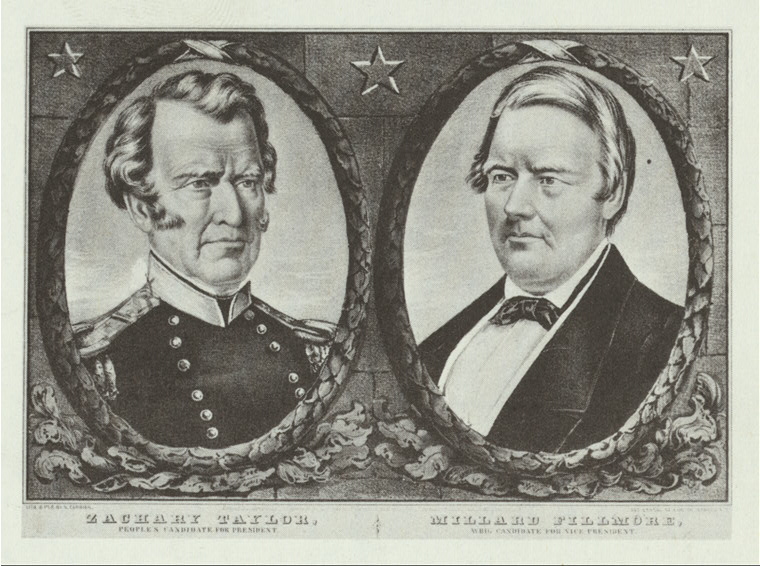
From a flyer or something published for the 1848 presidential campaign, images of the Whig Party ticket, Zachary Taylor for president and Millard Fillmore for vice president:
"Zachary Taylor, People's candidate for president; Millard Fillmore, Whig candidate for vice president"
We probably shouldn’t read anything into Taylor’s being identified as the “People’s Candidate” and Fillmore’s being identified as the “Whig Candidate.” Probably just the copy writer’s way of not sounding redundant.
Sitting Bear, Chief of the Arikaras, wearing a medal commemorating Millard Fillmore - Photo by Edward S. Curtis, Library of Congress image
In the 19th century, the U.S. Mint struck medals with the likeness of the sitting president, for use as gifts to foreign dignitaries. Often these medals would be given to Native Americans as tokens of friendship between the government and the tribe, or as a ceremonial gift on the striking of a treaty.
Description from the Library of Congress:
Photograph shows Sitting Bear, an Arikara chief, in full regalia, with a medallion around his neck. The medallion appears to bear the image of Millard Fillmore and the words: … President of the United States, 1851(?).
Famous photographer of American Indians Edward S. Curtis took this photo. The photo was copyrighted on November 19, 1908.
Reproduction Number: LC-USZ62-136605 (b&w film copy neg.)
Rights Advisory: No known restrictions on publication.
Call Number: LOT 12321-D [item] [P&P]
Other Number: H118592
Repository: Library of Congress Prints and Photographs Division Washington, D.C. 20540 USA
Notes:
H118592 U.S. Copyright Office.
Title from item.
Curtis no. 2894-08.
Forms part of: Edward S. Curtis Collection (Library of Congress).
Published in: The North American Indian / Edward S. Curtis. [Seattle, Wash.] : Edward S. Curtis, 1907-30, Suppl. v. 5, pl. 166.
Without medals, any plan of operations among the Indians, be it what it may, is essentially enfeebled. This comes of the high value which the Indians set upon these tokens of Friendship. They are, besides this indication of the Government Friendship, badges of power to them, and trophies of renown. They will not consent to part from this ancient right, as they esteem it; and according to the value they set upon medals is the importance to the Government in having them to bestow.
And, by the way — isn’t that a grand photo of Sitting Bear? Even knowing that Curtis might, on occasion, take some liberties in clothing Indians he photographed, it’s a great photo in a great setting of a great man.
Spread the word; friends don't allow friends to repeat history.
100,000 people gather in Times Square, New York City, tonight, and millions more around the world, in festivities for the new year made possible by the work of Thomas Alva Edison.
Here it is, the invention that stole sleep from our grasp, made clubbing possible, and launched 50,000 cartoons about ideas:
The light bulb Thomas Edison demonstrated on December 31, 1879, at Menlo Park, New Jersey - Wikimedia image (GFDL)
The light bulb. It’s an incandescent bulb.
It wasn’t the first bulb. Edison a few months earlier devised a bulb that worked with a platinum filament. Platinum was too expensive for mass production, though — and Edison wanted mass production. So, with the cadre of great assistants at his Menlo Park laboratories, he struggled to find a good, inexpensive filament that would provide adequate life for the bulb. By late December 1879 they had settled on carbon filament.
Edison invited investors and the public to see the bulb demonstrated, on December 31, 1879.
Thomas Edison in 1878, the year before he demonstrated a workable electric light bulb. CREDIT: Thomas Edison, head-and-shoulders portrait, facing left, 1880. Prints and Photographs Division, Library of Congress. Reproduction number LC-USZ62-98067
Edison’s successful bulb indicated changes in science, technology, invention, intellectual property and finance well beyond its use of electricity. For example:
Edison’s Menlo Park, New Jersey, offices and laboratory were financed with earlier successful inventions. It was a hive of inventive activity aimed to make practical inventions from advances in science. Edison was all about selling inventions and rights to manufacture devices. He always had an eye on the profit potential. His improvements on the telegraph would found his laboratory he thought, and he expected to sell the device to Western Union for $5,000 to $7,000. Instead of offering it to them at a price, however, he asked Western Union to bid on it. They bid $10,000, which Edison gratefully accepted, along with the lesson that he might do better letting the marketplace establish the price for his inventions. Other inventive labs followed Edison’s example, such as the famous Bell Labs, but few equalled his success, or had as much fun doing it. (Economics teachers: Need an example of the marketplace in action?)
Edison didn’t invent the light bulb — but his improvements on it made it commercial. “In addressing the question ‘Who invented the incandescent lamp?’ historians Robert Friedel and Paul Israel list 22 inventors of incandescent lamps prior to Joseph Wilson Swan and Thomas Edison. They conclude that Edison’s version was able to outstrip the others because of a combination of three factors: an effective incandescent material, a higher vacuum than others were able to achieve (by use of the Sprengel pump) and a high resistance lamp that made power distribution from a centralized source economically viable.”
Look around yourself this evening, and you can find a score of ways that Edison’s invention and its descendants affect your life. One of the more musing effects is in cartooning, however. Today a glowing lightbulb is universally accepted as a nonverbal symbol for ideas and inventions. (See Mark Parisi’s series of lightbulb cartoons, “Off the Mark.”)
Even with modern, electricity-saving bulbs, the cartoon shorthand hangs on, as in this Mitra Farmand cartoon.
Brilliant cartoon from Mitra Farmand, Fuffernutter
Or see this wonderful animation, a video advertisement for United Airlines, by Joanna Quinn for Fallon — almost every frame has the symbolic lightbulb in it.
Thomas Edison's electric lamp patent drawing and claim for the incandescent light bulb CREDIT: “New Jersey--The Wizard of Electricity--Thomas A. Edison's System of Electric Illumination,” 1880. Prints and Photographs Division, Library of Congress. Reproduction Number LC-USZ62-97960.
Do we, you and I in 2010, stand as witnesses to the end of newspapers in America?
It’s been a grand history. Newspapering gave us great leaders like Benjamin Franklin. Newspapering gave us wars, like the Spanish-American War. Newspapering gave us Charlie Brown, Ann Landers, the Yellow Kid, Jim Murray, Red Smith, Thomas Nast (and Santa Claus), the Federalist Papers, and coupons to save money on laundry soap.
It’s been a curious history, too. An 1897 editorial vouching for Santa Claus rates as the most popular editorial of all time, according to the Newseum in Washington, D.C.
The man who saved Christmas, at least for Virginia O'Hanlon: Francis Pharcellus Church - Newseum image
In autumn, 1897, 8-year-old Virginia O’Hanlon of 115 West 59th Street in New York, wrote to the New York Sun with this simple question:
“Please tell me the truth; is there a Santa Claus?”
In the age of Yellow Journalism, the fiercely competitive Sun‘s editors turned the letter to Francis Pharcellus. He responded to little Virginia on September 21, 1897:
“Yes, Virginia, there is a Santa Claus.”
Church’s brother, William Conant Church, owned and published the newspaper. Both had followed their father into the news business. They co-founded The Army-Navy Journal in 1863, and went on to a series of journalistic collaborations. Francis was 58 years old when he answered Virginia’s letter. (He died at age 67, in 1906.)
The New York Sun held down the conservative corner in New York journalism at the time, versus the New York Times and the New York Herald-Tribune. But it also had an interesting history, to a blogger intrigued by hoaxes. In 1835 the paper published a series of six newspaper stories falsely attributed to Sir John Herschel, a well-known astronomer, claiming to describe a civilization on the Moon — the Great Moon Hoax. The discovery was credited to a new, very powerful telescope.
In 1844 the paper published a hoax written by Edgar Allen Poe, the Balloon Hoax. Under a pseudonym, Poe wrote that a gas balloon had crossed the Atlantic in three days.
The Sun also featured outstanding reporting. A 1947 and 1948 series about crime on the docks of New York City won a Pulitzer Prize for writer Malcolm Johnson. That series inspired Elia Kazan’s 1954 movie On the Waterfront starring Marlon Brando, Rod Steiger, Eva Marie Saint, Karl Malden and Lee J. Cobb.
The New York Sun ceased publication in 1950.
For all of its history, the Sun and the Churches are most remembered for that defense of belief in Santa Claus. Virginia O’Hanlon grew up, graduated from Hunter College, got a masters at Columbia, and earned a Ph.D. from Fordham. She taught in the New York City Public School system, from which she retired in 1959. She died in 1971.
Birth of tradition
Columbia University was Church’s alma mater, as well as O’Hanlon’s. Her letter and his response get a reading each year at the Yule Log Ceremony at Columbia College, along with the poem “A Visit from St. Nicholas.” Animated, live-acting, and other television productions have been mounted in 1974, 1991, and 2009.
Is there a Santa Claus? Did Church write a credible defense? The text of the letter and answer, below the fold.
I’m looking for more photographs of presidents, especially Millard Fillmore and Andrew Johnson at the moment. Only a tiny handful of photos are available for Fillmore, and generally, there are only three photos of Andrew Johnson. Are there other photos hidden in archives, or is that really a reflection of how many photos were made of the two men?
Houston’s first marriage failed fast and hard. He was so shaken that he resigned his office as governor of Tennessee, and left for Indian territories. Eventually he found himself in Texas, and he was the leader of the Texian forces that defeated and captured Mexico’s President Santa Ana, securing independence from Mexico for Texas. Houston was president of the Texas Republic, and governor of the State of Texas.
What would Texas history be had Houston’s first marriage been happy, and he had stayed in Tennessee?
The Special Collections Library at the University of Tennessee recently purchased a copy of an invitation to the sudden January 1829 wedding of then-Tennessee governor Sam Houston and Eliza Allen. This rare item may be only one of its kind.
Aaron Purcell, university archivist, discovered the piece on eBay.com and purchased the invitation on February 14, 2007, just over 178 years after the wedding date. The invitation was kept by descendants of one of the wedding guests for five generations.
Sam Houston is an important figure in Tennessee’s history, serving as governor from 1827-1829 and representing the state in the U.S. House of Representatives from 1823-1827. Born in Lexington, Virginia, in 1793, his family moved to Maryville, Tennessee, in 1806. Houston joined the army in 1813 and fought at the Battle of Horseshoe Bend in 1814. There he caught the attention of Andrew Jackson. Jackson became Houston’s mentor and helped guide his political career.
While governor, Houston briefly courted 18-year-old Eliza Allen, daughter of a wealthy Gallatin, Tennessee, businessman. On January 15, 1829, the couple mailed a handful of invitations to a small January 22nd wedding at the Allen family home. It is one of these few invitations that UT was able to purchase.
The invitation UT acquired is addressed to Miss Harriet Roulstone, the daughter of George Roulstone, who in 1791 founded the Knoxville Gazette, the state’s first newspaper.
Shortly after the ceremony, the newlyweds were at odds. After 11 weeks, Eliza Allen left her husband and returned to her family’s home in Gallatin. There are many theories as to why the marriage was so short-lived, but none are substantiated. Allen burned all of her letters regarding the relationship and Houston was reluctant to speak about his brief marriage.
The invitation gives few details about the wedding, but the piece remained in the Roulstone family for many years, tucked in a trunk with other important family papers.
Shortly after his marriage dissolved, Houston resigned his position as governor and fled to Indian Territory. He married a Cherokee woman and became a citizen of the Cherokee Nation. Houston returned to public service in Texas, serving as president of the Republic of Texas, U.S. senator, and making several failed presidential runs. He died in 1863, leaving behind a complex legacy.
“Sam Houston materials are exceedingly rare and expensive,” Purcell said. UT holds only one other Houston item in its collections, a letter to Colonel Ramsey, dated February 1829. Both items are available for research use in the Special Collections Library at 1401 Cumberland Avenue.
About the Special Collections Library
The University of Tennessee Special Collections Library was founded in 1960 and resides in the historic James D. Hoskins Library building. Materials in special collections include manuscripts, books and other rare materials for research use. For more information, contact the library at (865) 974-4480 or visit www.lib.utk.edu/spcoll/.
Spread the word; friends don't allow friends to repeat history.
Columbus feared that King Ferdinand and Queen Isabella would not honor pledges they had made to him as recompense and honor for his great work of discovery on their behalf. Before his final voyage, he assembled a legal document showing those promises made to him, and his work for Spain.
This illustrates, once again, the human dimension of the great drama of the age of exploration, of Columbus’s stumbling on to the America’s in his efforts to get to China.
On January 5, 1502, prior to his fourth and final voyage to America, Columbus gathered several judges and notaries in his home in Seville. The purpose? To have them authorize copies of his archival collection of original documents through which Isabel and Fernando had granted titles, revenues, powers and privileges to Columbus and his descendants. These 36 documents are popularly called “Columbus’ Book of Privileges.” Four copies of his “Book” existed in 1502, three written on vellum and one on paper. The Library’s copy, one of the three on vellum, has a unique paper copy of the Papal Bull Dudum siquidem of September 26, 1493, which extended the Spanish claim for future explorations.
Decades later, the site of Velsicol’s DDT manufacturing at St. Louis, Michigan, along the Pine River, remains a still-recovering-from-contamination site. Velsicol denied DDT is dangerous in a letter to the publisher of Silent Spring. In 1999 EPA began a $100 million Superfund clean-up of Velsicol’s site. Even with new, better cleanup methods, it’s still a hazard. Photo from Penny Park, by the Pine River Superfund Citizen Task Force
When it comes to the St. Louis area Superfund sites, there must be a thousand sidebars – those quirky little stories that all played a role in what happened at the Velsicol Chemical plant, in the city and indeed the country throughout the last several decades.
And, I suspect, there are a thousand more yet to come out.
Several years ago, the PBS series “American Experience” showcased Rachel Carson, the woman who wrote “Silent Spring,” published in 1962. That was the book which became the force that led to the ban, for the most part, of DDT use in the U.S.
Velsicol in St. Louis was the largest manufacturer of DDT in the country.
In the program, Carson recalled the bad old days.
To say the chemical company didn’t much care for her is an understatement. They flat out called her a liar.
Not only was she up to no good with her “sinister influence.” She was also a “tool of the Communist menace.”
Nor did they care much for the New Yorker magazine, which published excerpts from her book shortly before publication. At least the same could be said for her publisher Houghton Mifflin.
Alma College Professor Ed Lorenz had traveled to Yale and perused Carson’s papers that are kept there.
He found a five-page letter written to the publisher from Velsicol’s lawyer outlining in great detail all the discrepancies, misstatements and misunderstandings on Carson’s part as well as the inaccuracies found in the New Yorker series.
Letter from Velsicol Chemical to publisher of Silent Spring, threatening to sue if alleged errors in Silent Spring were not corrected. No changes were made, and Velsicol did not sue. Letter image from the archives of Alma College.
Certainly wouldn’t want to see all those errors in the book due out, so a letter from Velsicol was in order. A letter that would “call several matters to your attention from legal and ethical standpoints.”
Louis McLean, the attorney, requested a meeting with the publisher so they could discuss all that and more besides.
The editor in chief wrote back and thanked him for the letter, forwarding on a copy to Carson.
“We have reviewed carefully the sources for the statements in her book, in the light of the points you bring up in your letter,” Paul Brooks wrote in response. “While there may be room for differences of opinion, we still believe, after thorough examination, that Miss Carson’s presentation is accurate and fair. Since our concern as well as yours is factual accuracy, we do not believe that a meeting would serve any useful purpose.”
Velsicol didn’t sue.
E.B. White, then the publisher of the New Yorker wrote to Carson, remarking on her courage for, “putting on the gloves and going in with this formidable opponent. This will be an Uncle Tom’s Cabin of a book, I feel – the sort that will help turn the tide.”
It did, at least in the U.S.
And one last item for the “It’s a small world department:” Did you know that the mother of Bernie Davis, the former Alma College professor and former county commissioner, was Carson’s administrative assistant?
She too was interviewed on “American Experience,” Lorenz said.
America is vexed with a non-centrally organized, but persistent, campaign to smear Rachel Carson and her work, with inaccurate claims about her research and the science of environmental protection — smears that would be laughable were there not so many ill-informed people who give them credence. In contrast, there is no paid lobby to spread the good works of Rachel Carson — the truth simply stands on its own.
More about DDT and Alma, Michigan, at Millard Fillmore’s Bathtub:
August 17, 1790, found U.S. President George Washington traveling the country, in Newport, Rhode Island.
Washington met with “the Hebrew Congregation” (Jewish group), and congregation leader (Rabbi?) Moses Seixas presented Washington with an address extolling Washington’s virtues, and the virtues of the new nation. Seixas noted past persecutions of Jews, and signalled a hopeful note:
Deprived as we heretofore have been of the invaluable rights of free citizens, we now (with a deep sense of gratitude to the Almighty disposer of all events) behold a government erected by the Majesty of the People–a Government which to bigotry gives no sanction, to persecution no assistance, but generously affording to All liberty of conscience and immunities of Citizenship, deeming every one, of whatever Nation, tongue, or language, equal parts of the great governmental machine.
George Washington's reply to the Newport, RI, "Hebrew congregation," August 17, 1790 - Library of Congress image
President Washington responded with what may be regarded as his most powerful statement in support of religious freedom in the U.S. — and this was prior to the ratification of the First Amendment:
It is now no more that toleration is spoken of as if it was the indulgence of one class of people that another enjoyed the exercise of their inherent natural rights. For happily, the government of the United States, which gives to bigotry no sanction, to persecution no assistance, requires only that they who live under its protection should demean themselves as good citizens, in giving it on all occasions their effectual support.
Below the fold, more history of the events and religious freedom, from the Library of Congress.
Historic irony: On Flag Day in 1943, the U.S. Supreme Court issued its decision in the case of West Virginia vs. Barnette.
Image 1 - Billy Gobitas explained why he would not salute the U.S. flag, November 5, 1935 - Library of Congress collection
The case started earlier, in 1935, when a 10-year-old student in West Virginia, sticking to his Jehovah’s Witness principles, refused to salute the U.S. flag in a state-required pledge of allegiance. From the Library of Congress:
“I do not salute the flag because I have promised to do the will of God,” wrote ten-year-old Billy Gobitas (1925-1989) to the Minersville, Pennsylvania, school board in 1935. His refusal, and that of his sister Lillian (age twelve), touched off one of several constitutional legal cases delineating the tension between the state’s authority to require respect for national symbols and an individual’s right to freedom of speech and religion.
The Gobitas children attended a public school which, as did most public schools at that time, required all students to salute and pledge allegiance to the flag of the United States. The Gobitas children were members of the Jehovah’s Witnesses, a church that in 1935 believed that the ceremonial saluting of a national flag was a form of idolatry, a violation of the commandment in Exodus 20:4-6 that “thou shalt not make unto thee any graven image, nor bow down to them. . . .” and forbidden as well by John 5:21 and Matthew 22:21. On 22 October 1935, Billy Gobitas acted on this belief and refused to participate in the daily flag and pledge ceremony. The next day Lillian Gobitas did the same. In this letter Billy Gobitas in his own hand explained his reasons to the school board, but on 6 November 1935, the directors of the Minersville School District voted to expel the two children for insubordination.
The Watch Tower Society of the Jehovah’s Witnesses sued on behalf of the children. The decisions of both the United States district court and court of appeals was in favor of the right of the children to refuse to salute. But in 1940 the United States Supreme Court by an eight-to-one vote reversed these lower court decisions and ruled that the government had the authority to compel respect for the flag as a key symbol of national unity. Minersville v. Gobitis[a printer’s error has enshrined a misspelling of the Gobitas name in legal records] was not, however, the last legal word on the subject. In 1943 the Supreme Court by a six-to-three vote in West Virginia State Board of Education v. Barnette, another case involving the Jehovah’s Witnesses, reconsidered its decision in Gobitis and held that the right of free speech guaranteed in the First Amendment to the Constitution denies the government the authority to compel the saluting of the American flag or the recitation of the pledge of allegiance.
There had been strong public reaction against the Gobitis decision, which had been written by Justice Felix Frankfurter (1882-1965). In the court term immediately following the decision, Frankfurter noted in his scrapbook that Justice William O. Douglas (1898-1980) told him that Justice Hugo LaFayette Black (1886-1971) had changed his mind about the Gobitis case. Frankfurter asked, “Has Hugo been re-reading the Constitution during the summer?” Douglas replied, “No–he has been reading the papers.”1 The Library’s William Gobitas Papers showcase the perspective of a litigant, whereas the abstract legal considerations raised by Gobitis and other cases are represented in the papers of numerous Supreme Court justices held by the Manuscript Division.
1. Quoted in H. N. Hirsch, The Enigma of Felix Frankfurter (New York: Basic Books, 1981), 152.
John E. Haynes and David Wigdor, Manuscript Division
Second page, Billy Gobitas's explanation of why he will not salute the U.S. flag: "I do not salute the flag not because I do not love my country but I love my country and I love God more and I must obey His commandments." - Library of Congress
Supreme Court justices do not often get a chance to reconsider their decisions. For example, overturning Plessy vs. Ferguson from 1896 took until 1954 in Brown v. Topeka Board of Education. In the flag salute/pledge of allegiance cases Justice Hugo Black had a change of mind, and when a similar case from West Virginia fell on the Court’s doorstep in 1943, the earlier Gobitis decision was reversed.
If there is any fixed star in our constitutional constellation, it is that no official, high or petty, can prescribe what shall be orthodox in politics, nationalism, religion, or other matters of opinion, or force citizens to confess by word or act their faith therein. If there are any circumstances which permit an exception, they do not now occur to us.
Jehovah’s Witnesses, and all other Americans, thereby have the right to refuse to say what they and their faith consider to be a vain oath.
And that, boys and girls, is what the First Amendment means.
One hundred and fifty National Geographic Society employees march in the Preparedness Parade on Flag Day, June 14, in 1916. With WWI underway in Europe and increasing tensions along the Mexican border, President Woodrow Wilson marched alongside 60,000 participants in the parade, just one event of many around the country intended to rededicate the American people to the ideals of the nation.
Not only the anniversary of the day the flag was adopted by Congress, Flag Day is also the anniversary of President Dwight Eisenhower’s controversial addition of the words “under God” to the Pledge of Allegiance in 1954.
(Text adapted from “:Culture: Allegiance to the Pledge?” June 2006, National Geographic magazine)
The first presidential declaration of Flag Day was 1916, by President Woodrow Wilson. Wilson won re-election the following November with his pledge to keep America out of World War I, but by April of 1917 he would ask for a declaration of war after Germany resumed torpedoing of U.S. ships. The photo shows an America dedicated to peace but closer to war than anyone imagined. Because the suffragettes supported Wilson so strongly, he returned the favor, supporting an amendment to the Constitution to grant women a Constitutional right to vote. The amendment passed Congress with Wilson’s support and was ratified by the states.
The flags of 1916 should have carried 48 stars. New Mexico and Arizona were the 47th and 48th states, Arizona joining the union in 1913. No new states would be added until Alaska and Hawaii in 1959. That 46-year period marked the longest time the U.S. had gone without adding states, until today. No new states have been added since Hawaii, more than 49 years ago. (U.S. history students: Have ever heard of an essay, “Manifest destiny fulfilled?”)
150 employees of the National Geographic Society marched, and as the proud CEO of any organization, Society founder Gilbert H. Grosvenor wanted a photo of his organization’s contribution to the parade. Notice that Grosvenor himself is the photographer.
I wonder if Woodrow Wilson took any photos that day, and where they might be hidden.
Since 1916, when President Woodrow Wilson issued a presidential proclamation establishing a national Flag Day on June 14, Americans have commemorated the adoption of the Stars and Stripes by celebrating June 14 as Flag Day. Prior to 1916, many localities and a few states had been celebrating the day for years. Congressional legislation designating that date as the national Flag Day was signed into law by President Harry Truman in 1949; the legislation also called upon the president to issue a flag day proclamation every year.
According to legend, in 1776, George Washington commissioned Philadelphia seamstress Betsy Ross to create a flag for the new nation. Scholars debate this legend, but agree that Mrs. Ross most likely knew Washington and sewed flags. To date, there have been twenty-seven official versions of the flag, but the arrangement of the stars varied according to the flag-makers’ preferences until 1912 when President Taft standardized the then-new flag’s forty-eight stars into six rows of eight. The forty-nine-star flag (1959-60), as well as the fifty-star flag, also have standardized star patterns. The current version of the flag dates to July 4, 1960, after Hawaii became the fiftieth state on August 21, 1959.
Fly your flag with pride today.
Elmhurst Flag Day 1939, DuPage County Centennial - Posters From the WPA
Or, until that account is unsuspended by the forces supporting Donald Trump: Follow @FillmoreWhite, the account of the Millard Fillmore White House Library
We've been soaking in the Bathtub for several months, long enough that some of the links we've used have gone to the Great Internet in the Sky.
If you find a dead link, please leave a comment to that post, and tell us what link has expired.
Thanks!
Retired teacher of law, economics, history, AP government, psychology and science. Former speechwriter, press guy and legislative aide in U.S. Senate. Former Department of Education. Former airline real estate, telecom towers, Big 6 (that old!) consultant. Lab and field research in air pollution control.
My blog, Millard Fillmore's Bathtub, is a continuing experiment to test how to use blogs to improve and speed up learning processes for students, perhaps by making some of the courses actually interesting. It is a blog for teachers, to see if we can use blogs. It is for people interested in social studies and social studies education, to see if we can learn to get it right. It's a blog for science fans, to promote good science and good science policy. It's a blog for people interested in good government and how to achieve it.
BS in Mass Communication, University of Utah
Graduate study in Rhetoric and Speech Communication, University of Arizona
JD from the National Law Center, George Washington University


 Posted by Ed Darrell




 The Special Collections Library at the University of Tennessee recently purchased a copy of an invitation to the sudden January 1829 wedding of then-Tennessee governor Sam Houston and Eliza Allen. This rare item may be only one of its kind.
 The invitation UT acquired is addressed to Miss Harriet Roulstone, the daughter of George Roulstone, who in 1791 founded the Knoxville Gazette, the state’s first newspaper.





 Millard Fillmore's Bathtub