December 17, written in the wind

December 17, 2007

Wright Bros. flyer at Kittyhawk, first flight

Photo from Treasures of the Library of Congress; “First Flight” by John T. Daniels (d. 1948); this is a modern gelatin print from the glass negative.

Ten feet in altitude, 120 feet traveled, 12 seconds long. That was the first flight in a heavier-than-air machine achieved by Orville and Wilbur Wright of Dayton, Ohio, at Kittyhawk, North Carolina, on December 17, 1903.

From the Library of Congress:

On the morning of December 17, 1903, Wilbur and Orville Wright took turns piloting and monitoring their flying machine in Kill Devil Hills, North Carolina. Orville piloted the first flight that lasted just twelve seconds. On the fourth and final flight of the day, Wilbur traveled 852 feet, remaining airborne for 57 seconds. That morning the brothers became the first people to demonstrate sustained flight of a heavier-than-air machine under the complete control of the pilot.

No lost luggage, no coffee, no tea, no meal in a basket, either.

Resources on the Wright Brothers’ first flight:


Human Liberty Bell: Tribute to photos of Mole & Thomas

December 12, 2007

Surely you’ve seen some of these photos; if you’re a photographer, you’ve marveled over the ability of the photographer to get all those people to their proper positions, and you’ve wondered at the sheer creative genius required to set the photos up.

Like this one, a depiction of the Liberty Bell — composed of 25,000 officers and men at Fort Dix, New Jersey. The photo was taken in 1918.

Mole & Thomas photo, Human Liberty Bell The Carl Hammer Gallery in Chicago featured an exhibit of these monumental photos in April and May, 2007:

The outbreak of World War I and its inherent violence engendered a new commitment by the world’s photographers to document every aspect of the fighting, ending an era of In A Patriotic Mole, A Living Photograph, Louis Kaplan, of Southern Illinois University, writes, “The so-called living photographs and living insignia of Arthur Mole [and John Thomas] are photo-literal attempts to recover the old image of national identity at the very moment when the United States entered the Great War in 1917.

Mole’s [and Thomas’s] photos assert, bolster, and recover the image of American national identity via photographic imaging. Moreover, these military formations serve as rallying points to support U.S. involvement in the war and to ward off any isolationist tendencies. In life during wartime, [their] patriotic images function as “nationalist propaganda” and instantiate photo cultural formations of citizenship for both the participants and the consumers of these group photographs.”

The monumentality of this project somewhat overshadows the philanthropic magnanimity of the artists themselves.Instead of prospering from the sale of the images produced, the artists donated the entire income derived to the families of the returning soldiers and to this country’s efforts to re-build their lives as a part of the re-entry process.

Eventually, other photographers, appeared on the scene, a bit later in time than the activity conducted by Mole and Thomas, but all were very clearly inspired by the creativity and monumentality of the duo’s production of the “Living” photograph.

One of the most notable of those artists was Eugene Omar Goldbeck. He specialized in the large scale group portrait and photographed important people (Albert Einstein), events, and scenes (Babe Ruth’s New York Yankees in his home town, San Antonio) both locally and around the world (Mt. McKinley). Among his military photographs, the Living Insignia projects are of particular significance as to how he is remembered.

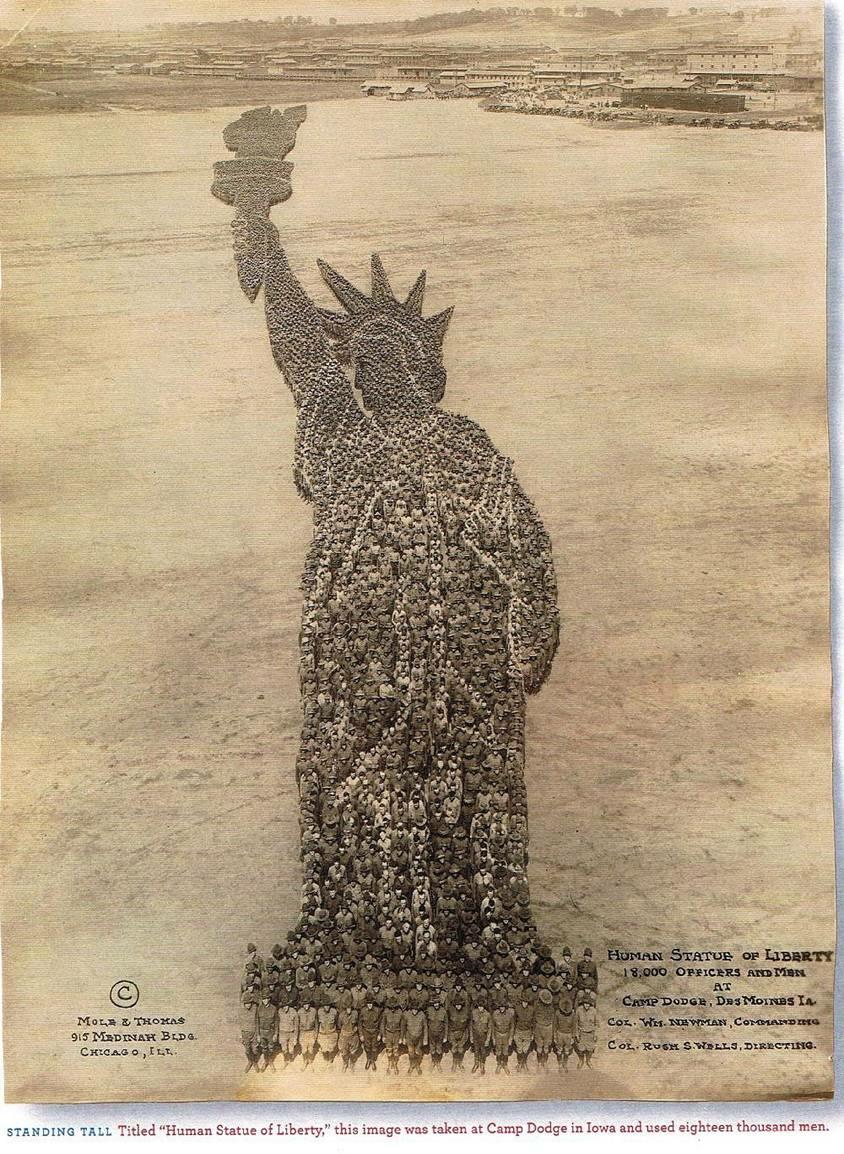
Using a camera as an artist’s tool, using a literal army as a palette, using a parade ground as a sort of canvas, these photographers made some very interesting pictures. The Human Statue of Liberty, with 18,000 men at Camp Dodge, Iowa?


statue-of-liberty-human-camp-dodge-from-snopes.jpg

Most of these pictures were taken prior to 1930. Veterans who posed as part of these photos would be between 80 and 100 years old now. Are there veterans in your town who posed for one of these photos?


Good photographic copies of some of these pictures are available from galleries. They are discussion starters, that’s for sure.

Some questions for discussion:

  1. Considering the years of the photos, do you think many of these men saw duty overseas in World War I.
  2. Look at the camps, and do an internet search for influenza outbreaks in that era. Were any of these camps focal points for influenza?
  3. Considering the toll influenza took on these men, about how many out of each photo would have survived the influenza, on average?
  4. Considering the time, assume these men were between the ages of 18 and 25. What was their fate after the Stock Market Crash of 1929? Where were they during World War II?
  5. Do a search: Do these camps still exist? Can you find their locations on a map, whether they exist or not?
  6. Why do the critics say these photos might have been used to build national unity, and to cement national identity and will in time of war?
  7. What is it about making these photos that would build patriotism? Are these photos patriotic now?

These quirky photos are true snapshots in time. They can be used for warm-ups/bell ringers, or to construct lesson plans around.

Tip of the old scrub brush to Gil Brassard, a native, patriotic and corporate historian hiding in Baton Rouge, Louisiana.


Oswald’s Ghost appears in Texas Theatre, 44 years later

November 22, 2007

President John F. Kennedy died 44 years ago today. Five year anniversaries tend to get more attention.

High school U.S. history students have been alive less than half the time since the assassination. To them it is ancient history, even more than the Vietnam War. Teachers need to find ways to make the history stick even in years that are not multiples of 5.

President Kennedy greeting a crowd in Ft. Worth, Texas, Nov. 22, 1963

A new film offers some aid.Oswald’s Ghost” had it’s world premiere at the Texas Theater in Oak Cliff, the place where Lee Oswald was arrested. Restoration of the theater is not complete, but it is far enough along to host events.

The movie is in severely limited release prior to a January 14, 2008 premier on PBS stations. Director Robert Stone places the assassination in history and tells some of the effects on America, rather than dwelling on facts or controversies around the shooting. The movie got a good review from the Dallas Morning News:

“Nobody had stepped back and told the story of the debate itself,” he says.

“How did these ideas come about? Who propagated them and why were they so widely believed? And what had they done to this country? Seventy percent of Americans still believe the government was involved in the Kennedy assassination or has worked to cover it up. And that’s had a huge impact.”

In the end, a seemingly disparate chorus of voices – including the late Norman Mailer – accomplish the filmmaker’s objective.

As he says, Oswald’s Ghost is “a way of explaining the ’60s. We’re not arguing anymore about what happened in Dealey Plaza. It’s an argument about explaining what came after … and how did everything go so wrong.”

With luck, it will be on DVD for classroom use by early February.

Dallas’s PBS outlet, KERA, is showing another locally-produced film this week that I have found useful in the classroom, focusing on the news coverage that day, JFK: Breaking the News. For slightly more adult teachers, there is the fun of finding news people in their infant careers, people like Robert McNeil then of NBC, Peter Jennings, and then-local Dallas reporters Jim Lehrer and Dan Rather, and Fort Worth reporter Bob Schieffer. Few other one-day events have produced such a stable of news greats — the Kennedy assassination spurred the careers of more new people than any other event with the possible exception of World War II. Jane Pauley narrates the story.

The Baltimore Sun’s Frank James offers serious thought on the historical influence of the day in a blog post, “The Big ‘What If?‘”

There is a webcam view of Dealey Plaza from the Texas Book Depository Building — the cam claims to be from the 6th floor window from which Oswald shot, but it looks like the top of the building to me.

The Kennedy assassination kicked the wind out of America. In many ways it was the event that triggered 1968, perhaps the worst single year in American history.

44 years, and we still don’t know the full set of ramifications of the events of that day. Historians keep chipping away.


Gettysburg Address, November 19, 1863

November 19, 2007


144 years ago today, Abraham Lincoln redefined the Declaration of Independence and the goals of the American Civil War, in a less-than-two-minute speech dedicating part of the battlefield at Gettysburg, Pennsylvania, as a cemetery and final resting place for soldiers who died in the fierce battle fought there the previous July 1 through 3.

Interesting news for 2007: More photos from the Library of Congress collection may contain images of Lincoln. The photo above, detail from a much larger photo, had been thought for years to be the only image of Lincoln from that day. The lore is that photographers, taking a break from former Massachusetts Sen. Edward Everett’ s more than two-hour oration, had expected Lincoln to go on for at least an hour. His short speech caught them totally off-guard, focusing their cameras or taking a break. Lincoln finished before any photographer got a lens open to capture images.

Images of people in these photos are very small, and difficult to identify. Lincoln was not identified at all until 1952:

The plate lay unidentified in the Archives for some fifty-five years until in 1952, Josephine Cobb, Chief of the Still Pictures Branch, recognized Lincoln in the center of the detail, head bared and probably seated. To the immediate left (Lincoln’s right) is Lincoln’s bodyguard, Ward Hill Lamon, and to the far right (beyond the limits of the detail) is Governor Andrew G. Curtin of Pennsylvania. Cobb estimated that the photograph was taken about noontime, just after Lincoln arrived at the site and before Edward Everett’s arrival, and some three hours before Lincoln gave his now famous address.

On-line, the Abraham Lincoln Blog covered the discovery that two more photographic plates from the 1863 speech at Gettysburg may contain images of Lincoln in his trademark stove-pipe hat. Wander over to the story at the USA Today site, and you can see just how tiny are these detail images in relation to the photographs themselves. These images are tiny parts of photos of the crowd at Gettysburg. (The story ran in USA Today last Thursday or Friday — you may be able to find a copy of that paper buried in the returns pile at your local Kwikee Mart.) Digital technologies, and these suspected finds of Lincoln, should prompt a review of every image from Gettysburg that day.

To the complaints of students, I have required my junior U.S. history students to memorize the Gettysburg Address. In Irving I found a couple of students who had memorized it for a an elementary teacher years earlier, and who still could recite it. Others protested, until they learned the speech. This little act of memorization appears to me to instill confidence in the students that they can master history, once they get it done.

To that end, I discovered a good, ten-minute piece on the address in Ken Burns’ “Civil War” (in Episode 5). On DVD, it’s a good piece for classroom use, short enough for a bell ringer or warm-up, detailed enough for a deeper study, and well done, including the full text of the address itself performed by Sam Waterson.

Edward Everett, the former Massachusetts senator and secretary of state, was regarded as the greatest orator of the time. A man of infinite grace, and a historian with some sense of events and what the nation was going through, Everett wrote to Lincoln the next day after their speeches:

“I should be glad, if I could flatter myself that I came as near the central idea of the occasion in two hours, as you did in two minutes.”

Interesting note: P. Z. Myers at Pharyngula notes that the Gettysburg Address was delivered “seven score and four years ago.” Of course, that will never happen again. I’ll wager he was the first to notice that odd juxtaposition on the opening line.

Resources for students and teachers:


What happened in 1066, again?

November 14, 2007

If I ever run into a class of U.S. kids who know why 1066 is an important date, I shall be moved to smile. Hasn’t happened yet.

Here’s an interesting and almost-fun post on the Battle of Hastings, from Samurai Dave.


Carnival catch up: Sputnik at Philosophia Naturalis 14

November 5, 2007

Interesting carnival of natural philosophy that I had not seen before — and Philosophia Naturalis Number 14 celebrates Sputnik. History teachers may want to visit the carnival.

This one is hosted at Dynamics of Cats, one of the Seed Empire science blogs. I regret it took so long to call it to your attention.


NBC video — free from HotChalk, through December

October 27, 2007

Teacher magazine reports that NBC News made available to teachers more than 5,000 chunks of news video and still photos from their news archives, for use in the classroom.

The service requires a free subscription to HotChalk through December. After that, a school subscription to HotChalk is necessary, starting in 2008.

Great resources, but I predict few teachers will have the connections to put these to work in the classroom. Comments are open, of course, for you to share your experience. Please comment on how useful you find these images, and how you use them.

Woman on cell phone, NBC News photo Historic photo of woman on early cellular telephone, NBC News photo, from HotChalk.


Portal to Texas History – Universty of North Texas

October 10, 2007

Texas history teachers — looking for good images? This seems to be a source.


Sputnik on newsreel

October 8, 2007

We still had movie newsreels in 1957. ASAP Retro, a part of Associated Press, I think, features the classic Ed Herlihy-announced 30 second explanation of Sputnik that was seen in movie theatres across America in late 1957 and early 1958.

You’ll need a live internet link to use it in class.

I do wish that more of these newsreels were available for easy use by teachers in classrooms, say on DVD, in short segments.


Prehistory and art: Lesson plan material

October 7, 2007

Teachers looking for good interactive graphics on human migration in prehistoric times should take a look at the website of Australia’s Bradshaw Foundation. The map requires an Adobe Flash player, and I cannot embed it here — but go take a look, here. “The Journey of Man” seems tailor made for classroom use, if you have a live internet connection and a projector.

Ancient art is the chief focus of the foundation.

Ancient paintings, the Bradshaw paintings, at the Bradshaw Foundation Examples of some of the most famous cave and rock paintings populate the site, along with many lesser known creations — the eponymous paintings, the Bradshaw group, generally disappear from U.S. versions of world history texts. The Bradshaw Foundation website explains:

The Bradshaw Paintings are incredibly sophisticated, as you will see from the 32 pictures in the Paintings Section, yet they are not recent creations but originate from an unknown past period which some suggest could have been 50,000 years ago. This art form was first recorded by Joseph Bradshaw in 1891, when he was lost on an Kimberley expedition in the north west of Australia. Dr. Andreas Lommel stated on his expedition to the Kimberleys in 1955 that the rock art he referred to as the Bradshaw Paintings may well predate the present Australian Aborigines.

This ancient art carries a story that should intrigue even junior high school students, and it offers examples of archaeological techniques that are critical to determining the ages of undated art in the wild:

According to legend, they were made by birds. It was said that these birds pecked the rocks until their beaks bled, and then created these fine paintings by using a tail feather and their own blood. This art is of such antiquity that no pigment remains on the rock surface, it is impossible to use carbon dating technology. The composition of the original paints cant be determined, and whatever pigments were used have been locked into the rock itself as shades of Mulberry red, and have become impervious to the elements.

Fortuitously, in 1996 Grahame Walsh discovered a Bradshaw Painting partly covered by a fossilised Mud Wasp nest, which scientists have removed and analysed using a new technique of dating, determining it to be 17,000 + years old.

Texas history and geography teachers should note the Bradshaw Foundation’s work on prehistorica art in the Pecos River Valley: “Pecos Experience: Art and archeaology in the lower Pecos.” There is much more here than is found in most Texas history texts — material useful for student projects or good lesson plans.

Painting from Panther Cave, lower Pecos, Texas - Bradshaw Foundation


Historic maps: Florida and the Gulf of Mexico

September 21, 2007

Go to the University of Florida Smathers Library site, and admire the beauty of these old maps of Florida and the Gulf of Mexico. (While I think fair use would cover it, I’m holding back on posting an image until copyright permission comes through — you’re licensed to use them in the classroom, however.)

What else would you expect from a library named after Sen. George A. Smathers, who was part of that legendary 1950 Senate campaign in Florida?

The maps featured on the first page include Spanish, Dutch, English, Belgian, French and Italian maps of the early explorers, suitable certainly for Texas history courses, and also for Florida, Louisiana and U.S. history units on European exploration.

This site is quite Florida-centric, but it’s links also provide some interesting and valuable resources, such as the link to satellite imagery of the areas, like the NOAA map, below.

NOAA map of ocean water temperatures around Florida, satellite image

Tip of the old scrub brush to A Cracker Boy Looks at Florida


Political cartoons: Powerful images, powerful ideas

September 20, 2007

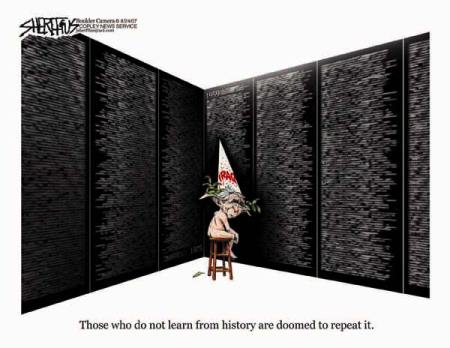
Sherffius in the Boulder Daily Camera, August 2007 - copyright Sherffius

Sherffius in the Boulder Daily Camera, August 2007 - copyright Sherffius

Sherffius, in the Boulder (Colorado) Daily Camera

The deadline for cartoonists to enter the Ranan Lurie Prize competition at the United Nations is October 1. The winning cartoon from 2006, from Argentinian cartoonist Alfredo Sabat, is one of the most popular images in Google’s image search for “cartoon.”

Images pack a punch. If a pen is mightier than a sword, a cartoonist’s pencil and ink drawing can be more powerful than a cannon.

While we wait for the winners of the Lurie competition, we can look around to see other great cartoonists’ work. Earlier I tried to call attention to the work of John Sherffius at the Boulder (Colorado) Daily Camera. Since then, he’s won the James Aronson Social Justice Award for Graphics for the body of his work. The power of his drawings should be clear from the cartoon above.

Do you have a favorite cartoonist, especially one from a smaller newspaper who has not yet received the kudos she or he is due? Tell us about it in comments — and give links, if you can.

And share the word with others:

Add to FacebookAdd to NewsvineAdd to DiggAdd to Del.icio.usAdd to StumbleuponAdd to RedditAdd to BlinklistAdd to TwitterAdd to TechnoratiAdd to Furl


Good news for history teachers: NY Times drops fees

September 18, 2007

The New York Times announced it will stop charging for access to much of its archives, from 1987 to the present, and from the paper’s inception through 1922.

Other articles from 1922 to 1987 will be available for a reduced fee, or free.

Access opens to much of the archived material at midnight tonight, September 18, 2007 (probably Eastern Time).

History, economics and science teachers especially now can get news stories of key events that were previously difficult to find and often expensive. Now-free periods of history include the periods covering the Spanish-American War, the entire administrations of Theodore Roosevelt and Woodrow Wilson, World War I, the administrations of George H. W. Bush, Bill Clinton and the current administration, the end of the Cold War, nullification and destruction of the Berlin Wall and reunification of Germany, breakup of the Soviet Union, the first Gulf War, and much more.

Still behind a proprietary shield will be World War II, the Great Depression and the New Deal, the rise of the Cold War, the Korean War, the development of atomic bombs and nuclear reactors, the discovery of the structure of DNA, the trial of John Scopes, the trial of the Rosenbergs, the McCarthy era, and the administrations of John F. Kennedy and Lyndon Johnson.

The Times said the policy change makes sense because of links from other internet sources that drive people to the Times’ site. The newspaper can make more money from advertising to those referral clicks than from charging an access fee.

This makes a great deal of high quality information about events in history available to teachers and students. One danger for the light-hearted: It may confuse students about the meaning of “free press.”


Millard Fillmore at the National Portrait Gallery

September 11, 2007

Part of the Smithsonian Museums, the National Portrait Gallery remains one of my favorite museums in Washington. It is off the Mall, tucked away at Eighth and F Streets, NW, D.C., (above the Gallery Place-Chinatown Metrorail station – Red, Yellow and Green lines). Free admission, great art, but far enough out of the way to almost guarantee no crowds.

If you Google “National Portrait Gallery,” you also get the gallery of the same name in London, which is not part of the Smithsonian. Another great gallery, but don’t confuse the two.

My continuing search for images of Millard Fillmore turned up this one at the NPG:

Millard Fillmore at the NPG, unnamed artist, circa 1840

The artist is unknown. It’s oil on canvas, and rather a specialty of the NPG — it’s not the official White House portrait. Some of the portraits of presidents come with cheeky commentary or history, since they are not the official portraits usually approved by the president in question himself.

Fillmore’s portrait by an unidentified artist dates from about the time he retired from the House of Representatives in the early 1840s. In the years following, he devoted himself to reconciling the growing differences among fellow Whigs in his native New York State a task for which this hulking and amiable politician was well suited.

“Hulking?”

Check out the other president’s portraits for a usually different view (Lyndon Johnson hated the portrait the NPG has of him, and Richard Nixon never looked better, nor Thomas Jefferson younger); see what else is there that you might use in the classroom.

The NPG has the added advantage of being a short walk from Washington’s China Town, where we used to dine happily at a restaurant named Szechuan, when such cuisine was rather new in the U.S. Several eateries in the area feature dim sum on Sunday mornings, for those days one would rather commune with good friends over delectable tidbits and a good Sunday newspaper, instead of sitting in a pew. Debra Winstead, a former colleague from the University of Arizona, introduced me to the joy of dim sum in D.C. a few years ago.

Good art, good food, good friends. No wonder Washington is such a livable city these days.


Cuneiform in a digital library

September 4, 2007

Irony sometimes means happy surprises. Cuneiform on the world wide web?

Tablet (Cornell 78) w inscriptions to Babylonian King Sinkashid (about 1800 B.C.) The University of California system is working hard to deliver important information to scholars on the web. One of these projects is the Cuneiform Digital Library Initiative (CDLI). Here is the official desription:

The Cuneiform Digital Library Initiative (CDLI) represents the efforts of an international group of Assyriologists, museum curators and historians of science to make available through the internet the form and content of cuneiform tablets dating from the beginning of writing, ca. 3350 BC, until the end of the pre-Christian era. We estimate the number of these documents currently kept in public and private collections to exceed 500,000 exemplars, of which now more than 200,000 have been catalogued in electronic form by the CDLI.

Some of the photos demonstrate the beauty of everyday history and archaeology. These are instructional photos, but some are works of art. Examples of drawings of the writing are available, which can be used in the classroom to show students what the writing looks like.

The image here is described: The tablet . . . (Cornell 78)
contains an inscription of the Old Babylonian king Sinkashid of Warka/Erech (ca. 1800 BC)
. (copyright by Cornell University Library)

Translated:

Obv.
  1 {d}suen-ga-szi-id “Sinkashid,
  2 nita kal-ga strong man,
  3 lugal unu{ki}-ga king of Uruk,
  4 lugal am-na-nu-um king of Amnanum,
Rev.
    e2-gal his palace
    nam-lugal-la-ka-ni of kingship
    mu-du3 did build.”

Some sites in CDLI allow searches by topic. Students, consider these school tablets, and thank your lucky stars, inventors and the trees for paper and ink. Can you imagine lugging these things in a backpack?

Read the rest of this entry »