Election Day 2012: Fly the flag, vote

November 6, 2012

Saint Louis Art Museum, St. Louis, Missouri George Caleb Bingham (American, 1811–1879). The County Election, 1852. Oil on canvas. 38 x 52 in. (96.5 x 132.1 cm). Gift of Bank of America.

The County Election, 1852. Saint Louis Art Museum, St. Louis, Missouri George Caleb Bingham (American, 1811–1879).  Oil on canvas. 38 x 52 in. (96.5 x 132.1 cm). Gift of Bank of America.

Every polling place should be flying the U.S. flag today.  You may fly yours, too.  In any case, if you have not voted already, go vote today as if our future depends upon it, as if our nation expects every voter to do her or his duty.

Today the nation and world listen to the most humble of citizens.  Speak up, at the ballot box.

Did you notice?  In Bingham’s picture, there are no U.S. flags.  You may fly yours anyway.

The whole world is watching.

More:


October 9 – St. Denis’s Day, patron saint for those who have lost their head

October 9, 2012

October 9 is the Feast Day of St. Denis.

Who?  He’s the patron saint of Paris (and France, by some accounts), and possessed people.   Take a look at this statue, from the “left door” of the Cathedral of Notre Dame  in Paris (Cathédrale Notre-Dame de Paris: portail de gauche).  He was martyred by beheading, in about 250 C.E.

English: Cathédrale Notre-Dame de Paris: porta...

St. Denis greets vistors to the Cathedral of Notre Dame, Paris (Cathédrale Notre-Dame de Paris: portail de gauche)

Our trusty friend Wikipedia explains:

According to the Golden Legend, after his head was chopped off, Denis picked it up and walked two miles, preaching a sermon the entire way.[6] The site where he stopped preaching and actually died was made into a small shrine that developed into the Saint Denis Basilica, which became the burial place for the kings of France. Another account has his corpse being thrown in the Seine, but recovered and buried later that night by his converts.[2]

Clearly, he is the guy to pray to about Michelle Bachmann, Rush Limbaugh, Todd Akin, Paul Ryan, intelligent design, and the Texas State Board of Education, no?  You catch my drift, you can use this factoid to some advantage, enlightenment, and perhaps humor.  In Catholic lore, St. Denis is one of the “14 Holy Helpers,” and his aid is sought to help people with headaches, or who have been possessed.

Crazy GOP members who I suspect of having been possessed give me and America a headache.  St. Denis seems to be our man.

Who else do you know of, in this election year, who keeps talking after losing his/her head?

As Rod Stewart sang, just “let your imagination run wild.”  Maybe St. Denis is listening.

More:

Statue to St. Denis, in Cluny

Another portrayal, in sculpture, of St. Denis. Notice how this one’s face doesn’t really look like the one above? Ouvre du Musée de Cluny, Wikipedia photo by Guillaume Blanchard (Aoineko), June 2001, FinePix 1400Z.

Save


El Grito de Dolores, September 16 (2012 edition)

September 16, 2012

An encore post, repeated:

No, Cinco de Mayo is not Mexico’s “Independence Day.”

It’s amazing what is not available on video for use in the classroom.

Texas kids have to study the “Grito de Dolores” in the 7th grade – the “Cry from Dolores” in one translation, or the “Cry of Pain” in another (puns in Spanish! Do kids get it?). Father Miguel Hidalgo y Castillo made the speech on September 16, 1810, upon the news that Spanish authorities had learned of his conspiracy to revolt for independence. The revolution had been planned for December 8, but Hidalgo decided it had to start early.

This date is celebrated in Mexico as Independence Day. Traditionally the President of Mexico issues an update on the Grito, after the original bell that Father Hidalgo used is rung, near midnight.

Hidalgo himself was captured by the Spanish in 1811, and executed.

Father Hidalgo issues the Grito

Statue of Father Hidalgo in Dolores, Mexico.

It’s a great story. It’s a good speech, what little we have of it (Hidalgo used no text, and we work from remembered versions).
It’s important to Texas history, too — it’s difficult to imagine Tejians getting independence from Spain in quite the same way they won it from Mexico.

Why isn’t there a good 10- to 15-minute video on the thing for classroom use? Get a good actor to do the speech, it could be a hit. Where is the video when we need it?

Update from 2008: Glimmerings of hope on the video front:  Amateur videos on YouTube provide some of the sense of what goes on in modern celebrations.

And, see this re-enactment from Monterrey:

Update from 2009: The Library of Congress’s Wise Guide for September features the history of the day:

The Grito de Dolores (“Cry of/from Dolores”) was the battle cry of the Mexican War of Independence, uttered on September 16, 1810, by Miguel Hidalgo y Costilla, a Roman Catholic priest from the small town of Dolores, near Guanajuato, Mexico.

“My Children, a new dispensation comes to us today…Will you free yourselves? Will you recover the lands stolen 300 years ago from your forefathers by the hated Spaniards? We must act at once.”

Although many mistakenly attribute the Cinco de Mayo holiday as the celebration of Mexican independence, Sept. 16 was the day the enthusiastic Indian and mestizo congregation of Hidalgo’s small Dolores parish church took up arms and began their fight for freedom against Spain.

Touring Turn-of-the-Century America: Photographs from the Detroit Publishing Company, 1880-1920” has a rich collection of photographs of Mexico. To view these pictures, search the collection on “Mexico.”

Portals to the World contains selective links providing authoritative, in-depth information about the nations and other areas of the world. Resources on Mexico include information on the country’s history, religion, culture and society to name a few.

September is also a notable month for Hispanic culture with the celebration of Hispanic Heritage Month Sept 15 – Oct. 15. Sept. 15 is significant because it is the anniversary of independence for Latin American countries Costa Rica, El Salvador, Guatemala, Honduras and Nicaragua. In addition to Mexico’s independence day on Sept. 16, Chile recognizes its independence day Sept.18. Also, Columbus Day or Día de la Raza, which is Oct. 12, falls within this 30-day period.

The theme for the 2009 Hispanic Heritage Month was “Embracing the Fierce Urgency of Now!” To coincide with the celebration, the Library and several partners present a website honoring Hispanic culture and people. [Nice idea, calling it “Heritage Month” instead of “History Month;” maybe we can change February to “Black Heritage Month,” and study Hispanic and black history every day.]

Viva la república! Viva el Cura Hidalgo! Una página de Gloria, TITLE TRANSLATION: Long live the republic! Long live Father Hidalgo! A page of glory. Between 1890 and 1913. Prints and Photographs Division. Reproduction Information: Reproduction Nos.: LC-USZ62-98851 (b&w film copy neg.), LC-DIG-ppmsc-04595 (digital file from original, recto), LC-DIG-ppmsc-04596 (digital file from original, verso); Call No.: PGA - Vanegas, no. 123 (C size) [P&P] Catalog Record: http://hdl.loc.gov/loc.pnp/ppmsc.04595A street in Guanajuato, Mexico. Between 1880 and 1897. Prints and Photographs Division. Reproduction Information: Reproduction No.: LC-D418-8481 (b&w glass neg.); Call No.: LC-D418-8481 <P&P>[P&P] Catalog Record: http://hdl.loc.gov/loc.pnp/det.4a27131

Specifically on the Grito de Dolores, see the Library of Congress’s American Memory Project:

Cry of Dolores

My Children, a new dispensation comes to us today…Will you free yourselves? Will you recover the lands stolen three hundred years ago from your forefathers by the hated Spaniards? We must act at once.Cry of Dolores, attributed to Father Miguel Hidalgo y Costilla, September 16, 1810.

The Palace from the Cathedral, city of Mexico
The [National] Palace from the Cathedral, city of Mexico,
William Henry Jackson, photographer,
between 1880 and 1897.
Touring Turn-of-the-Century America: Photographs from the Detroit Publishing Company, 1880-1920

Early on the morning of September 16, 1810, Father Miguel Hidalgo y Costilla summoned the largely Indian and mestizo congregation of his small Dolores parish church and urged them to take up arms and fight for Mexico’s independence from Spain. His El Grito de Dolores, or Cry of Dolores, which was spoken—not written—is commemorated on September 16 as Mexican Independence Day.

Father Hidalgo was born into a moderately wealthy family in the city of Guanajuato, northwest of Mexico City, in 1753. He attended the Jesuit College of San Francisco Javier, received a bachelor’s degree from the University of Mexico in 1774, and was ordained into the priesthood in 1778. He soon earned the enmity of the authorities, however, by openly challenging both church doctrine and aspects of Spanish rule by developing Mexican agriculture and industry.

In 1803, Hidalgo accepted the curacy of the small parish of Dolores, not far from his native city of Guanajuato. Between 1803 and 1810, he directed most of his energy to improving the economic prospects of his parishioners. He also joined the Academia Literaria, a committee seeking Mexico’s independence from Spain.

Guanajuato, Mexico
Guanajuato, Mexico,
William Henry Jackson, photographer,
between 1880 and 1897.
Touring Turn-of-the-Century America: Photographs from the Detroit Publishing Company, 1880-1920

In September 1810, Spanish authorities learned of the group’s plot to incite a rebellion. On September 13, they searched the home of Emeterio González in the city of Queretaro where they found a large supply of weapons and ammunition. Warned of his impending arrest, Hidalgo preempted authorities by issuing the El Grito de Dolores on the morning of September 16. Attracting enthusiastic support from the Indian and mestizo population, he and his band of supporters moved toward the town of San Miguel.

The rebel army encountered its first serious resistance at Guanajuato. After a fierce battle that took the lives of more than 500 Spaniards and 2,200 Indians, the rebels won the city. By October, the rebel army, now 80,000 strong, was close to taking Mexico City. Hidalgo, fearful of unleashing the army on the capital city, hesitated, then retreated to the north. He was captured in Texas, then still a part of the Spanish empire, and executed by firing squad on July 31, 1811. After ten more years of fighting, a weakened and divided Mexico finally won independence from Spain with the signing of the Treaty of Córdoba on August 24, 1821.

Learn more about Mexico:

Resources, other material:

Even More (2012):

Share this bit of history:  Tweet about it, note it on your Facebook page, or spread the word some other way.


EPA photograph exhibit in Dallas: Progress in environmental protection?

August 8, 2012

Let’s see what history shows.  EPA started a photographic record of environmental conditions, in 1971.  Recently the project gained light again with help of the National Archives.  Parts of the record are touring the country, and the display is available in Dallas for a week (photos added):

National “Documerica” Environmental Photo Exhibit Comes to Dallas

(DALLAS – August 7, 2012) The Environmental Protection Agency will open “Documerica” exhibit of photographs depicting environmental conditions of the past and present beginning August 7, 2012. The display arrives in Dallas after a quick stop in Austin at the Texas Environmental Superconference as part of its national tour. The exhibit will be open on the 7th Floor at Fountain Place in downtown Dallas through August 14, 2012.

(From the Documerica-1 Exhibition. For Other I...

One of the photos in the Documerica archives, looking to me to be from Texas, along Texas’s Colorado River (I have no idea whether this is one of the photographs displayed) (From the Documerica-1 Exhibition. For Other Images in This Assignment, See Fiche Numbers 27, 28, 31, 32, 33.) (Photo credit: The U.S. National Archives)

From its development in 1971, “Documerica” became the United States’ first serious pictorial examination of the environment. The project collected more than 15,000 images, documenting the environmental and human conditions of this country when EPA was starting its mission. The idea was to visually record the difference in conditions in later years, providing the public with a measurement of progress made to accomplish goals set by Congress.

Forty years later the project was rediscovered with the help of National Archives. “State of the Environment” launched Earth Day 2011 as an opportunity for the public to participate and engage in a modern revitalization of Documerica. There are more than 1,900 new images that have been submitted to EPA through Flickr.

The EPA photo project will continue accepting submissions through the end of 2013. Public entries will be considered for a larger exhibit of both projects set for March-September 2013 at the U.S. National Archives’ Lawrence F. O’Brien Gallery in Washington, D.C.

-30-

To learn more and to follow the project, visit: www.epa.gov/stateoftheenvironment
To match images near you, a selection of the full record is available on the National Archives Flickr photostream

More about activities in EPA Region 6 is available at http://www.epa.gov/aboutepa/region6.html

Can I make time to go?

Fountain Place, in Dallas; image from Dallas Architecture

EPA’s art exhibit is on the 7th floor of Fountain Place, this building, usually listed at 1445 Ross Avenue. It’s between the Woodall Rodgers Freeway and Ross Avenue, between North Field Street and North Akard Street, Metered parking may be available; it should be a not-too-difficult walk from the West End, if done before the temperature rises above 95 degrees (as it is predicted to do each day in the next week).

The building that houses the exhibit is a landmark in Dallas, designed by I. M. Pei; fountains and trees grace the base of the building.  If you’re not a denizen of daytime downtown Dallas, it might be worth a trip to see.

Alas, the fleeting nature of the stay in Dallas means it will be long gone before any environmental science classes can be assigned to view it.

Fortunately the photographs are available on Flickr — teachers, will you let us know what devious assignments you make out of this collection of historic photographs?

Additional Resources: 


Celebrate Social Security “birthday,” August 14, 2012 at FDR Library

August 1, 2012

Press release from the FDR Presidential Library and Home; some informational links added here:
FOR IMMEDIATE RELEASE
For press inquiries: Cliff Laube (845) 486-7745

FDR Presidential Library and Museum to host

2012 NATIONAL BIRTHDAY PARTY FOR SOCIAL SECURITY

August 14, 2012 at 11:00 a.m.
Henry A. Wallace Center at the FDR Presidential Library and Home

Reservations are required as seating is limited. For reservations call co-chair Stefan Lonce at (914) 629-4580.

HYDE PARK, NY — The Franklin D. Roosevelt Presidential Library and Museum will host a 2012 National Birthday Party for Social Security at 11:00 a.m. on Tuesday, August 14, 2012. Event co-chair Dr. Christopher Breiseth, Francis Perkins Center board member and former President and CEO of the Roosevelt Institute, will lead the festivities. The program will celebrate the 77th Anniversary of the signing of the Social Security Act by President Franklin D. Roosevelt with readings of the 1935 and 1983 social security signing statements, “A Promise to All Generations: Stories and Essays about Social Security and Frances Perkins” (co-edited by Dr. Breiseth), and “Driving with FDR: A Calendrical Biography.” The forthcoming book “Driving with FDR” is written by event co-chair Stefan Lonce, editor of The Montauk Sun newspaper.

Attendees will celebrate the occasion with refreshments — including two special birthday cakes — and free admission to the Roosevelt Library’s current special exhibition, “The Roosevelts: Public Figures, Private Lives,” the largest photography exhibit ever assembled on the lives and public careers of Franklin and Eleanor Roosevelt. This program will be held in the Henry A. Wallace Visitor and Education Center at the FDR Presidential Library and Home.

Reservations are required as seating is limited. For reservations call co-chair Stefan Lonce at (914) 629-4580.

The Franklin D. Roosevelt Presidential Library and Museum is dedicated to preserving historical material and providing innovative educational programs, community events, and public outreach. It is one of thirteen presidential libraries administered by the National Archives and Records Administration. For information about the FDR Presidential Library call (800) 337-8474 or visit www.fdrlibrary.marist.edu.

Historic Hyde Park is a group of government and private non-profit organizations based in Hyde Park, New York. Each has a unique mission, but all are united in their dedication to extending the legacy of Franklin and Eleanor Roosevelt to new generations. HHP includes the Franklin D. Roosevelt Presidential Library and Museum, the Home of Franklin D. Roosevelt National Historic Site, Eleanor Roosevelt National Historic Site, the Eleanor Roosevelt Center at Val-Kill, the Franklin and Eleanor Roosevelt Institute, and Vanderbilt Mansion National Historic Site. For more information about HHP visit www.HistoricHydePark.org.

# # #

Composite photo of people at FDR's signing of Social Security Act -- SSA image

From Social Security Administration: There were many photographs taken of the Social Security Act signing ceremony. The posing was different in many of the photographs and in no single photograph are all the participants visible. This composite photograph shows all of the participants in a single image. (See identification below)

People listed in the photograph, according to the Social Security Administration, “Who is who, and why they were there”:

1. Rep. Jere Cooper (D-TN). Cooper was a member of the House Ways and Means Committee and would go on in subsequent years to become something of an expert on Social Security topics and he was a major force in Social Security legislative developments during the 1940s to the mid-1950s. Mr. Cooper also rose to the position of Chairman of the Ways & Means Committee during the Eighty-fourth and Eighty-fifth Congresses.

2. Rep. Claude Fuller (D-AR). Fuller was a member of the Ways & Means Committee and was generally opposed to the Administration’s bill. During Committee consideration he made motions seeking to strike key provisions of the legislation. But when his efforts failed, he compromised with the Administration and joined in voting for passage of the bill.

3 . Rep. Robert Doughton (D-NC) was chairman of the House Ways and Means Committee. As such he was the principal official sponsor of the legislation in the House.

4. Rep. Frank Buck (D-CA) was a second-generation industrialist and fruit grower from California. He was a member of the House Ways & Means Committee, which had jurisdiction of the bill in the House. He graduated from Harvard Law School and served five terms in Congress, from 1933 until his death in 1942. (Representative Buck has often been misidentified in photos of the signing as being Edwin Witte. Witte, in fact, was not in the signing photographs.)

5. Rep. John Boehne, Jr.(D-IN) succeeded his father as a representative from Indiana. He was first swept into office in the 1932 elections with President Roosevelt and strongly supported FDR’s programs. At first, he was against the Social Security bill and wanted to exempt industrial employers with their own pension systems.

6 . Sen. Robert Wagner (D-NY) was born in Germany, immigrated to New York City, attended law school and was elected to the Senate in 1926. He served four terms. He was a close associate of Frances Perkins and helped draft several early New Deal measures. Wagner introduced the bill into the Senate. His son, Robert F. Wagner, was mayor of New York City for 16 years.

7 . Sen. Alben Barkley (D-KY) was a seven-term Congressman before being elected to the Senate in 1926. By 1937, he was Senate Majority Leader and a decade later, Vice President of the United States. He was an ardent New Dealer and helped shepherd the Social Security Act through the Senate. He argued for “a universal and uniform program in general.” He didn’t want to exempt certain private groups merely because they already had pension systems, as was proposed by some conservatives in the Congress.

8 . This individual is presently unknown.

9 . Sen. Robert LaFollette, Jr., (PROG-WI) was the eldest son of Robert LaFollette, a progressive Senator from Wisconsin and one-time presidential candidate. When his father died in 1925, Robert Jr., then only 30 years old, was appointed to succeed him. Initially elected as a Republican, LaFollette changed his party affiliation to the Progressive Party in 1934. LaFollette served on the House-Senate conference committee that drafted the final version of the Social Security bill. He served in the Senate until 1946, when he was defeated by Joseph McCarthy. In 1953, LaFollette committed suicide in Washington, D.C.

10 . Rep. John Dingell, Sr. (D-MI). Rep. Dingell was a member of the House Ways & Means Committee. He was a prominent leader in Congress in sponsoring social insurance legislation and teamed with Senator Wagner he authored a couple of important precursor bills to the Social Security Act. (Several authors have identified Dingell as “unidentified man” in some versions of the signing photo.)

11. Sen. Augustine Lonergan (D-CT) was a native of Connecticut and a graduate of Yale University. Although he was a four-term Congressman, he served only one term in the Senate. During the discussions on the Social Security bill, Lonergan gave information about various private insurance annuities to show how they compared to the social insurance program that was being proposed.

12 . Frances Perkins was appointed Secretary of Labor in 1933, making her the first woman to hold a cabinet-level position. Like FDR, she was a child of privilege, but became a strong advocate for the poor and working class. She began her career in New York City as a social worker and held several responsible State government jobs. She served as head of Roosevelt’s Committee on Economic Security, set up in 1934. The Social Security legislation sprang from this committee.

13. Rep. Frank Crowther (R-NY) was a Republican member of the House Ways & Means Committee;

14. Sen. William H. King (D-UT). King was a conservative Democrat and member of the Senate Finance Committee. King expressed persistent opposition to many features of the bill as it was being considered, and his support of the legislation was in doubt until the last possible minute. In the end, he voted for passage of the Social Security Act. (Senators King and Harrison have often been confused in the signing photos, including,we are embarrassed to admit, in SSA’s own OASIS magazine. Clue: King has a bowtie, Harrison has a regular long tie.)

15. Rep. David J. Lewis (D-MD) was a member of the House Ways & Means Committee and was probably the leading expert on social insurance legislation on the Committee. It was Lewis, a former coal miner and self-taught lawyer, who introduced the Social Security bill into the House on January 17, 1935. However, Chairman Doughton, exercising what he took to be the Chairman’s privileges, made a copy of Lewis’ bill and submitted it himself. Then he persuaded the House clerk to give him a lower number than Lewis’ copy. Newspapers then began calling the bill “The Wagner-Doughton bill.” When Lewis found out, he sputtered and swore, then went to work to understand every sentence and master the arguments in favor of the bill. And when David Lewis walked down the aisle of the House to debate on the bill’s behalf, he received a standing ovation–a subtle rebuke to Chairman Doughton’s high-handed treatment.

16 . Sen. Byron Patton “Pat” Harrison (D-MS) was a Congressman for 8 years before being elected to the Senate in 1918. In his book “The Development of the Social Security Act,” Edwin Witte gives Harrison credit for his “adroit” handling of the Social Security bill in the Senate Finance Committee. According to Witte, Title II would not have been approved by the Committee without Sen. Harrison’s help. Harrison went on to serve in the Senate for the rest of his life and was elected President pro tempore 6 months before his death in June 1941. (In other versions of the signing photo, Sen. Harrison can be more clearly seen wearing a white suit and tie and holding his trademark cigar.)

17. Sen. Joseph Guffey (D-PA) was 65 years old at the time the Social Security Act was passed, although he was only a first-term Senator. From Pennsylvania, he served two terms before being defeated in 1946. His vote on the Social Security bill was in doubt until the final roll call.

18. Senator Edward Costigan (D-CO), a member of the Finance Committee.

19. Rep. Samuel B. Hill (D-WA) was a member of the House Ways & Means Committee.

20. Rep. Fred Vinson (D-KY) was a member of the House Ways & Means Committee. He would go on to serve as Secretary of the Treasury and as a Justice and Chief Justice of the Supreme Court.

21 . President Franklin D. Roosevelt.

NOTE: For more biographical information on any of the members of Congress see the U. S. Senate Biographical Directory of the United States Congress on the Senate website

Astonishing to me that one person in the photograph remains unidentified.  Can you help identify the man?

More:


“Fighting to prevent this,” still – World War II poster

June 17, 2012

Think American Institute. “We’re Fighting to Prevent This.” Rochester, New York: Kelly Read, 1943. Prints and Photographs Division, Library of Congress

Think American Institute. “We’re Fighting to Prevent This.” Rochester, New York: Kelly Read, 1943. Prints and Photographs Division, Library of Congress

Both Republicans and Democrats might make a claim on this poster, today.

Propaganda for patriots, from World War II, from collections now held by the Library of Congress.


June 15: Magna Carta anniversary, #797

June 15, 2012

Today, June 15, 2012, is the 797th anniversary of the signing of the Magna Carta.  The document laid a foundation for freedom, almost 800 years ago, upon which we stand today.

Runnymede, Magna Carta Isle, photo by Wyrdlight, Antony McCallum, 2008 (Wikimedia)

What event critical to western history and the development of the democratic republic in the U.S. happened here in 1215?

A teacher might use some of these photos explaining the steps to the Constitution, in English law and the heritage of U.S. laws. Other than the Magna Carta, all the events of Runnymede get overlooked in American studies of history. Antony McCallum, working under the name Wyrdlight, took these stunning shots of this historic meadow. (He photographs stuff for studies of history, it appears.)

Maybe it’s a geography story.

View of Runnymede Meadow from Engham Village -- Wyrdlight photo through Wikimedia

View of Runnymede Meadow from Engham Village — Wyrdlight photo through Wikimedia

Several monuments to different events of the past millennium populate the site. The American Bar Association dedicated a memorial to the Magna Carta there — a small thing open to the air, but with a beautiful ceiling that is probably worth the trip to see it once you get to England.

Wikipedia explains briefly, with a note that the ABA plans to meet there again in 2015, the 800th anniversary of the Great Charter:

Magna Carta Memorial


The Magna Carta Memorial & view towards the ‘medes’


Engraved stone recalling the 1985 ABA visit

Situated in a grassed enclosure on the lower slopes of Cooper’s Hill, this memorial is of a domed classical style, containing a pillar of English granite on which is inscribed “To commemorate Magna Carta, symbol of Freedom Under Law”. The memorial was created by the American Bar Association to a design by Sir Edward Maufe R.A., and was unveiled on 18 July 1957 at a ceremony attended by American and English lawyers.[5]

Since 1957 representatives of the ABA have visited and rededicated the Memorial renewing pledges to the Great Charter. In 1971 and 1985 commemorative stones were placed on the Memorial plinth. In July 2000 the ABA came:

to celebrate Magna Carta, foundation of the rule of law for ages past and for the new millennium.

In 2007 on its 50th anniversary the ABA again visited Runnymede and during the convention installed as President Charles Rhyne who devised Law Day which seeks in the USA an annual reaffirmation of faith in the forces of law for peace.

The ABA will be meeting at Runnymede in 2015 on the 800th anniversary of the sealing of the original charter.

The Magna Carta Memorial is administered by the Magna Carta Trust, which is chaired by the Master of the Rolls.[10]

In 2008, flood lights were installed to light the memorial at night, but due to vandalism they now lie smashed.

I’ll wager the lights get fixed before 2015.

Detail of the Magna Carta monument at Runnymed...

Detail of ceiling of the Magna Carta Memorial detailing play of light, and star pattern, Runnymede – Wikimedia image

More, resources:

This is mostly an encore post.


Texas Statehood, December 29, 1845

December 29, 2011

166 years ago today: Rub your pet armadillo’s belly, slaughter the fatted longhorn, crank up the barbecue pit with the mesquite wood, put Willie Nelson and Bob Wills on the mp3 player, put the “Giant” DVD on the television, and raise your glass of Big Red, Dr. Pepper, or Lone Star Beer (or Pearl, or Shiner Bock, or Llano Wine).

Texas was admitted to the union of the United States of America on December 29, 1845.

President Polk's authorization to affix Great Seal of the U.S. to Texas Statehood documentsPresident Polk’s Authorization to Affix the Great Seal to Texas Statehood documents – Texas Memorial Museum, University of Texas at Austin

The text reads:

I hereby authorize and direct the Secretary of State to affix the Seal of the United States to an authenticated copy of “an act to extend the laws of the United States over the State of Texas and for other purposes” approved Dec. 29, 1845 dated this day, and signed by me and for so doing this shall be his warrant.

James K. Polk
Washington, Dec. 29, 1845

Texas Statehood - Great Seal of the U.S., State Archives Division, Texas State Library

Great Seal of the United States, as affixed to Texas Statehood proclamation - image from State Archives Division, Texas State Library

Resources:


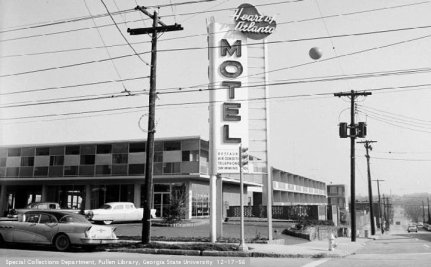
Heart of Atlanta Motel and civil rights

December 28, 2011

PG posted this photo in one of his collections at Chamblee54:

Heart of Atlanta Motel, 1956 - Special Collections and Archives,Georgia State University Library

Heart of Atlanta Motel, 1956 - Special Collections and Archives,Georgia State University Library

I wondered whether this is the motel in the case testing the 1964 Civil Rights Act — and sure enough, it is.  The case was decided, finally, by the U.S. Supreme Court in 1964, Heart of Atlanta Motel, Inc., v. United States, 379 U.S. 241 (1964) .

This important case represented an immediate challenge to the Civil Rights Act of 1964, the landmark piece of civil rights legislation which represented the first comprehensive act by Congress on civil rights and race relations since the Civil Rights Act of 1875. For much of the 100 years preceding 1964, race relations in the United States had been dominated by segregation, a system of racial separation which, while in name providing for “separate but equal” treatment of both white and black Americans, in truth perpetuated inferior accommodation, services, and treatment for black Americans.

During the mid-20th century, partly as a result of cases such as Powell v. Alabama, 287 U.S. 45 (1932); Smith v. Allwright, 321 U.S. 649 (1944); Shelley v. Kraemer, 334 U.S. 1 (1948); Sweatt v. Painter, 339 U.S. 629 (1950); McLaurin v. Oklahoma State Regents, 339 U.S. 637 (1950); NAACP v. Alabama, 357 U.S. 449 (1958); Boynton v. Virginia, 364 U.S. 454 (1960) and probably the most famous, Brown v. Board of Education of Topeka, 347 U.S. 483 (1954), the tide against segregation began to turn. However, segregation remained in full effect into the 1960s in parts of the southern United States, where the Heart of Atlanta Motel was located, despite these decisions.

The Atlanta Time Machine, a great collection of photos in the history of Atlanta and Georgia, has more photos, and this description of the site:

The Heart of Atlanta motel, located at 255 Courtland Street NE, was owned by Atlanta attorney Moreton Rolleston Jr.  Rolleston, a committed segregationist, refused to rent rooms at his hotel to black customers.  Upon passage of the Civil Rights Act of 1964, Rolleston immediately filed suit in federal court to assert that the law was the result of an overly broad interpretation of the U.S. Constitution’s commerce clause.  Rolleston represented himself in the case, HEART OF ATLANTA MOTEL, INC. v. UNITED STATES ET AL., which  went all the way to the United States Supreme Court.  Rolleston lost when the Supreme Court ruled that Congress was well within its powers to regulate interstate commerce in such a manner.  The Hilton Hotel now stands on the former site of the Heart of Atlanta Motel.

Texts in law school rarely have illustrations.  I know the motel mostly as a citation on pages of text, great grey oceans of somnambulent text.  This case is important in civil rights, though it is mentioned almost never in history texts.  What are these cases really about?  These photos offer us insight.

The Heart of Atlanta Motel aspired to greatness in the late 1950s and 1960s — evidenced by this publicity flyer photo from the Atlanta Time Machine; notice the flag flying for the motel’s Seahorse Lounge (Atlanta is landlocked):

Heart of Atlanta Motel publicity photo - Atlanta Time Machine

Heart of Atlanta Motel publicity photo - Atlanta Time Machine; not just a podunk "motor lodge," but a "resort motel." Click for larger image.

For the 1960s, this place offered great amenities, including two swimming pools and in-room breakfast service.

Flyer for the Heart of Atlanta Motel, circa 1960 - Atlanta Time Machine image

Flyer for the Heart of Atlanta Motel, circa 1960 - Atlanta Time Machine image

This photo is amusing — I can just imagine the difficulties of launching a motor boat of this size in one of the swimming pools, obviously for a publicity stunt.  The photo is dated February 27, 1960, in the Pullen Library Collection.

Boat in the pool at the Heart of Atlanta Motel, 1960 - Atlanta Time Machine image

Boat in the pool at the Heart of Atlanta Motel, 1960 - Atlanta Time Machine image

To compare how times have changed, you may want to look at this aerial photo of the area, including the Heart of Atlanta Hotel, and compare it with modern photos which show the Hilton Hotel that replaced the property.

Rolleston appears to have had a big ego.  As noted above, he represented himself in this case, and he argued it in the Supreme Court.  Here’s a picture from about that time, from the University of Missouri-Kansas City Law School “Famous Trials” site:

Moreton Rolleston, Jr., owner of the Heart of Atlanta Motel and the attorney who argued the case at the Supreme Court - UMKC Law School image

Moreton Rolleston, Jr., owner of the Heart of Atlanta Motel and the attorney who argued the case at the Supreme Court - UMKC Law School image; photo: Wayne Wilson/Leviton-Atlanta

You may decide for yourself whether this fits the old legal aphorism that a lawyer who represents himself in a case has a fool for a client.  The Oyez site at the University of Chicago provides access to the audio of the oral arguments.  Did Rolleston argue ably?  Rolleston argued against Archibald Cox, who went on to fame in the Watergate scandals.  This appears to have been Rolleston’s only appearance before the Supreme Court; it was Cox’s ninth appearance (he argued 20 cases before the Court in his career, several well known and notable ones).

Heart of Atlanta vs. United States was argued on October 5, 1964.  The opinion was issued on December 14, 1964, a 9-0 decision against Rolleston and segregation authored by Justice Tom C. Clark (one of Dallas’s earliest Eagle Scouts).

This was a fight Mr. Rolleston picked.  He was not cited nor indicted for violation of the Civil Rights Act, but instead asked for an injunction to prevent the law’s enforcement; according to the published decision,

Appellant, the owner of a large motel in Atlanta, Georgia, which restricts its clientele to white persons, three-fourths of whom are transient interstate travelers, sued for declaratory relief and to enjoin enforcement of the Civil Rights Act of 1964, contending that the prohibition of racial discrimination in places of public accommodation affecting commerce exceeded Congress’ powers under the Commerce Clause and violated other parts of the Constitution. A three-judge District Court upheld the constitutionality of Title II, §§ 201(a), (b)(1) and (c)(1), the provisions attacked, and, on appellees’ counterclaim, permanently enjoined appellant from refusing to accommodate Negro guests for racial reasons.

Oyez summarizes the case question:

Facts of the Case 

Title II of the Civil Rights Act of 1964 forbade racial discrimination by places of public accommodation if their operations affected commerce. The Heart of Atlanta Motel in Atlanta, Georgia, refused to accept Black Americans and was charged with violating Title II.

Question 

Did Congress, in passing Title II of the 1964 Civil Rights Act, exceed its Commerce Clause powers by depriving motels, such as the Heart of Atlanta, of the right to choose their own customers?

The decision turned on the commerce clause, and the reach of Congressional power to regulate interstate commerce.

Decision: 9 votes for U.S., 0 vote(s) against
Legal provision: Civil Rights Act of 1964, Title II

The Court held that the Commerce Clause allowed Congress to regulate local incidents of commerce, and that the Civil Right Act of 1964 passed constitutional muster. The Court noted that the applicability of Title II was “carefully limited to enterprises having a direct and substantial relation to the interstate flow of goods and people. . .” The Court thus concluded that places of public accommodation had no “right” to select guests as they saw fit, free from governmental regulation.

Good decision.

Heart of Atlanta Motel is gone.  The site is occupied by the Hilton Atlanta, today.


Washington crossing the Delaware – a slightly different view

December 26, 2011

Past in the Present has this wonderful, terse post up:

It’s the most wonderful time of the year

Unless you’re a Hessian.

Passage of the Delaware, by Thomas Sully (1819). Now in the Boston Museum of Fine Arts.

Passage of the Delaware, by Thomas Sully (1819). Now in the Boston Museum of Fine Arts.

  1. Hessian?  Do my students know what he’s talking about?
  2. What is the other famous painting of this event?
  3. Considering how famous that other painting is, isn’t it almost tragic this one isn’t more famous?
  4. Considering #3, how many other great paintings of U.S. history sit in museums, or in government buildings, waiting to be discovered?  Maybe bloggers could help, by finding those paintings, photographing them, and posting the photographs.

More:


How do we know? Who invented Santa Claus? Who really wrote “Account of a Visit from St. Nicholas?”

December 22, 2011

The annual retelling, a Christmas tradition; an encore post from 2007

Thomas Nast invented Santa Claus? Clement C. Moore didn’t write the famous poem that starts out, “‘Twas the night before Christmas, and all through the house . . . ?”

The murky waters of history from Millard Fillmore’s Bathtub soak even our most cherished ideas and traditions.

But isn’t that part of the fun of history?

Santa Claus delivers to Union soldiers, "Santa Claus in Camp" - Thomas Nast, Harper's Weekly, Jan 3, 1863

Thomas Nast’s first published drawing featuring Santa Claus; for Harper’s Weekly, “A Journal of Civilization,” January 3, 1863 Nast portrayed the elf distributing packages to Union troops: “Santa Claus in camp.” Nast (1840-1904) was 23 when he drew this image.

Yes, Virginia (and California, too)! Thomas Nast created the image of Santa Claus most of us in the U.S. know today. Perhaps even more significant than his campaign against the graft of Boss Tweed, Nast’s popularization of a fat, jolly elf who delivers good things to people for Christmas makes one of the great stories in commercial illustration. Nast’s cartoons, mostly for the popular news publication Harper’s Weekly, created many of the conventions of modern political cartooning and modeled the way in which an illustrator could campaign for good, with his campaign against the graft of Tammany Hall and Tweed. But Nast’s popular vision of Santa Claus can be said to be the foundation for the modern mercantile flurry around Christmas.

Nast is probably ensconced in a cartoonists’ hall of fame. Perhaps he should be in a business or sales hall of fame, too. [See also Bill Casselman’s page, “The Man Who Designed Santa Claus.]

Nast’s drawings probably drew some inspiration from the poem, “Account of a Visit from St. Nicholas,” traditionally attributed to Clement C. Moore, a New York City lawyer, published in 1822. The poem is among the earliest to describe the elf dressed in fur, and magically coming down a chimney to leave toys for children; the poem invented the reindeer-pulled sleigh.

Modern analysis suggests the poem was not the work of Moore, and many critics and historians now attribute it to Major Henry Livingston, Jr. (1748-1828) following sleuthing by Vassar College Prof. Don Foster in 2000. Fortunately for us, we do not need to be partisans in such a query to enjoy the poem (a complete copy of which is below the fold).

The Library of Congress still gives Moore the credit. When disputes arise over who wrote about the night before Christmas, is it any wonder more controversial topics produce bigger and louder disputes among historians?

Moore was not known for being a poet. The popular story is that he wrote it on the spur of the moment:

Moore is thought to have composed the tale, now popularly known as “The Night Before Christmas,” on December 24, 1822, while traveling home from Greenwich Village, where he had bought a turkey for his family’s Christmas dinner.

Inspired by the plump, bearded Dutchman who took him by sleigh on his errand through the snow-covered streets of New York City, Moore penned A Visit from St. Nicholas for the amusement of his six children, with whom he shared the poem that evening. His vision of St. Nicholas draws upon Dutch-American and Norwegian traditions of a magical, gift-giving figure who appears at Christmas time, as well as the German legend of a visitor who enters homes through chimneys.

Again from the Library of Congress, we get information that suggests that Moore was a minor celebrity from a well-known family with historical ties that would make a good “connections” exercise in a high school history class, perhaps (”the link from Aaron Burr’s treason to Santa Claus?”): (read more, below the fold)

Clement Moore was born in 1779 into a prominent New York family. His father, Benjamin Moore, president of Columbia University, in his role as Episcopal Bishop of New York participated in the inauguration of George Washington as the nation’s first president. The elder Moore also administered last rites to Alexander Hamilton after he was mortally wounded in a tragic duel with Aaron Burr.

A graduate of Columbia, Clement Moore was a scholar of Hebrew and a professor of Oriental and Greek literature at the General Theological Seminary in Manhattan. [See comment from Pam Bumsted below for more on Moore.] He is said to have been embarrassed by the light-hearted verse, which was made public without his knowledge in December 1823. Moore did not publish it under his name until 1844.

Tonight, American children will be tucked in under their blankets and quilts and read this beloved poem as a last “sugarplum” before slipping into dreamland. Before they drift off, treat them to a message from Santa, recorded by the Thomas Edison Company in 1922.

Santa Claus Hides in Your Phonograph
By Arthur A. Penn, Performed by Harry E. Humphrey.
Edison, 1922.
Coupling date: 6/20/1922. Cutout date: 10/31/1929.
Inventing Entertainment: The Motion Pictures and Sound Recordings of the Edison Companies

Listen to this recording (RealAudio Format)

Listen to this recording (wav Format, 8,471 Kb)

But Henry Livingston was no less noble or historic. He hailed from the Livingtons of the Hudson Valley (one of whose farms is now occupied by Camp Rising Sun of the Louis August Jonas Foundation, a place where I spent four amazing summers teaching swimming and lifesaving). Livingston’s biography at the University of Toronto site offers another path for a connections exercise (”What connects the Declaration of Independence, the American invasion of Canada, the famous poem about a visit from St. Nick, and George W. Bush?”):

Henry Livingston Jr. was born in Poughkeepsie, New York, on Oct. 13, 1748. The Livingston family was one of the important colonial and revolutionary families of New York. The Poughkeepsie branch, descended from Gilbert, the youngest son of Robert Livingston, 1st Lord of Livingston Manor, was not as well off as the more well-known branches, descended from sons Robert and Philip. Two other descendants of Gilbert Livingston, President George Walker Herbert Bush and his son, President-Elect George W. Bush, though, have done their share to bring attention to this line. Henry’s brother, Rev. John Henry Livingston, entered Yale at the age of 12, and was able to unite the Dutch and American branches of the Dutch Reformed Church. At the time of his death, Rev. Livingston was president of Rutgers University. Henry’s father and brother Gilbert were involved in New York politics, and Henry’s granduncle was New York’s first Lt. Governor. But the law was the natural home for many of Henry’s family. His brother-in-law, Judge Jonas Platt, was an unsuccessful candidate for governor, as was his daughter Elizabeth’s husband, U.S. Supreme Court Justice Smith Thompson. Henry’s grandson, Sidney Breese, was Chief Justice of the Illinois Supreme Court.

Known for his encyclopedic knowledge and his love of literature, Henry Livingston was a farmer, surveyor and Justice of the Peace, a judicial position dealing with financially limited criminal and civil cases. One of the first New Yorkers to enlist in the Revolutionary Army in 1775, Major Henry Livingston accompanied his cousin’s husband, General Montgomery, in his campaign up the Hudson River to invade Canada, leaving behind his new wife, Sarah Welles, and their week-old baby, on his Poughkeepsie property, Locust Grove. Baby Catherine was the subject of the first poem currently known by Major Livingston. Following this campaign, Livingston was involved in the War as a Commissioner of Sequestration, appropriating lands owned by British loyalists and selling them for the revolutionary cause. It was in the period following Sarah’s early death in 1783, that Major Livingston published most of his poems and prose, anonymously or under the pseudonym of R. Ten years after the death of Sarah, Henry married Jane Patterson, the daughter of a Dutchess County politician and sister of his next-door neighbor. Between both wives, Henry fathered twelve children. He published his good-natured, often occasional verse from 1787 in many journals, including Political Barometer, Poughkeepsie Journal, and New-York Magazine. His most famous poem, “Account of a Visit from St. Nicholas,” was until 2000 thought to have been the work of Clement Clarke Moore (1779-1863), who published it with his collected poems in 1844. Livingston died Feb. 29, 1828.

More on Henry Livingston and his authorship of the Christmas poem here.
Thomas Nast, Merry Old Santa Claus, Harper's Weekly, Jan 1, 1881

Our views of Santa Claus owe a great deal also to the Coca-Cola advertising campaign. Coca-Cola first noted Santa’s use of the drink in a 1922 campaign to suggest Coke was a year-round drink (100 years after the publication of Livingston’s poem). The company’s on-line archives gives details:

In 1930, artist Fred Mizen painted a department store Santa in a crowd drinking a bottle of Coke. The ad featured the world’s largest soda fountain, which was located in the department store of Famous Barr Co. in St. Louis, Mo. Mizen’s painting was used in print ads that Christmas season, appearing in The Saturday Evening Post in December 1930.

1936 Coca-Cola Santa cardboard store display

1936 Coca-Cola Santa cardboard store display

  • 1936 Coca-Cola Santa cardboard store display
1942 original oil painting - 'They Remembered Me'

1942 original oil painting - ‘They Remembered Me’

Archie Lee, the D’Arcy Advertising Agency executive working with The Coca-Cola Company, wanted the next campaign to show a wholesome Santa as both realistic and symbolic. In 1931, The Coca-Cola Company commissioned Michigan-born illustrator Haddon Sundblom to develop advertising images using Santa Claus — showing Santa himself, not a man dressed as Santa, as Mizen’s work had portrayed him.

  • 1942 original oil painting – ‘They Remembered Me’

For inspiration, Sundblom turned to Clement Clark Moore’s 1822 poem “A Visit From St. Nicholas” (commonly called “‘Twas the Night Before Christmas”). Moore’s description of St. Nick led to an image of Santa that was warm, friendly, pleasantly plump and human. For the next 33 years, Sundblom painted portraits of Santa that helped to create the modern image of Santa — an interpretation that today lives on in the minds of people of all ages, all over the world.

Santa Claus is a controversial figure. Debates still rage among parents about the wisdom of allowing the elf into the family’s home, and under what conditions. Theologians worry that the celebration of Christmas is diluted by the imagery. Other faiths worry that the secular, cultural impact of Santa Claus damages their own faiths (few other faiths have such a popular figure, and even atheists generally give gifts and participate in Christmas rituals such as putting up a decorated tree).

For over 100 years, Santa Claus has been a popular part of commercial, cultural and religious life in America. Has any other icon endured so long, or so well?

________________________
Below:
From the University of Toronto Library’s Representative Poetry Online

Major Henry Livingston, Jr. (1748-1828)

Account of a Visit from St. Nicholas

1 ‘Twas the night before Christmas, when all thro’ the house,
2 Not a creature was stirring, not even a mouse;
3 The stockings were hung by the chimney with care,
4 In hopes that St. Nicholas soon would be there;
5 The children were nestled all snug in their beds,
6 While visions of sugar plums danc’d in their heads,
7 And Mama in her ‘kerchief, and I in my cap,
8 Had just settled our brains for a long winter’s nap –
9 When out on the lawn there arose such a clatter,
10 I sprang from the bed to see what was the matter.
11 Away to the window I flew like a flash,
12 Tore open the shutters, and threw up the sash.
13 The moon on the breast of the new fallen snow,
14 Gave the lustre of mid-day to objects below;
15 When, what to my wondering eyes should appear,
16 But a miniature sleigh, and eight tiny rein-deer,
17 With a little old driver, so lively and quick,
18 I knew in a moment it must be St. Nick.
19 More rapid than eagles his coursers they came,
20 And he whistled, and shouted, and call’d them by name:
21 “Now! Dasher, now! Dancer, now! Prancer, and Vixen,
22 “On! Comet, on! Cupid, on! Dunder and Blixem;
23 “To the top of the porch! to the top of the wall!
24 “Now dash away! dash away! dash away all!”
25 As dry leaves before the wild hurricane fly,
26 When they meet with an obstacle, mount to the sky;
27 So up to the house-top the coursers they flew,
28 With the sleigh full of Toys — and St. Nicholas too:
29 And then in a twinkling, I heard on the roof
30 The prancing and pawing of each little hoof.
31 As I drew in my head, and was turning around,
32 Down the chimney St. Nicholas came with a bound:
33 He was dress’d all in fur, from his head to his foot,
34 And his clothes were all tarnish’d with ashes and soot;
35 A bundle of toys was flung on his back,
36 And he look’d like a peddler just opening his pack:
37 His eyes — how they twinkled! his dimples how merry,
38 His cheeks were like roses, his nose like a cherry;
39 His droll little mouth was drawn up like a bow.
40 And the beard of his chin was as white as the snow;
41 The stump of a pipe he held tight in his teeth,
42 And the smoke it encircled his head like a wreath.
43 He had a broad face, and a little round belly
44 That shook when he laugh’d, like a bowl full of jelly:
45 He was chubby and plump, a right jolly old elf,
46 And I laugh’d when I saw him in spite of myself;
47 A wink of his eye and a twist of his head
48 Soon gave me to know I had nothing to dread.
49 He spoke not a word, but went straight to his work,
50 And fill’d all the stockings; then turn’d with a jerk,
51 And laying his finger aside of his nose
52 And giving a nod, up the chimney he rose.
53 He sprung to his sleigh, to his team gave a whistle,
54 And away they all flew, like the down of a thistle:
55 But I heard him exclaim, ere he drove out of sight –
56 Happy Christmas to all, and to all a good night.

Online text copyright © 2005, Ian Lancashire for the Department of English, University of Toronto. Published by the Web Development Group, Information Technology Services, University of Toronto Libraries. Be sure to visit this site for more information on this poem, on Maj. Livingston, and on poetry in general.

Nota bene: By no means should readers assume that I’m saying the authorship of “A Visit from St. Nicholas” is settled. There remains much controversy, and many people convinced that Moore was, indeed, the author. See this comment from an earlier posting, for example.


Hope for history to repeat itself in 2012 – Berryman cartoon on Congress

November 21, 2011

Caption from the National Archives, where this cartoon resides:

Clifford Berryman cartoon from 1912, "Congress will come to order!"  National Archives

Clifford Berryman cartoon from 1912, "Congress will come to order!" National Archives

“Congress Will Come To Order!”
by Clifford K. Berryman
Washington Evening Star, December 2, 1912
From the US Senate Collection, Center for Legislative Archives

The ultimate prize of a congressional election is control over the two houses of Congress: the U.S. House of Representatives and the U.S. Senate. This cartoon shows Congress following the pivotal 1912 elections when the Democrats swept into power and captured majorities both houses.

Some might hope that this history repeats.


American Education Week, November 7-13 (1943) – locked up in Manzanar

November 8, 2011

Education Week poster at Manzanar War Relocation Center, 1943 - Ansel Adams, Library of Congress

"A woman prepares a sign promoting American Education Week by attaching it to the wall of the Education Department office." Photo by Ansel Adams, 1943, at Manzanar War Relocation Center - Library of Congress collections

Just an ironic blast from the past, an Ansel Adams photograph of an interned American citizen of Japanese descent, putting up a poster celebrating “American Education Week,” at the Manzanar War Relocation Center, California.  Photo details:

  • Title: Education week sign / photograph by Ansel Adams.
  • Creator(s): Adams, Ansel, 1902-1984, photographer
  • Date Created/Published: [1943]
  • Medium: 1 photographic print : gelatin silver.
    1 negative : nitrate.
  • Summary: A woman prepares a sign promoting American Education Week by attaching it to the wall of the Education Department office.
  • Reproduction Number: LC-DIG-ppprs-00417 (b&w digital file from original print) LC-DIG-ppprs-00158 (b&w digital file from original neg.) LC-A35-T01-6-M-6 (b&w film dup. neg.)
  • Rights Advisory: No known restrictions on publication.
  • Call Number: LOT 10479-7, no. 20 [P&P]
  • Repository: Library of Congress Prints and Photographs Division Washington, D.C. 20540 USA
  • Notes:
    • Title transcribed from Ansel Adams’ caption on verso of print.
    • Original neg. no.: LC-A35-6-M-6.
    • Gift; Ansel Adams; 1965-1968.
    • Forms part of: Manzanar War Relocation Center photographs.

A cure for the ills caused by air pollution: Vitamin D in milk

October 29, 2011

Air pollution texts often made the note, but I’ve not seen it talked about much recently:  Air pollution in the U.S. (and England) was so bad in the first years of the 20th century that it actually shut out the sun, and an epidemic of rickets followed.

FSA photo of child in Jefferson, Texas, with rickets - Library of Congress

Child with rickets, son of relief client near Jefferson, Texas. This child has never talked though he is two years old. He has never received any medical attention. Lee, Russell, 1903-1986, photographer. CREATED/PUBLISHED 1939 Mar. More information about the FSA/OWI Collection is available at http://hdl.loc.gov/loc.pnp/pp.fsaowi; CALL NUMBER LC-USF34- 032719-D REPRODUCTION NUMBER LC-USF34-032719-D DLC (b&w film neg.)

Public health officials, clever devils, discovered a form of vitamin D that prevented rickets.  It turns out that humans manufacture vitamin D from cholesterol, using ultraviolet B from the sun.  So, when the sun was smokily eclipsed, rickets proliferated.

In an era when technical and legal tools were inadequate to clean up the air pollution, physicians, nutritionists and researchers struck on the idea of supplementing food with vitamin D — and that is how we come to have vitamin D-fortified milk today, and a lot less rickets.

I was happy to find a publication at the National Institutes of Health that relates this history, at least in part, “Solar Ultraviolet Radiation and Vitamin D:  A Historical Perspective,” by Kumaravel Rajakumar, MD, Susan L. Greenspan, MD, Stephen B. Thomas, PhD, and Michael F. Holick, MD, PhD, in American Journal of Public Health, October 2007, Vol 97, No. 10.

At the dawn of the 20th century, the expansive industrialization and urban migration in the major cities of western Europe and the northern United States set the stage for the high prevalence of rickets among infants residing in those polluted and “sunless” cities. Overcrowded living conditions in the big-city slums and tenements and the sunlight deprivation precipitated by atmospheric pollution from smoke and smog were responsible for a rickets epidemic.  Increased ozone concentration from industrial pollution and the haze and clouds from atmospheric pollution compromise vitamin D production by absorbing the UV-B photons essential for its synthesis.

*          *          *          *          *

Edwards Park states, “But for rickets vitamin D would not have been discovered. Its discovery was the secret to rickets; its use is essentially the therapy of that disease.” The discovery of vitamin D led to the eradication of the epidemic rickets of the early 20th century. Pioneering advances were made in the understanding of vitamin D and rickets from 1915 to 1935. The discovery of the synthesis of vitamin D by the irradiation of foods was the “jewel in the crown” of vitamin D discoveries. This discovery was a catalyst for the public health triumph against rickets. It became feasible to fortify and enrich milk and other foods with vitamin D to ensure that the general population was likely to consume sufficient vitamin D.

It’s a good article with detailed history of rickets, the search to find what turned out to be vitamin D, and the use of nutritional supplements to eradicate a nasty, crippling disease in children.  Happy to see it online.

Some of our greatest triumphs in science, technology and public health are too little known.  I am working on the history of technology and science, and particularly its wedding with social progressivism in the Progressive Age, part of a project I was fortunate to stumble into in the Dallas Independent School District funded by a Teaching American History Grant from the U.S. Department of Education.  Sadly, Republicans in Congress insisted on cutting those grants to improve teaching with greater emphasis on original sources and original documents.

More Americans, more American school kids, should know about the triumphs of public health and science.  Maybe highlighting some of those advances here can help another teacher somewhere else.


A turn of the page of history: “When will Arabs awaken?”

October 22, 2011

I just stumbled across this photograph, taken in October 2010, in Sirte, Libya, at the opening of the “Second Arab-African Summit.”

2nd Arab-African Summit, Sirte, Libya, October 2010

2nd Arab-African Summit, Sirte, Libya, October 2010

One source identifies this as an Associated Press photo (can I claim fair use here for the purposes of history discussion?).

I cannot identify all the leaders of nations in this picture, but there, on the front row we see what are the ghosts of history — at least, they are ghosts from our vantage point in October 2011, just one year later.

On the far left of the first row in the photo smiles Tunisian President Zine el-Abidine Ben Ali, now resigned and fled the nation in the first big event of the sweeping broom of freedom we now call Arab Spring; next to him, Yemeni President Ali Abdullah Saleh, who today barely clings to power trying to negotiate his own departure after eight months of protests in his nation.  Dominating the center, in his flamboyant robes, Libyan leader Muammar Gaddafi, killed yesterday in the civil war that brought down his 42-years of despotic government a few weeks earlier.  Gaddafi’s leaning post is now-ousted-and-on-trial Egyptian President Hosni Mubarak.

Syria’s Bashar al Assad is happy he was not in the center of this group, and hopes that’s a good omen for him — though Assad did attend this event.

Syria President Bashar Al Assad at Sirte, Libya, African Arab Summit, October 10, 2010

Syria President Bashar Al Assad at Sirte, Libya, African Arab Summit, October 10, 2010 – photo by Kaled Desouki, via PRI

This historic photo above appeared as an illustration to an article by an Arab sociologist bemoaning the dwindling hopes of change in the Arab world, and asking the question:  “When will Arabs awaken?”  Dr. Mohammad Abdullah Al Mutawa’s article sounds prophetic, now.

When will the pages of history turn?  Soon, perhaps, and when we least expect it and when some have lost hope they will turn at all.

Can you help identify others in the photo?  Surely there are other photos from this meeting in Sirte, Libya.  What do they show?

More: