This might be a better topic for another blog I have in early creation stages — except that the difficulties with the anti-science program broadcast this weekend by D. James Kennedy’s Coral Ridge Ministries are exactly the same difficulties the same group has with history, and the concerns about revising history textbooks and history classes — to make them inaccurate and militantly polemic — also come from the same groups. The history errors alone in Kennedy’s program justify discussing it here. Read the rest of this entry »
D. James Kennedy’s killer legacy
August 27, 2006
 2 Comments |
  Bogus history, Charles Darwin, Creationism, Education, Evolution, History Revisionism, Hoaxes, Holocaust, Holocaust denial, Intelligent Design, Science, Science and faith, Voodoo history | Tagged: Bogus history, Charles Darwin, Creationism, D. James Kennedy, Educaiton, Evolution, History Revisionism, Hoaxes, Holocaust, Holocaust denial, Intelligent Design, Science, Science and Faith, Voodoo history |
  Permalink
 Posted by Ed Darrell
Misquoting Lincoln to support Bush
August 26, 2006Carpus at Aspirations of a Post Doc fisks a quote making the rounds that has Abraham Lincoln claiming dissent is close to treason. Go read his post. Turns out the quote was manufactured, partly in error, in 2003. Carpus points to the FactCheck.org report for a source.
Lincoln never said it. Lincoln did little to stifle dissent.
In fact, Lincoln’s management style as president was based on bringing people with dissenting views into his cabinet. Doris Kearns Goodwin’s latest book, Team of Rivals, strongly suggests that forging good policies from great dissent was a particular genius of Lincoln.
George W. could learn a lot from Abe, Carpus concludes — with astounding understatement.
2 Comments | Abraham Lincoln, Accuracy, Bad Quotes, Bogus history, Current History, History Revisionism | Permalink
Posted by Ed Darrell
Darwin-to-Hitler claims rebutted
August 24, 2006Controversy still simmers over the pending broadcast from Coral Ridge Ministries (CRM) of a program that claims links from evolution theory to the Holocaust. Apart from being incredibly simplistic historically, the claims raise the ire of scientists and biologists who say CRM gets most of the science and the history of the science wrong.
Rev. D. James Kennedy’s program is titled “Fatal Fruit.” Alas, it appears to contain many fatal flaws of history.
Several bloggers raised issues of accuracy in the past week, and especially after Dr. Francis Collins complained about the use of an interview he granted on such a cause (which he claims to be specious), Coral Ridge Ministries changed its promotional material, deleting references to Collins and to Ann Coulter, whose recent book deals in anti-Darwin disinformation. In response, CRM trotted out historian Richard Weikart, a fellow at the anti-Darwin Discovery Institute in Seattle, whose recent book was titled From Darwin to Hitler.
Ed Brayton notes difficulties with Weikart’s thesis, and the fact that most historians disagree with Weikart and CRM, in a post at Dispatches from the Culture Wars.
I am struck by the irony of CRM’s demonization of science and Darwin, in a program complaining about the effects of Hitler’s rise to power and his use of such demonization tactics against Jews, Gypsies, Africans, Arabs and others.
You may wish to look at my earlier post, with links to other stories.
4 Comments | Accuracy, Bogus history, Creationism, History Revisionism, Holocaust, Holocaust denial, Intelligent Design, Science, Voodoo history | Permalink
Posted by Ed Darrell
Twisting history still: D. James Kennedy
August 23, 2006Voodoo history just will not die.
Several years ago I caught the tail end of a television program featuring the Rev. D. James Kennedy railing against evolution and especially Charles Darwin. What caught my aural attention was a rant claiming that Darwin somehow bore responsibility for Stalin’s manifold evils perpetrated in the old Soviet Union.
That is bogus history of the first order, of course. Stalin banned the teaching of evolution, and he banned research even based on evolution.
Soviet genetics, top of the world in the early 1920s, was set back decades (and still has not recovered). Some top scientists were fired; some were imprisoned; some were sent to Siberia in hopes they would die (and some did); a few disappeared, perhaps after being shot. Soviet anti-Darwinian science contributed to the massive crop failures of the 1950s that led to the starvation of more than 4 million people. Claiming that Stalin loved Darwinian theory is bad history revisionism of first order. (If you’re Googling, look for the story of Trofim Lysenko, Stalin’s henchman against biology.)
Kennedy is at it again. The past couple of weeks have featured new rants against Darwin, leading up to a promised climax this weekend in which Kennedy will claim Darwin was responsible for Hitler and Nazi atrocities — again a fantastic claim, since Hitler directly repudiated Darwin, never expressed support for the idea of evolution, and since anti-Darwin quackery led to any number of stupid science moves in Nazi Germany, such as a ban on blood banks for fear that soldiers would get Jewish blood and turn Jewish (no, you can’t make that stuff up — see Ashley Montague’s essay in his 1959 book, Human Genetics).
Unfortunately for Kennedy and his Coral Ridge Ministries (CRM), his advance flackery got the attention of biologists like P. Z. Myers and others, like the Jewish Anti-Defamation League.
There is much bogus history to deal with there, and so little time. Check out the links. More to come from here, I hope.
2 Comments | Bogus history, Creationism, Evolution, History Revisionism, Hoaxes, Holocaust, Holocaust denial, Intelligent Design, Plagiarism, Religious Freedom, Voodoo history | Permalink
Posted by Ed Darrell
Twisting recent history (creationism), 2
August 11, 2006RECAP: It’s only nine months since Judge John Jones’ extremely well-reasoned and carefully-written decision in Kitzmiller vs. Dover Area School District, which declared unconstitutional the efforts by the school board in Dover, Pennsylvania, to sneak creationism into their schools’ biology curriculum. But the revisionists are out in force. On August 8, Joe Carter at Evangelical Outpost posted “10 ways Darwinists help intelligent design,” in extreme length.
Other people were bothered by the post, too. I see that Matt over at Pooflingers fisked the thing, too. I haven’t read his post yet — his is no doubt more incisive than what I’ve written below. But can there be too much taking to task those who would sacrifice our children’s education on a cross of hooey?
You can go read the entire thing at Evangelical Outpost if you want. I’ll post the list of ten, with corrections. History revisionism is an ugly thing, especially when the court decision is still fresh, available and an easy and educational read, and especially on things scientific, where one’s errors may be easier to spot. In keeping with the ethical standards ofthisblog, to expose hoaxes about bathtubs wherever they may appear, here goes;
Part 2: Joe Carter posted his list of ten things scientists do wrong; Part 1 covered the first five, here are numbers 6 through 10:
#6 By invoking design in non-design explanations. Anyone who wonders why so many people find intelligent design explanations plausible need only to listen to scientific community discuss the evolutionary process. Scientists have a complete inability to talk about and explain processes like natural selection without using the terms, analogies, and metaphors of design and teleology.
Take, for instance, the recent finding that leads researchers to believe they have found a second code in DNA in addition to the genetic code. On The New York Times science page we find an explanation by Eran Segal of the Weizmann Institute in Israel:
“A curious feature of the code is that it is redundant, meaning that a given amino acid can be defined by any of several different triplets. Biologists have long speculated that the redundancy may have been designed so as to coexist with some other kind of code, and this, Dr. Segal said, could be the nucleosome code.” [emphasis added]
No! No! No! Scientists note the appearance of design, but scientists go the extra mile; they go on to look for natural explanations for such appearances. Most often they have found a perfectly natural explanation that involves fitness for survival, sexual selection, or chemical and physical necessity, and they have found no intervention outside the critters’ struggle for survival. Read the rest of this entry »
6 Comments | Accuracy, Creationism, Current History, Education, Evolution, History Revisionism, Public education | Permalink
Posted by Ed Darrell
Twisting recent history (creationism), 1
August 10, 2006It’s only nine months since Judge John Jones’ extremely well-reasoned and carefully-written decision in Kitzmiller vs. Dover Area School District, which declared unconstitutional the efforts by the school board in Dover, Pennsylvania, to sneak creationism into their schools’ biology curriculum. But the revisionists are out in force. On August 8, Joe Carter at Evangelical Outpost posted “10 ways Darwinists help intelligent design,” in extreme length.
Other people were bothered by the post, too. I see that Matt over at Pooflingers fisked the thing, too. I haven’t read his post yet — his is no doubt more incisive than what I’ve written below. But can there be too much taking to task those who would sacrifice our children’s education on a cross of hooey? Read the rest of this entry »
3 Comments | Accuracy, Bad Quotes, Bogus history, Creationism, Current History, Ethics, Evolution, History Revisionism, Hoaxes, Religious Freedom | Permalink
Posted by Ed Darrell
U.S. history required – in college?
August 5, 2006Third or fourth time is the charm, right?
In Arizona, where the legislature recently decreed a U.S. flag and a copy of the Constitution and Bill of Rights will be displayed in all college classrooms, the debate now turns to whether the legislature should require the study of U.S. history by undergraduates. I appears the legislators do not find college kids have enough appreciation for our nation’s history.
I’ll reproduce the entire story out of the Arizona Republic below the fold (Dan Quayle’s family’s newspaper!).
Is it just me, or is it that these pseudo-patriots who don’t think our kids are well-enough indoctrinated always stamp the life out of history when they start these tirades? I have yet to find a law that mandates that history be interesting. Instead we get standards that provide great, boring, history-crushing, mind-and-butt-numbing lists. In short, these requirements tend to make history not worth the study.
And, as with those who celebrate Fillmore’s bringing the bathtub to the White House, the advocates almost always get history wrong. [Millard Fillmore himself, never attended college; he apprenticed first in the cloth business, and then in law.]
Barry Goldwater will be coming out of his grave to stop this silliness. Maybe literally. If such standards don’t make high school students history literate, what makes anyone think the failed methods would work on college students? If the standards do work to make high school kids knowledgeable in history, why would the college standards be necessary?
This controversy smells. It has the earmarks of being one more way to issue diatribes against “librul college professors.” It’s one more way of flogging public education, while refusing to give educators the tools to solve the problems.
Article below the fold; please comment. Read the rest of this entry »
2 Comments | America's founding, Bill of Rights, Curricula, Education, Flag etiquette, History, History Revisionism, U.S. Constitution | Permalink
Posted by Ed Darrell
Recognizing bogus history, 1
August 1, 2006Robert Park provides a short e-mail newsletter every Friday, covering news in the world of physics. It’s called “What’s New.” Park makes an art of smoking out bogus science and frauds people try to perpetrate in the name of science, or for money. He wrote an opinion column for the Chronicle of Higher Education published January 31, 2003, in which he listed the “7 warning signs of bogus science.”
Please go read Park’s entire essay, it’s good.
And it got me thinking about whether there are similar warning signs for bogus history? Are there clues that a biography of Howard Hughes is false that should pop out at any disinterested observer? Are there clues that the claimed quote from James Madison saying the U.S. government is founded on the Ten Commandments is pure buncombe? Should Oliver Stone have been able to to more readily separate fact from fantasy about the Kennedy assassination (assuming he wasn’t just going for the dramatic elements)? Can we generalize for such hoaxes, to inoculate ourselves and our history texts against error?
Perhaps some of the detection methods Park suggests would work for history. He wrote his opinion piece after the Supreme Court’s decision in Daubert v. Merrell Dow Pharmaceuticals, Inc., in which the Court laid out some rules lower courts should use to smoke out and eliminate false science. As Park described it, “The case involved Bendectin, the only morning-sickness medication ever approved by the Food and Drug Administration. It had been used by millions of women, and more than 30 published studies had found no evidence that it caused birth defects. Yet eight so-called experts were willing to testify, in exchange for a fee from the Daubert family, that Bendectin might indeed cause birth defects.” The Court said lower courts must act as gatekeepers against science buncombe — a difficult task for some judges who, in their training as attorneys, often spent little time studying science.
Some of the Daubert reasoning surfaced in another case recently, the opinion in Pennsylvania district federal court in which Federal District Judge John Jones struck down a school board’s order that intelligent design be introduced to high school biology students, Kitzmiller v. Dover Area School District.
Can we generalize to history, too? I’m going to try, below the fold. Read the rest of this entry »
4 Comments | Accuracy, Bad Quotes, Bogus history, History Revisionism, Religious Freedom, Voodoo history | Permalink
Posted by Ed Darrell
Bartonizing Jefferson
July 30, 2006Dictionaries of the future will feature “bartonizing,” after Texas mathematics teacher David Barton, with a reference to “bowdlerization.” Ed Brayton at Dispatches from the Culture Wars details a recent flurry of correcting a Barton misapprehension of history about one of Thomas Jefferson’s studies of the gospels, which resulted in a book called The Jefferson Bible.
The issue is a strange claim by Barton, repeated by Dr. D. James Kennedy at Coral Gables Ministries, that Jefferson wrote the thing in an attempt to convert Indians to Christianity. Students of Jefferson immediately recognize that claim as contrary to Jefferson’s character on several fronts.
The discussion is enlightened and enlightening; I noted the similar claim that Jefferson built a church and hired a priest for the Kaskaskias (in Illinois), with federal funds, is similarly in error. The fight against revisionist history — revising history to add errors — continues.
(One current edition of the Jefferson Bible on sale at Monticello features a forward by Rev. F. Forrester Church, minister at senior minister of the Unitarian Church of All Souls in New York City; that must frost Kennedy and Barton.)
Leave a Comment » | Accuracy, Bad Quotes, History Revisionism, Religious Freedom, Thomas Jefferson | Permalink
Posted by Ed Darrell
Mayflower catechism, no.
July 26, 2006Dispatches from the Culture Wars features a set of comments on an interview right-right-wing pundit John Lofton did with Roy Moore, the former chief justice of Alabama’s Supreme Court who lost his job when he illegally tried to force his religion on the court and on Alabama. This year Moore ran for governor of Alabama, losing in the primary election.
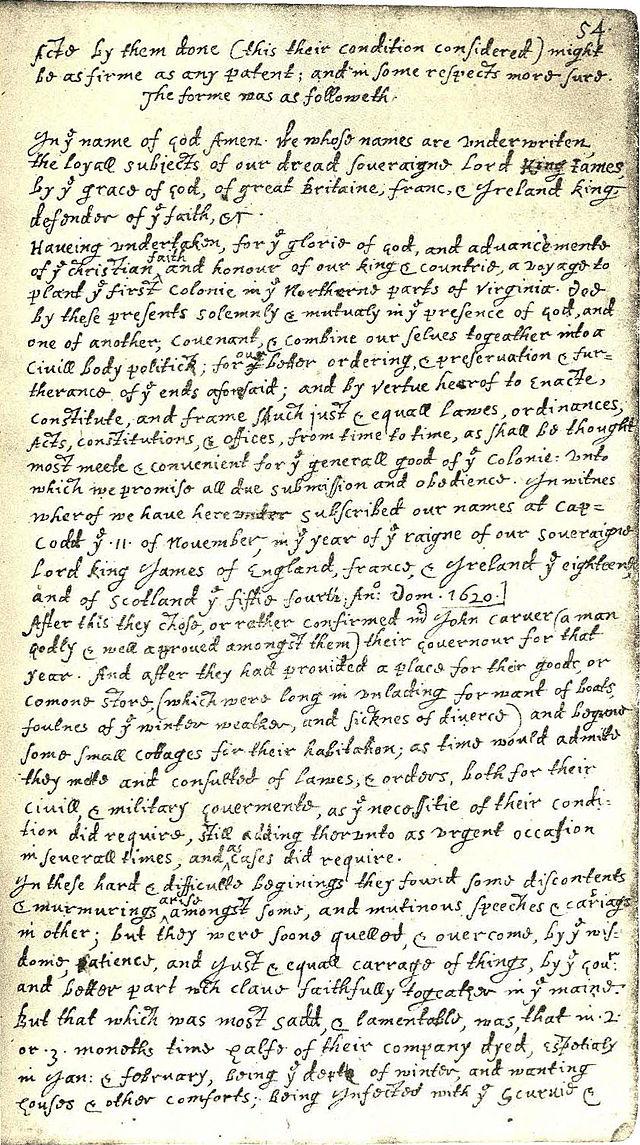
Mayflower Compact. It’s a contract between people. God is a witness, but not a party.
One of the grandest canards in current thought about U.S. history is that the Mayflower Compact set up a theocracy in Massachusetts. Lofton and Moore banter about it as if it were well established fact — or as if, as I suspect, neither of them has looked at the thing in a long time, and that neither of them has ever diagrammed the operative sentence in the thing.
The Mayflower Compact was an agreement between the people in two religiously disparate groups, that among them they would fairly establish a governing body to fairly make laws, and that they would abide by those laws. Quite the opposite of a theocracy, this was the first time Europeans set up in the New World a government by consent of the governed. That is something quite different from a theocracy. Read the rest of this entry »
4 Comments | America's founding, History Revisionism, Religious Freedom, U.S. Constitution | Permalink
Posted by Ed Darrell
Textbook fight in Texas:Watch carefully!
July 17, 2006Texas textbooks suffer from political wrangling by the state’s school board, which has little else to do with the texts but wrangle over what is in them and why. News suggests the board, recently fortified with primary election wins by extremely conservative, anti-public school forces, now will try to use the texts to change curricula statewide.
According to the Houston Chronicle, the Texas State Board of Education (Texas SBOE) will go after English literature in the next round of text approvals: http://www.chron.com/cs/CDA/printstory.mpl/metropolitan/4024620 Reporter Jane Elliott wrote:
“Many on the board want to replace a student-centered curriculum that calls on students to use their own attitudes and ethics to interpret texts with teacher-centered instruction that emphasizes the basics of spelling, grammar and punctuation.
“It was a fight social conservatives on the board lost in 1997, when moderates and liberals adopted the curriculum for all subjects. Now, with social conservatives expected to have a majority on the board for the first time after the November elections, the plan to rewrite the English standards is viewed by some as the opening shot in an effort to put a conservative imprint on the state’s curriculum.”
English does not lend itself much to political manipulation, generally. There is a set of classic literature that Texas teachers use, basically the same set teachers in other states use. It is possible that this change in process could help English instruction. Past experience suggests this is a stalking horse issue for the board to develop voting blocs and strategies to go after the content of U.S. history courses and biology courses later. Inherent dangers in these battles include the watering down of texts to the point that they are dishwater — deadly dull for students, and deadly to the teaching of the subjects.
Dr. Diane Ravitch, now of New York University, formerly the Assistant Secretary of Education for Research in the administration of George H. W. Bush, argues that both left and right share blame for bad textbooks as a result of these fights, in her book, The Language Police. I am most familiar with the Holt Rinehart Winston (HRW) series, The American Nation, from using it for three years (we were using an earlier edition of the book shown in the link).
The books must mention a broad range of specific topics and people. All of the approved history books suffer from a resulting dullness in their addressing the topics which makes history a real foot-slogging exercise for most Texas high school students. HRW offers significant additional products to help teachers — I made heavy use of the CD-ROM accompanying the text and especially its software to help generate tests. I found it necessary to use chunks from my extensive video library to supplement, and in critical areas for the Texas exit exam for seniors, the book did not inspire students to learn the material — for Wilson’s Fourteen Points, the Japanese internment during World War II, Truman’s decision to drop atomic bombs on Japan, Vietnam and the Cold War, for example. These specific areas do not stand out in the book, not as I wish they would, and not in a way that the average kid would understand the issues.
History should sing. The study of history should inspire students, as patriots, as citizens, as parents and as humans interested in real drama. Dull books put the burden on teachers to make the history sing, and too few teachers are up to the task, especially in a world dominated by state-mandated teaching to a test (Texas Assessment of Knowledge and Skills, or TAKS). I have a dream. I have high hopes that the Texas SBOE will make great new standards for English, standards that will lend themselves to helping teachers make the subject sing for the students so they will happily and well learn the topic.
I have a dream that this process will lead to a similar renaissance in U.S. history, and in biology, and in other topics. But I am dulled with the understanding of past history from the Texas SBOE.
Because Texas is a huge market for publishers, they will skew their books as Texas asks, often. You have a stake in the Texas curriculum regardless where you live. Watch that space!
4 Comments | Current History, History Revisionism, State school boards, TAKS, TEKS, Texas, Textbook Selection | Permalink
Posted by Ed Darrell
Ann Coulter, plagiarism, students, history
July 7, 2006Universal Press Syndicate, the company that syndicates Ann Coulter’s opinion columns to about 100 newspapers, announced that they will investigate allegations that Coulter plagiarized material for her columns (see the story in Editor & Publisher).
Surely when higher profile people get caught plagiarizing, it calls attention to the problem. Do these reports serve as any kind of warning, as any deterrent to kids who are tempted to do the same thing? (I am writing a syllabus for a late summer term class at a local university; the school asks that we include language in the syllabus that notes plagiarism is a major academic sin, and is grounds for dismissal. I wonder whether similar standards are imposed in the contracts syndicates give opinion writers? Should not the Coulters of the world be held to standards as high as any college freshman?)
Historians who have been snagged in the plagiarism net in recent years include outstanding, Pulitzer Prize-winners like Doris Kearns Goodwin and the late Stephen Ambrose, both of whom had relied on notes from paid researchers, and both of whom quickly apologized and took steps to tighten their attribution and research methods.
Ann Coulter is not in the same league as Ambrose or Goodwin in terms of the quality of her work or the accuracy of her reporting. Were I to bet, I’d bet she will not quickly offer apologies or corrections, nor quickly mend her ways, but that is my experience from inside conservative politics (I staffed the Senate conservative side and had an appointment in the Reagan administration). Of course, I hope I am wrong.
Coulter’s tactics in writing about science do not lend foundation for that hope. Her recent book, to which I will not link, offers three chapters of grotesque inaccuracy about biology and especially evolution theory. She has lifted wholesale sections of a notoriously inaccurate book published by intelligent design harpy Jonathan Wells, Icons of Evolution. P. Z. Myers’ blog, Pharyngula, is a good place to start on the science inaccuracies, with his post today.
The Fillmore’s Bathtub Challenge: Can you cite any significant claim from any of Coulter’s books that are accurate and can be verified? We should all be from Missouri on this issue. Comments are open.
Coda: Goodwin’s latest book is a fine resource for college and Texas high school history classes: Team of Rivals: The Political Genius of Abraham Lincoln. I recommend it.
6 Comments | Bad Quotes, Evolution, History Revisionism, Science | Permalink
Posted by Ed Darrell




 Millard Fillmore's Bathtub